Maitake Mushroom and Cancer Research
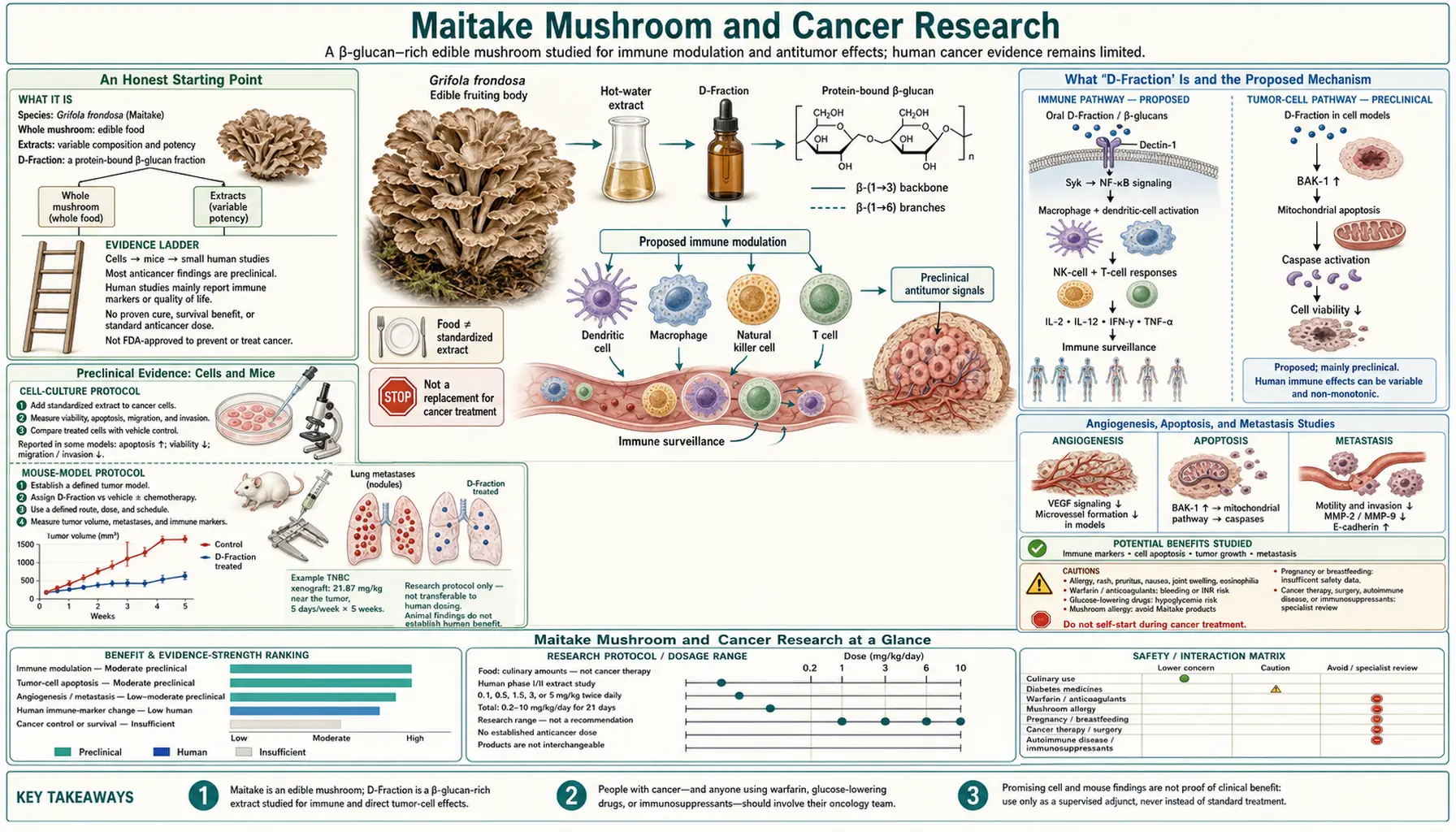
Read this first. No trial has shown that maitake cures, treats, or prevents cancer, and no study has tested it as a replacement for conventional cancer care. What maitake's beta-glucan "D-fraction" actually is, is a research subject — studied as a possible complementary agent that might support the immune system alongside standard treatment. The great majority of that research is preclinical (cancer cells in a dish and tumors in mice), and the human research consists of a handful of small studies that measured immune markers, treatment side effects and quality of life, not survival or cure. This page lays out honestly what the studies show, what they do not show, and why the gap between the two is large.
Table of Contents
- An Honest Starting Point
- What "D-Fraction" Is and the Proposed Mechanism
- Preclinical Evidence: Cells and Mice
- Angiogenesis, Apoptosis, and Metastasis Studies
- The Human Evidence: Small and Early
- Reducing Chemotherapy Toxicity (Preclinical)
- What Systematic Reviews Conclude
- Important Limitations
- Talking With Your Oncology Team
- Key Research Papers
- External Resources
- Connections
- Featured Videos
An Honest Starting Point
Medicinal mushrooms occupy a genuinely gray zone in oncology. On one hand, a related mushroom product — PSK (polysaccharide-K), from Trametes versicolor/turkey tail — has decades of use in Japan as an approved adjuvant alongside chemotherapy, and beta-glucans as a class have real, measurable effects on immune cells. On the other hand, this legitimate biology is routinely exaggerated in marketing into claims that mushrooms "fight" or "beat" cancer, which the evidence does not support.
Maitake sits firmly on the research side of that line. It has interesting immunology and a large preclinical literature, but the clinical evidence needed to call it a cancer treatment does not exist. The useful, honest framing is: maitake beta-glucan is being investigated as a possible immunologic adjunct — something that might help the immune system while proven treatments do the actual work — and that investigation is still early.
What "D-Fraction" Is and the Proposed Mechanism
The maitake "D-fraction" is a protein-bound beta-glucan extract; its more purified form is the "MD-fraction." As described on the Immune Support page, these beta-glucans are recognized by immune receptors such as Dectin-1 on macrophages and dendritic cells, and they can raise natural-killer-cell activity.
The proposed anticancer rationale is entirely immune-mediated: the beta-glucan does not attack tumor cells directly the way chemotherapy does. Instead, the hypothesis is that it primes innate immune cells (natural killer (NK) cells, macrophages, dendritic cells) so they recognize and attack tumor cells more effectively, and that it may counteract the immune suppression that tumors create around themselves. This is a plausible mechanism, and it is the mechanism actually observed in the animal studies. It is also why any real-world role would be as an add-on to, never a replacement for, treatments that reduce tumor burden directly.
Preclinical Evidence: Cells and Mice
The largest body of maitake cancer research is preclinical. In tumor-bearing mice, Kodama and colleagues repeatedly showed that D-fraction slowed tumor growth in a natural killer-cell-dependent manner. Masuda and colleagues found that orally administered soluble maitake beta-glucan produced a systemic antitumor immune response and reduced tumor-associated immunosuppression in mice. In breast-cancer cell lines, Alonso and colleagues reported that maitake D-fraction altered gene-expression programs associated with a less malignant phenotype and showed antitumoral and antimetastatic activity in triple-negative breast cancer cells.
These are real, peer-reviewed findings and they are internally consistent. But two cautions are essential. First, mouse tumor models and cell lines are notoriously poor predictors of human outcomes; a large fraction of agents that shrink tumors in mice fail in people. Second, much of the maitake antitumor animal work comes from a small number of research groups, and independent large-scale replication is limited. Preclinical promise is a reason to run human trials — it is not evidence that the agent works in humans.
Angiogenesis, Apoptosis, and Metastasis Studies
Mechanistic studies have looked at specific cancer processes. Matsui and colleagues (2001) reported that maitake D-fraction induced angiogenesis (the growth of new blood vessels, which tumors recruit) in vivo, increased the growth and migration of human blood-vessel lining (endothelial) cells in the dish, and significantly raised blood levels of vascular endothelial growth factor (VEGF), a signal for new vessel growth. In other words, it promoted rather than blocked new blood-vessel growth in this model; the authors suggested this might be related to the fraction's anti-tumor activity. Zhang and colleagues reported that maitake polysaccharides induced breast-cancer-cell apoptosis (programmed cell death) through a mitochondrial pathway in cell culture. Alonso and colleagues' metastasis work in triple-negative breast cancer cells pointed to reduced migratory/invasive behavior.
Findings like "induces apoptosis in a cancer cell line" are frequently over-quoted in supplement marketing, so it is worth stating plainly what they mean: an isolated cancer cell in a dish died when exposed to a concentration of extract, often high, under artificial conditions. This is standard early screening biology. It does not demonstrate that eating maitake or taking a maitake capsule delivers a relevant concentration to a tumor in a living person, nor that it produces any clinical benefit. These studies generate hypotheses; they do not establish efficacy.
The Human Evidence: Small and Early
The best-known human study is the phase I/II trial by Deng and colleagues at Memorial Sloan Kettering, which administered a maitake polysaccharide extract to postmenopausal breast-cancer patients. It enrolled 34 women who were free of disease after their initial breast-cancer treatment, in five dose groups taking 0.1, 0.5, 1.5, 3, or 5 mg/kg of a liquid extract by mouth twice daily for 3 weeks. No dose-limiting toxicity occurred; two women withdrew with mild (grade I) side effects possibly related to the extract — nausea and joint swelling in one, rash and itching in the other. It is crucial to understand what this trial was and was not. It was a dose-finding immunology trial: its purpose was to find a tolerable dose and measure the extract's effect on immune-cell function — not to measure whether patients' cancer improved. Its finding was that maitake produced dose-dependent immunologic changes that were both stimulatory and, at some doses, inhibitory — the researchers described many dose-response curves as "non-monotonic," with intermediate doses either raising or lowering immune measures compared with both high and low doses. That is a nuanced result, not a clean "maitake boosts anti-cancer immunity" headline.
Beyond that trial, the human record includes small case reports and observational descriptions, such as Kodama and colleagues' reports on whether MD-fraction might aid cancer patients, and two further trials:
- Throat cancer during chemoradiotherapy (2022). A randomized clinical trial (Hu and Xie) recruited 141 people with advanced laryngeal or pharyngeal cancer receiving chemotherapy and radiotherapy together, divided into a maitake group and a placebo group. The maitake group took Maitake D-Fraction capsules by mouth during treatment, 4 capsules 3 times a day, one hour before meals. Severe treatment-related side effects were less frequent in the maitake group, its overall quality-of-life score was higher 5 weeks after treatment, and more of its patients had returned to their starting quality-of-life score at 6 months. The abstract does not report survival.
- Myelodysplastic syndromes (2015). A phase II trial (Wesa and colleagues) gave oral maitake extract, 3 mg/kg twice daily for 12 weeks, to people with lower-risk (Low and Intermediate-1) myelodysplastic syndromes, a bone-marrow disorder that can progress to acute myelogenous leukemia. Of 21 patients enrolled, 18 completed the study. Basal neutrophil function (p = 0.005) and monocyte function (p = 0.021) rose; the extract was well tolerated, and 4 patients developed eosinophilia (a raised count of eosinophil white cells) without symptoms.
There is no completed large randomized controlled trial showing that maitake improves survival, recurrence, or tumor response in any cancer, and the one randomized trial reporting better quality of life (the 2022 throat-cancer trial of 141 patients) is a single study. Any claim otherwise misrepresents the evidence. The honest summary of human data: maitake beta-glucan is tolerable and measurably engages the immune system in cancer patients; apart from one trial reporting fewer treatment side effects and better quality of life, whether that helps them clinically is unknown.
Reducing Chemotherapy Toxicity (Preclinical)
A separate research thread asks whether maitake beta-glucan could reduce the harms of chemotherapy while preserving its benefit. In mice, Masuda and colleagues reported that maitake beta-glucan reduced the bone-marrow suppression and kidney toxicity of cisplatin without blunting its antitumor effect, and related work (Lin and colleagues, 2004) found reduced doxorubicin toxicity in mouse bone-marrow cell cultures. In normal mice given dose-intensive paclitaxel, daily oral maitake beta-glucan (4 or 6 mg/kg) meant white-cell counts fell less than with paclitaxel alone (p = 0.024) or with paclitaxel plus G-CSF (granulocyte colony-stimulating factor, a white-cell growth factor the authors describe as an effective treatment) (p = 0.031) — a mouse result. A 2024 study reported that maitake beta-glucan enhanced the tumor-cell-killing (antibody-dependent cytotoxicity) of the targeted antibody drug trastuzumab in laboratory models. On its own, the MD-Fraction did not directly kill HER2-positive breast-cancer cells in the dish, with or without trastuzumab; but in mice carrying HER2-positive tumors (xenograft models) the combination worked better than trastuzumab alone, through stronger antibody-dependent cellular cytotoxicity and complement-dependent cytotoxicity (immune killing that uses the blood's complement system).
If confirmed in humans, effects like these — protecting blood counts, protecting the kidney, or amplifying a targeted drug — would be clinically valuable. But they are animal and laboratory findings. They also mean that an agent that changes how chemotherapy or a targeted drug behaves could in principle help or interfere, and how maitake extracts interact with chemotherapy and targeted drugs in people is not well characterized.
What Systematic Reviews Conclude
Independent reviews are the appropriate place to look for a balanced verdict. A 2023 systematic review of medicinal-mushroom supplements in cancer by Narayanan and colleagues examined the clinical-trial evidence across mushroom products and concluded, consistent with earlier appraisals, that while some mushroom preparations show immunomodulatory signals and reasonable safety, the clinical evidence for improving cancer outcomes is limited, heterogeneous, and generally of low quality. The review covered 39 clinical studies of 12 mushroom preparations published from 2010 through 2020; the survival benefits it found were reported for Huaier granules (Trametes robiniophila) in 2 liver-cancer studies and 1 breast-cancer study, and for turkey-tail-derived PSK (polysaccharide-K) in 4 gastric-cancer studies in the adjuvant setting (alongside the main treatment), not for maitake. Broader reviews of medicinal mushrooms in oncology reach similar conclusions: promising biology, insufficient high-quality human evidence, and a clear need for larger trials.
The takeaway from the review literature is not "mushrooms don't do anything" — it is that the honest current status is unproven for cancer outcomes, with maitake specifically less clinically studied than some of its relatives.
Important Limitations
- Preclinical ≠ proven. Most maitake cancer data are from cells and mice, which frequently do not translate to humans.
- No outcome trials. There is no large randomized trial showing maitake improves survival, recurrence, or tumor response in any cancer.
- Product variability. Beta-glucan content and extract type differ hugely between products and between studies, so a supplement may not match any studied material.
- Publication and group bias. A large share of positive maitake antitumor work comes from a few groups; independent replication is limited.
- Immunomodulation cuts both ways. The 2009 breast-cancer trial found dose-dependent effects that were not uniformly beneficial — more is not automatically better, and interactions with immunotherapy are not understood.
Talking With Your Oncology Team
For people living with cancer who are interested in maitake, these are the facts that bear on combining it with treatment:
- Interaction risk. Beta-glucans modulate the immune system; their interaction with modern immunotherapies (checkpoint inhibitors) and with chemotherapy is not well characterized.
- Timing around treatment. Some centers ask patients to pause supplements around infusions or surgery.
- Bleeding and blood sugar. Maitake may affect blood glucose and, theoretically, bleeding — relevant around procedures.
- Not a substitute. No trial has tested maitake as a replacement for cancer treatment. In a 2018 study of people with curable (nonmetastatic) breast, prostate, lung, or colorectal cancer, those who used alternative medicine as their only treatment had a higher risk of death than matched patients given standard treatment (hazard ratio 2.50); that study covered alternative medicine in general, not mushroom supplements specifically.
In summary, culinary maitake is eaten as a food, while concentrated extracts remain an experimental adjunct whose interactions with chemotherapy, targeted drugs and immunotherapy in people are not well characterized; the 2009 breast-cancer trial found that the extract can lower some immune measures as well as raise others.
Key Research Papers
- Deng G et al. (2009). A phase I/II trial of a polysaccharide extract from Grifola frondosa (Maitake mushroom) in breast cancer patients: immunological effects. Journal of Cancer Research and Clinical Oncology, 135(9):1215–1221. — PubMed PMID: 19253021
- Narayanan S et al. (2023). Medicinal Mushroom Supplements in Cancer: A Systematic Review of Clinical Studies. Current Oncology Reports, 25(6):569–587. — PubMed PMID: 36995535
- Kodama N et al. (2002). Can maitake MD-fraction aid cancer patients? Alternative Medicine Review, 7(3):236–239. — PubMed PMID: 12126464
- Kodama N et al. (2002). Effects of D-Fraction, a polysaccharide from Grifola frondosa, on tumor growth involve activation of NK cells. Biological & Pharmaceutical Bulletin, 25(12):1647–1650. — PubMed PMID: 12499658
- Matsui K et al. (2001). Effects of maitake (Grifola frondosa) D-Fraction on carcinoma angiogenesis. Cancer Letters, 172(2):193–198. — PubMed PMID: 11566496
- Kodama N et al. (2005). Maitake D-Fraction enhances antitumor effects and reduces immunosuppression by mitomycin-C in tumor-bearing mice. Nutrition, 21(5):624–629. — PubMed PMID: 15850970
- Masuda Y et al. (2009). Maitake beta-glucan enhances therapeutic effect and reduces myelosuppression and nephrotoxicity of cisplatin in mice. International Immunopharmacology, 9(5):620–626. — PubMed PMID: 19249389
- Alonso EN et al. (2013). Genes related to suppression of malignant phenotype induced by Maitake D-Fraction in breast cancer cells. Journal of Medicinal Food, 16(7):602–617. — PubMed PMID: 23875900
- Alonso EN et al. (2017). Antitumoral effects of D-Fraction from Grifola frondosa (Maitake) mushroom in breast cancer. Nutrition and Cancer, 69(1):29–43. — PubMed PMID: 27892708
- Alonso EN et al. (2018). Antitumoral and antimetastatic activity of Maitake D-Fraction in triple-negative breast cancer cells. Oncotarget, 9(34):23396–23412. — PubMed PMID: 29805742
- Zhang Y et al. (2017). Grifola frondosa polysaccharides induce breast cancer cell apoptosis via the mitochondrial-dependent apoptotic pathway. International Journal of Molecular Medicine, 40(4):1089–1095. — PubMed PMID: 28765878
- Masuda Y et al. (2024). Maitake beta-glucan enhances the therapeutic effect of trastuzumab via antibody-dependent and complement-dependent cytotoxicity. Biological & Pharmaceutical Bulletin, 47(4):840–847. — PubMed PMID: 38616114
- Sevindik M et al. (2025). The role of medicinal mushrooms in cancer treatment: bioactive compounds and therapeutic potential (review). International Journal of Medicinal Mushrooms, 27(12):1–24. — PubMed PMID: 41135064
- Masuda Y et al. (2013). Oral administration of soluble β-glucans extracted from Grifola frondosa induces systemic antitumor immune response and decreases immunosuppression in tumor-bearing mice. International Journal of Cancer, 133(1):108–119. — PubMed PMID: 23280601
- Lin H et al. (2004). Maitake beta-glucan MD-fraction enhances bone marrow colony formation and reduces doxorubicin toxicity in vitro. International Immunopharmacology, 4(1):91–99. — PubMed PMID: 14975363
- Lin H et al. (2010). Maitake beta-glucan promotes recovery of leukocytes and myeloid cell function in peripheral blood from paclitaxel hematotoxicity. Cancer Immunology, Immunotherapy, 59(6):885–897. — PubMed PMID: 20140432
- Hu Q, Xie B (2022). Effect of Maitake D-fraction in advanced laryngeal and pharyngeal cancers during concurrent chemoradiotherapy: A randomized clinical trial. Acta Biochimica Polonica, 69(3):625–632. — PubMed PMID: 36070433
- Wesa KM et al. (2015). Maitake mushroom extract in myelodysplastic syndromes (MDS): a phase II study. Cancer Immunology, Immunotherapy, 64(2):237–247. — PubMed PMID: 25351719
- Johnson SB, Park HS, Gross CP, Yu JB (2018). Use of Alternative Medicine for Cancer and Its Impact on Survival. Journal of the National Cancer Institute, 110(1). — PubMed PMID: 28922780
PubMed Topic Searches
External Resources
- Memorial Sloan Kettering — About Herbs: Maitake (clinician-reviewed, purported-uses vs. evidence)
- National Cancer Institute — Complementary and Alternative Medicine
- PubMed — Maitake cancer research
Connections
- Maitake Mushroom (Main Page)
- Maitake Benefits Hub
- Maitake for Immune Support
- Maitake for Blood Sugar
- Maitake for Cholesterol & Blood Pressure
- Turkey Tail (PSK/PSP)
- Reishi Mushroom
- Agaricus Blazei
- Oncology (Diseases)
- Breast Cancer
- Prostate Cancer
- Colorectal Cancer
- Immunology (Diseases)
- Immune Boosting
- All Mushrooms