Maitake Mushroom — Benefits Deep Dive
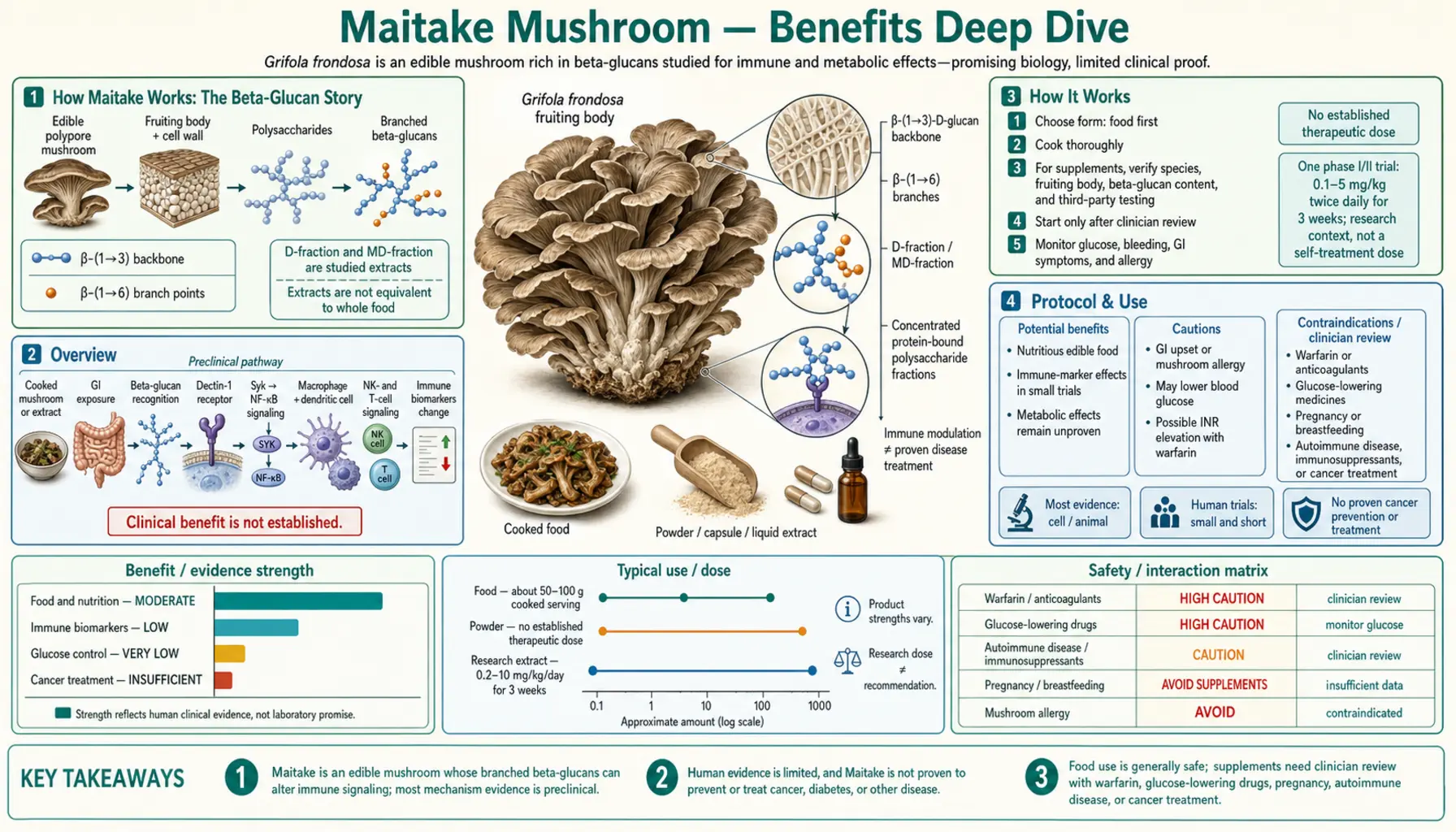
Maitake (Grifola frondosa, "hen of the woods") is both a prized culinary mushroom and one of the most researched functional fungi. Almost all of its studied benefits trace to a single family of molecules — its branched beta-glucan polysaccharides, best known as the "D-fraction" and "MD-fraction" — plus a distinct metabolic glycoprotein called the "SX-fraction." The four deep-dive pages below cover where maitake's research is most developed: immune modulation, blood-sugar and insulin sensitivity, cancer (as a research adjunct only), and cholesterol and blood pressure. Throughout, the framing is honest: maitake has genuinely interesting biology, but most of its evidence is preclinical (cells and animals), with only small, early human studies — it is a healthy food and an experimental adjunct, not a proven cure for anything.
Deep-Dive Articles
Immune Support
The D-fraction and MD-fraction beta-glucans, how they engage the Dectin-1 receptor on macrophages and dendritic cells, natural-killer-cell activation, and the honest limits of the small human immunology trials — including a Sloan Kettering dose-finding trial that found maitake is a two-directional immune modulator, not a simple "boost."
Read the deep dive →Blood Sugar & Insulin Sensitivity
The SX-fraction glycoprotein, viscous-fiber effects on post-meal glucose, insulin-sensitizing signaling through the protein kinase B (Akt)–glycogen synthase kinase-3 (GSK-3) and peroxisome proliferator-activated receptor delta (PPAR-delta) pathways, the gut-microbiome route, and the small human polycystic ovary syndrome (PCOS) ovulation study — with a clear statement that the human diabetes evidence is preliminary.
Read the deep dive →Cancer Research (Honest)
What the D-fraction cancer research actually shows and does not show: a large preclinical literature in cells and mice, one small phase I/II immunology trial, one 2022 randomized trial that measured side effects and quality of life during chemoradiotherapy (not survival), and why maitake remains an experimental adjunct in the research, not a tested substitute for cancer treatment.
Read the deep dive →Cholesterol & Blood Pressure
The lipid-lowering fiber and polysaccharide evidence, bile-acid and gut-microbiome mechanisms, fatty-liver (non-alcoholic fatty liver disease, NAFLD) studies, the spontaneously-hypertensive-rat blood-pressure work, a newly isolated maitake blood-pressure peptide, and the honest bottom line that human cardiovascular evidence is thin.
Read the deep dive →Table of Contents
How Maitake Works: The Beta-Glucan Story
Understanding maitake means understanding its polysaccharides. The cell wall of the mushroom is built largely from beta-glucan — long chains of glucose joined by beta-1,3 bonds with beta-1,6 branches, in maitake's case unusually highly branched and partly bound to protein. These molecules are essentially fiber: they are not digested and absorbed like a vitamin. Their effects arise in three ways.
- Immune pattern recognition. Beta-1,3-glucan is a molecular signature of fungal cell walls, and the human immune system has a dedicated receptor for it — Dectin-1 on macrophages, dendritic cells, and neutrophils. Engaging Dectin-1 primes innate immune cells and coordinates a broader response. This is the basis of the immune research.
- Metabolic signaling and viscous fiber. A distinct, smaller glycoprotein (the SX-fraction) and the viscous fiber together influence glucose and lipid handling — slowing carbohydrate absorption, improving insulin signaling in the liver and muscle, and lowering cholesterol via bile-acid binding. This underlies both the blood-sugar and cholesterol and blood-pressure research.
- Prebiotic / gut-microbiome effects. Because maitake fiber reaches the colon undigested, gut bacteria ferment it into short-chain fatty acids that influence inflammation, glucose control, and lipids from the gut — a mechanism that ties the metabolic benefits together.
Two practical consequences follow. First, extraction method matters: a culinary mushroom, a hot-water tea, and a purified "D-fraction" are chemically different, which is a major reason study results and commercial products vary. Second, most evidence is preclinical: the mechanisms above are best demonstrated in cells and animals, and the human trials remain small and preliminary. The deep-dive pages keep that distinction explicit throughout.
The polycystic ovary syndrome (PCOS) study named on the Blood Sugar card (Chen 2010) was an open trial with 80 patients at three clinics in Japan. Ovulation rates were 76.9% (20/26) with the maitake SX-fraction extract and 93.5% (29/31) with the first-line drug clomiphene citrate when counted by patient (not a significant difference), and 41.7% (30/72) versus 69.9% (58/83) when counted by treatment cycle (p = 0.0006). When the two were combined, 7 of 7 patients who had not ovulated on the maitake extract alone and 6 of 8 who had not ovulated on clomiphene alone did ovulate.
A 2026 randomized, double-blind, placebo-controlled trial (Masuda 2026) gave healthy young adults (18–20 years) and middle-aged/older adults (40–85 years) bread containing one of two maitake strains (Y10M or C5304) or a placebo every day, for 11 weeks (young adults) or 18 weeks (middle-aged/older adults). The overall number of upper respiratory tract infections, which the authors describe as common viral illnesses, did not differ between the groups. The Y10M strain was associated with fewer cumulative days of fever and runny nose in both age groups, and of sore throat in the young adults, while the C5304 strain showed limited effects. In the middle-aged and older adults, Y10M was also associated with changes in innate immune measures, so the results differed by strain and by age group.
Research Papers: Immune Support
- Kodama N et al. (2003). Effect of Maitake D-Fraction on the activation of NK cells in cancer patients. Journal of Medicinal Food, 6(4):371–377. — PubMed PMID: 14977447
- Masuda Y et al. (2012). Soluble β-glucan from Grifola frondosa induces proliferation and Dectin-1/Syk signaling in resident macrophages. Journal of Leukocyte Biology, 91(4):547–556. — PubMed PMID: 22028332
- Masuda Y et al. (2013). Oral soluble β-glucans from Grifola frondosa induce a systemic antitumor immune response in tumor-bearing mice. International Journal of Cancer, 133(1):108–119. — PubMed PMID: 23280601
- Ito K et al. (2009). Maitake beta-glucan enhances granulopoiesis and granulocyte mobilization via G-CSF and CXCR4/SDF-1. International Immunopharmacology, 9(10):1189–1196. — PubMed PMID: 19573626
- Lin H et al. (2004). Maitake MD-fraction enhances bone-marrow colony formation and reduces doxorubicin toxicity in vitro. International Immunopharmacology, 4(1):91–99. — PubMed PMID: 14975363
- Masuda Y, Nakayama Y, Shimizu R, et al. (2026). Maitake mushroom supplementation modulates upper respiratory symptoms and immune responses in healthy adults: a randomized, double-blind, placebo-controlled trial. Food & Function, 17(18):8114–8126. — PubMed PMID: 42627298
- Mayell M (2001). Maitake extracts and their therapeutic potential (review). Alternative Medicine Review, 6(1):48–60. — PubMed PMID: 11207456
Research Papers: Blood Sugar & Insulin
- Preuss HG et al. (2007). Enhanced insulin-hypoglycemic activity in rats consuming a specific maitake glycoprotein (SX-fraction). Molecular and Cellular Biochemistry, 306(1–2):105–113. — PubMed PMID: 17671829
- Horio H, Ohtsuru M (2001). Maitake (Grifola frondosa) improve glucose tolerance of experimental diabetic rats. Journal of Nutritional Science and Vitaminology (Tokyo), 47(1):57–63. — PubMed PMID: 11349892
- Ma X et al. (2014). A Grifola frondosa polysaccharide relieves insulin resistance in HepG2 cells via the Akt–GSK-3 pathway. Glycoconjugate Journal, 31(5):355–363. — PubMed PMID: 24908430
- Aoki H et al. (2018). Maitake extract activates PPARδ and improves glucose intolerance in obese mice. Bioscience, Biotechnology, and Biochemistry, 82(9):1550–1559. — PubMed PMID: 29873587
- Chen JT et al. (2010). Maitake extract induces ovulation in patients with polycystic ovary syndrome. Journal of Alternative and Complementary Medicine, 16(12):1295–1299. — PubMed PMID: 21034160
- Xiao C et al. (2015). Maitake polysaccharides F2 and F3 improve insulin resistance in diabetic rats. Food & Function, 6(11):3567–3575. — PubMed PMID: 26311233
Research Papers: Cancer (Honest Framing)
Note: the studies below are predominantly preclinical (cells and mice) plus one small phase I/II immunology trial and one randomized trial of side effects and quality of life. None demonstrates that maitake treats or cures cancer in humans. See the Cancer Research page for the full, honest appraisal.
In a 2022 randomized trial (Hu 2022) of 141 patients with advanced laryngeal and pharyngeal cancer receiving concurrent chemoradiotherapy, patients took oral Maitake D-fraction capsules or a placebo. Severe treatment-related side effects were less frequent in the maitake group, its global quality-of-life score was higher 5 weeks after treatment, and more of its patients were back at their starting quality-of-life score at 6 months.
- Deng G et al. (2009). A phase I/II trial of a maitake polysaccharide extract in breast cancer patients: immunological effects. Journal of Cancer Research and Clinical Oncology, 135(9):1215–1221. — PubMed PMID: 19253021
- Hu Q, Xie B (2022). Effect of Maitake D-fraction in advanced laryngeal and pharyngeal cancers during concurrent chemoradiotherapy: a randomized clinical trial. Acta Biochimica Polonica, 69(3):625–632. — PubMed PMID: 36070433
- Narayanan S et al. (2023). Medicinal Mushroom Supplements in Cancer: A Systematic Review of Clinical Studies. Current Oncology Reports, 25(6):569–587. — PubMed PMID: 36995535
- Kodama N et al. (2002). Can maitake MD-fraction aid cancer patients? Alternative Medicine Review, 7(3):236–239. — PubMed PMID: 12126464
- Alonso EN et al. (2018). Antitumoral and antimetastatic activity of Maitake D-Fraction in triple-negative breast cancer cells. Oncotarget, 9(34):23396–23412. — PubMed PMID: 29805742
- Masuda Y et al. (2009). Maitake beta-glucan reduces myelosuppression and nephrotoxicity of cisplatin in mice. International Immunopharmacology, 9(5):620–626. — PubMed PMID: 19249389
- Sevindik M et al. (2025). The role of medicinal mushrooms in cancer treatment (review). International Journal of Medicinal Mushrooms, 27(12):1–24. — PubMed PMID: 41135064
Research Papers: Cholesterol & Blood Pressure
- Kabir Y et al. (1987). Shiitake and maitake mushrooms lower blood pressure and plasma lipids in spontaneously hypertensive rats. Journal of Nutritional Science and Vitaminology (Tokyo), 33(5):341–346. — PubMed PMID: 3443885
- Fukushima M et al. (2001). Cholesterol-lowering effects of maitake, shiitake, and enokitake fiber in rats. Experimental Biology and Medicine (Maywood), 226(8):758–765. — PubMed PMID: 11520942
- Preuss HG et al. (2010). Maitake extracts ameliorate progressive hypertension and metabolic perturbations in aging female rats. International Journal of Medical Sciences, 7(4):169–180. — PubMed PMID: 20567593
- Ding Y et al. (2016). Mechanisms underlying the hypolipidaemic effects of Grifola frondosa in rat liver. Frontiers in Microbiology, 7:1186. — PubMed PMID: 27536279
- Wu WT, Hsu TH, Chen WL, et al. (2022). Polysaccharides of Grifola frondosa (maitake) ameliorate oxidative stress and hypercholesterolaemia in hamsters fed a high-fat, high-cholesterol diet. Journal of Pharmacy and Pharmacology, 74(9):1296–1306. — PubMed PMID: 35567773
- Cai Q et al. (2025). A maitake hexapeptide (APPLRP) lowers blood pressure and vascular inflammation in spontaneously hypertensive rats. Journal of Agricultural and Food Chemistry, 73(47):30458–30472. — PubMed PMID: 41229141
External Authoritative Resources
- Memorial Sloan Kettering — About Herbs: Maitake — clinician-reviewed, evidence-graded summary of purported uses vs. actual data
- National Cancer Institute — Complementary and Alternative Medicine
- PubMed — all Grifola frondosa research
- PubMed — Maitake D-fraction research
Connections
- Maitake Mushroom (Main Page)
- Maitake for Immune Support
- Maitake for Blood Sugar & Insulin
- Maitake and Cancer Research
- Maitake for Cholesterol & Blood Pressure
- Reishi Mushroom
- Shiitake Mushroom
- Turkey Tail Mushroom
- Lion's Mane Mushroom
- Cordyceps Mushroom
- Immune Boosting
- Type 2 Diabetes
- Hypertension
- Oncology (Diseases)
- All Mushrooms