Marshmallow Root
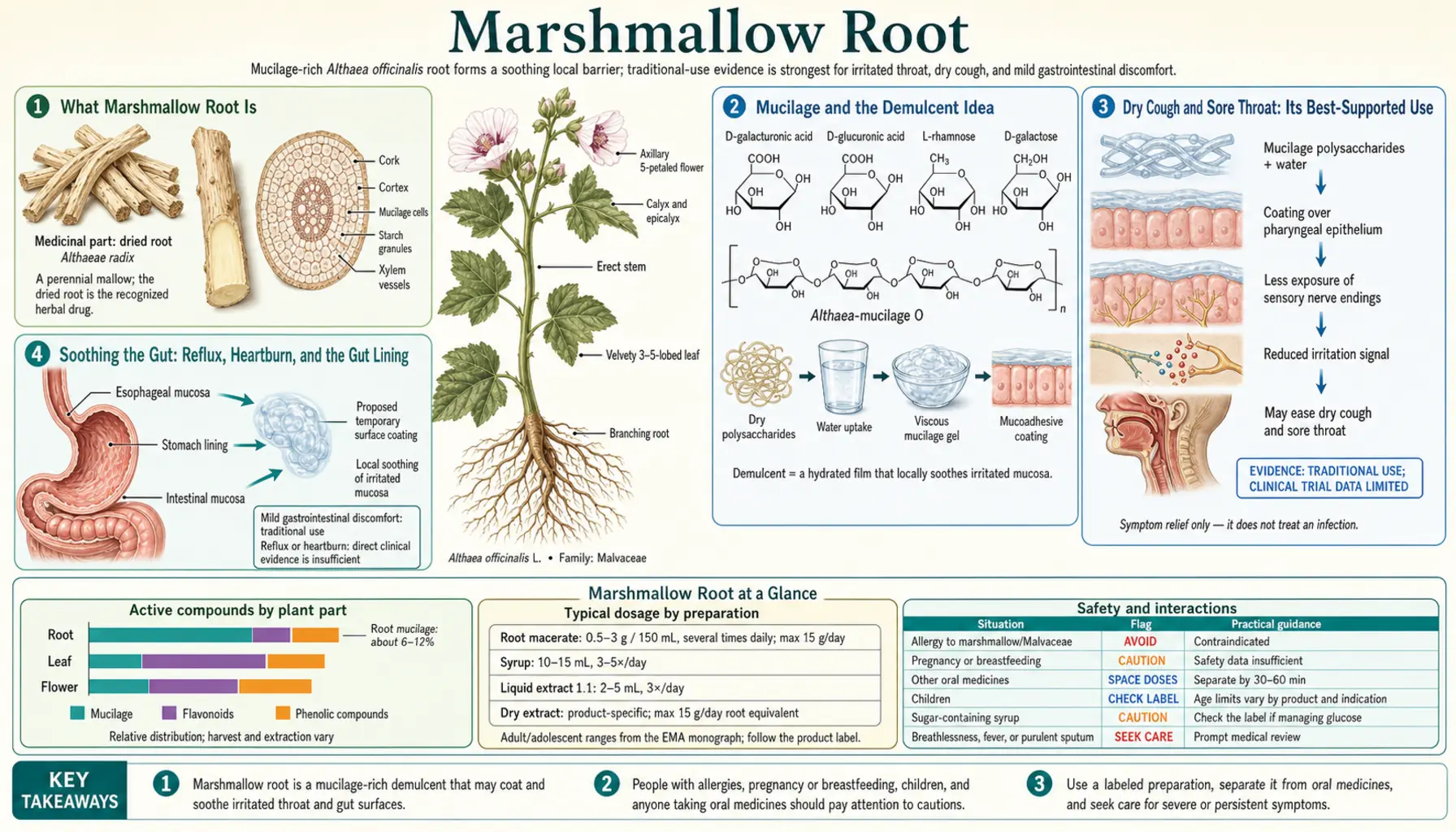
Marshmallow root comes from Althaea officinalis, a tall pink-flowered plant that has grown in the damp meadows and marshes of Europe and western Asia for thousands of years. Its very name tells you where it lives: marsh plus mallow. The root is prized for one simple, almost old-fashioned quality — it is soothing. When you soak it, it releases a slippery, gel-like substance called mucilage that coats and calms irritated tissue, the way a spoonful of honey seems to settle a raw throat. Herbalists call plants that do this demulcents.
This page explains what marshmallow root is, how the mucilage works, and where the evidence is strongest — a dry, tickly cough and a sore throat, which is the one use European regulators formally recognize. We will also look at the gentler, more traditional uses for the stomach, gut lining, and skin, tell the charming story of how a candy ended up named after a medicinal herb, and cover the practical things that matter: how to brew it in cold water (heat ruins it), what forms to buy, how much to take, and the one safety point worth remembering — because marshmallow forms a coating, it can slow how your body absorbs other medicines if you swallow them at the same time. Throughout, we will be honest: most of what we know rests on long tradition and laboratory findings, with only a handful of small human studies. That does not make it useless, but it does shape how confidently we can speak.
Table of Contents
- What Marshmallow Root Is
- Mucilage and the Demulcent Idea
- Dry Cough and Sore Throat: Its Best-Supported Use
- Soothing the Gut: Reflux, Heartburn, and the Gut Lining
- Skin and Topical Use
- Where the Candy Got Its Name
- How to Make a Cold-Water Infusion
- Forms and Dosing
- Safety, Interactions, and Cautions
- What the Evidence Actually Says
- Research Papers
- Connections
- Featured Videos
What Marshmallow Root Is
Althaea officinalis belongs to the mallow family (Malvaceae), the same broad family as hibiscus, okra, and cotton — and if you have ever noticed how okra turns a stew silky, you already understand marshmallow. The plant grows three to four feet tall, with soft velvety leaves and pale pink five-petalled flowers. The medicinal part is mostly the root, harvested in autumn from plants two or more years old, though the leaves and flowers are also used and carry some of the same soothing quality.
The genus name Althaea is thought to come from the Greek althainein, meaning "to heal," which tells you how long people have looked to this plant for comfort. It appears in the writings of Greek and Roman physicians such as Dioscorides and Pliny, in the medieval herbals, and in the traditional medicine of the Middle East and North Africa. Across all these settings the theme is the same: marshmallow is reached for when something is dry, raw, or inflamed and needs a soft protective layer.
What makes the root so slippery is its unusually high content of mucilage — roughly 5 to 11 percent of the dried root by weight, and highest in the cold months. That is the active ingredient in every practical sense, and it is worth understanding on its own terms.
Mucilage and the Demulcent Idea
Mucilage is a family of large, water-loving sugar molecules — complex polysaccharides with names like rhamnogalacturonans, arabinogalactans, arabinans, and glucans. On their own they are just powdery plant fibre. But add water and they swell into a soft, viscous, slightly sticky gel. That gel is the whole point.
The word demulcent comes from the Latin demulcere, "to stroke or soothe." A demulcent herb is one that lays down a thin, slippery film over a moist surface — the lining of your throat, your food pipe, or your gut. Think of it as a temporary protective coat, a bit like the way lip balm shields chapped lips. When a mucous membrane is dry, irritated, or inflamed, that coat does two useful things: it forms a physical barrier between the raw tissue and whatever is aggravating it (dry air, acid, coughing friction), and it seems to quiet the twitchy nerve endings that trigger the urge to cough or the sensation of scratchiness.
Laboratory work supports this picture. Researchers have shown that marshmallow polysaccharides actually stick to and are taken up by human epithelial cells — the cells that line the mouth and throat — and appear to nudge those cells toward repair and to shield them from irritation. In other words, the "protective coat" is not just folk imagery; there is a real physical interaction between the mucilage and the tissue it touches.
It is important to be clear about what a demulcent does not do. It does not kill bacteria or viruses, it does not cure an infection, and it does not fix whatever is causing the irritation underneath. It is a comfort measure — a genuinely useful one — that buys relief while the body heals itself or while you treat the real cause.
Dry Cough and Sore Throat: Its Best-Supported Use
If marshmallow root has a headline use, this is it. A dry, tickly, unproductive cough — the kind that comes with a cold, dry heated air, or a raw throat — is exactly the situation a demulcent is built for. The mucilage coats the irritated lining of the throat and upper airway, dampens the cough reflex, and eases the scratchy soreness.
This use is well enough established that Europe's medicines regulator formally recognizes it. The European Medicines Agency, through its Committee on Herbal Medicinal Products (HMPC), lists marshmallow root as a traditional herbal medicinal product for the relief of throat or mouth irritation and the associated dry cough. Germany's Commission E reached a similar conclusion decades earlier. The phrase "traditional use" is doing careful work here: it means the recognition rests on a long, plausible history of safe use rather than on a stack of large clinical trials — a lower bar than a prescription drug clears, but an honest and official acknowledgment nonetheless.
What human data exist are encouraging but modest. In laboratory and animal studies, marshmallow's rhamnogalacturonan produced a measurable, dose-dependent reduction in coughing, giving a mechanism for the tradition. On the human side, the evidence is mostly patient surveys rather than rigorous placebo-controlled trials: in one survey of people using a marshmallow root syrup or extract for an irritating cough, the large majority reported good relief and excellent tolerability, often within minutes to a couple of hours. A small study even looked at the dry cough that some people get as a side effect of ACE-inhibitor blood-pressure drugs and reported improvement with marshmallow.
How should you read that? Surveys are the weakest kind of evidence — there is no placebo group, and people who choose a remedy tend to report that it helped. But the findings line up neatly with a sensible mechanism and centuries of use, and the safety record is excellent. For a self-limiting dry cough or a sore throat, marshmallow is a reasonable, low-risk comfort measure. It is not a treatment for a chesty, phlegm-producing cough, and it is no substitute for medical care if a cough is severe, brings up blood, or lasts more than a few weeks.
Soothing the Gut: Reflux, Heartburn, and the Gut Lining
The same logic that makes marshmallow soothing to the throat is why traditional herbalists have long turned to it for the digestive tract. The theory is straightforward: the mucilage travels down and forms a soothing film over the lining of the food pipe and stomach, offering a measure of comfort in heartburn, acid reflux, and general irritation of the stomach lining (gastritis). Germany's Commission E specifically acknowledged marshmallow root for mild inflammation of the gastric mucosa.
Herbalists also group marshmallow among the "gut-lining" or "gut-soothing" herbs used in irritable, sensitive, or inflamed digestive conditions, alongside slippery elm and deglycyrrhizinated licorice. The idea of supporting the mucous barrier of the gut is biologically reasonable, and marshmallow's polysaccharides have shown anti-inflammatory and antioxidant activity on immune cells in the laboratory, which fits.
Here honesty matters most. The digestive uses are supported by tradition and by plausible mechanism, not by good clinical trials in people. There is far less human data here than for cough, and much of what circulates online overstates it. Marshmallow is a gentle, low-risk thing to try for occasional heartburn or a sensitive stomach, and many people find a warm cup genuinely settling. But persistent reflux, stomach pain, difficulty swallowing, or unexplained weight loss are reasons to see a clinician, not to self-treat indefinitely with tea.
Skin and Topical Use
Because mucilage is soothing and film-forming, marshmallow has a long history on the outside of the body too. Traditionally the root or leaf has been used in poultices, creams, and rinses for chapped, dry, or irritated skin, minor wounds, insect bites, and inflamed patches — anywhere a softening, protective layer might help. It also turns up in cosmetics and lip products for exactly this emollient quality.
The strongest hint that this is more than folklore comes from a study in which marshmallow flower mucilage was applied to full-thickness wounds in rabbits and appeared to speed healing compared with untreated wounds. That is an animal study, not a human trial, so it should be read as promising rather than proof. For everyday purposes, a cooled marshmallow infusion used as a soothing compress or added to a bath is a mild, pleasant, and low-risk home remedy for irritated skin — while anything that looks infected, is deep, or is not healing needs proper medical attention.
Where the Candy Got Its Name
Here is the delightful bit of history that surprises almost everyone: the fluffy white marshmallow candy is named after this herb, not the other way around. For most of its life, the "marshmallow" was medicine, not dessert.
The ancient Egyptians reportedly made a sweet confection by combining the sticky sap of marshmallow root with honey, reserving it for gods and royalty. But the recognizable ancestor of the modern treat appeared in nineteenth-century France, where confectioners called it pâte de guimauve — guimauve being the French word for marshmallow the plant. They whipped the mucilaginous root extract with sugar and egg white into a soft, airy, throat-soothing lozenge that was as much a cough remedy as a sweet.
The catch was that extracting and whipping real marshmallow root was slow and expensive. By the late 1800s candy makers had replaced the root mucilage with gelatin, which does the same fluffing job far more cheaply. The plant quietly dropped out, the name stayed, and the modern marshmallow — sugar, gelatin, and air — contains no Althaea officinalis at all. So when you toast one over a campfire, you are enjoying the great-grandchild of a genuine herbal cough sweet, with the medicine bred out of it.
How to Make a Cold-Water Infusion
This is the single most practical thing to know about marshmallow root, and it runs against instinct: brew it in cold water, not boiling water. Mucilage is delicate. Heat and prolonged boiling break down and degrade the long polysaccharide chains that do all the soothing, so a hot, hard-boiled brew ends up thinner and less protective than a patient cold soak. Cold water, given time, draws the mucilage out into a lovely slippery, viscous infusion — which is exactly what you want.
A simple cold infusion (cold macerate):
- Put about 1 to 2 tablespoons of dried, chopped marshmallow root (roughly 2–4 grams) into a jar or mug.
- Add about a cup (240 mL) of cool or room-temperature water.
- Stir, cover, and let it steep at least 1 to 4 hours, or overnight in the refrigerator. You will see the liquid turn slightly thick and slippery — that is the mucilage.
- Strain out the root. Drink it as is, or warm it gently if you prefer — just do not boil it. A little honey and lemon make it a pleasant throat drink.
If you are in a hurry, you can pour cooler (not boiling) water over the root and steep for 20–30 minutes, but a long cold soak gives the richest, most soothing result. Make it fresh each day; the slippery brew does not keep well and is best used within about 24 hours.
Forms and Dosing
Marshmallow root is sold in several forms, and the right one depends on what you want it for:
- Dried cut root — for the cold infusion above. The most traditional and, for a soothing drink, arguably the best.
- Powdered root and capsules — convenient, often used for digestive support. Take with plenty of water so the powder can hydrate.
- Syrups and lozenges — purpose-made for cough and sore throat; the mucilage bathes the throat directly, which is ideal for that use. This is the form behind most of the human survey data.
- Cold-water tinctures and liquid extracts — convenient drops; note that traditional water-based (glycerite or low-alcohol) extracts preserve mucilage better than high-alcohol tinctures.
- Topical creams and compresses — for irritated skin.
Traditional and regulatory sources describe a wide, gentle dosing range because marshmallow is so well tolerated. As a rough guide often cited for adults: a cold infusion made from roughly 2 grams of root, taken up to three times a day, or the equivalent in a commercial syrup, lozenge, or extract taken according to the label. Because the point is a soothing coating, sipping slowly and letting a lozenge or syrup linger in the throat works better than gulping. Always follow the directions on a specific product, since concentrations vary.
Safety, Interactions, and Cautions
Marshmallow root has an excellent safety record and is generally very well tolerated — that is a large part of why regulators are comfortable recognizing its traditional use. Side effects are uncommon and mild. That said, a few sensible points are worth knowing.
The one interaction worth remembering — timing your other medicines. The very quality that makes marshmallow useful, its coating mucilage, can in theory slow or reduce the absorption of other medicines taken by mouth at the same time. The film that soothes your throat can also form a temporary barrier in the gut that other drugs have to cross. The simple, effective fix is to space your doses: take marshmallow at least 1 to 2 hours apart from any prescription medication, so each has time to be absorbed on its own.
Blood sugar. Some sources suggest marshmallow may modestly lower blood sugar. If you take diabetes medication, keep an eye out and mention it to your clinician, since the effects could add together.
Pregnancy and breastfeeding. There is not enough reliable data to confirm safety, so the cautious and standard advice is to avoid concentrated medicinal use unless a qualified professional says otherwise.
Young children. Marshmallow syrups are used for children's coughs in some products, but suitability depends on the specific preparation and age — follow the product's own age guidance rather than improvising.
Allergy. True allergy is rare, but anyone sensitive to plants in the mallow family should be cautious.
None of this should overshadow the main message: for a healthy adult using it sensibly, marshmallow root is one of the gentler things in the herbal cabinet. The advice to "talk to your doctor" applies mostly to the specific situations above — other medications, diabetes, pregnancy, small children, or a cough or gut problem that is severe or persistent.
What the Evidence Actually Says
To pull it together honestly:
- Dry cough and sore throat — the best-supported use. Officially recognized by European and German regulators on the basis of traditional use, backed by a sensible mechanism and encouraging (if low-grade) human survey data. A reasonable, low-risk comfort measure.
- Digestive soothing (heartburn, reflux, gastritis, gut lining) — plausible and long-used, supported by mechanism and one regulatory nod for the stomach lining, but with little rigorous human evidence. Fine to try for mild, occasional symptoms; not a substitute for evaluating persistent problems.
- Skin and wounds — traditional, with supportive animal data. A mild home comfort measure, not a proven medical treatment.
Marshmallow root is a good example of an herb whose value is real but modest, and whose honest story is more interesting than the hype. It is not a cure for anything. What it is — reliably, gently, and safely — is soothing. For a raw throat or a tickly cough on a dry winter night, a slow cold-brewed cup of marshmallow is a small, old, harmless comfort, and sometimes that is exactly what is needed.
Research Papers
- Deters A, Zippel J, Hellenbrand N, Pappai D, Possemeyer C, Hensel A. Aqueous extracts and polysaccharides from marshmallow roots (Althaea officinalis L.): cellular internalisation and stimulation of cell physiology of human epithelial cells in vitro. Journal of Ethnopharmacology. 2010;127(1):62–69. doi:10.1016/j.jep.2009.09.050 — shows the mucilage physically adheres to and is taken up by throat-lining cells and supports their repair, giving the "protective coat" a real mechanism.
- Šutovská M, Nosáľová G, Šutovský J, Fraňová S, Prisenžňáková L, Capek P. Possible mechanisms of dose-dependent cough suppressive effect of Althaea officinalis rhamnogalacturonan in guinea pigs test system. International Journal of Biological Macromolecules. 2009;45(1):27–32. doi:10.1016/j.ijbiomac.2009.03.008 — a marshmallow polysaccharide produced a measurable, dose-dependent reduction in coughing, supporting the traditional cough use.
- Fink C, Schmidt M, Kraft K. Marshmallow root extract for the treatment of irritative cough: two surveys on users' view on effectiveness and tolerability. Complementary Medicine Research. 2018;25(5):299–305. doi:10.1159/000489560 — most users of a marshmallow cough product reported good relief and excellent tolerability, often within a couple of hours.
- Rabini S, Fink C, Kelber O, Vinson B, Kraft K. Patient survey with Althaea officinalis L. root extract in dry cough. European Journal of Integrative Medicine. 2015;7(Suppl 1):46–47. doi:10.1016/j.eujim.2015.09.115 — patient-reported effectiveness of a standardized marshmallow root extract for dry, irritating cough.
- Rouhi H, Ganji F. Effect of Althaea officinalis on cough associated with ACE inhibitors. Pakistan Journal of Nutrition. 2007;6(3):256–258. doi:10.3923/pjn.2007.256.258 — small study reporting improvement in the dry cough that some patients get from ACE-inhibitor blood-pressure drugs.
- Mahboubi M. Marsh mallow (Althaea officinalis L.) and its potency in the treatment of cough. Complementary Medicine Research. 2020;27(3):174–183. doi:10.1159/000503747 — a review pulling together the mucilage mechanism, tradition, and clinical signals behind marshmallow's use for cough and throat irritation.
- Bonaterra GA, Bronischewski K, Hunold P, Schwarzbach H, Heinrich EU, Fink C, Aziz-Kalbhenn H, Muller J, Kinscherf R. Anti-inflammatory and anti-oxidative effects of Phytohustil® and root extract of Althaea officinalis L. on macrophages in vitro. Frontiers in Pharmacology. 2020;11:290. doi:10.3389/fphar.2020.00290 — marshmallow root extract calmed inflammatory and oxidative activity in immune cells, fitting its soothing reputation.
- Valizadeh R, Hemmati AA, Houshmand G, Bayat S, Bahadoram M. Wound healing potential of Althaea officinalis flower mucilage in rabbit full thickness wounds. Asian Pacific Journal of Tropical Biomedicine. 2015;5(11):937–943. doi:10.1016/j.apjtb.2015.07.018 — topical marshmallow mucilage appeared to speed skin-wound healing in an animal model, a hint behind the topical tradition.
- Hage-Sleiman R, Mroueh M, Daher CF. Pharmacological evaluation of aqueous extract of Althaea officinalis flower grown in Lebanon. Pharmaceutical Biology. 2011;49(3):327–333. doi:10.3109/13880209.2010.516754 — reported anti-inflammatory and pain-easing activity of a marshmallow flower extract in laboratory models.
- Rownaghi M, Niakousari M. Assessing physicochemical characteristics of a shear-thinning polysaccharide mucilage extracted from marshmallow root (Althaea officinalis L.) by an ohmic heating system. International Journal of Biological Macromolecules. 2024;277:134274. doi:10.1016/j.ijbiomac.2024.134274 — characterizes the slippery, gel-forming mucilage and how extraction conditions such as heat affect it, relevant to why cold brewing preserves it.
- Tomoda M, Shimizu N, Suzuki H, Takasu T. Plant mucilages. XXVIII. Isolation and characterization of a mucilage, "althaea-mucilage OL," from the leaves of Althaea officinalis. Chemical and Pharmaceutical Bulletin. 1981;29(8):2277–2282. doi:10.1248/cpb.29.2277 — foundational chemistry identifying the polysaccharide structures that make up marshmallow's mucilage.
- Kardošová A, Machová E. Antioxidant activity of medicinal plant polysaccharides. Fitoterapia. 2006;77(5):367–373. doi:10.1016/j.fitote.2006.05.001 — found antioxidant activity in polysaccharides including that of Althaea officinalis, adding to the soothing/protective picture.
- Live PubMed topic search: Althaea officinalis and cough — the current literature on marshmallow for cough and throat irritation.
- Live PubMed topic search: Althaea officinalis mucilage and demulcent activity — studies on the mucilage chemistry and soothing action.
Connections
- All Herbs
- Slippery Elm — the classic sibling demulcent, also rich in soothing mucilage.
- Licorice — soothing herb (as DGL) used for the throat and gut lining.
- Fenugreek — another mucilage-rich seed with a slippery, soothing quality.
- Mullein — traditional soothing herb for dry, irritating coughs.
- Thyme — a companion cough herb often paired with demulcents.
- Aloe Vera — mucilaginous plant used for soothing skin and the gut.
- Chamomile — gentle calming herb for the digestive tract.
- Gastroenterology — conditions of the digestive tract where soothing herbs are used.
- Gastritis — irritation of the stomach lining, a traditional target for marshmallow.
- Pulmonology — the medicine of the airways, where dry cough belongs.
- Ear, Nose & Throat — where a sore, irritated throat is evaluated.
- Conditions on this site that reference this page: Laryngitis and Voice Disorders · Sore Throat · Canker Sores (Aphthous Ulcers) · Gum Disease · Tonsillitis · Gastroesophageal Reflux Disease (GERD) · Bronchitis