Moringa Benefits
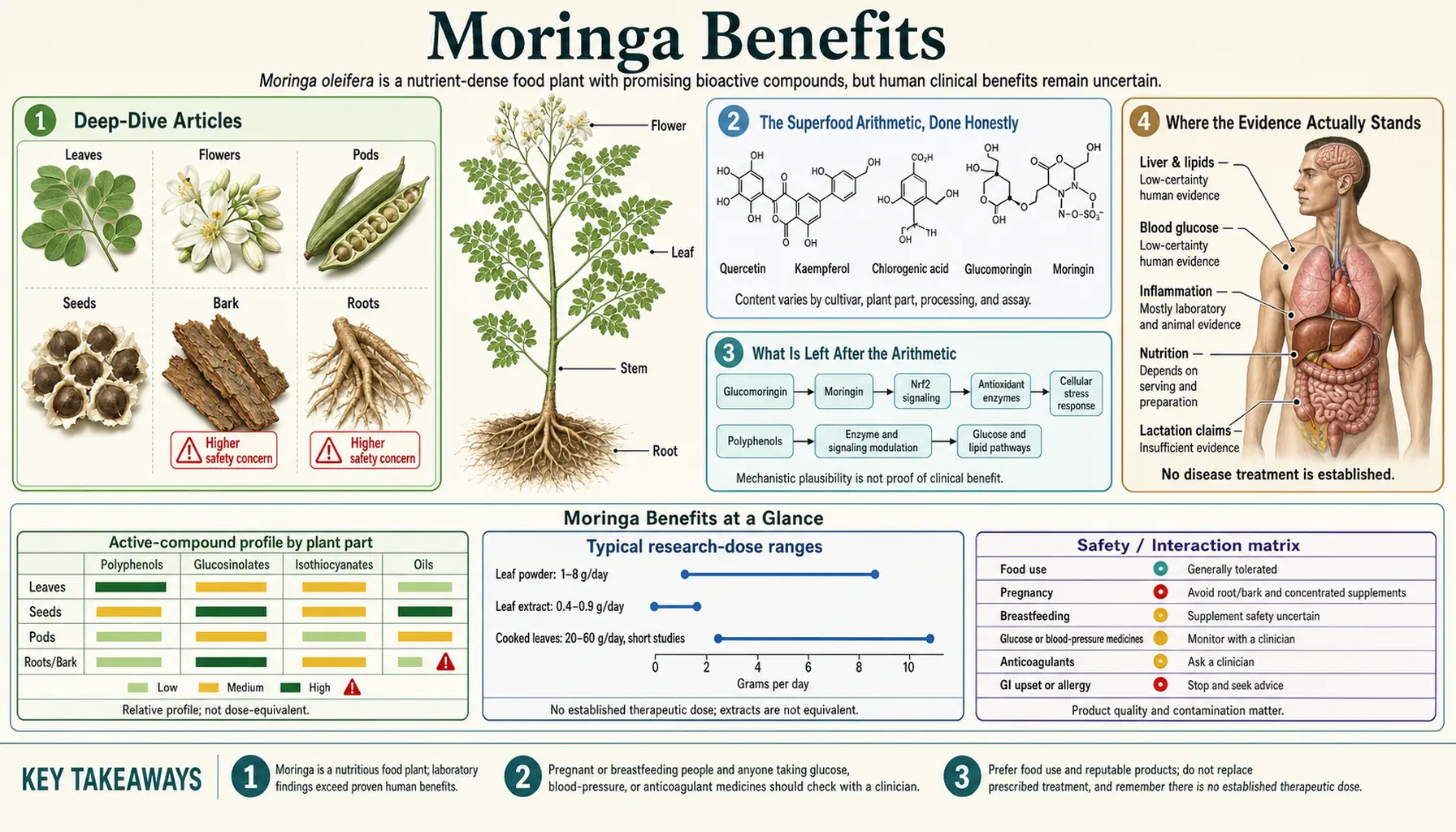
Moringa (Moringa oleifera, family Moringaceae) is a fast-growing tree from the Himalayan foothills of northwest India, now planted across the tropics. It is called the drumstick tree for its long, slender seed pods and the horseradish tree for the sharp bite of its roots. The leaves are cooked as a green vegetable or dried into a fine powder; the immature pods are a staple vegetable in South Indian cooking; the seeds are pressed for ben oil or crushed to help clear muddy water.
Moringa is also the most oversold plant in the supplement aisle. Almost every bag of powder carries some version of the same table: 7× the vitamin C of oranges, 4× the calcium of milk, 4× the vitamin A of carrots, 3× the potassium of bananas, 2× the protein of yogurt. Those numbers are not invented, but they are constructed in a way that makes them meaningless: they compare dried leaf powder, gram for gram, against fresh, water-rich whole foods, at a weight nobody eats. Remove three-quarters of the water from any leaf and its per-gram numbers soar. That is not nutrition; it is dehydration.
So the most useful thing this page can do is not add another benefit claim. It is to do the arithmetic properly — what a real teaspoon of powder actually puts into your body against a real daily requirement — and then look honestly at what is left. Some of what is left is genuinely good. The leaf is a real source of protein, provitamin A, calcium and iron in places where the underlying problem is food security, and that use case deserves respect rather than dismissal. The seed protein really does clarify turbid water. The isothiocyanate chemistry really is mechanistically interesting. What is thin is the human clinical evidence, and one of the better-designed trials on this page found nothing at all.
Table of Contents
Deep-Dive Articles
Four articles go deeper. Start with the nutrition one — correcting the superfood arithmetic changes how you read everything else on this page.
Nutrition and the Superfood Claims
The multiplier claims taken apart line by line, then rebuilt: what a 2 g teaspoon and a 6 g tablespoon of powder actually deliver against an adult Recommended Dietary Allowance (RDA), why the vitamin C claim is printed on the exact form that has the least vitamin C, and what oxalate and phytate do to the calcium and iron numbers on the label.
Read the deep dive →Blood Sugar and Cholesterol
The human trials, with their sample sizes on the table: a 32-person randomised placebo-controlled trial that found nothing, a 10-person dose study that raised insulin without moving glucose, and a meta-analysis routinely cited as proof that turns out to pool 699 rodents.
Read the deep dive →Isothiocyanates and Inflammation
Glucomoringin, moringin and the sulfur chemistry that makes this plant genuinely unusual — moringa’s answer to sulforaphane in broccoli. Strong mechanism, real preclinical data, zero clinical endpoints, and a practical problem: most powder on the shelf probably contains almost none of it.
Read the deep dive →Water Purification and Food Security
The two uses where moringa earns its reputation. A cationic seed protein that flocculates turbidity and cuts bacterial counts — precisely how far that goes and why it does not make unsafe water safe — and the leaf’s serious role in undernutrition, where the comparison is not a multivitamin but an empty plate.
Read the deep dive →Breast Milk and Lactation Claims
The traditional galactagogue use set against the trials: a Kenyan trial of 20 g of leaf powder a day (947 vs 618 mL of expressed milk), a double-blind Thai trial of 900 mg a day that found no significant difference, the reviews and their certainty, infant outcomes, drug interactions and what is not known.
Read the deep dive →The Superfood Arithmetic, Done Honestly
Here is the whole trick in one sentence. The famous multipliers come from the dried-powder column of a nutrient table, compared against 100 g of fresh orange, milk, carrot, banana and yogurt. Fresh moringa leaf is roughly three-quarters water. Dry it and every per-100-gram figure multiplies by about four- to eight-fold, purely because you removed water. Then set that against foods you eat whole, at a weight — 100 g of powder — that would be about seventeen heaped tablespoons in one sitting. Nobody does that.
The honest comparison uses a real serving of powder against a real serving of the comparison food. A level teaspoon of moringa leaf powder weighs roughly 2 g; a level tablespoon roughly 6 g. Most labels put the serving somewhere in that range, and most published human studies used between 4 and 8 g a day. Using mid-range values from published composition reviews, here is what a tablespoon actually contains:
| Nutrient | In 1 tbsp (6 g) powder | Share of adult daily need | The marketing claim | Honest comparison |
|---|---|---|---|---|
| Vitamin C | ~1–7 mg | 1–9% | “7× oranges” | A tenth to a fiftieth of one orange |
| Calcium | ~110 mg | ~11% | “4× milk” | About a third of one glass of milk |
| Potassium | ~85 mg | ~3% | “3× bananas” | About a fifth of one banana |
| Protein | ~1.6 g | ~3% | “2× yogurt” | About a sixth of a cup of yogurt |
| Iron | ~1.7 mg | 9–21% before absorption | “25× spinach” | Non-heme iron; a fraction is absorbed |
| Beta-carotene | ~1 mg | ~10–12% as vitamin A | “4× carrots” | About a fifth of one medium carrot |
Read the last two columns together. Every single multiplier inverts once you compare like with like. A claim of “seven times the vitamin C of oranges” becomes, at a real serving, roughly a fiftieth of one orange — a swing of two orders of magnitude, in the opposite direction from the one advertised.
Vitamin C is the sharpest case, because drying does not merely fail to help it — it destroys it. Fresh moringa leaf really does carry a respectable amount of vitamin C, in the neighbourhood of a citrus fruit per 100 g and sometimes well above it. Vitamin C is also heat-, light- and time-sensitive, and the most widely reproduced dried-powder value in the literature is lower per 100 g than an orange. So the “7× the orange” line is printed on precisely the form of moringa in which vitamin C is least reliable. The full breakdown is in Nutrition and the Superfood Claims.
What Is Left After the Arithmetic
Quite a lot, actually — just not what the label says.
- Calcium and provitamin A are the two respectable numbers. Around 11% of a day’s calcium and 10–12% of a day’s vitamin A activity from one tablespoon is a real contribution for a plant food, and better than most leafy greens deliver at that weight.
- It is a green vegetable, and it behaves like one. A spoon of moringa is a reasonable, healthy addition to a meal, in the same category as adding parsley, kale or spinach. That is a modest, honest, entirely defensible claim.
- Where food security is the actual problem, it is not modest at all. A drought-tolerant tree that yields protein-, calcium- and carotenoid-rich leaves nearly year-round, on poor soil, next to the house, is a serious nutritional asset. In a rural Bangladeshi school study of 226 girls aged 12 to 14, one school served a meal of rice, dal and fried potato with a moringa pakora (an oil-fried snack) for six months, and another school served a calorie-matched meal without it. Compared with the second school, haemoglobin (coefficient 0.41, P = 0.010) and serum retinol (coefficient 0.27) rose in the moringa group; weight did not change. That is the real use case, and the honest comparison there is not a multivitamin — it is nothing.
- The chemistry is genuinely distinctive. Moringa makes rhamnose-substituted glucosinolates found almost nowhere else, which release moringin, a stable isothiocyanate in the same family as broccoli’s sulforaphane. This is real, reproducible, mechanistically interesting work — and so far entirely preclinical.
- The seed clarifies water. A small cationic protein in the crushed seed flocculates suspended clay, algae and bacteria out of turbid water. This is well documented and used in the field. It is a clarification step, not a disinfection step.
Where the Evidence Actually Stands
| Use | Best available evidence | Honest verdict |
|---|---|---|
| Micronutrient contribution to a diet | Composition analyses; controlled feeding studies in undernourished populations | Real — modest in a well-fed diet, meaningful in a deficient one |
| Undernutrition, food-insecure settings | Quasi-experimental school feeding study (n=226, 6 months) and programme experience | Promising and important; few randomised trials |
| Water clarification (seed) | Decades of water-engineering studies; protein isolated and characterised | Established for turbidity; partial for bacteria; not a disinfectant |
| Blood glucose control | 44-study meta-analysis in rodents; small human trials, the best of which was negative | Not established in people |
| Cholesterol and lipids | Consistent rabbit and rodent data; sparse, inconsistent human data | Preclinical |
| Blood pressure | Postprandial human study (n=41); vasorelaxant compounds isolated; animal models | Early signal, enough to matter for drug interactions |
| Anti-inflammatory (isothiocyanates) | Cell culture and mouse models with defined isothiocyanate doses | Mechanistically strong, clinically untested |
| Milk supply (galactagogue) | Small trials, mostly Philippine and Indonesian; systematic reviews rate them weak | Traditional use with weak supporting trials |
| Root preparations for anything | Alkaloid content; traditional abortifacient use | Hazard — alkaloids; traditional abortifacient |
Newer Reviews and Trials
Blood sugar, blood fats and body weight. A 2025 meta-analysis of nine randomised trials (341 people taking moringa, 308 controls) found no significant effect of moringa on most heart and blood-sugar measures. A modest drop in diastolic blood pressure (standardised mean difference −0.41) did not hold up in sensitivity analyses, and the certainty of the evidence was rated very low for every outcome.
Blood pressure — two reviews that disagree. A separate 2026 meta-analysis of eight randomised trials reported that moringa lowered systolic blood pressure by 6.00 mmHg and diastolic blood pressure by 7.32 mmHg, with no significant change in body weight or body mass index (BMI). The 2025 review found the diastolic drop fragile; the 2026 review found a significant drop in both numbers. The two reviews stand as published, and they disagree on blood pressure.
Milk supply. In a 2025 pilot cluster-randomised trial in Kenya, 50 breastfeeding mother-infant pairs were assigned by location to corn porridge with 20 g a day of moringa leaf powder or to corn porridge alone for 3 months. At 3 months, mothers in the moringa group expressed a mean of 947 mL of milk over 24 hours against 618 mL in the control group (P = 0.003), with no effect on infant growth. A 2022 double-blind trial in 88 Thai women in early postpartum found no significant difference in median breast milk volume on the third day after birth with 900 mg a day of moringa leaf capsules (73.5 vs 50 mL, p = 0.19).
The Root Is Not the Leaf
This is the single most important safety point about moringa, and it is not a generic herbal disclaimer. The plant is not uniformly safe part for part.
Leaves and pods are food, with a long track record and good tolerability in the human studies that exist. The worst commonly reported effect of leaf powder is loose stools at large doses.
Root and root bark are not. They concentrate alkaloids — including the compound described in the mid-twentieth-century Indian literature as spirochin, along with benzylamine alkaloids — and analytical work has documented markedly higher anti-nutritional and alkaloid loads in the root than the leaf. Root bark has been used traditionally as an abortifacient and to bring on menstruation, which is exactly why it is dangerous in pregnancy. The pungent “horseradish” condiment scraped from the root is a folk use of the same alkaloid-rich root, not a safe seasoning.
The label and the plant part: root and bark carry the alkaloid load; leaf is the part eaten as food. A label that says leaf or leaf powder states the plant part; a label that says only “moringa” does not, and one that lists bark or root contains the alkaloid-rich parts.
Beyond that, four interactions and safety points are reported, and each is covered in detail on the relevant sub-article:
- Glucose-lowering drugs — a single 4 g dose measurably increased insulin secretion in healthy volunteers. Additive hypoglycaemia is plausible even though the best glycaemic trial was negative.
- Blood-pressure drugs — moringa contains isolated hypotensive thiocarbamate and isothiocyanate glycosides, and eating cooked leaves lowered two-hour postprandial blood pressure in a 41-person study.
- Thyroid medication — leaf extract shifted thyroid hormone levels in rats, and thiocyanate released from glucosinolates competes with iodide uptake. These findings bear on people who take levothyroxine.
- Pregnancy — root bark has been used traditionally as an abortifacient (see above). Ordinary culinary amounts of leaf are traditional; high-dose supplements and concentrated extracts have no adequate safety data.
Buying and Using Moringa
- Cooked leaves came before supplements. Leaves wilted into soup, dal, eggs or stew are the oldest and best-tested form, and they preserve more vitamin C and carotenoids than long boiling or long storage.
- Powder is a vegetable, not a multivitamin. A level teaspoon weighs roughly 2 g and a level tablespoon roughly 6 g; most published human studies used 4 to 8 g a day. Large doses mainly bring bitterness and loose stools.
- Fat helps. Beta-carotene is fat-soluble, so moringa in a dish with some oil, coconut milk or eggs delivers more usable vitamin A than moringa stirred into water.
- What a label can show: the plant part, the origin, a lot number and third-party heavy-metal testing. Leafy crops accumulate lead and cadmium from soil, and much moringa powder is sun-dried in open air — a dried raw agricultural product, not a sterile one. A 2019 microbiological risk assessment of moringa leaf powder for infants and children aged 6 to 23 months found the risk from the foodborne bacteria it evaluated low to moderate when the fortified porridge was brought to a rolling boil for 5 minutes (moderate to serious only for Clostridium perfringens type C), and higher for every pathogen evaluated when the porridge was not boiled.
- Isothiocyanate claims on labels are rarely quantified. The active enzyme that makes moringin is heat-labile and glucosinolate content varies enormously with cultivar, tissue and processing. Standardised preparations exist in research settings; almost nothing on a retail shelf is one.
Key Research Papers
Every identifier below was checked live against NCBI E-utilities — first author, title, journal and year all had to match before a PMID was printed. Where a source could not be confirmed that way it is represented by a PubMed topic search, which cannot resolve to the wrong paper.
Composition, phytochemistry and general reviews
- Leone A, Spada A, Battezzati A, Schiraldi A, Aristil J, Bertoli S. Cultivation, genetic, ethnopharmacology, phytochemistry and pharmacology of Moringa oleifera leaves: an overview. International Journal of Molecular Sciences. 2015;16(6):12791–12835. — PubMed PMID: 26057747
- Saini RK, Sivanesan I, Keum YS. Phytochemicals of Moringa oleifera: a review of their nutritional, therapeutic and industrial significance. 3 Biotech. 2016;6(2):203. — PubMed PMID: 28330275
- Anwar F, Latif S, Ashraf M, Gilani AH. Moringa oleifera: a food plant with multiple medicinal uses. Phytotherapy Research. 2007;21(1):17–25. — PubMed PMID: 17089328
- Liu R, Liu J, Huang Q, et al. Moringa oleifera: a systematic review of its botany, traditional uses, phytochemistry, pharmacology and toxicity. Journal of Pharmacy and Pharmacology. 2022;74(3):296–320. — PubMed PMID: 34718669
- Kou X, Li B, Olayanju JB, Drake JM, Chen N. Nutraceutical or pharmacological potential of Moringa oleifera Lam. Nutrients. 2018;10(3):343. — PubMed PMID: 29534518
Nutrition in practice — absorption and food security
- Khanam M, Sanin KI, Ara G, et al. Effects of Moringa oleifera leaves on hemoglobin and serum retinol levels and underweight status among adolescent girls in rural Bangladesh. Frontiers in Nutrition. 2022;9:959890 — PubMed PMID: 35938103 — Quasi-experimental, 226 girls, 6 months; haemoglobin and serum retinol both improved.
- Thurber MD, Fahey JW. Adoption of Moringa oleifera to combat under-nutrition viewed through the lens of the “Diffusion of innovations” theory. Ecology of Food and Nutrition. 2009;48(3):212–225. — PubMed PMID: 20161339
- Pullakhandam R, Failla ML. Micellarization and intestinal cell uptake of beta-carotene and lutein from drumstick (Moringa oleifera) leaves. Journal of Medicinal Food. 2007;10(2):252–257. — PubMed PMID: 17651060
- Dai J, Tao L, Shi C, et al. Fermentation improves calcium bioavailability in Moringa oleifera leaves and prevents bone loss in calcium-deficient rats. Food Science & Nutrition. 2020;8(7):3692–3703. — PubMed PMID: 32724632
- Walia K, Kapoor A, Farber JM. Qualitative microbiological risk assessment of Moringa oleifera leaf powder to be used to treat undernutrition in infants and children in Cambodia and India: a review. Journal of Food Protection. 2019;82(3):513–521. — PubMed PMID: 30810376
Glycaemia, lipids and blood pressure — including the negative trials
- Taweerutchana R, Lumlerdkij N, Vannasaeng S, Akarasereenont P, Sriwijitkamol A. Effect of Moringa oleifera leaf capsules on glycemic control in therapy-naïve type 2 diabetes patients: a randomized placebo controlled study. Evidence-Based Complementary and Alternative Medicine. 2017;2017:6581390 — PubMed PMID: 29317895 — Negative: 32 patients, 8 g/day, 4 weeks, no effect on fasting glucose or HbA1c.
- Anthanont P, Lumlerdkij N, Akarasereenont P, Vannasaeng S, Sriwijitkamol A. Moringa oleifera leaf increases insulin secretion after single dose administration: a preliminary study in healthy subjects. Journal of the Medical Association of Thailand. 2016;99(3):308–313 — PubMed PMID: 27276742 — Ten healthy volunteers; the insulin secretion rate (the area-under-the-curve ratio of insulin to glucose) rose 74% at 4 g, with no change in glucose.
- Watanabe S, Okoshi H, Yamabe S, Shimada M. Moringa oleifera Lam. in diabetes mellitus: a systematic review and meta-analysis. Molecules. 2021;26(12):3513 — PubMed PMID: 34207664 — Frequently cited as human proof; it pools 44 rodent studies.
- C Afiaenyi I, K Ngwu E, M Okafor A, Ayogu RN. Effects of Moringa oleifera leaves on the blood glucose, blood pressure, and lipid profile of type 2 diabetic subjects: a parallel group randomized clinical trial of efficacy. Nutrition and Health. 2025;31(1):281–291 — PubMed PMID: 37229639 — Forty adults, 20/40/60 g leaves for 14 days; no significant difference after adjustment.
- Chumark P, Khunawat P, Sanvarinda Y, et al. The in vitro and ex vivo antioxidant properties, hypolipidaemic and antiatherosclerotic activities of water extract of Moringa oleifera Lam. leaves. Journal of Ethnopharmacology. 2008;116(3):439–446 — PubMed PMID: 18249514 — Cholesterol-fed rabbits.
- Crișan D, Gavrilaș L, Păltinean R, Frumuzachi O, Mocan A, Crișan G. Effects of Moringa oleifera Lam. supplementation on cardiometabolic outcomes: a meta-analysis of randomized controlled trials with GRADE assessment. Nutrients. 2025;17(22):3501 — PubMed PMID: 41305552 — Nine trials, 341 people on moringa and 308 controls; no significant effect on most outcomes; certainty very low.
- Samarin MM, Sheikhhossein F, Khalilkhaneh AH, Ghaemi S, Abbasi A, Bazyar H, Djafari F, Dianati Z, Khodashenas SM, Askari G, Amini MR. The effect of Moringa oleifera on body weight and blood pressure: a systematic review and meta-analysis of randomized controlled trials. Food Science & Nutrition. 2026;14(5):e71899 — PubMed PMID: 42254443 — Eight trials; systolic −6.00 and diastolic −7.32 mmHg; no change in weight or BMI.
Milk supply
- Attia SL, Owuor PM, Odhiambo SA, Mogaka JN, Ondondo R, Navarro IC, Schadler A, McQuerry K, Fuchs GJ 3rd, Williams JE, Scarrow KN, McGuire MA, McGuire MK, Waterman C. Effect of maternal Moringa oleifera leaf supplementation on maternal and infant nutritional status and human milk output: a pilot single-blinded cluster-randomized trial. Current Developments in Nutrition. 2025;9(11):107568 — PubMed PMID: 41282517 — 50 Kenyan mother-infant pairs, 20 g/day for 3 months; 947 vs 618 mL expressed milk.
- Fungtammasan S, Phupong V. The effect of Moringa oleifera capsule in increasing breast milk volume in early postpartum patients: a double-blind, randomized controlled trial. European Journal of Obstetrics & Gynecology and Reproductive Biology: X. 2022;16:100171 — PubMed PMID: 36440058 — 88 women, 900 mg/day; no significant difference on day 3.
Isothiocyanates and inflammation
- Waterman C, Cheng DM, Rojas-Silva P, et al. Stable, water extractable isothiocyanates from Moringa oleifera leaves attenuate inflammation in vitro. Phytochemistry. 2014;103:114–122. — PubMed PMID: 24731259
- Waterman C, Rojas-Silva P, Tumer TB, et al. Isothiocyanate-rich Moringa oleifera extract reduces weight gain, insulin resistance, and hepatic gluconeogenesis in mice. Molecular Nutrition & Food Research. 2015;59(6):1013–1024. — PubMed PMID: 25620073
- Jaja-Chimedza A, Graf BL, Simmler C, et al. Biochemical characterization and anti-inflammatory properties of an isothiocyanate-enriched moringa (Moringa oleifera) seed extract. PLoS One. 2017;12(8):e0182658. — PubMed PMID: 28792522
- Fahey JW, Olson ME, Stephenson KK, et al. The diversity of chemoprotective glucosinolates in Moringaceae (Moringa spp.) Scientific Reports. 2018;8(1):7994. — PubMed PMID: 29789618
- Fahey JW, Wade KL, Stephenson KK, et al. A strategy to deliver precise oral doses of the glucosinolates or isothiocyanates from Moringa oleifera leaves for use in clinical studies. Nutrients. 2019;11(7):1547. — PubMed PMID: 31323988
Water treatment, safety and interactions
- Ghebremichael KA, Gunaratna KR, Henriksson H, Brumer H, Dalhammar G. A simple purification and activity assay of the coagulant protein from Moringa oleifera seed. Water Research. 2005;39(11):2338–2344. — PubMed PMID: 15921719
- Nkurunziza T, Nduwayezu JB, Banadda EN, Nhapi I. The effect of turbidity levels and Moringa oleifera concentration on the effectiveness of coagulation in water treatment. Water Science and Technology. 2009;59(8):1551–1558 — PubMed PMID: 19403968 — Every measured parameter met WHO drinking-water guidelines except E. coli.
- Jerri HA, Adolfsen KJ, McCullough LR, Velegol D, Velegol SB. Antimicrobial sand via adsorption of cationic Moringa oleifera protein. Langmuir. 2012;28(4):2262–2268 — PubMed PMID: 22129164 — States the regrowth problem plainly: crushed seed adds organic matter that feeds surviving bacteria.
- Stohs SJ, Hartman MJ. Review of the safety and efficacy of Moringa oleifera. Phytotherapy Research. 2015;29(6):796–804. — PubMed PMID: 25808883
- Monera TG, Wolfe AR, Maponga CC, Benet LZ, Guglielmo J. Moringa oleifera leaf extracts inhibit 6beta-hydroxylation of testosterone by CYP3A4. Journal of Infection in Developing Countries. 2008;2(5):379–383 — PubMed PMID: 19745507 — Paired with the human follow-up: Monera-Penduka TG, Maponga CC, Wolfe AR, Wiesner L, Morse GD, Nhachi CF. Effect of Moringa oleifera Lam. leaf powder on the pharmacokinetics of nevirapine in HIV-infected adults: a one sequence cross-over study. AIDS Research and Therapy. 2017;14:12 — PubMed PMID: 28293270 — which found no clinically significant interaction.
- Tahiliani P, Kar A. Role of Moringa oleifera leaf extract in the regulation of thyroid hormone status in adult male and female rats. Pharmacological Research. 2000;41(3):319–323. — PubMed PMID: 10675284
PubMed Topic Searches
External Resources
- PubMed — Moringa oleifera literature
- U.S. Department of Agriculture FoodData Central — check the comparison foods yourself
- U.S. National Center for Complementary and Integrative Health — Herbs at a Glance
- LactMed — U.S. National Institutes of Health drugs and lactation database
- WHO — household water treatment and safe storage
- PubChem — glucomoringin compound record
- World Flora Online — Moringa oleifera Lam. taxonomy
- ClinicalTrials.gov — registered moringa trials
Connections
- All Herbs
- Moringa — the main article
- Nutrition and the Superfood Claims
- Blood Sugar and Cholesterol
- Isothiocyanates and Inflammation
- Water Purification and Food Security
- Breast Milk and Lactation Claims
- Neem — another Indian tree with a large gap between claim and evidence
- Curry Leaf — a South Indian culinary leaf with overlapping claims
- Endocrinology — diabetes and thyroid conditions