Moringa Nutrition and the Superfood Claims
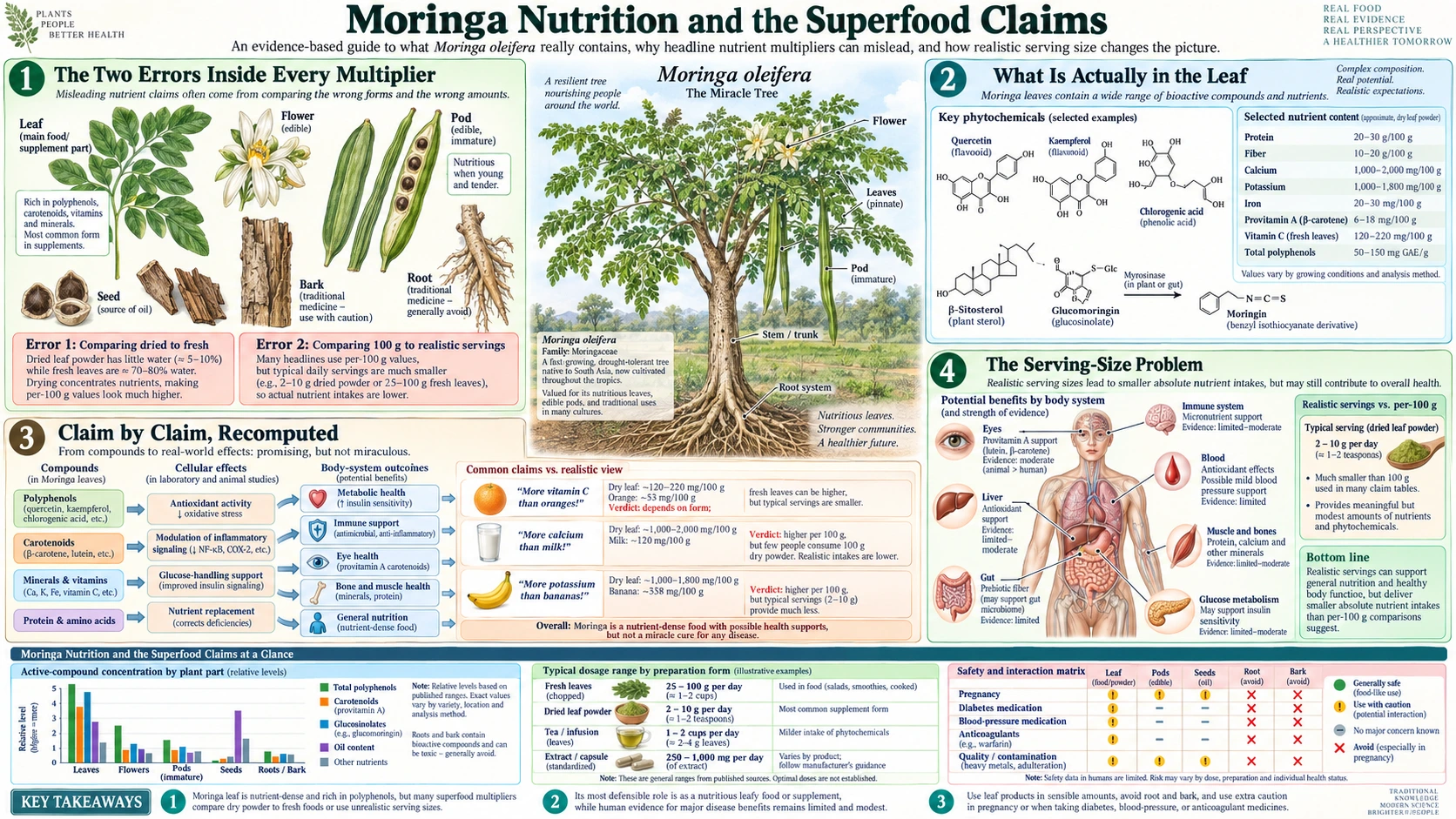
You have seen the chart. It is printed on the bag, on the label, on the shop sign, and on roughly every moringa post ever written: 7× the vitamin C of oranges. 4× the calcium of milk. 4× the vitamin A of carrots. 3× the potassium of bananas. 2× the protein of yogurt. Sometimes there is a bonus line about 25× the iron of spinach.
Those numbers did not come from nowhere. They trace back to real nutrient analyses of moringa leaves, done by people trying to solve real malnutrition. But by the time they reach a retail bag they have lost the two pieces of information that make them mean anything: which form of the plant the figure refers to, and how much of it you would have to eat. Without those, a multiplier is a decoration, not a fact.
This page does the arithmetic in the open. Not to debunk moringa — the leaf is a genuinely good vegetable and, in the right setting, a genuinely important one — but because the honest numbers are more useful than the inflated ones. If you know that a teaspoon of powder gives you about a tenth of a glass of milk’s worth of calcium, you can decide sensibly what to do with it. If you believe it gives you four glasses, you will make bad decisions with your money and possibly with your diet.
Table of Contents
- The Two Errors Inside Every Multiplier
- What Is Actually in the Leaf
- Claim by Claim, Recomputed
- The Serving-Size Problem
- What a Teaspoon Actually Delivers
- The Vitamin C Reversal
- Absorption: Oxalate, Phytate and Non-Heme Iron
- What Moringa Is Genuinely Good At
- Cooking, Fresh Leaves and Pods
- How to Read a Moringa Label
- Cautions
- Key Research Papers
- Connections
- Featured Videos
The Two Errors Inside Every Multiplier
Every version of the superfood chart contains at least one of two arithmetic problems, and usually both.
Error one: comparing dried to fresh. Fresh moringa leaf is roughly three-quarters water. Dry it, and you have removed most of the weight without removing any of the minerals or protein. Every per-100-gram number therefore multiplies by roughly four to eight times — not because anything was added, but because water left. Setting 100 g of dried powder against 100 g of a fresh orange is like being amazed that raisins are sweeter than grapes. If the chart on the bag does not tell you whether its moringa figure is fresh leaf or dried powder — and almost none of them do — the multiplier cannot be checked, which is convenient for whoever printed it.
Error two: comparing per-100-gram to per-100-gram, then selling you 2 grams. Even when a chart is internally consistent, it compares 100 g of moringa against 100 g of the other food. One hundred grams of dried moringa powder is about seventeen heaped tablespoons. It would be a bitter, gritty half-cup of green dust, and it is not remotely a serving. The label on the same bag will tell you the serving is one teaspoon. The chart and the directions on a single package are describing quantities that differ by a factor of fifty.
There is a third, quieter issue: the reference-food values used in the circulating charts are frequently well below the figures in modern food-composition databases. Recompute the same claims against current U.S. Department of Agriculture (USDA) values — which anyone can look up in FoodData Central — and several of the multipliers shrink, one of them reverses direction entirely, and another depends on which leaf sample is used.
What Is Actually in the Leaf
Moringa composition varies enormously — by cultivar, growing region, season, leaf age, and above all by how the leaf was dried. Published reviews give ranges rather than single values for exactly this reason, and any chart quoting one confident number per nutrient is hiding that variability. Working from mid-range figures reported across composition reviews:
| Per 100 g | Fresh leaf | Dried leaf powder | Why the gap |
|---|---|---|---|
| Water | ~75% | ~5–8% | The entire source of the “concentration” |
| Protein | 6–9 g (USDA FoodData Central, drumstick leaves, raw: 9.4 g) | 25–30 g | Water removed |
| Calcium | 185–440 mg | 1,600–2,200 mg | Water removed |
| Iron | ~4 mg | 25–32 mg | Water removed |
| Potassium | 260–340 mg | 1,200–1,600 mg | Water removed |
| Beta-carotene | ~6–7 mg (one 2014 analysis of fresh leaves: 18.2 mg trans-β-carotene) | 15–20 mg | Water removed, some oxidative loss |
| Vitamin C | 50–220 mg (one 2014 analysis of fresh leaves: 271.0 mg) | 15–120 mg | Goes down — destroyed by heat, light and time |
Notice the last row. Every nutrient in the table concentrates on drying except vitamin C, which does the opposite. Hold on to that; it is the subject of its own section below.
Claim by Claim, Recomputed
Let us give the claims their strongest possible reading: assume they refer to fresh leaf, per 100 g, against 100 g of the comparison food, using standard modern food-composition values for the comparison foods. This is the most generous framing available, and it is probably the framing the original analyses intended.
| Claim | Fresh moringa leaf /100 g | Comparison food /100 g | Actual ratio | Verdict |
|---|---|---|---|---|
| 7× the vitamin C of oranges | 50–220 mg | Orange ~53 mg | 1× to 4× | Overstated; depends entirely on leaf freshness |
| 4× the calcium of milk | 185–440 mg | Milk ~120 mg | 1.5× to 3.6× | Broadly holds on paper — see absorption below |
| 4× the vitamin A of carrots | ~6–7 mg β-carotene (18.2 mg in one 2014 analysis) | Carrot ~8.3 mg β-carotene | ~0.8× at mid-range figures | Varies — below to above a carrot depending on the sample |
| 3× the potassium of bananas | 260–340 mg | Banana ~358 mg | ~0.7× to 0.95× | Reversed — less than a banana |
| 2× the protein of yogurt | 6–9 g | Plain yogurt ~3.5–5 g | 1.3× to 2.5× | Roughly holds per 100 g |
So even on the most charitable reading — fresh leaf, gram for gram, no serving-size correction — one of the five headline claims is simply backwards: moringa leaf has less potassium than a banana. The vitamin A claim depends on the sample: at mid-range figures moringa leaf has less beta-carotene than a carrot, while one 2014 analysis of fresh leaves found 18.2 mg of trans-beta-carotene per 100 g, above the carrot’s ~8.3 mg. The vitamin C claim is inflated at most reported values, although the same 2014 analysis found 271.0 mg of vitamin C per 100 g of fresh leaf. Only calcium and protein survive, and protein only because 100 g of leaf is being compared against a food that is 85% water.
And this is before we address the fact that you are not going to eat 100 g of fresh moringa leaf, and definitely not 100 g of powder.
The Serving-Size Problem
Here is where the whole edifice comes down. A level teaspoon of moringa leaf powder weighs roughly 2 grams. A level tablespoon is roughly 6 grams. Product labels typically suggest one teaspoon to one tablespoon a day; many published human studies used between 4 and 8 g a day of powder, or 20–120 g of fresh or cooked leaves, and a 2022 systematic review of seven human studies describes doses from 0.5 g a day (in breast-milk work) up to 14–30 g a day.
Meanwhile the comparison foods come in servings too, and they are much larger:
- One medium orange — about 130 g, roughly 70 mg vitamin C
- One cup of milk — about 240 g, roughly 300 mg calcium
- One medium banana — about 118 g, roughly 420 mg potassium
- One medium carrot — about 60 g, roughly 5 mg beta-carotene
- Plain whole-milk yogurt — 3.47 g protein per 100 g (USDA FoodData Central)
The chart compares 100 g of moringa to 100 g of these foods. Real life compares 2 g of moringa to a whole orange, a whole glass of milk, a whole banana. That is a fiftyfold handicap on one side of the equation that no multiplier in the chart accounts for.
What a Teaspoon Actually Delivers
Here is the number you actually want. Using mid-range dried-powder composition values, and comparing against adult daily requirements:
| Nutrient | 1 tsp (2 g) | 1 tbsp (6 g) | Adult daily need | % of daily need per tbsp |
|---|---|---|---|---|
| Protein | ~0.55 g | ~1.6 g | 46–56 g | ~3% |
| Calcium | ~38 mg | ~114 mg | 1,000–1,200 mg | ~10–11% |
| Iron | ~0.6 mg | ~1.7 mg | 8 mg (men) / 18 mg (women 19–50) | 9–21% before absorption |
| Potassium | ~28 mg | ~84 mg | 2,600–3,400 mg | ~3% |
| Vitamin C | 0.3–2.4 mg | ~1–7 mg | 75–90 mg | 1–9% |
| Beta-carotene | ~0.35 mg | ~1 mg (≈85 µg RAE) | 700–900 µg RAE | ~10–12% |
Now translate that back into the language of the marketing:
- Vitamin C: a tablespoon gives 1–7 mg. One orange gives about 70 mg. So a tablespoon of moringa powder is somewhere between a tenth and a fiftieth of one orange — against a claim of seven oranges’ worth.
- Calcium: a tablespoon gives about 114 mg. A glass of milk gives about 300 mg. So it is about a third of one glass, against a claim of four glasses.
- Potassium: a tablespoon gives about 84 mg. A banana gives about 420 mg. So it is about a fifth of one banana, against a claim of three bananas.
- Protein: a tablespoon gives about 1.6 g. USDA lists plain whole-milk yogurt at 3.47 g of protein per 100 g, so a tablespoon of moringa powder holds less protein than 100 g of yogurt — against a claim of twice the protein of yogurt.
- Vitamin A: a tablespoon gives around 1 mg beta-carotene, roughly 85 µg of retinol activity. A medium carrot gives about five times that. So it is about a fifth of one carrot, against a claim of four.
Every single claim inverts. In the case of vitamin C the direction of the error is nearly two orders of magnitude. This is not a matter of moringa being slightly oversold; the advertised relationship and the real one point opposite ways.
The Vitamin C Reversal
The vitamin C claim deserves particular attention because it is the one printed most often and it is the one that is most exactly wrong.
Vitamin C is chemically fragile. It is degraded by heat, by oxygen, by light, and simply by time. Fresh moringa leaf, picked and eaten promptly, genuinely carries a good amount — comfortably in citrus territory per 100 g, and at the high end of reported values several times that. That is a legitimate observation about a fresh green vegetable.
But almost nobody buying moringa is buying fresh leaf. They are buying powder, which is made by drying leaves — often in open air over days — then milling, bagging, shipping and shelving them, sometimes for a year. Each of those steps costs vitamin C. Reported vitamin C in dried moringa powder ranges from a fairly respectable 120 mg per 100 g down to figures in the teens, and the widely reproduced low-end value is below that of a fresh orange per 100 g.
So the “seven times the vitamin C of an orange” line is printed on precisely the form of moringa in which vitamin C is least reliable and most likely to be nearly gone. Fresh oranges and fresh moringa leaves, lightly cooked, are the forms in which vitamin C is most reliably present.
The drying method also decides how much survives. In a 2014 study of fresh moringa leaves, freeze-drying (lyophilisation) kept 97.8% of the leaves’ vitamin C, while cabinet tray drying kept 90.1% of the trans-β-carotene and was as efficient as freeze-drying at keeping total carotenoids (60.1%).
Absorption: Oxalate, Phytate and Non-Heme Iron
Two of the numbers that survived the arithmetic — calcium and iron — face a second discount that never appears on any label: what is in the food is not what gets into you.
Iron in moringa is non-heme iron, the plant form. Heme iron from meat is absorbed at roughly 15–35%; non-heme iron typically at 2–20%, and at the low end of that when the meal contains binding compounds. So the 1.7 mg in a tablespoon might realistically deliver a few tenths of a milligram. The classic “25× the iron of spinach” line compares dried powder to fresh spinach and then ignores this entirely.
Moringa leaves contain oxalates and phytates, the same compounds that limit calcium and iron absorption from spinach, chard, beet greens and whole grains. Oxalate binds calcium into an insoluble complex in the gut; phytate binds iron, zinc and calcium alike. This is not a fringe concern — it is why researchers keep publishing work on improving mineral bioavailability from moringa. One study found that fermenting moringa leaves improved calcium bioavailability and prevented bone loss in calcium-deficient rats, which only makes sense if unfermented moringa calcium was not fully available to begin with. Another, a laboratory digestion study, found that adding garlic and onion raised bioaccessible iron from cooked moringa leaf mixtures to 36.35%–48.40%, against 23.28% in the unspiced control — again implying a baseline that needed improving.
Beta-carotene needs fat. Carotenoids from leafy greens are among the harder ones to absorb, and fat in the meal matters. Laboratory work on the digestion of moringa leaves (a digestion model with intestinal cells) found that its beta-carotene and lutein do get incorporated into absorbable micelles, and adding oil (5% vol/wt) to the leaves increased micellarization of both carotenoids, “particularly beta-carotene”. Practically: moringa in a curry with coconut milk, or scrambled into eggs, delivers more usable vitamin A than moringa stirred into water.
None of this makes moringa bad. It makes it a leafy green vegetable, subject to all the same absorption realities as every other leafy green vegetable. Which is the honest category it belongs in.
What Moringa Is Genuinely Good At
After all that subtraction, here is what actually stands up — and some of it is impressive.
- Calcium and provitamin A are its two best nutrients. Around 10–11% of a day’s calcium and 10–12% of a day’s vitamin A activity from one tablespoon of powder is a genuinely good showing for a plant food. Very few green powders do better.
- The protein is unusually complete for a leaf. Moringa leaf protein contains all nine essential amino acids, which is uncommon among leafy vegetables. The total amount per realistic serving is small, but the quality is real, and it matters in diets built mainly on a single cereal staple.
- It is a whole-food package, not an isolate. Along with the minerals come flavonoids (chiefly quercetin and kaempferol), chlorogenic acid, tocopherols, and the distinctive glucosinolates covered in Isothiocyanates and Inflammation. A vegetable is more than the sum of its label.
- Where the diet is genuinely deficient, the numbers change meaning entirely. Ten percent of a day’s calcium is a rounding error for someone drinking milk with breakfast. For an adolescent girl in a food-insecure household eating rice and lentils, an added source of calcium, iron, provitamin A and complete protein grown on the family plot is not a rounding error — it is a nutritional intervention. A six-month school-feeding study in rural Bangladesh that added a moringa-containing snack to a daily meal for 113 girls reported significantly higher haemoglobin and serum retinol than a calorie-matched control group at a comparable school. A 2022 systematic review of 33 studies (seven in humans) found that in humans moringa at higher doses (14–30 g a day), not lower doses (under 10 g a day), improved haemoglobin in children with iron-deficiency anaemia, and improved haemoglobin and vitamin A status in postmenopausal women; its authors call the evidence “limited but promising”. That is the setting where moringa earns its reputation, and it is covered in Water Purification and Food Security.
- The tree itself is the real superpower. It grows several metres a year, tolerates drought and poor soil, and yields edible leaves nearly year-round in warm climates. That agronomy — not any multiplier — is why aid organisations promote it.
Cooking, Fresh Leaves and Pods
The oldest and best-tested way to eat moringa is as food, and it is also the way that preserves the most nutrition.
- Leaves cook like spinach. Strip them from the stems and wilt them into dal, soup, stew, curry, eggs or rice at the end of cooking. In the Philippines the leaves — malunggay — go into the chicken soup tinola; across South India, East Africa and West Africa they go into everyday dishes. They are usually added late: long boiling costs vitamin C and carotenoids for no gain in flavour.
- Pods (drumsticks) are the immature seed pods, cooked like green beans and central to South Indian sambar. The fibrous outer skin is not eaten — you scrape the tender inner flesh and seeds out with your teeth or a spoon.
- Flowers are edible cooked, often battered and fried.
- Powder is the convenience form. One to two teaspoons stirred into soup, dal, sauce, yogurt or a smoothie. It is grassy and slightly bitter; heat mellows it. Adding it to something with fat improves the vitamin A you actually absorb.
- Seeds can be roasted and eaten in small amounts like a nut, or pressed for ben oil, a stable mild cooking and cosmetic oil. Concentrated seed extracts are a different matter — see Cautions.
How to Read a Moringa Label
- The word “leaf.” Leaf or leaf powder, named explicitly, is the part with the food tradition. An ingredient listed only as “moringa” does not say which part is inside, and bark or root are the parts covered by the safety concerns. This is the single most important line on the label and it is covered in Cautions below.
- A serving size in grams. “One scoop” tells you nothing. Two grams tells you everything you need to run the arithmetic on this page yourself.
- Country of origin and a lot number. Traceability is the difference between a food and an anonymous green powder.
- Third-party heavy-metal testing. Leafy crops take up lead and cadmium from soil, and moringa is often grown on marginal or roadside land. A certificate of analysis for heavy metals is worth more than any nutrient claim on the front.
- A raw agricultural product. Much moringa powder is dried in open air. A food-safety risk assessment of moringa leaf powder intended for undernourished infants and children in Cambodia and India examined exactly this microbiological concern. It found the risk low to moderate for most of the pathogens it evaluated when porridge fortified with the powder was boiled (a rolling boil for 5 min) before eating, with a moderate to serious risk from one (Clostridium perfringens type C), and an increased risk for all of them when the porridge was not boiled.
- Isothiocyanate claims are rarely quantified. The enzyme that produces moringin is heat-sensitive and glucosinolate content varies hugely. Standardised preparations exist in research; almost nothing on a shelf is one.
- Green, not khaki. Good powder is a bright green and smells grassy. Dull brown-green powder that smells of hay has been oxidising for a long time, and its vitamin C and carotenoids went with it.
Cautions
The root and root bark are not food. This is the sharpest safety line in the plant and it is not a generic disclaimer. Root and bark concentrate alkaloids — including the compound described in mid-twentieth-century Indian pharmacological literature as spirochin, along with benzylamine alkaloids — and an analysis of moringa roots found tannins (45 mg per 100 g) and oxalates (17.08 mg per 100 g) at higher levels than the other anti-nutritional factors it measured. The scraped root is sometimes used as a pungent horseradish-like condiment; that is a folk practice, and the root is the part of the plant this safety concern is about.
Pregnancy. Root and root bark have a long traditional use as an abortifacient and to induce menstruation. That traditional use is why the root and bark are the parts of concern in pregnancy; concentrated leaf extracts and high-dose supplements have no adequate human safety data. Ordinary culinary amounts of cooked leaf are traditional in many cuisines and are a different exposure. Moringa leaf is also traditionally used after birth to support milk supply; systematic reviews of that use find the supporting trials small and weak. A 2025 systematic review of eight randomized trials in postpartum mothers found that moringa leaf supplements given for 3 to 10 days increased breast-milk volume “by up to 400 mL/day” compared with controls, with a mean rise in serum prolactin of 231.72 ng/mL; its authors state that longer-term studies are still needed to establish dosing, sustained effectiveness and safety.
Digestive effects. Large doses of leaf powder commonly cause loose stools and stomach upset. This is dose-related and reversible. Product labels typically start at one teaspoon a day.
Diabetes medication. A single 4 g dose of moringa leaf increased insulin secretion by 74% in 10 healthy volunteers. The research raises a concern for people taking insulin, a sulfonylurea, metformin or any other glucose-lowering drug: moringa’s effect on insulin may add to the drug’s effect when a moringa habit is added or changed. Details in Blood Sugar and Cholesterol.
Blood-pressure medication. Moringa contains isolated hypotensive compounds, and a study of 41 healthy people found lower two-hour postprandial blood pressure after eating cooked moringa leaves: in the group that ate 120 g of cooked leaves, diastolic pressure two hours after the meal differed significantly from baseline (p = 0.013). Combined with an antihypertensive this could lower pressure further than intended.
Thyroid. Moringa leaf extract altered circulating thyroid hormone levels in rats, and thiocyanate released from glucosinolate breakdown competes with iodide for uptake into the thyroid. These findings matter most for people taking levothyroxine or being treated for a thyroid condition.
Concentrated seed extracts. A few roasted seeds as food is one thing; high-dose seed extract is another, and rodent work at supra-supplementation levels has shown signs of toxicity. The long food tradition is with the leaf, pods and flowers, and small amounts of roasted seed.
Key Research Papers
Every identifier below was verified live against NCBI E-utilities before it was printed — first author, title, journal and year all had to match. Unconfirmable sources are represented by PubMed topic searches instead of a number that might point at the wrong paper.
- Leone A, Spada A, Battezzati A, Schiraldi A, Aristil J, Bertoli S. Cultivation, genetic, ethnopharmacology, phytochemistry and pharmacology of Moringa oleifera leaves: an overview. International Journal of Molecular Sciences. 2015;16(6):12791–12835 — PubMed PMID: 26057747 — The most useful single source for composition ranges, and explicit that they vary widely.
- Saini RK, Sivanesan I, Keum YS. Phytochemicals of Moringa oleifera: a review of their nutritional, therapeutic and industrial significance. 3 Biotech. 2016;6(2):203. — PubMed PMID: 28330275
- Anwar F, Latif S, Ashraf M, Gilani AH. Moringa oleifera: a food plant with multiple medicinal uses. Phytotherapy Research. 2007;21(1):17–25. — PubMed PMID: 17089328
- Pullakhandam R, Failla ML. Micellarization and intestinal cell uptake of beta-carotene and lutein from drumstick (Moringa oleifera) leaves. Journal of Medicinal Food. 2007;10(2):252–257 — PubMed PMID: 17651060 — Cell-culture and digestion model; explains why fat in the meal matters.
- Dai J, Tao L, Shi C, et al. Fermentation improves calcium bioavailability in Moringa oleifera leaves and prevents bone loss in calcium-deficient rats. Food Science & Nutrition. 2020;8(7):3692–3703 — PubMed PMID: 32724632 — Animal study; the premise is that unfermented moringa calcium is incompletely available.
- Mawouma S, Doudou Walko F, Mbyeya J, Hamidou Yaya S, Awoudamkine E, Funtong CMM. Effect of Allium spices (garlic and onion) on the bioaccessibility of iron from Moringa oleifera leaves. Food Science & Nutrition. 2024;12(3):2115–2121. — PubMed PMID: 38455158
- Mawouma S, Ponka R, Mbofung CM. Acceptability and solubility of iron and zinc contents of modified Moringa oleifera sauces consumed in the Far-North region of Cameroon. Food Science & Nutrition. 2017;5(2):344–348. — PubMed PMID: 28265369
- Khanam M, Sanin KI, Ara G, et al. Effects of Moringa oleifera leaves on hemoglobin and serum retinol levels and underweight status among adolescent girls in rural Bangladesh. Frontiers in Nutrition. 2022;9:959890 — PubMed PMID: 35938103 — Quasi-experimental, 226 girls aged 12–14, six months; haemoglobin and serum retinol improved, weight did not.
- Kushwaha S, Chawla P, Kochhar A. Effect of supplementation of drumstick (Moringa oleifera) and amaranth (Amaranthus tricolor) leaves powder on antioxidant profile and oxidative status among postmenopausal women. Journal of Food Science and Technology. 2014;51(11):3464–3469 — PubMed PMID: 26396347 — Ninety women in three groups of 30; 7 g/day for three months. Reported gains — including a 17.5% rise in haemoglobin — are large for the dose, and the control group received no supplement at all rather than a placebo, so expectancy and dietary change are uncontrolled.
- Walia K, Kapoor A, Farber JM. Qualitative microbiological risk assessment of Moringa oleifera leaf powder to be used to treat undernutrition in infants and children in Cambodia and India: a review. Journal of Food Protection. 2019;82(3):513–521. — PubMed PMID: 30810376
- Stohs SJ, Hartman MJ. Review of the safety and efficacy of Moringa oleifera. Phytotherapy Research. 2015;29(6):796–804. — PubMed PMID: 25808883
- Igwilo IO, Ezeonu FC, Ezekwesili-Ofili JO, Igwilo SN, Nsofor CI, Abdulsalami MS, Obi E. Anti-nutritional factors in the roots of a local cultivar of Moringa oleifera (Lam). Pakistan Journal of Biological Sciences. 2014;17(1):114–117 — PubMed PMID: 24783788 — Roots only, no leaf comparison and no alkaloid measurement: tannins and oxalates at higher levels; saponins, cyanogenic glycosides and phytates at much lower levels.
- Saini RK, Shetty NP, Prakash M, Giridhar P. Effect of dehydration methods on retention of carotenoids, tocopherols, ascorbic acid and antioxidant activity in Moringa oleifera leaves and preparation of a RTE product. Journal of Food Science and Technology. 2014;51(9):2176–2182 — PubMed PMID: 25190880
- Brar S, Haugh C, Robertson N, Owuor PM, Waterman C, Fuchs GJ 3rd, Attia SL. The impact of Moringa oleifera leaf supplementation on human and animal nutrition, growth, and milk production: a systematic review. Phytotherapy Research. 2022;36(4):1600–1615 — PubMed PMID: 35302264
- Ammar M, Russo GL, Altamimi A, Altamimi M, Sabbah M, Al-Asmar A, Di Monaco R. Moringa oleifera supplementation as a natural galactagogue: a systematic review on its role in supporting milk volume and prolactin levels. Foods. 2025;14(14):2487 — PubMed PMID: 40724308
- Anthanont P, Lumlerdkij N, Akarasereenont P, Vannasaeng S, Sriwijitkamol A. Moringa oleifera leaf increases insulin secretion after single dose administration: a preliminary study in healthy subjects. Journal of the Medical Association of Thailand. 2016;99(3):308–313 — PubMed PMID: 27276742
- Chan Sun M, Ruhomally ZB, Boojhawon R, Neergheen-Bhujun VS. Consumption of Moringa oleifera Lam leaves lowers postprandial blood pressure. Journal of the American College of Nutrition. 2020;39(1):54–62 — PubMed PMID: 31063434
- U.S. Department of Agriculture, Agricultural Research Service. FoodData Central: Drumstick leaves, raw; Yogurt, plain, whole milk — FDC ID 168416; FDC ID 171284
- Original nutrient-composition tables for moringa leaf and powder, and the oxalate and phytate content that limits mineral absorption. PubMed search.
PubMed Topic Searches
- PubMed: Moringa nutrient composition
- PubMed: Drying and vitamin C retention
- PubMed: Leaf protein and amino acid profile
- PubMed: Non-heme iron, phytate and oxalate
- PubMed: Moringa calcium bioavailability
- PubMed: Heavy metals in moringa products
- PubMed: Beta-carotene bioavailability and dietary fat
- PubMed: Moringa, haemoglobin and adolescent nutrition
Connections
- All Herbs
- Moringa — the main article
- Moringa Benefits — hub
- Water Purification and Food Security
- Isothiocyanates and Inflammation
- Vitamin A — what beta-carotene converts into
- Vitamin C — and why drying destroys it
- Calcium
- Iron — heme versus non-heme absorption
- Curry Leaf