Amla / Indian Gooseberry Benefits
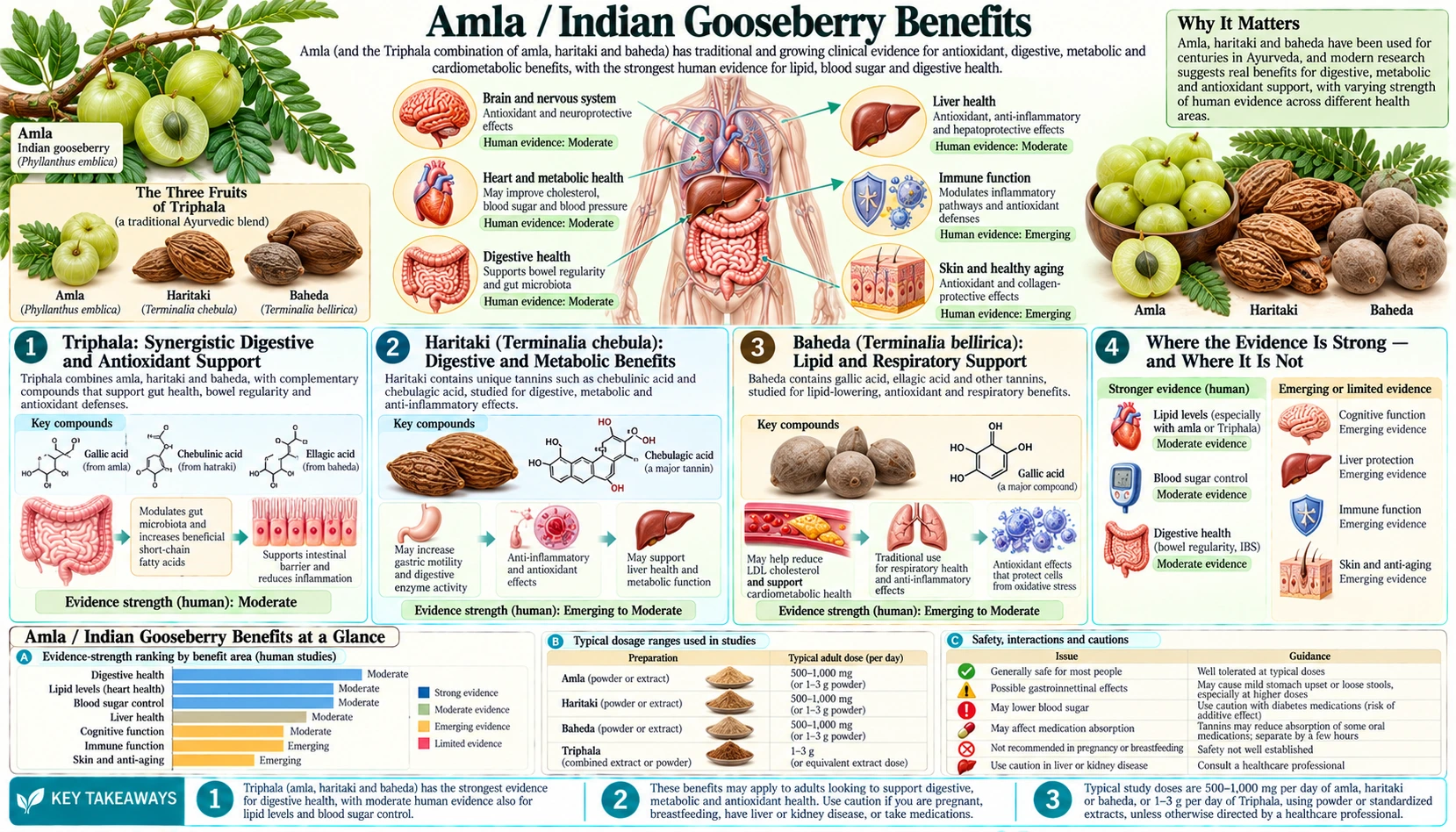
Amla — the fruit of Phyllanthus emblica, sold as Indian gooseberry, amalaki, aonla, nellikai and yu gan zi — is one of the few herbal products on this site with a genuine claim to being a food first and a supplement second. People eat it fresh with salt. They pickle it, candy it, juice it and cook it into chyawanprash. It is one of the three fruits of Triphala, alongside haritaki and baheda. And it carries a reputation for vitamin C so large that it has stopped being a measurement and become a slogan.
These four articles go underneath the slogan. The short version, before you read any of them: amla is a real vitamin C food whose famous number is smaller and much less certain than advertised; it has better human trial evidence than most herbs and that evidence is still thin, short and geographically lopsided; and its most reliably demonstrated benefit is one almost nobody mentions — what a Triphala mouthwash does to dental plaque.
Table of Contents
Deep-Dive Articles
Four articles, in the order that makes the rest make sense. Start with the chemistry — almost every other claim about amla is downstream of it.
Vitamin C and Antioxidant Chemistry
Why the quoted vitamin C figures range from 250 to 900 mg per 100 g, what a specific HPLC method found instead, and the analytical paper that could not find the antioxidant molecules amla is supposedly famous for.
Read the deep dive →Cholesterol and Metabolic Health
Five small randomised trials, one meta-analysis, one head-to-head against simvastatin with a design worth reading carefully, and one European trial that found nothing. What the numbers support and what they do not.
Read the deep dive →Hair, Skin and Traditional Cosmetic Use
Amla hair oil is a real tradition with one modern randomised trial behind it. What that trial measured, why an enzyme screen in rat liver is not a scalp result, and the widely cited skin paper that used the branch rather than the fruit.
Read the deep dive →Triphala and Digestive Use
What amla contributes to the three-fruit formula, the reflux trial, the microbiome claims and their actual evidence level, the strongest Triphala result on the page — a mouthwash — and the tannin-and-iron problem in detail.
Read the deep dive →Where the Evidence Is Strong — and Where It Is Not
An honest map before you read anything else. “Human randomized controlled trial (RCT)” here means a randomised controlled trial in people; “lab” means cell culture or animals, which tells you about mechanism and nothing about whether a capsule works.
| Use | Best available evidence | Honest verdict |
|---|---|---|
| Triphala mouthwash for plaque and gum inflammation | Several human randomized controlled trials (RCTs) plus a systematic review and meta-analysis, mostly against chlorhexidine | The best-supported use of any amla-containing product — and the one nobody markets |
| Cholesterol and triglycerides | Five small human randomized controlled trials, pooled in one 2023 meta-analysis; a second 2023 meta-analysis pooled nine trials (535 people); largest single trial n = 98 for 12 weeks | A real, consistent signal on blood markers. Short trials, small samples, no outcome data on heart attacks or strokes |
| Fasting blood glucose | Pooled reduction in the same meta-analysis; one uncontrolled dose-ranging study in Pakistan | Plausible, and most relevant to people who take diabetes medication. Not established as a treatment |
| Endothelial function, high-sensitivity C-reactive protein (hsCRP), oxidative-stress markers | Two human randomized controlled trials from one Hyderabad group | Surrogate markers, single centre. Interesting, not established |
| Blood pressure | One add-on randomized controlled trial in treated hypertension | Tested only as an add-on to blood-pressure medication, never as a replacement for it |
| Non-erosive reflux (heartburn without visible damage) | One 68-patient randomized controlled trial from Tehran | One trial, one centre, never replicated. Not a proven treatment |
| Female pattern hair loss | One triple-blind randomized controlled trial, 60 women, 12 weeks, amla syrup | Positive on a hair-cycle ratio and on satisfaction scores. A single small trial |
| Skin ageing, collagen, photoprotection | Human skin fibroblasts in culture; one clinical cosmetic study of the branch extract | Laboratory-stage. No trial of amla fruit on human skin ageing |
| “Antioxidant” and “immunity” claims generally | Assay numbers, animal models, marketing | The weakest ground on this page. See the chemistry article for why the assay numbers themselves are contested |
The cholesterol numbers in more detail. The largest single trial, Upadya and colleagues in 2019, gave 98 people with abnormal blood fats either 500 mg of amla extract or a matching placebo capsule twice a day for 12 weeks. Total cholesterol, triglycerides, low-density lipoprotein (LDL) cholesterol and very-low-density lipoprotein (VLDL) cholesterol were all significantly lower in the amla group than in the placebo group, and the atherogenic index of plasma (a ratio of triglycerides to “good” HDL cholesterol) fell by 39%. Coenzyme Q10 levels did not change. A second 2023 meta-analysis pooled nine randomized trials with 535 people who took 500–1,500 mg of amla fruit a day for 14 to 84 days. Compared with placebo, amla lowered LDL cholesterol by about 15 mg/dL, triglycerides by about 22 mg/dL and high-sensitivity C-reactive protein by about 1.7 mg/L. Its authors wrote that these results should be “interpreted with caution”, because the trials differed a great deal from one another, and that more research is needed to know whether amla helps prevent heart disease.
What Each Form Actually Delivers
“Amla” on a label can mean six different things that behave differently in your body and were tested in different studies — or in no study at all. The trial results do not transfer between them.
| Form | What it delivers | Was it what the trials used? |
|---|---|---|
| Fresh fruit | The full package: ascorbic acid, tannins, fibre, water. The only form that reliably delivers meaningful vitamin C | No. No modern randomized controlled trial used fresh fruit |
| Dried fruit powder (churna) | Tannins survive drying well; ascorbic acid content varies enormously with drying method and storage | The Pakistani glucose study used 1–3 g/day of powder — but without a placebo group |
| Juice | Highly variable. Frequently diluted and sugared; the ingredient label shows both | No |
| Standardised extract capsule | Concentrated polyphenols; usually little vitamin C. 500 mg twice daily is the studied dose | Yes — this is the form behind essentially all the lipid, glucose and blood-pressure results |
| Triphala churna | Roughly one-third amla by weight, plus haritaki and baheda. Typically 3–6 g at night | Only for the mouthwash and the negative cholesterol trial |
| Chyawanprash | Cooked amla in a jam that is largely sugar by weight | One 2001 Indian study on glucose tolerance and lipoproteins. Largely sugar, like a sweet |
| Amla hair oil | Topical, traditional, and outside every trial on this page except by analogy | No. The hair trial used an oral syrup |
The single most useful sentence on this page: fresh fruit is the form that delivers vitamin C; the lipid, glucose and blood-pressure trials used a standardised extract; the two are not interchangeable.
The Geography Problem
Something worth naming plainly, because it recurs in every one of the four articles.
Almost the entire positive clinical literature on amla comes from a small number of centres in one country, with a handful of research groups appearing repeatedly across the lipid, endothelial and blood-pressure trials. Several of the trials were registered after they started. Sample sizes run from 10 to 98. Follow-up runs from three to twelve weeks.
None of that makes the results wrong. Indian research groups study Indian medicinal plants for obvious and legitimate reasons, and expecting them not to would be absurd. But there is a well-documented pattern in complementary-medicine research in which effect sizes shrink sharply once a treatment is tested outside the country that developed it — and amla has one such test. In 2021, Donato and colleagues in Brescia, Italy ran a placebo-controlled, double-blind trial of a guggul-plus-Triphala preparation in 90 people with high cholesterol for three months. It found no benefit over placebo on total cholesterol, low-density lipoprotein (LDL) cholesterol, body mass index (BMI) or waist circumference — and 4.3% of the treated group developed a hypersensitivity rash, against none on placebo.
That was a different product and a different combination from the amla extracts that produced the positive results, so it is not a direct refutation. It is something more useful: a demonstration of what happens when one of these preparations meets an independent European trial team, and it puts the positive results in context.
The One Interaction Everybody Skips
Amla is rich in galloyl-group tannins — gallic acid, ellagic acid, the disputed emblicanins, and the mucic acid gallates identified in 2009. This chemistry is why it tastes astringent, and it is also why it interferes with iron.
The anchor study is not about amla at all. In 1989, Brune, Rossander and Hallberg in Göteborg measured non-haem iron absorption in humans against measured amounts of different phenolic structures, and found the inhibition was strongly dose-related and driven mainly by galloyl groups: 5 mg of tannic acid cut iron absorption by 20%, 25 mg by 67%, and 100 mg by 88%. Gallic acid inhibited iron absorption as much as tannic acid did, galloyl group for galloyl group. Catechin caused no inhibition and chlorogenic acid inhibited less; the authors concluded that catechol groups seem to be of minor importance, and suggested that condensed tannins do not interfere. The phenolics in that study were added to the same test meal as the iron, so it says nothing about taking them hours apart. It is the galloyl group that matters — and galloyl groups are exactly what amla and Triphala are full of.
Amla complicates its own story, because it also contains ascorbic acid, which strongly enhances non-haem iron absorption. Within the whole fresh fruit those two effects push in opposite directions and nobody has measured the net result directly. A tannin-rich extract with little vitamin C carries the galloyl groups without much of the ascorbic acid that pushes the other way. The research raises this concern most for people who are anaemic, iron-deficient, pregnant, regular blood donors, heavy menstruators or vegetarian: in the Brune study, galloyl tannins eaten in the same meal cut non-haem iron absorption sharply (25 mg of tannic acid by 67%), and no study on this page measured how far apart amla or Triphala and iron-containing meals or iron supplements would need to be.
Key Research Papers
Every identifier below was checked live against NCBI E-utilities before it was printed — first author, title, journal and year all had to match. Where a paper could not be confirmed that way, the entry carries a PubMed topic search instead of a number that might point at the wrong study.
The vitamin C and antioxidant chemistry
- Scartezzini P, Antognoni F, Raggi MA, Poli F, Sabbioni C. Vitamin C content and antioxidant activity of the fruit and of the Ayurvedic preparation of Emblica officinalis Gaertn. Journal of Ethnopharmacology. 2006;104(1–2):113–118 — PubMed PMID: 16226416 — Specific HPLC-DAD: 0.4% ascorbic acid in raw fruit, 1.28% after traditional processing.
- Majeed M, Bhat B, Jadhav AN, Srivastava JS, Nagabhushanam K. Ascorbic acid and tannins from Emblica officinalis Gaertn. fruits — a revisit. Journal of Agricultural and Food Chemistry. 2009;57(1):220–225 — PubMed PMID: 19063633 — Found no evidence of emblicanins A and B; identified co-eluting mucic acid gallates.
- Levine M, Conry-Cantilena C, Wang Y, et al. Vitamin C pharmacokinetics in healthy volunteers: evidence for a recommended dietary allowance. Proceedings of the National Academy of Sciences. 1996;93(8):3704–3709 — PubMed PMID: 8623000 — Human depletion–repletion study; the basis of modern vitamin C requirements.
- Carlsen MH, Halvorsen BL, Holte K, et al. The total antioxidant content of more than 3100 foods, beverages, spices, herbs and supplements used worldwide. Nutrition Journal. 2010;9:3 — PubMed PMID: 20096093 — The scale of assay-based food antioxidant rankings — and their limits.
Lipids, glucose and metabolic markers in humans
- Setayesh L, Haghighat N, Rasaei N, et al. The impact of Emblica officinalis (Amla) on lipid profile, glucose, and C-reactive protein: a systematic review and meta-analysis of randomized controlled trials. Diabetes & Metabolic Syndrome. 2023;17(3):102729 — PubMed PMID: 36934568 — Five RCTs pooled; interventions 3–12 weeks.
- Upadya H, Prabhu S, Prasad A, Subramanian D, Gupta S, Goel A. A randomized, double blind, placebo controlled, multicenter clinical trial to assess the efficacy and safety of Emblica officinalis extract in patients with dyslipidemia. BMC Complementary and Alternative Medicine. 2019;19(1):27 — PubMed PMID: 30670010 — Human RCT, n = 98, 500 mg twice daily for 12 weeks.
- Gopa B, Bhatt J, Hemavathi KG. A comparative clinical study of hypolipidemic efficacy of Amla (Emblica officinalis) with 3-hydroxy-3-methylglutaryl-coenzyme-A reductase inhibitor simvastatin. Indian Journal of Pharmacology. 2012;44(2):238–242 — PubMed PMID: 22529483 — 60 patients, 42 days, no placebo group — read the design.
- Akhtar MS, Ramzan A, Ali A, Ahmad M. Effect of Amla fruit (Emblica officinalis Gaertn.) on blood glucose and lipid profile of normal subjects and type 2 diabetic patients. International Journal of Food Sciences and Nutrition. 2011;62(6):609–616 — PubMed PMID: 21495900 — Uncontrolled dose-ranging study from Pakistan; comparisons are against baseline, not placebo.
- Donato F, Raffetti E, Toninelli G, Festa A, Scarcella C, Castellano M. Guggulu and Triphala for the treatment of hypercholesterolaemia: a placebo-controlled, double-blind, randomised trial. Complementary Medicine Research. 2021;28(3):216–225 — PubMed PMID: 33242870 — Human RCT, n = 90, 3 months — negative, with 4.3% hypersensitivity rash.
- Brown PDS, Ketter N, Vis-Dunbar M, Sakakibara BM. Clinical effects of Emblica officinalis fruit consumption on cardiovascular disease risk factors: a systematic review and meta-analysis. BMC Complementary Medicine and Therapies. 2023;23(1):190 — PubMed PMID: 37296402 — Nine RCTs, 535 participants, 14–84 days; lower LDL, triglycerides and hsCRP, with high heterogeneity.
Endothelial function, blood pressure and platelets
- Usharani P, Merugu PL, Nutalapati C. Evaluation of the effects of a standardized aqueous extract of Phyllanthus emblica fruits on endothelial dysfunction, oxidative stress, systemic inflammation and lipid profile in subjects with metabolic syndrome. BMC Complementary and Alternative Medicine. 2019;19(1):97 — PubMed PMID: 31060549 — Human RCT, n = 59, 250 and 500 mg twice daily.
- Usharani P, Fatima N, Muralidhar N. Effects of Phyllanthus emblica extract on endothelial dysfunction and biomarkers of oxidative stress in patients with type 2 diabetes mellitus: a randomized, double-blind, controlled study. Diabetes, Metabolic Syndrome and Obesity. 2013;6:275–284 — PubMed PMID: 23935377 — Human RCT.
- Shanmugarajan D, Girish C, Harivenkatesh N, Chanaveerappa B, Prasanna Lakshmi NC. Antihypertensive and pleiotropic effects of Phyllanthus emblica extract as an add-on therapy in patients with essential hypertension. Phytotherapy Research. 2021;35(6):3275–3285 — PubMed PMID: 33570228 — Human RCT, add-on design.
- Fatima N, Pingali U, Muralidhar N. Study of pharmacodynamic interaction of Phyllanthus emblica extract with clopidogrel and ecosprin in patients with type II diabetes mellitus. Phytomedicine. 2014;21(5):579–585 — PubMed PMID: 24291054 — Human crossover, n = 10 — significant antiplatelet activity alone and in combination. The basis of the bleeding caution.
Triphala, the mouth and the gut
- Peterson CT, Denniston K, Chopra D. Therapeutic uses of Triphala in Ayurvedic medicine. Journal of Alternative and Complementary Medicine. 2017;23(8):607–614 — PubMed PMID: 28696777 — Review.
- AlJameel AH, Almalki SA. Effect of triphala mouthrinse on plaque and gingival inflammation: a systematic review and meta-analysis of randomized controlled trials. International Journal of Dental Hygiene. 2020;18(4):344–351 — PubMed PMID: 32383334 — The strongest evidence base on this page.
- Pradeep AR, Suke DK, Martande SS, et al. Triphala, a new herbal mouthwash for the treatment of gingivitis: a randomized controlled clinical trial. Journal of Periodontology. 2016;87(11):1352–1359 — PubMed PMID: 27442086 — Human RCT.
- Karkon Varnosfaderani S, Hashem-Dabaghian F, Amin G, et al. Efficacy and safety of Amla (Phyllanthus emblica L.) in non-erosive reflux disease: a double-blind, randomized, placebo-controlled clinical trial. Journal of Integrative Medicine. 2018;16(2):126–131 — PubMed PMID: 29526236 — Human RCT, n = 68, 4 weeks.
- Peterson CT, Sharma V, Uchitel S, et al. Prebiotic potential of herbal medicines used in digestive health and disease. Journal of Alternative and Complementary Medicine. 2018;24(7):656–665 — PubMed PMID: 29565634 — In vitro faecal culture — not a human microbiome trial.
Hair, skin, iron and product quality
- Akhbari M, Firooz A, Rahimi R, Shirzad M, Esmaealzadeh N, Shirbeigi L. The effect of an oral product containing Amla fruit (Phyllanthus emblica L.) on female androgenetic alopecia: a randomized controlled trial. Journal of Ethnopharmacology. 2024;318(Pt A):116958 — PubMed PMID: 37487962 — Triple-blind human RCT, 60 women, 12 weeks.
- Fujii T, Wakaizumi M, Ikami T, Saito M. Amla (Emblica officinalis Gaertn.) extract promotes procollagen production and inhibits matrix metalloproteinase-1 in human skin fibroblasts. Journal of Ethnopharmacology. 2008;119(1):53–57 — PubMed PMID: 18588964 — Cell culture.
- Brune M, Rossander L, Hallberg L. Iron absorption and phenolic compounds: importance of different phenolic structures. European Journal of Clinical Nutrition. 1989;43(8):547–557 — PubMed PMID: 2598894 — Human absorption study — galloyl groups are the determinant; 25 mg tannic acid cut absorption 67%.
- Saper RB, Phillips RS, Sehgal A, et al. Lead, mercury, and arsenic in US- and Indian-manufactured Ayurvedic medicines sold via the Internet. JAMA. 2008;300(8):915–923 — PubMed PMID: 18728265 — Why third-party heavy-metal testing is a real question for imported products.
- Hegde SN, K LD, Choudhary M, Menon N, Singh G. A comprehensive metabolome profiling of Terminalia chebula, Terminalia bellerica, and Phyllanthus emblica to explore the medicinal potential of Triphala. Scientific Reports. 2024;14(1):31635. — PubMed PMID: 39738152
PubMed Topic Searches
External Resources
- PubMed — Phyllanthus emblica literature
- U.S. National Center for Complementary and Integrative Health — Herbs at a Glance
- LiverTox — U.S. National Institutes of Health database of drug and herbal liver injury
- PubChem — ascorbic acid compound record
- U.S. National Institutes of Health Office of Dietary Supplements — Vitamin C
- World Flora Online — Phyllanthus emblica L. taxonomy
- ClinicalTrials.gov — registered amla trials
- Clinical Trials Registry — India
Connections
- All Herbs
- Amla / Indian Gooseberry (Phyllanthus emblica) — the main article: botany, names, traditional use, dosing.
- Haritaki (Terminalia chebula) — the first fruit of Triphala, and the one carrying most of the bowel action.
- Baheda (Terminalia bellirica) — the second fruit of Triphala, and the least researched of the three.
- Chanca Piedra (Phyllanthus niruri) — the same genus, an entirely different plant and use.
- Vitamin C — what ascorbic acid actually does, and how much you need.