Hibiscus for Cholesterol and Metabolic Health
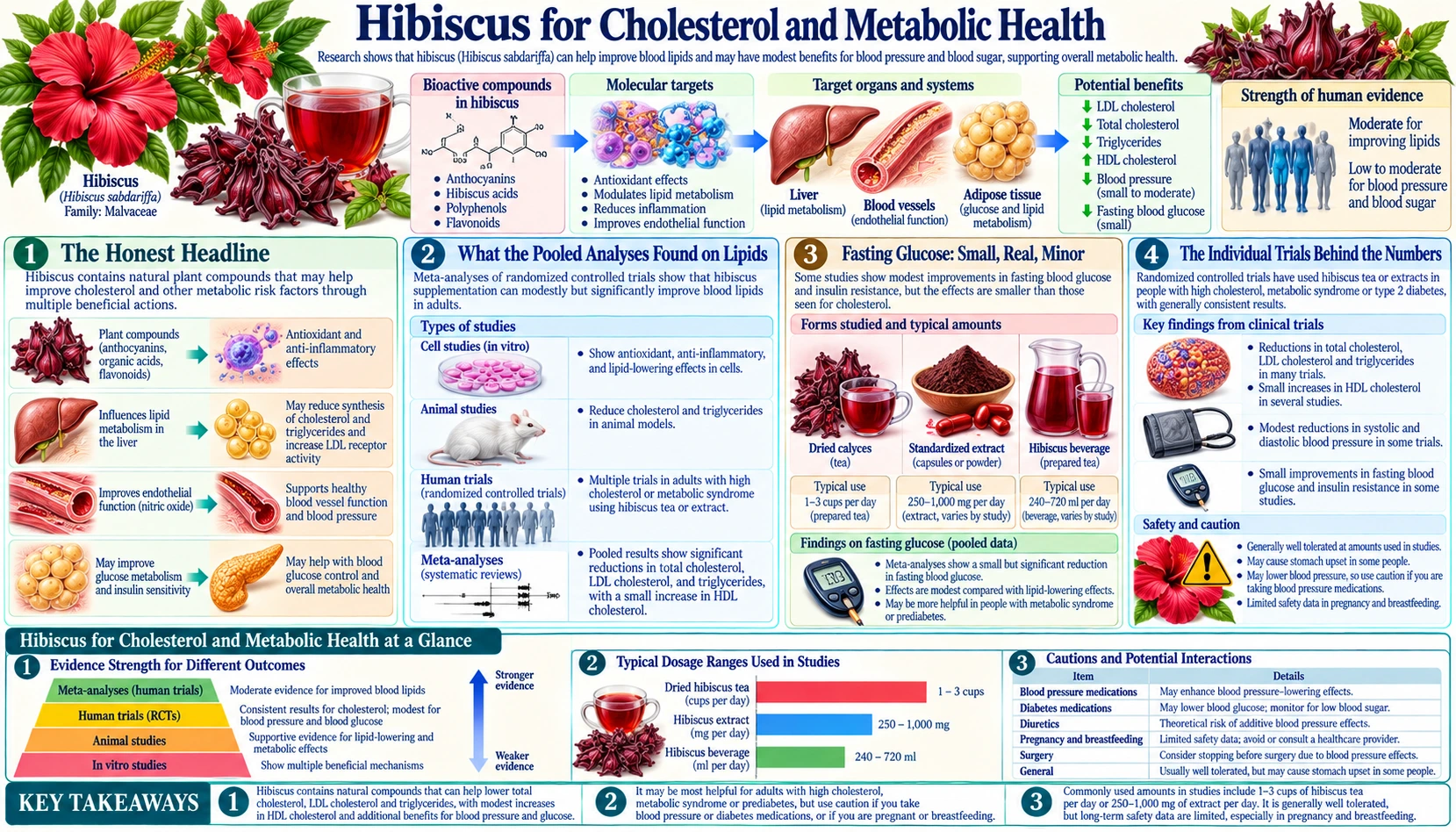
If the blood-pressure story is hibiscus at its strongest, this is hibiscus at its most oversold. Search the internet for “hibiscus cholesterol” and you will find confident claims that roselle tea lowers low-density lipoprotein (LDL), raises high-density lipoprotein (HDL), melts triglycerides, controls blood sugar and burns fat. Search the actual trials and you find something much quieter: one borderline low-density lipoprotein result that landed at exactly P = 0.05, a fasting-glucose reduction of under four milligrams per decilitre, and, in the two pooled analyses compared below, no significant effect on triglycerides or high-density lipoprotein (a 2025 umbrella review has since reported a rise in high-density lipoprotein).
That is not nothing. A small consistent nudge in glucose and low-density lipoprotein, in a drink you would enjoy anyway, is a perfectly reasonable thing to want. But it is a long way from what is usually claimed, and this article lays out where the line falls — including the awkward detail that the way most people actually drink hibiscus may cancel the benefit entirely.
Table of Contents
- The Honest Headline
- What the Pooled Analyses Found on Lipids
- Fasting Glucose: Small, Real, Minor
- The Individual Trials Behind the Numbers
- Body Weight and Liver Fat
- Why the Results Are So Inconsistent
- The Sugar Problem
- Hibiscus Acid and the “Starch Blocker” Claims
- How Hibiscus Affects Simvastatin Levels
- What the Evidence Means in Practice
- Key Research Papers
- Connections
- Featured Videos
The Honest Headline
Two independent teams pooled the randomised trials of hibiscus on cardiometabolic markers within two years of each other. Here is what they concluded, side by side.
| Marker | Najafpour Boushehri 2020 (7 trials, 362 people) | Ellis 2022 (17 chronic trials) |
|---|---|---|
| Low-density lipoprotein cholesterol | Non-significant trend toward reduction (P = 0.08) | −6.76 mg/dL (95% confidence interval (CI) −13.45 to −0.07), I² = 64%, P = 0.05, versus other teas and placebo |
| Total cholesterol | No significant effect | No significant pooled benefit reported |
| Triglycerides | No significant effect | No significant pooled benefit reported |
| High-density lipoprotein cholesterol | No significant effect | No significant pooled benefit reported |
| Fasting plasma glucose | −3.67 mg/dL (95% confidence interval −7.07 to −0.27), I² = 37% | Assessed; not a headline positive finding |
| Systolic blood pressure (for comparison) | −4.71 mmHg (95% confidence interval −7.87 to −1.55) | −7.10 mmHg (95% confidence interval −13.00 to −1.20), I² = 95%, P = 0.02 vs placebo; versus blood-pressure medication, no significant difference (2.13 mmHg, P = 0.40) |
A third, larger pooling has since appeared. A 2025 umbrella review with an updated dose-response meta-analysis (Norouzzadeh and colleagues) combined 26 randomised trials with 1,797 participants. It found that hibiscus lowered systolic and diastolic blood pressure in a dose-dependent way compared with placebo and other teas, and that it “also reduced total cholesterol, LDL-C, fasting blood glucose, and increased HDL-C” (low-density and high-density lipoprotein cholesterol). It reported “a minor, clinically insignificant increase in aspartate aminotransferase” (a liver enzyme) without a rise in adverse events, and concluded that although hibiscus is generally considered safe, “long-term and therapeutic dosing safety requires careful monitoring” (PubMed PMID: 39870328).
Read the low-density lipoprotein row carefully, because it is the strongest metabolic claim hibiscus has and it is fragile. The Ellis estimate is −6.76 mg/dL with a confidence interval running from −13.45 all the way to −0.07. The upper end of that interval is seven hundredths of a milligram per decilitre — effectively zero. The P value is 0.05 exactly, which is the definition of sitting on the fence. And the same marker in the other pooled analysis did not reach significance at all.
What the two analyses in the table support is not “hibiscus lowers low-density lipoprotein” and not “hibiscus does nothing for low-density lipoprotein,” but the accurate and less satisfying: there may be a small low-density lipoprotein benefit, it has not been established, and if it is real it is on the order of a few milligrams per decilitre.
What the Pooled Analyses Found on Lipids
For context on scale: a moderate-intensity statin lowers low-density lipoprotein by roughly 30 to 50 percent — in someone with a low-density lipoprotein of 140 mg/dL, that is 40 to 70 mg/dL. A serious dietary overhaul might move low-density lipoprotein 10 to 15 percent. The hibiscus estimate, if you take it at face value, is about 6.8 mg/dL — roughly a 5 percent change from a typical starting point, at the boundary of statistical detectability.
The heterogeneity on the low-density lipoprotein analysis was I² = 64 percent, which is substantial: the trials disagreed with one another well beyond chance. Some trials found a clear drop; others found nothing. The pooled figure is the average of a genuine disagreement.
Meanwhile, the two markers people most often claim hibiscus improves — triglycerides and high-density lipoprotein — came out null in both analyses in the table: the 2020 analysis found no significant effect on either, and the full Ellis 2022 paper reports no significant effect on triglycerides (P = 0.95) or high-density lipoprotein (P = 0.82). That deserves stating plainly, because negative findings almost never make it into the promotional copy. The 2025 umbrella review of 26 trials differs on high-density lipoprotein: it reported that hibiscus “increased HDL-C”, so on that marker the pooled analyses now disagree.
Hopkins and colleagues, in a 2013 comprehensive review of the animal and human studies, reported that total cholesterol, low-density lipoprotein and triglycerides were lowered in the majority of animal models while high-density lipoprotein was generally not affected, and that “over half of the RCTs” (randomised controlled trials) showed daily hibiscus tea or extract had a favourable influence on lipid profiles, including reduced total cholesterol, low-density lipoprotein and triglycerides and increased high-density lipoprotein. They concluded that hibiscus extracts are “promising as a treatment of hypertension and hyperlipidemia”, but that more high-quality animal and human studies are needed.
Fasting Glucose: Small, Real, Minor
The pooled fasting-glucose result — −3.67 mg/dL (95% confidence interval −7.07 to −0.27), with modest heterogeneity at I² = 37 percent — is arguably the tidiest metabolic finding hibiscus has. The confidence interval excludes zero, and the trials broadly agreed with each other.
Now put it in scale. Fasting glucose is normally under 100 mg/dL; prediabetes is 100 to 125; diabetes is 126 or above. A drop of 3.67 mg/dL will not move anyone across a diagnostic boundary unless they were already balanced on it. It is smaller than the day-to-day variation in your own fasting glucose. It is far smaller than what metformin, weight loss or a serious change in carbohydrate intake will do.
Nobody has shown that hibiscus changes hemoglobin A1c (HbA1c) — the three-month average that actually drives diabetes decisions — in a way that would alter management. Fasting glucose is a snapshot; hemoglobin A1c is the film.
So: a small, statistically real, clinically marginal improvement. Worth knowing about. Not worth building a diabetes plan around.
The Individual Trials Behind the Numbers
Metabolic syndrome — Gurrola-Díaz 2010
This Mexican trial used a factorial randomised design — diet alone, 100 mg a day of hibiscus extract powder in capsules, or extract plus diet, for one month — in people with and without metabolic syndrome. People with metabolic syndrome who took the extract had significantly lower glucose and total cholesterol, higher high-density lipoprotein cholesterol and a better triglyceride-to-HDL ratio (a marker of insulin resistance); a triglyceride-lowering effect was seen with extract plus diet in metabolic syndrome and with extract alone in people without it. It is one of the more frequently cited positive lipid results in the hibiscus literature — and, like almost every trial here, it is small, short and single-centre.
Type 2 diabetes — the Iranian sour-tea trials
Mozaffari-Khosravi and colleagues studied sour tea in adults with type 2 diabetes and mild hypertension, first against black tea and later against green tea. Their focus was blood pressure rather than lipids, but they are important to this article for a different reason: they establish that hibiscus has been tested specifically in people with diabetes, and it was tolerated. That is a genuine data point when you are wondering whether a tart red tea is safe alongside diabetes medication.
Where the animal data get ahead of the human data
Rodent studies of hibiscus extract on lipids are consistently, dramatically positive: lower total cholesterol, lower triglycerides, less hepatic fat, reduced atherosclerotic plaque. Cell-culture work shows effects on cholesterol synthesis and low-density lipoprotein oxidation.
Those studies routinely use extract doses that, scaled to a human, are far above anything you could drink, delivered to animals eating an artificially atherogenic diet. This is the single most common way herbal claims outrun their evidence: an impressive rodent result gets reported as though it were a human one. When the same question is asked in people, the effect shrinks to the borderline numbers in the table above.
Body Weight and Liver Fat
Chang and colleagues in Taiwan ran the trial most often cited for hibiscus and weight: a randomised, placebo-controlled study in adults aged 18 to 65 with a body-mass index (BMI) of 27 or above, split into a control group (n = 17) and a hibiscus-extract group (n = 19) for twelve weeks. The published finding was that hibiscus extract reduced body weight, BMI, body fat, the waist-to-hip ratio and serum free fatty acids and improved liver steatosis — fat in the liver — with no adverse effects reported during the trial.
Three caveats, all of them important:
- It is one small trial. Nothing of comparable size has replicated it. Single positive trials in nutrition have a poor track record of surviving replication.
- It used a concentrated extract in capsules, not brewed tea. There is no conversion factor between “a hibiscus capsule at the studied dose” and “a glass of agua de Jamaica.”
- Twelve weeks is short for a weight outcome, and weight trials of that length routinely show effects that disappear by a year.
The fair conclusion: interesting, not established. Hibiscus is not a weight-loss agent, and no reputable reading of this literature makes it one.
Why the Results Are So Inconsistent
The metabolic literature on hibiscus is a mess, and understanding why tells you more than any single trial does.
- The intervention is not one thing. Brewed tea, cold infusion, aqueous extract powder, hydro-alcoholic extract, capsules standardised to anthocyanin content. These differ in dose by an order of magnitude and nobody can convert between them.
- The comparator is not one thing. Water, placebo beverage, black tea, green tea, dietary advice. Black tea and green tea are not inert — comparing hibiscus against green tea and finding no difference is a completely different result from comparing it against water.
- Baseline lipids vary enormously. A trial in people with normal cholesterol has almost no room to show improvement.
- Diet was rarely controlled. In an outpatient lipid trial, what participants eat swamps what they drink.
- Trials are small and short. Lipid changes need weeks to stabilise, and a trial of forty people cannot detect a 5 mg/dL difference reliably.
- Publication bias. A small trial that finds nothing is far less likely to be written up and published than one that finds something.
The Sugar Problem
This is the part that never appears in the promotional literature and matters more than any of the above.
Hibiscus is genuinely, aggressively sour — a brewed infusion sits at a pH of roughly 2.5 to 3. Almost nowhere in the world is it drunk unsweetened. Agua de Jamaica is sweetened, often heavily. Bissap is sweetened. Jamaican sorrel is sweetened and frequently spiked with rum. Bottled and canned hibiscus drinks are sweetened as a matter of course. Egyptian karkade served hot at a celebration is sweetened.
A large glass of sweetened hibiscus can easily carry 20 to 40 grams of added sugar — comparable to a soft drink. Here is what that does to the very markers this article is about:
- Added sugar, especially fructose, raises triglycerides — one of the two markers hibiscus already fails to improve.
- It raises fasting glucose and worsens insulin resistance over time — wiping out a 3.67 mg/dL benefit many times over.
- It promotes liver fat — the exact outcome the Taiwanese trial reported hibiscus improving.
- It adds calories, working directly against the weight claim.
The arithmetic is brutal and simple: if you sweeten it like a soft drink, you are drinking a soft drink with a polyphenol garnish. Any metabolic benefit hibiscus might have is measured in single-digit milligrams per decilitre. Thirty grams of sugar is not.
Ways people make unsweetened hibiscus pleasant at no metabolic cost:
- Weaker brewing. Most people brew it far too strong and then need sugar to survive it; a weaker brew needs less sweetening.
- Cold brewing. Cold extraction pulls fewer harsh, astringent compounds and produces a rounder, less punishing drink.
- Blending. Mint, fresh ginger, a cinnamon stick, a few cloves, allspice, lemongrass, or a slice of orange all soften the sourness without sugar.
- Serving it very cold. Cold blunts perceived sourness considerably.
- Tapering. Sour tolerance is trainable; a gradual step-down, such as four teaspoons to three for a fortnight and then two, is the usual approach.
Hibiscus Acid and the “Starch Blocker” Claims
Some hibiscus supplements are marketed as carbohydrate blockers, on the strength of two chemical facts.
First, roselle contains hibiscus acid, a lactone form of hydroxycitric acid — the same compound family found in Garcinia cambogia, the notorious weight-loss ingredient. Hydroxycitric acid inhibits adenosine triphosphate-citrate lyase, an enzyme in fatty-acid synthesis, which is the theoretical basis for the fat-loss claim. In humans, Garcinia has been tested repeatedly for weight loss and the results have been consistently disappointing — and Garcinia delivers far more hydroxycitric acid than a cup of hibiscus tea does.
Second, hibiscus extracts inhibit the digestive enzymes alpha-amylase and alpha-glucosidase in laboratory assays, which would slow starch and sugar digestion — the mechanism acarbose uses as a diabetes drug. This effect is real in a test tube and has been shown in rodents fed starch loads.
Neither observation has been translated into a demonstrated human benefit at drinkable doses. The gap is enormous: an enzyme assay uses concentrations of extract that a cup of tea, diluted through the entire volume of the gut and then the body, does not remotely approach. If hibiscus meaningfully blocked starch digestion in people, the pooled fasting-glucose effect would be a great deal larger than 3.67 mg/dL.
“Hibiscus carb blocker” products rest on an in-vitro mechanism that has not been shown to work in people at drinkable doses.
How Hibiscus Affects Simvastatin Levels
There is one metabolic-medicine interaction with actual human data behind it, and the direction is not the one you would hope for.
Showande and colleagues studied hibiscus alongside simvastatin in two parts. In hyperlipidaemic rats, the aqueous extract lowered total cholesterol effectively, and at low doses combined with low-dose simvastatin appeared to enhance the drug’s lipid-lowering action — the encouraging half.
Then they gave a hibiscus beverage plus a single 40 mg dose of simvastatin to six healthy human volunteers in a randomised crossover design. The beverage increased simvastatin clearance by about 45 percent and reduced peak concentration by 18 percent. The geometric mean ratio of total drug exposure with and without hibiscus was 0.646, with a 90 percent confidence interval of 0.564 to 0.758 — outside the accepted bioequivalence range. In plain terms: the dose was the same, but the amount of simvastatin reaching the bloodstream over time was 0.646 times what it was without hibiscus.
The authors’ own conclusion was explicit — the animal result should not be used to make clinical recommendations, and co-administration of the beverage with simvastatin should be discouraged until more clinical data exist.
This is a six-person single-dose study, so it is a signal rather than a settled fact, and it has not been tested with other statins. The study gave the drink and the drug together; it did not test taking them hours apart.
What the Evidence Means in Practice
- High cholesterol: hibiscus is not an established treatment. The Ellis 2022 pooled estimate is a borderline 6.76 mg/dL of low-density lipoprotein. Statins, ezetimibe, fibre, weight loss and dietary fat quality are the levers that move this number, and hibiscus has not been tested as a replacement for them.
- Prediabetes or diabetes: a fasting-glucose drop under 4 mg/dL is too small to change diabetes management. Hibiscus has been tested in people with type 2 diabetes and was tolerated, which is worth something. Unsweetened, it can replace a sweetened beverage — and that swap is worth far more metabolically than any direct effect of the plant.
- Weight: the evidence is one small trial. Replacing sweetened drinks with unsweetened hibiscus removes calories, and that, not the flower, is the mechanism.
- Fatty liver: promising preliminary data, nothing established. High-dose extracts are also where the animal toxicity signals appear, and more is not obviously safer here; the 2013 Hopkins review notes possible adverse effects on the liver at high doses. In a 2020 rat toxicity study of sub-acute and sub-chronic oral administration of an aqueous extract of the calyces, 90 days of 125 to 500 mg/kg raised urea and creatinine and lowered high-density lipoprotein cholesterol, while liver and kidney tissue looked normal under the microscope; the authors concluded that prolonged oral consumption of the extract may not be recommended (Njinga and colleagues, Heliyon, 2020, PubMed PMID: 33005778).
- Statins: in the one human study, a hibiscus drink taken together with simvastatin lowered the drug’s blood levels; its authors concluded that co-administration “should be discouraged until more clinical data are available.”
- For everyone: the strongest metabolic argument for hibiscus is not what it does but what it displaces. Every glass of unsweetened hibiscus that replaces a sweetened soft drink is a real, quantifiable metabolic win, and it dwarfs anything in the meta-analyses.
Key Research Papers
Every identifier below was verified live against NCBI E-utilities before it was printed. Findings are labelled human, animal or in vitro, and negative results are reported as negative.
Pooled analyses of cardiometabolic markers
- Najafpour Boushehri S, Karimbeiki R, Ghasempour S, et al. The efficacy of sour tea (Hibiscus sabdariffa L.) on selected cardiovascular disease risk factors: a systematic review and meta-analysis of randomized clinical trials. Phytotherapy Research. 2020;34(2):329–339 — PubMed PMID: 31943427 — Human. Fasting glucose −3.67 mg/dL (I² = 37%); no significant effect on triglycerides, total cholesterol or HDL; LDL only a trend (P = 0.08).
- Ellis LR, Zulfiqar S, Holmes M, Marshall L, Dye L, Boesch C. A systematic review and meta-analysis of the effects of Hibiscus sabdariffa on blood pressure and cardiometabolic markers. Nutrition Reviews. 2022;80(6):1723–1737 — PubMed PMID: 34927694 — Human. LDL −6.76 mg/dL (95% CI −13.45 to −0.07), I² = 64%, P = 0.05; systolic blood pressure −7.10 mmHg, I² = 95%.
- Hopkins AL, Lamm MG, Funk JL, Ritenbaugh C. Hibiscus sabdariffa L. in the treatment of hypertension and hyperlipidemia: a comprehensive review of animal and human studies. Fitoterapia. 2013;85:84–94 — PubMed PMID: 23333908 — Review; over half of the randomised trials showed a favourable influence on lipid profiles; more high-quality animal and human studies needed.
- Norouzzadeh M, Hasan Rashedi M, Azizi MH, Teymoori F, Maghsoomi Z, Shidfar F. Efficacy and safety of Hibiscus sabdariffa in cardiometabolic health: an overview of reviews and updated dose-response meta-analysis. Complementary Therapies in Medicine. 2025;89:103135 — PubMed PMID: 39870328 — Human; 26 trials, 1,797 participants; lower total cholesterol, LDL-C and fasting glucose, higher HDL-C.
Individual metabolic trials
- Gurrola-Díaz CM, García-López PM, Sánchez-Enríquez S, Troyo-Sanromán R, Andrade-González I, Gómez-Leyva JF. Effects of Hibiscus sabdariffa extract powder and preventive treatment (diet) on the lipid profiles of patients with metabolic syndrome. Phytomedicine. 2010;17(7):500–505 — PubMed PMID: 19962289 — Human.
- Chang HC, Peng CH, Yeh DM, Kao ES, Wang CJ. Hibiscus sabdariffa extract inhibits obesity and fat accumulation, and improves liver steatosis in humans. Food & Function. 2014;5(4):734–739 — PubMed PMID: 24549255 — Human; small, 12 weeks, unreplicated.
- Mozaffari-Khosravi H, Jalali-Khanabadi BA, Afkhami-Ardekani M, Fatehi F, Noori-Shadkam M. The effects of sour tea (Hibiscus sabdariffa) on hypertension in patients with type II diabetes. Journal of Human Hypertension. 2009;23(1):48–54 — PubMed PMID: 18685605 — Human, diabetic population.
- Mozaffari-Khosravi H, Ahadi Z, Barzegar K. The effect of green tea and sour tea on blood pressure of patients with type 2 diabetes: a randomized clinical trial. Journal of Dietary Supplements. 2013;10(2):105–115 — PubMed PMID: 23725524 — Human.
The statin interaction
- Showande SJ, Adegbolagun OM, Igbinoba SI, Fakeye TO. In vivo pharmacodynamic and pharmacokinetic interactions of Hibiscus sabdariffa calyces extracts with simvastatin. Journal of Clinical Pharmacy and Therapeutics. 2017;42(6):695–703 — PubMed PMID: 28925046 — Rat plus a six-volunteer human crossover; human exposure ratio 0.646 (90% CI 0.564–0.758), outside bioequivalence.
Chemistry and background
- Da-Costa-Rocha I, Bonnlaender B, Sievers H, Pischel I, Heinrich M. Hibiscus sabdariffa L. – a phytochemical and pharmacological review. Food Chemistry. 2014;165:424–443 — PubMed PMID: 25038696 — Covers hibiscus acid, the organic-acid fraction and the enzyme-inhibition literature.
- Piovesana A, Rodrigues E, Noreña CPZ. Composition analysis of carotenoids and phenolic compounds and antioxidant activity from hibiscus calyces (Hibiscus sabdariffa L.) by HPLC-DAD-MS/MS. Phytochemical Analysis. 2019;30(2):208–217 — PubMed PMID: 30426586 — Analytical.
- Njinga NS, Kola-Mustapha AT, Quadri AL, et al. Toxicity assessment of sub-acute and sub-chronic oral administration and diuretic potential of aqueous extract of Hibiscus sabdariffa calyces. Heliyon. 2020;6(9):e04853 — PubMed PMID: 33005778 — Animal.
PubMed Topic Searches
- PubMed: Hibiscus and lipid profile
- PubMed: Hibiscus and LDL cholesterol
- PubMed: Hibiscus and type 2 diabetes
- PubMed: Hibiscus and digestive-enzyme inhibition
- PubMed: Hydroxycitric acid and weight loss
- PubMed: Hibiscus and hepatic steatosis
- PubMed: Sweetened beverages, triglycerides and insulin resistance
- PubMed: Hibiscus and statin interaction
Connections
- All Herbs
- Hibiscus Benefits — hub
- Hibiscus — the main article
- Blood Pressure — the stronger claim
- Brewing, Dosing and Cautions
- Anthocyanins
- Butterfly Pea
- Cardiology
- Atherosclerosis
- Garlic