Costus: Diosgenin, Costunolide and the Industrial Chemistry
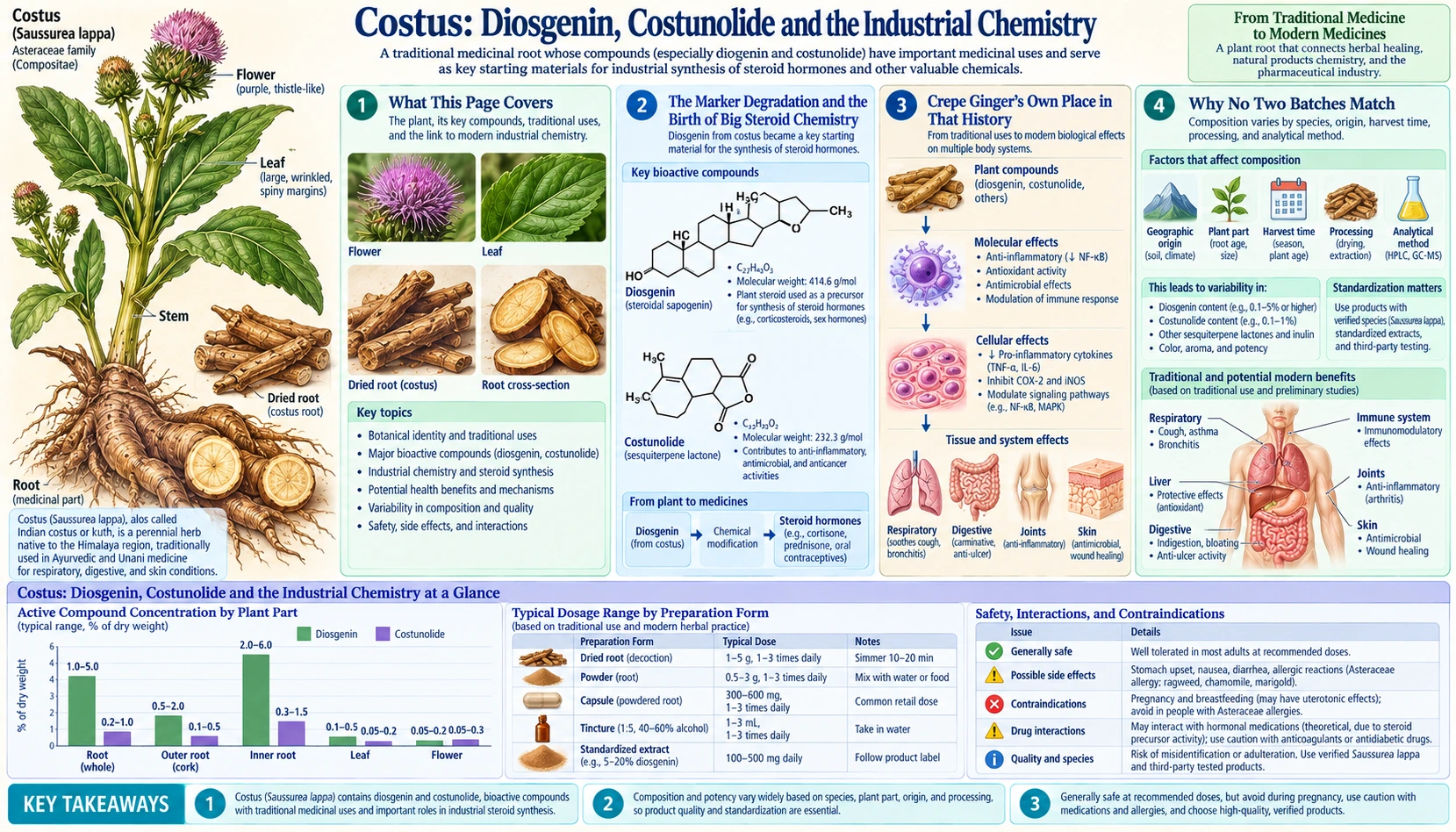
The main Costus page already does the essential work on diosgenin: it tells the Marker-degradation story, and it cites a randomised, placebo-controlled human trial in which applying a wild-yam (diosgenin-containing) cream did not raise progesterone in the blood or saliva. This page does not repeat that argument. It goes to the two places the main page has room for only in passing — the real depth of the industrial-chemistry history, including crepe ginger’s own overlooked place in it, and what isolated diosgenin and its rhizome-mate costunolide actually do to cells in a laboratory dish, which is a genuinely different question from what the plant does to a person who eats it.
Table of Contents
- What This Page Covers
- The Marker Degradation and the Birth of Big Steroid Chemistry
- Crepe Ginger’s Own Place in That History
- Why No Two Batches Match
- Two Chemistries in One Rhizome
- The Sesquiterpene-Lactone Allergy Question
- What Diosgenin and Costunolide Do to Cancer Cells in a Dish
- What the Cell-Culture Work Does Not Show
- Key Research Papers
- Connections
- Featured Videos
What This Page Covers
Two true things about diosgenin sit right next to each other and get confused constantly, and separating them cleanly is the entire point of this page:
- Diosgenin was a real industrial feedstock for synthesising steroid hormone drugs — progesterone, cortisone, and the first oral contraceptives. This is documented pharmaceutical history, not a supplement claim.
- Eating a diosgenin-containing plant does not make your body produce those hormones. The industrial conversion is a multi-step chemical synthesis requiring reagents no human enzyme possesses. This is settled, and the main Costus page already proves it with a human trial that measured serum and salivary progesterone directly and found no change after real-world topical wild-yam-cream use.
This page assumes you have read that argument and will not re-run it. What it adds: the Marker degradation in more mechanical detail, crepe ginger’s own specific and rarely mentioned role in the mid-century diosgenin supply story, why published diosgenin percentages are close to meaningless without a batch-specific certificate, a second, entirely different compound family the main page does not mention at all, and what diosgenin and its rhizome-mate costunolide have actually been shown to do — not to hormone levels, but to cancer cells in a dish.
The Marker Degradation and the Birth of Big Steroid Chemistry
Before 1940, steroid hormones for medical use came from animal sources at a scale that could never have supported mass treatment. Progesterone was extracted from thousands of pounds of animal ovaries to yield a few grams. Cortisone, when the Mayo Clinic first tested it against rheumatoid arthritis in 1948, was so scarce that the initial supply came from ox bile at a cost that made it a laboratory curiosity, not a medicine.
The chemist Russell Marker broke that bottleneck. Working at Pennsylvania State University in the late 1930s, he worked out a practical multi-step route — now called the Marker degradation — that converts the plant sapogenin diosgenin into progesterone: acetylation of the diosgenin molecule, oxidative degradation of its spiroketal side chain with chromic acid, and a controlled pyrolysis step that strips away the unwanted carbons, followed by further steps to reach the final hormone. None of this happens inside a cell. It requires reagents, controlled temperatures and organic solvents that exist in a chemistry laboratory, not in human metabolism.
Marker needed a cheap, abundant diosgenin source to make the route commercially viable, and he found it in wild Mexican yams — Dioscorea species known locally as cabeza de negro and barbasco. In 1944 he co-founded Syntex in Mexico City to exploit it, together with Emeric Somlo and Federico Lehmann, and the company began manufacturing progesterone. Marker himself left Syntex shortly afterwards, started another pharmaceutical company in Mexico, and later quit chemistry altogether. The price of progesterone fell by orders of magnitude within a few years. Cortisone became manufacturable at a scale that made rheumatoid arthritis treatment possible rather than theoretical. And on 15 October 1951, a Syntex team — Carl Djerassi, Luis Miramontes and George Rosenkranz — used diosgenin-derived intermediates to synthesise norethindrone, a potent progestin that works when swallowed. The first pill approved by the US Food and Drug Administration as a contraceptive (May 1960) used a closely related progestin, norethynodrel, made by Frank Colton at G. D. Searle in the United States; norethindrone and its derivatives soon became the most widely used progestins in oral contraceptives worldwide. A wild Mexican yam, converted through a chromic-acid pyrolysis nobody’s stomach can perform, is a real and direct ancestor of the modern birth-control pill. That fact is remarkable on its own terms and needs no supplement-marketing embellishment to be interesting.
Crepe Ginger’s Own Place in That History
The Mexican yam story is the one everyone tells. Crepe ginger’s own chapter is smaller but genuine, and the main page does not mention it at all.
Mexico’s wild yam supply was not available to every country that wanted to build a domestic steroid-hormone industry, and through the 1950s and 1960s a number of nations went looking for local diosgenin sources of their own. In 1970, Dasgupta and Pandey published “A new Indian source of diosgenin (Costus speciosus)” in Experientia, identifying crepe ginger’s rhizome as a viable domestic alternative. This was not an isolated curiosity: Panda’s 1980 histochemical survey of plants growing in the Darjeeling hills, and a run of Indonesian tissue-culture work through the 1990s by Indrayanto and colleagues, both treat Costus speciosus as a serious candidate diosgenin crop, worth studying for exactly the reason Marker studied Mexican yam — as domestic pharmaceutical raw material.
Nothing here changes the settled answer about eating the plant. It does correct a gap: crepe ginger’s role in this history is not “another plant that happens to share Mexican yam’s marketing story.” It is a separately documented, India-specific instance of the same industrial logic, verifiable back to a 1970 paper, not a piece of promotional folklore borrowed from the more famous case.
Why No Two Batches Match
The main page already refuses to state a diosgenin percentage for crepe ginger, and the chemistry literature explains exactly why that refusal is correct rather than merely cautious.
- Soil. Rawat and colleagues (2021) mapped how diosgenin content in Costus speciosus shifts across different soil types in the Indo-Gangetic plains — the same species, different fields, different numbers.
- Tissue and cultivation method. Indrayanto and colleagues (1994, 2001) found differential diosgenin accumulation between whole rhizomes and tissue-cultured material of the same plant, and went on to characterise the specific glucosylation steps a cell-suspension culture performs that a field-grown rhizome may not.
- Growth stage. Hundare and colleagues (2018) tracked diosgenin estimation against growth kinetics in callus cultures — content is not a fixed species property but a moving target across the plant’s development.
- Geography, going back further. Panda’s 1980 histochemical work in the Darjeeling hills was already documenting site-to-site variation within India, decades before the modern soil-chemistry literature formalised it.
Put together, these are not four studies quibbling over a decimal point. They are four independent demonstrations that diosgenin content is a function of where, how and when the plant was grown, and of which tissue was used — not a fixed constant of the species. A supplement label that states a diosgenin percentage without a batch-specific certificate of analysis is not simplifying the science. It is inventing a number the plant itself does not reliably produce twice.
Two Chemistries in One Rhizome
Here is a genuine addition to what the main page says about identifying this plant. The “costus problem” section there distinguishes crepe ginger from the CITES-protected Saussurea costus partly on chemistry: crepe ginger’s rhizome is described as dominated by steroidal saponins, while Saussurea’s signature constituents are the sesquiterpene lactones costunolide and dehydrocostus lactone. That distinction is correct as far as it goes, and it remains the right way to separate the two plants — family, CITES status, and the overall dominant chemistry all still point in different directions. But it understates crepe ginger’s own chemistry in one specific respect.
Costus speciosus rhizome contains sesquiterpene lactones too, costunolide among them — and they are not a trace contaminant or a mislabelled sample. Al-Attas and colleagues (2015), working specifically with Costus speciosus rhizomes, isolated eight compounds by repeated column chromatography and confirmed their structures by NMR and mass spectrometry: dehydrodihydrocostus lactone (mokko lactone), dehydrocostus lactone, arbusculin A, santamarine (douglanin), reynosin, a new eudesmane acid the authors named specioic acid, plus two sterols, 22,23-dihydrospinasterone and stigmasterol. Costunolide itself was not among them. Ibrahim and colleagues (2019) — a paper sharing several authors with the 2015 one, so not an independent group — reported the same six compounds (the five sesquiterpene lactones and specioic acid) from the rhizome and tested them against microbes: specioic acid stopped bacterial growth only at 150 to 550 µg/mL, depending on the bacterium. Costunolide itself was isolated from crepe ginger rhizome by Eliza and colleagues (2010), together with eremanthin, for the antidiabetic work covered on the blood sugar page, and again by Pitchai, Roy and Banu (2014) for breast-cancer cell work. No paper cited here measured how much costunolide the rhizome contains. This is replicated phytochemistry from at least two separate research groups, not a one-off contamination result.
What this means, precisely. Two unrelated plant families — Costaceae’s crepe ginger and Asteraceae’s Saussurea costus — both biosynthesise members of the sesquiterpene-lactone class, which occurs sporadically across many plant lineages rather than belonging exclusively to one. This is convergent chemistry, not shared identity, and it does not undermine the main page’s identification advice: crepe ginger’s dominant, defining constituent by weight is still the steroidal-saponin fraction, and Saussurea’s CITES status, its distinct family, and its very different traditional use profile (perfumery, incense, kuth/mu xiang) all remain real and separate grounds for telling the two apart. What the overlap does mean is that this rhizome is chemically richer, and carries one more class of biologically active compound, than the main page’s saponins-only framing currently suggests.
The Sesquiterpene-Lactone Allergy Question
Naming a new compound class in a plant means checking what that class is known to do, not just what this page’s citations say it does. Sesquiterpene lactones as a group are a well-documented cause of allergic contact dermatitis — the mechanism behind the long-known “Compositae dermatitis” seen in gardeners and florists handling chrysanthemums, ragweed and related plants, and the reason Saussurea costus root oil is a restricted fragrance ingredient. A 2025 case report (Marzario and colleagues), for instance, describes successful treatment of airborne allergic contact dermatitis to sesquiterpene lactones, confirmed by positive patch tests, in an adult who did not improve with avoiding the allergen or with steroid creams.
Applying that honestly here: a direct, species-locked PubMed search for allergy, dermatitis, sensitisation or a contact allergen specifically naming Costus speciosus or Cheilocostus speciosus returned zero records. That is a real search, run and checked, not an assumption. So the position the evidence supports is: plausible by chemical class, unquantified and unreported for this species specifically. Not a demonstrated hazard, and not something to wave away either — simply a gap nobody has looked into for a rhizome from which more than one research group has isolated members of a documented allergen class. For people with a known Compositae or sesquiterpene-lactone contact allergy who handle raw crepe ginger rhizome, this is a genuine, if untested, possibility.
What Diosgenin and Costunolide Do to Cancer Cells in a Dish
Separate from any hormone claim, diosgenin and costunolide isolated specifically from Costus speciosus have their own independent laboratory pharmacology, concentrated heavily in cancer cell-line work. This is a genuinely large and multi-group literature, worth walking through by compound and by cell line.
Diosgenin. Selim and Al Jaouni (2015) isolated diosgenin from Costus speciosus by HPTLC and reported anticancer, apoptotic and cell-proliferation-inhibiting effects. In numbers: the crepe-ginger diosgenin needed 32.62 µg/mL to halve the growth of liver-cancer (HepG2) cells and 11.03 µg/mL for breast-cancer (MCF-7) cells, while the cancer drug paclitaxel needed only 0.48 and 0.61 µg/mL in the same tests. At 250 µg/mL the same diosgenin made immune cells multiply — macrophages up to 3.2-fold and lymphocytes 2.1-fold compared with untreated cells. A follow-up 2016 paper from the same authors tested the same isolated diosgenin against lipopolysaccharide-stimulated RAW 264.7 macrophages and found it suppressed tumor necrosis factor-α release to a degree comparable with methotrexate, alongside antioxidant and antiangiogenic activity in the same assay panel.
Costunolide. Costunolide isolated from this plant has been tested against breast cancer cell lines in two papers from one research team (they share the author Roy). Pitchai, Roy and Banu (2014) tested it specifically against oestrogen-receptor-negative MDA-MB-231 cells — a deliberate choice that rules out any confusion with an oestrogen-mediated mechanism — and found dose-dependent cytotoxicity with no significant effect on normal breast cells (MCF-10A), via downregulation of NF-κB subunits at doses of 20 and 40 µM. Roy and Manikkam (2015) extended the work to both MCF-7 and MDA-MB-231 lines, finding an IC50 of 40 µM and cell-cycle arrest at G2/M. El-Far and colleagues (2021) tested costunolide (30 µM) and, separately, thymoquinone (50 µM; the active compound of Nigella sativa, black seed) against growing and doxorubicin-induced senescent colon and breast cancer cells, finding the senescent cells more sensitive to each compound than their growing counterparts. That paper calls costunolide “the active ingredient of Costus speciosus”, but its abstract does not say the costunolide tested was isolated from the plant.
Other cell lines, other extracts. Nair, Hettihewa and Rupasinghe (2014) tested methanol leaf extract against HepG2 liver cancer cells and reported reduced viability and induced apoptosis — explicitly the leaf, not the rhizome. Elkady (2019) tested hexane rhizome extract against PC-3 prostate cancer cells, reporting inhibited proliferation, migration and clonogenic potential, generation of reactive oxygen species, and cell-cycle arrest. Baskar and colleagues (2012), screening ten traditional Indian medicinal plants for antioxidant and antiproliferative activity against a colon cancer line, ranked Costus speciosus root third most potent of the ten — behind Asclepias curassavica and Cynodon dactylon, a result to report as “one of ten plants screened, ranked third,” not as a standalone anticancer finding.
Review-level synthesis. El-Far, Badria and Shaheen (2016) reviewed the plant’s active ingredients against known apoptotic pathways, and a 2025 comprehensive review by Al-Dhuayan and colleagues in Brazilian Journal of Biology summarised the cytotoxic evidence specifically against breast, ovarian and uterine cancer cell lines, alongside the plant’s antibacterial, anti-inflammatory and antidiabetic literatures.
One further compound is worth a precise mention. Bandara and colleagues identified methyl para-coumarate as the antifungal principle of crepe ginger rhizome in 1988 (covered on the antimicrobial page). A chemically identical compound, para-coumaric acid methyl ester, was separately tested for anti-angiogenic activity against endothelial cells and in a zebrafish tumour-xenograft model by Zhang and colleagues in 2018 — but that later paper cites crepe ginger only as the compound’s known botanical source in its background section, and does not state that the material it actually tested was extracted from this plant rather than obtained some other way. Reported here with that sourcing caveat attached.
What the Cell-Culture Work Does Not Show
Read the list above for volume and it looks impressive: eight or more independent papers, three named compounds, four different human cancer cell types. Read it for what it actually establishes and the picture changes considerably.
- Every single result above is in vitro — cells in a dish, or in one case a zebrafish embryo assay. None involves a mammalian tumour actually growing in a living animal, tracked over time, treated with an oral or injected dose, and measured for tumour volume. That is the next evidentiary step up from cell culture, and it has not been taken here.
- No study reports what concentration of diosgenin or costunolide is achievable in human blood or tumour tissue after any realistic oral intake — whole rhizome, tea, or standardised extract. The effective concentrations used in these dish experiments (costunolide at 20 and 40 µM in Pitchai’s study, an IC50 of 40 µM with cell-cycle arrest at G2/M in Roy’s, 30 µM in El-Far’s; diosgenin’s IC50 of 11.03–32.62 µg/mL in Selim’s) may be far higher than anything digestion and absorption would ever deliver to a tumour site, and nobody has measured the gap.
- Cytotoxicity against a cancer cell line in a dish is one of the least specific findings in preclinical pharmacology. A very large fraction of plant extracts and isolated plant compounds, tested at a high enough concentration against a cancer cell line, will kill some of those cells. That is true of table salt at a sufficiently punishing concentration. The value of a screening result like this lies almost entirely in whether it leads to the next step — mechanism, animal model, dose-finding — and for crepe ginger’s diosgenin and costunolide, that next step has not yet been taken by anyone.
- No human trial exists for any cancer indication, and none of the citations above claim otherwise.
The honest summary: crepe ginger contains at least two compounds, diosgenin and costunolide, with real laboratory evidence of cytotoxic activity against several human cancer cell lines, from more than one research group. That is a legitimate basis for further research. It is not a basis for using this plant, in any preparation, as a cancer treatment, and nothing in this literature suggests otherwise.
Key Research Papers
Every citation below was checked against the live PubMed record before being written onto this page, using a title/abstract-scoped, species-locked search to confirm the paper concerns this plant specifically.
- Dasgupta B, Pandey VB. A new Indian source of diosgenin (Costus speciosus). Experientia, 1970. — PubMed PMID: 5462855
- Panda PK, et al. Histochemical studies of Costus speciosus growing in Darjeeling hills in relation to diosgenin content. Indian Journal of Experimental Biology, 1980. — PubMed PMID: 7461758
- Indrayanto G, et al. Differential diosgenin accumulation in Costus speciosus and its tissue cultures. Planta Medica, 1994. — PubMed PMID: 7997486
- Rawat P, et al. Influence of Soil Variation on Diosgenin Content Profile in Costus speciosus from Indo-Gangetic Plains. Chemistry & Biodiversity, 2021. — PubMed PMID: 33837994
- Hundare A, et al. Growth kinetics and diosgenin estimation from callus cultures of Costus speciosus. Natural Product Research, 2018. — PubMed PMID: 29172707
- Al-Attas AA, El-Shaer NS, Mohamed GA, Ibrahim SR, Esmat A. Anti-inflammatory sesquiterpenes from Costus speciosus rhizomes. Journal of Ethnopharmacology, 2015. The isolation of dehydrocostus lactone, mokko lactone, arbusculin A, santamarine, reynosin and the new eudesmane acid specioic acid, directly from this plant’s rhizome (costunolide was not among the eight compounds). — PubMed PMID: 26593213
- Selim S, Al Jaouni S. Anticancer and apoptotic effects on cell proliferation of diosgenin isolated from Costus speciosus (Koen.) Sm. BMC Complementary and Alternative Medicine, 2015;15:301. — PubMed PMID: 26329920
- Selim S, Al Jaouni S. Anti-inflammatory, antioxidant and antiangiogenic activities of diosgenin isolated from traditional medicinal plant, Costus speciosus (Koen ex. Retz.) Sm. Natural Product Research, 2016. — PubMed PMID: 26222585
- Pitchai D, Roy A, Banu S. In vitro and in silico evaluation of NF-κB targeted costunolide action on estrogen receptor-negative breast cancer cells. Phytotherapy Research, 2014. — PubMed PMID: 24733523
- Roy A, Manikkam R. Cytotoxic Impact of Costunolide Isolated from Costus speciosus on Breast Cancer via Differential Regulation of Cell Cycle. Phytotherapy Research, 2015. — PubMed PMID: 26178525
- Nair SV, Hettihewa M, Rupasinghe HPV. Apoptotic and inhibitory effects on cell proliferation of hepatocellular carcinoma HepG2 cells by methanol leaf extract of Costus speciosus. BioMed Research International, 2014. — PubMed PMID: 24818148
- Elkady AI. Targeting prostate cancer cell proliferation, stemness and metastatic potential using Costus speciosus derived phytochemicals. American Journal of Translational Research, 2019. — PubMed PMID: 31105862
- El-Far AH, Badria FA, Shaheen HM. Possible Anticancer Mechanisms of Some Costus speciosus Active Ingredients Concerning Drug Discovery. Current Drug Discovery Technologies, 2016. — PubMed PMID: 27515456
- El-Far AH, et al. Thymoquinone and Costunolide Induce Apoptosis of Both Proliferative and Doxorubicin-Induced-Senescent Colon and Breast Cancer Cells. Integrative Cancer Therapies, 2021. — PubMed PMID: 34490824
- Al-Dhuayan IS, et al. Exploring the anticancer potential of Costus speciosus: a comprehensive review. Brazilian Journal of Biology, 2025. — PubMed PMID: 40435094
- Baskar AA, Al Numair KS, Alsaif MA, Ignacimuthu S. In vitro antioxidant and antiproliferative potential of medicinal plants used in traditional Indian medicine to treat cancer. Redox Report, 2012. Ten-plant screen; Costus speciosus root ranked third. — PubMed PMID: 22776996
- Zhang HZ, et al. Anti-angiogenic activity of para-coumaric acid methyl ester on HUVECs in vitro and zebrafish in vivo. Phytomedicine, 2018. Sourcing of the tested compound not stated as this plant specifically; read with that caveat. — PubMed PMID: 30195867
- Marzario B, Cino D, Colantonio S. Successful treatment of airborne allergic dermatitis to sesquiterpene lactone with upadacitinib: a case report. SAGE Open Medical Case Reports, 2025. Sesquiterpene lactones as a documented contact-allergen class. — PubMed PMID: 40421285
- Indrayanto G, Zumaroh S, Syahrani A, Wilkins AL. C-27 and C-3 glucosylation of diosgenin by cell suspension cultures of Costus speciosus. Journal of Asian Natural Products Research, 2001. — PubMed PMID: 11407817
- Eliza J, Daisy P, Ignacimuthu S. Antioxidant activity of costunolide and eremanthin isolated from Costus speciosus (Koen ex. Retz) Sm. Chemico-Biological Interactions, 2010. — PubMed PMID: 20709041
- Ibrahim SRM, Ahmed El-Shaer NSA, Asfour HZ, Elshali KZ, Awad Shaaban MI, Al-Attas AAM, Allah Mohamed GA. Antimicrobial, antiquorum sensing, and antiproliferative activities of sesquiterpenes from Costus speciosus rhizomes. Pakistan Journal of Pharmaceutical Sciences, 2019. Same research team as Al-Attas 2015. — PubMed PMID: 30772798
- Bandara BM, Hewage CM, Karunaratne V, Adikaram NK. Methyl ester of para-coumaric acid: antifungal principle of the rhizome of Costus speciosus. Planta Medica, 1988. — PubMed PMID: 3200938
- Seeman JI. Russell Earl Marker and the Beginning of the Steroidal Pharmaceutical Industry. Chemical Record, 2023. Marker’s biography, Syntex’s founding and his departure. — PubMed PMID: 36995067
- Larrea F, Morales-Esponda M, Chirinos M, Díaz-Sánchez V. The origins of oral contraception: the role of Mexican scientists in developing the first synthetic oral contraceptive progestin. Revista de Investigación Clínica, 2025. — PubMed PMID: 41330040
- Colton FB. Steroids and “the pill”: early steroid research at Searle. Steroids, 1992. The 1960 approval of the norethynodrel-mestranol pill. — PubMed PMID: 1481226
- Komesaroff PA, Black CV, Cable V, Sudhir K. Effects of wild yam extract on menopausal symptoms, lipids and sex hormones in healthy menopausal women. Climacteric, 2001. The randomised, placebo-controlled cross-over trial (23 women, a wild-yam cream applied to the skin) that found no change in serum or salivary progesterone, in full on the main page. — PubMed PMID: 11428178
Connections
- All Herbs
- Costus Benefits Hub
- Blood Sugar: The Real Human Evidence — costunolide and eremanthin’s antidiabetic work.
- Anti-Inflammatory and Analgesic Evidence — the same sesquiterpene lactones’ anti-inflammatory activity.
- Antimicrobial and Antiviral Evidence — costunolide’s antifungal MIC data.
- Costus (Cheilocostus speciosus) — the main page, with the four-plant naming problem and the full hormone-myth refutation.
- Fenugreek — another major dietary diosgenin source carrying the identical hormone-precursor myth.
- Oncology — treatments with actual human trial evidence behind them.
- Contact Dermatitis — the mechanism behind the sesquiterpene-lactone allergy question.
- Menopause — the condition the wild-yam-cream trial actually tested.