Bitter Melon Safety: Seeds, Favism, Pregnancy and Medications
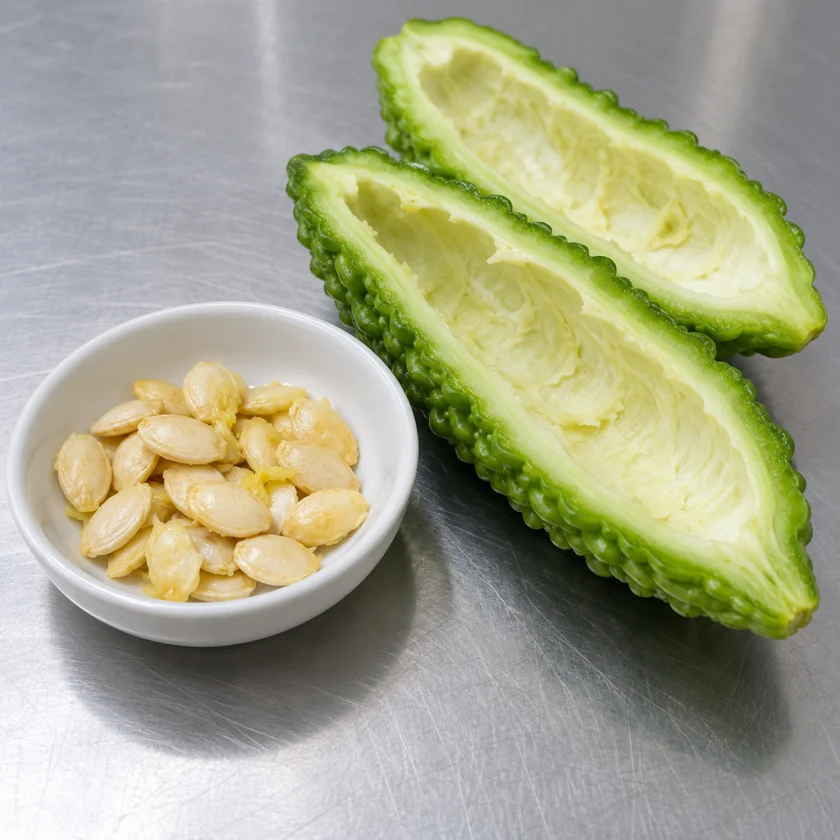
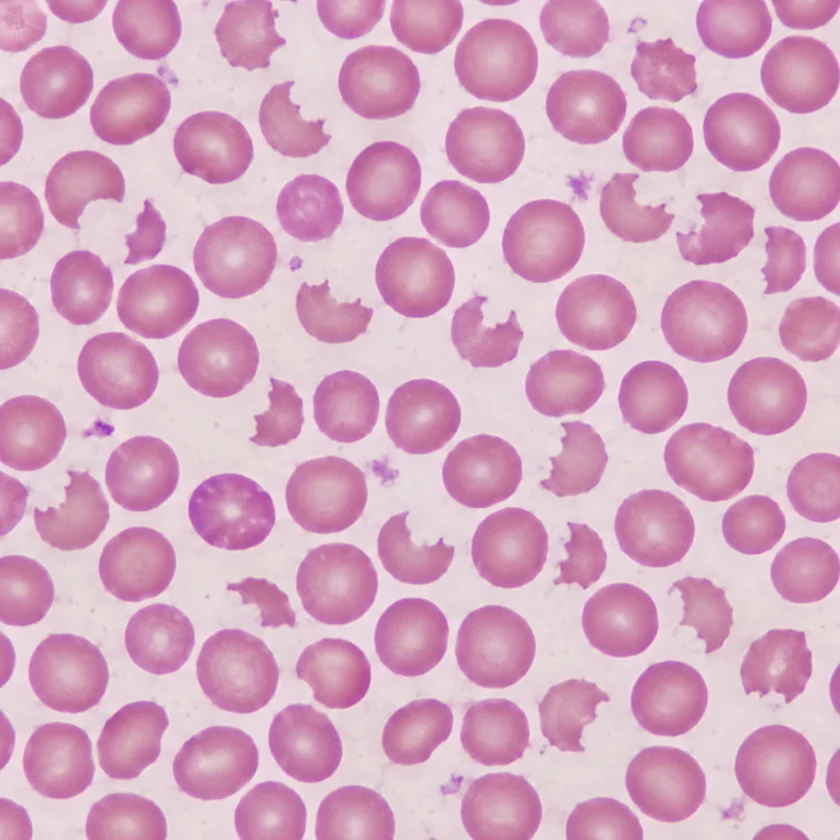
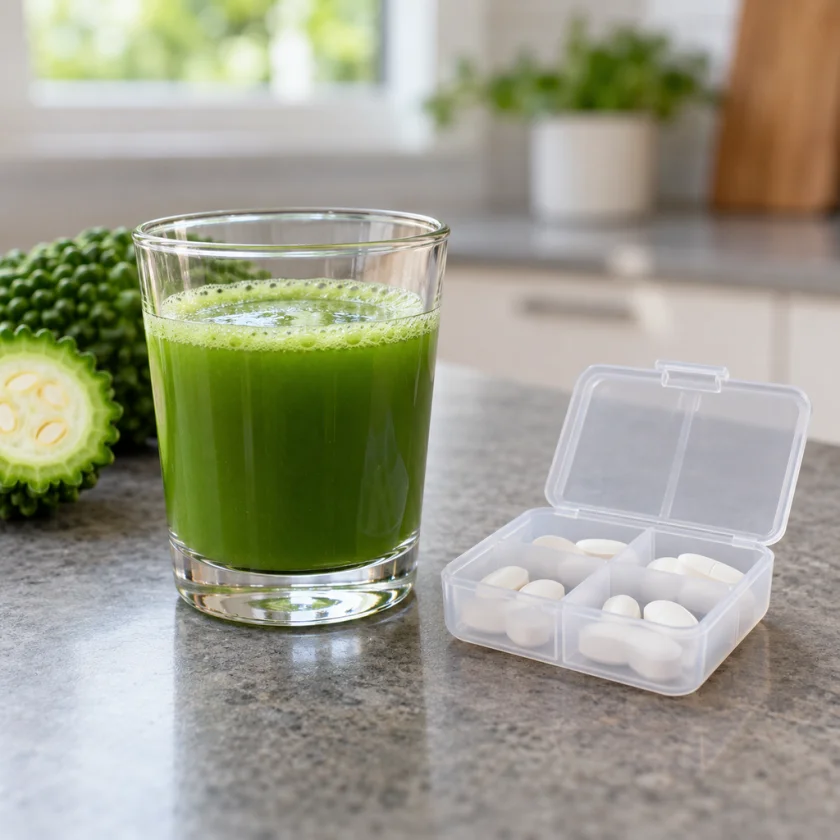
Bitter melon (Momordica charantia) is an everyday vegetable across Asia, Africa and the Caribbean, and most of the people in its clinical trials reported no serious problems. The safety questions that the research does raise are narrow and specific: an added blood-sugar drop for people already on glucose-lowering medicines, a documented episode in two young children, a red-blood-cell reaction in people with an inherited enzyme deficiency, and animal findings on pregnancy and fertility that trace back largely to proteins in the seeds. This page sets out each one, who it concerns, and what kind of evidence stands behind it — a human case, an animal experiment, or a reviewer's summary — and checks the safety section of a recent video against those sources.
Table of Contents
- What the Video Says About Safety
- Glucose-Lowering Medicines: an Additive Effect
- The Documented Case in Two Children
- G6PD Deficiency and Favism
- Pregnancy and Fertility in Animal Studies
- The Seeds: Lectin, Vicine and Momorcharins
- The Red Seed Aril Claim
- Liver Enzyme Findings
- Allergy, Headache and Digestive Upset
- The Unripe-Fruit Juice Record
- Safety Findings at a Glance
- Where This Page Corrects the Video
- Key Research Papers
- Connections
- Featured Videos
What the Video Says About Safety
Near the end of the episode the presenter turns from benefits to cautions. In summary, the video describes bitter melon as generally well tolerated, with some people reporting bloating, diarrhea or nausea. It then names four groups it considers at higher risk:
- people taking blood-sugar medicines or insulin, because the food and the drug together could push glucose too low;
- pregnant people, with the video stating that animal studies suggest the plant may trigger uterine contractions;
- children, in connection with the red, fleshy coating around the seeds of a ripe fruit, which the video calls “toxic, especially for kids”;
- people with G6PD deficiency, because of a seed compound the video names as vicine, which it links to acute breakdown of red blood cells.
Earlier in the episode, the same compound, vicine, is presented as one of the substances associated with insulin release from the pancreas. The sections below take each of these points to the published reviews and studies and report what they actually describe.
Glucose-Lowering Medicines: an Additive Effect
The interaction concern is the most practical one on this page, and it follows directly from the reason people take bitter melon in the first place. A 2003 safety and efficacy review in a hospital-pharmacy journal (Basch, Gabardi and Ulbricht) concluded that bitter melon may have an additive effect when combined with other glucose-lowering agents. In plain terms: if a medicine already lowers blood sugar and the plant lowers it a little further, the two effects can stack.
How large that extra drop is in practice is not well measured. The pooled trials show modest average effects — one 2024 meta-analysis of eight trials in people with type 2 diabetes found fasting glucose about 0.85 mmol/L lower, while a 2023 meta-analysis of nine placebo-controlled trials found no reliable change at all (see the clinical trials page). But averages say little about an individual, and preparations vary widely in strength. The same 2003 review judged the available data insufficient to support use of the plant without careful supervision and monitoring.
The research therefore raises the concern chiefly for people using insulin or medicines that can themselves cause low blood sugar, where an unplanned additional drop carries the most risk. Decisions about combining a supplement with diabetes treatment belong with the clinician who manages that treatment.
The Documented Case in Two Children
The clearest human harm in the reviewed literature involves children, but not the seed coating. A 2019 review by Bortolotti, Mercatelli and Polito, citing an earlier report by Raman and Lau (1996), describes two small children who developed convulsions and then fell into a hypoglycemic coma one to two hours after drinking a bitter-melon beverage on an empty stomach. The 2003 Basch review likewise lists hypoglycemic coma and convulsions in children among the reported adverse effects.
The mechanism in that report is the plant's blood-sugar effect itself. A small body has small glycogen reserves, and a child who has not eaten has little stored glucose to fall back on, so a preparation that lowers glucose modestly in an adult with diabetes can drop a fasting child's blood sugar to the point of seizure. This is a case report, not a trial, and the number of documented children is small; but it is the strongest pediatric evidence in the sources this page relies on, and it points to a hot drink or tea rather than to any one part of the fruit.
G6PD Deficiency and Favism
What G6PD deficiency is. Glucose-6-phosphate dehydrogenase (G6PD) is an enzyme that red blood cells rely on to protect themselves from oxidative damage. Some people inherit a gene variant that leaves them with too little working enzyme. Most of the time they feel entirely well and may not know they have it. The problem appears when they meet a strong oxidative trigger — certain medicines, some infections, or certain foods. Their red blood cells cannot defend themselves, and large numbers burst at once. That sudden destruction of red cells is called hemolysis, and it can cause fatigue, pale or yellowish skin, dark urine and, in severe episodes, a medical emergency. The gene sits on the X chromosome, so the deficiency shows up more often in males.
What favism is. Favism is the name for a hemolytic episode triggered by eating fava (broad) beans, which contain the compounds vicine and convicine. It is the reaction, not the underlying deficiency.
The bitter melon link. Bitter melon seeds contain vicine too. A 2022 review by Çiçek states that the vicine in the seeds causes favism in people with G6PD deficiency, citing a 1960s report. The 2019 Bortolotti review states that G6PD-deficient people can develop favism from the plant, and the 2003 Basch review lists a favism-like syndrome among reported adverse effects. The concern therefore centres on the seeds and on preparations made from them, and applies to people who carry the deficiency. For them, the research describes a well-understood chemical trigger, not a vague sensitivity.
Pregnancy and Fertility in Animal Studies
All of the pregnancy and fertility findings in these sources come from animals. No controlled human study of bitter melon in pregnancy appears in them. What the animal work describes, precisely:
- Pregnancy loss from seed proteins. A 2017 review by Jia and colleagues reports that alpha-momorcharin, a protein from the seeds, terminated early pregnancy in mice by inhibiting development of the very early embryo (the morula stage), and that beta-momorcharin affected embryo implantation.
- Uterine bleeding. The 2022 Çiçek review reports uterine bleeding in pregnant rats and rabbits given fresh fruit juice at about 6 mL per kilogram of body weight.
- Hormone activity. Çiçek also reports estrogenic activity for four of the plant's triterpenoids, and Jia reports that water extracts of the leaves lowered progesterone and estrogen in rats.
- Fertility. The 2003 Basch review lists reduced fertility in mice; the 2019 Bortolotti review describes strongly reduced fertility in animal models and abortive properties of proteins from the plant's extracts.
What the reviewers conclude. Çiçek's position, in the author's own words, is that bitter melon preparations “should be omitted during pregnancy.” Bortolotti and colleagues treat the fertility and abortive findings as reasons for caution. These are the reviewers' stated positions, based on animal data; the strength of the caution comes from the seriousness of the possible outcome, not from human trial evidence, which does not exist.
The Seeds: Lectin, Vicine and Momorcharins
Across these hazards one part of the plant keeps recurring. The seeds carry three separate classes of concern:
- A lectin. Çiçek describes a mildly toxic lectin — a carbohydrate-binding protein — in the seeds and also in the rind.
- Vicine. The favism trigger described above.
- Momorcharins. Alpha- and beta-momorcharin are ribosome-inactivating proteins: they can shut down the protein-making machinery of cells. They are the seed proteins behind the mouse pregnancy findings.
Çiçek notes that seed decoctions are regarded with caution for these reasons. By contrast, the unripe fruit flesh — the green vegetable that is sliced, stir-fried and juiced — is the part with the longest record of eating and the fewest reported problems (see below). Where a preparation comes from matters: a whole-fruit powder, a seed extract and a cooked vegetable are not the same exposure.
The Red Seed Aril Claim
As the fruit ripens, it turns yellow-orange, splits, and reveals seeds wrapped in a bright red, fleshy coating called the aril. The video says this coating is toxic, especially for children, and can cause vomiting, diarrhea and more serious reactions.
Here is what can and cannot be stated from the reviews and studies behind this page:
- Not found: none of these sources documents poisoning from the red aril itself. No primary report of aril toxicity in children was located for this page. The claim circulates in secondary and popular literature, but its original source could not be verified.
- Documented: the pediatric harm that is on record — convulsions and hypoglycemic coma — followed a bitter-melon beverage taken on an empty stomach. It is a blood-sugar effect, not aril poisoning.
- Documented: the seeds that the aril surrounds are where vicine, the lectin and the momorcharins are found.
So the aril claim is not shown to be false; it is unverified. The well-documented concerns attach to the seeds and to concentrated or fasting-state blood-sugar exposure.
Liver Enzyme Findings
Liver results point in two directions, and both are worth stating:
- In animals: the 2003 Basch review reports raised gamma-glutamyl transferase (GGT) and alkaline phosphatase (ALP) — two enzymes doctors use as liver markers — in animals given the plant. Bortolotti and colleagues describe rises in transaminases (another family of liver enzymes) in animals without accompanying tissue damage on examination, and on that basis advise caution in people with liver disease.
- In people: the 2023 meta-analysis by Laczkó-Zöld and colleagues, pooling randomized trials against placebo, found no change in the liver enzymes ALT and AST, and no change in creatinine (a kidney marker). Those trials ran only 4 to 16 weeks.
The human trial data therefore do not show a liver signal over a few months of use; the animal data show enzyme changes whose meaning is unclear; and nothing in these sources addresses long-term use in people who already have liver disease.
Allergy, Headache and Digestive Upset
Allergy. Bitter melon belongs to the gourd family (Cucurbitaceae), alongside cucumber, melon, squash and pumpkin. Bortolotti and colleagues list allergy to plants in this family as a reason for caution, since cross-reactions within a botanical family are possible.
Headache. The 2003 Basch review lists headaches among the reported adverse effects.
Digestive upset. The video mentions bloating, diarrhea and nausea in some people. The reviews used on this page do not quantify how often they occur. The 2019 meta-analysis by Peter and colleagues, covering ten studies and more than a thousand participants, reported no serious adverse effects.
The Unripe-Fruit Juice Record
Balancing the hazards, Çiçek's 2022 review states that for juice of the unripe fruit, no serious adverse events have been reported. Together with the Peter 2019 finding of no serious adverse effects across trials, and the Laczkó-Zöld 2023 finding of no liver or kidney marker changes against placebo, the human record for the green fruit and its standard trial preparations is reassuring for most adults over the short periods studied.
That record has limits. Most trials lasted weeks to a few months, they enrolled mainly adults with type 2 diabetes or prediabetes, and they generally excluded pregnant women and children. The absence of reported harm in those groups reflects the absence of study, not evidence of safety.
Safety Findings at a Glance
| Hazard | Who it concerns | Evidence type | Source |
|---|---|---|---|
| Additive glucose lowering | People on insulin or glucose-lowering medicines | Review | Basch 2003 |
| Convulsions, hypoglycemic coma | Young children, beverage on an empty stomach | Human case report (in reviews) | Bortolotti 2019 citing Raman & Lau 1996; Basch 2003 |
| Favism (hemolysis) from seed vicine | People with G6PD deficiency | Review, citing human reports | Çiçek 2022; Bortolotti 2019; Basch 2003 |
| Early pregnancy loss, impaired implantation | Pregnancy | Animal (mice) | Jia 2017 |
| Uterine bleeding | Pregnancy | Animal (rats, rabbits) | Çiçek 2022 |
| Reduced fertility | People trying to conceive | Animal | Basch 2003; Bortolotti 2019 |
| Seed lectin | Anyone eating seeds or seed preparations | Review | Çiçek 2022 |
| Raised GGT, ALP, transaminases | People with liver disease | Animal | Basch 2003; Bortolotti 2019 |
| No ALT/AST/creatinine change vs placebo | Trial adults, 4–16 weeks | Meta-analysis of human RCTs | Laczkó-Zöld 2023 |
| Allergic cross-reaction | People allergic to gourd-family plants | Review | Bortolotti 2019 |
| Bloating, diarrhea, nausea; headache | Some users | Video statement; review | Source video; Basch 2003 |
| Red seed aril toxicity | Children (as claimed) | Unverified | No primary source located |
| No serious adverse events | Unripe-fruit juice; trial participants | Review; meta-analysis | Çiçek 2022; Peter 2019 |
Where This Page Corrects the Video
The video's safety section is broadly in line with the reviews. The points below sharpen or qualify it; none is an outright factual error.
Simplifications and unsupported points
- Vicine and insulin secretion. The video groups vicine with compounds associated with insulin release. Evidence for that role is weak. Vicine's well-established, documented role is as the favism trigger in people with G6PD deficiency.
- The red aril. The video calls the aril “toxic, especially for kids.” No primary source for aril poisoning was found for this page. The documented harm in children is convulsions and hypoglycemic coma after a bitter-melon beverage on an empty stomach (Bortolotti 2019, citing Raman & Lau 1996) — a blood-sugar effect. The seeds, not the aril, carry vicine, a lectin and the momorcharins.
- “Uterine contractions” in pregnancy. The animal findings in these reviews are more specific: uterine bleeding in pregnant rats and rabbits (Çiçek 2022) and termination of early pregnancy in mice by the seed proteins alpha- and beta-momorcharin (Jia 2017), plus reduced fertility in animals.
- G6PD deficiency “sometimes called favism.” Favism is the hemolytic reaction a trigger provokes in someone with the deficiency; the deficiency itself is the inherited enzyme shortfall.
Consistent with the evidence
- Medications. The video's warning about combining bitter melon with blood-sugar medicines or insulin matches the 2003 Basch review, which describes a possible additive effect with other glucose-lowering agents and judged the data insufficient for use without careful supervision and monitoring.
Key Research Papers
- Basch E, Gabardi S, Ulbricht C. Bitter melon (Momordica charantia): a review of efficacy and safety. Am J Health Syst Pharm. 2003;60(4):356-359. PMID: 12625217
- Çiçek SS. Momordica charantia L.—diabetes-related bioactivities, quality control, and safety considerations. Front Pharmacol. 2022;13:904643. PMID: 35656300
- Bortolotti M, Mercatelli D, Polito L. Momordica charantia, a nutraceutical approach for inflammatory related diseases. Front Pharmacol. 2019;10:486. PMID: 31139079
- Jia S, Shen M, Zhang F, Xie J. Recent advances in Momordica charantia: functional components and biological activities. Int J Mol Sci. 2017;18(12):2555. PMID: 29182587
- Laczkó-Zöld E, Csupor-Löffler B, Kolcsár EB, Ferenci T, Nan M, Tóth B, Csupor D. The metabolic effect of Momordica charantia cannot be determined based on the available clinical evidence: a systematic review and meta-analysis of randomized clinical trials. Front Nutr. 2023;10:1200801. PMID: 38274207
- Peter EL, Kasali FM, Deyno S, et al. Momordica charantia L. lowers elevated glycaemia in type 2 diabetes mellitus patients: systematic review and meta-analysis. J Ethnopharmacol. 2019;231:311-324. PMID: 30385422
- Zhang X, Zhao Y, Song Y, Miao M. Effects of Momordica charantia L. supplementation on glycemic control and lipid profile in type 2 diabetes mellitus patients: a systematic review and meta-analysis of randomized controlled trials. Heliyon. 2024;10(10):e31126. PMID: 38784554