Bitter Melon Clinical Trials: Why the Meta-Analyses Disagree
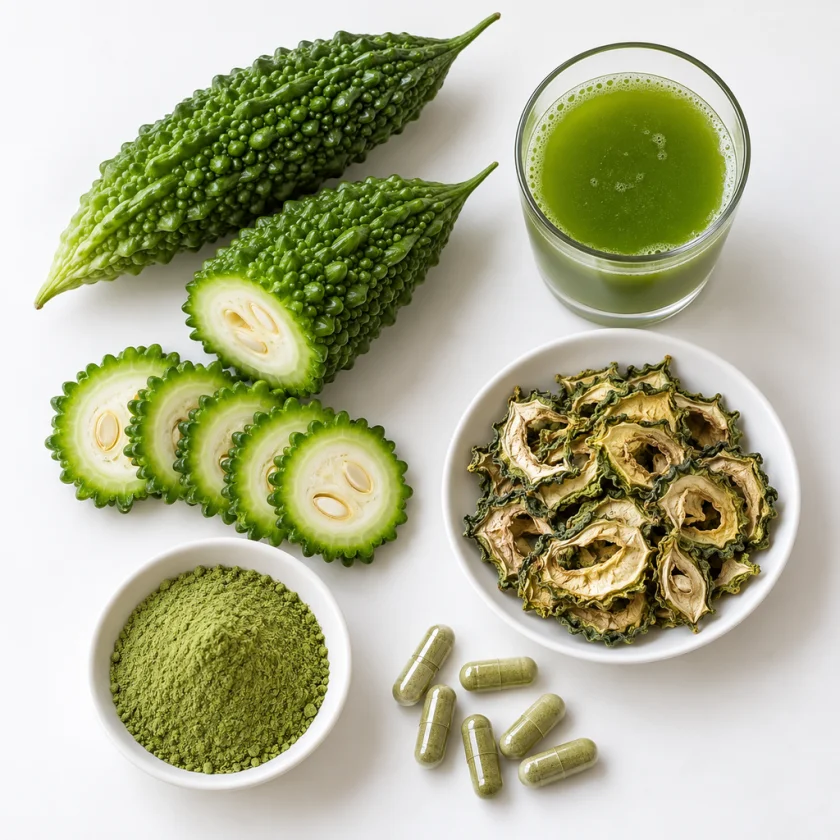
Two systematic reviews of the same plant, published a few months apart, reached opposite-sounding conclusions. A 2024 meta-analysis in Heliyon reported that bitter melon (Momordica charantia) lowered fasting glucose, post-meal glucose and HbA1c in people with type 2 diabetes. A meta-analysis in Frontiers in Nutrition (volume dated 2023) put it in its title that the metabolic effect of bitter melon “cannot be determined” from the clinical evidence. Two older reviews — a 2019 meta-analysis and a 2012 Cochrane review — sit on either side of that split. This page sets the four reviews next to each other, explains the specific choices that pushed them apart, describes four of the individual trials underneath them, and puts the headline HbA1c figure into plain numbers.
Table of Contents
- One Video, Two Meta-Analyses
- The Four Reviews Side by Side
- Who Was Studied
- End Values Versus Change Scores
- Heterogeneity: Trials That Disagree With Each Other
- Preparations, Doses and Durations
- Small Trials and Risk of Bias
- Four Individual Trials
- What a 0.38-Point HbA1c Change Means
- What the Trials Reported on Safety
- Where the Evidence Stands
- Where This Page Corrects the Video
- Key Research Papers
- Connections
- Featured Videos
One Video, Two Meta-Analyses
The video builds its blood-sugar segment around a contrast. It first presents the 2024 Heliyon meta-analysis and its four statistically significant results: lower fasting glucose, lower post-meal glucose, lower HbA1c and lower total cholesterol. It then turns to “the other side of the story”: the Frontiers in Nutrition meta-analysis of nine randomized trials, whose authors judged the evidence too weak, the trials too small and the results too inconsistent to say what bitter melon does to metabolism.
The presenter attributes the gap to the variety of products tested — whole-fruit powders, extracts and peptide preparations — and to doses running from about 0.6 to 6 grams a day over 4 to 16 weeks, and closes the segment by describing the effects as mild and the conclusions as inconsistent. That outline matches the published papers. What the video leaves out is that the two reviews also made different choices about whom to include and how to calculate the effect — choices that by themselves can turn a modest positive result into a null one. Those choices are the subject of most of this page.
The Four Reviews Side by Side
The table below lists the pooled results each review reported for fasting blood glucose (FBG) and HbA1c, compared with a control group. Glucose figures are in millimoles per litre; multiplying by about 18 converts them to milligrams per decilitre (so 0.85 mmol/L is roughly 15 mg/dL). The figures in brackets are 95% confidence intervals.
| Review | Trials | Participants | Population | FBG | HbA1c | Conclusion |
|---|---|---|---|---|---|---|
| Zhang et al. 2024, Heliyon | 8 RCTs | 423 | Diagnosed type 2 diabetes | −0.85 mmol/L (−1.44 to −0.26); I² 73.4% | −0.38 points (−0.53 to −0.23); I² 37.6% | Significant falls in FBG, post-meal glucose, HbA1c and total cholesterol; no significant change in LDL, HDL or triglycerides; more high-quality studies needed |
| Laczkó-Zöld et al. 2023, Front Nutr | 9 RCTs | 414 | Metabolic-syndrome outcomes; not limited to diagnosed diabetes | −0.03 (−0.38 to 0.31); I² 34% | −0.12 (−0.35 to 0.11); I² 56% | No significant effect on any glucose, lipid, weight or blood-pressure outcome; low power, trials too short; effect “cannot be determined” |
| Peter et al. 2019, J Ethnopharmacol | 10 studies | 1,045 | Type 2 diabetes (one further prediabetes trial reported separately) | −0.72 mmol/L (−1.33 to −0.12) vs placebo; I² 14% | −0.26 points (−0.49 to −0.03) vs placebo; I² 0% | Improved glycaemic control, but based on low to very low quality evidence with moderate to high risk of bias |
| Ooi et al. 2012, Cochrane | 4 RCTs | 479 | Type 2 diabetes | Not pooled | Not pooled | No meta-analysis possible because no preparation was tested twice; no significant difference from placebo, metformin or glibenclamide; insufficient evidence |
Read across the HbA1c column and the pattern is clear: the 2024 review's estimate is the largest, the 2019 review's is smaller but still statistically significant, and the 2023 review's confidence interval runs from a small fall to a small rise. None of the four found an effect large enough to settle the question, and every one of them closed by calling for larger, better-designed trials.
Who Was Studied
The single biggest difference between the positive and the null reviews is the people in them. The Heliyon review restricted itself to trials in patients with diagnosed type 2 diabetes. The Frontiers review was framed around metabolic syndrome — body weight, blood pressure, lipids and glucose together — and pooled trials across that wider group rather than limiting itself to people with diabetes.
That matters because a glucose-lowering effect, if there is one, has the most room to show up where glucose is highest. The individual trials point the same way. The 2018 Tanzanian crossover trial in people with prediabetes reported that participants with higher starting glucose showed the larger fall, and that not everyone responded. When a review mixes people whose fasting glucose is already near normal with people whose glucose is well above it, a real effect in the second group can be diluted by the absence of change in the first.
The reverse caution also applies. A result in diagnosed type 2 diabetes does not automatically carry over to people who simply want to keep their blood sugar in check, or to people with normal glucose. Each population is a separate research question.
End Values Versus Change Scores
A meta-analysis has to decide what number it pools from each trial. There are two common choices:
- End values — compare the bitter melon group with the control group at the end of the trial. The 2019 review states that it estimated the effect as the mean difference at follow-up.
- Change scores — compare how much each group changed from its own starting point. The Frontiers review states that its main analysis was a meta-analysis of change scores.
In a large, well-randomized trial the two approaches give nearly the same answer, because both groups start in the same place. In small trials of 20 to 50 people per arm they can diverge. If the bitter melon group happened to start with lower glucose than the placebo group, an end-value comparison credits that head start to the treatment; a change-score comparison does not. Many of the bitter melon trials are small enough for such chance imbalances to occur, which is one reason the two methods can move a pooled estimate toward or away from zero.
The Heliyon abstract reports weighted mean differences without saying which of the two approaches it used, and its authors applied the Hartung-Knapp adjustment, a conservative method that widens confidence intervals; they report that their results stayed significant after it. Neither method is wrong. They answer slightly different questions, and with trials this small the choice is enough to change the headline.
Heterogeneity: Trials That Disagree With Each Other
Heterogeneity describes how much the individual trials in a meta-analysis disagree with one another beyond what chance would explain. It is usually reported as I², a percentage: near 0% means the trials tell a consistent story; above roughly 50% is generally read as substantial disagreement; above 75% as considerable.
The bitter melon reviews cover the full range:
- In the Heliyon review, the fasting glucose result carried an I² of 73.4%, post-meal glucose 66.9% and total cholesterol 63.6%. Only HbA1c was moderate, at 37.6%. A pooled average of trials this inconsistent tells less about what any one product does than the single figure suggests.
- In the Frontiers review, the glucose and HbA1c results were moderately heterogeneous (34% and 56%), while body weight reached 97% — the trials were essentially measuring different things.
- The 2019 review reported low heterogeneity for its placebo comparisons (14% for fasting glucose and 0% for HbA1c), but rated the underlying trials at moderate to high risk of bias, so consistency there does not translate into confidence.
High heterogeneity is a signal that something about the trials — the product, the dose, the people, the length of follow-up or the trial quality — differs enough to change the result. The next two sections cover the most likely sources.
Preparations, Doses and Durations
“Bitter melon” in these trials is not one thing. Participants received dried whole-fruit powder, fruit-pulp capsules, water or alcohol extracts, juice, and in some studies preparations made from other parts of the plant. The 2012 Cochrane review found this so limiting that it declined to pool the trials at all: among the four trials it included, no single preparation had been tested twice, so combining them would have meant averaging different products. Its authors named standardization and quality control of preparations as the first problem for future research.
Doses varied roughly tenfold, from about 0.6 grams to 6 grams a day, and treatment lasted from 4 to 16 weeks. Both the Frontiers and the 2019 reviews report that 4-to-16-week span. Sixteen weeks is at the outer edge of what an HbA1c test can capture, and four weeks is too short for HbA1c to reflect a change fully, since the test integrates blood glucose over roughly the lifespan of a red blood cell (about three months). The Frontiers authors state that the trials were too short to detect long-term metabolic effects reliably.
A separate meta-analysis of bitter melon and blood lipids (Amini 2024) found its clearest cholesterol results in the subgroup of trials using 2,000 mg a day or less for 8 weeks or less — a reminder that within such a small evidence base, a higher dose or a longer trial does not reliably produce a larger effect. That review is covered on the cholesterol page linked below.
Small Trials and Risk of Bias
All four reviews flag trial quality. The Cochrane review rated the risk of bias in its four trials as generally high and noted that only two of them had been published as full peer-reviewed papers. The 2019 review graded its primary outcomes as low to very low quality evidence and specifically called for trials with proper random sequence generation, concealed allocation and blinding of both participants and researchers. The Frontiers review described the overall statistical power as low. The Heliyon review used the GRADE system to rate certainty and its authors likewise concluded that further high-quality studies are needed to validate their results.
Small trials with design weaknesses tend, as a group, to overstate treatment effects — positive small studies are more likely to be published, and unblinded assessment can tilt results. That does not mean the positive findings are wrong. It means the size of the effect is uncertain in both directions, and that a single large, well-blinded trial of a standardized preparation would carry more weight than any of the current pooled estimates.
Four Individual Trials
The pooled numbers are built from trials like these. Each summary below comes from the trial's published abstract.
Dans et al. 2007 — the Philippines
Forty adults with newly diagnosed or poorly controlled type 2 diabetes (HbA1c between 7% and 9%) took bitter melon capsules or placebo three times a day after meals for three months, on top of their standard treatment, in a double-blind design. The difference in HbA1c change between groups was 0.22 points in favour of bitter melon, with a confidence interval that ran from a fall of 0.40 to a rise of 0.84 — not statistically significant. Fasting glucose, cholesterol, weight, kidney and liver markers did not differ. The investigators had designed the trial to detect a 1-point fall in HbA1c; with the small change actually observed, they calculated their trial's power at only 11% and stated that no firm conclusion could be drawn. The title itself says the preparation's effect “needs further studies”.
Inayat U Rahman et al. 2015 — Pakistan
Ninety-five people with type 2 diabetes were randomized to bitter melon at 2 g a day, bitter melon at 4 g a day, or the sulfonylurea drug glibenclamide at 5 mg a day for 10 weeks. HbA1c and fasting glucose fell from baseline in all three groups; the improvement on a 2-hour glucose tolerance test was significant only with glibenclamide. Blood lipids, an atherogenic index, body weight and systolic blood pressure improved in both bitter melon groups and worsened in the drug group. The authors concluded that bitter melon had a weaker glucose-lowering effect than the drug but a more favourable effect on cardiovascular risk markers. There was no placebo group, so the bitter melon results are comparisons with each group's own baseline.
Krawinkel et al. 2018 — prediabetes in Tanzania
Fifty-two people with prediabetes took 2.5 g of bitter gourd powder a day for eight weeks and, in a separate eight-week period after a four-week washout, a cucumber-based comparison, in a single-blinded crossover design. Fasting plasma glucose fell by 0.31 mmol/L (about 5.6 mg/dL) more with bitter gourd than with the comparison; 44 participants completed the study. Not all participants responded, and those with higher starting glucose showed larger falls. No serious adverse effects were observed. This is the prediabetes trial the 2019 review reported separately, and its authors wrote that the finding needs replicating.
Kim et al. 2020 — South Korea
In a randomized, placebo-controlled trial in type 2 diabetes, 90 participants were analysed after 12 weeks of a bitter melon extract or placebo added to their care. HbA1c stayed unchanged in both groups, while average fasting glucose fell in the bitter melon group. No serious adverse events were reported. The split result — a fasting glucose change without an HbA1c change — is a small-scale version of the disagreement between the meta-analyses.
What a 0.38-Point HbA1c Change Means
HbA1c is the percentage of haemoglobin in red blood cells that has glucose attached to it. Because red cells live about three months, it reflects average blood glucose over roughly that period, which is why diabetes trials use it as a main outcome. It is reported in percentage points: a reading of 5.7% to 6.4% is the usual prediabetes range and 6.5% or above is the usual diagnostic threshold for diabetes.
The Heliyon figure of −0.38 is a difference between groups, not a drop from each person's starting value. Put simply: at the end of the trials, people taking bitter melon averaged about 0.38 points lower than people in the control groups. For someone starting at 8.0%, that would correspond to roughly 7.6%. Using the widely applied conversion between HbA1c and estimated average glucose (about 28.7 mg/dL per HbA1c point), 0.38 points corresponds to an average glucose roughly 11 mg/dL lower.
How that compares with other figures in the same literature:
- The confidence interval for the Heliyon estimate ran from 0.23 to 0.53 points.
- The 2019 review's estimate against placebo was 0.26 points; the Frontiers estimate was 0.12 points and not statistically significant.
- The 2007 Philippine trial was designed around a 1-point fall as its target effect, which gives a sense of the size of change those investigators were looking for.
Whether a change of this size matters to an individual depends on their starting HbA1c, the rest of their treatment and the product actually taken — questions the trials do not answer for any one person. Decisions about diabetes treatment, including any supplement, belong with the clinician who manages it.
What the Trials Reported on Safety
Within the trials, the safety record over 4 to 16 weeks was reassuring. The 2019 and 2012 reviews report no serious adverse effects in the included trials, though the 2019 authors describe the safety data as sparse for several outcomes. The Frontiers review found no notable change in the liver enzymes ALT and AST or in creatinine (a kidney marker) compared with placebo, which its authors describe as supporting the plant's safety. The Philippine, Tanzanian and Korean trials reported few, mild or no serious adverse events.
The trials were short and small, and they were not designed to detect rare harms. Case reports and reviews outside these trials describe other concerns — low blood sugar in children after drinking a bitter melon beverage, a favism-like reaction in people with G6PD deficiency, and possible additive effects with glucose-lowering medicines. A 2003 safety review in a pharmacy journal judged the data insufficient for use without careful supervision and monitoring. Those findings are covered on the safety page linked below.
Where the Evidence Stands
Taken together, the four reviews describe a small, uneven body of human research. In people with diagnosed type 2 diabetes, the reviews that pooled end-of-trial values or restricted themselves to that population found modest falls in fasting glucose and HbA1c. The review that pooled change scores across a broader metabolic population found nothing it could distinguish from placebo. The Cochrane reviewers, working with fewer trials, found the products too varied to combine at all.
Those results are less contradictory than they first appear. All are consistent with a small effect that may be real in people with elevated glucose, that varies with the preparation, and that the existing trials are too small, short and inconsistent to measure precisely. Every review's authors reached the same practical conclusion about the research itself: larger, longer, well-blinded trials of a standardized preparation are needed before the size of the effect can be stated with confidence.
Where This Page Corrects the Video
Errors
- Who was in the 2024 meta-analysis. The video describes the 423 participants of the Heliyon review as people concerned about their blood sugar. The review enrolled patients with diagnosed type 2 diabetes. The same paper also found no significant change in LDL cholesterol, HDL cholesterol or triglycerides; the video mentions only the fall in total cholesterol.
- What the 2023 meta-analysis found. The video cites the Frontiers in Nutrition review for finding no change in body weight, body fat or BMI, which is accurate. That review also found no significant effect on fasting glucose, HbA1c, LDL or total cholesterol — its title states that the metabolic effect of bitter melon cannot be determined from the available trials.
Simplifications
- Typical trial dose and length. In its section on eating bitter melon, the video says most studies used about 1 to 2 grams of extract a day for 4 to 12 weeks. The trials in these reviews ranged from about 0.6 to 6 grams a day over 4 to 16 weeks, as the video itself says earlier. The lipid meta-analysis's subgroup effects were seen at 2,000 mg a day or less.
- Why the reviews differ. The video attributes the disagreement to varied preparations, doses and durations, which the reviews confirm. The difference in population (diagnosed type 2 diabetes versus a broader metabolic group) and in analysis method (end values versus change scores) are further reasons the video does not mention.
Key Research Papers
- Zhang X, Zhao Y, Song Y, Miao M. Effects of Momordica charantia L. supplementation on glycemic control and lipid profile in type 2 diabetes mellitus patients: a systematic review and meta-analysis of randomized controlled trials. Heliyon. 2024;10(10):e31126. PMID: 38784554
- Laczkó-Zöld E, Csupor-Löffler B, Kolcsár EB, Ferenci T, Nan M, Tóth B, Csupor D. The metabolic effect of Momordica charantia cannot be determined based on the available clinical evidence: a systematic review and meta-analysis of randomized clinical trials. Front Nutr. 2023;10:1200801. PMID: 38274207
- Peter EL, Kasali FM, Deyno S, et al. Momordica charantia L. lowers elevated glycaemia in type 2 diabetes mellitus patients: systematic review and meta-analysis. J Ethnopharmacol. 2019;231:311-324. PMID: 30385422
- Ooi CP, Yassin Z, Hamid TA. Momordica charantia for type 2 diabetes mellitus. Cochrane Database Syst Rev. 2012;(8):CD007845. PMID: 22895968
- Dans AM, Villarruz MV, Jimeno CA, et al. The effect of Momordica charantia capsule preparation on glycemic control in type 2 diabetes mellitus needs further studies. J Clin Epidemiol. 2007;60(6):554-559. PMID: 17493509
- Inayat U Rahman, Khan RU, Khalil Ur Rahman, Bashir M. Lower hypoglycemic but higher antiatherogenic effects of bitter melon than glibenclamide in type 2 diabetic patients. Nutr J. 2015;14:13. PMID: 25623883
- Krawinkel MB, Ludwig C, Swai ME, et al. Bitter gourd reduces elevated fasting plasma glucose levels in an intervention study among prediabetics in Tanzania. J Ethnopharmacol. 2018;216:1-7. PMID: 29339109
- Kim SK, Jung J, Jung JH, et al. Hypoglycemic efficacy and safety of Momordica charantia (bitter melon) in patients with type 2 diabetes mellitus. Complement Ther Med. 2020;52:102524. PMID: 32951763
- Amini MR, Rasaei N, Jalalzadeh M, Pourreza S, Hekmatdoost A. The effects of bitter melon (Momordica charantia) on lipid profile: a systematic review and meta-analysis of randomized controlled trials. Phytother Res. 2024;38(12):5949-5961. PMID: 39444254
- Krawinkel MB, Keding GB. Bitter gourd (Momordica charantia): a dietary approach to hyperglycemia. Nutr Rev. 2006;64(7):331-337. PMID: 16910221
- Basch E, Gabardi S, Ulbricht C. Bitter melon (Momordica charantia): a review of efficacy and safety. Am J Health Syst Pharm. 2003;60(4):356-359. PMID: 12625217