Why Bitter Melon Is Bitter: Compounds, Nutrition and Cooking
Bitter melon (Momordica charantia) is one of the few vegetables eaten because of its bitterness rather than in spite of it. This page looks at the plant itself, the family of chemicals that makes it taste the way it does, what a 100-gram portion contains according to the US Department of Agriculture, and how cooks in Asia, Africa and the Caribbean prepare it. It also checks a recent video’s description of the plant’s chemistry and nutrition against the published research and the USDA data. This is a food and botany page: it reports composition and kitchen practice, not doses.
Table of Contents
- A Gourd Named for Its Bite
- The Bitter Chemistry: Cucurbitane Triterpenoids
- Charantin and “Plant Insulin”: What They Actually Are
- Why the Plant Makes Bitter Compounds
- Does a More Bitter Variety Mean More Active Compounds?
- Nutrients in Raw Pods, Boiled Pods and Leafy Tips
- How Bitter Melon Is Eaten Around the World
- Salting and Squeezing: The Kitchen Trade-Off
- Green Fruit, Ripe Fruit and the Red Aril
- Where This Page Corrects the Video
- Key Research Papers
- Connections
- Featured Videos
A Gourd Named for Its Bite
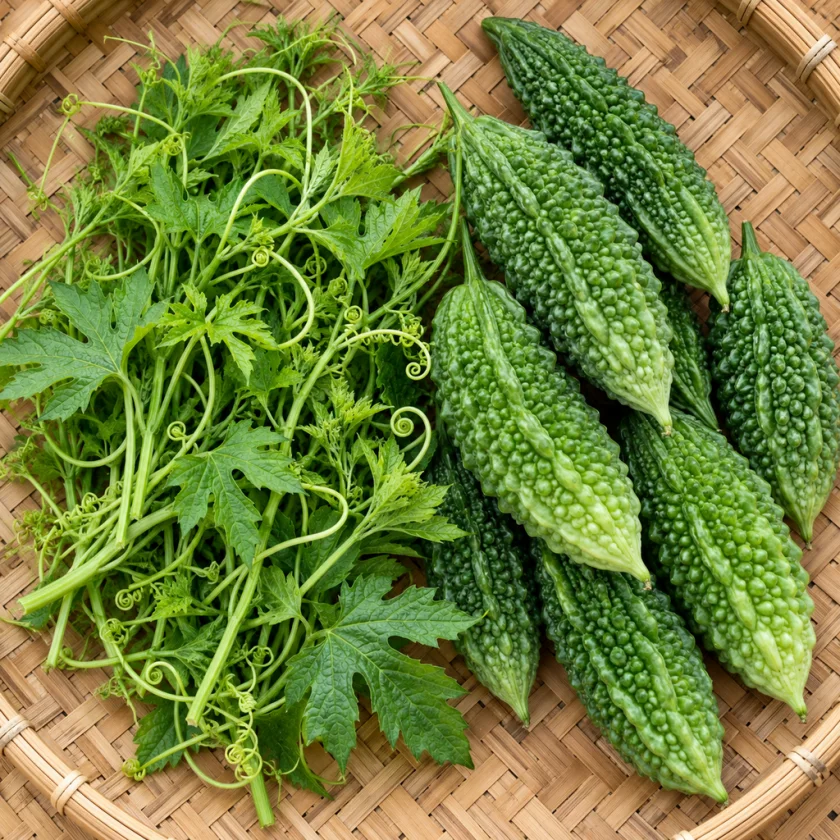
Bitter melon is a fast-growing climbing vine of the gourd family, the Cucurbitaceae — the same family as cucumber, squash, pumpkin, watermelon and zucchini. It climbs by coiled tendrils, has deeply lobed leaves and small yellow flowers, and produces an oblong fruit whose skin is covered in ridges and warty bumps. Depending on where it is grown it is called bitter gourd, balsam pear, karela, ampalaya, kŭgua, goya or cerasee.
The genus name Momordica is usually traced to the Latin verb for “to bite”. The explanation given in the video, and in many botanical references, is that the flattened seeds have jagged, uneven edges that look as though something has bitten into them. The name, in other words, describes the seed, not the taste — the bitterness is a happy coincidence for anyone remembering it.
The video also gives a short account of where the plant came from and how it spread. That story — wild origins in Africa, domestication in South and East Asia, and its long role in Ayurveda, Chinese medicine and Caribbean folk practice — is covered in depth on the Bitter Melon History page, so it is not repeated here.
Two parts of the plant reach the table. The main one is the unripe green fruit, sold as a vegetable. The second is the young shoots and leaves (“leafy tips”), which are cooked as greens in the Philippines and elsewhere and brewed as a tea in the Caribbean. The two are nutritionally quite different, as the table further down shows.
The Bitter Chemistry: Cucurbitane Triterpenoids
The bitterness of the gourd family as a whole comes from a class of molecules called cucurbitacins: heavily oxygenated triterpenoids built on a four-ring carbon skeleton known as cucurbitane. A 2019 study of how the plant makes them (Takase and colleagues, Journal of Biological Chemistry) describes cucurbitacins as characteristic of the Cucurbitaceae and responsible for its members’ bitter taste. It also notes something specific to bitter melon: its fruits carry cucurbitacin-type compounds with an unusual oxygen “ether bridge” between two carbons of the skeleton (C5 and C19), a feature not seen in other members of the family.
The same research team traced part of the assembly line. Using gene-expression data from the fruit, they identified three cytochrome P450 enzymes that add oxygen atoms to the triterpenoid frame, and showed that one of them can form that characteristic ether bridge. A small chemical step — adding a hydroxyl group next to a double bond — turns out to open the way to a wide variety of finished bitter molecules. That variety is the reason the literature lists so many names.
The names readers meet most often are:
- Momordicins — cucurbitane triterpenoids long associated with the fruit’s bitter taste.
- Momordicosides — cucurbitane triterpenoids with sugar units attached (glycosides). In 2008 Tan and colleagues isolated four of them, momordicosides Q, R, S and T, together with a related compound, karaviloside XI. In muscle and fat cells grown in the laboratory these compounds moved the glucose transporter GLUT4 to the cell surface, an effect linked to activation of the energy-sensing enzyme AMPK, and in mice they improved glucose disposal and fat burning.
- Karavilosides — further cucurbitane glycosides, including the karaviloside XI tested alongside the momordicosides in 2008.
A 2022 review by Çiçek in Frontiers in Pharmacology describes how research interest has shifted towards exactly these cucurbitane-type triterpenoids, because the older candidate compounds (below) occur in amounts too low to explain the effects reported in studies. The Tan paper’s authors described cucurbitane triterpenoids as “the characteristic constituents” of the plant. So the molecules that make bitter melon bitter are, to a large extent, the same molecules that laboratory researchers now study most closely. The clinical evidence on what eating or taking bitter melon does for people is a separate question, covered on the Clinical Trial Evidence page.
Charantin and “Plant Insulin”: What They Actually Are
Older articles, and many popular ones today, name three “hypoglycaemic principles” in bitter melon: charantin, polypeptide-p and vicine. A 2006 review by Krawinkel and Keding in Nutrition Reviews lists all three as substances with antidiabetic properties, while noting that the mechanism was “still under debate”. Two of the three are often described inaccurately.
Charantin is not a saponin
The video calls charantin a type of steroidal saponin; the same description appears widely elsewhere. According to Çiçek (2022), charantin is not a single compound at all but a mixture of two sterol glucosides — plant sterols, chemically related to the cholesterol-like sterols found in many vegetables, each carrying one glucose unit. A saponin is a different kind of molecule, usually with a chain of several sugars, named for its soap-like foaming. The same review reports that charantin is present only in low concentrations and has limited bioavailability, so it cannot by itself account for the blood-sugar effects reported in studies. The AMPK and GLUT4 findings that are sometimes credited to charantin come from the momordicoside work described above, not from charantin.
“Plant insulin” is a protein
Polypeptide-p, also called p-insulin, is a small protein isolated from the seeds and fruit and given the nickname “plant insulin” because of a resemblance to animal insulin. The video is careful to say that most of the evidence comes from laboratory and animal studies. Two further points are worth adding. First, because it is a protein, the digestive tract breaks it down into amino acids, which is also why human insulin itself is injected rather than swallowed; the early human reports on polypeptide-p used injection, not food. Second, Çiçek (2022) groups p-insulin with charantin as occurring in low concentrations with limited bioavailability. Whatever bitter melon does when eaten, “plant insulin” is an unlikely explanation.
Vicine
The third compound, vicine, sits mainly in the seeds. Its best-documented effect is not on blood sugar: it is the trigger for favism, the breakdown of red blood cells in people with G6PD deficiency. That topic belongs to the Safety and Toxicity page.
Why the Plant Makes Bitter Compounds
The video explains the bitterness as a chemical shield: an insect takes one bite, finds it intensely bitter, and leaves the plant alone. This matches the general botanical view of cucurbitacins across the gourd family, where these compounds are widely regarded as a defence against plant-eating insects and other herbivores. Plants cannot run from what eats them, so many of them invest in chemistry instead, and bitterness is one of the most common results.
It is worth being clear about what the papers on this page do and do not show. The 2019 biosynthesis study establishes that cucurbitacins are the bitter compounds and how bitter melon builds them; it does not test what they do to insects. None of the papers cited here measures insect feeding on bitter melon. The defence explanation is therefore reported here as the video’s account and the general view in plant biology, not as a finding of the sources listed below.
One small irony is often pointed out in discussions of plant chemistry: the bitterness that is thought to discourage insects is exactly what many human food cultures prize in this vegetable, as the cuisine section below describes.
Does a More Bitter Variety Mean More Active Compounds?
The video makes a specific claim: bitterer varieties tend to carry more of the active compounds, so people who cannot face the bitterness may be “missing out”. The idea has a logic to it, since the bitter taste and the most-studied compounds both come from the same cucurbitane family.
However, none of the papers in this page’s reference list compares varieties, measures their triterpenoid content against their bitterness, or tests whether a more bitter fruit has a larger effect on people. The claim is reported here as the video’s, not as a measured finding. Several practical complications are worth knowing:
- Many cultivars, many profiles. Markets sell everything from long, pale, smooth-ridged fruit (often described as milder) to small, dark green, spiky fruit (often described as much more bitter). Their chemistry is known to vary, but bitterness is a single sensation produced by a mixture of many molecules.
- Not every bitter molecule is a studied one. The compounds tested in the 2008 GLUT4 study are a handful out of dozens. A fruit could be very bitter because of compounds that have never been tested.
- The clinical trials did not standardise this. The trials pooled in meta-analyses used whole-fruit powders, dried extracts, juices and isolated fractions from varieties that were often not even named. That lack of standardisation is one of the reasons reviewers give for the inconsistent results, as described on the Clinical Trial Evidence page.
Nutrients in Raw Pods, Boiled Pods and Leafy Tips
The US Department of Agriculture’s FoodData Central database lists three bitter-melon foods in its standard reference set (SR Legacy). The figures below are per 100 grams, roughly 3.5 ounces. The boiled figures are for pods “cooked, boiled, drained, with salt”, which is why their sodium is much higher.
| Per 100 g | Pods, raw | Pods, boiled, drained (salted) | Leafy tips, raw |
|---|---|---|---|
| Energy | 17 kcal | 19 kcal | 30 kcal |
| Water | 94.0 g | 94.0 g | 89.3 g |
| Protein | 1.0 g | 0.84 g | 5.3 g |
| Fat | 0.17 g | 0.18 g | 0.69 g |
| Carbohydrate | 3.7 g | 4.3 g | 3.3 g |
| Fibre | 2.8 g | 2.0 g | not listed |
| Vitamin C | 84 mg | 33 mg | 88 mg |
| Folate | 72 µg | 51 µg | 128 µg |
| Vitamin A (RAE) | 24 µg | 6 µg | 87 µg |
| Potassium | 296 mg | 319 mg | 608 mg |
| Magnesium | 17 mg | 16 mg | 85 mg |
| Calcium | 19 mg | 9 mg | 84 mg |
| Phosphorus | 31 mg | 36 mg | 99 mg |
| Iron | 0.43 mg | 0.38 mg | 2.04 mg |
| Zinc | 0.80 mg | 0.77 mg | 0.30 mg |
| Sodium | 5 mg | 242 mg | 11 mg |
Source: USDA FoodData Central, SR Legacy entries 168393 (pods, raw), 168496 (pods, boiled, drained, with salt) and 168391 (leafy tips, raw). View the raw-pod entry at FoodData Central.
What the numbers show
- Raw pods are a vitamin C food. At 84 mg per 100 g, raw bitter melon holds more than an orange (about 53 mg) and about as much as a green bell pepper (about 80 mg), and close to the 90 mg Daily Value used on US food labels. It is also very low in energy: 17 kcal, with 94% of its weight water.
- Boiling cuts vitamin C by more than half. The boiled entry carries 33 mg, about 61% less than raw. Vitamin C dissolves in water and breaks down with heat, so much of it is lost to the cooking water and drained away. Folate (72 to 51 µg) and vitamin A (24 to 6 µg) also fall. Fibre is listed at 2.0 g boiled against 2.8 g raw.
- The leafy tips are the richer food. Gram for gram, the young leaves and shoots have about five times the protein, five times the magnesium, four to five times the calcium and iron, roughly double the potassium and folate, and more vitamin C than the pods.
- Potassium is moderate in the fruit (about 300 mg) and high in the leaves (608 mg).
The USDA tables list nutrients only. They do not measure the cucurbitane triterpenoids discussed above, so they cannot say how cooking changes the bitter compounds.
How Bitter Melon Is Eaten Around the World
The video lists stir-frying, soups and juicing as common ways of eating bitter melon. Across the regions where it is a staple, cooks have developed many more, and most of them pair the bitterness with something rich, salty, sour or sweet rather than trying to hide it.
- Stir-fried (China, Okinawa, Southeast Asia). Thin crescents of fruit are tossed in a hot wok, often with egg, fermented black beans, garlic or a little meat. Okinawa’s best-known home dish, goya champurū, is a stir-fry of bitter melon with tofu and egg, and the vegetable is closely tied to that island’s food identity.
- Soups and braises. In southern China and Vietnam the fruit goes into clear soups with pork ribs or fish. A well-known Vietnamese version, canh khổ qua, stuffs short sections of the hollowed fruit with seasoned minced pork before simmering them in broth. Filipino pinakbet stews bitter melon with squash, eggplant, okra and beans in fermented fish or shrimp paste.
- Stuffed and fried (South Asia). In Indian and Pakistani kitchens karela is scraped, salted, slit and filled with a spiced onion or ground-meat mixture, then pan-fried or baked. Thin rounds are also fried until crisp and eaten as a side dish.
- With eggs and greens (Philippines). Ampalaya sauteed with egg and tomato is an everyday dish, and the leafy tips are added to stews and soups.
- Juice. Raw bitter melon is blended or pressed into juice, sometimes cut with apple, cucumber, lemon or other vegetables. Raw juice keeps the vitamin C that boiling removes, but it is also the form with the most concentrated bitterness.
- Tea from the vine (Caribbean). In Jamaica and neighbouring islands, the leaves and stems of a small wild-type bitter melon are dried and steeped as cerasee tea, a long-standing folk practice described on the History page.
- Pickled. Sliced fruit is pickled in vinegar or brine in parts of Asia, where the sourness softens the bite.
These are descriptions of how the vegetable is used, not instructions. In nearly all of these dishes it is the unripe green fruit, with its seeds and spongy white pith removed, that goes into the pot.
Salting and Squeezing: The Kitchen Trade-Off
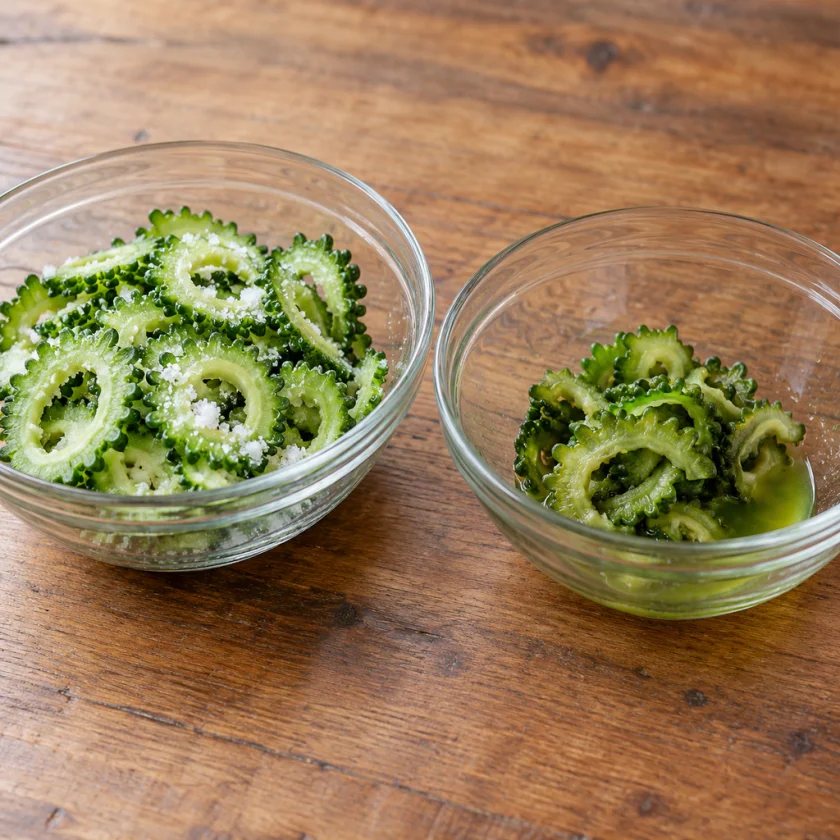
The most widespread way of taming the bitterness is a simple one. Cooks in many cuisines halve the fruit lengthwise, scoop out the seeds and the white pith (which is very bitter), slice the flesh, sprinkle it with salt and leave it for a while. Salt draws water out of the cut cells by osmosis. The slices are then squeezed firmly by hand, often rinsed, and squeezed again before cooking. Some cooks blanch the slices briefly in boiling water instead, or as well. The video mentions the salting method too, and notes that it costs some nutrition in exchange for a milder taste.
That trade-off is real, and it follows from basic food chemistry. The liquid squeezed out is mostly the fruit’s own water, and anything dissolved in it leaves with it. That includes the water-soluble vitamins — vitamin C and folate above all — and minerals such as potassium. Blanching adds heat to the same process. Nobody appears to have published a measurement of exactly how much salting and squeezing removes, but the USDA’s boiled-and-drained figures give a sense of scale: in that preparation vitamin C fell from 84 mg to 33 mg per 100 g.
Whether salting also lowers the amount of the bitter triterpenoids is a fair question with no measured answer in the sources here. The milder taste suggests some bitter material is removed or diluted, but the cucurbitane glycosides vary in how readily they dissolve in water, and no study cited on this page quantifies it. Cooks also note that salting adds sodium; how much stays depends on rinsing.
Green Fruit, Ripe Fruit and the Red Aril
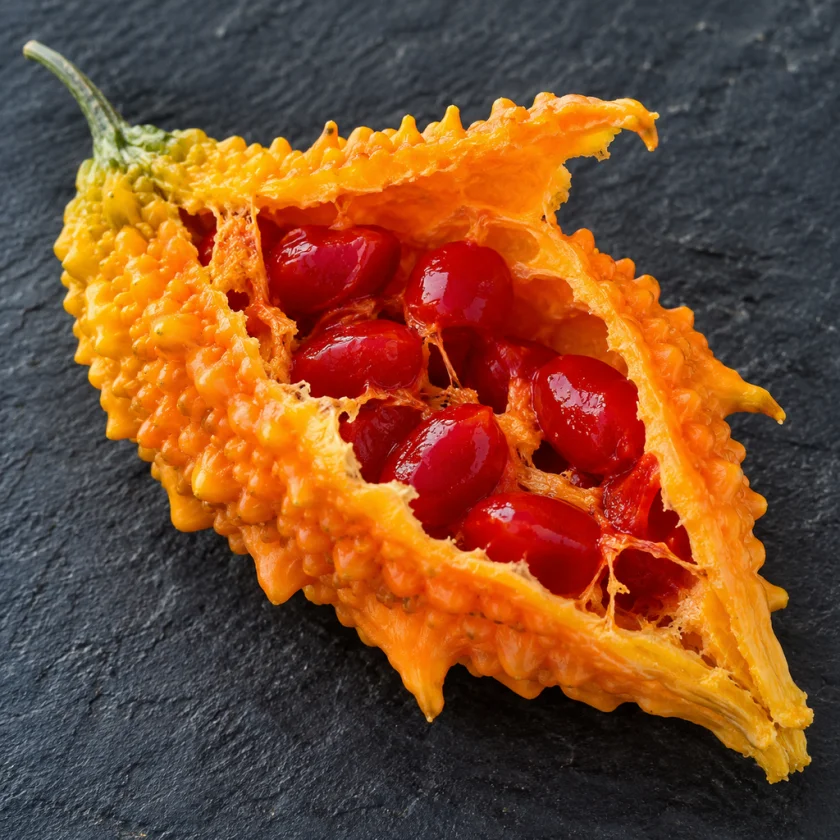
Bitter melon is eaten unripe. In the market it is firm and green, from pale jade to deep emerald, with white seeds and pale pith. Left on the vine, the fruit turns yellow and then orange, softens, and finally splits open at the tip, often curling back into three sections. Inside, each seed is wrapped in a bright red, fleshy coating called an aril, which is generally described as sweet rather than bitter. In the wild, this colourful coating is thought to attract birds that eat it and spread the seeds.
The ripe stage changes what the fruit is. The flesh becomes soft and is not usually cooked, and the seeds are now mature. The research summarised on the safety page concerns the seeds in particular: Çiçek (2022) describes a mildly toxic lectin in the seeds and rind and the favism trigger vicine in the seeds, and Jia and colleagues (2017) describe seed proteins, alpha- and beta-momorcharin, that disrupted early pregnancy in mice. The video adds a claim that the red aril is toxic, especially to children. How far the evidence supports that claim, and what the documented cases of harm in children actually involved, is covered on the Bitter Melon Safety page rather than here.
Çiçek’s review also notes that no serious adverse events have been reported for juice made from the unripe fruit, the form most cuisines use. Separate questions — pregnancy, G6PD deficiency, and combining bitter melon with blood-sugar medicines — are likewise on the safety page.
Where This Page Corrects the Video
The video gives a mostly accurate picture of the plant and its uses. The points below are where the research or the USDA data say something different or more precise.
Errors
- Charantin (E1). The video calls charantin “a type of steroidal saponin”. According to Çiçek (2022), charantin is a mixture of two sterol glucosides, not a saponin, and it occurs in concentrations too low to explain the plant’s reported effects. The bitter taste comes from cucurbitane-type triterpenoids (Takase 2019).
- Fibre and vitamin C (E4). The video gives a 3.5-ounce serving roughly 2 g of dietary fibre and 44 to 78 mg of vitamin C. In the USDA database, 100 g of raw pods holds 2.8 g fibre and 84 mg vitamin C. The figures of 2.0 g fibre and 33 mg vitamin C are for boiled pods. Cooking cuts the vitamin C by more than half.
Simplifications
- “Plant insulin” (S1). The video rightly says the polypeptide-p evidence is mostly from the laboratory and animals. To that: polypeptide-p is a protein, which digestion breaks down; the early human reports used injection rather than food; and Çiçek (2022) describes it as present in low concentration with limited bioavailability.
- Insect defence and bitterness strength. The insect-defence explanation agrees with the general view of cucurbitacins in plant biology but is not tested in the sources here. The claim that more bitter varieties hold more active compounds is the video’s own and is not measured in any paper on this page.
Key Research Papers
- Takase S, Kera K, Nagashima Y, Mannen K, Hosouchi T, Shinpo S, Kawashima M, Kotake Y, Yamada H, Saga Y, Otaka J, Araya H, Kotera M, Suzuki H, Kushiro T. Allylic hydroxylation of triterpenoids by a plant cytochrome P450 triggers key chemical transformations that produce a variety of bitter compounds. Journal of Biological Chemistry. 2019;294(49):18662-18673. PMID: 31656227
- Tan MJ, Ye JM, Turner N, Hohnen-Behrens C, Ke CQ, Tang CP, Chen T, Weiss HC, Gesing ER, Rowland A, James DE, Ye Y. Antidiabetic activities of triterpenoids isolated from bitter melon associated with activation of the AMPK pathway. Chemistry & Biology. 2008;15(3):263-273. PMID: 18355726
- Çiçek SS. Momordica charantia L.—diabetes-related bioactivities, quality control, and safety considerations. Frontiers in Pharmacology. 2022;13:904643. PMID: 35656300
- Krawinkel MB, Keding GB. Bitter gourd (Momordica charantia): a dietary approach to hyperglycemia. Nutrition Reviews. 2006;64(7):331-337. PMID: 16910221
- Jia S, Shen M, Zhang F, Xie J. Recent advances in Momordica charantia: functional components and biological activities. International Journal of Molecular Sciences. 2017;18(12):2555. PMID: 29182587
PubMed Topic Searches
Connections
- Bitter Melon (Main Page)
- Bitter Melon Benefits Hub
- Bitter Melon History
- Bitter Melon Clinical Trials
- Bitter Melon and Cholesterol
- Bitter Melon Safety
- Bitter Melon for Blood Sugar
- Bitter Melon for Weight Loss
- Bitter Melon for Diabetes Complications
- Bitter Melon Cancer Cell Studies
- Bitter Melon in Blood Sugar Management