Shampoo Ginger — Benefits Deep Dive
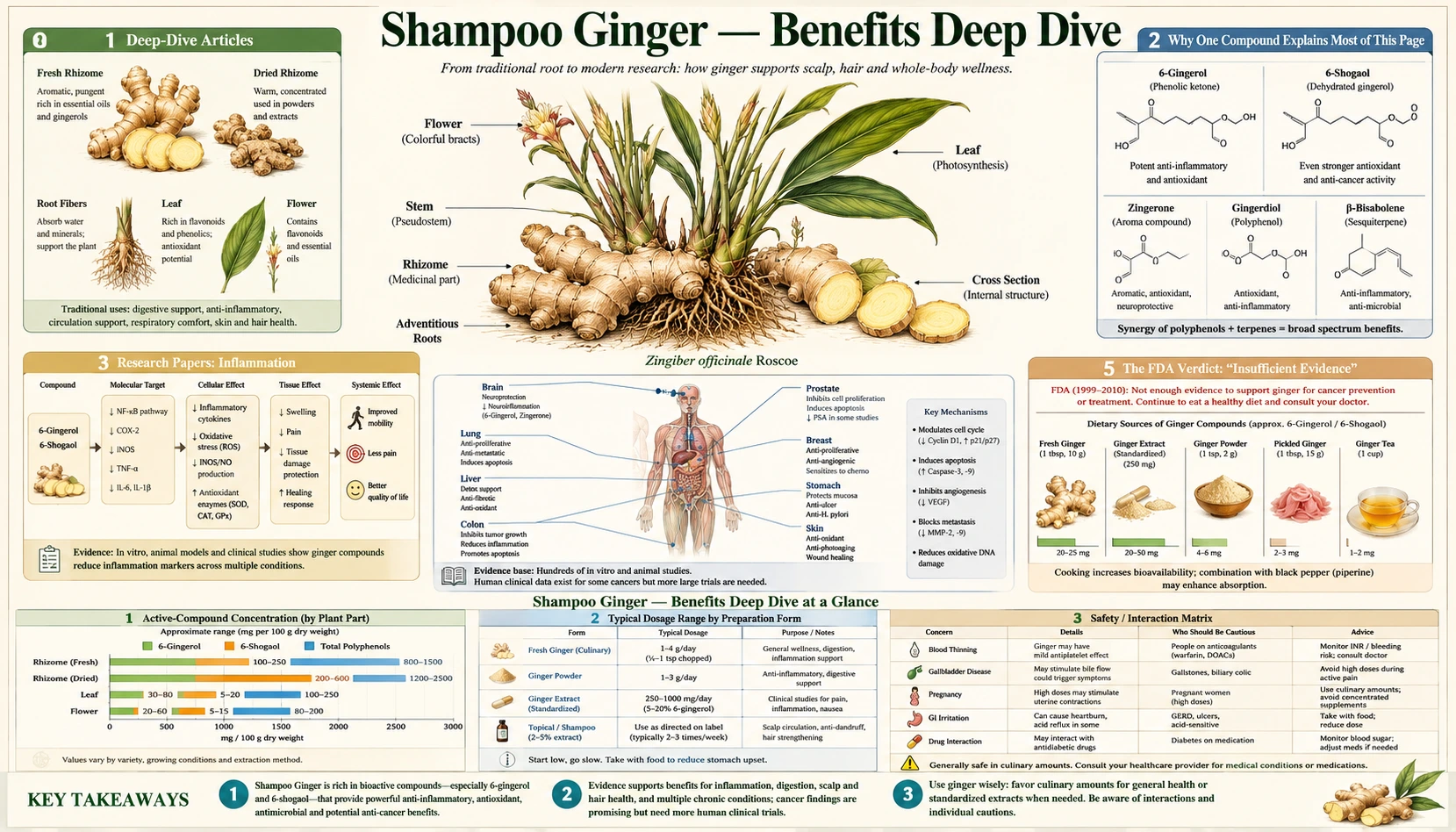
Zingiber zerumbet — shampoo ginger, pinecone ginger, or (confusingly, and dangerously, given the unrelated toxic Asarum plant that shares the English name) "wild ginger" — carries one of the more mechanistically coherent research programmes of any plant compound this site covers, built almost entirely around a single reactive chemical: zerumbone, a cysteine-trapping sesquiterpene that switches off nuclear factor kappa B (NF-κB) and switches on nuclear factor erythroid 2-related factor 2 (Nrf2) in roughly a dozen different tissue and disease models. The four pages below go past the main Wild Ginger page's summary to work through that evidence properly — the inflammation literature's real breadth, the cancer research's cell-culture promise set against its one actual human trial (published 2024, and not the "no clinical trial" the main page used to say), the antimicrobial findings and exactly why they do not extend to the plant's own namesake shampoo claim, and the traditional digestive use set against a 2023 journal retraction that removed the strongest single piece of gastroprotective evidence. Every citation below was checked against a live PubMed search before being written down.
Deep-Dive Articles
Zerumbone and Inflammation
The Kelch-like ECH-associated protein 1 (Keap1)/Nrf2 and IkappaB kinase beta (IKKβ)/NF-κB cysteine-trap mechanism, and the roughly dozen animal and cell models it has been tested in — sepsis-induced lung injury, pulmonary fibrosis, pancreatitis, atopic dermatitis, periodontal inflammation, high-glucose macrophage activation, and a four-study neuropathic pain programme. The bioavailability problem that likely explains why none of it has translated yet, what an approved drug sharing the same mechanism (dimethyl fumarate) tells you about a realistic ceiling, and why human evidence for any inflammatory condition remains at zero.
Read the deep dive →Zerumbone and Cancer
One of the larger anticancer cell-culture literatures of any plant sesquiterpene — apoptosis, cell-cycle arrest, invasion suppression, tested across melanoma, glioblastoma, gastric, colorectal, hepatocellular and breast cancer models — set against the single human study that exists: a 2024 Brazilian pilot in patients with advanced solid tumors that measured quality of life, not tumor response. It was non-randomized and open-label: 35 patients (mean age 68) with no remaining treatment options took 400 mg of zerumbone twice a day for 8 weeks, and only 16 finished. Quality-of-life scores (activity, social and emotional), anxiety, depression and fatigue scores improved; weight and sleep quality did not change; the authors say a randomized placebo-controlled study is needed to confirm the results. A full three-valued-verdict breakdown of what that trial does and does not show, and why curcumin's clinical track record is the right comparison to keep expectations honest.
Read the deep dive →Antimicrobial and Antifungal Properties
Helicobacter pylori urease inhibition, acne and endodontic bacteria, and a genuinely substantial cluster of work against Candida albicans biofilms including fluconazole-resistant strains. Then the question the plant's own name invites: does any of this support the traditional shampoo/hair-rinse use? A direct check of the literature for hair, scalp or dandruff findings — and why an antifungal result against Candida cannot be assumed to transfer to Malassezia, the organism actually responsible for dandruff.
Read the deep dive →Digestive, Liver and Metabolic Health
The most geographically consistent traditional claim — digestive use across Hawaii, Malaysia, Indonesia, Vietnam and Thailand — set against the 2023 retraction of its flagship supporting study, told in full with the editors' actual stated reasons. What survives: a narrower urease-inhibition finding, and a separate, largely single-laboratory body of animal work on hepatoprotection, fatty liver, and diabetic kidney and retinal protection.
Read the deep dive →Table of Contents
Why One Compound Explains Most of This Page
Most Benefits hubs on this site cover several unrelated active compounds. Shampoo ginger is unusual: almost every claim across all four deep-dive pages traces back to zerumbone, a single monocyclic sesquiterpene ketone that is typically the dominant compound — often well over half — of the rhizome's essential oil. Zerumbone's cross-conjugated dienone structure makes it an electrophile that covalently modifies reactive cysteine residues in proteins, and two cysteine-sensor proteins account for most of its reported biology: Keap1, whose modification releases the antioxidant transcription factor Nrf2, and IKKβ, whose modification blocks activation of the inflammatory transcription factor NF-κB. Switch those two systems and you touch inflammation, oxidative stress, and several of the pathways cancer cells depend on to survive and spread — which is why one compound's laboratory literature spans lung injury, pancreatitis, dermatitis, neuropathic pain, melanoma, glioblastoma, and diabetic kidney damage without requiring four separate mechanistic stories.
The same reactivity is the reason for caution: a compound that covalently modifies cysteines is not selective the way a designed drug is, and at high concentration that same chemistry is how it kills cells in a dish, healthy or cancerous alike. It is also, per the Inflammation page's detailed discussion, poorly water-soluble with limited oral bioavailability — the most likely reason a research programme this broad and this mechanistically coherent has produced, as of 2026, exactly one human study.
A 2024 scoping review of shampoo ginger’s medicinal properties gathered 54 studies, all of them in animals, and found “no published human studies” (the review appeared shortly before the 2024 pilot study in cancer patients was published). Only half of the studies described the plant preparation they used in adequate detail. An ethanol extract of the plant was well tolerated in animals for up to 28 days, and the authors write that comprehensive safety data are still needed before clinical trials can be run.
Research Papers: Inflammation
- Chang HH et al. (2026). Zerumbone from Zingiber zerumbet (L.) Roscoe ex Sm. ameliorates atopic dermatitis by regulating the MAP kinase/NF-κB, Akt, and STAT pathways. Journal of Ethnopharmacology, 366:121687. — PubMed PMID: 41990445
- Chen J et al. (2024). Protective effect of zerumbone on sepsis-induced acute lung injury through anti-inflammatory and antioxidative activity via NF-κB pathway inhibition and HO-1 activation. Naunyn-Schmiedeberg's Archives of Pharmacology, 397(4):2241–2255. — PubMed PMID: 37812239
- Zhang F, Xu D (2023). Zerumbone ameliorates the inflammatory response and organ damage in severe acute pancreatitis via the ROS/NF-κB pathway. BMC Gastroenterology, 23(1):333. — PubMed PMID: 37759163
- Gopalsamy B et al. (2017). Antiallodynic and antihyperalgesic activities of zerumbone via the suppression of IL-1β, IL-6, and TNF-α in a mouse model of neuropathic pain. Journal of Pain Research, 10:2605–2619. — PubMed PMID: 29184437
- Kesharwani SS, Bhat GJ (2020). Formulation and Nanotechnology-Based Approaches for Solubility and Bioavailability Enhancement of Zerumbone. Medicina (Kaunas), 56(11):557. — PubMed PMID: 33114101
Research Papers: Cancer
- de Queiroz LV et al. (2024). Bitter ginger (Zingiber zerumbet) for patients with solid tumors with no treatment options: A pilot clinical study. Complementary Therapies in Medicine, 80:103021. — PubMed PMID: 38199583
- Soroush A et al. (2024). Anti-cancer potential of zerumbone in cancer and glioma: current trends and future perspectives. Medical Oncology, 41(5):125. — PubMed PMID: 38652207
- Sung B et al. (2008). Zerumbone down-regulates chemokine receptor CXCR4 expression leading to inhibition of CXCL12-induced invasion of breast and pancreatic tumor cells. Cancer Research, 68(21):8938–44. — PubMed PMID: 18974138
- Tanaka T et al. (2001). Chemoprevention of azoxymethane-induced rat aberrant crypt foci by dietary zerumbone isolated from Zingiber zerumbet. Life Sciences, 69(16):1935–45. — PubMed PMID: 11693274
- Schnoell J et al. (2022). Zerumbone acts as a radiosensitizer in head and neck squamous cell carcinoma. Investigational New Drugs, 40(2):224–231. — PubMed PMID: 34613571
Research Papers: Antimicrobial and Antifungal
- Woo HJ et al. (2021). Zerumbone Inhibits Helicobacter pylori Urease Activity. Molecules, 26(9):2663. — PubMed PMID: 34062878
- Shin DS, Eom YB (2019). Zerumbone inhibits Candida albicans biofilm formation and hyphal growth. Canadian Journal of Microbiology, 65(10):713–721. — PubMed PMID: 31158320
- Abreu-Pereira CA et al. (2025). Zerumbone enhances the photodynamic effect against biofilms of fluconazole-resistant Candida albicans clinical isolates. Journal of Dentistry, 155:105631. — PubMed PMID: 39956310
- Jyothilakshmi M et al. (2017). Antidermatophytic and Protease-inhibiting Activities of Zerumbone: A Natural Sesquiterpene from the Rhizome of Zingiber zerumbet (L.) Roscoe ex J.E; Smith. Pharmacognosy Magazine, 13(49):2–6. — PubMed PMID: 28216875
- Na Nongkhai T et al. (2024). In Vitro Cytotoxicity and Antimicrobial Activity against Acne-Causing Bacteria and Phytochemical Analysis of Galangal (Alpinia galanga) and Bitter Ginger (Zingiber zerumbet) Extracts. International Journal of Molecular Sciences, 25(20):10869. — PubMed PMID: 39456652
Research Papers: Digestive, Liver and Metabolic
- PLOS ONE Editors (2023). Retraction: Antisecretory, Gastroprotective, Antioxidant and Anti-Helicobcter Pylori Activity of Zerumbone from Zingiber Zerumbet (L.) Smith. PLoS One, 18(11):e0294009. Retracts Sidahmed HM et al. (2015), PMID 25798602. — PubMed PMID: 37948334
- Hamid A et al. (2018). Hepatoprotective Effects of Zerumbone against Paracetamol-Induced Acute Hepatotoxicity in Rats. The Malaysian Journal of Medical Sciences, 25(2):64–71. — PubMed PMID: 30918456
- Tzeng TF et al. (2013). Zerumbone, a tropical ginger sesquiterpene, ameliorates streptozotocin-induced diabetic nephropathy in rats by reducing the hyperglycemia-induced inflammatory response. Nutrition & Metabolism, 10(1):64. — PubMed PMID: 24499158
- Yob NJ et al. (2011). Zingiber zerumbet (L.) Smith: A Review of Its Ethnomedicinal, Chemical, and Pharmacological Uses. Evidence-Based Complementary and Alternative Medicine, 2011:543216. — PubMed PMID: 21584247
- Chan JSW et al. (2024). Zingiber zerumbet: A Scoping Review of its Medicinal Properties. Planta Medica, 90(3):204–218. — PubMed PMID: 38035621
External Resources
- PubChem — Zerumbone Compound Record (CID 5470187) — structure, physical and chemical properties from the National Library of Medicine's compound database
- PubMed — All research on zerumbone
- PubMed — All research on Zingiber zerumbet (title/abstract-scoped, to exclude MeSH-drift results from Zingiber officinale)
- The main Wild Ginger page — identity, traditional use, forms, dosage and full safety cautions, including the critical distinction from toxic Asarum "wild ginger"