Saffron: Sources, Dosing, and Safety
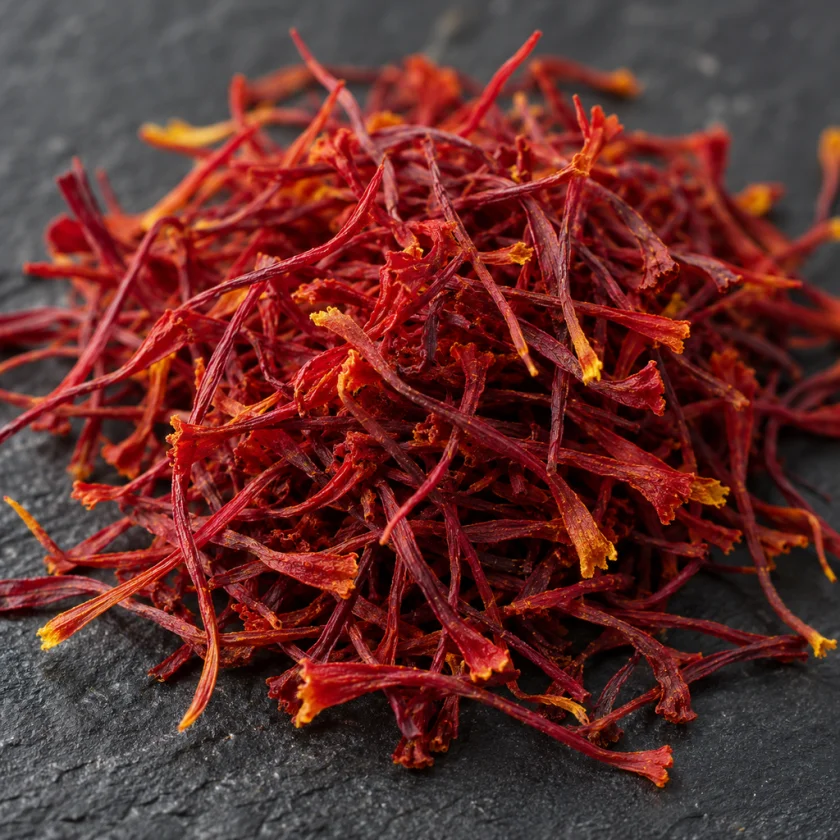
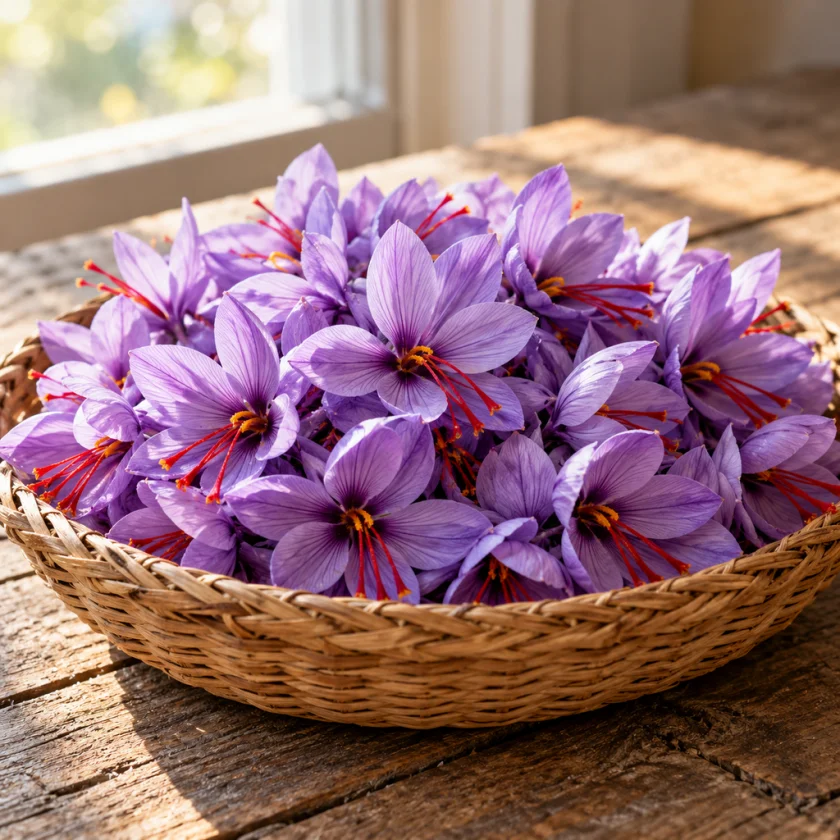
Saffron is the most expensive spice in the world — each flower yields only three red stigmas, and it takes roughly 150,000 flowers, all hand-picked, to make a single kilogram. That extraordinary value creates two practical problems this page covers. First, because saffron is so costly, it is one of the most heavily adulterated foods on Earth: what is sold may be bulked, dyed, or entirely fake. Second, while normal amounts are very safe, saffron is not harmless in large doses, and it carries a real pregnancy caution. This page covers the dose used in the clinical trials (about 30 mg per day), how real saffron is told apart from fake, and what the research shows about its safety limits.
Table of Contents
- The World's Most Expensive Spice
- Crocin, Picrocrocin, Safranal, and Grading
- The Adulteration Problem
- Signs of Fake or Low-Grade Saffron
- Doses Used in Trials: About 30 mg a Day
- Forms: Threads, Powder, and Extracts
- Safety and High-Dose Toxicity
- Pregnancy and Who the Research Raises Concerns For
- Drug Interactions
- Quality Checks in Brief
- Key Research Papers
- Connections
- Featured Videos
The World's Most Expensive Spice
Saffron is the dried red stigma of Crocus sativus, a sterile autumn-flowering crocus that must be propagated by hand from corms. Each purple flower produces just three thread-like crimson stigmas, and those threads must be plucked individually, usually within hours of the flower opening. The result is a spice that trades by the gram and routinely sells for more than its weight in silver. The main producers are Iran (by far the largest, at roughly 90 percent of world supply), followed by regions of Spain, India (Kashmir), Afghanistan, Greece, and Morocco.
None of this matters for cooking a paella — a pinch is a pinch. It matters enormously for anyone buying saffron as a supplement, because the economics of a spice this valuable create overwhelming incentives to cheat, and because the difference between a strong, genuine product and a weak or fake one can be the difference between the dose used in the trials and no active compound at all.
Crocin, Picrocrocin, Safranal, and Grading
Saffron's quality is defined by three families of molecules, each responsible for one sensory property:
- Crocins — the water-soluble carotenoid pigments that give saffron its intense red-gold color. Coloring strength is the headline quality measure.
- Picrocrocin — the compound responsible for saffron's characteristic bitter taste.
- Safranal — the volatile molecule, formed from picrocrocin during drying, that provides the distinctive aroma.
The international standard ISO 3632 grades saffron by measuring these three by spectrophotometry: coloring strength (crocins, read near 440 nm), bitterness (picrocrocin, near 257 nm), and aroma (safranal, near 330 nm). Higher coloring strength earns a higher category (Category I is the top grade). When a supplement is standardized — guaranteeing, say, a minimum percentage of crocins or a set amount of safranal per capsule — it is these same markers being pinned down, which is why standardized extracts gave the reproducible results seen in the depression trials.
The Adulteration Problem
Saffron's price makes it a perennial target for fraud — it has been adulterated for centuries, and modern food-quality studies (such as Mena-García and colleagues, 2023) still routinely find diluted or mislabeled products on the market. Common tricks include:
- Bulking with look-alike plant material — safflower petals (sometimes sold as "American saffron"), marigold, corn silk, or shredded, dyed fibers coloured to resemble stigmas.
- Adding other plant parts of the saffron flower itself — the yellow-white style below the stigma has little active compound but adds weight.
- Coloring with dyes — from natural sources like turmeric and gardenia to artificial colorants such as tartrazine, and, in the worst cases, unapproved industrial dyes.
- Weighting — soaking threads in honey, glycerin, or oil, or dusting them with mineral salts, to increase weight sold.
- Powder substitution — ground saffron is the easiest to fake, since color and aroma can be mimicked with cheaper spices; whole threads are harder to counterfeit convincingly.
The consequence for a supplement buyer is twofold: an adulterated product may deliver far less active compound than the label implies, and some adulterants (certain synthetic dyes) are undesirable to consume. This is why sourcing is not a side issue — it directly determines whether a product delivers anything like the studied dose.
Signs of Fake or Low-Grade Saffron
No home test is definitive, but a few practical checks catch most crude fakes:
- Whole threads are easier to judge than powder. Genuine threads have a trumpet-shaped flare at one end; powder hides these features.
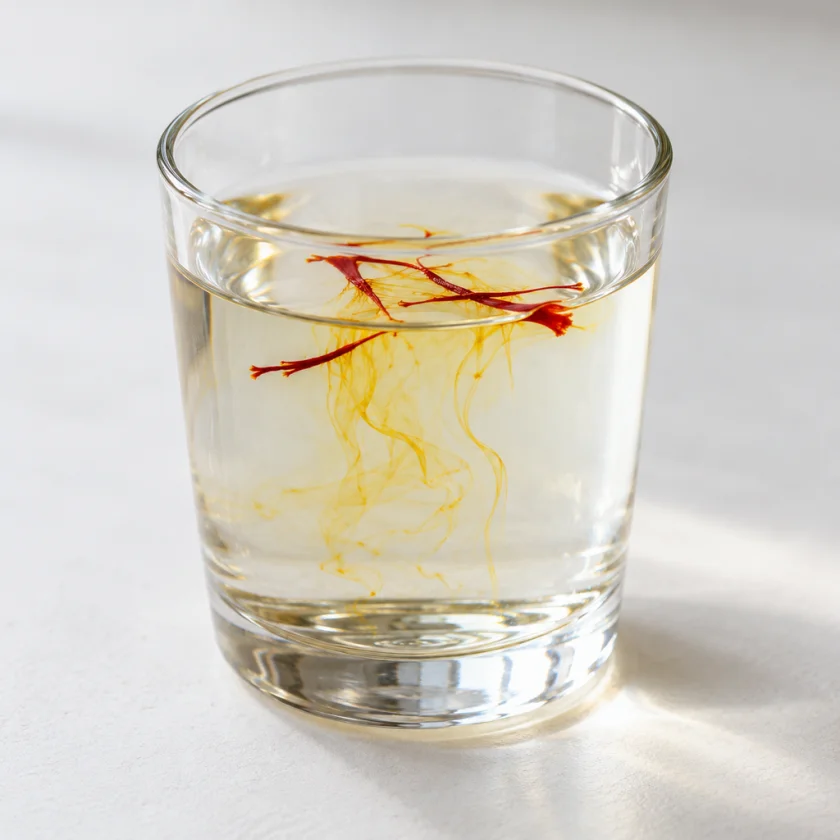
- The slow-color test. A few threads are dropped into lukewarm water. Real saffron releases its golden-yellow color slowly, over many minutes, and the threads keep their red color rather than instantly bleeding red. A quick burst of red or orange dye suggests artificial coloring (fake "American saffron" from safflower turns the water red-orange fast).
- Smell and taste. Real saffron smells sweetly of hay and honey and tastes bitter, never sweet. A sweet taste points to a sugar or honey coating.
- Price realism. Saffron that is dramatically cheaper than the market rate is almost certainly adulterated or fake — the economics do not allow genuine bargains.
- For supplements, the quality markers are standardization to crocin/safranal content and a reference to ISO 3632 grading or third-party testing.
Doses Used in Trials: About 30 mg a Day
The great convenience of saffron research is how consistent the dose has been:
- Mood and PMS: essentially every trial used 30 mg per day of standardized saffron, usually split as 15 mg twice daily. Standardized branded extracts studied for mood are often dosed around 28–30 mg per day.
- Eye (age-related macular degeneration, AMD): the retinal-function studies used about 20 mg per day.
- General ceiling: some reviews describe saffron as well tolerated up to about 1.5 grams per day in the short term, but the Bostan 2017 toxicology review lists nausea, vomiting, diarrhea and bleeding at 1.2 to 2 grams (see the safety section below); the benefits reported in trials were at 30 mg, and the research links higher doses with more side effects.
In short: 30 mg per day of a standardized product is the dose used in the mood and premenstrual trials, and about 20 mg per day in the eye research; the benefits reported were at these doses, not higher ones. Culinary use in food is far below these amounts and is simply a flavoring, not a therapeutic dose.
Forms: Threads, Powder, and Extracts
- Whole threads — best for cooking and hardest to fake, but impractical for precise supplement dosing because potency varies by grade and storage.
- Ground powder — convenient for cooking but the easiest form to adulterate, so its source matters most.
- Standardized extract capsules/tablets — the form used in clinical trials and the most reliable for a consistent 30 mg dose of active compounds. These products state their crocin or safranal content.
Crocin and safranal degrade with exposure to light and heat, which is why saffron is kept in an airtight container away from both; a beautiful thread that has sat in a sunny rack for years may be far weaker than a fresh, well-stored one.
Safety and High-Dose Toxicity
At the doses used in research, saffron has a reassuring safety record. In a formal safety evaluation, Modaghegh and colleagues (2008) gave healthy volunteers saffron tablets (up to 400 mg per day for a week) and found no clinically important adverse effects on blood counts or biochemistry, and Mohamadpour and colleagues (2013) reported similar tolerability for crocin tablets. The mild side effects sometimes reported at supplement doses include nausea, headache, reduced appetite, and drowsiness.
The picture changes at much higher doses. Toxicology reviews such as Bostan and colleagues (2017) describe saffron as safe at the doses used in trials. One summary table in that review lists nausea, vomiting, diarrhea, and bleeding with saffron intakes of 1.2 to 2 grams; most of its other toxicity figures come from animal studies, such as an oral LD50 (the dose that kills half the test animals) of about 4,120 mg of saffron extract per kg of body weight in mice. A 2012 review by Poma and colleagues describes doses above 5 grams a day as a pregnancy hazard because of saffron's uterine-stimulating activity. These are enormous amounts compared with the 30 mg dose used in trials — more than a hundred-fold higher — and they are why "megadosing" saffron is a hazard rather than merely wasteful.
Pregnancy and Who the Research Raises Concerns For
- Pregnancy — the concern is medicinal doses. High doses of saffron have a long traditional use as an emmenagogue and abortifacient (to bring on menstruation or end pregnancy), and toxicology reviews link large amounts to uterine stimulation and bleeding. A case-control study described in the Bostan 2017 review found a significantly higher miscarriage rate among pregnant women exposed to high levels of saffron during the harvest. A culinary pinch in food is generally regarded as fine; the concern is concentrated supplement doses, and questions about saffron supplements in pregnancy or when trying to conceive belong with a clinician.
- Breastfeeding. There is not enough reliable safety data on supplement-level saffron during breastfeeding.
- Bipolar disorder. Because saffron may act on mood chemistry, the research raises a theoretical concern for people with bipolar disorder, as any antidepressant-like agent can affect mood cycling; this is a question for a psychiatrist.
- Bleeding disorders and surgery. High doses may affect clotting; stopping supplement-level saffron before scheduled surgery is commonly described, and the concern applies most to people with a bleeding disorder.
- Allergy. True saffron allergy is uncommon but possible, particularly in people who handle the plant.
Drug Interactions
- Antidepressants and other serotonergic drugs. Because saffron may modestly increase serotonin activity, combining it with selective serotonin reuptake inhibitors (SSRIs), serotonin-norepinephrine reuptake inhibitors (SNRIs), MAO inhibitors, tramadol, or triptans is a theoretical concern for a prescriber to weigh. Stopping a prescribed antidepressant to switch to saffron is a separate decision that belongs with the prescriber — see the mood and depression page.
- Blood-pressure medication. Saffron may have mild blood-pressure-lowering effects: in the Modaghegh 2008 safety study, 400 mg a day for a week significantly lowered standing systolic and mean arterial pressure, which could add to the effect of antihypertensive drugs.
- Blood thinners and antiplatelets. High doses may add to the effect of anticoagulant or antiplatelet drugs.
- Drug-metabolizing enzymes. A 2025 review by Bathaei and colleagues examined saffron's effects on cytochrome P450 enzymes, which handle the breakdown of many medications — a reminder that even a "food" botanical can, in principle, affect how drugs are cleared. This matters most for medications with a narrow safety margin, which is a question for a pharmacist.
Quality Checks in Brief
The quality points in brief:
- Whole red threads from a reputable seller, or for supplement use a standardized extract that states its crocin/safranal content, are the forms easiest to judge.
- A stated ISO 3632 category or third-party testing is the main quality marker on a label.
- Bargains are a warning sign — genuine saffron cannot be cheap.
- The slow-color water test and the smell/taste checks screen threads at home.
- The mood/PMS trials used about 30 mg per day; higher doses have not been shown to add benefit and bring more side effects.
- Questions about interactions, pregnancy, or an existing condition belong with a doctor or pharmacist — saffron is well studied but not risk-free.
Key Research Papers
- Modaghegh MH, Shahabian M, Esmaeili HA, et al. (2008). Safety evaluation of saffron (Crocus sativus) tablets in healthy volunteers. Phytomedicine — PubMed PMID: 18693099
- Mohamadpour AH, Ayati Z, Parizadeh MR, et al. (2013). Safety evaluation of crocin (a constituent of saffron) tablets in healthy volunteers. Iranian Journal of Basic Medical Sciences — PubMed PMID: 23638291
- Bostan HB, Mehri S, Hosseinzadeh H (2017). Toxicology effects of saffron and its constituents: a review. Iranian Journal of Basic Medical Sciences — PubMed PMID: 28293386
- Schmidt M, Betti G, Hensel A (2007). Saffron in phytotherapy: pharmacology and clinical uses. Wiener Medizinische Wochenschrift — PubMed PMID: 17704979
- Mena-García A, Sanz ML, Díez-Municio M, Ruiz-Matute AI (2023). A combined gas and liquid chromatographic approach for quality evaluation of saffron-based food supplements. Foods — PubMed PMID: 38002129
- Moratalla-López N, Bagur MJ, Lorenzo C, et al. (2019). Bioactivity and bioavailability of the major metabolites of Crocus sativus L. flower. Molecules — PubMed PMID: 31382514
- José Bagur M, Alonso Salinas GL, Jiménez-Monreal AM, et al. (2018). Saffron: an old medicinal plant and a potential novel functional food. Molecules — PubMed PMID: 29295497
- Christodoulou E, Kadoglou NP, Kostomitsopoulos N, Valsami G (2015). Saffron: a natural product with potential pharmaceutical applications. Journal of Pharmacy and Pharmacology — PubMed PMID: 26272123
- Bathaei P, et al. (2025). Effects of Crocus sativus and its active constituents on cytochrome P450: a review. Naunyn-Schmiedeberg's Archives of Pharmacology — PubMed PMID: 40167627
- Hausenblas HA, Saha D, Dubyak PJ, Anton SD (2013). Saffron (Crocus sativus L.) and major depressive disorder: a meta-analysis of randomized clinical trials. Journal of Integrative Medicine — PubMed PMID: 24299602
- Poma A, Fontecchio G, Carlucci G, Chichiriccò G (2012). Anti-inflammatory properties of drugs from saffron crocus. Anti-Inflammatory & Anti-Allergy Agents in Medicinal Chemistry — PubMed PMID: 22934747