Saffron — Benefits Deep Dive
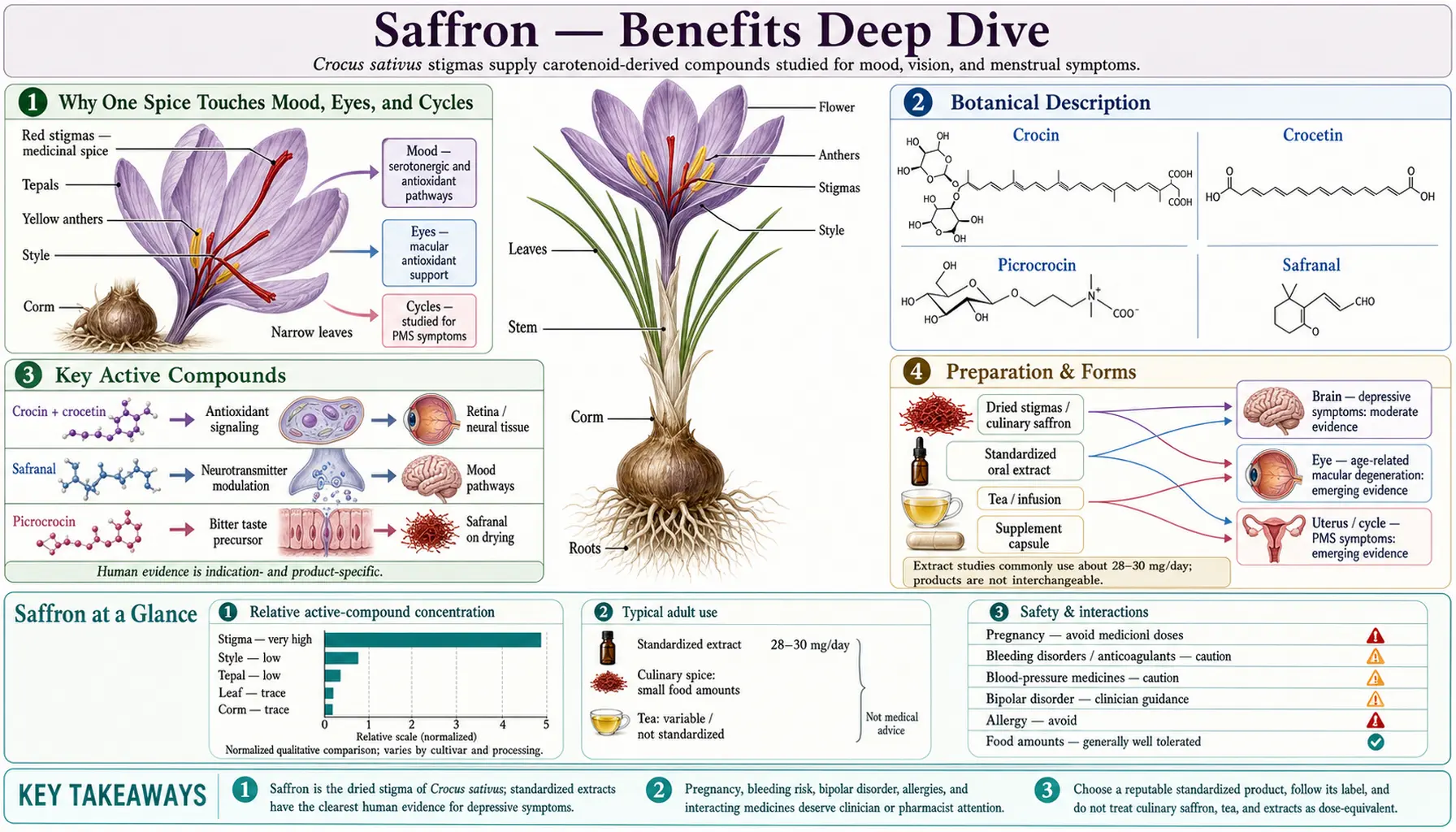
Saffron (Crocus sativus) is the dried red stigma of a purple autumn crocus, harvested by hand three threads at a time — which is why it is the most expensive spice on Earth. Beyond the kitchen, saffron has become one of the more genuinely well-studied botanicals in modern trials, thanks to three signature compounds: two pigments, crocin and crocetin (the carotenoids that give the red color), and one aroma compound, safranal. Its single strongest evidence base is in mild-to-moderate depression, where more than a dozen randomized controlled trials — several head-to-head against standard antidepressants — consistently favor saffron over placebo. The four deep-dive pages below cover mood and depression, eye and macular health, premenstrual and menstrual symptoms, and the practical questions of sourcing, dosing, and safety (including the fact that saffron is one of the most heavily adulterated foods in the world).
Deep-Dive Articles
Mood & Depression
Saffron's strongest and most-replicated benefit. More than a dozen randomized trials of standardized saffron at about 30 mg per day for mild-to-moderate depression, several comparing it head-to-head with fluoxetine, imipramine, citalopram, and sertraline, plus meta-analyses. Presented honestly: small, mostly short studies, mild-to-moderate cases only; stopping a prescribed antidepressant suddenly can cause withdrawal symptoms and relapse.
Read the deep dive →Eye & Macular Health
Crocin and crocetin are carotenoids, and small clinical trials (the Falsini and Piccardi studies) suggest oral saffron can measurably improve retinal function in early age-related macular degeneration. Early-stage but intriguing evidence in age-related macular degeneration (AMD), retinitis pigmentosa, glaucoma, and the diabetic retina — and an honest account of the studies' small size and short duration.
Read the deep dive →PMS & Menstrual Symptoms
A landmark double-blind trial found saffron reduced premenstrual symptoms more than placebo, and its well-documented mood effect overlaps with the emotional symptoms of PMS and PMDD. Also covers menstrual cramps (dysmenorrhea) and where saffron fits among herbal options — while being clear that dedicated PMS trials remain few.
Read the deep dive →Sources, Dosing & Safety
The practical page. About 30 mg per day is the studied dose; the ISO 3632 grading system rates saffron by crocin, picrocrocin, and safranal content; and because saffron is so valuable it is one of the most faked foods in the world. Covers spotting adulteration, high-dose toxicity, the strong pregnancy caution, and drug interactions.
Read the deep dive →Table of Contents
- Deep-Dive Articles
- Why One Spice Touches Mood, Eyes, and Cycles
- Research Papers: Mood & Depression
- Research Papers: Eye & Macular Health
- Research Papers: PMS & Menstrual
- Research Papers: Sourcing, Dosing & Safety
- Research Papers: Mechanisms & Reviews
- External Authoritative Resources
- Connections
- Featured Videos
Why One Spice Touches Mood, Eyes, and Cycles
It is fair to be skeptical when a single plant is credited with helping conditions as different as depression, macular degeneration, and premenstrual syndrome. The skepticism is healthy — but in saffron's case the diverse claims trace back to a small number of shared molecules with genuinely broad biology.
- Crocin and crocetin are carotenoids. Like beta-carotene, lutein, and zeaxanthin, they are pigment antioxidants. Crocetin is unusually small and water-dispersible for a carotenoid, so it is absorbed and can reach tissues that ordinary carotenoids struggle to enter — including the retina, which is the basis of the eye and macular research.
- Saffron compounds interact with mood chemistry. Laboratory work suggests crocin and safranal modestly inhibit the reuptake of serotonin, dopamine, and norepinephrine, and dampen inflammatory and oxidative signaling in the brain — mechanisms that plausibly underlie the antidepressant trial results and, by extension, the emotional symptoms of premenstrual syndrome.
- Antioxidant and anti-inflammatory effects are the common thread. Oxidative stress and low-grade inflammation are shared features of neurodegeneration, retinal aging, and cyclical mood change. A compound that reduces both can, in principle, touch all three — though "in principle" is not the same as proven, and the pages below are careful about that distinction.
The honest summary across all four topics: the depression evidence is strong and replicated (with one limit: the newest meta-analysis, Mahmoudi 2026, pooling 34 randomized trials and 1,769 people, found that self-rated depression scores fell by 4.39 points on the Beck Depression Inventory across 14 trials and self-rated anxiety by 5.06 points on the Beck Anxiety Inventory, but found no significant effect on the clinician-rated Hamilton depression scale or on the Profile of Mood States; results varied widely between trials, and the authors rated the certainty of the evidence as moderate), the eye evidence is promising but early, and the PMS evidence is limited but consistent with the mood data. None of it replaces medical care, and the sourcing and safety page explains why the quality of what you actually buy may matter as much as the science.
Research Papers: Mood & Depression
- Akhondzadeh S, et al. (2005). Crocus sativus L. in the treatment of mild to moderate depression: a double-blind, randomized and placebo-controlled trial. Phytotherapy Research — PubMed PMID: 15852492
- Noorbala AA, et al. (2005). Hydro-alcoholic extract of Crocus sativus L. versus fluoxetine in the treatment of mild to moderate depression. Journal of Ethnopharmacology — PubMed PMID: 15707766
- Akhondzadeh S, et al. (2004). Comparison of Crocus sativus L. and imipramine in the treatment of mild to moderate depression. BMC Complementary and Alternative Medicine — PubMed PMID: 15341662
- Hausenblas HA, et al. (2013). Saffron and major depressive disorder: a meta-analysis of randomized clinical trials. Journal of Integrative Medicine — PubMed PMID: 24299602
- Tóth B, et al. (2019). The efficacy of saffron in the treatment of mild to moderate depression: a meta-analysis. Planta Medica — PubMed PMID: 30036891
- Mahmoudi R, et al. (2026). Effect of saffron on depression, anxiety and mood disorder: a GRADE-assessed systematic review and meta-analysis of 34 randomized controlled trials. Nutritional Neuroscience — PubMed PMID: 41693488
Research Papers: Eye & Macular Health
- Falsini B, et al. (2010). Influence of saffron supplementation on retinal flicker sensitivity in early age-related macular degeneration. Investigative Ophthalmology & Visual Science — PubMed PMID: 20688744
- Piccardi M, et al. (2012). A longitudinal follow-up study of saffron supplementation in early age-related macular degeneration: sustained benefits to central retinal function. Evidence-Based Complementary and Alternative Medicine — PubMed PMID: 22852021
- Marangoni D, et al. (2013). Functional effect of saffron supplementation and risk genotypes in early age-related macular degeneration. Journal of Translational Medicine — PubMed PMID: 24067115
- Bisti S, et al. (2014). Saffron and retina: neuroprotection and pharmacokinetics. Visual Neuroscience — PubMed PMID: 24819927
- Sepahi S, et al. (2021). Pharmacological effects of saffron and its constituents in ocular disorders: a systematic review. Current Neuropharmacology — PubMed PMID: 32379589
- Broadhead GK, Grigg J, McCluskey PJ, Hong T, Schlub TE, Chu E, Chang AA (2024). Saffron therapy for the ongoing treatment of age-related macular degeneration. BMJ Open Ophthalmology — PubMed PMID: 38485112
The longest saffron eye study so far is that 2024 extension: 93 adults over 50 with mild or moderate age-related macular degeneration took 20 mg of saffron a day for 12 months, with no placebo group. The electrical response of the central retina (multifocal electroretinogram response density, rings 1 and 2) rose significantly, but average reading-chart vision ended 1.6 letters worse, which the authors say may have been due to cataracts progressing. No saffron-related serious adverse events were seen.
Research Papers: PMS & Menstrual
- Agha-Hosseini M, et al. (2008). Crocus sativus L. (saffron) in the treatment of premenstrual syndrome: a double-blind, randomised and placebo-controlled trial. BJOG. — PubMed PMID: 18271889
- Nahid K, et al. (2009). The effect of an Iranian herbal drug on primary dysmenorrhea: a clinical controlled trial. Journal of Midwifery & Women's Health. Note: the product tested was a combination of saffron, celery seed and anise extracts (500 mg three times a day), compared with mefenamic acid and placebo in 180 students. — PubMed PMID: 19720342
- Dante G, Facchinetti F (2011). Herbal treatments for alleviating premenstrual symptoms: a systematic review. Journal of Psychosomatic Obstetrics & Gynaecology. — PubMed PMID: 21171936
- Mohammadi MM, Karimi Z (2026). Effect of saffron on premenstrual syndrome and dysmenorrhea: a systematic review and meta-analysis. Korean Journal of Family Medicine. — PubMed PMID: 41151539
A 2026 meta-analysis of randomized trials found that saffron reduced premenstrual symptoms compared with control (standardized mean difference −0.64, 95% confidence interval −0.84 to −0.44) and reduced period pain (−0.51, 95% confidence interval −1.01 to −0.01). The period-pain effect is the smaller and less certain of the two: its interval almost reaches zero.
Research Papers: Sourcing, Dosing & Safety
- Modaghegh MH, et al. (2008). Safety evaluation of saffron (Crocus sativus) tablets in healthy volunteers. Phytomedicine. — PubMed PMID: 18693099
- Bostan HB, et al. (2017). Toxicology effects of saffron and its constituents: a review. Iranian Journal of Basic Medical Sciences. — PubMed PMID: 28293386
- Mena-García A, et al. (2023). A combined gas and liquid chromatographic approach for quality evaluation of saffron-based food supplements. Foods. — PubMed PMID: 38002129
- Bathaei P, et al. (2025). Effects of Crocus sativus and its active constituents on cytochrome P450: a review. Naunyn-Schmiedeberg's Archives of Pharmacology. — PubMed PMID: 40167627
Research Papers: Mechanisms & Reviews
- Lopresti AL, Drummond PD (2014). Saffron (Crocus sativus) for depression: a systematic review of clinical studies and examination of underlying antidepressant mechanisms of action. Human Psychopharmacology. — PubMed PMID: 25384672
- Matraszek-Gawron R, et al. (2022). Current knowledge of the antidepressant activity of chemical compounds from Crocus sativus L. Pharmaceuticals. — PubMed PMID: 36678554
- José Bagur M, et al. (2018). Saffron: an old medicinal plant and a potential novel functional food. Molecules. — PubMed PMID: 29295497
- Christodoulou E, et al. (2015). Saffron: a natural product with potential pharmaceutical applications. Journal of Pharmacy and Pharmacology. — PubMed PMID: 26272123
- Moratalla-López N, et al. (2019). Bioactivity and bioavailability of the major metabolites of Crocus sativus L. flower. Molecules. — PubMed PMID: 31382514
External Authoritative Resources
- U.S. National Institutes of Health (NIH) National Center for Complementary and Integrative Health — Saffron — plain-language government summary of what the research does and does not show
- MedlinePlus — Saffron — uses, dosing, safety, and interactions
- ISO 3632 — Saffron (Crocus sativus L.) Specification — the international grading standard for crocin, picrocrocin, and safranal content
- PubMed — Saffron randomized controlled trials
- PubMed — All research on saffron / Crocus sativus