Black Pepper: Sources, Dosing & Safety
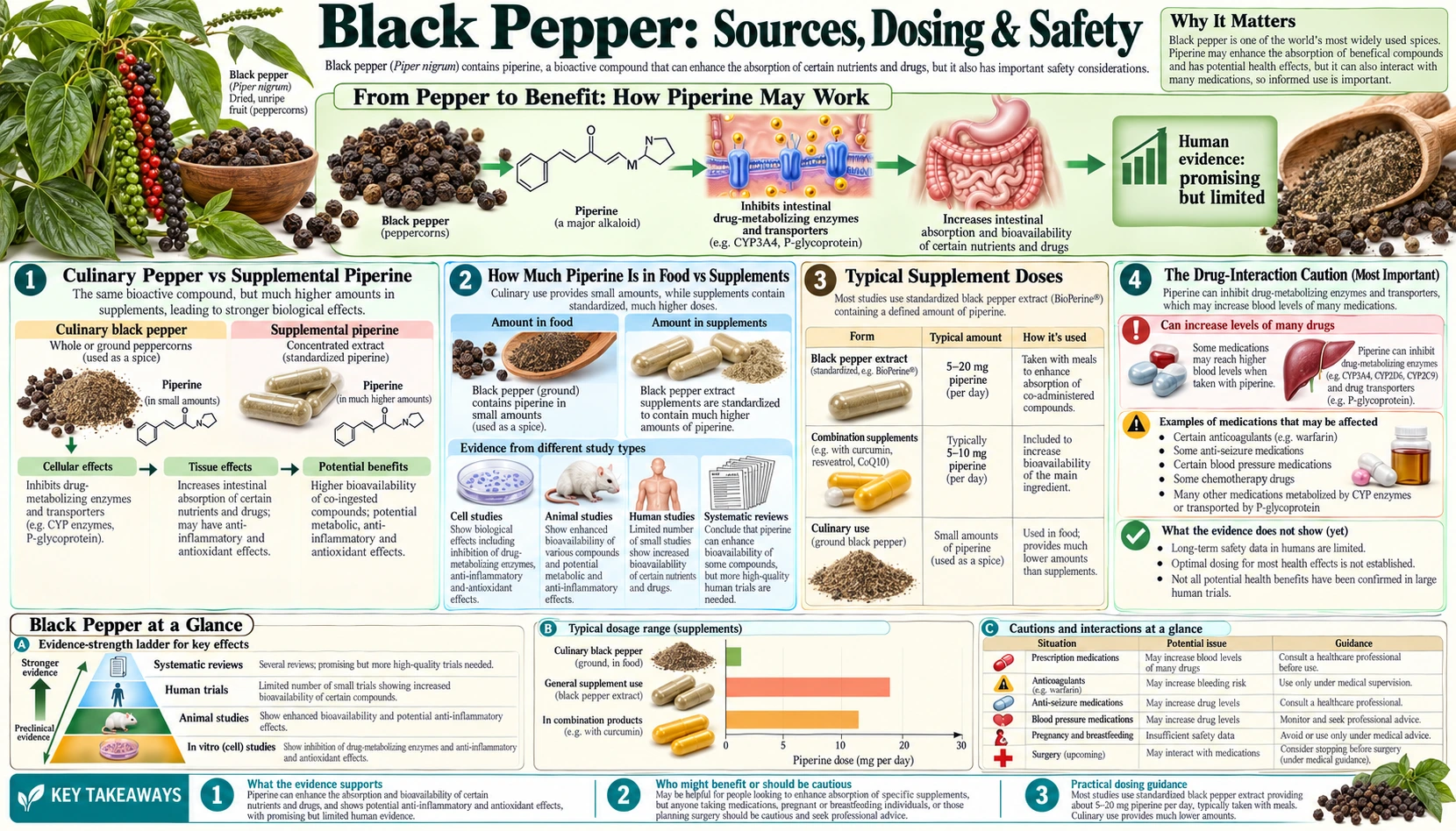
There is a wide gulf between the black pepper on your dinner table and a concentrated piperine capsule, and the research treats them very differently. Culinary black pepper has one of the best safety records of any substance on Earth — billions of people have used it daily for thousands of years. Concentrated piperine supplements (usually a standardized piperine extract (95% piperine)) are a newer and different proposition: the whole point of them is to alter your metabolism enough to boost absorption, and a metabolic modifier is, by definition, something that can interact with medications. This page covers how much piperine is in food versus supplements, typical doses, the toxicity data, and — most importantly — the drug-interaction findings that matter most for people taking prescription medicine.
Table of Contents
- Culinary Pepper vs Supplemental Piperine
- How Much Piperine Is in Food vs Supplements
- Typical Supplement Doses
- The Drug-Interaction Caution (Most Important)
- Specific Drugs of Concern
- Toxicity and Safety Studies
- Pregnancy and Special Populations
- Liver Injury Reports With Turmeric-Plus-Pepper Supplements
- The Evidence in Brief: Food and Supplements
- Key Research Papers
- External Resources
- Connections
- Featured Videos
Culinary Pepper vs Supplemental Piperine
Black pepper is the dried, unripe fruit ("peppercorn") of the vine Piper nigrum. Its pungency comes from piperine, which makes up roughly 3–9% of the dried peppercorn by weight, along with a fragrant volatile oil. White pepper is the same fruit with the outer layer removed; green and pink peppercorns are variations in ripeness and processing. All of the culinary forms deliver piperine in the modest amounts that come with seasoning food.
Supplemental piperine is a different animal. It is extracted and concentrated — a widely used form is a standardized piperine extract (95% piperine) — and dosed deliberately to modify metabolism and enhance the absorption of a companion compound such as curcumin. The distinction is not academic. Everything reassuring about pepper's safety comes from the culinary tradition; the cautions on this page apply chiefly to the concentrated supplemental form, where the dose and the intent are both different.
A useful mental model: culinary pepper is a food, and supplemental piperine is closer to a mild pharmacological agent. Both are legitimate, but the long safety record belongs to the food.
How Much Piperine Is in Food vs Supplements
Because piperine is 3–9% of a peppercorn, a rough sense of dietary exposure is easy to build:
- A moderate seasoning of a dish — on the order of a quarter to a half teaspoon of ground black pepper spread across servings — delivers on the rough order of a few tens of milligrams of piperine at most, and often much less per portion.
- The famous curcumin study used just 20 mg of piperine to produce its large absorption effect — an amount reachable through generous culinary use.
- A standardized supplement capsule commonly provides 5–20 mg of piperine as a standardized piperine extract (95% piperine), sometimes more, on top of whatever the diet supplies.
The point here is that a supplement is not needed to get piperine's absorption benefit — a well-peppered turmeric dish already lands in the studied range. Supplements add convenience and a guaranteed dose, but they also stack onto dietary intake, which is what pushes some people into the interaction zone. Black pepper in food is the form that carries the long culinary safety record.
Typical Supplement Doses
When piperine is sold as a standalone or add-on supplement, common practice looks like this:
- As an absorption enhancer: roughly 5–20 mg of piperine (often as a standardized piperine extract (95% piperine)) paired with the compound being boosted, most commonly curcumin. The human studies on this page used 20 mg.
- In combination products: many curcumin, resveratrol, and multi-ingredient formulas include a few milligrams of piperine by default, so people often consume it without realizing.
- Higher standalone doses are marketed for metabolic or "fat-burning" purposes, but as the Antioxidant & Metabolic page explains, the human evidence does not support those uses — and higher doses increase interaction risk without a proven payoff.
There is no official recommended intake for piperine because it is not an essential nutrient. The absorption effect in the research was seen at small doses (20 mg), and larger doses act through the same enzyme inhibition that drives the drug interactions.
The Drug-Interaction Caution (Most Important)
This is the single most important section on the page. Piperine's benefit and its risk are the same mechanism. By inhibiting the cytochrome P450 3A4 (CYP3A4) and other cytochrome-P450 enzymes, the UGT glucuronidation enzymes, and the P-glycoprotein efflux pump — the systems mapped by Atal (1985) and Bhardwaj (2002) — piperine slows the clearance of many compounds. When that compound is curcumin, the result is a welcome absorption boost. When it is a prescription drug, the result can be a higher-than-expected blood level of the medication.
This is not theoretical. Human studies have documented real interactions:
- Bano and colleagues (1991) showed piperine raised blood levels of propranolol (a beta-blocker) and theophylline (an airway drug) in healthy volunteers (six per drug, after piperine 20 mg daily for 7 days).
- Velpandian and colleagues (2001) found dietary piperine interfered with the pharmacokinetics of phenytoin, an anti-seizure drug: in six healthy volunteers, a black-pepper soup before a 300 mg phenytoin tablet raised total exposure and delayed elimination.
- Pattanaik and colleagues (2009) reported that piperine altered steady-state carbamazepine levels in epilepsy patients: in 20 patients, one 20 mg dose of piperine significantly raised total carbamazepine exposure and its average steady-state level.
For a drug where the effective dose and the toxic dose are far apart, a modest bump in level is usually harmless. For a drug with a narrow therapeutic index — where the safe and unsafe levels are close together — even a modest increase can matter. That is why the concern focuses on specific medication classes rather than on drugs in general.
Specific Drugs of Concern
The research raises interaction concerns for the following drug groups, chiefly with concentrated piperine supplements rather than ordinary culinary pepper. In people, only phenytoin, carbamazepine, propranolol and theophylline have been tested; the other groups are listed because they are cleared by the same enzymes and pumps piperine blocks.
- Anti-seizure drugs — phenytoin and carbamazepine specifically, both with documented interactions and narrow margins.
- Medications metabolized by cytochrome P450 3A4 — a very large group that includes certain statins, some blood-pressure and heart-rhythm drugs, many benzodiazepines, and others. Cytochrome P450 3A4 handles roughly half of all drugs, so this is a broad flag.
- P-glycoprotein substrates — including the heart drug digoxin and various others, where reduced efflux can raise absorption.
- Immunosuppressants — such as those used after transplantation (for example, tacrolimus and cyclosporine), where precise blood levels are critical.
- Certain human immunodeficiency virus (HIV) medications and blood thinners — classes where level changes have real consequences.
- Other cytochrome P450 3A4/P-gp inhibitors already onboard — grapefruit juice and some herbs act on the same systems; piperine adds to their effect.
The concern is greatest for drugs with a narrow safety window and for drugs already known to interact with grapefruit, which acts on the same enzyme. Black pepper in food is the form with the long culinary safety record.
Toxicity and Safety Studies
Setting drug interactions aside, piperine's own toxicity profile is reassuring at dietary and typical supplemental doses. Piyachaturawat and colleagues (1983) studied the acute and subacute toxicity of piperine in mice, rats, and hamsters and found piperine acutely toxic at high doses, with the lethal dose depending on the route. Taken by mouth (by stomach tube), the dose that killed half the animals (LD50) was 330 mg per kilogram of body weight in male mice and 514 mg/kg in female rats, and under the skin it was 200 mg/kg in mice — hundreds of milligrams per kilogram, far beyond what a person consumes. Injected into a vein or the belly cavity, much smaller doses were lethal: 15.1 mg/kg into a vein and 43 mg/kg into the belly cavity in male mice, 60 mg/kg into the belly cavity in female mice and 33.5 mg/kg in female rats. Most animals given a lethal dose died of breathing paralysis within 3–17 minutes.
Bhat and Chandrasekhara (1986) mapped how piperine is absorbed, distributed to tissues, and excreted in rats, providing the metabolic groundwork that underlies both its bioavailability effect and its safety assessment. The compound is handled and eliminated by the body rather than accumulating to dangerous levels at ordinary intakes.
The one animal signal that warrants a specific mention is reproductive: Daware and colleagues (2000) reported reproductive toxicity of high-dose piperine in Swiss albino mice. Piperine at 10 and 20 mg/kg of body weight lengthened the resting phase of the reproductive cycle (diestrus), which seemed to lower mating performance and fertility, and piperine given by mouth for five days after mating showed considerable anti-implantation activity (fewer embryos settling in the womb). Growth of the litters after birth and the sex ratio were not affected. These doses are well above culinary exposure; they are the basis of the pregnancy point below, which concerns concentrated supplements specifically.
Pregnancy and Special Populations
- Pregnancy and breastfeeding: culinary black pepper as a normal part of food is considered fine and has been eaten by pregnant women across every culture for millennia. Concentrated high-dose piperine supplements are a different matter — human pregnancy safety data for them are lacking, and the one signal is the mouse study above (Daware 2000), with lower fertility and anti-implantation effects at 10–20 mg/kg.
- People on multiple medications (polypharmacy): the more prescription drugs someone takes, the higher the chance one of them is affected by piperine's enzyme inhibition. Older adults, who more often take several medications, are the group most exposed to this with high-dose supplements.
- Active peptic ulcer, gastritis, or reflux: as discussed on the Digestion & Gut page, pungent pepper can aggravate an irritated stomach or trigger heartburn in susceptible people.
- Upcoming surgery: piperine's potential to alter drug metabolism also applies to the medicines given around a scheduled procedure.
Liver Injury Reports With Turmeric-Plus-Pepper Supplements
Liver injury from turmeric supplements is a separate safety finding, and black pepper appears in it. A 2023 case series from the United States Drug-Induced Liver Injury Network (DILIN) reviewed every case enrolled from 2004 to 2022 in which turmeric was an implicated product:
- It found 10 cases of turmeric-associated liver injury, all enrolled since 2011 and 6 of them since 2017. Eight were women, and the median age was 56 (range 35–71).
- Five people were admitted to hospital, and 1 died of acute liver failure. The injury typically appeared 1 to 4 months after starting the product.
- Laboratory testing confirmed turmeric in all 7 products that could be tested; 3 of them also contained piperine (black pepper).
- Seven of the 10 patients carried the gene type HLA-B*35:01, far more often than in the general population.
- The authors concluded that liver injury from turmeric appears to be increasing in the United States, “perhaps reflecting usage patterns or increased combination with black pepper”.
A 2025 case report and review from Australia describes a 40-year-old woman with increasing tiredness, itching and dark urine who developed significant drug-induced liver injury after drinking turmeric-and-black-pepper “wellness shots”. Its authors note that recent concerns about turmeric and the liver are linked to formulations with enhanced bioavailability, often including piperine, and that the role of genetic predisposition still needs study. Tiredness, itching and dark urine, the symptoms in this case, are signs of liver injury that hospitals treat as urgent.
The Evidence in Brief: Food and Supplements
Pulling it all together:
- Food. A well-peppered turmeric dish delivers piperine in the studied range for boosting curcumin, with the full reassurance of the culinary safety record.
- Supplement doses. For boosting curcumin with a standardized piperine supplement, the small doses (single-digit to ~20 mg) are the ones studied; higher doses add interaction risk without proven benefit.
- Medications. The interaction concern with high-dose piperine is greatest for anti-seizure drugs, immunosuppressants, blood thinners, digoxin and drugs flagged for a grapefruit interaction.
- Metabolic claims. Piperine for weight loss, cholesterol or blood sugar is unproven in people (see the Antioxidant & Metabolic page).
- Pregnancy. The reproductive signal comes from concentrated piperine in mice; culinary pepper has been part of ordinary food in pregnancy across cultures.
Used this way, black pepper is what it has always been: a safe, flavorful spice with one genuinely useful, human-proven trick — helping you absorb the good compounds it shares a plate with.
Key Research Papers
- Bano G, et al. (1991). Effect of piperine on bioavailability and pharmacokinetics of propranolol and theophylline in healthy volunteers. European Journal of Clinical Pharmacology — PubMed PMID: 1815977
- Velpandian T, et al. (2001). Piperine in food: interference in the pharmacokinetics of phenytoin. European Journal of Drug Metabolism and Pharmacokinetics — PubMed PMID: 11808866
- Pattanaik S, et al. (2009). Pharmacokinetic interaction of single dose of piperine with steady-state carbamazepine in epilepsy patients. Phytotherapy Research — PubMed PMID: 19283724
- Atal CK, et al. (1985). Biochemical basis of enhanced drug bioavailability by piperine: evidence that piperine is a potent inhibitor of drug metabolism. Journal of Pharmacology and Experimental Therapeutics — PubMed PMID: 3917507
- Bhardwaj RK, et al. (2002). Piperine, a major constituent of black pepper, inhibits human P-glycoprotein and CYP3A4. Journal of Pharmacology and Experimental Therapeutics — PubMed PMID: 12130727
- Han HK (2011). The effects of black pepper on the intestinal absorption and hepatic metabolism of drugs. Expert Opinion on Drug Metabolism & Toxicology — PubMed PMID: 21434835
- Piyachaturawat P, et al. (1983). Acute and subacute toxicity of piperine in mice, rats and hamsters. Toxicology Letters — PubMed PMID: 6857729
- Daware MB, et al. (2000). Reproductive toxicity of piperine in Swiss albino mice. Planta Medica — PubMed PMID: 10821048
- Bhat BG, Chandrasekhara N (1986). Studies on the metabolism of piperine: absorption, tissue distribution and excretion of urinary conjugates in rats. Toxicology — PubMed PMID: 3715893
- Halegoua-DeMarzio D, Navarro V, Ahmad J, Avula B, Barnhart H, Barritt AS, Bonkovsky HL, Fontana RJ, Ghabril MS, Hoofnagle JH, Khan IA, Kleiner DE, Phillips E, Stolz A, Vuppalanchi R (2023). Liver injury associated with turmeric — a growing problem: ten cases from the Drug-Induced Liver Injury Network [DILIN]. American Journal of Medicine 136(2):200-206 — PubMed PMID: 36252717
- Shrestha A, Elliott S, Abasszade JH, Wu K, Worland T, Simpson I, Dev A (2025). Drug-induced liver injury associated with turmeric and piperine: a case and review. Case Reports in Gastroenterology 19(1):96-106 — PubMed PMID: 39995754
- Srinivasan K (2007). Black pepper and its pungent principle-piperine: a review of diverse physiological effects. Critical Reviews in Food Science and Nutrition — PubMed PMID: 17987447
- Kesarwani K, Gupta R, Mukerjee A (2013). Bioavailability enhancers of herbal origin: an overview. Asian Pacific Journal of Tropical Biomedicine — PubMed PMID: 23620848
PubMed Topic Searches
External Resources
- PubChem — Piperine — U.S. National Institutes of Health (NIH) chemical record with safety and toxicity data
- U.S. Department of Agriculture (USDA) FoodData Central — nutrient composition for the spice "pepper, black"
- MedlinePlus — Herbs and Supplements (A–Z) — U.S. National Library of Medicine consumer reference