White Button Mushroom, Aromatase, and Breast Health
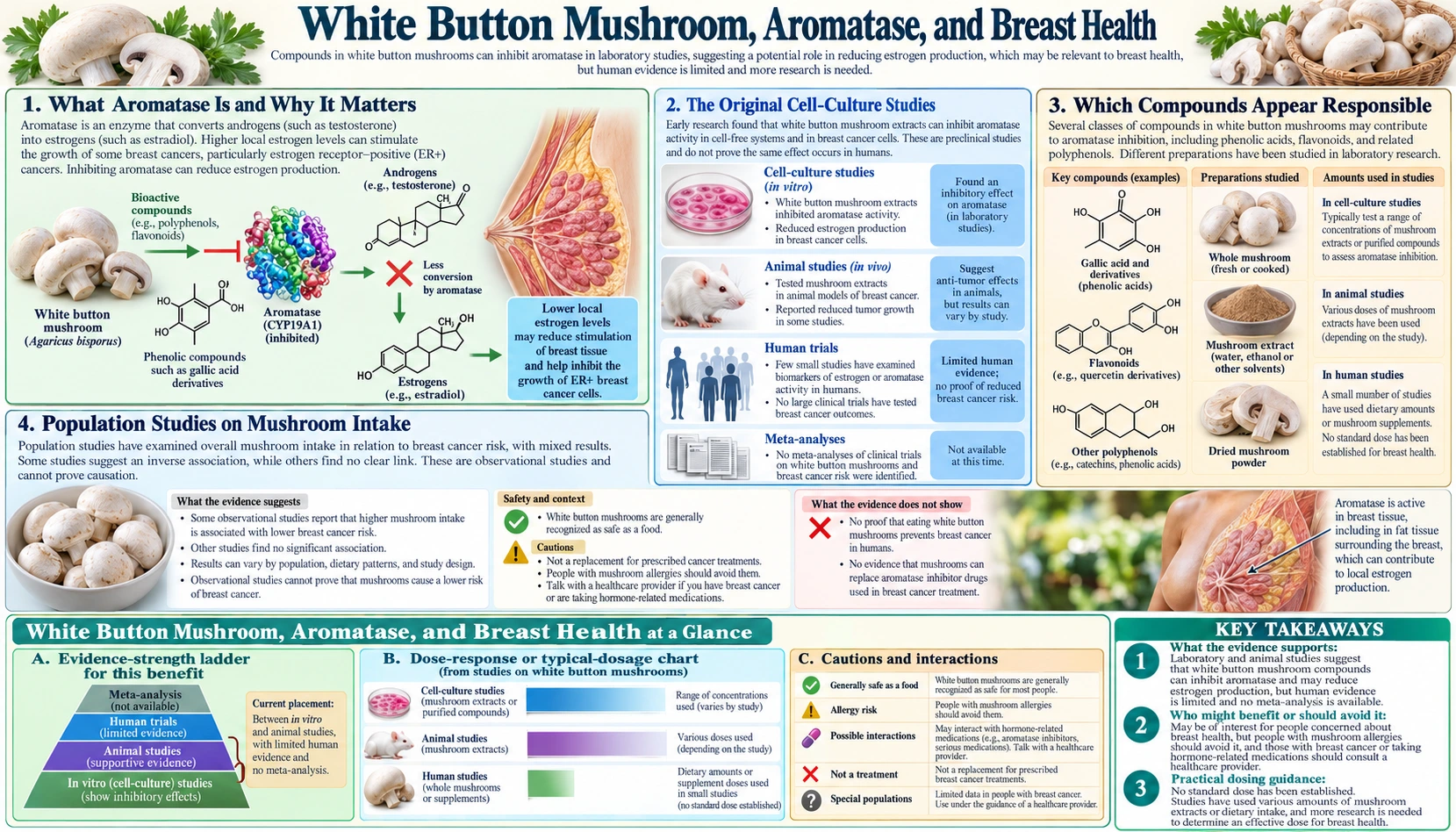
Read this framing first. White button mushrooms have a real and unusually consistent body of research showing that their extracts inhibit aromatase — the enzyme that makes estrogen — in laboratory cell studies, and several population studies link higher mushroom intake to lower breast-cancer rates. That is a genuinely interesting scientific signal, and this page explains it fairly. But it is essential to be clear: eating mushrooms is not a proven way to prevent or treat breast cancer, and no study has tested mushrooms as a replacement for screening or prescribed treatment. The gap between "an extract inhibits an enzyme in a dish" and "a food prevents a disease in people" is enormous, and the honest state of the evidence lives inside that gap. This is a page about promising research, presented as research.
Table of Contents
- What Aromatase Is and Why It Matters
- The Original Cell-Culture Studies
- Which Compounds Appear Responsible
- Population Studies on Mushroom Intake
- What the Epidemiology Can and Cannot Tell Us
- The Gap Between Cell Studies and Proven Therapy
- Where This Honestly Fits
- Sensible Context for Breast-Health Concerns
- Cautions
- Key Research Papers
- External Authoritative Resources
- Connections
- Featured Videos
What Aromatase Is and Why It Matters
Aromatase (the enzyme encoded by the CYP19A1 gene) is the enzyme that converts androgens into estrogens — it is the last, rate-limiting step in the body's production of estrogen. In premenopausal women the ovaries are the main site of estrogen production, but after menopause the ovaries largely stop, and the body's estrogen comes increasingly from aromatase acting in peripheral tissues, including fat and breast tissue itself.
This matters for breast biology because roughly three-quarters of breast cancers are hormone-receptor-positive — their growth is driven by estrogen binding to receptors on the tumour cells. That is precisely why a class of drugs called aromatase inhibitors (anastrozole, letrozole, exemestane) is a cornerstone of treatment for hormone-receptor-positive breast cancer in postmenopausal women: by blocking aromatase, they lower the estrogen that fuels those tumours. These are powerful, prescription-only medicines with real effects and real side effects.
The scientific interest in white button mushrooms began with a simple, striking observation: mushroom extracts appear to inhibit this same enzyme in the laboratory. That does not make a mushroom a drug — but it is why researchers took an interest, and it is the thread that connects everything below.
The Original Cell-Culture Studies
The foundational work came from the laboratory of Shiuan Chen at the City of Hope research institute. In a 2001 paper in the Journal of Nutrition, Grube, Eng, Kao, Kwon, and Chen reported that white button mushroom extract inhibited aromatase activity and suppressed the proliferation of estrogen-receptor-positive breast cancer cells in culture. Among a range of vegetables screened, white button mushroom was one of the most potent aromatase inhibitors.
Chen's group followed up in 2006 in Cancer Research (Chen, Oh, Phung, et al.), characterising the anti-aromatase activity of phytochemicals in Agaricus bisporus in more detail and testing mushroom extract in cell and animal-tumour models. Related work from the same group (Adams et al., 2008) reported antiproliferative and pro-apoptotic effects and inhibition of prostate tumour growth in a mouse model — suggesting the activity was not limited to breast tissue.
These are careful, reputable studies, and the finding has been reproduced enough to be considered robust as a laboratory phenomenon. The critical words are "laboratory phenomenon." The extracts were applied directly to cells or fed at defined doses to mice with implanted tumours. Neither situation is the same as a person eating sauteed mushrooms with dinner, where the compounds must survive cooking and digestion, be absorbed, reach the tissue at a meaningful concentration, and act over years. Those steps are exactly what the cell studies cannot tell us about.
Which Compounds Appear Responsible
What in the mushroom does this? The research points chiefly at certain fatty acids and lipid fractions — notably conjugated linoleic acid and related unsaturated fatty acids — as significant contributors to the aromatase-inhibiting activity of white button mushroom extracts, along with other phytochemicals. Chen's group fractionated the extracts and traced much of the activity to these lipid components.
In plain terms, their 2006 study found that the most active fraction (the part that dissolves in ethyl acetate) held mainly unsaturated fatty acids: linoleic acid, linolenic acid and conjugated linoleic acid. Linoleic acid and conjugated linoleic acid blocked aromatase with similar strength, but only conjugated linoleic acid slowed the testosterone-driven growth of the aromatase-carrying breast cancer cells, so the authors concluded that conjugated linoleic acid and its derivatives are the most likely relevant aromatase inhibitors in mushrooms. In mice carrying these tumour cells, mushroom extract lowered tumour cell growth and tumour weight, with no change in the rate of cell death (apoptosis).
This is mechanistically plausible, but it also complicates the "just eat mushrooms" story. If the active fraction is a specific set of fatty acids present at modest levels, then the dose of active compound in a normal serving is far lower than the concentrations used to inhibit the enzyme in a dish. It also means the effect, whatever its size in humans, may depend on how the mushrooms are prepared and on the individual's absorption and metabolism — variables no one has pinned down. Identifying the active compounds is scientifically valuable, but it does not shorten the distance to a proven human benefit.
Population Studies on Mushroom Intake
Alongside the laboratory work, several observational studies have examined whether people who eat more mushrooms have lower breast-cancer rates:
- Zhang et al., 2009 (International Journal of Cancer). A case-control study of Chinese women found that higher intake of fresh and dried mushrooms was associated with lower breast-cancer risk, and that combining mushrooms with green tea was associated with a further reduction. It compared 1,009 women with breast cancer with 1,009 women without it: eating 10 g or more of fresh mushrooms a day went with lower odds of breast cancer than eating none (odds ratio 0.36), and a high intake of fresh mushrooms together with daily green tea went with an odds ratio of 0.11. The lower risk was seen in both pre- and postmenopausal women. This is one of the most-cited studies in the area.
- Shin et al., 2010 (Nutrition and Cancer). A Korean case-control study (358 patients, 360 cancer-free women) reported that the highest mushroom intake was associated with reduced breast-cancer risk among premenopausal women only (odds ratio 0.35 for the highest versus the lowest quarter of intake), with the association stronger for estrogen- and progesterone-receptor-positive tumours (odds ratio 0.30) than for receptor-negative ones — consistent with an estrogen-related mechanism.
- Meta-analyses (Li et al., 2014, PLoS ONE; and Ba et al., 2021, Advances in Nutrition). Pooled analyses of observational studies have concluded that higher mushroom consumption is associated with modestly lower risk of breast cancer specifically and of cancer generally. Li pooled eight case-control and two cohort studies (6,890 cases) and found a relative risk of 0.97 for breast cancer with each extra gram of mushrooms a day. Ba pooled 17 observational studies: the highest mushroom eaters had a relative risk of 0.65 for breast cancer (10 studies) compared with the lowest.
- Lee et al., 2019 (Cancer Prevention Research). The largest prospective study so far followed 68,327 women in the Nurses' Health Study and 44,664 men in the Health Professionals Follow-up Study in the United States for up to 26 years, during which 22,469 cancers were diagnosed. People who ate five or more servings of mushrooms a week had no significantly different risk of total cancer than people who almost never ate them (hazard ratio 1.06, 95% CI 0.98–1.14). The study found no association with 16 specific cancers, breast cancer included, and a borderline higher trend for lung cancer (P trend = 0.05).
Taken together, most case-control studies, and the meta-analyses built largely on them, point in one direction: more mushrooms, somewhat less breast cancer, on average. The largest prospective cohort did not find this, and the 2021 meta-analysis itself noted that 11 of its 17 studies were case-control designs, which carry a potential for recall and selection bias.
What the Epidemiology Can and Cannot Tell Us
Observational studies of diet are genuinely useful, but they carry well-known limitations, stated plainly here:
- Association is not causation. People who eat more mushrooms tend to eat more vegetables and whole foods, weigh less, exercise more, and differ in dozens of ways from people who eat few. Statistical adjustment reduces but never eliminates this "confounding." The lower cancer rate might be caused by the overall healthy pattern, not by mushrooms specifically.
- Diet is measured imperfectly. Most studies rely on food-frequency questionnaires, which are approximate and subject to recall error.
- Effect sizes are modest. The associations, where present, are reductions in relative risk — meaningful at a population level, but not the kind of dramatic effect that would justify calling any food protective for an individual.
- Publication and heterogeneity. Studies vary in population, mushroom types, and quality, and meta-analyses inherit those differences.
None of this makes the findings worthless — a biologically-plausible association across multiple populations is a legitimate reason to keep studying mushrooms. But it falls well short of proof that eating mushrooms lowers your risk. The only design that could establish causation — a large, long randomised controlled trial of mushroom intake with breast-cancer outcomes — has not been done, and would be difficult and expensive to do.
The Gap Between Cell Studies and Proven Therapy
It is worth naming the gap explicitly, because a great deal of health misinformation lives inside it. A substance can inhibit an enzyme in a laboratory dish and still do nothing useful in a human being, for many reasons: it may not be absorbed; it may be broken down before reaching the target; the concentration achievable from food may be far below the active threshold; the body may compensate; or the effect may be real but too small to matter clinically. The history of nutrition is full of compounds that looked exciting in cells and disappointed in trials.
So the correct reading of the white button mushroom evidence is layered:
- Laboratory (strong and reproducible): mushroom extracts inhibit aromatase and slow estrogen-driven cancer-cell growth in culture.
- Epidemiology (suggestive): higher mushroom intake is associated with modestly lower breast-cancer risk across several populations in case-control studies and meta-analyses, though the largest prospective cohort found no link.
- Clinical proof (absent): no randomised trial shows that eating mushrooms prevents or treats breast cancer in humans.
All three layers are true at once. Honesty means holding them together — being genuinely interested in the first two without pretending they add up to the third.
Where This Honestly Fits
Given all that, what is the reasonable, non-hyped takeaway? Mushrooms are a nutritious, low-calorie, high-satiety food that fits every mainstream dietary pattern associated with lower cancer risk — the vegetable-forward, whole-food, weight-controlling patterns that public-health bodies already recommend. Because excess body fat raises post-menopausal estrogen (fat tissue is itself a site of aromatase activity), a filling low-calorie food that helps with weight control has an indirect, well-established rationale for breast health that does not depend on the mushroom's special aromatase chemistry at all.
In other words: there are good, ordinary reasons to eat mushrooms as part of a breast-healthy diet, and a scientifically-interesting-but-unproven additional hypothesis about aromatase on top. The solid reasons stand on their own; the aromatase story remains intriguing science under study, and no study has tested mushrooms as a substitute for screening or prescribed therapy. For the disease itself, see Breast Cancer.
Sensible Context for Breast-Health Concerns
If breast health is on your mind, the interventions with real, proven value are unglamorous and well-established:
- Screening — mammography and clinical follow-up at the intervals screening guidelines set catch disease early, when it is most treatable. Nothing in this page changes that.
- Weight and physical activity — maintaining a healthy weight and staying active are among the best-supported modifiable factors for post-menopausal breast-cancer risk, partly through their effect on estrogen.
- Alcohol — even moderate alcohol intake is a recognised breast-cancer risk factor; reducing it is one of the clearest dietary levers.
- An overall vegetable-and-whole-food diet — the pattern that mushrooms fit into, and where their strongest rationale lies.
- Prescribed prevention or treatment — for those at high risk or with a diagnosis, medications including actual aromatase inhibitors are prescription drugs. No food has been shown to substitute for them.
Mushrooms belong in the diet as one healthy food among many — a sensible, pleasant addition, not a shield.
Cautions
- Not a treatment or a preventive. No study has tested mushrooms — or any food — as a replacement for screening, diagnosis, or prescribed treatment for breast cancer.
- Food and prescribed medication. The mushroom aromatase research was done in cells and mice; no study has tested mushrooms alongside, or in place of, a prescribed aromatase inhibitor or other breast-cancer therapy.
- Supplements are not the food. Concentrated "mushroom aromatase" supplements are not proven, are not regulated as drugs, and are not endorsed here. This page is about mushrooms as food.
- Cooked versus raw — raw Agaricus mushrooms contain small amounts of agaritine, which cooking substantially reduces (see the Immune Support page's note on agaritine).
- Individual variation is unknown. Because the human effect (if any) is unproven, no one can tell you what a given amount will do for you personally, and no study supports claims of a precise benefit.
Key Research Papers
The studies below are cell-culture and observational research. None establishes that eating mushrooms prevents or treats breast cancer; they are presented so readers can examine the actual science behind the aromatase discussion.
- Grube BJ, Eng ET, Kao YC, Kwon A, Chen S (2001). White button mushroom phytochemicals inhibit aromatase activity and breast cancer cell proliferation. Journal of Nutrition — PubMed PMID: 11739882
- Chen S, Oh SR, Phung S, et al. (2006). Anti-aromatase activity of phytochemicals in white button mushrooms (Agaricus bisporus). Cancer Research — PubMed PMID: 17178902
- Adams LS, Phung S, Wu X, Ki L, Chen S (2008). White button mushroom (Agaricus bisporus) exhibits antiproliferative and proapoptotic properties and inhibits prostate tumor growth in athymic mice. Nutrition and Cancer — PubMed PMID: 19005974
- Zhang M, Huang J, Xie X, Holman CD (2009). Dietary intakes of mushrooms and green tea combine to reduce the risk of breast cancer in Chinese women. International Journal of Cancer — PubMed PMID: 19048616
- Shin A, Kim J, Lim SY, et al. (2010). Dietary mushroom intake and the risk of breast cancer based on hormone receptor status. Nutrition and Cancer — PubMed PMID: 20432168
- Li J, Zou L, Chen W, et al. (2014). Dietary mushroom intake may reduce the risk of breast cancer: evidence from a meta-analysis of observational studies. PLoS ONE — PubMed PMID: 24691133
- Ba DM, Ssentongo P, Beelman RB, et al. (2021). Higher mushroom consumption is associated with lower risk of cancer: a systematic review and meta-analysis of observational studies. Advances in Nutrition — PubMed PMID: 33724299
- Lee DH, Yang M, Keum N, Giovannucci EL, Sun Q, Chavarro JE (2019). Mushroom Consumption and Risk of Total and Site-Specific Cancer in Two Large U.S. Prospective Cohorts. Cancer Prevention Research — PubMed PMID: 31164344
- Martin KR, Brophy SK (2010). Commonly consumed and specialty dietary mushrooms reduce cellular proliferation in MCF-7 human breast cancer cells. Experimental Biology and Medicine — PubMed PMID: 20921274
- Chen S (1998). Aromatase and breast cancer. Frontiers in Bioscience 3:d922-933. — PubMed PMID: 9696881
PubMed Topic Searches
External Authoritative Resources
- National Cancer Institute — Breast Cancer — authoritative, evidence-based information on risk, screening, and treatment
- American Cancer Society — Breast Cancer
- Memorial Sloan Kettering — About Herbs (integrative-oncology evidence summaries)
- PubMed — mushrooms, aromatase, and breast cancer