White Button, Cremini & Portobello Mushrooms (Agaricus bisporus)
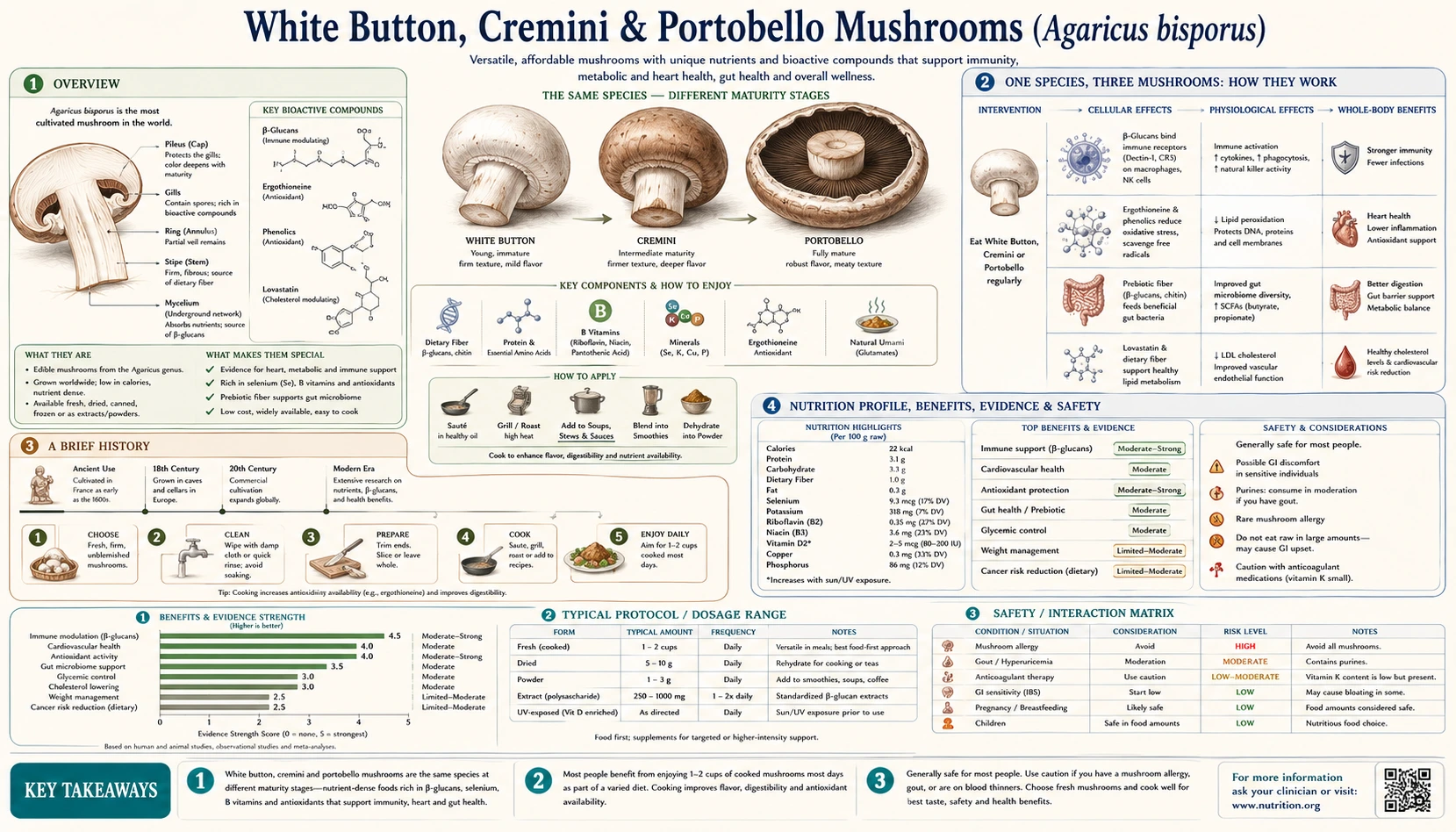
The mushroom in your grocery cart is almost certainly Agaricus bisporus. White button, cremini (also spelled crimini, and sold as "baby bella"), and the large portobello are not three different mushrooms — they are the same species at different ages and color strains. It is the most-cultivated and most-eaten mushroom on Earth, and unlike its medicinal cousins, its appeal is straightforward: it is a low-calorie, low-fat, nutrient-dense food that adds savory umami depth to ordinary cooking. This page treats it as food first — what it contains, what the research actually supports, and how to buy, store, and cook it safely.
Table of Contents
- Overview
- One Species, Three Mushrooms
- A Brief History
- Nutrition Profile
- Vitamin D from Sunlight & Ultraviolet
- Ergothioneine & Selenium — Antioxidants
- Potassium, Blood Pressure & Cardiometabolic Health
- Weight, Satiety & Blood Sugar
- Gut Health & Prebiotic Fiber
- Breast Health Research
- Culinary Use, Forms & Selection
- Safety & Cautions
- Key Research Papers
- Connections
- Featured Videos
Overview
Agaricus bisporus is a saprotrophic mushroom — it lives on decaying organic matter rather than on a living tree — and it is the workhorse of global mushroom farming. By volume it dwarfs every other cultivated mushroom, supplying the buttons, criminis, and portobellos that fill produce sections worldwide. Whereas reishi, lion's mane, chaga, and turkey tail are valued mainly for concentrated bioactive compounds taken as teas or extracts, A. bisporus is eaten as an everyday vegetable in stir-fries, omelets, sauces, soups, and grain bowls.
That "purely nutritious" framing is the honest one. The button mushroom does carry some genuinely interesting compounds — the antioxidant ergothioneine, the provitamin ergosterol that becomes vitamin D under ultraviolet light, and a modest amount of beta-glucan fiber — but its day-to-day value is as a low-energy, high-flavor food that helps round out a plant-rich diet. Most of the human evidence below treats it as a food, not a drug.
One Species, Three Mushrooms
This is the single most useful thing to understand about the grocery-store mushroom: white button, cremini, and portobello are all Agaricus bisporus. The differences come down to strain (color) and maturity (age), not species.
- White button — an immature white strain. These are harvested young, before the cap has opened, so the gills underneath are still pale and closed. Mild, with the highest water content and the gentlest flavor.
- Cremini / crimini / "baby bella" — an immature brown strain of the very same species. Same age and shape as a white button, but a naturally darker, denser cap that brings a slightly firmer texture and a deeper, earthier taste.
- Portobello — a mature brown mushroom, simply a cremini left to grow. As the cap opens fully it widens to several inches, the dark gills become exposed, water is lost, and the flavor concentrates. The meaty texture of a grilled portobello "cap steak" is the same mushroom you would otherwise have eaten small.
Because they are one species, their nutrition is broadly similar. Practical differences are about water and surface area: older, darker, more open mushrooms tend to be a little more concentrated in flavor and dry matter, while young white buttons are wetter and milder. Knowing they are interchangeable means you can substitute freely in almost any recipe.
A Brief History
Deliberate cultivation of Agaricus bisporus is usually traced to 17th-century France, where growers learned to raise it on composted horse manure in the cool, humid stone quarries and caves around Paris — the origin of the old name champignon de Paris. The dark, temperature-stable caves provided exactly the conditions the fungus needed, and the practice spread across Europe over the following two centuries.
In the United States the crop became an industry. Southeastern Pennsylvania — especially the area around Kennett Square, often called the "mushroom capital" — grew into the heart of American mushroom production after growers there refined indoor, climate-controlled cultivation in the late 1800s and early 1900s. The familiar all-white button was popularized in the 20th century as a naturally occurring pale mutant that was selected and propagated for its clean appearance. Modern production uses pasteurized compost, controlled humidity, and careful temperature management to grow mushrooms indoors year-round, which is why fresh buttons, criminis, and portobellos are available in every season.
Nutrition Profile
White, cremini, and portobello mushrooms share a lean, water-rich nutrient profile. A typical serving is low in calories (raw A. bisporus is roughly 90 percent water), with only about 3 grams of protein per 100 grams, very little fat, and almost no sodium — making them an unusually "guilt-free" way to add bulk and flavor to a dish.
What they bring nutritionally:
- Fiber, including fungal beta-glucan and chitin. Mushroom fiber is not the same as plant fiber: the cell walls are built from chitin and beta-glucans rather than cellulose. This is the fraction linked to gut and satiety effects discussed below.
- B vitamins. Button mushrooms are a good source of several B vitamins — notably riboflavin (B2), niacin (B3), and pantothenic acid (B5). They are one of the few non-animal foods that naturally contribute these in meaningful amounts.
- Copper. Mushrooms are among the better dietary sources of copper, a mineral needed for iron metabolism and connective tissue.
- Selenium. They supply selenium, a trace mineral that supports antioxidant enzymes (and which partners with ergothioneine, below).
- Potassium and phosphorus. A useful amount of potassium and phosphorus, contributing to overall mineral intake.
Two honest caveats. First, because mushrooms are mostly water, the absolute numbers per serving are modest — they complement a meal rather than dominate its nutrition. Second, exact percentages depend on the strain, growing conditions, and especially on whether the mushroom has been exposed to ultraviolet light (which dramatically changes its vitamin D content). For that reason this page describes nutrients qualitatively ("a good source of…") rather than quoting precise daily-value figures that would vary from package to package.
Vitamin D from Sunlight & Ultraviolet
Here is the most distinctive nutritional feature of the button mushroom. Like human skin, mushrooms contain a sterol — in their case ergosterol — that converts to vitamin D2 (ergocalciferol) when exposed to ultraviolet (UV) light. A mushroom grown entirely in the dark contains very little vitamin D, but the same mushroom exposed to sunlight or a controlled ultraviolet lamp can become a meaningful dietary source. This is why some grocery mushrooms are now labeled "ultraviolet-treated" or "high in vitamin D."
The human evidence is real, not just theoretical. In a randomized controlled trial, Urbain and colleagues fed ultraviolet-B–irradiated button mushrooms to adults who were deficient in serum 25-hydroxyvitamin D and found that the mushroom-derived vitamin D2 was bioavailable and raised vitamin D status over the study period — demonstrating that an ordinary Agaricus bisporus mushroom, once exposed to ultraviolet light, can act as a genuine vitamin D food. The trial ran for 5 weeks in winter in 26 young adults with serum 25-hydroxyvitamin D of 50 nmol/l or less: serum 25-hydroxyvitamin D rose by 3.9 nmol/l per week with the mushroom soup and by 4.7 nmol/l per week with a vitamin D2 supplement, and the authors concluded that the mushroom vitamin D2 was not different to the supplement. Other controlled studies comparing ultraviolet-mushroom D2 with supplemental vitamin D have generally confirmed that it raises circulating 25-hydroxyvitamin D, though some work suggests D3 may be modestly more efficient at maintaining levels.
The practical takeaways: dark-grown mushrooms supply little vitamin D; ultraviolet-treated or deliberately sun-exposed button mushrooms can supply a worthwhile amount; and you can boost a home batch by setting fresh mushrooms gill-side up in direct sunlight for a stretch before cooking. For anyone limiting animal foods, ultraviolet mushrooms are one of the only non-fortified, naturally vitamin-D-bearing foods available.
Cooking does not destroy most of this vitamin D. In a 2023 laboratory study, button mushrooms exposed to pulsed ultraviolet light, air-dried and then rehydrated in warm water kept a high share of their vitamin D (≥95% of the D vitamers) after cooking, compared with rehydrated, uncooked mushrooms; frying (5 minutes) and baking (10 minutes, 200 °C) kept significantly more vitamin D2 than boiling (20 minutes, 90 °C).
Ergothioneine & Selenium — Antioxidants
Agaricus bisporus is one of the leading dietary sources of ergothioneine, an unusual sulfur-containing amino-acid antioxidant that the human body cannot make itself — it must come from food, and fungi are the main producers. The body actively transports ergothioneine via a dedicated carrier and concentrates it in tissues exposed to oxidative stress, which has led some researchers to propose it as a candidate "longevity vitamin": a nutrient that is not strictly essential for short-term survival but whose adequacy may matter for long-term health.
Mushrooms, including buttons and creminis, are described in the food-chemistry literature as a rich source of both ergothioneine and glutathione, the two acting as complementary antioxidants. Population data add a layer of interest: surveys have linked higher mushroom intake (a marker of ergothioneine intake) with measurable serum ergothioneine and, in some prospective cohorts, with lower mortality — associations that are suggestive but, being observational, cannot prove that ergothioneine itself is responsible.
Ergothioneine itself (as capsules, not mushrooms) has been tested in a small pilot trial. In a double-blind, randomized, placebo-controlled study, 19 people aged 60 or above with mild cognitive impairment took ergothioneine (25 mg per capsule) or a placebo 3 times a week for one year. The ergothioneine group performed better on a test of learning ability (the Rey Auditory Verbal Learning Test) and kept stable blood levels of neurofilament light chain, a marker of nerve-cell damage, while the placebo group saw no improvement in the memory tests and a significant rise in that marker. Blood counts and kidney and liver function did not change. It was a pilot study of 19 people.
The selenium in button mushrooms complements this antioxidant picture, since selenium is a building block of the body's glutathione peroxidase enzymes. Together, ergothioneine and selenium are a reasonable part of why mushrooms are framed as antioxidant-supporting foods — though, as always, this is about supporting a healthy diet rather than treating any disease.
Potassium, Blood Pressure & Cardiometabolic Health
Mushrooms contribute potassium with essentially no sodium, which is the nutritional ratio public-health guidance favors for healthy blood pressure. Swapping a salty, processed ingredient for sauteed mushrooms shifts a meal in that favorable direction without adding fat or sodium.
On the cardiometabolic side, controlled animal work has shown that Agaricus bisporus supplementation can improve lipid handling: in one study, white button mushroom (with or without a probiotic mixture) corrected dyslipidemia in hypercholesterolemic rats. These mechanistic and animal findings are encouraging and biologically plausible, but they are not the same as proof in humans — the honest reading is that mushrooms fit naturally into a heart-healthy, low-sodium, plant-forward eating pattern, and that direct human trials on blood pressure and lipids remain limited.
One randomized trial has tested whole mushrooms in people (Uffelman and colleagues, 2024). Sixty adults without diagnosed cardiometabolic disease (aged 46 ± 12 years, classified as overweight or obese) ate a Mediterranean-style diet, with all foods provided, either without mushrooms or with 84 g a day of white button (4 days a week) and oyster (3 days a week) mushrooms for 8 weeks. The mushroom diet improved fasting serum glucose (change from baseline −2.9 ± 1.18 compared with 0.6 ± 1.10 mg/dL), but the mushrooms did not influence the other established or emerging risk factors measured, which included blood pressure and fasting blood fats. (The Mediterranean diet itself, with or without mushrooms, changed some blood-fat measures.)
Weight, Satiety & Blood Sugar
The button mushroom's biggest practical advantage for weight is its low energy density: because it is mostly water and fiber, it adds volume and savory flavor for very few calories. The classic application is the meat swap — replacing part or all of the ground beef in a dish with finely chopped mushrooms (sometimes called "blending"). Substitution studies of mushroom-for-meat meals have reported that people feel comparably full and satisfied on the lower-calorie version, supporting mushrooms as a tool for reducing energy intake without leaving the plate sparse. In one such study (Cheskin and colleagues, 2008), adults ate four beef lunches and four mushroom lunches of the same volume, in random order, over two weeks: energy intake was 730+/-7.9 kcal at the meat lunches versus 310+/-5.8 kcal at the mushroom lunches, the subjects made up only 11.4+/-12.0% of that difference over 4 days, and ratings of palatability, appetite, satiation and satiety did not differ significantly.
Because they are low in available carbohydrate and rich in fiber, mushrooms also have a minimal effect on blood sugar, making them an easy, blood-sugar-friendly addition for people watching glycemic load. None of this makes mushrooms a weight-loss treatment on their own; the realistic claim is that, used as a high-volume, low-calorie, umami-rich substitute, they make calorie-conscious meals more satisfying.
Gut Health & Prebiotic Fiber
Mushroom fiber — the chitin and beta-glucans in the cell walls — largely resists digestion in the upper gut and reaches the colon, where gut bacteria can ferment it. That makes some of it behave as a prebiotic: food for beneficial microbes. Laboratory work using simulated gastrointestinal digestion followed by gut-microbiota fermentation of Agaricus bisporus polysaccharides has shown that this fungal fiber is fermented by the human gut microbiome, the step that underlies prebiotic and short-chain-fatty-acid effects.
As with the cardiometabolic findings, most of this evidence is preclinical or mechanistic rather than from large human trials, so the appropriate framing is modest: the fiber in button mushrooms is the type that feeds gut bacteria, which is one more reason mushrooms belong in a diverse, fiber-rich diet that supports digestive health. Cooking softens the chitin-rich cell walls and makes the nutrients more accessible, which is another reason mushrooms are usually eaten cooked rather than raw.
Breast Health Research
Mushrooms come up frequently in breast-cancer discussions, and it is worth stating clearly what the science does and does not show. There are two distinct lines of evidence, and neither establishes that eating mushrooms prevents breast cancer.
1. Epidemiology (association). Observational studies — including case-control research from China such as the Shanghai work linking higher mushroom intake to lower breast-cancer odds — have found that women who eat more mushrooms tend to have lower breast-cancer risk. A meta-analysis of dietary mushroom intake and breast cancer (Li and colleagues) pooled these observational studies and reported an inverse association, and broader reviews have likewise linked higher mushroom consumption to lower overall cancer risk. One such review, a 2021 meta-analysis of 17 observational studies (Ba and colleagues), reported a pooled relative risk (RR) for the highest compared with the lowest mushroom consumption of 0.66 (95% confidence interval, CI: 0.55, 0.78) for total cancer and 0.65 (95% CI: 0.52, 0.81; 10 studies) for breast cancer; the authors list as a limitation that 11 of the 17 studies were case-control designs, which are open to recall and selection bias. These are correlations: people who eat more mushrooms may differ in many other ways (diet, lifestyle, body weight), and observational data cannot prove cause and effect.
2. Preclinical mechanism (aromatase inhibition). Separately, laboratory studies have identified a plausible mechanism. Phytochemicals in white button mushrooms inhibit aromatase, the enzyme that synthesizes estrogen, and suppress the proliferation of estrogen-responsive breast-cancer cells in culture (Grube and colleagues), with follow-up work characterizing the anti-aromatase activity. Because many breast cancers are estrogen-driven, an aromatase-inhibiting food is biologically interesting — but cell-culture and animal findings do not automatically translate to prevention in people.
The honest synthesis: the association is real and the mechanism is plausible, which together explain why mushrooms are discussed as part of a protective overall diet, but button mushrooms are not a proven cancer preventive, and no study has tested them as a substitute for screening and medical care.
Culinary Use, Forms & Selection
The button mushroom's culinary value is umami — the savory, meaty "fifth taste" that comes from naturally occurring glutamate and related compounds. That depth is what lets mushrooms stand in for meat and round out vegetarian dishes.
- Water and browning. Because raw mushrooms are roughly 90 percent water, the first thing that happens in a hot pan is that they release that water and steam. Patience matters: let the water cook off, then keep going so the mushrooms brown. Browning (the Maillard reaction) is where the deep, savory flavor develops — crowding the pan or under-cooking leaves them pale and rubbery.
- White vs. brown vs. portobello. Use mild white buttons where you want the mushroom to recede (cream sauces, delicate soups); reach for cremini when you want more earthiness; and use big portobello caps where you want a meaty centerpiece — grilled or roasted as "cap steaks," stuffed, or sliced for sandwiches.
- Forms. Sold fresh (whole, sliced, or stuffing-sized caps), and also dried, canned, and frozen. Fresh is best for texture; dried mushrooms and their soaking liquid are a concentrated umami booster for stocks and sauces.
- Selection & storage. Choose firm, dry mushrooms with no sliminess and, on younger buttons, closed caps. Store them in the refrigerator in a paper bag or their breathable carton rather than a sealed plastic bag — trapped moisture makes them slimy. They are usually cleaned by brushing or a quick rinse just before cooking rather than soaked.
And remember the interchangeability: since white, cremini, and portobello are one species, you can swap them by weight in almost any recipe, adjusting only for the wetter, milder nature of young white buttons.
Safety & Cautions
Cultivated Agaricus bisporus is a very safe, well-tolerated food. A few points are worth knowing:
- Cooking and agaritine. Raw Agaricus mushrooms naturally contain agaritine, a compound in the hydrazine family that has raised theoretical concern in laboratory studies. Practically, agaritine is substantially reduced by cooking (and by storage and processing), which is why button, cremini, and portobello mushrooms are usually eaten cooked rather than raw. Cooking also softens the chitin-rich cell walls and improves digestibility.
- Rare allergy and intolerance. Mushroom allergy is uncommon but exists; some people also find large quantities of raw mushrooms hard to digest. People who have reacted to mushrooms before can react again.
- Wild Agaricus misidentification. This page is about cultivated mushrooms bought from a store, which are safe and reliably identified. Foraging is a different matter: some wild Agaricus look-alikes are genuinely toxic, and a few deadly mushrooms in unrelated genera can resemble immature buttons. Only an expert identification reliably tells a foraged mushroom from its toxic look-alikes.
- Kidney note. Mushrooms contribute potassium and phosphorus; for people with advanced kidney disease on a potassium- or phosphorus-restricted diet, they count toward the daily limit like any vegetable.
Educational disclaimer: this article is for general information and is not medical advice. It does not diagnose, treat, cure, or prevent any disease. Food and supplement responses vary from person to person. The main food-safety facts are listed above: cooking reduces the agaritine in raw mushrooms, mushrooms count toward potassium and phosphorus limits on restricted kidney diets, and some wild look-alikes are toxic.
Key Research Papers
Selected peer-reviewed literature. Links resolve to PubMed or DOI.
- Urbain P, Singler F, Ihorst G, Biesalski HK, Bertz H. Bioavailability of vitamin D2 from UV-B-irradiated button mushrooms in healthy adults deficient in serum 25-hydroxyvitamin D: a randomized controlled trial. Eur J Clin Nutr. 2011;65(8):965-71. — PubMed PMID: 21540874
- Kalaras MD, Richie JP, Calcagnotto A, Beelman RB. Mushrooms: A rich source of the antioxidants ergothioneine and glutathione. Food Chem. 2017;233:429-433. — PubMed PMID: 28530594
- Beelman RB, Kalaras MD, Phillips AT, Richie JP. Is ergothioneine a 'longevity vitamin' limited in the American diet? J Nutr Sci. 2020;9:e52. — PubMed PMID: 33244403
- Beelman RB, Phillips AT, Richie JP, et al. Health consequences of improving the content of ergothioneine in the food supply. FEBS Lett. 2022;596(10):1231-1240. — PubMed PMID: 34954825
- Ba DM, Ssentongo P, Beelman RB, et al. Higher Mushroom Consumption Is Associated with Lower Risk of Cancer: A Systematic Review and Meta-Analysis of Observational Studies. Adv Nutr. 2021;12(5):1691-1704. — PubMed PMID: 33724299
- Li J, Zou L, Chen W, et al. Dietary mushroom intake may reduce the risk of breast cancer: evidence from a meta-analysis of observational studies. PLoS One. 2014;9(4):e93437. — PubMed PMID: 24691133
- Grube BJ, Eng ET, Kao YC, Kwon A, Chen S. White button mushroom phytochemicals inhibit aromatase activity and breast cancer cell proliferation. J Nutr. 2001;131(12):3288-93. — PubMed PMID: 11739882
- Chen S, Oh SR, Phung S, et al. Anti-aromatase activity of phytochemicals in white button mushrooms (Agaricus bisporus). Cancer Res. 2006;66(24):12026-34. — PubMed PMID: 17178902
- Ba DM, Gao X, Al-Shaar L, et al. Prospective study of dietary mushroom intake and risk of mortality: results from NHANES 2003-2014 and a meta-analysis. Nutr J. 2021;20(1):80. — PubMed PMID: 34548082
- Fu C, Ye K, Ma S, et al. Simulated gastrointestinal digestion and gut microbiota fermentation of polysaccharides from Agaricus bisporus. Food Chem. 2023;418:135849. — PubMed PMID: 36963137
- Uffelman CN, Schmok JN, Campbell RE, et al. Consuming Mushrooms When Adopting a Healthy Mediterranean-Style Dietary Pattern Does Not Influence Short-Term Changes of Most Cardiometabolic Disease Risk Factors in Healthy Middle-Aged and Older Adults. J Nutr. 2024;154(2):574-582. — PubMed PMID: 38135005
- Cardwell G, Bornman JF, James AP, et al. Effect of household cooking on the retention of vitamin D2 and 25-hydroxyvitamin D2 in pulse UV-irradiated, air-dried button mushrooms (Agaricus bisporus). Food Chem. 2023;424:136387. — PubMed PMID: 37224637
- Yau YF, Cheah IK, Mahendran R, et al. Investigating the efficacy of ergothioneine to delay cognitive decline in mild cognitively impaired subjects: A pilot study. J Alzheimers Dis. 2024;102(3):841-854. — PubMed PMID: 39544014
- Cheskin LJ, Davis LM, Lipsky LM, et al. Lack of energy compensation over 4 days when white button mushrooms are substituted for beef. Appetite. 2008;51(1):50-7. — PubMed PMID: 18221822