King Oyster Mushroom — Benefits Deep Dive
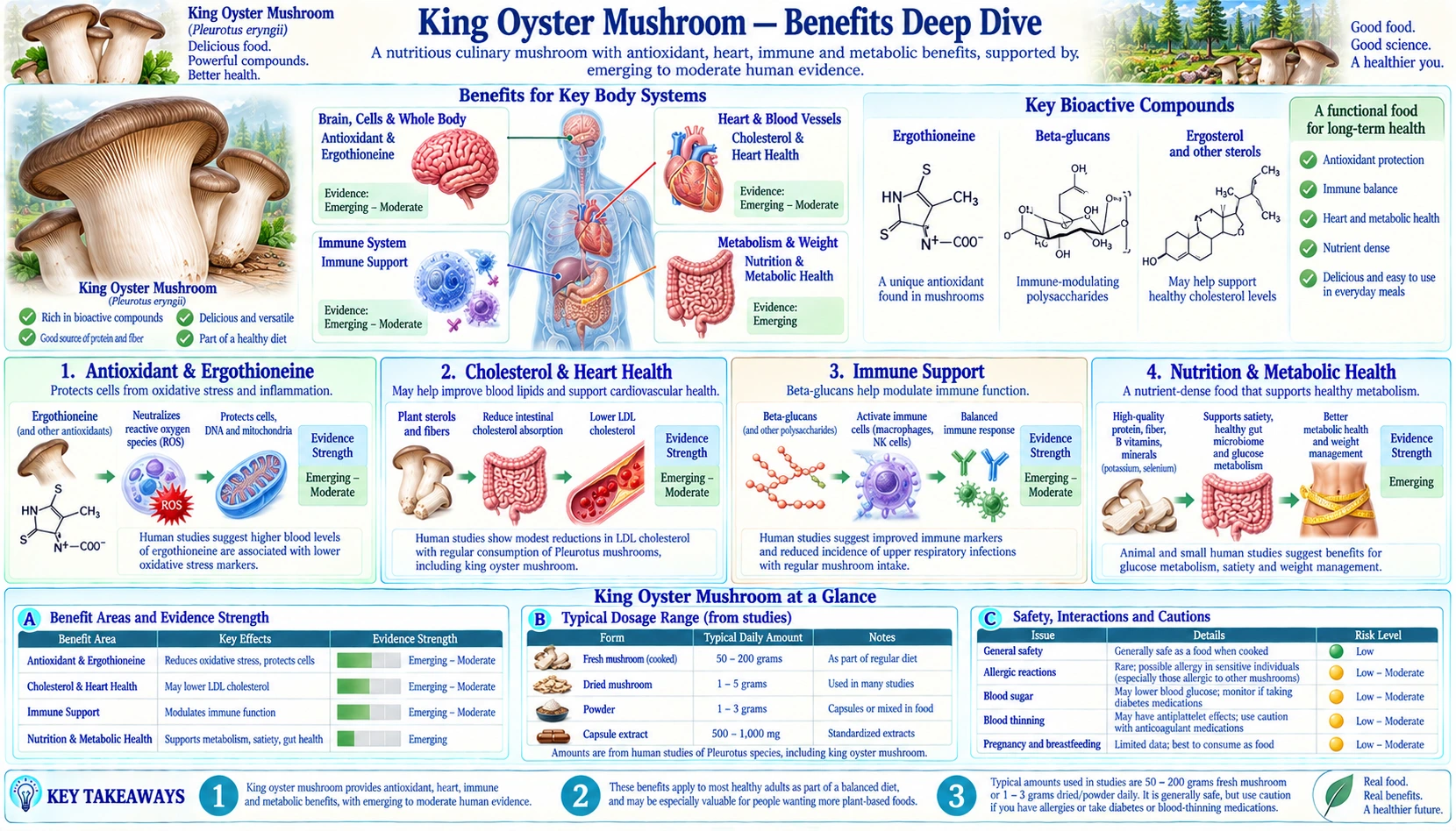
The King Oyster (Pleurotus eryngii) is the largest member of the oyster-mushroom family and one of the most nutritionally interesting culinary mushrooms. Its thick, meaty stem makes it a popular plant-based substitute for scallops and pulled pork, but its real value lies underneath the texture: it is among the richest dietary sources of ergothioneine, a rare sulfur-containing antioxidant the body actively concentrates in tissues under oxidative stress. Like its Pleurotus cousins it also carries immune-active beta-glucans, and its close relative the oyster mushroom (P. ostreatus) has been found to contain small amounts of lovastatin — a real but modest effect that does not replace statin medication. The four deep-dive pages below examine where the evidence is strongest (antioxidant defense), where it is genuinely promising (cholesterol, immune, metabolic), and where it is still mostly preclinical — with honest framing throughout.
Deep-Dive Articles
Antioxidant & Ergothioneine
Why oyster mushrooms are among the richest food sources of ergothioneine, the OCTN1 (organic cation transporter novel type 1, gene SLC22A4) transporter that selectively concentrates it in high-stress tissues, the "longevity vitamin" hypothesis, mushroom glutathione and polyphenols, and the honest limits of the current human evidence.
Read the deep dive →Cholesterol & Heart Health
The natural lovastatin story told honestly: Pleurotus fruiting bodies contain small, highly variable amounts of the same HMG-CoA (3-hydroxy-3-methylglutaryl coenzyme A) reductase inhibitor found in prescription statins — a modest effect that is not a substitute for medication. Beta-glucan bile-acid binding, the Bobek animal studies, small human lipid trials, and where the mushroom fits in a heart-healthy diet.
Read the deep dive →Immune Support
Beta-glucans as the key immunomodulators, recognition by the Dectin-1 and complement receptor pathways, the structure of Pleurotus glucans (pleuran), innate-immune and prebiotic effects, and a clear-eyed separation of what is shown in humans versus what is still preclinical.
Read the deep dive →Nutrition & Metabolic Health
A high-protein, high-fiber, low-calorie food: the amino-acid and mineral profile, dietary fiber and satiety, blood-sugar and insulin-sensitivity signals, ultraviolet-boosted vitamin D2 potential, and the mushroom's role as a satisfying meat substitute in weight management.
Read the deep dive →Table of Contents
- Deep-Dive Articles
- Why One Mushroom Touches So Many Systems
- Research Papers: Antioxidant & Ergothioneine
- Research Papers: Cholesterol & Heart Health
- Research Papers: Immune Support
- Research Papers: Nutrition & Metabolic Health
- Research Papers: Cross-Cutting (Composition & Safety)
- External Authoritative Resources
- Connections
- Featured Videos
Why One Mushroom Touches So Many Systems
Most foods are interesting for one or two nutrients. The King Oyster is unusual because three genuinely distinct classes of bioactive compound sit in the same fruiting body, and each maps to a different area of the research literature.
- Ergothioneine (an antioxidant amino acid) — a sulfur-containing compound that the body cannot make and must obtain from the diet, for which mushrooms are the dominant source. A dedicated transporter, OCTN1, actively pumps it into cells and concentrates it in tissues exposed to oxidative stress. This is the best-supported area of the research and is covered in Antioxidant & Ergothioneine.
- Lovastatin-family compounds (secondary metabolites) — the lovastatin studies cited on this page measured the oyster mushroom (Pleurotus ostreatus), whose fruiting bodies contain small amounts of lovastatin, the same HMG-CoA reductase inhibitor used in prescription statins. The amount is modest and variable, which is exactly why the honest framing in Cholesterol & Heart Health stresses that a mushroom serving is not a substitute for a prescribed statin.
- Beta-glucans (structural cell-wall polysaccharides) — the fibrous scaffolding of the mushroom is built from beta-(1,3)/(1,6)-glucans that the human innate immune system recognizes as a pattern, and that also act as fermentable prebiotic fiber. This drives both the immune and the fiber/satiety themes in Nutrition & Metabolic Health.
A human study has tested king oyster itself. In an acute randomised crossover trial, 19 volunteers with metabolically unhealthy obesity ate a meal containing Pleurotus eryngii and a control meal matched in macronutrient and calorie content. After the mushroom meal the blood-glucose response was lower, the ghrelin response was lower (p = 0.033), hunger was lower (p = 0.046) and fullness was higher (p = 0.042). Insulin, peptide YY (PYY), glucagon-like peptide-1 (GLP-1) and glicentin did not differ. It was a single-meal study, not a test of eating the mushroom over weeks or months.
A recurring theme across all four pages is the gap between preclinical evidence (cell cultures and rodent studies, which are plentiful and often striking) and human evidence (which is thinner, uses small samples, and shows more modest effects). Where that gap exists, these pages say so plainly rather than borrowing a rodent result and implying it applies to people. King Oyster is a genuinely healthy whole food with a strong nutritional case; it is not a drug, and the pages here are careful not to dress it up as one.
Research Papers: Antioxidant & Ergothioneine
- Cheah IK, Halliwell B (2012). Ergothioneine; antioxidant potential, physiological function and role in disease. Biochimica et Biophysica Acta. — PubMed
- Halliwell B, Cheah IK, Tang RMY (2018). Ergothioneine – a diet-derived antioxidant with therapeutic potential. FEBS Letters. — PubMed
- Beelman RB, Kalaras MD, Phillips AT, Richie JP (2020). Is ergothioneine a "longevity vitamin" limited in the American diet? Journal of Nutritional Science. — PubMed
- Kalaras MD, Richie JP, Calcagnotto A, Beelman RB (2017). Mushrooms: A rich source of the antioxidants ergothioneine and glutathione. Food Chemistry. — PubMed
- Gründemann D, Harlfinger S, Golz S, et al. (2005). Discovery of the ergothioneine transporter. Proceedings of the National Academy of Sciences of the United States of America. — PubMed PMID: 15795384
Research Papers: Cholesterol & Heart Health
- Gunde-Cimerman N, Cimerman A (1995). Pleurotus fruiting bodies contain the inhibitor of HMG-CoA reductase – lovastatin. Experimental Mycology. — PubMed
- Bobek P, Galbavy S (1999). Hypocholesterolemic and antiatherogenic effect of oyster mushroom (Pleurotus ostreatus) in rabbits. Nahrung. — PubMed
- Schneider I, Kressel G, Meyer A, et al. (2011). Lipid lowering effects of oyster mushroom (Pleurotus ostreatus) in humans. Journal of Functional Foods. — PubMed
- Khatun K, Mahtab H, Khanam PA, et al. (2007). Oyster mushroom reduced blood glucose and cholesterol in diabetic subjects. Mymensingh Medical Journal. — PubMed
- Alarcón J, Aguila S, Arancibia-Avila P, et al. (2003). Production and purification of statins from Pleurotus ostreatus (Basidiomycetes) strains. Zeitschrift für Naturforschung C. — PubMed PMID: 12622228
- Alarcón J, Aguila S (2006). Lovastatin production by Pleurotus ostreatus: effects of the C:N ratio. Zeitschrift für Naturforschung C. — PubMed PMID: 16610224
Research Papers: Immune Support
- Brown GD, Gordon S (2001). Immune recognition. A new receptor for beta-glucans (Dectin-1). Nature. — PubMed
- Synytsya A et al. (2009). Glucans from fruiting bodies of Pleurotus ostreatus and Pleurotus eryngii: structure and potential prebiotic activity. Carbohydrate Polymers. — PubMed
- Jesenak M et al. (2013). Immunomodulatory effect of pleuran (beta-glucan from Pleurotus ostreatus) in children with recurrent respiratory tract infections. International Immunopharmacology. — PubMed
- Vetvicka V, Vetvickova J (2014). Immune-enhancing effects of Maitake (Grifola frondosa) and Shiitake (Lentinula edodes) extracts. Annals of Translational Medicine. (Maitake and shiitake, not Pleurotus.) — PubMed PMID: 25332990
Research Papers: Nutrition & Metabolic Health
- Alam N, Amin R, Khan A, et al. (2008). Nutritional Analysis of Cultivated Mushrooms in Bangladesh – Pleurotus ostreatus, Pleurotus sajor-caju, Pleurotus florida and Calocybe indica. Mycobiology. (Oyster-mushroom relatives; P. eryngii was not among the species analysed.) — PubMed PMID: 23997631
- Cardwell G et al. (2018). A review of mushrooms as a potential source of dietary vitamin D. Nutrients. — PubMed
- Kanagasabapathy G, Kuppusamy UR, Abd Malek SN, et al. (2012). Glucan-rich polysaccharides from Pleurotus sajor-caju (Fr.) Singer prevents glucose intolerance, insulin resistance and inflammation in C57BL/6J mice fed a high-fat diet. BMC Complementary and Alternative Medicine. (Mouse study.) — PubMed PMID: 23259700
- Kanagasabapathy G, Chua KH, Malek SN, et al. (2014). AMP-activated protein kinase mediates insulin-like and lipo-mobilising effects of β-glucan-rich polysaccharides isolated from Pleurotus sajor-caju (Fr.), Singer mushroom, in 3T3-L1 cells. Food Chemistry. (Cell study.) — PubMed PMID: 24128468
- Kleftaki SA, Simati S, Amerikanou C, et al. (2022). Pleurotus eryngii improves postprandial glycaemia, hunger and fullness perception, and enhances ghrelin suppression in people with metabolically unhealthy obesity. Pharmacological Research. — PubMed PMID: 34798266
- Roncero-Ramos I, Delgado-Andrade C (2017). The beneficial role of edible mushrooms in human health. Current Opinion in Food Science. — PubMed
Research Papers: Cross-Cutting (Composition & Safety)
- Ba DM, Ssentongo P, Beelman RB, et al. (2021). Higher Mushroom Consumption Is Associated with Lower Risk of Cancer: A Systematic Review and Meta-Analysis of Observational Studies. Advances in Nutrition. — PubMed PMID: 33724299
- Ba DM, Gao X, Al-Shaar L, et al. (2021). Mushroom intake and depression: A population-based study using data from the US National Health and Nutrition Examination Survey (NHANES), 2005-2016. Journal of Affective Disorders. — PubMed PMID: 34333177
- Feeney MJ et al. (2014). Mushrooms and health summit proceedings. Journal of Nutrition. — PubMed
- Kabir Y, Kimura S (1989). Dietary mushrooms reduce blood pressure in spontaneously hypertensive rats. Journal of Nutritional Science and Vitaminology. — PubMed
- Valverde ME, Hernández-Pérez T, Paredes-López O (2015). Edible mushrooms: improving human health and promoting quality life. International Journal of Microbiology. — PubMed
What the 2021 cancer meta-analysis found: across 17 observational studies, the highest mushroom intake compared with the lowest was associated with a lower risk of total cancer (pooled relative risk 0.66; 95% confidence interval 0.55, 0.78). Eleven of the 17 were case-control studies, which the authors note carry a potential for recall and selection bias.
External Authoritative Resources
- U.S. Department of Agriculture (USDA) FoodData Central — searchable nutrient database (search "mushroom, oyster" and "Pleurotus" for composition data)
- U.S. National Institutes of Health (NIH) Office of Dietary Supplements — Vitamin D Fact Sheet (background for ultraviolet-generated mushroom vitamin D2)
- American Heart Association — Healthy Eating (context for the heart-health page)
- PubMed — All research on Pleurotus eryngii
- PubMed — All research on ergothioneine