King Oyster Mushroom for Immune Support
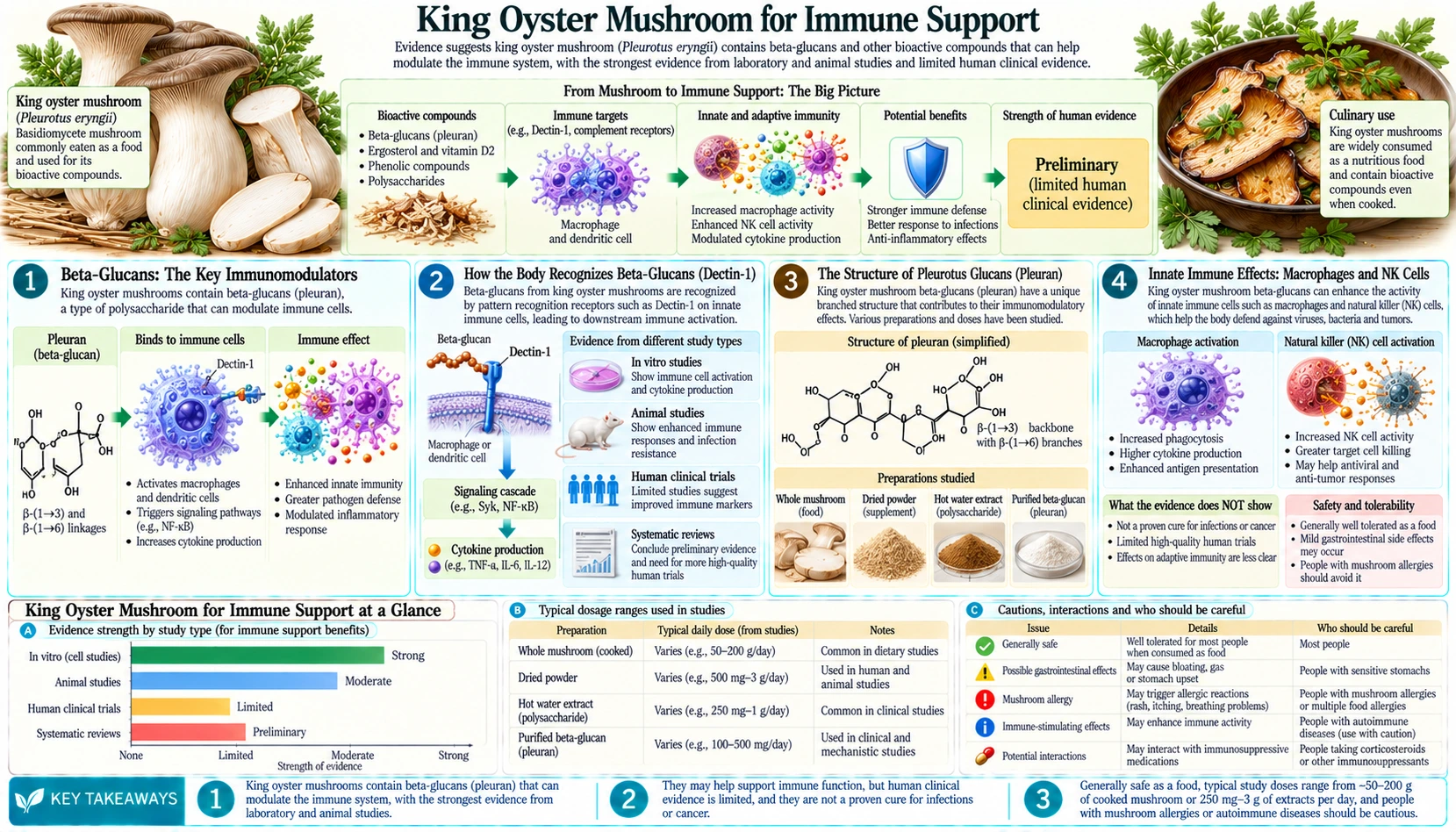
The walls of a King Oyster mushroom are built from beta-glucans — branched sugar polymers that the human immune system reads as a signal. Our innate immune cells carry receptors that evolved to recognize the beta-glucan pattern on the surface of fungi, so when we eat or absorb these fibers, they can gently prime immune cells rather than merely passing through as inert bulk. This is the real basis of the "immune-boosting mushroom" idea. But the phrase is often oversold, so this page keeps two things straight: the genuine, well-mapped biology of how beta-glucans are recognized and what they do — and the honest fact that most of the direct clinical trial evidence uses concentrated extracts of the related pearl oyster (pleuran), that King Oyster's own human data are thinner, and that food is support, not a treatment.
Table of Contents
- Beta-Glucans: The Key Immunomodulators
- How the Body Recognizes Beta-Glucans (Dectin-1)
- The Structure of Pleurotus Glucans (Pleuran)
- Innate Immune Effects: Macrophages and Natural Killer Cells
- Gut, Prebiotic, and Microbiome Effects
- Preclinical vs Human Evidence — Honest Assessment
- Ergothioneine and Antioxidant Support of Immunity
- Practical Use for Immune Support
- Cautions
- Key Research Papers
- Connections
- Featured Videos
Beta-Glucans: The Key Immunomodulators
Beta-glucans are chains of glucose (a sugar), but the way the glucose units are linked makes all the difference. Unlike the easily digested alpha-linkages in starch, the beta-(1,3) and beta-(1,6) linkages in fungal cell walls resist human digestive enzymes. That is why beta-glucan behaves as fiber — and, more interestingly, why the immune system treats it as a marker of "fungus present."
The word to keep in mind is immunomodulator, not "immune booster." A booster implies simply turning the immune system up, which is neither accurate nor desirable (an over-revved immune system causes allergy and autoimmunity). Beta-glucans instead appear to tune or train immune cells — helping them respond more effectively to a genuine threat while not driving indiscriminate inflammation. This is a more subtle and more plausible mechanism than "boosting," and it is the framing supported by the underlying biology.
Beta-glucans from different sources are not interchangeable. Cereal beta-glucans (from oats and barley) are mostly beta-(1,3)(1,4)-linked and are studied mainly for cholesterol and blood sugar. Fungal and yeast beta-glucans are beta-(1,3)(1,6)-linked, and it is this (1,6)-branched structure that the immune receptors recognize most strongly. King Oyster, as a Pleurotus mushroom, carries the immune-relevant fungal type.
How the Body Recognizes Beta-Glucans (Dectin-1)
The mechanism became concrete in 2001, when Brown and Gordon showed that a known immune-cell receptor, Dectin-1, is the previously unidentified receptor on macrophages that binds beta-(1,3)-glucans. Dectin-1 sits on the surface of macrophages, neutrophils, dendritic cells, and monocytes — the front-line "innate" immune cells that patrol tissues. It is a pattern-recognition receptor: it evolved to detect the beta-glucan signature exposed on the surface of fungi, allowing the immune system to spot a fungal presence and respond.
When beta-glucan engages Dectin-1 (often working together with a second receptor, complement receptor 3, and with Toll-like receptors), it triggers signaling inside the immune cell that can:
- Enhance phagocytosis — the cell's ability to engulf and destroy pathogens;
- Stimulate a controlled release of signaling molecules (cytokines) that coordinate the wider immune response;
- Prime a longer-lasting state of readiness in innate cells, a phenomenon researchers call "trained immunity."
This receptor-based recognition is why fungal beta-glucans are of genuine scientific interest rather than folklore: there is a real molecular lock (Dectin-1) and a real key (the beta-glucan) with well-documented downstream signaling. What remains harder to pin down is how much of an ingested, food-level dose reaches and activates these receptors in a living person, and what clinical difference that makes — which is the honest limitation addressed later on this page.
The Structure of Pleurotus Glucans (Pleuran)
The best-characterized Pleurotus immune polysaccharide is pleuran, a beta-(1,3)(1,6)-D-glucan isolated from the pearl oyster mushroom (Pleurotus ostreatus), King Oyster's close relative. Structural studies — including work by Synytsya and colleagues that characterized glucans from both P. ostreatus and P. eryngii (the King Oyster) — show these mushrooms produce the immune-relevant, branched beta-glucan architecture, along with other polysaccharides such as chitin and mannans in the cell wall.
Two structural facts matter for anyone reading the research:
- Branching and molecular size drive activity. The degree of (1,6)-branching, the chain length, and whether the glucan is in a triple-helix or single-chain configuration all influence how strongly it engages immune receptors. This is why two "beta-glucan" products can behave very differently, and why extraction method matters.
- Whole mushroom vs isolated extract are not the same dose. In a whole cooked mushroom, beta-glucan is locked inside a fibrous cell-wall matrix. Most clinical trials use a purified, concentrated pleuran extract at a standardized dose — not a plate of mushrooms. Eating King Oyster gives you the glucan in its natural food matrix at food-level amounts, which is real but not equivalent to a supplement dose in a trial.
King Oyster's own glucans are structurally similar to the better-studied pearl-oyster pleuran, so it is reasonable to expect qualitatively similar immune-relevant properties. It is not reasonable to assume the exact trial results from concentrated pleuran extracts transfer directly to a serving of King Oyster on your plate.
Innate Immune Effects: Macrophages and Natural Killer Cells
In laboratory and animal studies, Pleurotus beta-glucans and extracts have repeatedly shown effects on the innate immune system:
- Macrophage activation. Beta-glucans stimulate macrophages to increase phagocytosis and to release coordinating cytokines, improving the clearance of microbes and debris in these models.
- Natural killer (NK) cell activity. Several studies report enhanced natural killer-cell activity with mushroom beta-glucans; natural killer cells are the innate lymphocytes that survey for infected and abnormal cells.
- Dendritic cell maturation. By engaging pattern-recognition receptors, beta-glucans can help dendritic cells mature and bridge the innate and adaptive arms of immunity.
- "Trained immunity." Beta-glucan exposure can leave innate immune cells in a primed epigenetic state, so they respond more briskly to a later, unrelated challenge — an emerging and actively researched concept.
These are consistent, mechanistically sensible findings. The essential caveat is that most were produced with isolated glucans, injected or high-dose oral extracts, or cell-culture systems — conditions that maximize glucan delivery. They establish that the machinery is real; they do not, by themselves, prove that eating cooked King Oyster mushrooms measurably changes immune outcomes in a healthy person.
Gut, Prebiotic, and Microbiome Effects
A large share of the immune system lives in and around the gut, and this is one of the more credible routes by which eating whole King Oyster mushrooms could support immunity. Because their beta-glucans and other polysaccharides resist digestion, they arrive in the colon intact and become food for beneficial gut bacteria — a prebiotic effect. Synytsya and colleagues specifically noted the potential prebiotic activity of P. ostreatus and P. eryngii glucans.
When gut bacteria ferment these fibers, they produce short-chain fatty acids (such as butyrate) that nourish the cells lining the colon, help maintain the gut barrier, and influence the many immune cells stationed in the gut wall. A well-fed, diverse gut microbiome is associated with better-regulated immunity and lower background inflammation. This food-matrix, whole-mushroom pathway — feeding the microbiome — is arguably a more realistic everyday immune benefit of eating King Oyster than any direct systemic "boost," and it dovetails with the fiber and metabolic story on the Nutrition & Metabolic Health page.
Preclinical vs Human Evidence — Honest Assessment
It is worth separating three tiers of evidence clearly, because they are routinely blurred together in marketing.
Strong mechanism (well established): beta-(1,3)(1,6)-glucans are recognized by Dectin-1 and related receptors on innate immune cells, with well-documented downstream signaling. Pleurotus mushrooms, including King Oyster, contain these glucans. This part is solid science.
Human trials — but mostly on concentrated pearl-oyster extract: the most cited human immune trials use standardized pleuran from P. ostreatus (marketed as an immune supplement), not King Oyster and not whole mushrooms. For example, in a double-blind, placebo-controlled, randomised trial by Jesenak and colleagues in 175 children with recurrent respiratory tract infections, 36% of the children given a pleuran syrup with vitamin C had no respiratory infections throughout the treatment, compared with 21% of those given vitamin C alone; the syrup group also had fewer episodes of flu and flu-like illness and fewer lower respiratory tract infections. In a double-blind, placebo-controlled study of 50 athletes supplemented for 3 months, pleuran significantly reduced the incidence of upper respiratory tract infection symptoms and increased the number of circulating natural killer cells. These are real randomized data, but they test a specific extract at a specific dose in specific populations — not "eating mushrooms."
A 2025 international, randomised, double-blind, placebo-controlled trial enrolled 249 children with recurrent respiratory tract infections in Slovakia, the Czech Republic and Serbia. For 3 months of the respiratory infection season, the children took either a chewable pleuran supplement with vitamin D and zinc or vitamin D and zinc alone; 217 completed the study. The pleuran group had fewer respiratory tract infections (2.35 vs. 2.77; P = 0.042), which the authors describe as a 15.2% reduction over 3 months, and 18.6% fewer common cold episodes. Only mild adverse events were reported. Like the earlier trials, it tested a pearl-oyster extract, not King Oyster or whole mushrooms.
King Oyster (P. eryngii) specifically — thinner: direct human immune trials of King Oyster itself are limited, and much of what is claimed for it is extrapolated from its pearl-oyster cousin and from preclinical work. The extrapolation is reasonable given the shared glucan chemistry, but it is extrapolation, and this page labels it as such rather than presenting it as proven.
The bottom line: the immune biology of Pleurotus beta-glucans is genuine and interesting, some concentrated-extract human data are encouraging, and eating King Oyster supplies immune-relevant fungal fiber as part of ordinary meals — but it is not a validated treatment or a substitute for vaccination, medical care, or the basics (sleep, nutrition, not smoking) that actually govern immune resilience.
Ergothioneine and Antioxidant Support of Immunity
Beta-glucans are not the only immune-relevant compound in a King Oyster. The mushroom is also among the richest food sources of ergothioneine, and the OCTN1 transporter that captures it is expressed strongly in immune cells such as monocytes. A well-functioning immune response generates a burst of reactive oxygen species to kill microbes; antioxidant systems keep that burst from damaging the body's own tissues. Ergothioneine and the mushroom's glutathione contribute to that protective buffer. The full detail is on the Antioxidant & Ergothioneine page and on our Ergothioneine page.
The King Oyster also supplies small amounts of immune-supportive micronutrients — including selenium (a cofactor for antioxidant enzymes), zinc, and copper — and can be a source of vitamin D2 when ultraviolet-exposed, a vitamin with well-established immune roles (see Vitamin D3). None of these is present in a King Oyster at a "therapeutic dose," but together they make the mushroom a nutrient-dense contributor to the dietary foundation of normal immune function.
Practical Use for Immune Support
- Eaten as food, regularly. Several servings of mushrooms a week — King Oyster rotated with other varieties — supply fungal beta-glucan, ergothioneine, and prebiotic fiber in the context of a whole-food diet. This food-level use is the one consistent with the evidence summarised above.
- Cooked. Cooking breaks down the tough cell walls, improving digestibility and the availability of both nutrients and glucans. Raw oyster mushrooms are also harder on the stomach.
- Food is not a supplement dose. The pleuran clinical trials used a concentrated, standardized extract — a different product from a plate of mushrooms.
- The foundations. No mushroom substitutes for sleep, a broadly nutritious diet, physical activity, not smoking, and recommended vaccinations — these are what most strongly determine immune resilience. See Immune Boosting for the broader picture.
Cautions
- Autoimmune conditions and immunosuppression. Because beta-glucans are immunomodulators, the research raises a concern for people with autoimmune disease or those taking immunosuppressant medication (for example after an organ transplant) who use concentrated beta-glucan or mushroom-extract supplements. Ordinary culinary amounts of cooked mushrooms are generally well tolerated, but concentrated extracts are a different matter.
- Allergy and spore sensitivity. A minority of people are sensitive to oyster mushrooms; heavy occupational spore exposure can cause respiratory reactions. Most people eat culinary portions without problems.
- Cooking and correct identification. The safety information on this page applies to cultivated or expertly identified mushrooms, eaten cooked.
- Support, not treatment. King Oyster is a healthful food that supports the dietary foundation of immunity. It is not a treatment for infection or immune disease and is not a substitute for medical care.
Key Research Papers
- Brown GD, Gordon S (2001). Immune recognition. A new receptor for beta-glucans. Nature. — PubMed PMID: 11544516
- Synytsya A, Mickova K, Synytsya A, et al. (2009). Glucans from fruit bodies of cultivated mushrooms Pleurotus ostreatus and Pleurotus eryngii: structure and potential prebiotic activity. Carbohydrate Polymers. — doi:10.1016/j.carbpol.2008.11.021
- Jesenak M, Majtan J, Rennerova Z, et al. (2013). Immunomodulatory effect of pleuran (beta-glucan from Pleurotus ostreatus) in children with recurrent respiratory tract infections. International Immunopharmacology. — PubMed PMID: 23261366
- Bergendiova K, Tibenska E, Majtan J (2011). Pleuran (beta-glucan from Pleurotus ostreatus) supplementation, cellular immune response and respiratory tract infections in athletes. European Journal of Applied Physiology. — PubMed PMID: 21249381
- Jesenak M, Prokopova E, Bozensky J, Bonaci-Nikolic B, Milosevic K, Stankovic K, Ostojic O, Zivkovic Z, Diamant Z, Kunc P, Janeczek K, Majtan J (2025). Novel Chewable Pleuran-Based Supplement Decreases Respiratory Tract Infections in Children: A Randomised Controlled Trial. Advances in Therapy. — PubMed PMID: 41085920
- Vetvicka V, Vetvickova J (2014). Immune-enhancing effects of Maitake (Grifola frondosa) and Shiitake (Lentinula edodes) extracts. Annals of Translational Medicine. A study of Maitake and Shiitake extracts, not oyster mushrooms. — PubMed PMID: 25332990
- Brown GD, Gordon S (2003). Fungal beta-glucans and mammalian immunity. Immunity. — PubMed PMID: 14499107
- Chan GC, Chan WK, Sze DM (2009). The effects of beta-glucan on human immune and cancer cells. Journal of Hematology & Oncology. — PubMed PMID: 19515245
- Novak M, Vetvicka V (2008). Beta-glucans, history, and the present: immunomodulatory aspects and mechanisms of action. Journal of Immunotoxicology. — PubMed PMID: 18382858
- Rop O, Mlcek J, Jurikova T (2009). Beta-glucans in higher fungi and their health effects. Nutrition Reviews. — PubMed PMID: 19906249
- Wasser SP (2002). Medicinal mushrooms as a source of antitumor and immunomodulating polysaccharides. Applied Microbiology and Biotechnology. — PubMed PMID: 12436306
PubMed Topic Searches
- PubMed: Pleurotus beta-glucan and immunity
- PubMed: Pleuran immunomodulatory clinical trials
- PubMed: Dectin-1, beta-glucan, and trained immunity
- PubMed: Mushroom polysaccharides, prebiotics, and the microbiome
- PubMed: Pleurotus eryngii immunomodulatory research