King Oyster Mushroom for Cholesterol & Heart Health
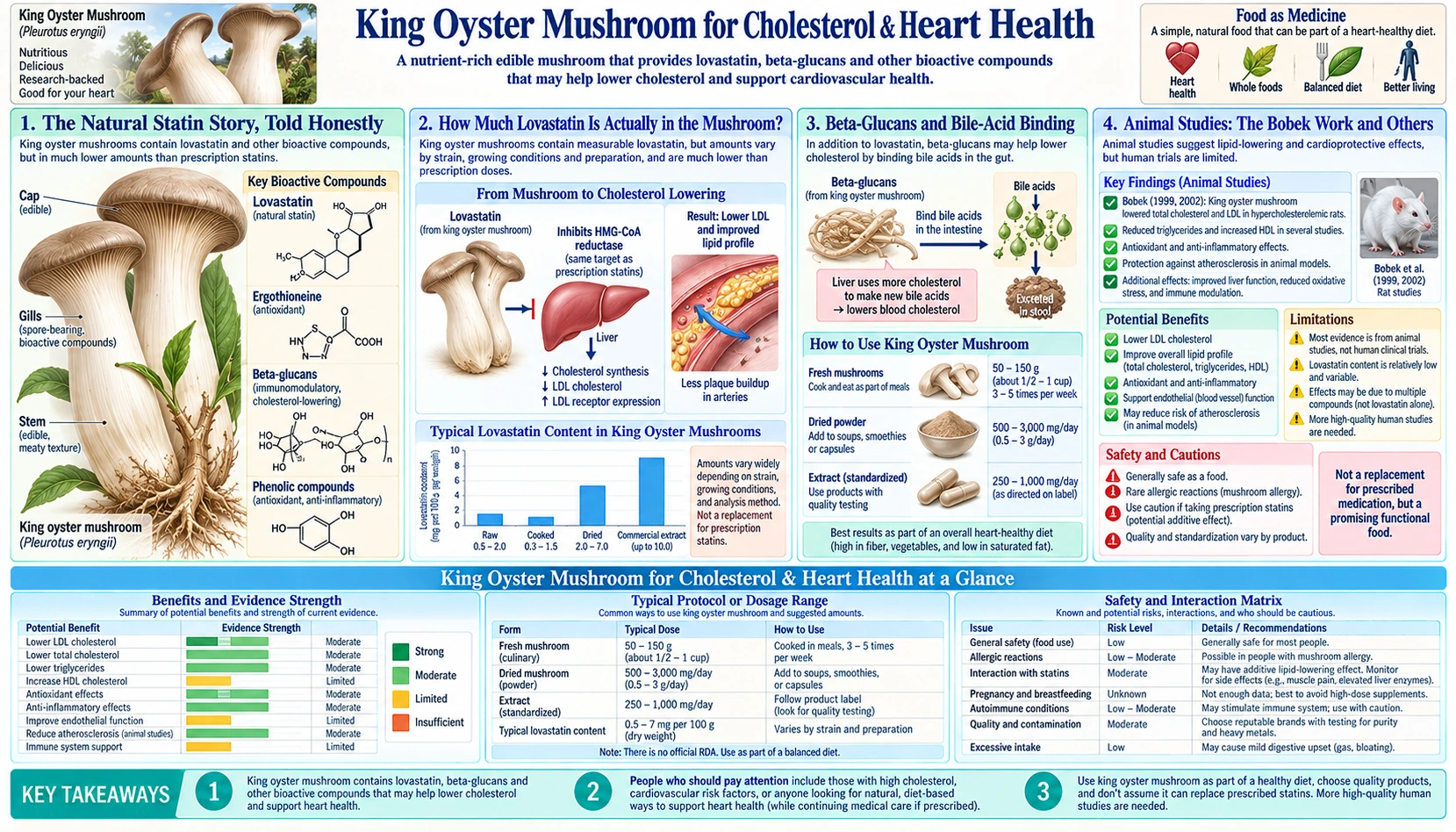
Here is a claim you will see repeated online: "oyster mushrooms contain a natural statin." It is true — and it is one of the most over-hyped facts in mushroom nutrition. Pleurotus mushrooms really do make small amounts of lovastatin, the same HMG-CoA reductase inhibitor sold as a prescription cholesterol drug. But the amount in a serving is small, highly variable, and nowhere near a therapeutic pharmaceutical dose. This page tells the story honestly: the real biochemistry, roughly how much is actually in the mushroom, the separate bile-acid-binding effect of its fiber, what the animal and (small) human studies show, and — most importantly — why a plate of King Oyster mushrooms is a genuinely heart-healthy food that no study has tested as a replacement for a prescribed statin.
Table of Contents
- The Natural Statin Story, Told Honestly
- How Much Lovastatin the Mushroom Actually Contains
- Beta-Glucans and Bile-Acid Binding
- Animal Studies: The Bobek Work and Others
- Human Studies: Small and Modest
- Why It Is Not a Substitute for Statin Medication
- Blood Pressure and Vascular Effects
- Where King Oyster Fits in a Heart-Healthy Diet
- Cautions and Interactions
- Key Research Papers
- Connections
- Featured Videos
The Natural Statin Story, Told Honestly
Statin drugs work by blocking an enzyme called HMG-CoA reductase, the rate-limiting step your liver uses to manufacture cholesterol. The very first statin, lovastatin (originally called mevinolin or monacolin K), was not invented in a lab from scratch — it was discovered in a fungus. Lovastatin is produced naturally by molds such as Aspergillus terreus and by the red yeast that ferments red yeast rice.
In 1995, Gunde-Cimerman and Cimerman reported that the fruiting bodies of Pleurotus mushrooms — the oyster-mushroom genus that includes the King Oyster — also contain lovastatin. That finding is real and has been confirmed by later analyses: oyster mushrooms genuinely make small amounts of the same molecule that is the active ingredient in a prescription cholesterol drug.
The 1995 paper studied the pearl oyster (Pleurotus ostreatus) and followed the inhibitor through the mushroom’s development. It found lovastatin in the vegetative mycelium (the thread-like body of the fungus), in the primordia and in different parts of fruiting bodies of different sizes. Less lovastatin was found in the stems (stipes) than in the caps (pilei), or, at mature stages, than in the gills (lamellae) and spores. The abstract gives no amounts. This matters for the King Oyster, which is eaten mostly for its thick stem.
So the headline is accurate. The problem is what people do with it. "Contains a natural statin" gets quietly upgraded, in blog posts and product marketing, into "lowers cholesterol like a statin" or "a natural alternative to statins." Those upgrades are not supported by the numbers. The honest version keeps two facts in view at once: (1) yes, there is real lovastatin in the mushroom, and (2) there is not very much of it, and it varies enormously from sample to sample. The rest of this page is about holding both of those facts together.
How Much Lovastatin the Mushroom Actually Contains
This is where the hype meets arithmetic. Prescription lovastatin is dosed at roughly 20 to 80 milligrams per day. To match even the low end of that from mushrooms, you would need the mushroom's lovastatin content to be substantial and reliable. It is neither.
Measured lovastatin content in oyster mushrooms varies widely across published studies — by strain, growing substrate, maturity, which tissue is analyzed, and the extraction and detection method used. Reported values span a broad range, and a few outlier reports of very high concentrations have not been consistently reproduced. What is consistent is the direction of the conclusion: a normal culinary serving of oyster mushrooms delivers, at most, a small fraction of a therapeutic statin dose — and often far less. You cannot count on eating your way to a 20 mg lovastatin dose from a plate of mushrooms, because the content is both low and unpredictable.
Three points follow directly:
- Variability is the rule, not the exception. Two batches of oyster mushrooms can differ severalfold in lovastatin content. Food is not a standardized dose form.
- Cooking and digestion further reduce the delivered amount. Not all of the lovastatin present survives preparation and is absorbed in active form.
- The bioactive lovastatin story is probably not the main reason oyster mushrooms modestly help lipids. As the next section explains, fiber-driven bile-acid binding likely does at least as much of the work.
The takeaway: the "natural statin" content is real but small and unpredictable — a minor bonus, not a dose. If you need a specific reduction in low-density lipoprotein (LDL) cholesterol for cardiovascular risk, that is a medical target that food alone — mushroom or otherwise — usually cannot hit reliably.
Beta-Glucans and Bile-Acid Binding
The less glamorous but more dependable heart mechanism in mushrooms is their fiber, particularly beta-glucans. This is the same broad class of soluble fiber that gives oats and barley their well-established, health-authority-recognized cholesterol-lowering effect, though the fine structure of mushroom (fungal) beta-glucan differs from the cereal (plant) form.
The mechanism is straightforward plumbing. Your liver makes bile acids out of cholesterol and secretes them into the gut to help digest fat. Normally most of those bile acids are reabsorbed and recycled. Soluble, viscous fiber binds bile acids in the intestine and carries some of them out in the stool. To replace the lost bile acids, the liver has to pull more cholesterol out of the blood to make new ones — which lowers circulating low-density lipoprotein cholesterol. Fiber also slows the absorption of dietary fat and cholesterol and feeds gut bacteria that produce short-chain fatty acids, which may further nudge the liver's cholesterol handling.
This fiber effect is modest per serving but consistent, well understood, and does not depend on the mushroom's unpredictable lovastatin content. It is the more reliable half of the King Oyster's cholesterol story, and it is shared, in principle, with a whole-food, high-fiber dietary pattern generally. For the vascular disease this ultimately aims to prevent, see Atherosclerosis and Coronary Artery Disease.
Animal Studies: The Bobek Work and Others
The most detailed cholesterol research on oyster mushrooms comes from animal experiments, especially a series of studies led by Pavel Bobek in the 1990s using Pleurotus ostreatus (the pearl oyster, King Oyster's close relative) in rats, hamsters, and rabbits fed high-cholesterol diets.
Across those studies, adding oyster mushroom (as dried powder or extract) to a cholesterol-loaded diet consistently:
- Lowered total and low-density lipoprotein cholesterol compared with the same diet without mushroom;
- Reduced cholesterol accumulation in the liver;
- In the rabbit atherosclerosis model, reduced the fatty plaque build-up in the aorta (an antiatherogenic effect), suggesting the benefit is not just a lab number but reaches the artery wall.
These results are genuinely encouraging and mechanistically coherent — they line up with both the fiber and the lovastatin explanations. But they come with the standard translational caveat: the animals were fed large amounts of mushroom relative to their body weight, on deliberately cholesterol-rich diets, under controlled conditions. Rodent and rabbit results establish plausibility and mechanism; they do not tell you the size of the effect in a free-living human eating an ordinary portion. That is what human trials are for — and, as the next section shows, those are much thinner.
The rabbit numbers. In the rabbit study (Bobek and Galbavý, 1999), adding 10% dried oyster mushroom to a diet containing 1% cholesterol reduced serum cholesterol by 65% and the cholesterol content of the aorta by 80%. The plaque area (the part of the artery wall that stained positive for fat) was 26% in the control rabbits and 2% in the mushroom-fed rabbits. All control animals showed atherogenic changes in the aorta; the mushroom diet prevented them in three of five animals. This is an animal result, not a human one.
A King Oyster-specific rat study. Most of the work above used the pearl oyster. In a 2017 study of a King Oyster variety, Pleurotus eryngii var. ferulae, rats with high-fat/high-cholesterol-induced hyperlipidemia were fed a diet containing the mushroom for 3 weeks. Their serum triacylglycerols, low-density lipoprotein cholesterol and very-low-density lipoprotein cholesterol fell significantly, and their high-density lipoprotein cholesterol rose significantly (P < 0.05). This too is a rat study, not a human result.
Human Studies: Small and Modest
The human evidence for oyster mushrooms and cholesterol is limited to a handful of small trials, and the honest summary is "promising but modest and under-powered."
- Diabetic subjects (Khatun and colleagues, 2007): a small study in people with diabetes found that oyster mushroom intake was associated with lower blood glucose and lower total cholesterol during the mushroom-eating periods. Eighty-nine people were recruited and 30 completed the protocol: 7 days with mushroom, 7 days without and then 7 days with mushroom again. Mushroom also significantly lowered triglycerides and systolic and diastolic blood pressure, and when mushroom was withdrawn, blood glucose, total cholesterol, triglycerides and diastolic blood pressure rose significantly again. The sample was small and the design limited, but the direction matched the animal data.
- Lipid-lowering feeding study (Schneider and colleagues, 2011): a controlled human study reported reductions in total cholesterol and triglycerides when oyster mushroom was added to the diet, again modest in size. (This summary could not be checked against the paper’s abstract for this page.)
- Double-blind randomized trial (Johnen and colleagues, 2026): 46 adults (37 women, 9 men) with moderately raised low-density lipoprotein cholesterol (116–190 mg/dL) drank a beverage containing 8.4 g of oyster mushroom powder, providing 3 g of beta-glucans, or a beverage without mushroom, every day for 4 weeks. The mushroom powder “did not modulate LDL-C” (low-density lipoprotein cholesterol), and no treatment effect was seen for other blood lipids. After adjustment for sex, a further analysis found lower markers of cholesterol absorption, especially in women.
- Other small trials and pilot studies have generally pointed the same way — small favorable shifts in total and low-density lipoprotein cholesterol — but with samples too small, and durations too short, to be definitive or to estimate the effect precisely.
What is missing is exactly what would settle the question: a large, long, well-controlled randomized trial with cardiovascular endpoints. Until that exists, the accurate statement is that eating oyster mushrooms regularly is associated with, and biologically plausible for, small improvements in the lipid profile — on the order of a healthy dietary change, not a drug. Separately, a 2021 meta-analysis of prospective cohort studies covering 601,893 people found mushroom consumption associated with a lower risk of death from all causes (pooled risk ratio 0.94; 95% CI 0.91–0.98). In the US National Health and Nutrition Examination Survey (NHANES) cohort analysed in the same paper, the association was not significant (hazard ratio 0.84; 95% CI 0.67–1.06).
Why It Is Not a Substitute for Statin Medication
This is the most important section on the page, so it is stated plainly:
No study has tested oyster mushrooms as a replacement for a prescribed statin; the outcome trials that show fewer heart attacks and strokes were done with the drugs. The differences are concrete:
- Dose. A prescription statin delivers a precise, standardized dose every day. A mushroom serving delivers a small, unpredictable, and much lower amount of lovastatin. You cannot titrate a food to a cholesterol target.
- Evidence of outcomes. Statins are among the most rigorously tested drugs in medicine, with large randomized trials showing they reduce heart attacks, strokes, and death in appropriate patients. No such outcome trials exist for oyster mushrooms.
- Risk level matters. People prescribed statins usually have elevated cardiovascular risk (prior heart attack, diabetes, very high low-density lipoprotein, familial hypercholesterolemia). That is precisely the situation the drug trials studied, and a modest, unreliable food effect has not been shown to do the same job there.
- Red yeast rice is a cautionary parallel. Red yeast rice contains the same molecule (monacolin K = lovastatin) at higher and more variable amounts than mushrooms, and is marketed as a "natural" cholesterol supplement. Precisely because it can contain a real drug dose, it carries real drug risks and unpredictable potency — a reminder that "natural statin" is not automatically "safe and gentle."
The research supports an additive framing, not a substitutive one: the studies on this page describe King Oyster mushrooms as a food within a heart-healthy diet, and none of them tested stopping or reducing a statin and eating mushrooms instead.
Blood Pressure and Vascular Effects
Cholesterol is only one lever on heart health. King Oyster mushrooms also contribute to cardiovascular health in gentler, food-level ways:
- Potassium and low sodium. Mushrooms are naturally low in sodium and provide potassium, the mineral balance that supports healthy blood pressure — especially when mushrooms replace saltier, more processed foods on the plate. Animal work on other mushrooms has found blood-pressure-lowering effects: in Kabir and Kimura’s 1989 study of spontaneously hypertensive rats, 8 weeks of maitake feeding lowered blood pressure while shiitake did not; oyster mushrooms were not tested. In the small Khatun study of people with diabetes (see Human Studies above), oyster mushroom periods were accompanied by significantly lower systolic and diastolic blood pressure. The broad dietary principle of more potassium and less sodium is well established for hypertension.
- Antioxidant support for the vessel wall. The ergothioneine and other antioxidants discussed on the Antioxidant & Ergothioneine page help limit the oxidation of low-density lipoprotein particles, and oxidized low-density lipoprotein is a key step in plaque formation. This is a plausible, mechanistically supported contribution, though again mostly preclinical.
- Displacing worse foods. Much of a mushroom's real-world heart benefit may simply be substitution: a hearty King Oyster dish that takes the place of processed meat or refined carbohydrate improves the overall diet, which is what actually moves cardiovascular risk.
Where King Oyster Fits in a Heart-Healthy Diet
The research on this page places King Oyster mushrooms in heart health as one nutritious component of an overall dietary pattern with strong evidence, such as a Mediterranean-style diet. On our Mediterranean Diet page you can see the pattern that trials have actually linked to lower cardiovascular events: abundant vegetables, legumes, whole grains, nuts, olive oil, and fish, with little processed meat and refined sugar.
King Oyster earns its place in that pattern for practical reasons: it is low in calories and sodium, brings fiber and antioxidants, and — because of its meaty texture — makes an excellent partial or full substitute for red and processed meat; the Mediterranean-style pattern above includes little processed meat. A "pulled king oyster" sandwich or a seared king-oyster "scallop" is not medicine, but it makes the genuinely evidence-based dietary changes easier and more enjoyable to sustain.
Common ways cooks prepare it:
- The thick stems are sliced into medallions, seared, and used in place of scallops or as a steak topping.
- Shredded and braised, it serves as a plant-based filling for tacos, sandwiches, or grain bowls in place of processed meat.
- It goes into soups, stews, and stir-fries, building savory, umami-rich meals with less salt.
Cautions and Interactions
- Not tested as a replacement for prescribed lipid therapy. Repeating the central point: no study has tested stopping or reducing a statin (or any prescribed medication) and relying on mushrooms instead.
- "Natural statin" supplements carry drug-like risks. Concentrated products such as red yeast rice can contain drug-level, poorly standardized amounts of lovastatin, with the same potential for muscle and liver side effects and drug interactions as a prescription statin — but without the quality control. Whole culinary mushrooms do not carry this concern at ordinary intakes.
- Cooked, and cultivated or expertly identified. King Oyster mushrooms are normally eaten cooked rather than raw, which makes them easier to digest. Mushrooms that are neither cultivated nor expertly identified carry the risk of poisonous look-alikes.
- Individual response varies. Any food effect on cholesterol is modest and differs between people. The trials on this page measured that effect with blood lipid tests taken before and after the mushroom periods.
Key Research Papers
- Gunde-Cimerman N, Cimerman A (1995). Pleurotus fruiting bodies contain the inhibitor of 3-hydroxy-3-methylglutaryl-coenzyme A reductase-lovastatin. Experimental Mycology 19(1):1-6. — PubMed PMID: 7614366
- Bobek P, Ozdin L, Kuniak L (1995). The effect of oyster mushroom (Pleurotus ostreatus), its ethanolic extract and extraction residues on cholesterol levels in serum, lipoproteins and liver of rat. Die Nahrung 39(1):98-99. — PubMed PMID: 7898579
- Bobek P, Galbavy S (1999). Hypocholesterolemic and antiatherogenic effect of oyster mushroom (Pleurotus ostreatus) in rabbits. Nahrung. — PubMed PMID: 10555301
- Schneider I, Kressel G, Meyer A, et al. (2011). Lipid lowering effects of oyster mushroom (Pleurotus ostreatus) in humans. Journal of Functional Foods 3(1):17-24. — doi:10.1016/j.jff.2010.11.004
- Khatun K, Mahtab H, Khanam PA, et al. (2007). Oyster mushroom reduced blood glucose and cholesterol in diabetic subjects. Mymensingh Medical Journal. — PubMed PMID: 17344789
- Alarcón J, Aguila S, Arancibia-Avila P, Fuentes O, Zamorano-Ponce E, Hernández M (2003). Production and purification of statins from Pleurotus ostreatus (Basidiomycetes) strains. Zeitschrift für Naturforschung C, Journal of Biosciences 58(1-2):62-64. — PubMed PMID: 12622228
- Alarcón J, Aguila S (2006). Lovastatin production by Pleurotus ostreatus: effects of the C:N ratio. Zeitschrift für Naturforschung C, Journal of Biosciences 61(1-2):95-98. — PubMed PMID: 16610224
- Gil-Ramírez A, Clavijo C, Palanisamy M, et al. (2013). Screening of edible mushrooms and extraction by pressurized water (PWE) of 3-hydroxy-3-methyl-glutaryl CoA reductase inhibitors. Journal of Functional Foods 5(1):244-250. — doi:10.1016/j.jff.2012.10.013
- Kabir Y, Kimura S (1989). Dietary mushrooms reduce blood pressure in spontaneously hypertensive rats. Journal of Nutritional Science and Vitaminology. — PubMed PMID: 2738717
- Guillamon E, Garcia-Lafuente A, Lozano M, et al. (2010). Edible mushrooms: role in the prevention of cardiovascular diseases. Fitoterapia. — PubMed PMID: 20550954
- Ba DM, Gao X, Al-Shaar L, Muscat J, Chinchilli VM, Ssentongo P, Zhang X, Liu G, Beelman RB, Richie JP Jr (2021). Prospective study of dietary mushroom intake and risk of mortality: results from continuous National Health and Nutrition Examination Survey (NHANES) 2003-2014 and a meta-analysis. Nutrition Journal 20(1):80. — PubMed PMID: 34548082
- Choi JH, Kim DW, Kim S, Kim SJ (2017). In Vitro Antioxidant and In Vivo Hypolipidemic Effects of the King Oyster Culinary-Medicinal Mushroom, Pleurotus eryngii var. ferulae DDL01 (Agaricomycetes), in Rats with High-Fat Diet-Induced Fatty Liver and Hyperlipidemia. International Journal of Medicinal Mushrooms 19(2):107-119. — PubMed PMID: 28436319
- Johnen J, Waizenegger J, Ellinger J, Lütjohann D, Steffens KE, Wagner KG, Stoffel-Wagner B, Dolscheid-Pommerich R, Ellinger S (2026). Effects of regular consumption of a β-glucan-rich oyster mushroom powder on cholesterol metabolism in adults with moderately elevated LDL-cholesterol concentrations: a double-blind randomized controlled trial. Nutrition & Metabolism 23(1). — PubMed PMID: 42071226
PubMed Topic Searches
- PubMed: Pleurotus, lovastatin, and cholesterol
- PubMed: Oyster mushroom and human lipid profile
- PubMed: Mushroom beta-glucan, cholesterol, and bile acids
- PubMed: Red yeast rice, monacolin K, and safety
- PubMed: Edible mushrooms and cardiovascular disease prevention
External Resources
- American Heart Association — Cholesterol
- NIH NCCIH — Red Yeast Rice (context on "natural statin" supplements)
- PubMed — All Pleurotus and cholesterol research