King Oyster Mushroom (Pleurotus eryngii) — King Trumpet
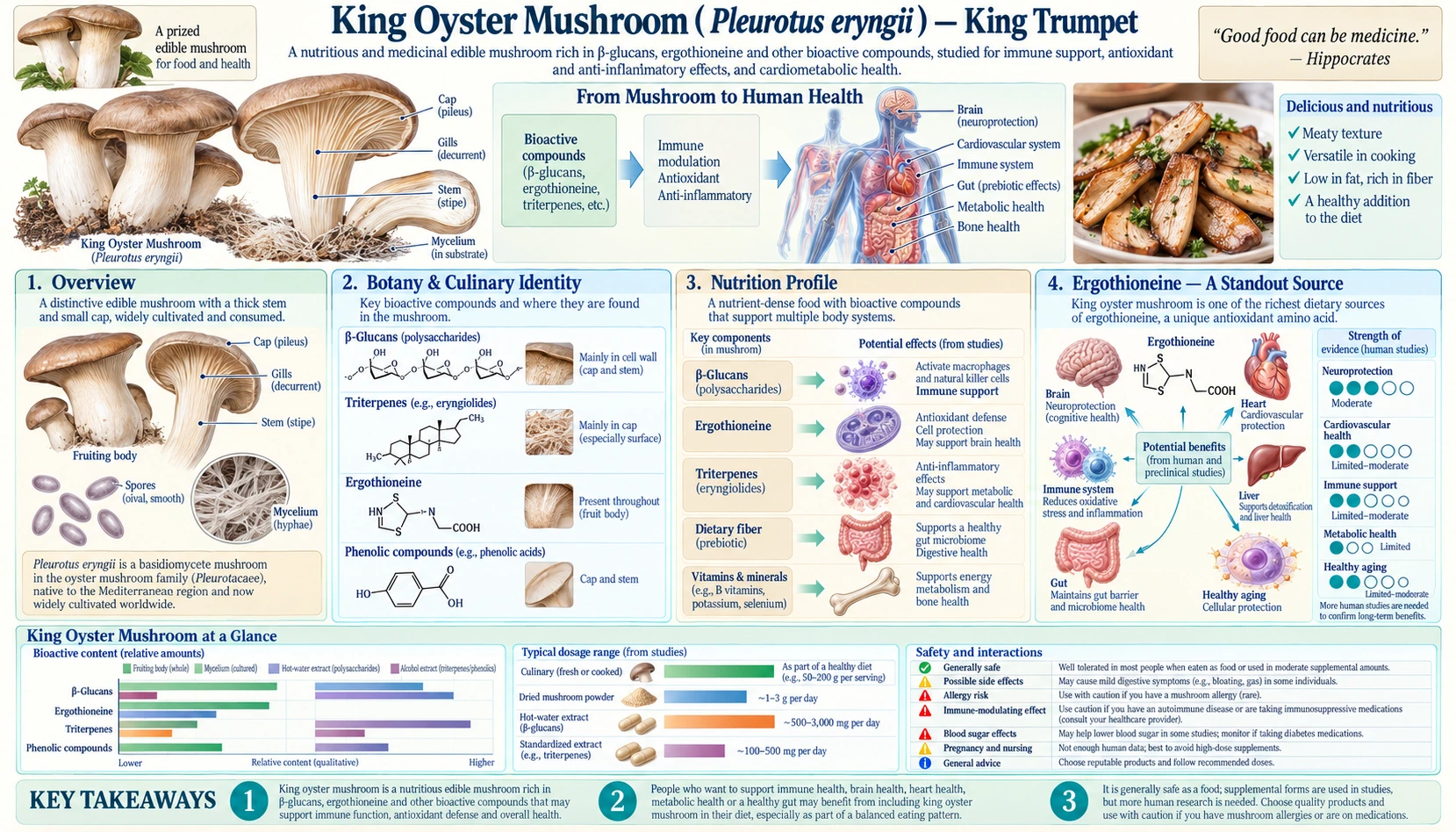
The king oyster mushroom (Pleurotus eryngii), also sold as the king trumpet, French horn, or eryngii mushroom, is the largest member of the oyster-mushroom family. Unlike its thin-fleshed cousins, it grows a thick, dense, ivory stem that holds its shape and develops a savory, scallop-like bite when cooked — which is why home cooks and chefs reach for it as a plant-based stand-in for scallops, pulled pork, and bacon. Beyond the kitchen, it is genuinely nutritious: low in calories, a source of plant protein and dietary fiber, and one of the richest natural food sources of ergothioneine, a diet-derived antioxidant that the body actively absorbs and stores. This page covers what is in a king oyster mushroom, what the science actually shows, and how to use it.
Table of Contents
- Overview
- Botany & Culinary Identity
- Nutrition Profile
- Ergothioneine — A Standout Source
- Vitamin D2 Potential
- Cholesterol & Lipids
- Antioxidant & Anti-Inflammatory
- Gut Health & Prebiotic Fiber
- Blood Sugar & Metabolic Health
- Weight & Satiety
- Culinary Use & Selection
- Forms & Dosage
- Safety & Cautions
- Educational Disclaimer
- Key Research Papers
- Connections
- Featured Videos
Overview
Pleurotus eryngii is a cultivated gourmet mushroom native to the grasslands and rocky soils of the Mediterranean, the Middle East, and parts of Asia, where it grows on the roots and dead tissue of plants in the carrot family — particularly the field eryngo (Eryngium campestre), which gives the species its name. Today it is grown commercially on pasteurized straw or sawdust substrate and is widely available fresh in supermarkets year-round.
What sets the king oyster apart from most culinary mushrooms is its texture. Instead of a flimsy cap on a thin stalk, it forms a substantial, columnar stem of firm white flesh. That density is the whole point: it browns deeply, soaks up marinades, and can be sliced, shredded, or scored to mimic seafood and meat. Among medicinal and culinary mushrooms, the king oyster occupies an unusual middle ground — it is first and foremost a delicious, satisfying food, and only secondarily a source of studied bioactive compounds. The most compelling of those compounds is ergothioneine, where this species ranks among the highest of all dietary sources.
Botany & Culinary Identity
The king oyster is the largest species in the genus Pleurotus, the same genus as the common gray and pearl oyster mushrooms. While ordinary oyster mushrooms grow in shelf-like clusters with broad, fan-shaped caps and almost no stem, P. eryngii grows as individual fruiting bodies with a small, flat to slightly domed brown cap perched atop a thick, club-shaped white stem that can be several inches long and as wide as a thumb or wider.
Several variants are cultivated, including P. eryngii var. ferulae and var. elaeoselini, each associated with a different host plant. For the cook, the key feature is consistent: a meaty, low-moisture stem with a mild, savory, faintly nutty flavor and a satisfying chew. This is the part that gets sliced into thick coins for "scallops," pulled lengthwise into "pulled pork," or cut into thin planks for "bacon." The common names — king oyster, king trumpet, French horn mushroom, eryngii — all refer to the same species. Because the flesh holds its structure through high-heat cooking far better than delicate mushrooms, it has become a fixture of plant-based and vegan cooking.
Nutrition Profile
Like most edible mushrooms, the king oyster is mostly water, which makes it naturally low in calories and energy-dense flavor without the load. The notable nutritional features, described qualitatively, are:
- Low calorie, modest plant protein. Fresh king oyster mushrooms are very low in calories yet contribute a meaningful amount of protein for a vegetable, including a spread of amino acids that lend the savory, umami quality.
- Notably high dietary fiber. The dense flesh is comparatively rich in fiber, including fungal beta-glucans and chitin. This is part of what gives the cooked mushroom its body and is central to its effects on the gut and on satiety.
- B vitamins. Mushrooms are a useful source of several B vitamins; king oyster supplies niacin (B3), riboflavin (B2), and pantothenic acid (B5), which support energy metabolism.
- Minerals. It provides copper and potassium, along with smaller amounts of other minerals.
- Ergosterol. The fungal sterol ergosterol — the mushroom's version of cholesterol — is present in the cell membranes and is the precursor that can be converted to vitamin D2 (see below).
- Ergothioneine. An unusual sulfur-containing amino-acid derivative that is the mushroom's signature antioxidant (see the next section).
Because nutrient content varies with growing conditions, strain, and how the mushroom is cooked, exact numbers are not given here. The practical takeaway is that king oyster is a low-calorie, high-fiber food that adds protein, B vitamins, copper, potassium, and antioxidants to a meal.
Ergothioneine — A Standout Source
Ergothioneine is the king oyster's most distinctive compound. It is a naturally occurring sulfur-containing antioxidant that humans and animals cannot make for themselves — it has to come from the diet. Fungi (and certain bacteria) are essentially the only organisms that synthesize it, which means mushrooms are by far the leading dietary source. Among mushrooms, Pleurotus species, including P. eryngii, are consistently among the richest, with concentrations far higher than the white button mushrooms most people eat.
What makes ergothioneine especially interesting is that the body treats it like something valuable. A dedicated transporter protein, OCTN1 (encoded by the gene SLC22A4), was identified specifically as the route by which ergothioneine is taken up into cells. Because the body has evolved a transporter dedicated to absorbing and retaining this single dietary compound, and because it then accumulates in tissues that face high oxidative stress — such as red blood cells, the liver, the lens of the eye, and the brain — some researchers have proposed that ergothioneine may function as a "longevity vitamin": not essential in the classic sense, but potentially protective over a lifetime.
Mechanistically, ergothioneine scavenges reactive oxygen species, helps protect cells from oxidative and inflammatory damage, and is unusually stable inside the body compared with many antioxidants. Researchers have even asked whether falling ergothioneine levels with age might contribute to age-related neurodegenerative disease, although that remains a hypothesis under investigation rather than established fact. Cultivation studies have also shown that the ergothioneine content of P. eryngii can be boosted through submerged mycelial culture and fermentation, pointing to it as a practical food-based source of the antioxidant. The honest bottom line: ergothioneine is a strong antioxidant in laboratory tests that the body actively absorbs and stores, but a 2012 review by Cheah and Halliwell notes that its antioxidant role inside the body has yet to be fully verified; the king oyster is one of the best food sources, and the most exciting human-health claims are still being worked out.
How much ergothioneine a mushroom holds varies widely. A 2017 comparison of different mushroom species (Kalaras and colleagues) measured ergothioneine from 0.15 to 7.27 mg per gram of dry weight, and in the selected species where cap and stem were compared it was more concentrated in the cap than in the stem — a point relevant to the king oyster, which is eaten mostly for its thick stem.
The first small human trial of ergothioneine itself was a pilot study published in 2024 (Yau and colleagues). Nineteen people aged 60 or over with mild cognitive impairment took either ergothioneine (25 mg capsules three times a week) or a placebo for one year, in a double-blind, randomized design. Ergothioneine did not change clinical safety markers (blood counts, kidney and liver function). The ergothioneine group did better on a word-learning test (the Rey Auditory Verbal Learning Test) and kept stable blood levels of neurofilament light chain (a blood marker of nerve-cell damage), while the placebo group showed no improvement on the cognitive tests and a significant rise in neurofilament light chain. It was a small pilot study, and it used capsules, not mushrooms.
For a deeper look at the compound itself, see the dedicated Ergothioneine page.
Vitamin D2 Potential
Mushrooms are the only significant non-animal food source of vitamin D — they are fungi, not plants, and no plant food supplies it in useful amounts — and the king oyster is no exception. The relevant raw material is ergosterol, the fungal sterol that fills the mushroom's cell membranes. When ergosterol is exposed to ultraviolet light — the same way human skin makes vitamin D3 from sunlight — it is converted to vitamin D2 (ergocalciferol).
Fresh mushrooms grown indoors in the dark contain little vitamin D, but their vitamin-D content can rise dramatically when they are deliberately exposed to ultraviolet (UV) light, either as whole caps or as dried powder. In a 2023 study, ultraviolet-C irradiation raised the vitamin D2 (ergocalciferol) content of dried powders of six mushrooms, P. eryngii among them (Kido and colleagues). A 2025 study applied ultraviolet-B light to corn flour that had first been colonised by P. eryngii and lion’s mane (Hericium erinaceus) mycelium, raising its vitamin D2 to up to 18.98 µg per 100 g (Duru and colleagues) — a fermented flour, not the whole mushroom. Setting fresh mushrooms in sunlight before cooking has been measured in button mushrooms (Agaricus bisporus), not king oyster: in a 2011 study (Simon and colleagues), vitamin D was 5 µg per 100 g dry weight in untreated mushrooms, 410 after commercial ultraviolet-B treatment and 374 after direct sunlight, and sunlight exposure also caused a 26% loss of riboflavin. Vitamin D2 is somewhat less potent at raising and maintaining blood vitamin-D levels than the D3 form found in animal foods and most supplements, but for people eating little animal food it represents a genuine plant-based dietary source. The king oyster's high ergosterol content makes it a good candidate for this ultraviolet-boosting approach.
Cholesterol & Lipids
King oyster mushrooms have been studied for effects on blood fats, and this is an area where it is important to be clear about the strength of the evidence. The interest has two roots. First, like several mushrooms, Pleurotus species contain naturally occurring compounds in the statin family — lovastatin-type molecules that, in principle, inhibit cholesterol synthesis. Two honest qualifications belong beside that: the species where lovastatin is best documented and most abundant is the ordinary oyster mushroom, P. ostreatus, not the king oyster; and the quantities measured in mushroom flesh are orders of magnitude below a prescribed statin dose, so a dinner portion is not a low-dose statin however appealing that idea sounds. Second, the mushroom's high content of soluble and insoluble fiber, including beta-glucan, can bind bile acids in the gut and modestly influence cholesterol handling, a mechanism shared with oats and other high-fiber foods.
In a 2008 study in atherosclerosis-prone mice (apolipoprotein E-deficient), a diet containing 3% dried king oyster (eringi), maitake or bunashimeji mushroom powder for 10 weeks reduced arterial plaque in the aortic root compared with the control diet. Blood fats changed little with king oyster: total cholesterol was significantly lower than in the control group only at 12 weeks of age, triglycerides did not differ, and bunashimeji had the strongest effect of the three mushrooms (Mori and colleagues). These results are biologically encouraging, but they come largely from preclinical (animal) research, often at intakes far higher, relative to body weight, than a person would eat at dinner. Robust, large human clinical trials confirming a cholesterol-lowering benefit specifically from culinary amounts of king oyster mushroom are limited. What can be said is that king oyster is a whole food that is low in saturated fat, high in fiber and calorie-light, often cooked in place of fatty meat, while any direct, drug-like cholesterol-lowering effect remains unproven in humans.
Antioxidant & Anti-Inflammatory
Beyond ergothioneine, king oyster mushrooms contain a mix of antioxidant compounds — phenolic acids, other sulfur compounds, and the polysaccharides that characterize medicinal mushrooms. Laboratory studies on the fruiting bodies, mycelia, and fermented products of P. eryngii have measured meaningful antioxidant activity, the capacity to neutralize free radicals in test-tube assays.
The fungal beta-glucans also interact with the immune system. Beta-glucans are recognized by receptors on immune cells and can modulate immune responses, which is the basis for much of the broader research interest in medicinal mushrooms. For the king oyster specifically, the anti-inflammatory and immune-modulating findings are mostly preclinical, so they are best framed as part of why a varied, mushroom-containing diet may support overall resilience rather than as a treatment for any particular condition. Eaten regularly as part of a colorful, plant-forward diet, king oyster contributes to the total antioxidant load of meals.
Gut Health & Prebiotic Fiber
The dense fiber that gives the king oyster its meaty bite does most of its work in the gut. Mushroom fiber is a blend of beta-glucans, chitin, and other complex carbohydrates that the human body cannot fully digest. Instead, these fibers travel to the large intestine, where they act as prebiotics — food for beneficial gut bacteria.
When gut microbes ferment these fibers, they produce short-chain fatty acids such as butyrate, which nourish the cells lining the colon and help maintain a healthy gut barrier. A fiber-rich diet of this kind is associated with better bowel regularity, a more diverse microbiome, and improved metabolic signaling. Because the king oyster is comparatively high in fiber for a low-calorie food, it is an easy, satisfying way to add prebiotic fiber to a meal — especially for people trying to eat less meat without feeling deprived. As with any high-fiber food, people unaccustomed to a lot of fiber often increase their intake gradually to let the gut adjust.
Blood Sugar & Metabolic Health
King oysters fit naturally into a blood-sugar-friendly pattern of eating. They are very low in available carbohydrate, high in fiber, and add bulk and protein to a plate — all qualities that tend to blunt the rise in blood sugar after a meal, particularly when the mushroom replaces a refined starch or fatty meat.
Broader research on mushroom consumption and metabolic health is supportive but mostly not specific to this species. Studies of regular mushroom intake (including button mushrooms) in people with or at risk of metabolic syndrome have examined effects on glucose and related risk factors, with generally favorable but modest signals. There is also preclinical work on Pleurotus polysaccharides and glucose handling. The well-supported part is straightforward: the king oyster is a low-calorie, high-fiber, low-glycemic vegetable, while specific therapeutic claims for diabetes are not established.
There is, however, a human study of this exact mushroom. In a 2022 randomized crossover trial (Kleftaki and colleagues), 19 adults with metabolically unhealthy obesity ate a meal containing king oyster mushroom and a control meal matched for calories and macronutrients, in random order after an overnight fast. After the mushroom meal the rise in blood glucose was lower, hunger was lower and fullness higher, and ghrelin (a hunger hormone) was suppressed more; insulin, peptide YY, GLP-1 and glicentin did not differ between the meals. A 2025 crossover study from the same group (Amerikanou and colleagues), in 13 male volunteers, used baked king oyster with a known beta-glucan content (4.5 g) and found a smaller rise in the blood’s aromatic amino acids (phenylalanine, tyrosine and tryptophan) after the mushroom meal than after the control meal. Both studies measured the effect of a single meal.
Weight & Satiety
One of the king oyster's most practical advantages for weight management is its low energy density — a lot of food, very few calories. Because the flesh is mostly water and fiber, a generous portion delivers volume, chew, and savory satisfaction for a small calorie cost. Foods that combine high volume, high fiber, and protein tend to be filling, helping people feel satisfied on fewer calories.
This is exactly why the king oyster works so well as a meat substitute. Swapping seared king oyster "scallops" or shredded king oyster "pulled pork" for the animal versions can sharply cut the calories, saturated fat, and energy density of a dish while keeping the meaty texture and umami that make a meal feel complete. For anyone trying to eat more plants and fewer calories without feeling hungry, it is a useful tool — not a magic weight-loss food, but a genuinely satisfying low-calorie ingredient.
Culinary Use & Selection
The whole appeal of the king oyster lies in cooking the stem, so technique matters. A few practical pointers:
- Selection. Fresh king oysters are firm and heavy, with smooth, dry, ivory-white stems and small intact brown caps; slimy, shriveled, browning, or soft ones are past their best.
- Storage. Refrigerated in a paper bag (not sealed plastic) so they can breathe, they store well for several days to about a week.
- "Scallops." The stem is sliced crosswise into thick coins about three-quarters of an inch tall, a crosshatch is scored into the cut faces, and the coins are seared hard in a hot, oiled pan until deeply golden on both sides. The crosshatch and high heat create a caramelized, scallop-like crust.
- "Pulled" or "shredded." The stem is shredded lengthwise with a fork into ragged strips, then sautéed or roasted until chewy and browned and tossed with a sauce for a pulled-pork or pulled-chicken effect.
- General cooking. Because the flesh is low in moisture, king oyster takes well to dry-heat methods — searing, roasting, grilling, air-frying — that concentrate flavor and develop browning. Given room in the pan rather than crowded, it browns rather than steams. It also holds up in braises and stir-fries.
- Cooked, not raw. Like most cultivated mushrooms, king oysters are meant to be eaten cooked, not raw (see Safety).
Forms & Dosage
The king oyster is, above all, a food, eaten as part of regular meals — there is no established medicinal dose. The common forms are:
- Fresh whole mushrooms — the standard culinary form, used as described above.
- Dried mushrooms and powder — rehydrated for cooking or added to broths, sauces, and seasoning blends; concentrating the mushroom this way also concentrates its fiber and ergothioneine. Dried or powdered mushrooms exposed to ultraviolet light are a route to higher vitamin D2.
- Extract supplements — mushroom extract capsules and powders exist, but the evidence base for isolated king oyster supplements is thin, and most of the documented benefits flow from eating the whole mushroom as food.
In everyday cooking, a serving is roughly a cup of cooked mushroom, eaten in place of meat or alongside other vegetables.
Safety & Cautions
King oyster mushrooms are a well-tolerated, widely eaten food with a strong safety record. The points that bear on their safety:
- Cooking. King oysters are eaten cooked, not raw. Cooking softens the tough chitin in the cell walls (improving digestibility), develops the flavor and texture, and is the standard practice for cultivated mushrooms. Raw mushrooms are harder to digest and may cause stomach upset.
- Allergy. Mushroom allergy is uncommon but real, and people who have reacted to mushrooms before can react to them again.
- Fiber adjustment. The high fiber content can cause gas or bloating when a lot is eaten suddenly, especially by people whose usual diet is low in fiber; a gradual increase gives the gut time to adjust.
- Foraging caution. The king oysters sold in shops are cultivated. Wild mushroom identification is genuinely dangerous for the untrained — a wild-foraged mushroom is safe to eat only once an expert has confirmed what it is.
- Special situations. The safety record described above is for king oyster eaten as food. No safety data have been established for concentrated king oyster extract supplements in people who are pregnant, immunocompromised, taking medications, or managing a medical condition.
Educational Disclaimer
This page is for general education only and is not medical advice. King oyster mushroom is a food, not a treatment for any disease. Much of the cardiometabolic research described here is preclinical (animal or laboratory) or is drawn from broader mushroom studies rather than trials of this specific species, and findings from such studies do not always translate to people eating culinary amounts. Nothing here is intended to diagnose, treat, cure, or prevent any condition. Concentrated supplements have not been studied for safety in people who are pregnant, nursing, immunocompromised, or managing a health condition.
Key Research Papers
Selected peer-reviewed literature. Links resolve to PubMed or DOI.
- Liang CH, Huang LY, Ho KJ, Lin SY, Mau JL. Submerged cultivation of mycelium with high ergothioneine content from the culinary-medicinal king oyster mushroom Pleurotus eryngii (higher Basidiomycetes) and its composition. Int J Med Mushrooms. 2013;15(2):153-64. — PubMed PMID: 23557367
- Chen SY, Ho KJ, Liang CH, Tsai CH, Huang LY, Mau JL. Preparation of culinary-medicinal king oyster mushroom Pleurotus eryngii-fermented products with high ergothioneine content and their taste quality. Int J Med Mushrooms. 2012;14(1):85-93. — PubMed PMID: 22339711
- Liang CH, Ho KJ, Huang LY, Tsai CH, Lin SY, Mau JL. Antioxidant properties of fruiting bodies, mycelia, and fermented products of the culinary-medicinal king oyster mushroom, Pleurotus eryngii (higher Basidiomycetes), with high ergothioneine content. Int J Med Mushrooms. 2013;15(3):267-75. — PubMed PMID: 23662614
- Mori K, Kobayashi C, Tomita T, et al. Antiatherosclerotic effect of the edible mushrooms Pleurotus eryngii (Eringi), Grifola frondosa (Maitake), and Hypsizygus marmoreus (Bunashimeji) in apolipoprotein E-deficient mice. Nutr Res. 2008;28(5):335-42. — PubMed PMID: 19083429
- Gründemann D, Harlfinger S, Golz S, et al. Discovery of the ergothioneine transporter. Proc Natl Acad Sci U S A. 2005;102(14):5256-61. — PubMed PMID: 15795384
- Cheah IK, Halliwell B. Ergothioneine; antioxidant potential, physiological function and role in disease. Biochim Biophys Acta. 2012;1822(5):784-93. — PubMed PMID: 22001064
- Halliwell B, Cheah I. Are age-related neurodegenerative diseases caused by a lack of the diet-derived compound ergothioneine? Free Radic Biol Med. 2024;217:60-67. — PubMed PMID: 38492784
- Duru BN, Doğan N, Berktas S, Cam M, Doğan C. Successive fungal solid-state fermentation and UV-B irradiation: A novel strategy to boost bioactive potential and vitamin D2 levels of corn flour. Food Chem. 2025;492(Pt 2):145430. — PubMed PMID: 40645051
- Kido S, Chosa E, Tanaka R. The effect of six dried and UV-C-irradiated mushrooms powder on lipid oxidation and vitamin D contents of fish meat. Food Chem. 2023;398:133917. — PubMed PMID: 35987007
- Polito F, De Martino L, Mirabile G, et al. Composition and antimicrobial activity of hydroalcoholic extracts of Pleurotus eryngii var. ferulae and P. eryngii var. elaeoselini. Front Chem. 2024;12:1498787. — PubMed PMID: 39697823
- Kleftaki SA, Simati S, Amerikanou C, Gioxari A, Tzavara C, Zervakis GI, Kalogeropoulos N, Kokkinos A, Kaliora AC. Pleurotus eryngii improves postprandial glycaemia, hunger and fullness perception, and enhances ghrelin suppression in people with metabolically unhealthy obesity. Pharmacol Res. 2022;175:105979. — PubMed PMID: 34798266
- Amerikanou C, Kleftaki SA, Gioxari A, Tagkouli D, Kasoura A, Simati S, Tzavara C, Kokkinos A, Kalogeropoulos N, Kaliora AC. The Performance of Pleurotus eryngii β-Glucans on Protein Digestion and the Release of Free Amino Acids in the Bloodstream of Obese Adults. Foods. 2025;14(15):2649. — PubMed PMID: 40807584
- Yau YF, Cheah IK, Mahendran R, Tang RM, Chua RY, Goh RE, Feng L, Li J, Kua EH, Chen C, Halliwell B. Investigating the efficacy of ergothioneine to delay cognitive decline in mild cognitively impaired subjects: A pilot study. J Alzheimers Dis. 2024;102(3):841-854. — PubMed PMID: 39544014
- Simon RR, Phillips KM, Horst RL, Munro IC. Vitamin D mushrooms: comparison of the composition of button mushrooms (Agaricus bisporus) treated postharvest with UVB light or sunlight. J Agric Food Chem. 2011;59(16):8724-32. — PubMed PMID: 21736377
- Kalaras MD, Richie JP, Calcagnotto A, Beelman RB. Mushrooms: A rich source of the antioxidants ergothioneine and glutathione. Food Chem. 2017;233:429-433. — PubMed PMID: 28530594
Further reading via PubMed topic search: Pleurotus eryngii ergothioneine · Pleurotus eryngii cholesterol & lipids · ergothioneine OCTN1 antioxidant · Pleurotus eryngii vitamin D2 Ultraviolet.