Enoki Mushroom (Flammulina velutipes)
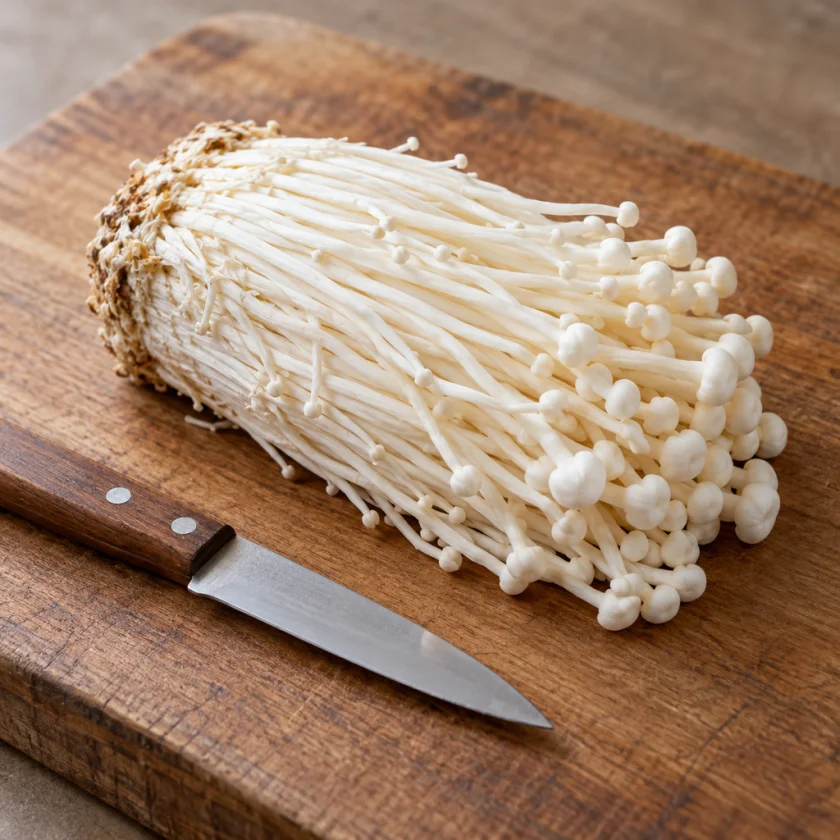
The enoki mushroom (Flammulina velutipes) is one of the most recognizable mushrooms in East Asian cooking: long, thin, pale stalks topped with tiny caps, sold in tight clumps that look almost like noodles. It is prized less for any dramatic medicinal reputation than for being delicate, mild, low in calories, and pleasantly crunchy — a "purely nutritious" everyday food rather than a heavyweight in the way reishi or turkey tail are. That said, enoki carries one genuinely important food-safety caveat (repeated Listeria outbreaks tied to raw or undercooked product) and a small but interesting body of immune research centered on a protein called FIP-fve. This page covers what enoki is, what is in it, what the research actually shows, and how to handle it safely.
Table of Contents
- Overview
- Cultivated vs. Wild
- Nutrition Profile
- Immune-Active Proteins & Polysaccharides
- Antioxidant Effects
- Gut Health & Fiber
- Blood Lipids & Metabolic
- Allergy & Th1 Modulation
- A Human Trial in Men With Age-Related Symptoms
- Culinary Use & Selection
- Forms & Dosage
- Food Safety & Cautions
- Educational Disclaimer
- Key Research Papers
- Connections
- Featured Videos
Overview
Enoki — also written enokitake (Japanese), enoki-dake, or golden needle mushroom (a translation of the Chinese name) — is the cultivated form of Flammulina velutipes. In stores it appears as a dense bouquet of slender white-to-cream stalks several inches long, joined at a spongy base, each capped by a small pinhead. The flavor is mild and slightly fruity, the texture crisp and a little springy, and it cooks in seconds. Enoki is among the most widely produced cultivated mushrooms in the world, with the bulk of commercial supply grown in East Asia.
Botanically the same species also grows wild across temperate regions, where it looks nothing like the supermarket version (see the next section). Within the fungal kingdom, Flammulina velutipes sits among the gilled mushrooms (Agaricales). Unlike the dense, woody polypores prized in traditional medicine — reishi, chaga, turkey tail — enoki is a soft, fleshy, edible mushroom first and foremost. Its health interest comes from ordinary nutrition plus a thin but real research literature on specific bioactive proteins and polysaccharides.
Cultivated vs. Wild
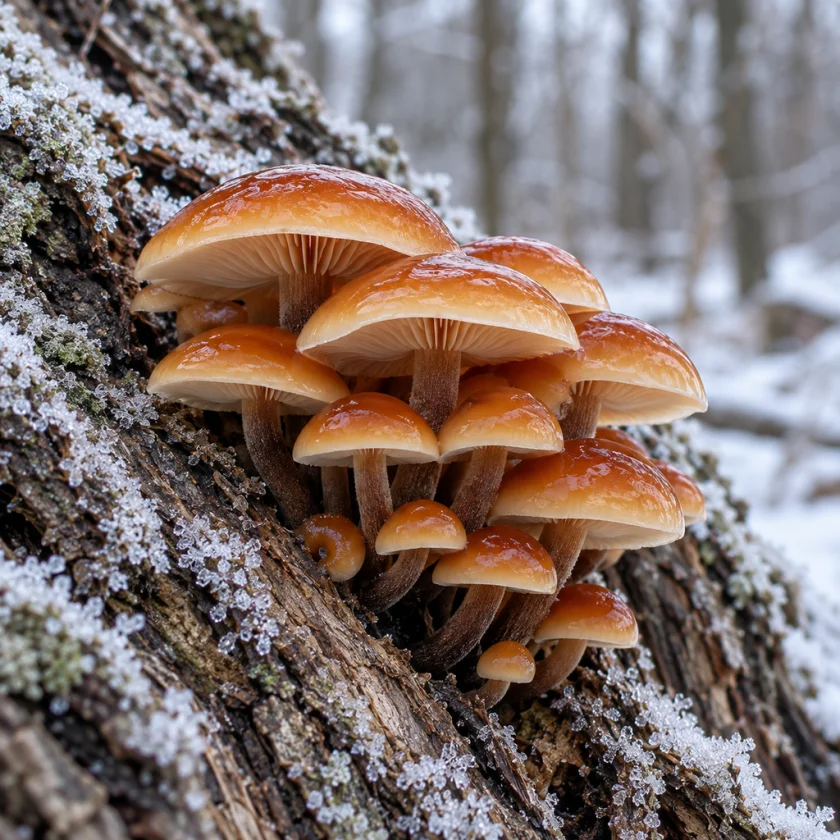
Few mushrooms illustrate the influence of growing conditions as starkly as Flammulina velutipes. The pale, long-stemmed "enokitake" you buy is grown in cool, dark, carbon-dioxide-rich chambers. Darkness suppresses cap expansion and pigment, while the enclosed environment and crowding force the stalks to grow long and thin as they stretch toward what little air movement exists. The result is the familiar ivory-colored, spaghetti-like cluster.
The wild form is a different creature in appearance. Commonly called the velvet shank or winter mushroom, it has a short, tough, dark-brown velvety stem and a sticky, orange-to-tan cap, and it famously fruits in cold weather — even pushing up through frost on dead hardwood logs and stumps. It is the same species genetically, but sunlight, open air, and natural substrate produce a stocky, pigmented mushroom that most people would never connect to the delicate white clusters in a grocery cooler.
A practical note for foragers: the wild winter mushroom is edible and can be tasty, but it grows at the same time of year as the deadly Galerina species, which it can superficially resemble. Identification of any wild mushroom requires real expertise. For the vast majority of people, "enoki" simply means the cultivated product, and that is the form discussed for the rest of this page.
Nutrition Profile
Enoki is a classic low-calorie, high-water vegetable-style food. A serving delivers very few calories while contributing useful amounts of several nutrients, which is why it is popular in lighter cooking. Rather than invent precise percentages, here is the qualitative picture supported by food-composition data:
- Low in calories and fat — mostly water, with negligible fat and a modest amount of carbohydrate.
- Dietary fiber — a meaningful source of mushroom fiber, including beta-glucans and chitin-type fibers in the cell walls that resist digestion and reach the colon.
- B vitamins — notably a good source of niacin (vitamin B3), along with other B vitamins such as riboflavin, pantothenic acid, and thiamine, which support energy metabolism.
- Potassium — like most mushrooms, enoki contributes potassium, an electrolyte important for blood pressure regulation and nerve and muscle function.
- Plant-style protein — a modest amount of protein for a vegetable, containing a range of amino acids.
- Ergothioneine — mushrooms are the richest dietary source of this unusual antioxidant amino acid; Flammulina velutipes is among the species that accumulate it, and comparative analyses of mushroom bioactives have measured it in enoki tissue.
The takeaway is that enoki earns its "purely nutritious" reputation honestly: it adds volume, fiber, texture, and a sprinkle of micronutrients to a dish for almost no caloric cost. The more speculative health claims below are largely separate from this everyday nutritional value.
Immune-Active Proteins & Polysaccharides
The most studied bioactive in enoki is FIP-fve (fungal immunomodulatory protein from Flammulina velutipes), a small protein in the FIP family that also includes proteins from reishi and other fungi. In laboratory and animal studies, FIP-fve interacts with immune cells — it can activate certain lymphocytes and shift the balance of signaling molecules (cytokines). Closely related research describes proflamin, an earlier-characterized antitumor glycoprotein from the same species, and several polysaccharides (sometimes labeled in older work as EA6 or as Flammulina polysaccharides, FVP), which are large sugar molecules that show immune-stimulating and antioxidant activity in test systems.
It is important to read these findings honestly. Almost all of this work is preclinical — cells in dishes, isolated proteins, and rodent models. These studies are scientifically legitimate and help explain why enoki extracts behave the way they do biologically, but they do not establish that eating enoki, or taking an enoki supplement, treats or prevents any disease in humans. The proteins are also often studied as purified, sometimes high-dose preparations rather than as the small amounts you would get from a serving of mushrooms in soup. FIP-fve and the polysaccharides are an interesting and active area of early-stage research, not a proven therapy.
One practical purification detail from the research literature is worth knowing: enoki fruiting bodies also contain flammutoxin, a cytolytic protein. Studies developing FIP-fve as a candidate ingredient have specifically worked out how to separate and remove flammutoxin from the immunomodulatory protein, underscoring that "bioactive" extracts are carefully processed materials, not just blended mushrooms.
Antioxidant Effects
Enoki extracts show antioxidant activity in laboratory assays, attributed to a mix of phenolic compounds, polysaccharides, and ergothioneine. In food-science research, ergothioneine-rich mushroom extracts — including from Flammulina velutipes — have been used to slow lipid oxidation and discoloration in stored fish and meat, a real-world demonstration of antioxidant chemistry. Comparative studies have also measured several bioactive components in the fruiting bodies and mycelia of culinary-medicinal mushrooms, helping quantify what enoki contributes.
What this means for a person eating enoki is more modest. Antioxidant activity measured in a test tube or used to preserve salmon does not translate directly into a measurable health benefit in the body, where antioxidant balance is governed by many overlapping systems. The reasonable conclusion is that enoki, like other mushrooms, contributes some antioxidant compounds to the diet — a sensible reason to eat a variety of vegetables and fungi, not a stand-alone health intervention.
Gut Health & Fiber
Enoki's springy texture comes partly from its cell-wall fibers, including beta-glucans and chitin-rich material. These are largely indigestible by human enzymes, so they pass to the large intestine where gut bacteria can ferment some of them. Insoluble dietary fiber from mushroom sources has been characterized for potential effects on glucose and lipid handling, and fermentable fibers in general are recognized for supporting a healthy microbiome and regular bowel function. In one laboratory comparison of insoluble fiber from enoki, carrots and oats, enoki fiber (mainly hemicelluloses and cellulose) had the strongest glucose-binding capacity and the strongest ability to inhibit fat digestion of the three, and in mice all three fibers improved glucose tolerance and held back the rise in blood fats after a fat load.
This is one of the more grounded reasons to enjoy enoki: it is a low-calorie way to add fiber and bulk to meals. As with any fiber-rich food, large amounts eaten suddenly can cause gas or bloating in sensitive people. Thorough cooking both improves digestibility and, far more importantly, addresses the food-safety issue covered below.
Blood Lipids & Metabolic
Several animal and laboratory studies have explored whether enoki affects blood fats and metabolism. Work in rodents and in poultry feeding trials has reported hypolipidemic (cholesterol- and triglyceride-lowering) and antioxidant effects from enoki fruiting bodies or stem material, and a study in laying hens described effects on oxidative damage and yolk-precursor synthesis via liver-blood-ovary signaling. A dedicated study fed male hamsters on a high-fat diet 1, 2 or 3% enoki powder or enoki extract for 8 weeks; the 3% groups had the lowest total cholesterol, triglyceride, low-density lipoprotein (LDL) cholesterol and LDL to high-density lipoprotein (HDL) ratio in serum and liver (P < 0.05).
These are genuinely interesting signals, but they remain preliminary and largely non-human. Feeding a concentrated mushroom fraction to rats or chickens is a long way from a controlled human trial showing that eating enoki lowers cholesterol or improves metabolic markers. The honest summary: enoki fits comfortably into a heart-healthy, high-vegetable, lower-calorie eating pattern, and that pattern as a whole is well supported — but enoki itself is not an established cholesterol treatment.
Allergy & Th1 Modulation
One of the more specific research threads on FIP-fve concerns allergy and asthma. In mouse models of allergic airway disease, oral or administered FIP-fve has been reported to reduce airway inflammation, modulate the immune response toward a Th1 pattern (away from the Th2-dominant pattern associated with allergy), and influence cytokines such as IL-17 tied to airway remodeling. Studies include dust-mite-induced allergy models, neutrophilic asthma models, and a 2025 obese allergic-asthma model in which FIP-fve mitigated airway inflammation and related metabolic dysfunction.
This body of work is the strongest scientific reason enoki is mentioned in immune contexts — but it is critical to keep it in proportion. These are animal experiments using a purified protein, not clinical trials, and they do not show that eating enoki helps human asthma or allergies. These animal studies give no basis for treating asthma or any allergic condition with enoki. The FIP-fve allergy research is best understood as promising mechanistic science that may one day inform new therapies, while remaining at the early stage today.
A Human Trial in Men With Age-Related Symptoms
A 2025 randomized, double-blind, placebo-controlled trial tested an enoki extract in people. Healthy middle-aged and older Japanese men with Aging Males' Symptoms (AMS) scores of 27–49 took a powdered enoki mushroom extract containing adenosine, or a placebo, for 12 weeks. The extract significantly improved the sexual subscale of the AMS score, the number of men showing high improvement was significantly higher than with placebo, and more men in the extract group had a rise in total testosterone of 0.5 ng/mL or more. The trial abstract does not state how many men took part. This is a single trial of a concentrated extract, not of enoki eaten as food.
Culinary Use & Selection
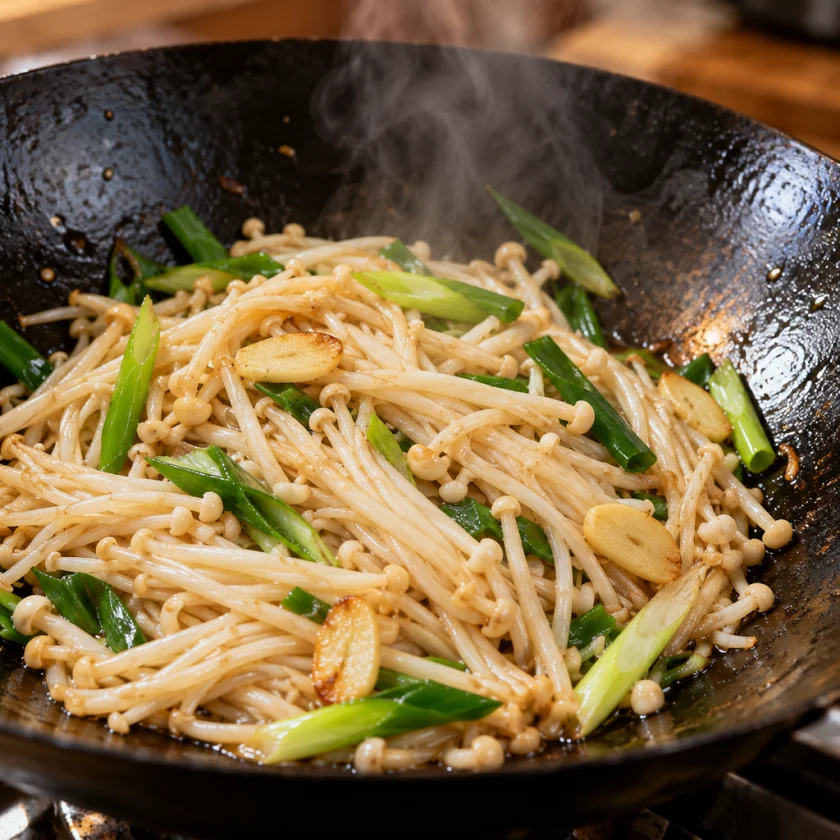
Enoki shines in quick-cooked dishes. It is a staple in hot pot, where the clusters are dunked into simmering broth; in miso and other soups; in stir-fries; folded into noodle dishes; rolled in thin slices of meat and grilled; or briefly sauteed as a side. Because the stalks are slender, they cook almost instantly and can turn slippery if overcooked, so they are usually added near the end. The flavor is mild, so enoki readily takes on the seasoning of whatever it is cooked in.
Fresh enoki is firm, dry, and bright white-to-cream, with closed caps; packages that are slimy, browning, mushy, sour-smelling, or have water pooled inside are past their best. Preparation usually means slicing off the dense, often gritty base of the cluster (roughly the bottom inch where the stalks join, which can hold growing-medium residue) and discarding it, then separating the strands and rinsing them well under running water. While enoki can technically be eaten raw, the food-safety section below explains the risk of doing so.
Forms & Dosage
Enoki is overwhelmingly consumed as fresh, whole food, and that is how it is best treated — as a culinary mushroom rather than a supplement. There is no established "dose" for health benefits; you simply use it as an ingredient in normal amounts, the way you would any vegetable. Cooked enoki can be enjoyed regularly as part of a varied diet.
It is also sold dried (rehydrated and cooked before eating) and occasionally appears in mushroom-blend powders or extracts marketed for immune support. These concentrated products are a different proposition from food: the purified proteins and polysaccharides studied in the lab are not the same as a capsule of mushroom powder, and supplement claims often outrun the human evidence. There is no proven supplemental dose of enoki for any condition. The strongest case for enoki is simply eating the mushroom as food. None of the studies cited on this page tested the safety of concentrated mushroom products in pregnancy, in people with medical conditions, or alongside medications.
Food Safety & Cautions
This is the single most important section on the page. Enoki mushrooms have been repeatedly linked to outbreaks and recalls involving Listeria monocytogenes, a bacterium that can survive and even grow at refrigerator temperatures and that causes listeriosis — an infection that is mild in many healthy adults but can be severe or fatal in vulnerable people. United States and international investigations have traced multiple multistate listeriosis outbreaks to imported enoki, and laboratory work has shown that Listeria contamination can survive and grow during enoki cultivation and persist on the product. Because the mushrooms are often sold for raw or lightly-cooked use (such as garnishes or quick hot-pot dips), inadequately cooked enoki has been a recurring source of illness. According to a 2025 overview by U.S. outbreak investigators, enoki mushrooms were first linked to listeriosis illnesses in 2020; contaminated enoki led to “a series of highly impactful recalls,” and state, federal, and international partners developed an outbreak-prevention strategy that includes enhanced surveillance.
The food-safety research describes these protective steps:
- Thorough cooking. Heat inactivates Listeria, but brief contact with hot liquid is not enough. In a 2024 laboratory study, ramen broth poured over contaminated raw enoki at 60 and 70°C cut Listeria by only 1–3 log CFU/g (colony-forming units per gram; each log is a tenfold drop), 80°C broth by 4–5 log, and 90–100°C broth by more than 5 log, and in all cases surviving bacteria, often more than 2.4 log CFU/g, were still present after 60 minutes. Enoki simmered, stir-fried, or boiled until fully heated through is cooked; enoki eaten raw, barely warmed, or only wilted in hot broth is not.
- Rinsing and trimming. Enoki is usually rinsed under running water and the dense base trimmed off. In 2025 challenge tests, leftover growing substrate on the mushrooms sped up Listeria growth.
- Cold storage slows but does not stop Listeria. In the same 2025 challenge tests on imported enoki, Listeria counts rose significantly from 30 to 1,000 CFU/g within 4 days at 10°C and 9 days at 4°C, and a growth model indicated a 100-fold increase in 3.7 days at 10°C and 8.8 days at 4°C. Prompt refrigeration and use-by dates limit this growth; slimy, off-smelling, or out-of-date packages are usually thrown away.
- Cross-contamination — Listeria can pass from raw mushrooms to ready-to-eat foods, hands, boards, and utensils, which is why kitchens keep them apart and wash them.
Listeriosis is most dangerous for certain groups: pregnant people (listeriosis can cause miscarriage, stillbirth, and severe newborn infection), older adults, newborns, and anyone who is immunocompromised (including people on immune-suppressing medication or undergoing cancer treatment). For these groups, raw or undercooked enoki carries the highest risk. Separately, mushroom allergy is uncommon but real; itching, hives, swelling, or breathing difficulty after eating enoki are signs of an allergic reaction, and swelling or breathing difficulty are signs hospitals treat as urgent. Finally, because mushrooms contribute potassium and enoki is a fiber source, enoki counts toward the potassium total of people on potassium-restricted diets (such as advanced kidney disease), as other vegetables do.
Educational Disclaimer
This article is for general educational purposes only and is not medical advice, diagnosis, or treatment. Most health claims about enoki beyond its basic nutrition rest on laboratory and animal research and have not been confirmed in humans; the one exception found is a single 2025 placebo-controlled trial of an enoki extract for age-related symptoms in men (described above). Nothing here is intended to diagnose, treat, cure, or prevent any disease, or to substitute for professional medical care. The food-safety information — especially the need to cook enoki thoroughly and the heightened risk for pregnant, elderly, and immunocompromised people — is general information; current public-health advisories carry the latest outbreak and recall notices.
Key Research Papers
Selected peer-reviewed literature. Links resolve to PubMed or DOI.
- Viazis S, Conrad A, Palacios A, et al. An Overview of Listeriosis Outbreak Investigations in the United States Linked to Imported Enoki Mushrooms and Associated Regulatory Activities, Research, and Food Safety Knowledge Gaps. Compr Rev Food Sci Food Saf. 2025;24(5):e70292. — PubMed PMID: 40958164
- Grocholl J, Ferguson M, Hughes S, Trujillo S, Burall LS. Listeria monocytogenes Contamination Leads to Survival and Growth During Enoki Mushroom Cultivation. J Food Prot. 2024;87(6):100290. — PubMed PMID: 38701973
- Salazar JK, George J, Fay ML, Stewart DS, Ingram DT. Comparative growth kinetics of Listeria monocytogenes and Salmonella enterica on dehydrated enoki and wood ear mushrooms during rehydration and storage. Front Microbiol. 2024;15:1406971. — PubMed PMID: 39161606
- Özgen R, Şöhretoğlu D, Kuruüzüm-Uz A. Biological activities and bioactive constituents of Flammulina velutipes: An updated systematic review. J Sci Food Agric. 2026;106(14):8298-8314. — PubMed PMID: 41906329
- Hsiao CH, Ko JL, Wu TS, Lue KH, Wu CT. Fungal immunomodulatory protein FIP-fve mitigates airway inflammation and metabolic dysfunction in an obese allergic asthma model. Sci Rep. 2025;15(1):32770. — PubMed PMID: 40998975
- Pan HH, Ko JL, Wu CT, et al. Effect of the Fungal Immunomodulatory Protein FIP-fve in the Neutrophilic Asthma Animal Model. Int Arch Allergy Immunol. 2021;182(12):1143-1154. — PubMed PMID: 34649239
- Chu PY, Sun HL, Ko JL, et al. Oral fungal immunomodulatory protein-Flammulina velutipes has influence on pulmonary inflammatory process and potential treatment for allergic airway disease: A mouse model. J Microbiol Immunol Infect. 2017;50(3):297-306. — PubMed PMID: 26427878
- Yeh MY, Ko WC, Lin LY. Hypolipidemic and antioxidant activity of enoki mushrooms (Flammulina velutipes). Biomed Res Int. 2014;2014:352385. — PubMed PMID: 25250317
- Yang X, Dai J, Zhong Y, et al. Characterization of insoluble dietary fiber from three food sources and their potential hypoglycemic and hypolipidemic effects. Food Funct. 2021;12(14):6576-6587. — PubMed PMID: 34100044
- Lin SY, Chen YK, Yu HT, et al. Comparative study of contents of several bioactive components in fruiting bodies and mycelia of culinary-medicinal mushrooms. Int J Med Mushrooms. 2013;15(3):315-23. — PubMed PMID: 23662618
- Salazar JK, Fay ML, Fleischman G, et al. Inactivation kinetics of Listeria monocytogenes and Salmonella enterica on specialty mushroom garnishes based on ramen soup broth temperature. Front Microbiol. 2024;15:1485398. — PubMed PMID: 39697650
- Upham JP, Markell JA. Challenge Testing to Determine Growth of Listeria monocytogenes on Fresh Enoki Mushrooms at 4 °C and 10 °C Storage Temperatures. J Food Prot. 2025;88(9):100577. — PubMed PMID: 40617322
- Yamada S, Shirai M, Nagashima K, et al. Beneficial Effects of Enoki Mushroom Extract on Male Menopausal Symptoms in Japanese Subjects: A Randomized, Double-Blind, Placebo-Controlled Study. Nutrients. 2025;17(7):1208. — PubMed PMID: 40218966
- Wu H, Yuan J, Yin H, et al. Flammulina velutipes stem regulates oxidative damage and synthesis of yolk precursors in aging laying hens by regulating the liver-blood-ovary axis. Poult Sci. 2023;102(1):102261. — PubMed PMID: 36410067