Artemisinin and Malaria
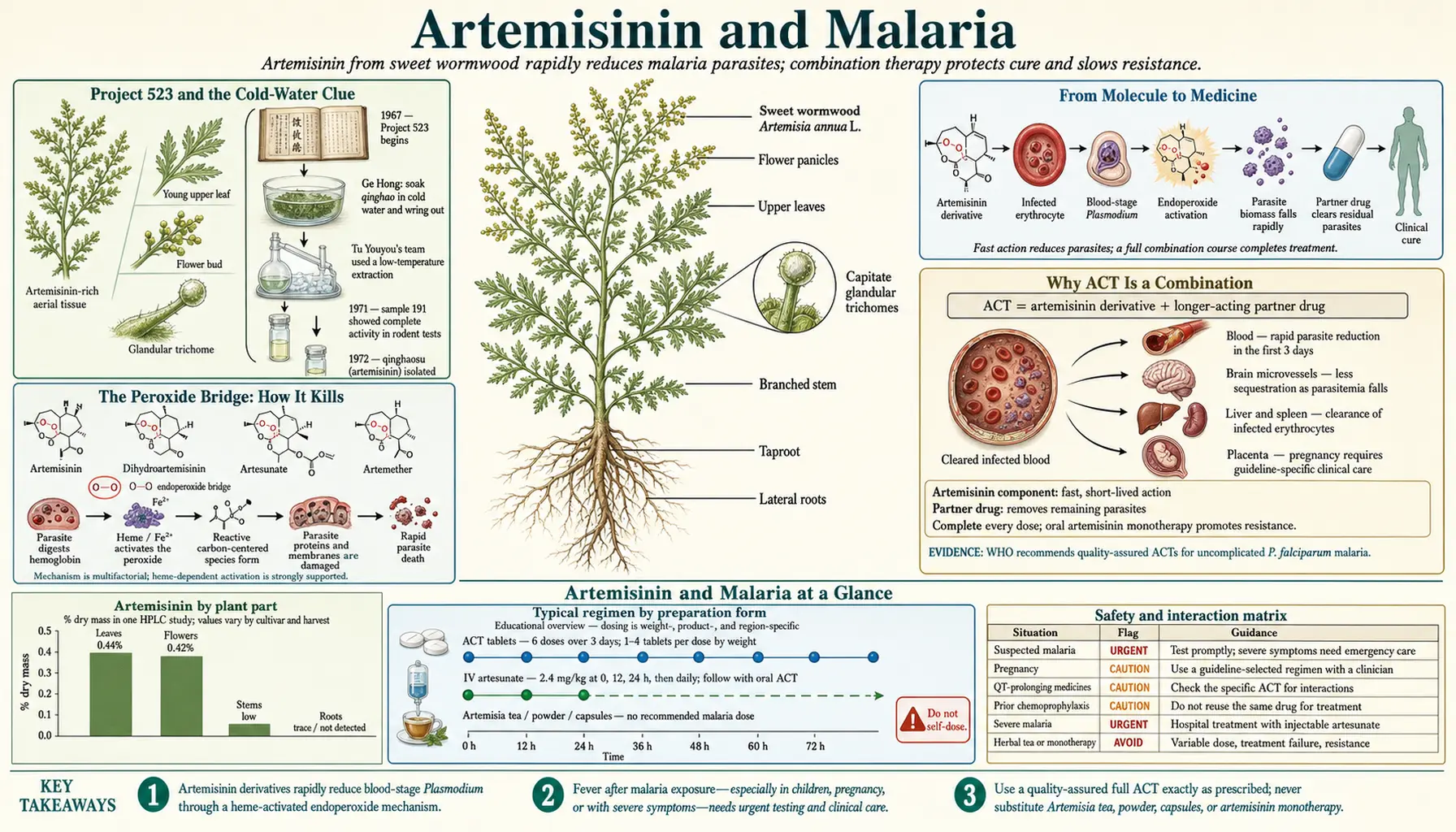
If you have a fever and you have been anywhere malaria is transmitted, stop reading and get tested. A rapid diagnostic test takes fifteen minutes, a blood film takes an hour, and falciparum malaria can go from a headache to a coma inside forty-eight hours. Treatment is artemisinin-based combination therapy, and it works. Nothing in this article is a reason to delay that.
What follows is the real story of how a plant in a Chinese herbal became the most important antimalarial molecule on earth — and why the same story ends with the World Health Organization asking people not to drink the plant. Both halves are true, and the second half is the one that saves lives now.
Table of Contents
- Project 523 and the Cold-Water Clue
- The Peroxide Bridge: How It Kills
- From Molecule to Medicine
- Why ACT Is a Combination
- Severe Malaria: The Trials That Changed Practice
- What a Cup of Tea Actually Delivers
- The Two Retracted Trials
- The Whole-Plant Argument, Stated Fairly
- Resistance: From the Mekong to Uganda
- Why Herbal Monotherapy Harms Other People
- If You Might Have Malaria
- Key Research Papers
- Connections
Project 523 and the Cold-Water Clue
On 23 May 1967, the Chinese government launched a classified military research programme, named after its start date: Project 523. The problem was urgent and geopolitical. Chloroquine, the workhorse antimalarial of the mid-twentieth century, was failing across Southeast Asia, and malaria was inflicting more casualties on soldiers in Vietnam than combat was. China had agreed to help. Hundreds of scientists across dozens of institutes were assigned to find something new.
Tu Youyou, then a researcher at the Academy of Traditional Chinese Medicine in Beijing, was put in charge of one strand: comb the classical medical literature for antimalarial candidates. Her team assembled more than 2,000 traditional preparations and screened hundreds of extracts. Qinghao — Artemisia annua — came up again and again for the intermittent fevers that are the signature of malaria. But the extracts kept underperforming, and inconsistently so, which is the kind of result that usually gets a candidate dropped.
The breakthrough was not chemical. It was textual. In Zhouhou Beiji Fang (A Handbook of Prescriptions for Emergencies), written around 340 CE by the alchemist-physician Ge Hong, the instruction for qinghao was unlike the standard decoction method used for nearly every other herb. It said to take a handful of qinghao, soak it in roughly two litres of water, wring out the juice, and drink it all. Cold. No boiling.
Tu recognised the significance immediately: if the traditional preparation deliberately avoided heat, the active principle was probably heat-labile, and every boiling extraction her team had run had been destroying it. She switched to a low-temperature ether extraction. In 1971 the resulting extract showed 100 percent inhibition of parasitaemia in mouse and monkey malaria. In 1972 her team crystallised the pure compound: qinghaosu — artemisinin.
Because the programme was secret and China was mid-Cultural Revolution, the discovery reached the outside world slowly, and credit was contested for decades. In 2015 the Nobel Assembly settled it, awarding Tu Youyou half of the Nobel Prize in Physiology or Medicine. She was the first Chinese woman to win a science Nobel. She had no doctorate, no research experience abroad, and no membership in the Chinese Academy of Sciences — a fact Chinese scientists still argue about.
It is worth being precise about what the tradition contributed and what it did not. It identified the right species out of a very large flora, and it preserved — for sixteen hundred years, in a single sentence — the one processing detail that mattered. It did not supply a dose, a purity standard, a partner drug, or any way of knowing whether a given plant was strong or weak. Those had to be invented. That gap is the subject of the rest of this article.
The Peroxide Bridge: How It Kills
Artemisinin is a sesquiterpene lactone — a fifteen-carbon plant terpene — carrying something almost no other natural product carries: an endoperoxide bridge, a strained “–O–O–” link locked inside a 1,2,4-trioxane ring. That bridge is chemically loaded. Break it and you get radicals.
Here is the elegant part. Inside a red blood cell, the malaria parasite eats haemoglobin, and in doing so liberates enormous quantities of free heme — iron-bearing, highly reactive, and toxic enough that the parasite has to crystallise it into inert hemozoin just to survive its own meal. That iron is what activates artemisinin. Ferrous iron cleaves the peroxide bridge, and the resulting carbon-centred radicals attack whatever is nearby.
What they attack turned out to be almost everything. A 2015 chemical-proteomics study tagged artemisinin and found it covalently bound to more than 120 parasite proteins spanning essential pathways — and that this promiscuous alkylation required heme activation. That explains two clinical observations at once: why artemisinin acts so fast (it hits many targets simultaneously), and why full resistance has been so slow to appear (a parasite cannot mutate its way out of a hundred simultaneous hits; it can only learn to hide from the activation step).
It also explains the selectivity. Human cells do not gorge on haemoglobin and do not carry a digestive vacuole full of free heme. The drug is preferentially activated inside the parasite, which is why a compound that generates indiscriminate radicals is nonetheless well tolerated.
From Molecule to Medicine
Pure artemisinin has three serious drug-development problems: it is barely soluble in water or oil, absorbed erratically, and cleared fast — and it induces its own metabolism, so blood levels drop over successive days of dosing. Chemists solved this by modifying the molecule while leaving the peroxide bridge untouched.
| Compound | What it is | Where it is used |
|---|---|---|
| Artemisinin | The parent natural product from A. annua leaves | Mostly a starting material now; not a first-line medicine on its own |
| Dihydroartemisinin (DHA) | The reduced form; also the active metabolite the others convert into | Oral ACT, usually paired with piperaquine |
| Artesunate | Water-soluble hemisuccinate ester of DHA | Intravenous treatment of severe malaria — the single most important formulation; also oral ACT with amodiaquine or mefloquine |
| Artemether | Oil-soluble methyl ether of DHA | Oral ACT with lumefantrine (Coartem), the most-used ACT worldwide; intramuscular in some settings |
| Arteether | Oil-soluble ethyl ether | Limited use; the compound most implicated in animal neurotoxicity studies |
All of them are converted to dihydroartemisinin in the body, so they share a mechanism. What differs is solubility, route and speed — and for a disease that can kill in a day, being able to push a full dose into a vein in thirty seconds is not a minor advantage.
Why ACT Is a Combination
Artemisinins clear parasites faster than any other antimalarial class — roughly a ten-thousandfold reduction in parasite biomass per asexual cycle. But they are cleared from the blood within hours. Give an artemisinin alone for three days and a small residue of parasites can survive to repopulate; give it long enough to finish the job alone and you would need a week of dosing that nobody completes reliably.
So every WHO-recommended regimen pairs a fast, short-acting artemisinin with a slow, long-acting partner drug — lumefantrine, amodiaquine, piperaquine, mefloquine, sulfadoxine-pyrimethamine or pyronaridine. The artemisinin destroys the bulk of the parasite population in the first days; the partner drug mops up the remainder over the following weeks. That is artemisinin-based combination therapy (ACT).
The combination is not primarily about efficacy. It is about resistance arithmetic. For a parasite to survive two drugs with different mechanisms, it needs two independent resistance mutations in the same organism — a far rarer event than either alone. Every use of an artemisinin without a partner drug hands the parasite population a free trial run at solving one drug in isolation. This is the reason WHO has campaigned since 2006 to remove oral artemisinin monotherapies from the market, and it is the reason a home-brewed Artemisia tea is a problem rather than a folk shortcut: an infusion is monotherapy, at a low and unmeasurable dose, taken without supervision.
Severe Malaria: The Trials That Changed Practice
Two large randomised trials moved severe malaria from quinine to artesunate, and they are worth knowing because they show what the standard of evidence in this field actually looks like.
SEAQUAMAT (published 2005) randomised 1,461 patients with severe falciparum malaria across Bangladesh, India, Indonesia and Myanmar to intravenous artesunate or intravenous quinine. Mortality fell from 22 percent on quinine to 15 percent on artesunate — a roughly 35 percent relative reduction in deaths. The trial was stopped early.
AQUAMAT (published 2010) repeated the question in African children — 5,425 of them, across nine countries. Mortality fell from 10.9 percent to 8.5 percent. In absolute terms, roughly one additional child survived for every forty-one treated with artesunate rather than quinine.
Those two trials are why intravenous artesunate is now the global standard for severe malaria. They are also a useful yardstick: this is what “proven” looks like — thousands of randomised patients, a hard endpoint (death), replication on two continents. Hold every other claim about this plant against that bar.
What a Cup of Tea Actually Delivers
This is the number that settles the argument, and it comes from a proper pharmacokinetic study rather than from anyone’s opinion.
Fourteen healthy male volunteers each drank one litre of tea prepared from 9 g of dried Artemisia annua leaves. Researchers measured artemisinin in the tea and in the volunteers’ blood by HPLC. Findings:
- The litre contained 94.5 mg of artemisinin — approximately 19 percent of the usually recommended daily dose.
- Peak plasma concentration was 240 ± 75 ng/mL, reached faster than from solid oral dosage forms, with comparable bioavailability.
- The authors’ own conclusion: plasma concentrations after this tea are “sufficient for clinical effects, but insufficient to recommend such preparations as equivalent substitutes for modern artemisinin drugs in malaria therapy.”
Read that carefully, because both halves matter. The tea is not inert — that is exactly the problem. It delivers enough artemisinin to pressure the parasite population and not enough to eliminate it. That is the definition of a resistance-selecting dose.
And that is with 9 g of a known, assayed batch, prepared in a controlled way. Real-world leaf varies severalfold in artemisinin content by cultivar, growing region and harvest timing. Nobody drinking a tea at home knows which end of that range they are on.
The clinical trial evidence agrees. A randomised, double-blind trial in Tanzania compared A. annua tea against sulfadoxine-pyrimethamine in semi-immune adults with uncomplicated falciparum malaria. At day 7, cure rates looked similar (7/10 tea, 7/9 SP). By day 14 both had slipped (4/10 and 4/9). By day 28 the tea arm had cured 1 of 9 patients; SP had cured 3 of 8. Both drugs failed badly — SP resistance was already widespread — but a 1-in-9 cure rate at day 28 is a recrudescence rate, not a treatment.
The Two Retracted Trials
If you search for “Artemisia tea malaria trial,” you will find a dramatic result: a large double-blind randomised trial in the Democratic Republic of Congo reporting that Artemisia annua and Artemisia afra infusions outperformed artesunate-amodiaquine, with day-28 cure rates of 100 percent in adults on A. annua versus 30 percent on ACT, faster fever clearance, complete gametocyte elimination, and one-eighth the adverse events. It was published in Phytomedicine in 2019 and it is cited constantly by advocates of herbal malaria treatment.
It was retracted in 2020. So was its companion paper, published in the same journal in 2018, which reported that the same infusions outperformed praziquantel for schistosomiasis. Both retraction notices are indexed in PubMed alongside the originals, and both original records now carry a “Retracted Article” flag.
The retractions followed detailed published critiques by other researchers questioning the trials’ data and conduct. You do not have to adjudicate that dispute yourself to know what it means for a reader: these two papers cannot be used as evidence. A retracted trial is not a controversial trial or an unfairly attacked trial — it is a trial the journal has formally withdrawn from the scientific record.
It is also worth noticing what the retracted malaria paper claimed on its own terms. It reported that A. afra — which the authors themselves state contained negligible artemisinin — performed about as well as A. annua. If that were true, artemisinin would not be the active principle, which would overturn fifty years of pharmacology, a Nobel Prize and the entire mechanism established by heme-activation studies. Extraordinary claims of that size need extraordinary evidence, and these papers no longer supply any.
There is one more publication in this family that circulates widely: a 2017 Phytomedicine case report describing 18 patients in the DRC with severe malaria who did not respond to ACT or intravenous artesunate and who recovered after receiving dried-leaf A. annua tablets (total adult artemisinin dose 55 mg over five days). That paper has not been retracted. But it is an uncontrolled case series with no comparison group, no randomisation, no blinding, and no molecular confirmation of resistance — and its own conclusion, that dried-leaf Artemisia should be “rapidly incorporated into the antimalarial regimen for Africa,” goes far beyond what 18 uncontrolled cases can support. Treat it as a hypothesis worth testing, not a finding.
The Whole-Plant Argument, Stated Fairly
The strongest scientific case for the plant — as opposed to the purified drug — comes from a research group at Worcester Polytechnic Institute and the University of Massachusetts, and it deserves an honest hearing rather than a dismissal.
Their argument runs like this. In a rodent malaria model (Plasmodium chabaudi), a single dose of dried whole-plant A. annua reduced parasitaemia more effectively than a comparable dose of pure artemisinin, apparently because whole-leaf material produced roughly 40-fold greater artemisinin bioavailability in mouse blood. Follow-up work attributed this to plant flavonoids and other constituents inhibiting the cytochrome P450 enzymes that would otherwise clear artemisinin, plus possible synergy from additional antiplasmodial compounds in the leaf. A 2015 paper in PNAS reported that whole-plant material also slowed the evolution of resistance in rodent malaria and retained activity against artemisinin-resistant parasites.
That is a genuinely interesting hypothesis: a plant as a natural combination therapy. Here is why it has not changed guidance.
- It is rodent data. P. chabaudi in a mouse is not P. falciparum in a child. Antimalarial history is littered with compounds that cured mice.
- The dose problem does not go away. Even if whole leaf is pharmacokinetically superior per milligram, the milligrams themselves remain unmeasured in any home or artisanal preparation.
- The human trials that were supposed to confirm it were retracted. The whole-plant argument’s two flagship human results are no longer in the literature.
- The downside risk is asymmetric. If the hypothesis is right and it is not adopted, the world keeps using a therapy that already works. If it is wrong and it is adopted, artemisinin resistance accelerates and the last good drug class is lost.
The correct response to a promising hypothesis is a properly powered, independently monitored, randomised non-inferiority trial with molecular genotyping to distinguish recrudescence from reinfection. Until such a trial exists and is not retracted, the honest position is: interesting, unproven, and not something to try at home.
Resistance: From the Mekong to Uganda
Artemisinin resistance is not a theoretical risk being invoked to frighten people away from herbs. It is a documented, mapped, genotyped fact, and it has been getting worse for fifteen years.
- 2009 — the first clear signal. On the Thai–Cambodian border, parasites in patients treated with artesunate were clearing measurably more slowly than in north-western Thailand. Parasite clearance half-life became the defining phenotype of “artemisinin partial resistance.”
- 2014 — the gene. Mutations in the parasite’s kelch13 propeller domain were identified as the molecular marker, turning a slow clinical measurement into a genotype that can be surveyed at scale.
- 2014 — the map. A multi-site study across Asia and Africa showed slow clearance established across the Greater Mekong Subregion.
- 2019 — treatment failure. In Cambodia, Thailand and Vietnam, artemisinin resistance combined with piperaquine resistance produced outright failure of dihydroartemisinin-piperaquine — the partner drug falling as well, exactly the scenario the combination strategy exists to prevent.
- 2020–2021 — Africa. An indigenous kelch13 R561H mutant lineage was found expanding in Rwanda, and delayed parasite clearance with validated kelch13 mutations was documented in northern Uganda. Artemisinin partial resistance had arrived on the continent that carries the overwhelming majority of malaria deaths.
- Since then, systematic mapping of kelch13 markers across Africa has continued to show spread. This is an active, worsening situation, not a closed chapter.
Africa accounts for the great majority of the world’s malaria deaths, most of them in children under five. If ACT fails there the way chloroquine failed there, the death toll will rise by hundreds of thousands per year, and there is no equally good replacement class waiting.
Why Herbal Monotherapy Harms Other People
Most bad supplement decisions hurt only the person making them. This one is different, and it is worth stating without softening.
When someone with malaria takes an under-dosed artemisinin — whether as a tea, an artisanal tablet, a substandard pharmaceutical, or an incomplete course — the parasites in their bloodstream experience a selection event. The most drug-sensitive parasites die. The least sensitive survive. Those survivors are then taken up by mosquitoes and transmitted to the next person. Every under-dosed treatment is a small, real contribution to a global evolutionary process, and the cost is paid by whoever gets bitten next.
This is why WHO discourages Artemisia annua herbal preparations for malaria treatment or prevention, and why it has spent nearly two decades pressuring manufacturers to withdraw oral artemisinin monotherapies. It is not a judgement about herbal medicine in general. It is a specific judgement about one molecule whose usefulness is a shared, exhaustible global resource.
There is a real and sympathetic counter-argument — that in villages with no clinic, no ACT stock and no money, a plant that grows locally is better than nothing. That argument deserves respect, and it is why the whole-plant research programme exists at all. But the answer to a broken supply chain is a fixed supply chain, and the evidence that the tea works well enough to substitute is precisely the evidence that was retracted.
If You Might Have Malaria
- Get tested the same day. Fever plus travel to, or residence in, a malaria-transmission area is enough. Rapid diagnostic tests and blood films are quick and widely available. Tell the clinician where you have been and when.
- Do not wait to see if it passes. Falciparum malaria in a non-immune person can become severe within 24–48 hours. Warning signs needing emergency care: confusion or drowsiness, seizures, difficulty breathing, inability to keep fluids down, very dark urine, jaundice, bleeding.
- Take the full ACT course. All of it, even after you feel better on day two. Stopping early is itself resistance selection. Take it with fatty food if the label says so — lumefantrine absorption depends on it.
- Do not use Artemisia preparations as travel prophylaxis. French clinicians have published cases of imported falciparum malaria in travellers who did exactly that. Use the chemoprophylaxis your travel clinic prescribes.
- Tell your clinician about every supplement you take. Artemisinin-containing products can interact with the drugs you are about to be given, and can confuse the clinical picture.
- After treatment, be aware of post-artesunate delayed haemolysis — a drop in haemoglobin one to three weeks after intravenous artesunate for severe malaria. It is well described, usually self-limiting, and worth a follow-up blood count. New fatigue or dark urine in that window is a reason to be checked.
Key Research Papers
Every PMID below was verified live against NCBI E-utilities before publication — first author, title, journal and year all had to match.
Discovery and mechanism
- Tu Y. The discovery of artemisinin (qinghaosu) and gifts from Chinese medicine. Nature Medicine. 2011;17(10):1217–1220.
- Tu Y. Artemisinin — a gift from traditional Chinese medicine to the world (Nobel Lecture). Angewandte Chemie International Edition. 2016;55(35):10210–10226.
- Meshnick SR. Artemisinin: mechanisms of action, resistance and toxicity. International Journal for Parasitology. 2002;32(13):1655–1660.
- Wang J, Zhang C, Chia WN, et al. Haem-activated promiscuous targeting of artemisinin in Plasmodium falciparum. Nature Communications. 2015;6:10111.
- Wright CW, Linley PA, Brun R, Wittlin S, Hsu E. Ancient Chinese methods are remarkably effective for the preparation of artemisinin-rich extracts of qing hao with potent antimalarial activity. Molecules. 2010;15(2):804–812. A direct test of Ge Hong’s cold-water instruction.
The drug in practice
- Dondorp A, Nosten F, Stepniewska K, Day N, White N; SEAQUAMAT group. Artesunate versus quinine for treatment of severe falciparum malaria: a randomised trial. The Lancet. 2005;366(9487):717–725.
- Dondorp AM, Fanello CI, Hendriksen IC, et al. Artesunate versus quinine in the treatment of severe falciparum malaria in African children (AQUAMAT): an open-label, randomised trial. The Lancet. 2010;376(9753):1647–1657.
- Nosten F, White NJ. Artemisinin-based combination treatment of falciparum malaria. American Journal of Tropical Medicine and Hygiene. 2007;77(6 Suppl):181–192.
- White NJ. Qinghaosu (artemisinin): the price of success. Science. 2008;320(5874):330–334.
- Abanyie F, Ng J, Tan KR. Post-artesunate delayed hemolysis in patients with severe malaria in the United States — April 2019 through July 2021. Clinical Infectious Diseases. 2023;76(3):e857–e863.
Resistance
- Dondorp AM, Nosten F, Yi P, et al. Artemisinin resistance in Plasmodium falciparum malaria. New England Journal of Medicine. 2009;361(5):455–467.
- Ariey F, Witkowski B, Amaratunga C, et al. A molecular marker of artemisinin-resistant Plasmodium falciparum malaria. Nature. 2014;505(7481):50–55.
- Ashley EA, Dhorda M, Fairhurst RM, et al. Spread of artemisinin resistance in Plasmodium falciparum malaria. New England Journal of Medicine. 2014;371(5):411–423.
- van der Pluijm RW, Imwong M, Chau NH, et al. Determinants of dihydroartemisinin-piperaquine treatment failure in Plasmodium falciparum malaria in Cambodia, Thailand, and Vietnam: a prospective clinical, pharmacological, and genetic study. The Lancet Infectious Diseases. 2019;19(9):952–961.
- Uwimana A, Legrand E, Stokes BH, et al. Emergence and clonal expansion of in vitro artemisinin-resistant Plasmodium falciparum kelch13 R561H mutant parasites in Rwanda. Nature Medicine. 2020;26(10):1602–1608.
- Balikagala B, Fukuda N, Ikeda M, et al. Evidence of artemisinin-resistant malaria in Africa. New England Journal of Medicine. 2021;385(13):1163–1171.
- Hanboonkunupakarn B, Tarning J, Pukrittayakamee S, Chotivanich K. Artemisinin resistance and malaria elimination: where are we now? Frontiers in Pharmacology. 2022;13:876282.
The herb as a malaria treatment — including the retractions
- Räth K, Taxis K, Walz G, Gleiter CH, Li SM, Heide L. Pharmacokinetic study of artemisinin after oral intake of a traditional preparation of Artemisia annua L. (annual wormwood). American Journal of Tropical Medicine and Hygiene. 2004;70(2):128–132.
- Blanke CH, Naisabha GB, Balema MB, Mbaruku GM, Heide L, Müller MS. Herba Artemisiae annuae tea preparation compared to sulfadoxine-pyrimethamine in the treatment of uncomplicated falciparum malaria in adults: a randomized double-blind clinical trial. Tropical Doctor. 2008;38(2):113–116.
- RETRACTED. Munyangi J, Cornet-Vernet L, Idumbo M, et al. Artemisia annua and Artemisia afra tea infusions vs. artesunate-amodiaquine (ASAQ) in treating Plasmodium falciparum malaria in a large scale, double blind, randomized clinical trial. Phytomedicine. 2019;57:49–56. Retraction notice: Phytomedicine. 2020;78:153304.
- Argemi X, Hansmann Y, Gaudart J, Gillibert A. Comment on “Effect of Artemisia annua and Artemisia afra tea infusions on schistosomiasis in a large clinical trial.” Phytomedicine. 2019;62:152804.
- Argemi X, Houze S, Noel H, Broca O, Chidiac C, Rapp C. Imported Plasmodium falciparum malaria following non-pharmaceutical forms of Artemisia annua prophylaxis. Journal of Travel Medicine. 2019;26(8):taz073.
- Daddy NB, Kalisya LM, Bagire PG, Watt RL, Towler MJ, Weathers PJ. Artemisia annua dried leaf tablets treated malaria resistant to ACT and i.v. artesunate: case reports. Phytomedicine. 2017;32:37–40. Uncontrolled case series — hypothesis-generating only.
- de Ridder S, van der Kooy F, Verpoorte R. Artemisia annua as a self-reliant treatment for malaria in developing countries. Journal of Ethnopharmacology. 2008;120(3):302–314.
The whole-plant hypothesis
- Elfawal MA, Towler MJ, Reich NG, Golenbock D, Weathers PJ, Rich SM. Dried whole plant Artemisia annua as an antimalarial therapy. PLoS One. 2012;7(12):e52746. Rodent model.
- Elfawal MA, Towler MJ, Reich NG, Weathers PJ, Rich SM. Dried whole-plant Artemisia annua slows evolution of malaria drug resistance and overcomes resistance to artemisinin. Proceedings of the National Academy of Sciences. 2015;112(3):821–826. Rodent model.
- Desrosiers MR, Mittelman A, Weathers PJ. Dried leaf Artemisia annua improves bioavailability of artemisinin via cytochrome P450 inhibition and enhances artemisinin efficacy downstream. Biomolecules. 2020;10(2).
- Weathers PJ. Artemisinin as a therapeutic vs. its more complex Artemisia source material. Natural Product Reports. 2023;40(7):1158–1169. The whole-plant case argued by its leading proponent.
- Mouton J, Jansen O, Frédérich M, van der Kooy F. Is artemisinin the only antiplasmodial compound in the Artemisia annua tea infusion? An in vitro study. Planta Medica. 2013;79(6):468–470.
Live PubMed Searches
- Artemisinin mechanism and heme activation
- ACT efficacy studies
- kelch13 resistance in Africa
- Artemisia annua infusions in malaria
- Intravenous artesunate for severe malaria
- Post-artesunate delayed haemolysis
- Monotherapy and resistance selection
- Tu Youyou and the history of artemisinin
Connections
- All Herbs
- Artemisia annua Benefits — the hub
- Artemisia annua (Sweet Wormwood)
- Forms, Dosing, and the Herb vs Drug Question — how much is really in the leaf
- Antiparasitic Uses — schistosomiasis and the other parasites
- Inflammation and Immune
- Malaria — diagnosis, severe-disease warning signs, and treatment
- Wormwood (Artemisia absinthium) — different plant, no artemisinin
- Mugwort (Artemisia vulgaris)
- Andrographis