⚠ Evidence warning: Clinical trials or other evidence do not support the claim that bai zhu relieves poor appetite, bloating and loose stools (Spleen qi deficiency). This page keeps it as a report of what people, websites or other media say.
Atractylodes (Bai Zhu) for Digestion and Spleen Qi
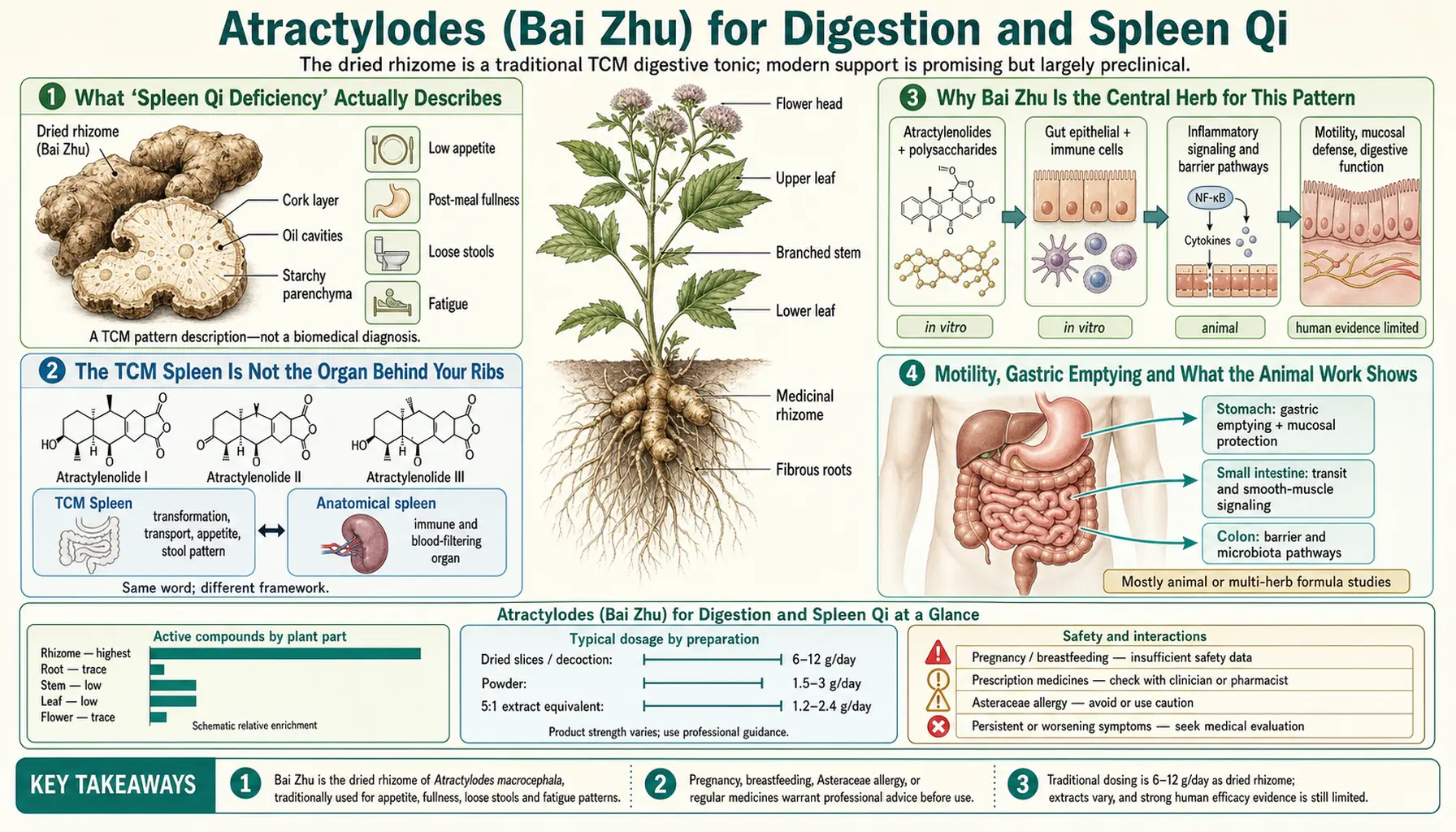
If atractylodes has one job in traditional East Asian medicine, this is it. Atractylodes macrocephala Koidz. — bai zhu, 白术, Vietnamese bạch truật — is the herb a practitioner reaches for when someone has no appetite, bloats after eating, passes loose stools, and wants to lie down an hour after lunch. The drug is the dried rhizome, Rhizoma Atractylodis Macrocephalae, from cultivated plants two to three years old, classically grown in Zhejiang.
The honesty note first. Human clinical evidence for bai zhu as a single herb is very limited. Almost everything published is cell culture, rodent work, or trials of multi-herb formulas in which this herb’s individual contribution cannot be isolated. The traditional indication described below is coherent, ancient and clinically detailed — and it has never been tested properly on its own.
Table of Contents
- What “Spleen Qi Deficiency” Actually Describes
- The Traditional Chinese Medicine (TCM) Spleen Is Not the Organ Behind Your Ribs
- Why Bai Zhu Is the Central Herb for This Pattern
- Motility, Gastric Emptying and What the Animal Work Shows
- Atractylenolides, Atractylon and the Gut
- Processing Changes the Drug: Raw, Bran-Fried, Charred
- The Classical Formulas and How They Differ
- What Human Evidence Actually Exists
- Practical Use: Dose, Forms, Label Checks
- Cautions and Contraindications
- Key Research Papers
- Connections
- Featured Videos
What “Spleen Qi Deficiency” Actually Describes
“Spleen qi deficiency” sounds like mysticism until you see the symptom list, at which point it becomes uncomfortably recognisable. A practitioner using that phrase is describing a person who:
- has little appetite, or feels hungry but full after three bites;
- bloats after eating — not painfully, but with a distended, heavy fullness that builds through the meal and persists for an hour or two;
- passes loose, poorly formed stools, often with undigested food visible, often first thing in the morning;
- feels flattened by meals rather than restored by them — the postprandial fatigue that makes an afternoon unusable;
- describes heavy limbs, a leaden quality to the arms and legs, worse in humid weather;
- bruises easily, has a pale complexion, and often a pale tongue with a thin white coat and scalloped edges where it presses against the teeth.
That is a syndrome description, not a diagnosis in the biomedical sense. It maps loosely and imperfectly onto things a gastroenterologist might call functional dyspepsia, post-infectious irritable bowel syndrome (IBS), bile-acid diarrhoea, small-intestinal bacterial overgrowth, or simply “nothing found on investigation.” The mapping is not one-to-one, and presenting it as one is misleading. What the traditional category does well is group a cluster of symptoms that Western medicine often treats as unrelated — low appetite, loose stools, and fatigue after eating — and treat them as one problem with one remedy.
The Traditional Chinese Medicine (TCM) Spleen Is Not the Organ Behind Your Ribs
This confuses more readers than anything else on the subject, so it is worth being blunt about it.
The anatomical spleen is a fist-sized lymphoid organ tucked under the left ribs. It filters old red blood cells, houses immune cells, and can be removed entirely without affecting digestion at all. If you have had a splenectomy, your digestion is unchanged.
The Spleen of Chinese medicine — conventionally capitalised in English texts precisely to mark the distinction — is not that organ. It is a functional system: the body’s capacity to extract usable nourishment from food and turn it into energy and tissue, plus the ability to keep fluids moving rather than pooling. In physiological terms it overlaps with pancreatic and biliary secretion, gastric and small-bowel motility, mucosal absorption, and postprandial energy handling. Chinese medicine developed its organ categories from observed function, centuries before dissection-based anatomy assigned the same names to specific structures. When translators later mapped 脾 (pí) onto the English word “spleen,” they created a permanent false cognate.
So when a practitioner says bai zhu “tonifies the Spleen,” they are not claiming it does anything to the lymphoid organ. They are claiming it improves the digestion-and-fluid-handling function. Anyone who tells you a herb “heals your spleen” and shows you a picture of the anatomical organ has either misunderstood the tradition or is hoping you will.
Why Bai Zhu Is the Central Herb for This Pattern
Chinese materia medica describes bai zhu as sweet, bitter and warm, entering the Spleen and Stomach, with four stated actions: tonify the Spleen and augment qi, dry dampness and promote urination, stabilise the exterior and stop sweating, and calm the fetus. The first two are why it appears in digestive formulas.
The reason it became the central herb rather than one of many is the combination. Plenty of herbs tonify; plenty dry dampness. Bai zhu is described as doing both at once, which matters because the traditional model treats the two problems as causally linked: a weak Spleen fails to transform fluids, fluids accumulate as “dampness,” and accumulated dampness further burdens the Spleen. That is a feedback loop, and a herb that acts on both ends of it can, in principle, break it. Whether that model is true in a mechanistic sense is unanswerable with current data. Whether it is useful as a clinical heuristic is a separate question, and thousands of practitioners have found it so.
Its partner in nearly every formula is poria, a fungus with a milder, more purely fluid-moving action. The pairing — one tonifying and drying, one draining and neutral — is the traditional workhorse combination for digestive weakness with fluid retention.
Motility, Gastric Emptying and What the Animal Work Shows
The most plausible modern account of what bai zhu does for digestion is that it modulates gastrointestinal motility. Multiple rodent studies have measured gastric emptying and small-intestinal transit after dosing with atractylodes extracts, generally using charcoal-meal or dye-transit methods, and generally in animals first made dysmotile with atropine, loperamide, or a stress protocol.
The pattern reported across this literature is bidirectional normalisation: extracts tend to speed transit in models where it has been artificially slowed, and slow it in models where it has been artificially accelerated. That is an appealing result, because it matches the traditional claim that the same herb helps both sluggish digestion and diarrhoea. It is also exactly the kind of result that deserves scepticism, because bidirectional effects are easy to produce artefactually when you compare against two different pathological baselines rather than against normal animals.
Proposed mechanisms include effects on interstitial cells of Cajal (the gut’s pacemaker cells), cholinergic signalling, and gut hormones such as motilin and gastrin. Rodent studies have reported changes in serum motilin and gastrin after atractylodes-containing formulas. These are measurements in rats, at doses set by the experimenters, and they have not been reproduced in humans with the isolated herb.
What this does not establish: that a human taking 9 g of bai zhu in a decoction achieves a tissue concentration comparable to the rodent dose, or that any motility change large enough to measure in a rat translates into a symptom change a person would notice.
Atractylenolides, Atractylon and the Gut
Two chemically distinct fractions carry the pharmacology:
The volatile-oil fraction contains the sesquiterpene lactones — atractylenolide I, II and III, plus atractylon and β-eudesmol. These are the compounds used for chemical authentication of the drug, and atractylenolide I is the one most studied in modern pharmacology (mainly for macrophage signalling, covered on the immune and inflammation page). In the digestive context, the lactones are the fraction credited with the drying, dampness-resolving action, and atractylenolide III in particular has been examined for effects on gastric mucosal protection in rodents.
The polysaccharide fraction (AMP, or PAMK in the agricultural literature) consists of large water-soluble sugar polymers. They are not absorbed intact; whatever they do, they do it in the lumen and at the mucosal surface — feeding bacteria, interacting with gut-associated immune tissue, and possibly influencing barrier proteins. This fraction is discussed in detail on the gut barrier page.
The practical implication is that extraction method changes the medicine. Water decoction — the traditional method — pulls out polysaccharides efficiently and volatile oil only partially, and prolonged hard boiling drives off more of the volatile fraction. Alcohol tinctures do the reverse. A capsule of milled raw powder delivers everything but in a much smaller quantity.
Processing Changes the Drug: Raw, Bran-Fried, Charred
Chinese pharmacy has always held that processing (páo zhǐ) changes what bai zhu does. This is one of the cases where the traditional claim rests on real, measurable pharmacognosy rather than on folklore: volatile-oil content falls with heating, and the volatile oil is where the lactones live. Analytical studies comparing raw and fried material consistently find lower total volatile oil and a shifted lactone ratio after frying.
| Form | Preparation | Traditional use | Chemical correlate |
|---|---|---|---|
| Raw (sheng bai zhu) | Cleaned, dried, sliced only | More diuretic, more strongly damp-draining; chosen when fluid retention dominates | Highest volatile-oil and atractylenolide content |
| Dry-fried / bran-fried (chao bai zhu) | Stir-fried in a dry wok, usually with wheat bran, until golden | Milder, less drying, more digestion-tonifying; the default in appetite and bloating formulas | Reduced volatile oil; altered lactone ratios |
| Charred (jiao bai zhu) | Fried until the surface is scorched | Used for diarrhoea, on the traditional principle that charring makes a herb astringent | Volatile oil largely driven off; pyrolysis products formed |
In the tradition, bran-fried is the form used for the digestive indication. Western products essentially never state which they used. When a supplier does specify “stir-fried” or “dry-fried,” it is a reasonable signal that they are sourcing from a dispensary supply chain that follows traditional processing.
The Classical Formulas and How They Differ
Bai zhu is almost never taken alone. The formula chosen tells you what problem is being targeted:
- Si Jun Zi Tang (Four Gentlemen Decoction) — ginseng or codonopsis, bai zhu, poria, licorice. The base prescription for digestive weakness with fatigue. Four ingredients, deliberately gentle, and the scaffold on which dozens of later formulas are built.
- Shen Ling Bai Zhu San — Four Gentlemen plus lotus seed, coix, Chinese yam, cardamom, platycodon and others. Adds food-grade, starch-heavy ingredients and is the classical choice when chronic loose stools are the main complaint rather than fatigue.
- Bu Zhong Yi Qi Tang (Tonify the Middle, Augment Qi) — adds astragalus, bupleurum and cimicifuga. Used where there is fatigue with a sensation of downward heaviness or prolapse.
- Li Zhong Wan (Regulate the Middle Pill) — bai zhu with dried ginger, ginseng and licorice. The warming formula for cold-type abdominal pain with watery stools.
- Ling Gui Zhu Gan Tang — poria, cinnamon twig, bai zhu, licorice. Aimed at fluid metabolism; see the fluid balance page.
- Tong Xie Yao Fang — bai zhu, white peony root, tangerine peel and saposhnikovia. Ancient Chinese medical texts list it for diarrhoea, and it is used for chronic diarrhoea with abdominal pain. A 2022 review of 11 randomised trials in 985 adults with diarrhoea-type irritable bowel syndrome found this standard four-herb formula better than placebo and Western drugs for overall symptom improvement (moderate-certainty evidence) and better than placebo for stool consistency, stool frequency and abdominal pain — but its authors wrote that no clear, confirmed conclusion can be drawn, because the trials it pooled were inadequately designed.
Bai zhu’s share within these formulas is typically 6–12 g of dried rhizome per day.
What Human Evidence Actually Exists
Here is the state of play, stated plainly.
There is no adequately designed, adequately powered, independently replicated randomised trial of bai zhu alone for any digestive complaint. Not for functional dyspepsia, not for irritable bowel syndrome, not for chronic diarrhoea, not for post-chemotherapy appetite loss.
What does exist:
- Trials of formulas containing it. Si Jun Zi Tang and Shen Ling Bai Zhu San have been studied in functional dyspepsia, chronic gastritis, and diarrhoea, mostly in China, and mostly with methodological limitations that Western systematic reviewers flag repeatedly: small samples, inadequate randomisation and allocation concealment, unblinded assessment, short follow-up, comparison against a conventional drug rather than placebo, and a concern about publication bias in a literature where nearly every published result was positive. Placebo-controlled trials of one bai zhu formula, Tong Xie Yao Fang, now give a more mixed picture (next item). Reviews of these formulas generally conclude “possible benefit, evidence of low quality, better trials needed” which has been the conclusion for two decades.
- Placebo-controlled trials of Tong Xie Yao Fang. In a 2017 trial of 1,044 adults with irritable bowel syndrome at 5 hospitals in China, a tongxie formula built on bai zhu (with other herbs added according to each patient’s features) reduced all 6 symptoms measured over 4 weeks more than placebo did. In a 2018 trial of 160 adults with diarrhoea-type irritable bowel syndrome, 57.5% on Tong Xie Yao Fang granules reported adequate relief of their overall symptoms, against 37.5% on placebo. But a 2025 trial of 96 adults found no significant difference after 8 weeks: 79.2% responded on the formula and 70.8% on placebo, with both groups improving substantially.
- Reviews in functional dyspepsia. A 2018 review of 14 systematic reviews of Chinese herbal medicine for functional dyspepsia (indigestion with no cause found) rated them of mediocre quality. Their pooled results found herbal formulas more effective than prokinetic drugs (medicines that speed the stomach) for overall indigestion symptoms, with no significant difference in side effects. Three formulas stood out; one was Xiang Sha Liu Jun Zi decoction, a formula built on the Four Gentlemen base that contains bai zhu.
- The attribution problem. Even where a formula trial is positive, the design cannot tell you whether bai zhu contributed. Si Jun Zi Tang contains ginseng, a herb with its own effects on fatigue and appetite. A positive result is a result about the combination. What is not known is whether bai zhu itself contributes to the Tong Xie Yao Fang results, because no trial has tested the formula with and without it.
- Pharmacokinetics. Human data on the absorption and disposition of atractylenolides after an oral decoction is sparse. Without it, translating a cell-culture concentration into a swallowed dose is guesswork.
None of this means the herb does nothing. It means that if you take it and feel better, you cannot currently distinguish a real pharmacological effect from formula-partner effects, regression to the mean, dietary changes that usually accompany starting a herbal regimen, and expectation. That is not a dismissal — it is the actual epistemic position, and it is better to know it than to be sold certainty.
Practical Use: Dose, Forms, Label Checks
Decoction is the traditional and best-documented route: 6–12 g of dried sliced rhizome per day, simmered with the rest of a formula for 30–45 minutes and divided into two or three doses, usually taken warm and away from meals or shortly before them. Granules — concentrated spray-dried decoction — are the practical modern equivalent; their dose is set by the manufacturer’s stated extract ratio, not by the weight of powder. Capsules of raw milled powder deliver far less than a decoction; two 500 mg capsules (1 g) is well below the 6–12 g traditional daily dose. Tinctures have no traditional precedent for this herb and extract a different profile.
Four details on a label identify the product:
- Binomial: Atractylodes macrocephala. If it says A. lancea or A. chinensis, you have cang zhu — a more aromatic, more strongly drying herb that dries dampness rather than tonifying. Different drug, different indication.
- Plant part: rhizome. Not “root,” not “whole herb.”
- Processing: in the tradition, bran-fried or dry-fried is the form for the digestive indication, when a label states it at all.
- Single herb or formula? Many products sold as “Atractylodes” are actually Four Gentlemen or Jade Windscreen blends; the full ingredient list shows which.
A fair test of a digestive herb is bounded — two to four weeks — and judged on concrete markers decided in advance: stool form, how a person feels ninety minutes after lunch, whether a normal-sized meal can be finished. Herbs that are working for a digestive pattern generally show something within that window; a herb that has shifted nothing in that time has shown no effect for that person.
Cautions and Contraindications
- Warning signs. Persistent diarrhoea, unintentional weight loss, blood in the stool, iron-deficiency anaemia, vomiting, difficulty swallowing, or new digestive symptoms after age 50 are signs that hospitals investigate for serious disease; a tonic does not address their cause. Coeliac disease, inflammatory bowel disease, pancreatic insufficiency and colorectal cancer all present with symptoms on the “Spleen qi deficiency” list.
- Diuretics. Bai zhu is traditionally fluid-moving, and rodent data points the same way. Combined with furosemide, a thiazide or spironolactone, the theoretical effect is additive on fluid and electrolyte loss.
- Pregnancy. Classical texts list bai zhu as calming the fetus, and it appears in traditional pregnancy formulas. There is no reliable human safety data supporting that use. Long traditional use without a recorded harm signal is reassuring but is not a safety study, and no adequate one exists.
- Asteraceae allergy. Atractylodes is in the daisy family. People allergic to ragweed, chrysanthemum, chamomile or marigold may cross-react to it.
- Traditional contraindication. Traditionally not used in patterns of yin deficiency with heat — dryness, thirst, night sweats, a red peeled tongue — because a warm drying herb is expected to worsen them.
- Immunosuppressants. The polysaccharide fraction is studied for immune stimulation, which in theory works against drugs meant to suppress the immune system, such as tacrolimus, ciclosporin, azathioprine, methotrexate and biologics. No human interaction study exists.
Key Research Papers
Entries ending in a PMID link point to that paper’s own PubMed record; the others resolve to a live PubMed record set for the topic named. Author, title and journal are plain text so you can verify each independently.
- Zhu B, Zhang QL, Hua JW, Cheng WL, Qin LP. The traditional uses, phytochemistry, and pharmacology of Atractylodes macrocephala Koidz.: a review. Journal of Ethnopharmacology. 2018;226:143–167. PubMed PMID: 30130541
- Rodent studies of Atractylodes macrocephala on gastric emptying and small-intestinal transit. PubMed record set.
- Atractylodes-containing formulas and gut hormones: motilin, gastrin and interstitial cells of Cajal. PubMed record set.
- Clinical and mechanistic literature on Si Jun Zi Tang (Four Gentlemen Decoction) in functional gastrointestinal disorders. PubMed record set.
- Trials and systematic reviews of Shen Ling Bai Zhu San for chronic diarrhoea and Spleen-deficiency patterns. PubMed record set.
- Effects of processing (raw, bran-fried, charred) on volatile oil and atractylenolide content of Rhizoma Atractylodis Macrocephalae. PubMed record set.
- Atractylenolide III and gastric mucosal protection in animal models. PubMed record set.
- Chu MHK, Wu IXY, Ho RST, Wong CHL, Zhang AL, Zhang Y, Wu JCY, Chung VCH. Chinese herbal medicine for functional dyspepsia: systematic review of systematic reviews. Therapeutic Advances in Gastroenterology. 2018;11:1756284818785573. PubMed PMID: 30034530
- Chemical and pharmacological comparison of Atractylodes macrocephala (bai zhu) and Atractylodes lancea (cang zhu). PubMed record set.
- Liang SB, Cao HJ, Kong LY, Wei JL, Robinson N, Yang SH, Zhu SJ, Li YQ, Fei YT, Han M, Liu JP. Systematic review and meta-analysis of Chinese herbal formula Tongxie Yaofang for diarrhea-predominant irritable bowel syndrome: evidence for clinical practice and future trials. Frontiers in Pharmacology. 2022;13:904657. PubMed PMID: 36091782
- Fan H, Zheng L, Lai Y, Lu W, Yan Z, Xiao Q, Li B, Tang M, Huang D, Wang Y, Li Z, Mei Y, Jiang Z, Liu X, Tang Q, Zuo D, Ye J, Yang Y, Huang H, Tang Z, Xiao J; China Irritable Bowel Syndrome Consortium. Tongxie formula reduces symptoms of irritable bowel syndrome. Clinical Gastroenterology and Hepatology. 2017;15(11):1724–1732. PubMed PMID: 28634136
- Chen M, Tang TC, Wang Y, Shui J, Xiao XH, Lan X, Yu P, Zhang C, Wang SH, Yao J, Zheng H, Huang DQ. Randomised clinical trial: Tong-Xie-Yao-Fang granules versus placebo for patients with diarrhoea-predominant irritable bowel syndrome. Alimentary Pharmacology & Therapeutics. 2018;48(2):160–168. PubMed PMID: 29856472
- Liang SB, Cheng HJ, Zhang QY, Han M, Li YF, Cao HJ, Yu ZY, Kong LY, Cai YM, An LB, Zhao BT, Xu SS, Yan L, Zhang NW, Jia BY, Liu WF, Niu F, Wu BT, Song JM, Jia SX, Shi MM, Zhang XN, Chung VCH, Robinson N, Liu JP. Chinese herbal formula Tongxie Yaofang granules for diarrhoea-predominant irritable bowel syndrome: a randomised, double-blind, placebo-controlled, phase II trial. BMJ Open. 2025;15(1):e088410. PubMed PMID: 39870499
PubMed Topic Searches
- PubMed: Atractylodes macrocephala gastrointestinal
- PubMed: Bai zhu spleen qi deficiency
- PubMed: Spleen deficiency syndrome animal model
- PubMed: Sijunzi decoction
- PubMed: Shenling Baizhu San
- PubMed: Buzhong Yiqi Tang
- PubMed: Atractylenolide gastrointestinal motility
- PubMed: Herbal medicine functional dyspepsia placebo trials
Connections
- All Herbs
- Atractylodes (Bai Zhu) — the main research article
- Atractylodes Benefits hub
- Atractylodes: History and Traditional Use
- Fluid Balance and Edema
- Immune and Inflammation
- Gut Barrier and Microbiome
- Codonopsis — partner qi tonic in Four Gentlemen
- Poria Mushroom — the classic pairing herb
- Licorice — harmonising herb in the same formulas
- Ginger — warming digestive herb
- Astragalus — added in Bu Zhong Yi Qi Tang
- Small Intestinal Bacterial Overgrowth — a modern diagnosis behind many bloating patterns