Nattokinase & Vitamin K2 (Menaquinone-7, MK-7) — The Natto Connection
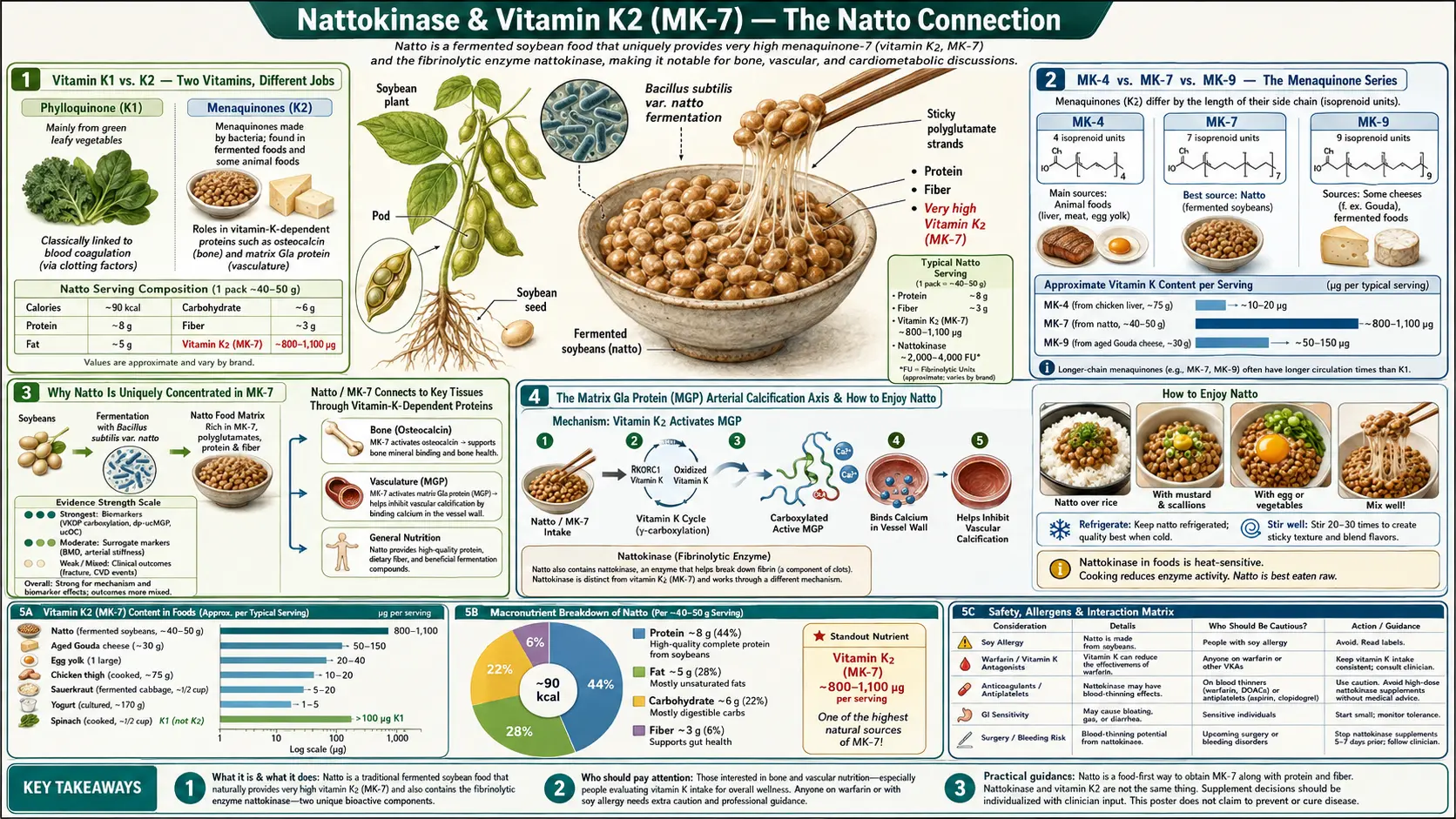
Natto is the world's most concentrated dietary source of vitamin K2 menaquinone-7 (MK-7), delivering approximately 1,000 mcg of menaquinone-7 per 100 g serving — an order of magnitude higher than any cheese, fermented dairy, or organ meat. Menaquinone-7 is the long-chain menaquinone with a 72-hour serum half-life (versus approximately 6 hours for menaquinone-4, MK-4), which makes a single daily dose sufficient to maintain stable circulating levels and tissue saturation. The biology that matters is the matrix Gla protein (MGP) axis: MGP is the body's principal endogenous inhibitor of arterial calcification, it requires gamma-carboxylation by vitamin K2 to become functional, and its job is to bind free calcium ions in the vascular wall and direct them out of arterial tissue and into bone matrix. The Rotterdam Study (Geleijnse 2004), the Knapen 2015 randomized controlled trial (RCT) in postmenopausal women, and the Beulens 2009 cross-sectional study of coronary calcification all support a meaningful cardiovascular protective effect of dietary or supplemental menaquinone-7. The clinical convergence is striking: natto delivers BOTH the fibrinolytic enzyme nattokinase that dissolves fibrin clots AND the matrix-Gla-protein-activating vitamin menaquinone-7 that prevents arterial calcification — two fundamentally different mechanisms operating on the same end target (cardiovascular disease) in a single traditional food. This deep-dive walks through menaquinone-7 chemistry, the MGP arterial calcification axis, the pivotal randomized controlled trials (RCTs), how whole natto, isolated nattokinase and isolated menaquinone-7 differ, and the warfarin compatibility considerations.
Table of Contents
- Vitamin K1 vs. K2 — Two Vitamins, Different Jobs
- Menaquinone-4 vs. Menaquinone-7 vs. MK-9 — The Menaquinone Series
- Why Natto Is Uniquely Concentrated in Menaquinone-7
- The Matrix Gla Protein (MGP) Arterial Calcification Axis
- Osteocalcin and Bone — The Other K2-Dependent Gla Protein
- The Rotterdam Study — K2 and Coronary Heart Disease
- The Knapen 2015 Randomized Controlled Trial — Menaquinone-7 and Arterial Stiffness
- The ECKO Trial — K1 vs. K2 in Osteoporosis
- Whole Natto vs. Isolated Nattokinase vs. Isolated Menaquinone-7 — How They Differ
- Amounts Used for Menaquinone-7 Alone or in Combination
- Warfarin Compatibility — A Real Concern
- Key Research Papers
- Connections
- Featured Videos
Vitamin K1 vs. K2 — Two Vitamins, Different Jobs
"Vitamin K" is actually a family of related fat-soluble compounds with different sources, kinetics, and biological roles. The two principal forms are:
- Vitamin K1 (phylloquinone) — the form found in leafy green vegetables (kale, spinach, collards, broccoli). K1 is the form recognized by the standard nutrition label, and is the form used by the liver to gamma-carboxylate clotting factors II, VII, IX, and X. Most dietary K1 is delivered to the liver and used for clotting-factor activation; little reaches the peripheral tissues.
- Vitamin K2 (menaquinones, MK-n) — a family of compounds with longer isoprenoid side chains, produced by bacterial fermentation (in fermented foods, in the gut microbiome, and in animal tissues that have converted dietary K1 to K2). K2 has a different lipoprotein distribution profile (it preferentially reaches peripheral tissues including bone and arterial wall) and a different set of target proteins (matrix Gla protein, osteocalcin, growth-arrest-specific protein 6 (Gas6), and others).
The clinical distinction matters because the cardiovascular and skeletal effects associated with vitamin K2 are NOT well-replicated by vitamin K1 supplementation. Dietary K1 intake from leafy greens is associated with improved hemostasis but not with the same cardiovascular calcification protection or the same fracture-risk reduction. K2 is required for the activation of matrix Gla protein and the calcification-relevant fraction of osteocalcin; K1 cannot fully substitute for these functions in peripheral tissues.
This is why the cardiovascular and bone literature has increasingly distinguished K1 from K2 over the last two decades, and why food sources of K2 (fermented foods, particularly natto; aged cheeses; egg yolks and animal fats from grass-fed sources; and some organ meats) have received attention disproportionate to their absolute K content compared to leafy greens.
For more on vitamin K generally, see our Vitamin K page.
Menaquinone-4 vs. Menaquinone-7 vs. MK-9 — The Menaquinone Series
Within the vitamin K2 family, the different menaquinones (MK-n) are distinguished by the length of their isoprenoid side chain. The relevant variants for human nutrition are:
- menaquinone-4 (MK-4) — short side chain (4 isoprene units). Found in animal foods (egg yolks, butter, dairy, organ meats from grass-fed animals). Short half-life (approximately 6 hours in serum). High-dose menaquinone-4 (45 mg/day, vastly above typical dietary intake) is the form used in Japanese osteoporosis treatment as the prescription drug menatetrenone.
- menaquinone-7 (MK-7) — medium-long side chain (7 isoprene units). Concentrated almost exclusively in natto (~1,000 mcg per 100 g) and to a far lesser extent in some aged cheeses, which carry about 64–73 mcg of total K2 per 100 g (aged Gouda, Edam), mostly as MK-8 and MK-9 — only about 0–2 mcg of that is menaquinone-7 (Vermeer 2018, PMID 29617314). Long serum half-life (approximately 72 hours), making once-daily dosing physiologically straightforward.
- MK-8 and MK-9 — longer-chain menaquinones found in some fermented dairy products. Less studied than menaquinone-4 and menaquinone-7, but the long-chain forms appear to share menaquinone-7's tissue-distribution profile.
The Sato 2012 bioavailability study and the Schurgers 2007 supplement study measured serum levels, not levels in bone, arterial wall or kidney. In Sato 2012, a single 420 mcg dose of menaquinone-7 given with breakfast was well absorbed, peaked in serum at 6 hours and was detectable for up to 48 hours, while menaquinone-4 was not detectable in serum at any time point; the authors suggested that menaquinone-7 may be of particular importance for tissues outside the liver. Schurgers 2007 compared K1 with menaquinone-7: both were absorbed well, but menaquinone-7 had a very long half-life, accumulated to 7- to 8-fold higher levels during prolonged intake, and induced more complete carboxylation of osteocalcin. A separate 2002 lipoprotein-transport study by Schurgers and Vermeer, which tested K1, menaquinone-4 and menaquinone-9 (not menaquinone-7), found that unlike K1 the menaquinones were also carried in low-density lipoprotein, which the authors said explains why menaquinones may have a different distribution profile beyond the liver.
This is why menaquinone-7 has become the dominant form in vitamin K2 supplements over the last 15 years: the longer half-life makes once-daily dosing feasible, and its steadier serum levels support the cardiovascular and skeletal applications that motivated supplement use in the first place. Most current "vitamin K2" supplements specify menaquinone-7, often derived from natto fermentation.
Why Natto Is Uniquely Concentrated in Menaquinone-7
The reason natto is so uniquely concentrated in menaquinone-7 is the specific bacterial strain used in its fermentation. Bacillus subtilis var. natto is an unusual menaquinone-7 producer — most fermentation bacteria produce smaller amounts of various menaquinones, but this particular strain converts a substantial fraction of its carbon flux into menaquinone-7 specifically as part of its respiratory metabolism. The fermentation of cooked soybeans by this bacterium therefore produces, alongside the now-famous nattokinase enzyme, an exceptional concentration of menaquinone-7.
The Kaneki 2001 paper documented the geographic implications of this. Japanese populations who regularly eat natto have markedly higher circulating menaquinone-7 levels than populations in other countries (and than Japanese populations in regions where natto is less commonly consumed). The eastern Japanese regional preference for natto (vs. the relative aversion in western Japan) correlates with regional differences in circulating menaquinone-7: mean serum levels in postmenopausal women were 5.26 ng/mL in Tokyo, 1.22 ng/mL in Hiroshima and 0.37 ng/mL in British women. The paper found a statistically significant inverse correlation between natto consumption and the incidence of hip fractures in women across Japan's prefectures; it did not report cardiovascular outcomes.
The practical implication: a single serving of natto (~30–50 g for a typical Japanese breakfast portion) delivers approximately 300–500 mcg of menaquinone-7, which is a substantial fraction of even the most aggressive supplemental dose. Daily natto consumption produces menaquinone-7 saturation that is genuinely difficult to achieve through other dietary means in non-Japanese populations.
The Matrix Gla Protein (MGP) Arterial Calcification Axis
The cardiovascular protective effect of vitamin K2 is mediated primarily through matrix Gla protein (MGP), a small (84 amino acid) calcium-binding protein expressed at high levels in vascular smooth muscle cells, chondrocytes, and several other tissues. MGP requires post-translational gamma-carboxylation of five specific glutamic acid residues (converting them to gamma-carboxyglutamic acid, or "Gla" residues) to become functional. This carboxylation reaction requires vitamin K2 as cofactor for the enzyme gamma-glutamyl carboxylase.
Functional (carboxylated) MGP serves as the body's principal endogenous inhibitor of arterial calcification. The mechanism is direct: carboxylated MGP binds free calcium ions and calcium-phosphate nucleation sites in the vascular wall, physically preventing the precipitation of hydroxyapatite-like calcium-phosphate mineral that constitutes vascular calcification. MGP-knockout mice develop massive arterial calcification within weeks of birth and die from arterial rupture; rare humans with Keutel syndrome (a genetic deficiency in MGP) develop similar arterial calcification phenotypes.
The clinical relevance for vitamin K2 nutrition: in K2-insufficient subjects (the typical Western diet), a substantial fraction of MGP circulates in the uncarboxylated, dysfunctional form. The "uncarboxylated MGP" fraction (sometimes measured as the dp-ucMGP biomarker, "desphospho-uncarboxylated MGP") is elevated in K2-insufficient subjects and correlates with cardiovascular risk in observational studies. Supplementation with menaquinone-7 reduces dp-ucMGP, increases the carboxylated/functional fraction, and is the principal mechanism by which K2 protects against arterial calcification.
This is a fundamentally different mechanism from the fibrinolytic activity of nattokinase. Nattokinase dissolves fibrin that has already formed (and modulates the fibrinolytic system to prevent future fibrin accumulation). Menaquinone-7 prevents calcium from precipitating in the arterial wall in the first place. The two mechanisms address different aspects of cardiovascular pathology and are mechanistically additive. The fact that nature has conveniently packaged both in a single food (natto) is one of the more elegant examples of how traditional fermented foods can deliver multiple bioactive compounds that turn out to be synergistic for a single end goal.
Osteocalcin and Bone — The Other K2-Dependent Gla Protein
The second major vitamin K2-dependent Gla protein is osteocalcin (also called bone Gla protein, BGP). Osteocalcin is produced by osteoblasts during bone formation and requires gamma-carboxylation by vitamin K2 to bind calcium in the bone matrix. Uncarboxylated osteocalcin (ucOC) is the dysfunctional form; it does not adequately mineralize bone matrix, and elevated ucOC fraction is independently associated with fracture risk in postmenopausal women.
The clinical implication is that vitamin K2 (and specifically menaquinone-7) supplementation supports bone mineralization independent of its effects on calcium and vitamin D status. Several randomized controlled trials have documented improvements in bone mineral density and reduced fracture risk with menaquinone-7 supplementation in postmenopausal women. The Knapen 2013 trial in 244 postmenopausal women given 180 mcg/day menaquinone-7 for 3 years showed reduced age-related bone loss compared to placebo, with corresponding reduction in ucOC.
The complementarity with the cardiovascular calcification mechanism is striking: vitamin K2 directs calcium AWAY from arterial walls (via carboxylated MGP) and INTO bone (via carboxylated osteocalcin). Insufficient K2 has the inverse effect — calcium accumulates in arterial walls (calcification) and is lost from bone (osteoporosis). The clinical picture of an elderly patient with severe osteoporosis AND severe coronary artery calcification ("calcium paradox") is the visible expression of long-term vitamin K2 insufficiency interacting with calcium supplementation and aging.
For more on bone health and calcium metabolism, see our pages on Vitamin K and Magnesium.
The Rotterdam Study — K2 and Coronary Heart Disease
The Rotterdam Study (Geleijnse 2004, Journal of Nutrition) is the foundational prospective cohort study linking dietary vitamin K2 intake to cardiovascular outcomes. Design:
- 4,807 Dutch adults aged 55 and older at baseline
- Dietary K1 and K2 intake assessed by detailed food frequency questionnaire
- Outcome ascertainment over a mean follow-up of 7–10 years for incident coronary heart disease, severe aortic calcification (assessed by abdominal radiography), and all-cause mortality
Results:
- Higher dietary vitamin K2 intake (highest vs. lowest tertile) was associated with approximately 57% lower coronary heart disease mortality
- Higher K2 intake was associated with approximately 52% lower severe aortic calcification
- Higher K2 intake was associated with approximately 26% lower all-cause mortality
- Vitamin K1 intake (from leafy greens) showed no significant association with any of these endpoints — the protective effect was specific to K2
The Rotterdam Study established the K2-cardiovascular protection association at the population level, and importantly demonstrated that the effect was specific to K2 rather than to vitamin K generally. The principal dietary sources of K2 in the Dutch cohort were aged cheese (rich in MK-8 and MK-9) and curd cheese, not natto (which is not commonly consumed in the Netherlands), so the protective effect appears to be a property of K2 as a class rather than specific to menaquinone-7.
The Beulens 2009 paper, a separate cross-sectional study of 564 postmenopausal women in Utrecht, the Netherlands, examined coronary calcification specifically (on computed tomography, CT, scans) and found that higher menaquinone intake was associated with less coronary calcification (relative risk 0.80 for the highest versus lowest quartile; 95% confidence interval 0.65–0.98), while phylloquinone (K1) intake was not. Together these papers form the strongest observational evidence base for K2 as a cardiovascular protective nutrient.
The Knapen 2015 Randomized Controlled Trial — Menaquinone-7 and Arterial Stiffness
The Knapen 2015 trial in Thrombosis and Haemostasis is the most important randomized controlled trial of menaquinone-7 specifically for cardiovascular outcomes. Design:
- 244 healthy postmenopausal Dutch women, aged 55–65
- Randomized to 180 mcg/day menaquinone-7 (a branded menaquinone-7 ingredient used in several trials) or placebo
- 3-year intervention period (notably longer than most supplement trials)
- Primary endpoint: arterial stiffness measured by carotid-femoral pulse wave velocity (cfPWV), a validated non-invasive marker of arterial wall properties
- Secondary endpoints: carotid distensibility, dp-ucMGP biomarker, lipid profile
Results:
- Carotid-femoral pulse wave velocity decreased (improved) significantly in the menaquinone-7 group vs. placebo over the 3-year period
- Carotid distensibility, distension, compliance and local carotid pulse wave velocity improved only in women whose baseline Stiffness Index β was above the median of 10.8
- dp-ucMGP (the inactive/uncarboxylated MGP biomarker) decreased significantly, confirming biochemical effect on the target mechanism
- The protective effect was most pronounced in subjects with the highest baseline arterial stiffness
- Safety was excellent over the 3-year intervention period; no significant adverse events attributable to menaquinone-7
The Knapen trial is the strongest randomized controlled trial evidence to date that menaquinone-7 supplementation has measurable benefit on arterial-wall properties in healthy postmenopausal women. The 180 mcg/day dose used in the trial is achievable with daily natto consumption (well within the ~300–500 mcg per serving) or with a single menaquinone-7 capsule (most products provide 100–180 mcg per capsule).
The ECKO Trial — K1 vs. K2 in Osteoporosis
The ECKO trial (Cheung 2008, PLoS Medicine) is an important reference point for the K1 vs. K2 distinction in bone health. Design:
- 440 postmenopausal Canadian women with osteopenia (T-score between −2.0 and −1.0)
- Randomized to 5 mg/day vitamin K1 (phylloquinone) or placebo
- 2-year intervention period, extended for earlier participants for up to an additional 2 years
- Primary endpoints: changes in bone mineral density at the lumbar spine and total hip at 2 years; fractures were a secondary outcome
Results were mixed: there were no significant differences in changes in bone mineral density at any site between the two groups over the 2- to 4-year period, and the authors concluded that 5 mg/day of K1 does not protect against age-related decline in bone mineral density. Fewer women in the K1 group had clinical fractures (nine versus 20, p = 0.04), but the study was not powered to examine fractures and the numbers were small; the authors wrote that K1 may protect against fractures and that more studies are needed.
The interpretation that has become standard: K1 at high doses can produce some K2 effects, probably via partial enzymatic conversion to menaquinone-4 in tissues including bone. But menaquinone-7 supplementation at much lower doses (180–360 mcg) produces equivalent or greater peripheral effects with much better tissue-distribution kinetics. This is the reasoning practitioners give for preferring menaquinone-7 over high-dose K1.
Whole Natto vs. Isolated Nattokinase vs. Isolated Menaquinone-7 — How They Differ
Natto delivers two distinct cardiovascular-relevant bioactive compounds (nattokinase the enzyme + menaquinone-7 the vitamin), and the food, the isolated enzyme and the isolated vitamin each deliver a different combination of them. Several scenarios:
- Goal: maximum cardiovascular protection, willing to eat the food. Daily whole natto (30–50 g) is the most concentrated single source. Delivers both nattokinase (full activity) and menaquinone-7 (full dose, ~300–500 mcg per serving). Also delivers the fermented soy peptides with ACE-inhibitor activity, the probiotic bacteria, the soy protein and fiber. The principal limitation is taste — natto is famously an acquired taste, with sticky/stringy texture, strong ammonia-like aroma, and bitter undertone that even many Japanese people dislike. For those who can tolerate it, it is the only option that delivers all of these together.
- Goal: fibrinolytic support, no interest in eating natto. Standardized nattokinase capsules are commonly sold at 2,000 FU/day, often enteric-coated. These deliver the fibrinolytic enzyme without the menaquinone-7 (which is largely extracted out of pure nattokinase products), without the soy peptides, and without the food's other components.
- Goal: vitamin K2 for bone and arterial calcification protection, no interest in fibrinolysis. Pure menaquinone-7 capsules are commonly sold at 90–180 mcg/day. These deliver the matrix-Gla-protein-activating vitamin without the fibrinolytic enzyme. For people on warfarin, vitamin K2 interacts with the drug (see warfarin section below), which makes it a question for their physician.
- Goal: both effects, can't eat natto. This can mean a separate nattokinase capsule (2,000 FU/day) plus a separate menaquinone-7 capsule (180 mcg/day), or a combination product that lists both ingredients and their amounts. Many cardiovascular-targeted "natto extract" products attempt this but vary widely in actual nattokinase activity and menaquinone-7 content.
- Goal: both effects, will eat occasional natto. Some people combine 2–3 servings of natto per week (acceptable for many Westerners who can tolerate the taste with strong seasoning) with supplemental nattokinase or menaquinone-7 on the other days.
For the practical food considerations of natto itself — sourcing, preparation, seasonings, comparison to other fermented soy foods — see our Natto food page.
Amounts Used for Menaquinone-7 Alone or in Combination
- General cardiovascular and bone maintenance: the Knapen trials used 180 mcg/day menaquinone-7 for 3 years, and supplements commonly provide 90–180 mcg/day. Menaquinone-7 is fat-soluble and is usually described as taken with a fat-containing meal for better absorption.
- Active osteoporosis or established arterial calcification (under physician supervision): practitioners describe 180–360 mcg/day menaquinone-7.
- Combined with vitamin D3: the K2 + D3 combination is well-supported by mechanism (D3 increases calcium absorption from gut; K2 directs that calcium into bone rather than arterial wall). Typical amounts in combination products: 2,000–5,000 international units (IU) D3 + 90–180 mcg K2 daily. Many combination supplements provide this in a single capsule.
- Combined with calcium supplementation: the rationale given for adding K2 is that supplemental calcium intake without K2 could theoretically accelerate arterial calcification. The same dose ranges are described.
- Time-of-day: the long half-life makes timing less important. It is commonly taken with breakfast or with the largest fat-containing meal of the day.
- Time-to-effect: dp-ucMGP (the K2-status biomarker) responds within 4–8 weeks of starting menaquinone-7. Clinical effects on arterial stiffness, bone density, and fracture risk require months to years.
- Quality considerations: most published randomized controlled trials used a branded menaquinone-7 ingredient made by natto fermentation. Labels of comparable products state the form — menaquinone-7 from Bacillus subtilis natto fermentation, as the all-trans form — and the dose in micrograms; some carry third-party testing.
Warfarin Compatibility — A Real Concern
Warfarin works by inhibiting the vitamin K cycle, blocking the regeneration of reduced vitamin K (the active form for gamma-glutamyl carboxylase). This reduces the gamma-carboxylation of clotting factors II, VII, IX, and X, producing the anticoagulant effect. The clinical effect of warfarin is therefore highly sensitive to vitamin K intake — large changes in dietary vitamin K (from any source) disrupt international normalized ratio (INR) control and require dose adjustment.
The clinical implications for warfarin patients considering nattokinase or vitamin K2:
- Starting menaquinone-7 in a warfarin-stable patient can reduce international normalized ratio (the carboxylation system is partially restored, clotting factor activity rises, anticoagulation effect decreases). Schurgers 2007 reported that preparations supplying 50 mcg/day or more of menaquinone-7 may interfere with oral anticoagulant treatment in a clinically relevant way — less than the 90–180 mcg/day in common supplements. Clinicians handle this either by not starting menaquinone-7 supplements or by adjusting the warfarin dose under supervision.
- Stable high menaquinone-7 intake (e.g., daily natto consumption from the start of warfarin therapy, or stable supplemental menaquinone-7) can be accommodated by titrating warfarin dose to achieve target international normalized ratio at that K2 intake level. The principal requirement is stability — sudden changes in K2 intake produce sudden changes in international normalized ratio.
- Some warfarin patients are deliberately co-administered low-dose vitamin K (100–200 mcg/day of K1, sometimes with K2) under physician supervision to improve international normalized ratio stability. This is a counterintuitive but well-documented strategy for patients with highly variable international normalized ratio.
- Nattokinase itself (as opposed to menaquinone-7) has the opposite directional effect — it ADDS fibrinolytic activity on top of warfarin's anticoagulant effect, increasing bleeding risk. The research raises a bleeding concern for people on warfarin who add nattokinase; decisions about combining them belong with a physician, with bleeding monitoring.
- For warfarin patients who want vitamin K2 for bone or arterial protection, direct oral anticoagulants (apixaban, rivaroxaban, edoxaban, dabigatran) do not have the same vitamin-K-sensitivity, so whether a switch is possible is a question patients raise with their cardiologist. It is a separate clinical decision, and these drugs are not suitable for every warfarin indication; atrial fibrillation is the setting where the question most often comes up.
The DOAC drugs (apixaban, rivaroxaban, edoxaban, dabigatran) act downstream of the vitamin-K-dependent carboxylation step — they directly inhibit either factor Xa or factor IIa (thrombin). They are not affected by dietary vitamin K intake, so the K2-supplementation question is much simpler in DOAC-treated patients than in warfarin-treated patients. The bleeding-risk caution still applies to nattokinase combined with DOACs, but the K2 itself does not interfere with the anticoagulant.
For more on warfarin and anticoagulation, see our Coagulation Panel page.
Key Research Papers
- Geleijnse JM et al. (2004). Dietary intake of menaquinone is associated with a reduced risk of coronary heart disease: the Rotterdam Study. J Nutr 134(11):3100-3105. — PubMed PMID: 15514282
- Knapen MHJ et al. (2015). Menaquinone-7 supplementation improves arterial stiffness in healthy postmenopausal women: a double-blind randomised clinical trial. Thromb Haemost. — PubMed PMID: 25694037
- Beulens JWJ et al. (2009). High dietary menaquinone intake is associated with reduced coronary calcification. Atherosclerosis. — PubMed PMID: 18722618
- Schurgers LJ et al. (2007). Vitamin K-containing dietary supplements: comparison of synthetic vitamin K1 and natto-derived menaquinone-7. Blood. — PubMed PMID: 17158229
- Sato T et al. (2012). Comparison of menaquinone-4 and menaquinone-7 bioavailability in healthy women. Nutr J. — PubMed PMID: 23140417
- Cheung AM et al. (2008). Vitamin K supplementation in postmenopausal women with osteopenia (ECKO trial). PLoS Med. — PubMed PMID: 18922041
- Knapen MHJ et al. (2013). Three-year low-dose menaquinone-7 supplementation helps decrease bone loss in healthy postmenopausal women. Osteoporos Int. — PubMed PMID: 23525894
- Schurgers LJ, Vermeer C (2002). Differential lipoprotein transport pathways of K-vitamins in healthy subjects. Biochim Biophys Acta. — PubMed
- Kaneki M et al. (2001). Japanese fermented soybean food as the major determinant of the large geographic difference in circulating levels of vitamin K2. Nutrition. — PubMed
- Maresz K (2015). Proper calcium use: vitamin K2 as a promoter of bone and cardiovascular health. Integr Med (Encinitas). — PubMed PMID: 26770129
- Theuwissen E et al. (2014). Vitamin K status in healthy volunteers. Food Funct. — PubMed PMID: 24296867
- Luo G et al. (1997). Spontaneous calcification of arteries and cartilage in mice lacking matrix Gla protein. Nature. — PubMed PMID: 9052783
PubMed Topic Searches
Connections
- All Food
- Nattokinase Overview
- Nattokinase Benefits Hub
- Cardiovascular & Fibrinolysis
- Blood Pressure
- Stroke Prevention
- Vitamin K
- Vitamin D3
- Vitamin A
- Magnesium
- Calcium
- Natto (Food)
- Atherosclerosis
- Coronary Calcium Score
- Coronary Calcium Reversal
- Coagulation Panel
- Lipid Panel
- ApoB
- Bacillus Subtilis
- History