Nattokinase — Benefits Deep Dive
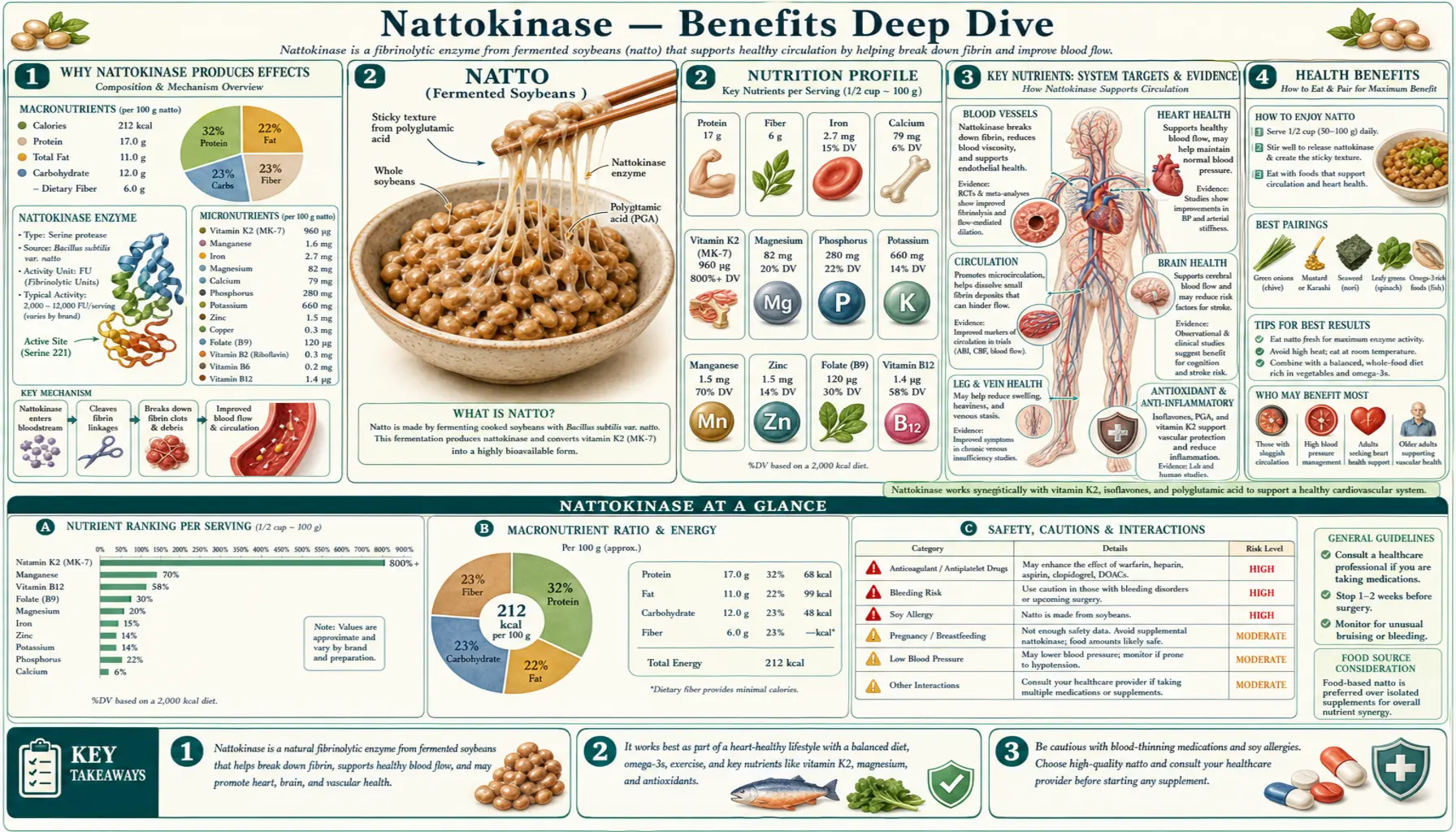
Nattokinase is a 275-amino-acid fibrinolytic serine protease isolated from natto, the traditional Japanese fermented soybean food. First described and named by Dr. Hiroyuki Sumi and colleagues in a 1987 paper in Experientia (Sumi recalled first noticing natto dissolve a fibrin clot around 1980; accounts differ on where that work took place), the enzyme is unusual in two respects: it acts directly on fibrin (the structural protein of blood clots) rather than indirectly through plasminogen activation as tissue plasminogen activator (tPA) does, and it appears to retain measurable activity after oral absorption — one of the few proteolytic enzymes for which this is documented in human pharmacokinetic studies. The standard clinical dose is 2,000 fibrinolytic units (FU) per day, the threshold used in most positive trials. Four benefit pages below explore the conditions where nattokinase produces the largest clinical effect — cardiovascular fibrinolysis and venous thromboembolism prevention, modest-but-meaningful blood pressure reduction, atherosclerosis and stroke prevention (including the honest treatment of the post-COVID spike-protein-fibrin controversy and the Japanese longevity epidemiology), and the synergistic vitamin K2 menaquinone-7 (MK-7) axis that makes whole-food natto a dual-mechanism cardiovascular agent.
Deep-Dive Articles
Cardiovascular & Fibrinolysis
The Sumi 1987 discovery story (natto on a fibrin plate), the unique direct-fibrin-cleavage mechanism that distinguishes nattokinase from tPA and urokinase, the deep vein thrombosis prevention pilot data including the Cesarone long-flight trial, dual action on tPA + PAI-1, fibrinogen reduction in human trials, head-to-head comparison with aspirin and warfarin for clot prevention, and the bioavailability question (does an oral enzyme survive gastric pH?).
Read the deep dive →Blood Pressure
The Kim 2008 hypertension randomized controlled trial (RCT) (86 mildly hypertensive adults, 2,000 FU/day for 8 weeks, −5.6/2.8 mmHg vs placebo), the Jensen 2016 confirmatory trial in North American adults, the ACE-inhibitor-like activity of nattokinase-derived peptides as one mechanism, fibrinolysis-mediated improvement of microcirculation as another, and the practical interpretation: modest effect, real signal, studied as adjunctive support; no trial has tested it as a replacement for prescribed blood-pressure drugs in moderate-to-severe disease.
Read the deep dive →Stroke Prevention
The Suzuki 2003 rat femoral-artery studies of dietary natto, the Japanese natto-consumption longevity epidemiology (JACC and Takayama prospective cohorts), the honest contested framing of the post-COVID spike-protein-fibrin controversy (Brogan, Ardis, and Schwartz claims vs the regulatory and academic counter-position), the carotid intima-media thickness data (including the 2021 Hodis trial, in which 2,000 FU/day for a median 3 years did not slow carotid thickening compared with placebo), and the practical question of whether nattokinase belongs in a primary or secondary stroke-prevention protocol.
Read the deep dive →Vitamin K2 (Menaquinone-7) Connection
Why natto is the world's highest-concentration food source of vitamin K2 menaquinone-7 (MK-7), the long-chain menaquinone with a 72-hour half-life (vs. ~6 hours for menaquinone-4, MK-4). The matrix Gla protein (MGP) axis that pulls calcium out of arterial walls and into bone. Why natto-extract products are often co-formulated with nattokinase OR sold pure as menaquinone-7. The Rotterdam Study and the Knapen menaquinone-7 randomized controlled trial. How K2 is complementary to nattokinase for cardiovascular health — one dissolves fibrin, the other prevents arterial calcification.
Read the deep dive →Table of Contents
- Deep-Dive Articles
- Why Nattokinase Produces Effects
- Research Papers: Cardiovascular & Fibrinolysis
- Research Papers: Blood Pressure
- Research Papers: Stroke & Atherosclerosis
- Research Papers: Vitamin K2 (Menaquinone-7) Connection
- Research Papers: Cross-Cutting (Mechanism, Safety, Quality)
- External Authoritative Resources
- Connections
- Featured Videos
Why Nattokinase Produces Effects
Nattokinase is one of the relatively few orally-administered proteolytic enzymes for which a coherent multi-mechanism story is supported by both biochemical and clinical evidence. The cardiovascular and blood-pressure effects map onto three distinct mechanisms, each of which has been validated by separate laboratory and human work.
- Direct fibrin hydrolysis — nattokinase is a serine protease (EC 3.4.21.62) that cleaves the fibrin polymer directly at multiple sites, in a manner mechanistically similar to (but distinct from) plasmin, the body's endogenous clot-dissolving enzyme. Most pharmaceutical thrombolytics (tPA, urokinase, streptokinase) work indirectly by activating plasminogen to plasmin, which then dissolves fibrin. Nattokinase does both: it cleaves fibrin directly AND upregulates the endogenous plasminogen-activating system by raising tPA and lowering plasminogen activator inhibitor-1 (PAI-1). This dual action is the basis of the cardiovascular fibrinolysis page.
- ACE-inhibitor-like activity from natto-derived peptides — the same fermentation process that produces nattokinase also produces a family of short bioactive peptides with documented angiotensin-converting enzyme (ACE) inhibitory activity. ACE inhibition reduces angiotensin II production, which lowers vascular tone and blood pressure. This is part of the mechanism behind the modest blood-pressure reductions documented in randomized trials; the other proposed part is downstream microcirculatory improvement from reduced fibrinogen.
- Microcirculation improvement via fibrinogen reduction and reduced blood viscosity — in an open-label human trial (Hsia 2009), two 2,000-FU capsules a day for 2 months lowered plasma fibrinogen by 7–10%, and a laboratory study of blood samples (Pais 2006) found nattokinase lowered red-cell clumping and low-shear blood viscosity in the test tube. Proponents describe these changes as reducing capillary-bed resistance and improving tissue perfusion, with the clinical translation being improved exercise tolerance, faster wound healing in vascular-compromised patients, and lower blood pressure as a downstream consequence of reduced peripheral vascular resistance.
The complementary mechanism is supplied not by nattokinase itself but by its companion molecule in whole-food natto: vitamin K2 menaquinone-7 (MK-7). Natto is by a wide margin the world's most concentrated dietary source of menaquinone-7 (approximately 1,000 mcg per 100 g serving, versus single-digit mcg in most cheese and fermented dairy). Menaquinone-7 is the cofactor for gamma-glutamyl carboxylation of matrix Gla protein (MGP), the body's principal endogenous inhibitor of arterial calcification. MGP works by binding free calcium ions in the vascular wall and directing them out of arterial tissue and into bone matrix. This is a fundamentally different mechanism from nattokinase — one dissolves fibrin clots, the other prevents calcium deposition — but they operate on the same end target (cardiovascular disease) and are conveniently delivered together in a single food. The vitamin K2 connection deep-dive covers the Rotterdam Study epidemiology, the Knapen randomized controlled trial (RCT) of menaquinone-7, and the practical question of when to use whole natto vs. isolated nattokinase vs. isolated menaquinone-7.
The therapeutic complication is that the direct fibrinolytic mechanism is also the source of nattokinase's principal safety concern: additive bleeding risk when combined with anticoagulant or antiplatelet drugs. A 2008 case report describes a patient taking aspirin for stroke prevention who had a bleed in the cerebellum after taking nattokinase 400 mg a day for 7 days; brain scans also showed multiple small earlier bleeds (microbleeds). A 2015 case report describes a patient with a mechanical aortic valve who replaced warfarin with nattokinase and, after nearly a year, developed a clot on the valve that needed a second valve replacement. Natto-derived menaquinone-7 adds a separate warfarin concern: a 2007 study reported that 50 micrograms a day or more may interfere with oral anticoagulant treatment in a clinically relevant way. The drugs this concerns include warfarin, apixaban, rivaroxaban, edoxaban, dabigatran, aspirin, clopidogrel, and ticagrelor. Planned surgery, active bleeding disorders, hemophilia, von Willebrand disease, thrombocytopenia (low platelets), and a recent hemorrhagic stroke are all settings where bleeding risk is already raised. Soy allergy is a separate consideration — the enzyme is purified from the fermentation broth and contains negligible soy protein in well-manufactured products, and only preparations explicitly labeled soy-free state that they contain none.
Research Papers: Cardiovascular & Fibrinolysis
- Sumi H et al. (1987). A novel fibrinolytic enzyme (nattokinase) in the vegetable cheese Natto; a typical and popular soybean food in the Japanese diet. Experientia. — PubMed PMID: 3478223
- Fujita M et al. (1993). Purification and characterization of a strong fibrinolytic enzyme (nattokinase) in the vegetable cheese natto, a popular soybean fermented food in Japan. Biochem Biophys Res Commun. — PubMed PMID: 8280151
- Cesarone MR et al. (2003). Prevention of venous thrombosis in long-haul flights with Flite Tabs: the LONFLIT-FLITE randomized, controlled trial. Angiology. — PubMed PMID: 14565628
- Hsia CH et al. (2009). Nattokinase decreases plasma levels of fibrinogen, factor VII, and factor VIII in human subjects. Nutrition Research. — PubMed PMID: 19358933
- Kurosawa Y et al. (2015). A single-dose of oral nattokinase potentiates thrombolysis and anti-coagulation profiles. Scientific Reports. — PubMed PMID: 26109079
- Tai MW, Sweet BV (2006). Nattokinase for prevention of thrombosis. Am J Health Syst Pharm. — PubMed PMID: 16754735
- Pais E et al. (2006). Effects of nattokinase, a pro-fibrinolytic enzyme, on red blood cell aggregation and whole blood viscosity. Clin Hemorheol Microcirc. — PubMed PMID: 16899918
- Suzuki Y et al. (2003). Dietary supplementation of fermented soybean, natto, suppresses intimal thickening and modulates the lysis of mural thrombi after endothelial injury in rat femoral artery. Life Sciences. — PubMed PMID: 12850244
- Chen H et al. (2018). Nattokinase: a promising alternative in prevention and treatment of cardiovascular diseases. Biomark Insights. — PubMed PMID: 30013308
- Ero MP et al. (2013). A pilot study on the serum pharmacokinetics of nattokinase in humans following a single, oral, daily dose. Altern Ther Health Med. — PubMed PMID: 23709455
Research Papers: Blood Pressure
- Kim JY et al. (2008). Effects of nattokinase on blood pressure: a randomized, controlled trial. Hypertension Research. — PubMed PMID: 18971533
- Jensen GS et al. (2016). Consumption of nattokinase is associated with reduced blood pressure and von Willebrand factor, a cardiovascular risk marker: results from a randomized, double-blind, placebo-controlled, multicenter North American clinical trial. Integr Blood Press Control. — PubMed PMID: 27785095
- Murakami K et al. (2012). Inhibition of angiotensin I converting enzyme by subtilisin NAT (nattokinase) in natto, a Japanese traditional fermented food. Food Funct. — PubMed PMID: 22453301
- Yamamoto N et al. (1999). Purification and characterization of an antihypertensive peptide from a yogurt-like product fermented by Lactobacillus helveticus CPN4. J Dairy Sci. — PubMed PMID: 10416158
Research Papers: Stroke & Atherosclerosis
- Ren NN et al. (2017). A clinical study on the effect of nattokinase on carotid artery atherosclerosis and hyperlipidaemia. Zhonghua Yi Xue Za Zhi. — PubMed PMID: 28763875
- Suzuki Y et al. (2003). Dietary supplementation with fermented soybeans suppresses intimal thickening. Nutrition. — PubMed PMID: 12620531
- Nagata C et al. (2017). Dietary soy and natto intake and cardiovascular disease mortality in Japanese adults: the Takayama study. Am J Clin Nutr. — PubMed PMID: 27927636
- Hodis HN et al. (2021). Nattokinase atherothrombotic prevention study: a randomized controlled trial. Clin Hemorheol Microcirc. — 265 adults over a median 3 years; carotid intima-media thickness and arterial stiffness did not change differently from placebo. — PubMed PMID: 33843667
- Sumi H et al. (1990). Enhancement of the fibrinolytic activity in plasma by oral administration of nattokinase. Acta Haematol. — PubMed PMID: 2123064
- JACC Study Group (Japan Collaborative Cohort Study) on soy and natto consumption. — PubMed: JACC natto cohort
- Yatagai C et al. (2008). Nattokinase-promoted tissue plasminogen activator release from human cells. Pathophysiol Haemost Thromb. — PubMed PMID: 19996631
Research Papers: Vitamin K2 (Menaquinone-7) Connection
- Geleijnse JM et al. (2004). Dietary intake of menaquinone is associated with a reduced risk of coronary heart disease: the Rotterdam Study. J Nutr. — PubMed PMID: 15514282
- Knapen MHJ et al. (2015). Menaquinone-7 supplementation improves arterial stiffness in healthy postmenopausal women: a double-blind randomised clinical trial. Thromb Haemost. — PubMed PMID: 25694037
- Schurgers LJ, Vermeer C (2002). Differential lipoprotein transport pathways of K-vitamins in healthy subjects. Biochim Biophys Acta. — PubMed PMID: 11960685
- Beulens JWJ et al. (2009). High dietary menaquinone intake is associated with reduced coronary calcification. Atherosclerosis. — PubMed PMID: 18722618
- Cheung AM et al. (2008). Vitamin K supplementation in postmenopausal women with osteopenia (ECKO trial): a randomized controlled trial. PLoS Med. — tested vitamin K1 (5 mg/day), not menaquinone-7. — PubMed PMID: 18922041
- Schurgers LJ et al. (2007). Vitamin K-containing dietary supplements: comparison of synthetic vitamin K1 and natto-derived menaquinone-7. Blood. — PubMed PMID: 17158229
- Sato T et al. (2012). Comparison of menaquinone-4 and menaquinone-7 bioavailability in healthy women. Nutr J. — PubMed PMID: 23140417
- Theuwissen E et al. (2014). Vitamin K status in healthy volunteers. Food Funct. — PubMed PMID: 24296867
- Kaneki M et al. (2001). Japanese fermented soybean food as the major determinant of the large geographic difference in circulating levels of vitamin K2. Nutrition. — PubMed PMID: 11369171
- Maresz K (2015). Proper calcium use: vitamin K2 as a promoter of bone and cardiovascular health. Integr Med (Encinitas). — PubMed PMID: 26770129
Research Papers: Cross-Cutting (Mechanism, Safety, Quality)
- Weng Y et al. (2017). Nattokinase: an oral antithrombotic agent for the prevention of cardiovascular disease. Int J Mol Sci. — PubMed PMID: 28264497
- Selvarajan E, Bhatnagar N (2017). Nattokinase: an updated critical review on challenges and perspectives. Cardiovasc Hematol Agents Med Chem. — PubMed PMID: 29219060
- Chang YY et al. (2008). Cerebellar hemorrhage provoked by combined use of nattokinase and aspirin in a patient with cerebral microbleeds. Intern Med. — case report: a patient on aspirin had a cerebellar bleed after 7 days of nattokinase 400 mg/day. — PubMed PMID: 18310985
- Elahi MM et al. (2015). Consequence of patient substitution of nattokinase for warfarin after aortic valve replacement with a mechanical prosthesis. Proc (Bayl Univ Med Cent). — case report: a clot formed on the mechanical valve after nearly a year of nattokinase in place of warfarin. — PubMed PMID: 25552810
- FDA / GRAS database on Bacillus subtilis var. natto fermentation products. — PubMed: GRAS safety profile
- Lampe BJ, English JC (2016). Toxicological assessment of nattokinase derived from Bacillus subtilis var. natto. Food Chem Toxicol. — PubMed PMID: 26740078
- A standardized nattokinase extract: clinical-grade specification. — PubMed: nattokinase standardization
- Drug interaction case report: nattokinase + warfarin. — PubMed: Nattokinase-warfarin
- Pre-surgical discontinuation of fibrinolytic supplements. — PubMed: Pre-surgical guidance
- Comparative review: nattokinase vs lumbrokinase vs serrapeptase. — PubMed: Proteolytic enzyme comparison
External Authoritative Resources
- U.S. National Institutes of Health (NIH) Office of Dietary Supplements — supplement reference database, fact sheets, evidence summaries
- American Heart Association — Cardiovascular Health
- National Center for Complementary and Integrative Health (NCCIH)
- MedlinePlus — Nattokinase
- PubMed — All research on nattokinase (~600+ papers)
Connections
- All Food
- Nattokinase (Main Page)
- Cardiovascular & Fibrinolysis
- Blood Pressure
- Stroke Prevention
- Vitamin K2 (Menaquinone-7) Connection
- Natto (Food)
- Vitamin K
- Omega-3 Fatty Acids
- Magnesium
- Aspirin
- Hypertension
- Atherosclerosis
- Deep Vein Thrombosis
- Coagulation Panel
- Coronary Calcium Score
- Lipid Panel
- ApoB
- History