Spinach for Lutein and Eye Health
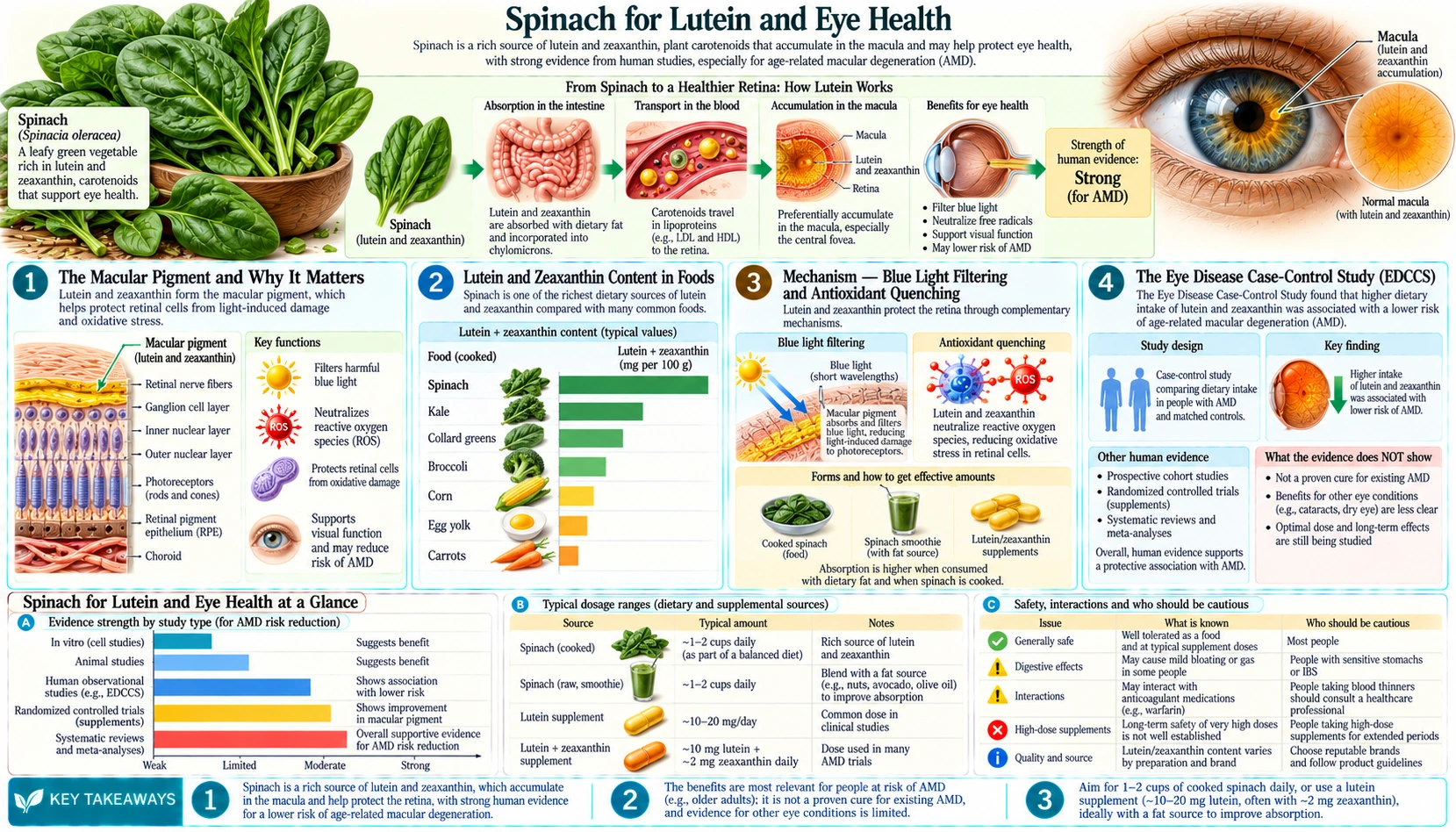
Spinach is one of the two top dietary sources of lutein and zeaxanthin — the two xanthophyll carotenoids that selectively accumulate in the macula of the retina, forming the yellow macular pigment that filters blue light and quenches reactive oxygen species generated by photoreception. A single cup of cooked spinach (180 g) delivers approximately 20 mg lutein + zeaxanthin by U.S. Department of Agriculture figures, more than the 10 mg lutein + 2 mg zeaxanthin daily dose tested in the AREDS2 trial in people at risk of advanced age-related macular degeneration (in that trial's primary analysis, adding lutein + zeaxanthin did not significantly reduce progression to advanced disease). The Eye Disease Case-Control Study, the POLA Study, and multiple meta-analyses have consistently shown that higher dietary lutein intake correlates with reduced age-related macular degeneration (AMD) risk. This page covers the macular pigment biology, the pivotal AREDS and AREDS2 trials, the bioavailability question (why egg yolks may deliver more usable lutein than spinach despite lower content), and the practical eye-protective dietary strategy.
Table of Contents
- The Macular Pigment and Why It Matters
- Lutein and Zeaxanthin Content in Foods
- Mechanism — Blue Light Filtering and Antioxidant Quenching
- The Eye Disease Case-Control Study (EDCCS)
- AREDS and AREDS2 — The Pivotal Trials
- Bioavailability — Why Egg Yolks Beat Spinach
- Cataract Prevention
- Visual Performance, Glare, and Computer Use
- Practical Dose and Duration
- Cautions
- Key Research Papers
- Connections
- Featured Videos
The Macular Pigment and Why It Matters
The macula is a 5-6 mm region near the center of the retina containing the highest density of cone photoreceptors. The center of the macula (fovea) is responsible for high-acuity central vision — reading, face recognition, fine detail. The macula has a distinctly yellow appearance when viewed through an ophthalmoscope, and that yellow color comes from the deposition of two xanthophyll carotenoids in the central retinal layers.
The macular pigment consists of three closely related molecules:
- Lutein — concentrated in the perifoveal region; the most abundant macular pigment carotenoid overall
- Zeaxanthin — concentrated in the central fovea; sourced from dietary intake (particularly from yellow-orange foods like corn and egg yolks)
- meso-Zeaxanthin — concentrated in the very center of the foveola; produced by retinal conversion of lutein rather than direct dietary intake
The Bone and Landrum 1997 paper in Experimental Eye Research first mapped the precise stereoisomer distribution and showed that meso-zeaxanthin is not a dietary contaminant but a locally-produced retinal isomer of lutein. The reason these three are deposited in the macula and not elsewhere in the body is not fully understood — specific binding proteins are involved: StARD3, a member of the steroidogenic acute regulatory domain (StARD) protein family, binds lutein, while GSTP1 is the macular zeaxanthin-binding protein (Li and colleagues, 2011); in monkey retina, StARD3 is found in all neurons of the macula, especially the cone inner segments and axons.
The pigment density (measured as macular pigment optical density, MPOD) varies several-fold between individuals depending on dietary intake and genetic factors. Low MPOD is associated with increased risk of age-related macular degeneration; high MPOD is protective. The pigment density can be increased over 4-6 months by sustained dietary intake of lutein-rich foods or supplements — this is one of the few cases where a dietary intervention produces a measurable change in a tissue-specific biomarker.
Lutein and Zeaxanthin Content in Foods
Per the U.S. Department of Agriculture (USDA) FoodData Central database, comparative lutein + zeaxanthin content (mcg per 100 g):
- Kale, cooked — ~4,980 mcg per 100 g (raw kale ~6,260 mcg)
- Spinach, cooked — ~11,300 mcg per 100 g
- Spinach, raw — ~12,200 mcg per 100 g
- Collard greens, cooked — ~6,200 mcg per 100 g
- Turnip greens, cooked — ~7,100 mcg per 100 g
- Romaine lettuce, raw — ~2,310 mcg per 100 g
- Broccoli, cooked — ~1,080 mcg per 100 g
- Peas, cooked — ~2,590 mcg per 100 g
- Sweet corn, yellow — ~644 mcg per 100 g raw, ~906 mcg cooked (high zeaxanthin fraction)
- Egg yolk — ~1,090 mcg per 100 g; whole egg ~503 mcg (much higher bioavailability than greens)
- Avocado — ~270 mcg per 100 g (very high bioavailability due to fat matrix)
One U.S. cup of cooked spinach (180 g) delivers approximately 20 mg lutein + zeaxanthin, which exceeds the 10 mg/day lutein + 2 mg/day zeaxanthin dose used in the AREDS2 trial. Daily intake of spinach or kale is one of the most direct ways to achieve sustained macular pigment loading without supplementation. The trade-off is that the bioavailability from leafy greens is lower than from egg yolks or supplements — see the bioavailability section below.
Marigold petals are the commercial extraction source for most lutein supplements; the AREDS2 trial used commercial lutein and zeaxanthin supplement preparations.
Mechanism — Blue Light Filtering and Antioxidant Quenching
The protective role of macular pigment operates through two complementary mechanisms:
- Optical filtering — lutein and zeaxanthin absorb light in the blue wavelength range (peak absorption 450-475 nm). The macular pigment lies anatomically anterior to the photoreceptor outer segments, so blue light passes through the pigment layer before reaching the photoreceptors. By absorbing blue photons before they reach the photoreceptors, the pigment reduces both photoreceptor damage and the intensity of the photochemical damage to the underlying retinal pigment epithelium. This is the "yellow lens" effect — the macula functionally acts as a built-in sunglasses lens.
- Antioxidant quenching — the constant photochemistry of vision generates substantial reactive oxygen species (singlet oxygen, peroxyl radicals, lipid peroxides) in the photoreceptor outer segments and RPE. Lutein and zeaxanthin are exceptionally efficient at quenching singlet oxygen — the rate constant for singlet oxygen quenching by lutein is approximately 8 × 10⁹ M−1s−1, among the highest of any biological antioxidant. The macular pigment deposition site is precisely where this antioxidant function is most needed.
The two mechanisms reinforce each other — reducing the photon flux reaches the photoreceptors AND quenching the reactive oxygen species (ROS) that the remaining photon flux generates. This is why the macula has co-opted carotenoid pigments rather than relying solely on enzymatic antioxidant defenses (superoxide dismutase, catalase, glutathione peroxidase) that protect other tissues.
Failure of macular pigment protection is implicated in age-related macular degeneration. Drusen, the focal extracellular deposits between the RPE and Bruch's membrane that characterize early age-related macular degeneration, are believed to result in part from accumulated oxidative damage to RPE cells over decades. Geographic atrophy, the advanced dry-AMD complication, involves progressive loss of RPE cells in the central macula with secondary photoreceptor death. Wet age-related macular degeneration involves choroidal neovascularization through Bruch's membrane in response to chronic VEGF release from stressed RPE. All three pathologies share the common feature of cumulative oxidative damage in the macula, and all three correlate inversely with macular pigment density.
The Eye Disease Case-Control Study (EDCCS)
The Eye Disease Case-Control Study (Seddon et al. 1994 JAMA) was the landmark observational study linking dietary lutein to age-related macular degeneration risk. The study enrolled 356 patients with advanced age-related macular degeneration and 520 matched controls without age-related macular degeneration across five clinical centers. Detailed dietary intake was assessed via food frequency questionnaire and converted to carotenoid intake estimates.
Key findings:
- Highest quintile of dietary lutein + zeaxanthin intake had a 57% lower odds of advanced age-related macular degeneration compared to the lowest quintile, after adjustment for age, sex, smoking, and other risk factors.
- The association was specific to lutein + zeaxanthin among the carotenoids studied (alpha-carotene, beta-carotene, beta-cryptoxanthin, lycopene did not show a similar protective association).
- Spinach and collard greens were the two specific foods most strongly inversely associated with age-related macular degeneration risk.
- The study enrolled only people with advanced disease — its stated aim was the risk of neovascular ("wet") age-related macular degeneration — so it made no comparison with early age-related macular degeneration; its conclusion concerns the advanced, exudative form, the most visually disabling.
The EDCCS was followed by multiple prospective cohort studies (Nurses Health Study, Health Professionals Follow-Up Study, Beaver Dam Eye Study, Rotterdam Study, Blue Mountains Eye Study) that largely confirmed the lutein-AMD inverse association. The 2012 Ma et al. systematic review and meta-analysis pooled 6 studies with over 4,500 age-related macular degeneration cases and concluded that higher lutein/zeaxanthin intake was associated with reduced risk of late age-related macular degeneration specifically.
The Delcourt POLA Study (Pathologies Oculaires Liees a l'Age) in southern France provided complementary evidence from plasma carotenoid measurements rather than dietary recall. Plasma zeaxanthin was significantly lower in age-related macular degeneration cases than controls, with a strong dose-response relationship across quartiles.
AREDS and AREDS2 — The Pivotal Trials
The Age-Related Eye Disease Study (AREDS) was a multicenter U.S. National Institutes of Health-funded randomized trial that recruited 3,640 participants aged 55-80 with various stages of age-related macular degeneration. Participants were randomized to four arms: antioxidants (vitamin C 500 mg, vitamin E 400 international units (IU), beta-carotene 15 mg), zinc 80 mg + copper 2 mg, both, or placebo. After 6.3 years, the combination arm reduced progression to advanced age-related macular degeneration by 25% in participants with intermediate age-related macular degeneration at baseline. This established the original AREDS formula as standard of care for intermediate age-related macular degeneration.
The AREDS2 trial (JAMA 2013) was designed to address two limitations of the original formula:
- Beta-carotene was associated with increased lung cancer risk in smokers (ATBC and CARET trials). AREDS2 tested adding lutein 10 mg + zeaxanthin 2 mg to the formula and, in a secondary randomization, removing beta-carotene.
- Whether adding omega-3 fatty acids (docosahexaenoic acid (DHA) 350 mg + eicosapentaenoic acid (EPA) 650 mg) would provide additional benefit.
AREDS2 enrolled 4,203 participants with intermediate age-related macular degeneration or unilateral advanced age-related macular degeneration. Primary findings:
- In the primary analysis, adding lutein + zeaxanthin did not significantly reduce progression to advanced age-related macular degeneration compared with placebo (hazard ratio 0.90, P = .12; 29% vs 31% progressed by 5 years). In pre-specified analyses by diet, people with the lowest dietary lutein + zeaxanthin intake had less progression with the supplement (hazard ratio 0.74), and later exploratory analyses that compared lutein + zeaxanthin directly with beta-carotene found a hazard ratio of 0.82 for advanced disease (AREDS2 Report No. 3, 2014).
- More lung cancers occurred in the beta-carotene group than in the group without beta-carotene (23 vs 11), mostly in former smokers; the investigators concluded that lutein + zeaxanthin could be an appropriate carotenoid substitute for beta-carotene in the formula.
- Omega-3 fatty acids provided no additional benefit on top of the carotenoid + zinc + antioxidant formula in this trial population.
- The current AREDS2 formula (lutein 10 mg, zeaxanthin 2 mg, vitamin C 500 mg, vitamin E 400 international units, zinc 80 mg, copper 2 mg) is now the standard ophthalmologic recommendation for intermediate age-related macular degeneration.
The clinical implication for spinach consumers: the 10 mg lutein daily dose used in AREDS2 is exceeded by 1 cup of cooked spinach per day (about 20 mg lutein + zeaxanthin), while 1 cup of cooked kale (118 g) provides about 5.9 mg. Combined with the dietary co-factors of fat-soluble vitamins, mineral cofactors from a balanced diet, and the dietary nitrate vasodilator effect of leafy greens, regular consumption supplies lutein at or above the trial dose through food alone — though the trial used a specific isolated supplement formulation, not food, and food-based delivery has different bioavailability characteristics discussed below.
Bioavailability — Why Egg Yolks Beat Spinach
One of the more counterintuitive findings in the lutein literature is that egg yolks, despite containing only about 1,090 mcg of lutein + zeaxanthin per 100 g (versus 11,300 mcg per 100 g for cooked spinach), deliver substantially more bioavailable lutein per milligram of intake. The Chung 2004 Journal of Nutrition study gave 10 healthy men, in a crossover design, each of four lutein sources in turn — a lutein supplement, a lutein ester supplement, spinach, and lutein-enriched egg, about 6 mg of lutein each — for 9 days, and measured serum lutein response. The dose-adjusted serum lutein response was significantly higher after egg than after the supplements or spinach, while lutein bioavailability from the supplements and from spinach did not differ.
The reason is the food matrix. Lutein in spinach is bound within the chloroplast structure, complexed with chlorophyll-protein complexes, embedded in fibrous plant tissue, and requires substantial mechanical and enzymatic disruption to be released for absorption. Lutein in egg yolks is dissolved in the lipid phase of the yolk, fully bioavailable, and absorbed with the highly efficient lipid-handling machinery of the intestine.
The Castenmiller 1999 Journal of Nutrition study showed that the spinach food matrix limits the bioavailability of beta-carotene, and of lutein to a lesser extent: compared with a carotenoid supplement, beta-carotene bioavailability from spinach was 5.1–9.5% across whole-leaf, minced and liquefied spinach, while lutein bioavailability was 45–55%, and breaking down the spinach matrix had no effect on lutein bioavailability.
What this means for spinach eaters:
- Cooking — heat breaks down the chloroplast matrix, and cooked spinach is commonly described as releasing more of its lutein for absorption than raw spinach.
- Dietary fat — lutein is fat-soluble and requires bile-stimulating dietary fat for efficient absorption. Sauteing spinach in olive oil, adding cheese to a spinach salad, or pairing with an avocado are common ways of adding fat. In the Brown 2004 study (7 people eating salads of spinach, romaine lettuce, cherry tomatoes and carrots), essentially no carotenoid absorption was seen with fat-free dressing; absorption rose with reduced-fat dressing and was substantially greater again with full-fat dressing.
- Chopping or blending — mechanical disruption of plant cell walls increases bioavailable carotenoid yield, and a spinach smoothie is commonly said to release more usable lutein than the same spinach eaten whole (in the Castenmiller study above, breaking down the matrix raised beta-carotene absorption but not lutein absorption).
- Eggs as a complementary source — one large egg yolk (17 g) delivers approximately 0.2 mg lutein + zeaxanthin but with much higher absorption efficiency. Egg yolks also contain zeaxanthin in a higher fraction than spinach does, helping balance the lutein/zeaxanthin intake ratio toward the AREDS2 formula proportions.
Cataract Prevention
Cataracts — opacification of the lens — are the leading cause of blindness worldwide (treatable with surgery) and the leading cause of correctable visual impairment in older adults. The lens is exposed to lifelong ultraviolet (UV) and visible-light photochemistry and has minimal cellular turnover capability (lens cells are sealed in at birth and accumulate damage for decades).
The Chasan-Taber 1999 study in the Nurses Health Study cohort followed 77,466 women nurses for 12 years and found that the highest quintile of lutein/zeaxanthin intake had 22% lower risk of cataract extraction compared to the lowest quintile; eating spinach and kale more often was associated with a moderate decrease in cataract risk in that cohort. Its companion study in men (Brown 1999; 36,644 male health professionals followed for 8 years) found a 19% lower risk in the highest fifth of intake, with broccoli and spinach the foods most consistently linked to lower risk.
The Christen 2008 study of 35,551 female health professionals (relative risk of cataract 0.82 for the highest vs lowest fifth of lutein/zeaxanthin intake) and other prospective studies have generally supported a modest inverse association between dietary lutein/zeaxanthin and cataract incidence, though the effect size is smaller and less consistent than for age-related macular degeneration prevention. The mechanism is similar — xanthophyll deposition in the lens, with blue-light filtering and antioxidant quenching reducing the accumulation of photo-oxidative damage that drives lens protein denaturation and crystallin aggregation over decades.
Visual Performance, Glare, and Computer Use
Beyond disease prevention, there is growing evidence that increasing macular pigment density improves visual performance in functional ways:
- Glare disability and photostress recovery — the Hammond 2014 IOVS placebo-controlled trial in 115 young healthy adults showed that lutein + zeaxanthin supplementation (10 mg + 2 mg daily) for 1 year shortened recovery time after a bright-light photostress challenge; glare disability was linked with macular pigment density but did not improve significantly in the treated group. Practical relevance: recovering from the dazzle of oncoming headlights when driving at night.
- Chromatic contrast and color discrimination — the same Hammond trial documented improvements in chromatic contrast sensitivity, particularly in the blue-yellow axis where the macular pigment provides the most selective filtering.
- Computer-use eyestrain — the Stringham 2017 study evaluated lutein + zeaxanthin supplementation in adults with high screen time (>6 hours/day) and reported reduced eyestrain, headache, and visual fatigue scores over 6 months of supplementation versus placebo. The proposed mechanism is reduced retinal exposure to the blue-spectrum-rich emission of LCD/LED screens.
- Visual processing speed — the Bovier, Renzi and Hammond 2014 placebo-controlled trial in young healthy adults found that four months of zeaxanthin (20 mg a day) or a mix of zeaxanthin 26 mg, lutein 8 mg and omega-3 fatty acids raised critical flicker fusion thresholds (a measure of temporal visual processing) by about 12% compared with placebo, suggesting effects beyond simple light filtering.
These functional effects are independent of the long-term disease-prevention benefit and may be the more immediately relevant outcome for young and middle-aged adults with adequate baseline visual function. The macular pigment density increases over 4-6 months of sustained intake and remains elevated as long as intake is sustained.
Practical Dose and Duration
What AREDS2 and the broader trial literature used:
- Dose tested in AREDS2 — 10 mg lutein + 2 mg zeaxanthin daily, in people at risk of advanced age-related macular degeneration. One cup of cooked spinach a day (about 20 mg lutein + zeaxanthin) exceeds it; one cup of cooked kale provides about 5.9 mg; 10/2 supplements match it.
- Formula used for intermediate age-related macular degeneration — full AREDS2 formula (lutein 10 mg, zeaxanthin 2 mg, vitamin C 500 mg, vitamin E 400 international units, zinc 80 mg, copper 2 mg). Its 80 mg of zinc is twice the 40 mg/day adult upper limit for zinc from all sources set by the U.S. National Academies, a limit based on zinc lowering the body's copper status.
- Dose in the visual performance trials — the Hammond 2014 trial used the same 10/2 ratio as the AREDS2 trial; benefits typically appear after 4-6 months of sustained intake.
- Duration — the macular pigment density rises gradually over 3-6 months and remains elevated as long as intake continues. Stopping intake produces gradual decline back to baseline. There is no documented benefit to mega-dosing or intermittent loading — the trials used sustained moderate daily intake.
Food sources: 1 cup of cooked spinach daily provides more than the AREDS2 lutein dose, along with folate, vitamin K, magnesium, fiber and nitrate. Supplements are the other route; both food and supplements deliver bioavailable lutein, and in the Chung 2004 comparison, lutein bioavailability from spinach and from supplements did not differ, while egg was higher. Eggs and avocados are complementary sources.
Cautions
- Carotenodermia — very high intake of carotenoids (typically beta-carotene from carrot juice or pumpkin) can produce yellow-orange skin discoloration, particularly in the palms and soles. This is harmless and reversible. Lutein-induced carotenodermia is much rarer than beta-carotene carotenodermia because the xanthophyll uptake is more tightly regulated.
- Smokers and beta-carotene — isolated high-dose beta-carotene increases lung cancer risk in current and former heavy smokers per the ATBC and CARET trials. In AREDS2, more lung cancers occurred with beta-carotene than without it, mostly in former smokers, and the investigators concluded that lutein + zeaxanthin could be an appropriate carotenoid substitute in the formula.
- Drug interactions — cholestyramine, mineral oil, orlistat, and other fat-malabsorption drugs reduce carotenoid absorption. Statins do not significantly affect carotenoid absorption.
- Spinach-specific cautions — the same vitamin K, oxalate, and iron-absorption considerations discussed in other deep-dives on this site apply. None of these contraindicate spinach for age-related macular degeneration prevention in the typical patient.
- Substituting greens for ophthalmologic care — lutein-rich diet is a supportive intervention for age-related macular degeneration prevention and progression slowing. It is not a substitute for regular dilated eye exams in adults over 50, prompt evaluation of visual changes, or formal ophthalmologic management of established age-related macular degeneration (which may include anti-VEGF injections for wet age-related macular degeneration).
Key Research Papers
- Age-Related Eye Disease Study 2 Research Group (2013). Lutein + zeaxanthin and omega-3 fatty acids for age-related macular degeneration. JAMA 309:2005-2015. — PubMed PMID: 23644932
- Seddon JM et al. (1994). Dietary carotenoids, vitamins A, C, and E, and advanced age-related macular degeneration (EDCCS). JAMA 272:1413-1420. — PubMed PMID: 7933422
- Delcourt C et al. (2006). Plasma lutein and zeaxanthin and other carotenoids as modifiable risk factors for age-related maculopathy and cataract: the POLA Study. IOVS 47:2329-2335. — PubMed PMID: 16723441
- Bone RA, Landrum JT et al. (1997). Distribution of lutein and zeaxanthin stereoisomers in the human retina. Experimental Eye Research 64:211-218. — PubMed PMID: 9176055
- Hammond BR Jr et al. (2014). A double-blind, placebo-controlled study on the effects of lutein and zeaxanthin on photostress recovery, glare disability, and chromatic contrast. IOVS 55:8583-8589. — Search PubMed
- Eisenhauer B et al. (2017). Lutein and zeaxanthin — food sources, bioavailability and dietary variety in age-related macular degeneration protection. Nutrients 9:120. — Search PubMed
- Chung HY et al. (2004). Lutein bioavailability is higher from lutein-enriched eggs than from supplements and spinach in men. Journal of Nutrition 134:1887-1893. — PubMed PMID: 15284371
- Castenmiller JJ et al. (1999). The food matrix of spinach is a limiting factor in determining the bioavailability of beta-carotene and to a lesser extent of lutein in humans. Journal of Nutrition 129:349-355. — PubMed PMID: 10024612
- Stringham JM, Hammond BR (2008). Macular pigment and visual performance under glare conditions. Optometry & Vision Science 85:82-88. — Search PubMed
- Ma L et al. (2012). Lutein and zeaxanthin intake and the risk of age-related macular degeneration: a systematic review and meta-analysis. British Journal of Nutrition 107:350-359. — PubMed PMID: 21899805
- AREDS Research Group (2001). A randomized, placebo-controlled, clinical trial of high-dose supplementation with vitamins C and E, beta carotene, and zinc for age-related macular degeneration. Arch Ophthalmol 119:1417-1436. — PubMed PMID: 11594942
- Brown L et al. (1999). A prospective study of carotenoid intake and risk of cataract extraction in US men. AJCN 70:517-524. — PubMed PMID: 10500021
- Chasan-Taber L et al. (1999). A prospective study of carotenoid and vitamin A intakes and risk of cataract extraction in US women. AJCN 70:509-516. — PubMed PMID: 10500020
- Bovier ER, Renzi LM, Hammond BR (2014). A double-blind, placebo-controlled study on the effects of lutein and zeaxanthin on neural processing speed and efficiency. PLoS One 9:e108178. — PubMed PMID: 25251377
- Age-Related Eye Disease Study 2 (AREDS2) Research Group (2014). Secondary analyses of the effects of lutein/zeaxanthin on age-related macular degeneration progression: AREDS2 report No. 3. JAMA Ophthalmology 132:142-149. — PubMed PMID: 24310343
PubMed Topic Searches
Connections
- All Food
- Spinach Main Page
- Spinach Benefits Hub
- Spinach for Folate & Pregnancy
- Spinach Iron & Oxalates
- Cooking vs Raw
- Vitamin A & Beta-Carotene
- Vitamin A for Vision
- Vitamin C
- Vitamin E
- Zinc
- Copper
- Macular Degeneration
- Cataracts
- Kale (Higher Lutein)
- Eggs (Bioavailable Lutein)
- Avocado
- History
- Nutrients