Spinach — Cooking vs Raw
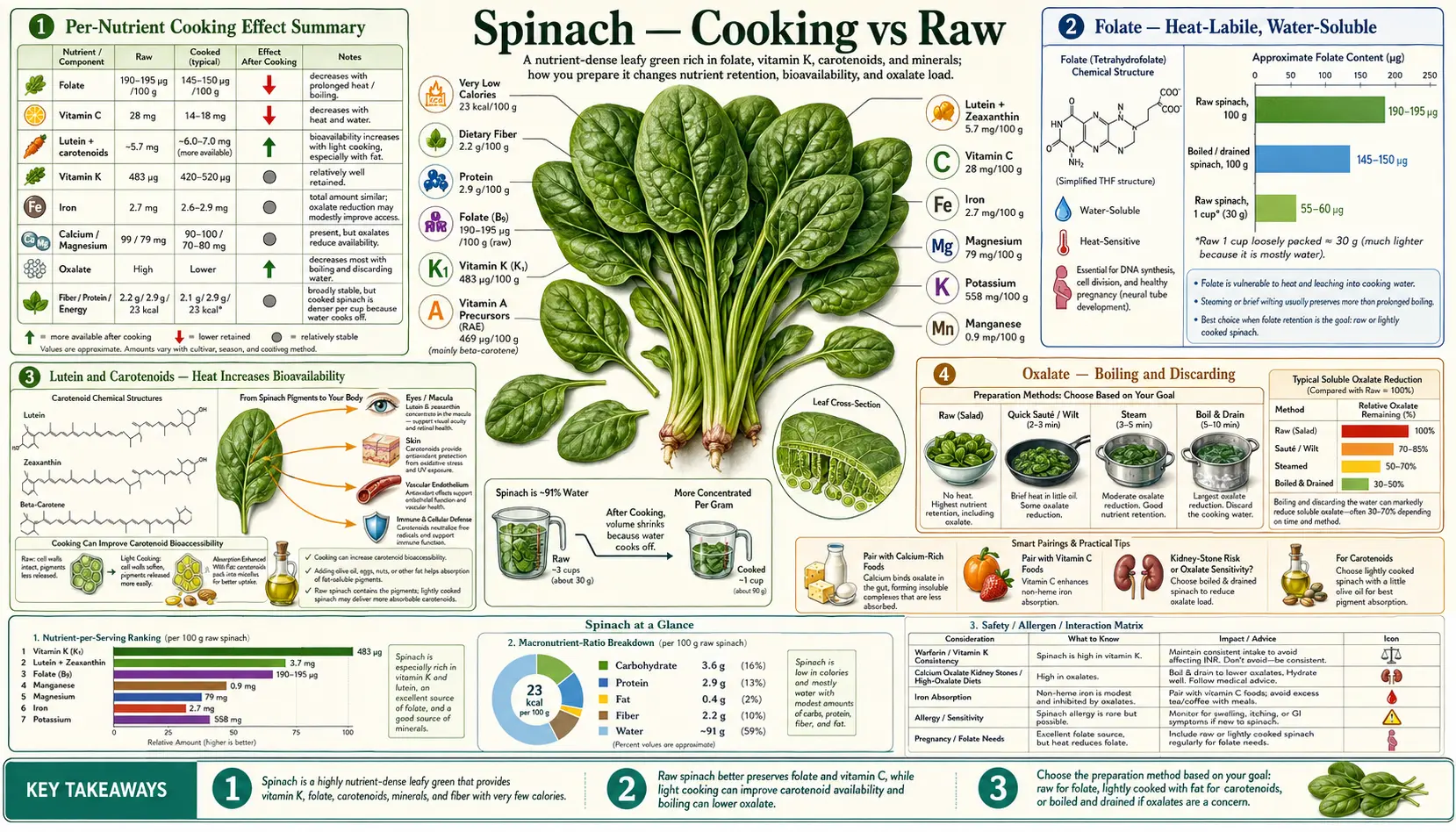
Cooking moves spinach's nutrients in different directions. In a UK study, boiling left 49% of spinach's folate, while steaming for up to 4.5 minutes caused no significant loss. Beta-carotene and lutein are held inside the leaf's cell structure, and the research describes processing, heat and dietary fat as factors that can raise how much is absorbed. Across nine vegetables, boiling reduced soluble oxalate by 30-87% and steaming by 5-53%, with the lost oxalate recovered in the cooking water. USDA FoodData Central lists less vitamin C and potassium per 100 g in boiled, drained spinach than in raw spinach, and similar amounts of vitamin K. This page sets out what the studies measured, nutrient by nutrient.
Table of Contents
- Per-Nutrient Cooking Effect Summary
- Folate — Heat-Labile, Water-Soluble
- Lutein and Carotenoids — Matrix, Heat and Fat
- Oxalate — Boiling and Discarding
- Vitamin C — Raw vs Boiled
- Vitamin K — Similar Raw and Boiled
- Minerals — Iron, Magnesium, Potassium
- Dietary Nitrate
- Raw Spinach Cautions — Bacterial Contamination
- Putting the Findings Together
- Key Research Papers
- Connections
- Featured Videos
Per-Nutrient Cooking Effect Summary
USDA FoodData Central (FDC) lists the following amounts per 100 g for raw spinach (FDC ID 168462) and for spinach cooked, boiled, drained, without salt (FDC ID 168463). Both are SR Legacy records.
- Folate — raw 194 µg; boiled 146 µg
- Vitamin C — raw 28.1 mg; boiled 9.8 mg
- Vitamin K1 (phylloquinone) — raw 482.9 µg; boiled 493.6 µg
- Beta-carotene — raw 5,626 µg; boiled 6,288 µg
- Lutein + zeaxanthin — raw 12,198 µg; boiled 11,308 µg
- Vitamin A (RAE) — raw 469 µg; boiled 524 µg
- Calcium — raw 99 mg; boiled 136 mg
- Iron — raw 2.71 mg; boiled 3.57 mg
- Magnesium — raw 79 mg; boiled 87 mg
- Potassium — raw 558 mg; boiled 466 mg
- Manganese — raw 0.897 mg; boiled 0.935 mg
- Water — raw 91.4 g; boiled 91.21 g
These are amounts in 100 g of food as weighed raw, or as weighed after boiling and draining. They are not retention percentages, and they say nothing about how much of each nutrient is absorbed. The studies in the sections below measured retention, oxalate and absorption directly, each for a limited set of methods.
No single preparation in these studies came out ahead on every nutrient. Boiling lowered soluble oxalate, and in a separate study it also lowered folate; steaming kept folate but removed less oxalate; the carotenoid studies point to disruption of the leaf structure and the presence of fat as the main factors in absorption.
Folate — Heat-Labile, Water-Soluble
Folate is water-soluble and can be degraded by heat. Spinach folate is the subject of the pregnancy benefit deep-dive.
McKillop and colleagues (2002, British Journal of Nutrition) measured total folate in foods cooked the way local shoppers reported cooking them:
- Boiling for typical times — 49% of spinach folate retained (191.8 µg/100 g raw vs 94.4 µg/100 g boiled; P<0.005).
- Steaming — no significant decrease in spinach folate, even at the longest steaming period tested (4.5 minutes).
- Other foods — boiling left 44% of broccoli folate, while boiling whole potatoes for 60 minutes did not significantly change their folate content. The authors concluded that folate retention depends both on the food and on the cooking method.
The study did not report figures for microwaving, sautéing, or soups in which the cooking water is eaten.
Storage before cooking also matters. Pandrangi and LaBorde (2004) stored commercially packaged fresh spinach at 4°C, 10°C and 20°C. Only 53% of its folate remained after 8 days at 4°C, 6 days at 10°C and 4 days at 20°C — the points at which the spinach had become visually unacceptable at each temperature. Carotenoid levels at those points were 54%, 61% and 44% of initial levels, respectively, and the presence or absence of packaging made no difference.
Lutein and Carotenoids — Matrix, Heat and Fat
Beta-carotene and lutein sit inside the leaf's cell structure, and how much of them is absorbed depends on that food matrix as well as on how much is present.
Castenmiller and colleagues (1999, Journal of Nutrition) gave groups of 12 adults one of four spinach products for 3 weeks: whole leaf, minced, enzymatically liquefied, or liquefied with added fiber. Compared with a purified carotenoid supplement, the relative bioavailability of beta-carotene was 5.1%, 6.4%, 9.5% and 9.3%, respectively, and of lutein 45%, 52%, 55% and 54%. Enzymatic disruption of the cell walls raised beta-carotene uptake but had no effect on lutein, and lutein was the more available of the two from every product. The study compared degrees of processing, not raw versus cooked spinach.
Other findings:
- A 2000 review by van het Hof and colleagues reported beta-carotene bioavailability of 14% from mixed vegetables compared with purified beta-carotene in a simple matrix, against 67% for lutein. Processing such as mechanical homogenization or heat treatment has the potential to enhance carotenoid bioavailability from vegetables — by amounts ranging from 18% to sixfold in the studies reviewed — and about 3-5 g of fat per meal appeared to be enough for carotenoid absorption.
- In Brown and colleagues' 2004 study, 7 adults ate salads of spinach, romaine lettuce, cherry tomatoes and carrots with dressings containing 0, 6 or 28 g of canola oil. With the fat-free dressing, the appearance of alpha-carotene, beta-carotene and lycopene in plasma chylomicrons was negligible; it rose with the reduced-fat dressing and rose further with the full-fat dressing.
- In a laboratory digestion model using carrots (not spinach), Hedrén and colleagues (2002) found 3% of beta-carotene released from raw carrot pieces, 21% when pulped, 27% when the pulp was cooked, and 39% when cooking oil was added to the cooked pulp.
The role of lutein in the eye is covered in the eye-health benefits deep-dive. Beta-carotene is a precursor of vitamin A.
Oxalate — Boiling and Discarding
As discussed in the iron and oxalate deep-dive, spinach is rich in oxalate, much of it in the water-soluble form. Chai and Liebman (2005, Journal of Agricultural and Food Chemistry) analyzed nine raw and cooked vegetables with an enzymatic method:
- Boiling — reduced soluble oxalate by 30-87%.
- Steaming — reduced soluble oxalate by 5-53%.
- Baking (tested only for potatoes) — no oxalate loss.
- Insoluble oxalate — losses during cooking ranged from 0 to 74%.
- Cooking water — analysis of the water used for boiling and steaming recovered approximately 100% of the oxalate lost from the vegetables.
These are ranges across all nine vegetables; the abstract does not give a separate figure for spinach. The recovery finding means the oxalate leached into the water rather than being destroyed by heat. The authors noted that soluble oxalate appears to be better absorbed than insoluble oxalate, and concluded that cooking methods that significantly reduce soluble oxalate may be an effective strategy for decreasing urinary oxalate in people predisposed to kidney stones.
The same leaching that removes oxalate also moves water-soluble nutrients into the water: McKillop's 49% folate retention after boiling is one measured example. Kidney stones are covered in the kidney stones section.
Vitamin C — Raw vs Boiled
Vitamin C (ascorbic acid) is water-soluble and is degraded by heat. USDA FoodData Central lists 28.1 mg of vitamin C per 100 g of raw spinach (FDC ID 168462) and 9.8 mg per 100 g of boiled, drained spinach (FDC ID 168463).
None of the studies on this page measured spinach vitamin C after steaming, microwaving or sautéing, or during refrigerated storage, so no figures are given for those.
Vitamin C's role in non-heme iron absorption is covered in the iron and oxalate deep-dive.
Vitamin K — Similar Raw and Boiled
Spinach is rich in vitamin K1 (phylloquinone), a fat-soluble vitamin. USDA FoodData Central lists 482.9 µg per 100 g raw (FDC ID 168462) and 493.6 µg per 100 g boiled and drained (FDC ID 168463).
Vitamin K is required for the gamma-carboxylation that activates:
- Clotting factors II (prothrombin), VII, IX and X
- Matrix Gla protein (MGP), an inhibitor of vascular calcification
- Osteocalcin, a protein of bone matrix
- Protein S, part of the body's anticoagulant pathway
The clinically important interaction is with warfarin, which works by antagonizing vitamin K. Large changes in vitamin K intake can shift warfarin's effect on INR: a sudden increase can weaken anticoagulation (raising the risk of clots), and a sudden decrease can strengthen it (raising the risk of bleeding). For this reason, anticoagulation guidance commonly describes a consistent week-to-week vitamin K intake — not zero intake — for people taking warfarin. The direct oral anticoagulants (apixaban, rivaroxaban, dabigatran, edoxaban) do not act through vitamin K and do not share this interaction. Decisions about diet and anticoagulants belong with a clinician.
Minerals — Iron, Magnesium, Potassium
Minerals are elements and are not destroyed by heat. Cooking can change the amount in the food by moving minerals into the cooking water, and the amount absorbed depends on what else is in the food.
- Iron — FDC lists 2.71 mg per 100 g raw and 3.57 mg per 100 g boiled. Iron absorption from spinach is covered in the iron and oxalate deep-dive.
- Calcium — FDC lists 99 mg per 100 g raw and 136 mg per 100 g boiled. In a randomized crossover study of 13 healthy adults, Heaney and colleagues (1988) gave test meals of milk or spinach each containing 200 mg of labeled calcium. Mean absorption was 27.6% from milk and 5.1% from spinach, and was higher from milk in every participant. The test spinach held a slight stoichiometric excess of oxalate, so the authors judged that essentially all of its calcium was bound.
- Magnesium — FDC lists 79 mg per 100 g raw and 87 mg per 100 g boiled. In a crossover study of 9 healthy adults, Bohn and colleagues (2004) found apparent magnesium absorption of 26.7% from a meal served with 300 g of spinach versus 36.5% from a meal served with 300 g of kale (P=0.01). The authors attributed the difference to spinach's oxalate, on indirect evidence, and noted that spinach's higher native magnesium content may at least partly counterbalance the lower absorption.
- Potassium — FDC lists 558 mg per 100 g raw and 466 mg per 100 g boiled. Potassium is water-soluble and can leach into cooking water.
- Manganese — FDC lists 0.897 mg per 100 g raw and 0.935 mg per 100 g boiled.
Dietary Nitrate
Vegetables supply approximately 80% of dietary nitrate (Hord 2009); high nitrate levels in vegetables are frequently reported (Chan 2011), and the European Food Safety Authority has assessed nitrate in spinach and lettuce specifically. Oral and gut bacteria reduce nitrate to nitrite, which can be recycled in the body to nitric oxide (Lundberg 2008). The Siervo 2013 meta-analysis pooled 16 short randomized crossover trials (254 participants; 2 hours to 15 days) of inorganic nitrate or beetroot juice supplements and found an average fall in systolic blood pressure of 4.4 mmHg; the change in diastolic pressure (−1.1 mmHg) was not significant. Those trials tested supplements and juice, not spinach. Blood pressure is covered in the hypertension section.
On cooking and handling, Chan's 2011 review states that nitrate levels in some vegetables can decrease after cooking in water or blanching, and that removing the stem and midrib lowers the nitrate content of lettuce and spinach. None of the studies on this page gave spinach-specific nitrate retention figures by cooking method.
The main concern with nitrate in spinach is for infants:
- The European Food Safety Authority's contaminants panel (EFSA CONTAM, 2010) noted that cooked spinach is more likely than lettuce to be part of an infant's diet. It judged nitrate exposure at the current or proposed EU maximum levels in spinach cooked from fresh unlikely to be a health concern, but stated that a risk for some infants eating more than one spinach meal a day could not be excluded.
- The same panel stated that inappropriate storage of cooked vegetables can convert nitrate to nitrite in the food, increasing the potential for methaemoglobinaemia, and that infants and children with bacterial infections of the gut are more sensitive to nitrate; it recommended against feeding spinach to such children.
- Chan's review describes infants under 3 months as particularly susceptible to methaemoglobinaemia, notes that puréeing releases the vegetable's own nitrate reductase (raising nitrite) while frozen storage inhibits nitrite build-up, and advises that home-prepared infant food containing vegetables be deferred until 3 months of age. The review also argues that the traditional view that adults are not at risk is worth reconsidering given high nitrate levels in some vegetables.
Raw Spinach Cautions — Bacterial Contamination
Raw leafy greens can carry bacteria that cooking would kill. A CDC analysis of US outbreak data for 1998-2008 attributed 46% of outbreak-associated foodborne illnesses to produce (Painter 2013).
The best-known spinach outbreak was the 2006 multistate Escherichia coli O157:H7 outbreak linked to fresh bagged spinach from California. The national investigation (Sharapov 2016) identified 225 cases (191 confirmed, 34 probable) in 27 states; 116 people were hospitalized, 39 developed hemolytic uremic syndrome, and 5 died. Of the outbreak-strain patients who gave details, 91% reported eating fresh spinach in the 10 days before illness. A follow-up environmental study on the central California coast matched isolates from feral swine, cattle, surface water, sediment and soil at one ranch to the outbreak strain (Jay 2007).
Spinach grows close to the soil, where contamination from water or animal feces can reach the leaves, and raw spinach is eaten without a cooking step that would kill vegetative bacteria such as E. coli, Salmonella and Listeria.
What the agencies state:
- The US Food and Drug Administration's consumer guidance is to wash all produce thoroughly under running water before preparing or eating it, without soap, detergent or commercial produce wash, and notes that rinsing reduces but does not eliminate bacteria.
- The same guidance describes produce labeled "pre-washed" or "ready-to-eat" as ready to eat without further washing; if such produce is washed again, FDA states it must not come into contact with unclean surfaces or utensils.
- Pregnant people, older adults, young children and people with weakened immune systems are the groups public-health agencies describe as at higher risk of severe foodborne illness.
Putting the Findings Together
What the studies on this page measured, side by side:
- Folate — boiling left 49% of spinach folate; steaming for up to 4.5 minutes caused no significant loss (McKillop 2002).
- Soluble oxalate — across nine vegetables, boiling reduced it by 30-87% and steaming by 5-53%, and the lost oxalate was recovered in the cooking water (Chai and Liebman 2005).
- Carotenoids — disrupting spinach's cell structure raised beta-carotene uptake but not lutein uptake (Castenmiller 1999); fat in a salad dressing raised carotenoid absorption from a spinach-containing salad (Brown 2004); a review reported that homogenization or heat can raise carotenoid bioavailability from vegetables by 18% to sixfold (van het Hof 2000).
- Vitamin C and potassium — FDC lists less of both per 100 g in boiled, drained spinach than in raw spinach.
- Vitamin K, calcium, iron and magnesium — FDC lists similar or higher amounts per 100 g in boiled spinach; calcium absorption from spinach was 5.1% against 27.6% from milk (Heaney 1988), and magnesium absorption was lower with spinach than with kale (Bohn 2004).
- Storage — packaged fresh spinach kept 53% of its folate after 8 days at 4°C (Pandrangi and LaBorde 2004).
- Raw spinach — carries the bacterial risk described above, documented most fully in the 2006 E. coli O157:H7 outbreak (Sharapov 2016).
No study here measured every nutrient across every method in the same spinach, so these figures cannot be combined into a single ranking of preparations. Questions about diet in pregnancy, kidney stone disease or warfarin treatment are for a clinician.
Key Research Papers
- McKillop DJ et al. (2002). The effect of different cooking methods on folate retention in various foods that are amongst the major contributors to folate intake in the UK diet. British J Nutrition 88:681-688. — PubMed PMID: 12493090
- Chai W, Liebman M (2005). Effect of different cooking methods on vegetable oxalate content. J Agric Food Chem 53:3027-3030. — PubMed PMID: 15826055
- Castenmiller JJ et al. (1999). The food matrix of spinach is a limiting factor in determining the bioavailability of beta-carotene and to a lesser extent of lutein in humans. J Nutrition 129:349-355. — PubMed PMID: 10024612
- van het Hof KH et al. (2000). Dietary factors that affect the bioavailability of carotenoids. J Nutrition 130:503-506. — PubMed PMID: 10702576
- Bohn T, Davidsson L, Walczyk T, Hurrell RF (2004). Fractional magnesium absorption is significantly lower in human subjects from a meal served with an oxalate-rich vegetable, spinach, as compared with a meal served with kale, a vegetable with a low oxalate content. British J Nutrition 91:601-606. — PubMed PMID: 15035687
- Hedrén E, Diaz V, Svanberg U (2002). Estimation of carotenoid accessibility from carrots determined by an in vitro digestion method. European J Clinical Nutrition 56:425-430. — PubMed PMID: 12001013
- Brown MJ et al. (2004). Carotenoid bioavailability is higher from salads ingested with full-fat than with fat-reduced salad dressings. AJCN 80:396-403. — PubMed PMID: 15277161
- Dewanto V et al. (2002). Thermal processing enhances the nutritional value of tomatoes by increasing total antioxidant activity. J Agric Food Chem 50:3010-3014. — PubMed PMID: 11982434
- Pandrangi S, LaBorde LF (2004). Retention of folate, carotenoids, and other quality characteristics in commercially packaged fresh spinach. J Food Science 69:C702-C707. — doi:10.1111/j.1365-2621.2004.tb09919.x
- Centers for Disease Control and Prevention (2006). Ongoing multistate outbreak of Escherichia coli serotype O157:H7 infections associated with consumption of fresh spinach — United States, September 2006. MMWR 55:1045-1046. — PubMed PMID: 17008868
- Lundberg JO, Weitzberg E, Gladwin MT (2008). The nitrate-nitrite-nitric oxide pathway in physiology and therapeutics. Nature Reviews Drug Discovery 7:156-167. — PubMed PMID: 18167491
- Siervo M et al. (2013). Inorganic nitrate and beetroot juice supplementation reduces blood pressure in adults: a systematic review and meta-analysis. J Nutrition 143:818-826. — PubMed PMID: 23596162
- Heaney RP, Weaver CM, Recker RR (1988). Calcium absorbability from spinach. AJCN 47:707-709. — PubMed PMID: 3354496
- Sharapov UM, Wendel AM, Davis JP, et al. (2016). Multistate outbreak of Escherichia coli O157:H7 infections associated with consumption of fresh spinach: United States, 2006. J Food Protection 79:2024-2030. — PubMed PMID: 28221950
- Jay MT, Cooley M, Carychao D, et al. (2007). Escherichia coli O157:H7 in feral swine near spinach fields and cattle, central California coast. Emerging Infectious Diseases 13:1908-1911. — PubMed PMID: 18258044
- Painter JA, Hoekstra RM, Ayers T, et al. (2013). Attribution of foodborne illnesses, hospitalizations, and deaths to food commodities by using outbreak data, United States, 1998-2008. Emerging Infectious Diseases 19:407-415. — PubMed PMID: 23622497
- Hord NG, Tang Y, Bryan NS (2009). Food sources of nitrates and nitrites: the physiologic context for potential health benefits. AJCN 90:1-10. — PubMed PMID: 19439460
- Chan TY (2011). Vegetable-borne nitrate and nitrite and the risk of methaemoglobinaemia. Toxicology Letters 200:107-108. — PubMed PMID: 21075182
- EFSA Panel on Contaminants in the Food Chain (CONTAM) (2010). Statement on possible public health risks for infants and young children from the presence of nitrates in leafy vegetables. EFSA Journal 8:1935. — PubMed PMID: 42004122
- U.S. Department of Agriculture, Agricultural Research Service. FoodData Central: Spinach, raw (SR Legacy). — FDC ID: 168462
- U.S. Department of Agriculture, Agricultural Research Service. FoodData Central: Spinach, cooked, boiled, drained, without salt (SR Legacy). — FDC ID: 168463
- U.S. Food and Drug Administration. Selecting and Serving Produce Safely. — fda.gov