Kale, Vitamin K, and Bone Health
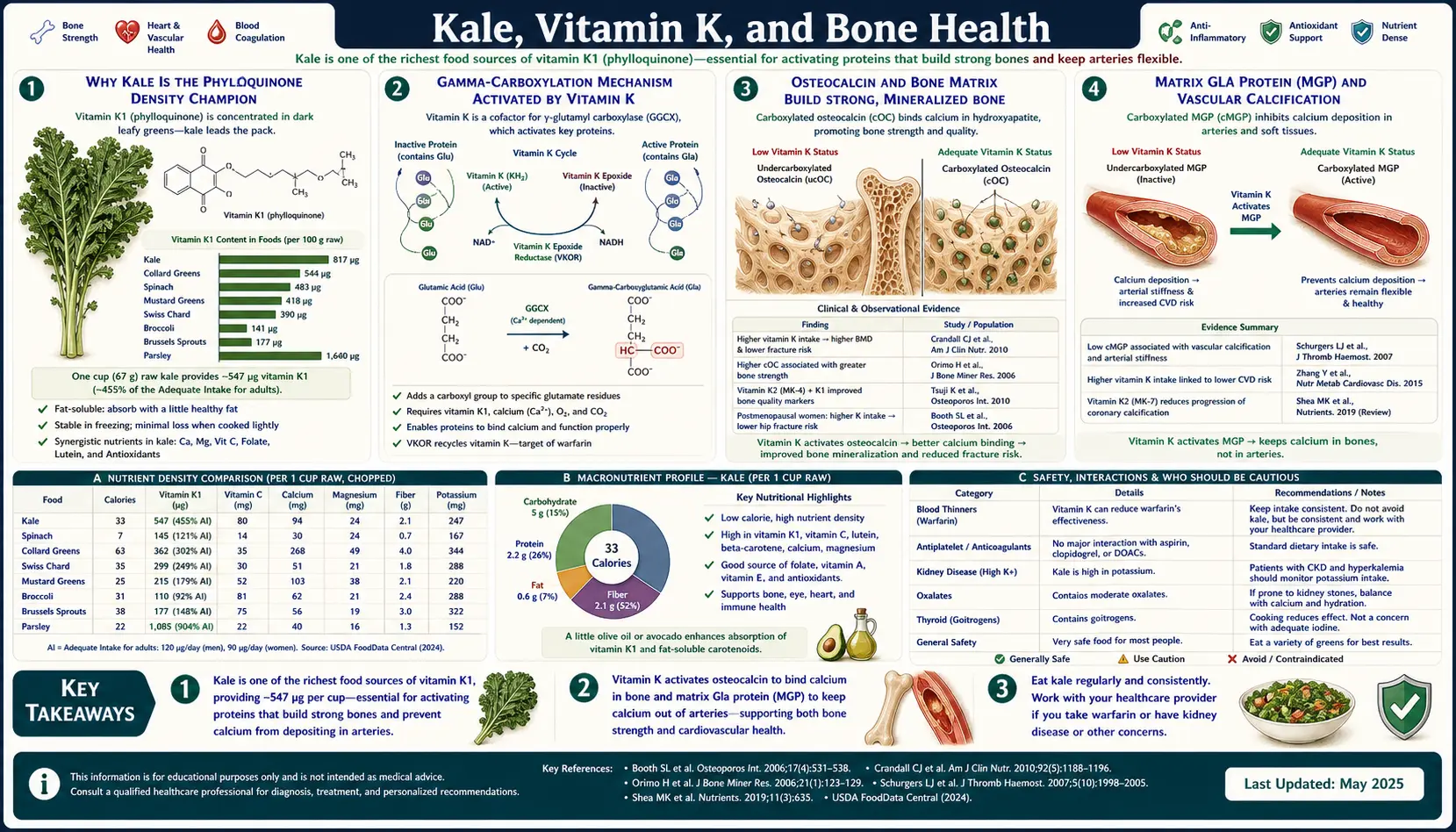
Kale is one of the dark-green vegetables that an analysis of the US FDA Total Diet Study found to be the top contributors to phylloquinone (Vitamin K1) intake in the American diet (Booth 1996). The USDA SR Legacy database lists raw kale at 389.6 micrograms of phylloquinone per 100 grams and boiled, drained kale at 418.5 micrograms per 100 grams. Vitamin K enables the enzyme gamma-glutamyl carboxylase to carboxylate selected glutamic acid residues on the vitamin K-dependent proteins (Linus Pauling Institute). Two of those proteins matter for the skeleton and the arteries: osteocalcin, a bone-matrix protein made by osteoblasts, and matrix Gla protein, an inhibitor of arterial calcification (Theuwissen 2012). High serum concentrations of under-carboxylated osteocalcin (ucOC) and low serum vitamin K have been associated with lower bone mineral density and a higher risk of hip fracture (Feskanich 1999; Szulc 1993; Vergnaud 1997), while trials that gave vitamin K are mixed (Mott 2019). This deep-dive covers the biochemistry, the cohort studies and trials, the K1-to-MK-4 conversion in tissues, and what the research reports about warfarin and dietary vitamin K.
Table of Contents
- Kale as a Phylloquinone Source
- The Gamma-Carboxylation Mechanism
- Osteocalcin and Bone Matrix
- Matrix Gla Protein and Vascular Calcification
- K1 vs K2 (MK-4 / MK-7): Conversion in Tissues
- Hip-Fracture Epidemiology and Intervention Data
- The Warfarin Interaction and Dietary Vitamin K
- What Studies Report About Intake and Absorption
- Cautions and Drug Interactions
- Key Research Papers
- Connections
- Featured Videos
Kale as a Phylloquinone Source
Phylloquinone (Vitamin K1) is made by plants and is the predominant form of vitamin K in the diet; green leafy vegetables and some plant oils are major contributors (Linus Pauling Institute). An analysis of the US FDA Total Diet Study found that dark-green vegetables were the top contributors to phylloquinone intake in the American diet, with the fats and oils added to mixed dishes and desserts also important, and that the share of phylloquinone coming from vegetables increased with age (Booth 1996).
The USDA SR Legacy database lists raw kale at 389.6 micrograms of phylloquinone per 100 grams and boiled, drained kale at 418.5 micrograms per 100 grams; its household measure for raw kale is 1 cup = 21 grams. Boiled leafy greens in the same database include spinach at 493.6 micrograms, collards at 406.6 micrograms and Swiss chard at 327.3 micrograms per 100 grams, and raw spinach (482.9), raw collards (437.1) and raw Swiss chard (830) are listed in the same range or higher, so kale is one of several greens in this range rather than the single richest. The Kale Nutrients page lists the rest of its nutrient profile.
In 2001 the US Food and Nutrition Board of the Institute of Medicine set an Adequate Intake (AI) for Vitamin K of 120 micrograms a day for men and 90 micrograms a day for women aged 19 and older, based on phylloquinone intakes in healthy individuals; menaquinone intakes were not considered. The Linus Pauling Institute notes that it is not clear whether the AI is enough to optimize the gamma-carboxylation of the vitamin K-dependent proteins in bone. The authors of the Nurses' Health Study analysis concluded that their data support the suggestion for a reassessment of Vitamin K requirements based on bone health and blood coagulation (Feskanich 1999).
The Gamma-Carboxylation Mechanism
Vitamin K-dependent proteins need carboxylation of certain glutamate (Glu) residues, which become gamma-carboxyglutamate (Gla) residues, for their biological functions. The enzymes involved are gamma-glutamyl carboxylase (GGCX), vitamin K epoxide reductase (VKOR) and a vitamin K reductase not yet identified; because vitamin K is hydrophobic, they are thought to be integral membrane proteins of the endoplasmic reticulum (Tie & Stafford 2016). The ability to bind calcium ions is what the vitamin K-dependent clotting factors need for their activation (Linus Pauling Institute).
The mechanism is a cycle. Reduced Vitamin K (the hydroquinone form, KH2) is oxidized to Vitamin K epoxide (KO), and this reaction enables GGCX to carboxylate the target residues; KO is then reduced back to the quinone and on to the hydroquinone, with VKOR catalysing the first of these steps (Linus Pauling Institute). The VKOR complex recycles vitamin K 2,3-epoxide to vitamin K hydroquinone, and its gene, VKORC1, encodes a small transmembrane protein of the endoplasmic reticulum (Rost 2004). The cycle allows a small amount of Vitamin K to be reused many times, which decreases the dietary requirement (Linus Pauling Institute).
Coumarin anticoagulants such as warfarin inhibit VKOR (Rost 2004; Li 2004), which prevents vitamin K recycling (Linus Pauling Institute). The intended effect is on the blood coagulation factors, but the inhibition is not restricted to them: vitamin K antagonists also reduce the synthesis of functional extra-hepatic vitamin K-dependent proteins, and vascular calcification is one of the effects of these drugs revealed more recently (Willems 2014).
Seventeen Vitamin K-dependent (VKD) proteins had been identified by 2012; osteocalcin, matrix Gla protein and possibly Gla-rich protein (GRP) inhibit soft-tissue calcification and need vitamin K-dependent carboxylation for their activity (Theuwissen 2012). The VKD proteins include the coagulation factors, which are made in the liver, and the anticoagulant proteins C, S and Z; Gas6, a cell-growth regulation factor found throughout the nervous system and in the heart, lungs, stomach, kidneys and cartilage; and GRP and periostin, which are also made in bone, where their roles are still unclear (Linus Pauling Institute).
Osteocalcin and Bone Matrix
Osteocalcin (also called bone Gla protein) is made by osteoblasts, and its synthesis is regulated by calcitriol, the active form of Vitamin D; its calcium-binding capacity requires the vitamin K-dependent gamma-carboxylation of three glutamic acid residues (Linus Pauling Institute). Those three Gla residues are critical for its structure, which appears to regulate the maturation of bone mineral (Gundberg 2012), and the carboxylated form regulates the size and shape of hydroxyapatite (Booth 2013).
In humans, the percentage of circulating osteocalcin that is not gamma-carboxylated (percent ucOC) is used as a biomarker of Vitamin K status; when ucOC is not corrected for total osteocalcin, the measure is confounded by osteoblast activity independent of Vitamin K (Gundberg 2012). A review of how status is measured notes that the under-carboxylated fractions of three Vitamin K-dependent proteins can be measured in blood, change with Vitamin K supplementation and are only modestly correlated with each other, and that no single biomarker is considered a gold standard for Vitamin K status (Shea & Booth 2016). In 195 elderly institutionalized French women, baseline ucOC was higher in the 15 who went on to have a hip fracture during 18 months of follow-up (Szulc 1993). In the EPIDOS study of women over 75, ucOC in the highest quartile was associated with hip fracture (odds ratio 1.9; 95% CI 1.2–3.0), and still predicted it after adjustment for femoral neck bone density and gait speed (odds ratio 1.8), whereas total osteocalcin did not (Vergnaud 1997). A review notes that observational studies using percent ucOC led to the conclusion that Vitamin K insufficiency leads to age-related bone loss, but that clinical trials do not provide overall support for the suggestion that supplementing the general population will reduce bone loss or fracture risk (Gundberg 2012).
Two large US cohorts reported an inverse association between dietary Vitamin K intake and hip fracture: the Nurses' Health Study (Feskanich 1999) and the Framingham Heart Study (Booth 2000), both described in the hip-fracture section below. In the Nurses' Health Study the estimates did not change when calcium and Vitamin D intakes were added to the models. In Framingham, Vitamin K intake was not associated with bone mineral density. These are observational associations; they do not show that Vitamin K intake itself caused the difference.
The broader bone-health picture — calcium, Vitamin D3, magnesium and the K2 / D3 interaction — is covered on the Osteoporosis page and the Vitamin D3 page.
Matrix Gla Protein and Vascular Calcification
The second major extra-hepatic Vitamin K-dependent protein is matrix Gla protein (MGP). MGP is made by vascular smooth muscle cells and is the most important inhibitor of arterial mineralization currently known (Theuwissen 2012); a review by Schurgers, Cranenburg and Vermeer describes it as generally accepted to be a potent inhibitor of arterial calcification that needs Vitamin K (Schurgers 2008). Vascular calcification is associated with cardiovascular illness and death (Elango 2021).
The extra-hepatic Gla proteins are only partly carboxylated in the healthy adult population. Circulating dephospho-uncarboxylated MGP (dp-ucMGP) has been found to predict cardiovascular risk and mortality, and total uncarboxylated MGP to be associated with the extent of arterial calcification (Theuwissen 2012). The direct oral anticoagulants (DOACs) act on clotting factors directly: dabigatran inhibits thrombin (factor IIa), and apixaban, edoxaban and rivaroxaban inhibit factor Xa (Hindley 2023). A 2021 review reports that retrospective cohorts, observational studies and randomized trials have found slower progression of vascular calcification with several DOACs than with warfarin (Elango 2021).
For the form of Vitamin K that kale supplies, the population data are mixed. In the Rotterdam Study (4,807 adults with no history of myocardial infarction at baseline, followed to 2000), higher dietary menaquinone (K2) intake was associated with lower coronary heart disease mortality, all-cause mortality and severe aortic calcification, but phylloquinone (K1) intake was not related to any of these outcomes (Geleijnse 2004). The cardiovascular role of micronutrients is covered on the Atherosclerosis page.
K1 vs K2 (MK-4 / MK-7): Conversion in Tissues
Vitamin K2 is a family of menaquinones named MK-n for the number of 5-carbon units in the side chain (MK-2 to MK-13). Most menaquinones are made by bacteria and are found in fermented foods and animal products; MK-4 is the only menaquinone not produced by bacteria, is found in dairy products and some meats, and is also converted in tissues from other dietary forms, including phylloquinone; natto, soybeans fermented by Bacillus subtilis natto, is rich in MK-7 (Linus Pauling Institute). In six healthy men given K1, MK-4 and MK-9 together, all three were carried mainly in the triacylglycerol-rich lipoproteins, which are cleared mainly by the liver, during the first 4 hours; unlike K1, both menaquinones were also found in low-density lipoprotein, and MK-4 in high-density lipoprotein, which the authors proposed explains the wider distribution of menaquinones outside the liver (Schurgers & Vermeer 2002). A comparison of K1 and natto-derived MK-7 supplements found that MK-7 has a very long circulating half-life, giving more stable blood levels and a 7- to 8-fold accumulation during prolonged intake, and induced more complete osteocalcin carboxylation (Schurgers 2007).
The body also makes MK-4 from K1. MK-4 is present throughout extra-hepatic tissues, with particularly high concentrations in the brain, kidney and pancreas of humans and rats, and phylloquinone has consistently been shown to be converted to MK-4 — either directly in tissues or via menadione followed by prenylation. In 2010 Nakagawa and colleagues identified the human enzyme that makes MK-4, UBIAD1, which is located in the endoplasmic reticulum and expressed in several mouse tissues; its MK-4 synthesis was not affected by warfarin (Nakagawa 2010). The Vitamin K page sets out the broader K1 / K2 evidence: Vitamin K page.
Western trials of Vitamin K and bone have given different results. A Dutch trial gave 244 healthy postmenopausal women 180 micrograms of MK-7 a day or placebo for 3 years: MK-7 improved Vitamin K status (the ucOC/cOC ratio), reduced the age-related decline in bone mineral content and density at the lumbar spine and femoral neck, but not at the total hip, and favourably affected bone strength (Knapen 2013). Two larger Western trials found no effect on bone density. In the Canadian ECKO trial, 440 postmenopausal women with osteopenia took 5 mg a day of Vitamin K1 or placebo for 2 to 4 years; bone density did not differ, and fewer women in the Vitamin K group had clinical fractures (9 versus 20), but the trial was not powered for fractures (Cheung 2008). In a Norwegian trial, 334 healthy women 1 to 5 years after menopause took 360 micrograms a day of MK-7, given as natto capsules, or placebo for 12 months; ucOC fell, but bone loss did not differ at the total hip or any other site (Emaus 2010). The 2019 meta-analysis of 36 trials of oral Vitamin K concluded that for postmenopausal or osteoporotic patients there is no evidence that Vitamin K affects bone mineral density or vertebral fractures, and that it may reduce clinical fractures but the evidence is insufficient to confirm this (Mott 2019). In that review the odds of any clinical fracture were lower with Vitamin K (OR 0.72; 95% CI 0.55–0.95), which became 0.76 (0.58–1.01) when restricted to trials at low risk of bias, and vertebral fractures did not differ (OR 0.96; 0.83–1.11) (Mott 2019); a 2020 correction adjusted every estimate that had included the Yamaguchi Osteoporosis Prevention Study (Mott 2020 correction).
Hip-Fracture Epidemiology and Intervention Data
The clinical evidence connecting dietary Vitamin K to hip fracture comes mainly from prospective cohorts, plus trials of Vitamin K given as a supplement or drug:
- Nurses' Health Study (Feskanich 1999) — 72,327 women aged 38–63, followed for 10 years, with 270 hip fractures. Women in quintiles 2–5 of Vitamin K intake had a lower age-adjusted relative risk of hip fracture (RR 0.70; 95% CI 0.53–0.93) than women in the lowest quintile (below 109 micrograms a day); risk did not decrease further between quintiles 2 and 5. Lettuce was the food that contributed most to Vitamin K intake, and eating it one or more times a day (versus once a week or less) was associated with a lower risk (RR 0.55; 95% CI 0.40–0.78).
- Framingham Heart Study (Booth 2000) — 335 men and 553 women (average age 75) whose hip fractures were recorded from 1988 to 1995. People in the highest quartile of Vitamin K intake (median 254 micrograms a day) had a lower fully adjusted relative risk of hip fracture (RR 0.35; 95% CI 0.13–0.94) than those in the lowest quartile (median 56 micrograms a day). Vitamin K intake was not associated with bone mineral density in men or women.
- Japanese MK-4 trials — MK-4 (menatetrenone) has been tested in Japan at pharmacological doses, in milligrams rather than the micrograms found in food. In an open-label trial, 241 osteoporotic patients received 45 mg a day or no treatment for two years, and clinical fractures were more frequent in the untreated group (Shiraki 2000). In the largest menatetrenone trial, the open-label OF study (2,193 women on calcium alone, 2,185 on calcium plus menatetrenone), new vertebral fractures over 36 months, the primary endpoint, did not differ significantly, and the lower 48-month rate of new clinical fractures with menatetrenone was not significant (Inoue 2009). A 2006 meta-analysis pooled the 7 randomized trials that reported fracture data — all Japanese, all using menaquinone — and reported lower odds of vertebral, hip and nonvertebral fractures (Cockayne 2006). In 2018 the journal published a notice titled “Caution of Conclusions of a Meta-analysis Including Problematic Trials” (2018 notice), and one of the review's authors published a caution to readers that it had included problematic trials (Torgerson 2018), so its pooled figures are not repeated here. Concerns were later raised about the integrity of the Yamaguchi Osteoporosis Prevention Study (YOPS; Avenell 2020), and the YOPS report was retracted in 2025 (Ishida 2004). Other Vitamin K2 bone papers from one Japanese author group have also been retracted: two menatetrenone fracture trials in elderly patients with Alzheimer's disease (Sato 2005, retracted 2018; Sato 2011, retracted because of scientific misconduct) and two reviews of Vitamin K2 or menatetrenone for osteoporosis (Iwamoto 2004, retracted in 2021 because its text, data and some figures came from sources retracted or under investigation; Iwamoto 2013, retracted 2019). None of these retracted papers is relied on here; they are listed, with their notices, in the Key Research Papers. The 2019 update, written after the integrity of some of the earlier evidence had been questioned, did not confirm a fracture benefit (Mott 2019; see the section above).
No randomized trial of eating kale or other green leafy vegetables with fracture as the outcome was found in PubMed. The case for dietary Vitamin K and bone therefore rests on the cohort associations and the mechanistic data on osteocalcin carboxylation; the trial evidence for supplements is mixed.
The Warfarin Interaction and Dietary Vitamin K
The best-known clinical question about kale is its interaction with warfarin and other vitamin K antagonists. The mechanism is direct: warfarin inhibits VKORC1, blocking Vitamin K recycling. Large quantities of dietary or supplemental Vitamin K can overcome the anticoagulant effect of vitamin K antagonists (Linus Pauling Institute). A study of K1 and MK-7 supplements noted that MK-7 preparations supplying 50 micrograms a day or more may interfere with oral anticoagulant treatment in a clinically relevant way (Schurgers 2007).
For many years patients starting a vitamin K antagonist were discouraged from eating Vitamin K-rich foods such as green leafy vegetables. A 2016 systematic review (2 dietary intervention trials and 9 observational studies) found conflicting evidence on how dietary Vitamin K affects the coagulation response; an effect may be detectable only at high intakes (above 150 micrograms a day). The reviewers concluded that the evidence does not support advice to change dietary habits when starting a vitamin K antagonist, that restricting dietary Vitamin K does not seem to be a valid way to improve anticoagulation quality, and that keeping dietary habits stable, without wide changes in Vitamin K intake, may be more relevant (Violi 2016).
The Linus Pauling Institute reports that experts now advise a reasonably constant dietary intake of Vitamin K that meets current dietary recommendations (90–120 micrograms a day) for people taking vitamin K antagonists, and that large fluctuations in intake might interfere with adjustment of the anticoagulant dose. Decisions about anticoagulants and diet belong with the prescribing clinician.
The direct oral anticoagulants work differently: dabigatran inhibits thrombin and apixaban, edoxaban and rivaroxaban inhibit factor Xa (Hindley 2023), rather than blocking Vitamin K recycling.
What Studies Report About Intake and Absorption
- Intakes in the cohorts — in the Nurses' Health Study the lower-risk groups were all women above 109 micrograms a day (Feskanich 1999); in Framingham the highest quartile had a median intake of 254 micrograms a day (Booth 2000). In the FDA Total Diet Study (1987–88 survey data), 25- to 30-year-old women and men consumed less than the Vitamin K RDA then in force, formula-fed infants six times more, and all other groups amounts within the recommended intakes but below 90 micrograms a day (Booth 1996).
- Absorption from vegetables — in five volunteers given 1 mg of phylloquinone, blood levels after spinach were far lower than after a pharmaceutical phylloquinone preparation: 7.5-fold lower when the spinach was eaten with butter and 24.3-fold lower without added fat; the authors concluded that phylloquinone bound in plant membranes is poorly absorbed and that absorption may depend on fat (Gijsbers 1996). In a second study, absorption from a 500-microgram tablet was higher than from 150 grams of raw spinach supplying 495 micrograms; absorption from fresh spinach, broccoli and romaine lettuce did not differ, absorption from fresh and cooked broccoli did not differ, and romaine eaten with a meal containing 30% or 45% of energy as fat made no difference (Garber 1999).
- Supplements — the Western bone trials used 180 micrograms of MK-7 a day for 3 years (Knapen 2013), 360 micrograms of MK-7 a day for 1 year (Emaus 2010) and 5 mg of Vitamin K1 a day for 2 to 4 years (Cheung 2008); a Japanese open-label MK-4 trial used 45 mg a day (Shiraki 2000). The meta-analysis evidence on supplements and fractures is summarised above (Mott 2019).
- Calcium and Vitamin D — osteocalcin synthesis is regulated by calcitriol, the active form of Vitamin D (Linus Pauling Institute); calcium and Vitamin D have their own pages (Calcium, Vitamin D3).
- Warfarin — see the warfarin section above: the 2016 systematic review points to stable intake rather than restriction (Violi 2016).
Cautions and Drug Interactions
- Warfarin and other vitamin K antagonists — the main interaction, discussed above; some studies found a negative correlation between Vitamin K intake and changes in the INR (Violi 2016)
- Broad-spectrum antibiotics — a review of antibiotic-associated hypoprothrombinemia found that the reports usually implicated broad-spectrum antibiotics or several antibiotics together, that proposed mechanisms included eradication of gut bacteria, and that it was rare in patients without complicating conditions (Schentag 1987)
- Cholestyramine and other bile-acid sequestrants — these cholesterol-lowering drugs, as well as orlistat, mineral oil and the fat substitute olestra, may interfere with fat absorption and affect the absorption of fat-soluble vitamins, including Vitamin K (Linus Pauling Institute)
- Anticonvulsants and anti-tuberculosis drugs in pregnancy — prescribing anticonvulsants (for example phenytoin), anti-tuberculosis drugs (rifampin, isoniazid) or vitamin K antagonists to pregnant or breastfeeding women may place the newborn at increased risk of Vitamin K deficiency (Linus Pauling Institute)
- Advanced chronic kidney disease — a high prevalence of subclinical Vitamin K deficiency is reported in end-stage kidney disease; in a 12-month pilot trial in 86 hemodialysis patients, 10 mg of phylloquinone three times a week lowered dp-ucMGP by 86% but did not change the progression of coronary artery calcification (Holden 2023)
- History of kidney stones — oxalate content and large raw-green intakes are covered on the oxalate page
- Thyroid — the goitrogen question for brassicas such as kale is covered on the oxalate and cooking page
Key Research Papers
- Feskanich D, Weber P, Willett WC, Rockett H, Booth SL, Colditz GA (1999). Vitamin K intake and hip fractures in women: a prospective study. American Journal of Clinical Nutrition 69(1): 74–79 — PubMed PMID: 9925126 · Search PubMed
- Booth SL, Tucker KL, Chen H, Hannan MT, Gagnon DR, Cupples LA, Wilson PW, Ordovas J, Schaefer EJ, Dawson-Hughes B, Kiel DP (2000). Dietary vitamin K intakes are associated with hip fracture but not with bone mineral density in elderly men and women. American Journal of Clinical Nutrition 71(5): 1201–1208 — PubMed PMID: 10799384 · Search PubMed
- Cockayne S, Adamson J, Lanham-New S, Shearer MJ, Gilbody S, Torgerson DJ (2006). Vitamin K and the prevention of fractures: systematic review and meta-analysis of randomized controlled trials. Archives of Internal Medicine 166(12): 1256–1261 — PubMed PMID: 16801507 — Expression of concern (2018 notice, listed as its own entry below)
- JAMA Internal Medicine (2018). Caution of Conclusions of a Meta-analysis Including Problematic Trials. JAMA Internal Medicine 178(6): 875–876 (notice on Cockayne 2006, PMID 16801507) — PubMed PMID: 29582046
- Torgerson DJ (2018). Caution to Readers About Systematic Review on Vitamin K and Prevention of Fractures That Included Problematic Trials. JAMA Internal Medicine 178(6): 863–864 — PubMed PMID: 29582044
- Schurgers LJ, Vermeer C (2002). Differential lipoprotein transport pathways of K-vitamins in healthy subjects. Biochimica et Biophysica Acta 1570(1): 27–32 — PubMed PMID: 11960685 · Search PubMed
- Nakagawa K, Hirota Y, Sawada N, Yuge N, Watanabe M, Uchino Y, Okuda N, Shimomura Y, Suhara Y, Okano T (2010). Identification of UBIAD1 as a novel human menaquinone-4 biosynthetic enzyme. Nature 468(7320): 117–121 — PubMed PMID: 20953171 · Search PubMed
- Schurgers LJ, Cranenburg EC, Vermeer C (2008). Matrix Gla-protein: the calcification inhibitor in need of vitamin K. Thrombosis and Haemostasis 100(4): 593–603 — PubMed PMID: 18841280
- Knapen MH, Drummen NE, Smit E, Vermeer C, Theuwissen E (2013). Three-year low-dose menaquinone-7 supplementation helps decrease bone loss in healthy postmenopausal women. Osteoporosis International 24(9): 2499–2507 — PubMed PMID: 23525894
- Booth SL, Centi A, Smith SR, Gundberg C (2013). The role of osteocalcin in human glucose metabolism: marker or mediator? Nature Reviews Endocrinology 9(1): 43–55 — PubMed PMID: 23147574 · Search PubMed
- Geleijnse JM, Vermeer C, Grobbee DE, Schurgers LJ, Knapen MH, van der Meer IM, Hofman A, Witteman JC (2004). Dietary intake of menaquinone is associated with a reduced risk of coronary heart disease: the Rotterdam Study. Journal of Nutrition 134(11): 3100–3105 — PubMed PMID: 15514282
- Shea MK, Booth SL (2016). Concepts and Controversies in Evaluating Vitamin K Status in Population-Based Studies. Nutrients 8(1): 8 — PubMed PMID: 26729160 · Search PubMed
- Booth SL, Pennington JA, Sadowski JA (1996). Food sources and dietary intakes of vitamin K-1 (phylloquinone) in the American diet: data from the FDA Total Diet Study. Journal of the American Dietetic Association 96(2): 149–154 — PubMed PMID: 8557941 · Search PubMed
- Vermeer C, Joyce I, Theuwissen E (2017). Vitamin K, an underestimated vitamin. Network Health Digest (review) PubMed: Vermeer reviews (editorial note: this item was not found in PubMed or Crossref and is not relied on in the text)
- Mott A, Bradley T, Wright K, Cockayne ES, Shearer MJ, Adamson J, Lanham-New SA, Torgerson DJ (2019). Effect of vitamin K on bone mineral density and fractures in adults: an updated systematic review and meta-analysis of randomised controlled trials. Osteoporosis International 30(8): 1543–1559 — PubMed PMID: 31076817 (correction 2020, adjusting estimates that included the Yamaguchi Osteoporosis Prevention Study: PubMed PMID: 32965511)
- Schurgers LJ, Teunissen KJ, Hamulyák K, Knapen MH, Vik H, Vermeer C (2007). Vitamin K-containing dietary supplements: comparison of synthetic vitamin K1 and natto-derived menaquinone-7. Blood 109(8): 3279–3283 — PubMed PMID: 17158229
- Violi F, Lip GY, Pignatelli P, Pastori D (2016). Interaction between dietary vitamin K intake and anticoagulation by vitamin K antagonists: is it really true? A systematic review. Medicine (Baltimore) 95(10): e2895 — PubMed PMID: 26962786
- Gijsbers BL, Jie KS, Vermeer C (1996). Effect of food composition on vitamin K absorption in human volunteers. British Journal of Nutrition 76(2): 223–229 — PubMed PMID: 8813897
- Garber AK, Binkley NC, Krueger DC, Suttie JW (1999). Comparison of phylloquinone bioavailability from food sources or a supplement in human subjects. Journal of Nutrition 129(6): 1201–1203 — PubMed PMID: 10356087
- Cheung AM, Tile L, Lee Y, Tomlinson G, Hawker G, Scher J, Hu H, Vieth R, Thompson L, Jamal S, Josse R (2008). Vitamin K supplementation in postmenopausal women with osteopenia (ECKO trial): a randomized controlled trial. PLoS Medicine 5(10): e196 (correction: PLoS Med 5(12): e247) — PubMed PMID: 18922041
- Emaus N, Gjesdal CG, Almås B, Christensen M, Grimsgaard AS, Berntsen GK, Salomonsen L, Fønnebø V (2010). Vitamin K2 supplementation does not influence bone loss in early menopausal women: a randomised double-blind placebo-controlled trial. Osteoporosis International 21(10): 1731–1740 — PubMed PMID: 19937427
- Shiraki M, Shiraki Y, Aoki C, Miura M (2000). Vitamin K2 (menatetrenone) effectively prevents fractures and sustains lumbar bone mineral density in osteoporosis. Journal of Bone and Mineral Research 15(3): 515–521 — PubMed PMID: 10750566
- Inoue T, Fujita T, Kishimoto H, Makino T, Nakamura T, Nakamura T, Sato T, Yamazaki K (2009). Randomized controlled study on the prevention of osteoporotic fractures (OF study): a phase IV clinical study of 15-mg menatetrenone capsules. Journal of Bone and Mineral Metabolism 27(1): 66–75 — PubMed PMID: 19082528
- Avenell A, Grey A, Gamble GD, Bolland MJ (2020). Concerns about the integrity of the Yamaguchi Osteoporosis Prevention Study (YOPS) report, Am J Med. 2004;117:549-555. American Journal of Medicine 133(6): e311–e314 — PubMed PMID: 32532372
- Ishida Y, Kawai S (2004). Comparative efficacy of hormone replacement therapy, etidronate, calcitonin, alfacalcidol, and vitamin K in postmenopausal women with osteoporosis: the Yamaguchi Osteoporosis Prevention Study. American Journal of Medicine 117(8): 549–555 — PubMed PMID: 15465502 — Retracted (retraction notice: PubMed PMID: 40222753)
- Sato Y, Kanoko T, Satoh K, Iwamoto J (2005). Menatetrenone and vitamin D2 with calcium supplements prevent nonvertebral fracture in elderly women with Alzheimer's disease. Bone 36(1): 61–68 — PubMed PMID: 15664003 — Retracted (retraction notice: PubMed PMID: 29150013)
- Sato Y, Honda Y, Umeno K, Hayashida N, Iwamoto J, Takeda T, Matsumoto H (2011). The prevention of hip fracture with menatetrenone and risedronate plus calcium supplementation in elderly patients with Alzheimer disease: a randomized controlled trial. Kurume Medical Journal 57(4): 117–124 — PubMed PMID: 21778673 — Retracted (retraction notice: PubMed PMID: 28408729)
- Iwamoto J, Takeda T, Sato Y (2004). Effects of vitamin K2 on osteoporosis. Current Pharmaceutical Design 10(21): 2557–2576 — PubMed PMID: 15320745 — Retracted (retraction notice: PubMed PMID: 34264184)
- Iwamoto J, Sato Y (2013). Menatetrenone for the treatment of osteoporosis. Expert Opinion on Pharmacotherapy 14(4): 449–458 — PubMed PMID: 23346882 — Retracted (retraction notice: PubMed PMID: 31437064)
- Gundberg CM, Lian JB, Booth SL (2012). Vitamin K-dependent carboxylation of osteocalcin: friend or foe? Advances in Nutrition 3(2): 149–157 — PubMed PMID: 22516722
- Szulc P, Chapuy MC, Meunier PJ, Delmas PD (1993). Serum undercarboxylated osteocalcin is a marker of the risk of hip fracture in elderly women. Journal of Clinical Investigation 91(4): 1769–1774 — PubMed PMID: 8473517
- Vergnaud P, Garnero P, Meunier PJ, Bréart G, Kamihagi K, Delmas PD (1997). Undercarboxylated osteocalcin measured with a specific immunoassay predicts hip fracture in elderly women: the EPIDOS Study. Journal of Clinical Endocrinology and Metabolism 82(3): 719–724 — PubMed PMID: 9062471
- Theuwissen E, Smit E, Vermeer C (2012). The role of vitamin K in soft-tissue calcification. Advances in Nutrition 3(2): 166–173 — PubMed PMID: 22516724
- Tie JK, Stafford DW (2016). Structural and functional insights into enzymes of the vitamin K cycle. Journal of Thrombosis and Haemostasis 14(2): 236–247 — PubMed PMID: 26663892
- Rost S, Fregin A, Ivaskevicius V, Conzelmann E, Hörtnagel K, Pelz HJ, Lappegard K, Seifried E, Scharrer I, Tuddenham EG, Müller CR, Strom TM, Oldenburg J (2004). Mutations in VKORC1 cause warfarin resistance and multiple coagulation factor deficiency type 2. Nature 427(6974): 537–541 — PubMed PMID: 14765194
- Li T, Chang CY, Jin DY, Lin PJ, Khvorova A, Stafford DW (2004). Identification of the gene for vitamin K epoxide reductase. Nature 427(6974): 541–544 — PubMed PMID: 14765195
- Willems BA, Vermeer C, Reutelingsperger CP, Schurgers LJ (2014). The realm of vitamin K dependent proteins: shifting from coagulation toward calcification. Molecular Nutrition & Food Research 58(8): 1620–1635 — PubMed PMID: 24668744
- Hindley B, Lip GYH, McCloskey AP, Penson PE (2023). Pharmacokinetics and pharmacodynamics of direct oral anticoagulants. Expert Opinion on Drug Metabolism & Toxicology 19(12): 911–923 — PubMed PMID: 37991392
- Elango K, Javaid A, Khetarpal BK, Ramalingam S, Kolandaivel KP, Gunasekaran K, Ahsan C (2021). The effects of warfarin and direct oral anticoagulants on systemic vascular calcification: a review. Cells 10(4): 773 — PubMed PMID: 33807457
- Holden RM, Booth SL, Zimmerman D, Moist L, Norman PA, Day AG, Menard A, Fu X, Shea MK, Babiolakis CS, Nolan R, Turner ME, Ward E, Kaufmann M, Adams MA, Heyland DK (2023). Inhibit progression of coronary artery calcification with vitamin K in hemodialysis patients (the iPACK-HD study): a randomized, placebo-controlled multi-center, pilot trial. Nephrology Dialysis Transplantation 38(3): 746–756 — PubMed PMID: 35641194
- Schentag JJ, Welage LS, Grasela TH, Adelman MH (1987). Determinants of antibiotic-associated hypoprothrombinemia. Pharmacotherapy 7(3): 80–86 — PubMed PMID: 3306622
- Linus Pauling Institute, Oregon State University. Vitamin K (Micronutrient Information Center; updated May 2022, reviewed July 2022) — lpi.oregonstate.edu/mic/vitamins/vitamin-K
PubMed Topic Searches
Connections
- All Food
- Kale (Main Page)
- Kale Benefits Hub
- Kale for Lutein/Eye Health
- Kale Glucosinolates and Cancer
- Kale Oxalates and Cooking
- Vitamin K (K1 and K2)
- Vitamin D3 (Calcium Partner)
- Calcium
- Magnesium
- Osteoporosis
- Atherosclerosis
- Spinach
- Broccoli
- Natto (MK-7 Source)
- Lab: Vitamin K Status (ucOC)
- History
- Nutrients