Kale — Benefits Deep Dive
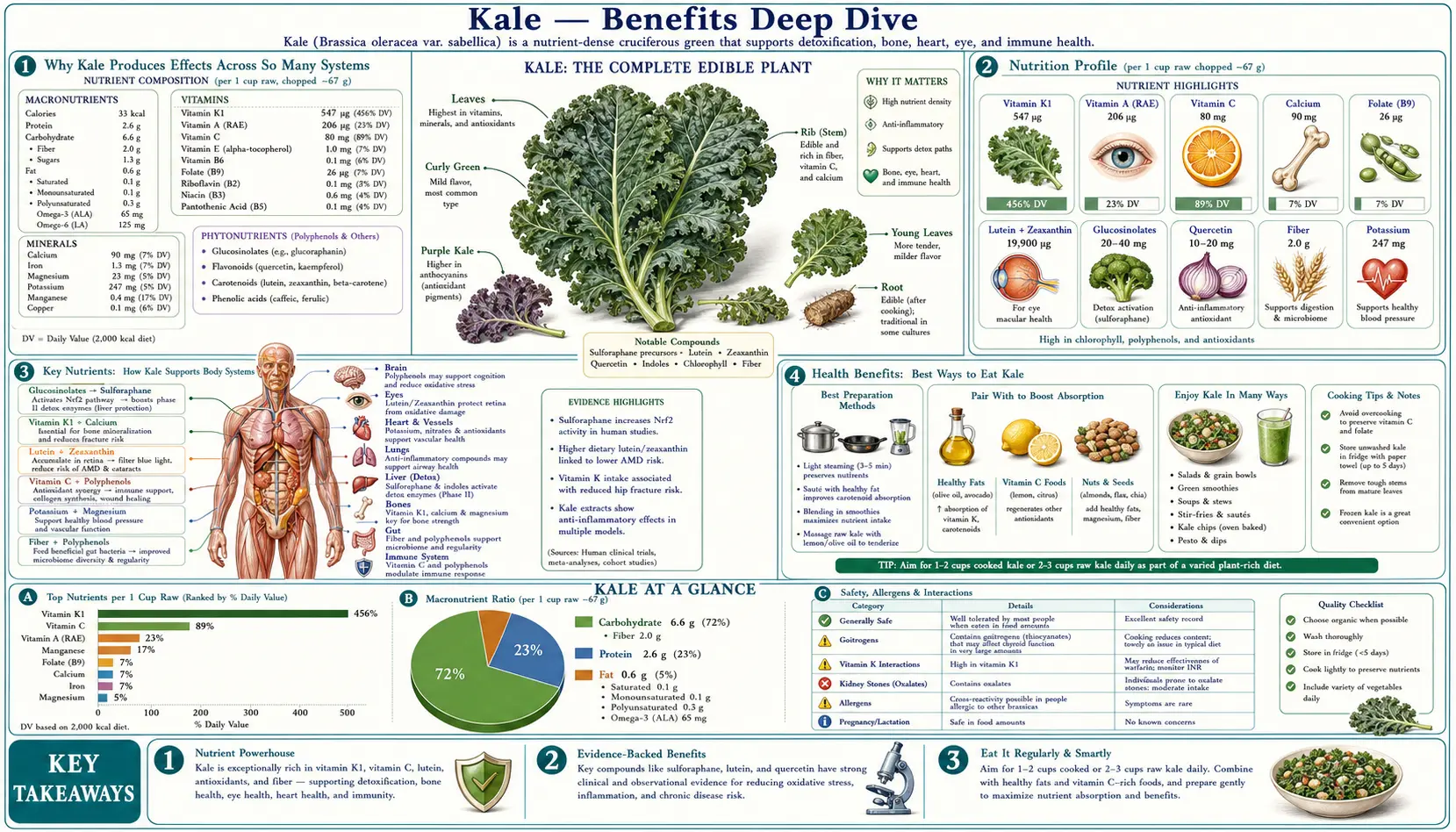
Kale (Brassica oleracea var. sabellica or var. acephala) is a cruciferous leafy green. The USDA SR Legacy database lists raw kale at 389.6 micrograms of phylloquinone (Vitamin K1) per 100 grams, and boiled, drained kale at 418.5 micrograms per 100 grams. The Daily Value for Vitamin K on US food labels is 120 micrograms (21 CFR 101.9), so 100 grams of raw kale supplies about 325% of the Daily Value (389.6 ÷ 120); the same database lists 93.4 milligrams of Vitamin C and 241 micrograms RAE of Vitamin A per 100 grams of raw kale. Four deep-dive pages below cover what the research reports on Vitamin K1 and bone, together with the warfarin interaction; lutein and zeaxanthin and the eye; glucosinolates and cancer; and oxalate, goitrogens and cooking.
Deep-Dive Articles
Vitamin K and Bone
Kale as one of several green leafy sources of phylloquinone (K1), the gamma-carboxylation of osteocalcin and matrix Gla protein, the Nurses' Health Study and Framingham hip-fracture associations, the conversion of K1 to MK-4 in tissues, what a 2016 systematic review reports about dietary Vitamin K and warfarin, and studies of how well phylloquinone is absorbed from vegetables.
Read the deep dive →Lutein and Eye Health
Lutein and zeaxanthin in leafy greens such as kale and spinach, macular pigment optical density (MPOD), the AREDS2 trial (no further reduction in progression to advanced AMD, and lutein/zeaxanthin proposed as a substitute for beta-carotene after more lung cancers in former smokers), the cataract cohort data, the LUNA supplement study, and dietary fat and carotenoid absorption.
Read the deep dive →Glucosinolates and Cancer
How the myrosinase enzyme released by chewing or chopping converts glucoraphanin to sulforaphane and glucobrassicin to indole-3-carbinol / DIM, the NRF2 pathway and Phase II enzymes, the broccoli-sprout research and how it compares with mature kale, estrogen metabolism, and the observational breast, prostate and colorectal cancer data.
Read the deep dive →Oxalates and Cooking
Kale's low oxalate content compared with spinach (in one absorption study, 0.01 g in 150 g of kale versus 1.27 g in 150 g of spinach), how dietary oxalate relates to calcium-oxalate kidney stones, the goitrogen question (goitrin and thiocyanate from glucosinolates and thyroid iodine uptake), and what studies report about blanching, steaming, boiling and sautéing.
Read the deep dive →Table of Contents
- Deep-Dive Articles
- Kale's Main Compound Groups and What Studies Report
- Research Papers: Vitamin K and Bone
- Research Papers: Lutein and Eye Health
- Research Papers: Glucosinolates and Cancer
- Research Papers: Oxalates, Goitrogens, and Cooking
- Research Papers: Cross-Cutting (Cardiovascular, Inflammation, Microbiome)
- External Authoritative Resources
- Connections
- Featured Videos
Kale's Main Compound Groups and What Studies Report
Kale is studied for four groups of compounds. The figures below come from the USDA SR Legacy database and from the papers listed under each heading further down the page; most of the human evidence is observational.
- Phylloquinone (Vitamin K1) — USDA SR Legacy lists 389.6 micrograms per 100 grams of raw kale and 418.5 micrograms per 100 grams boiled; other greens in the same database are in a similar range (raw spinach 482.9, raw collards 437.1 micrograms per 100 grams). Vitamin K mediates the gamma-carboxylation of several bone proteins, notably osteocalcin (Feskanich 1999). In the Nurses' Health Study (72,327 women, 270 hip fractures over 10 years), women in quintiles 2–5 of Vitamin K intake had a lower age-adjusted relative risk of hip fracture than women in the lowest quintile, below 109 micrograms a day (RR 0.70; 95% CI 0.53–0.93), and lettuce, the largest contributor to intake, eaten one or more times a day was associated with RR 0.55 (Feskanich 1999). In the Framingham Heart Study the highest quartile of intake (median 254 micrograms a day) had a fully adjusted relative risk of 0.35 (95% CI 0.13–0.94) against the lowest quartile (median 56 micrograms a day), with no association between Vitamin K intake and bone mineral density (Booth 2000). These are observational associations. In the ECKO trial, 5 mg a day of Vitamin K1 for 2 to 4 years did not change bone mineral density in 440 postmenopausal women with osteopenia; fewer women in the Vitamin K group had clinical fractures (9 versus 20), but the trial was not powered for fractures (Cheung 2008). In a kale-feeding study using carbon-13-labelled kale, the modelled bioavailability of phylloquinone from a 400 g serving eaten with 30 g of oil averaged 4.7% (Novotny 2010). The Vitamin K and bone page covers this in detail.
- Lutein and zeaxanthin — USDA SR Legacy lists 6.26 mg of lutein plus zeaxanthin per 100 grams of raw kale and 4.98 mg per 100 grams boiled; raw spinach is listed at 12.2 mg, raw collards at 4.32 mg and raw romaine at 2.31 mg per 100 grams. In the Nurses' Health Study, women in the highest quintile of lutein and zeaxanthin intake had a lower risk of cataract extraction than those in the lowest (RR 0.78; 95% CI 0.63–0.95), and more frequent intake of spinach and kale was associated with a moderate decrease in risk (Chasan-Taber 1999). In the AREDS2 trial (4,203 participants), adding 10 mg lutein and 2 mg zeaxanthin to the AREDS supplement formula did not further reduce progression to advanced age-related macular degeneration in the primary analysis (HR 0.90; 98.7% CI 0.76–1.07); more lung cancers occurred in the beta-carotene groups, mostly in former smokers, and the investigators concluded that lutein plus zeaxanthin could be an appropriate substitute for beta-carotene in the formula (AREDS2 2013). The lutein page covers macular pigment and the eye.
- Glucosinolates — sulfur compounds of the cabbage family that, when the plant is chewed or chopped, are broken down by the myrosinase enzyme into isothiocyanates such as sulforaphane, and into indoles. Sulforaphane was isolated from broccoli in 1992 as a potent inducer of Phase II detoxication enzymes in cultured mouse cells and mouse tissues (Zhang 1992). A food-composition review of published data found glucosinolate values for the same vegetable varying widely between studies (median 5.8-fold between minimum and maximum) and average losses of about 36% in cooking (McNaughton 2003). Three-day-old broccoli and cauliflower sprouts contained 10 to 100 times more glucoraphanin than the mature plants (Fahey 1997). In meta-analyses of observational studies, high versus low cruciferous-vegetable intake was associated with lower breast cancer risk (RR 0.85; 13 studies, 11 of them case-control; Liu & Lv 2013), lower prostate cancer risk overall (RR 0.90) but not in the cohort studies alone (RR 0.95; 95% CI 0.88–1.02; Liu 2012), and lower colon cancer risk (OR 0.84; Tse & Eslick 2014). See the glucosinolates and cancer page.
- Provitamin A carotenoids — USDA SR Legacy lists 2,873 micrograms of beta-carotene and 241 micrograms RAE of Vitamin A per 100 grams of raw kale. US food labels count 12 micrograms of dietary beta-carotene as 1 microgram RAE (21 CFR 101.9). The Vitamin A Benefits Hub covers Vitamin A in detail.
Some of the same compounds raise questions in particular situations. Warfarin: warfarin and other vitamin K antagonists work against Vitamin K, and patients have long been discouraged from eating Vitamin K-rich foods such as green leafy vegetables; a 2016 systematic review (2 dietary intervention trials and 9 observational studies) found conflicting evidence, with an effect on coagulation perhaps detectable only above about 150 micrograms a day, and concluded that the evidence does not support advice to change dietary habits when starting these drugs, that restricting dietary Vitamin K does not seem a valid way to improve anticoagulation, and that keeping intake stable may be more relevant (Violi 2016). Decisions about anticoagulants and diet belong with the prescribing clinician. Thyroid: some glucosinolates break down to goitrin and thiocyanate, which may decrease thyroid hormone production; a 2016 review reported that kale belonging to Brassica oleracea contains less than 10 micromoles of goitrin per 100-gram serving and can be considered of minimal risk, while collards, Brussels sprouts and some Russian kale (Brassica napus) contain enough goitrin to potentially decrease iodine uptake by the thyroid, and that thiocyanate from indole glucosinolates can be assumed to carry minimal risk (Felker 2016). Oxalate: kale is low in oxalate — in one absorption study 150 grams of kale contained 0.01 g of oxalic acid against 1.27 g in 150 grams of spinach (Storcksdieck genannt Bonsmann 2008), and in another 300 grams of kale contained 0.1 mmol of oxalate against 6.6 mmol in 300 grams of spinach (Bohn 2004). Calcium from labelled kale was absorbed at a fractional rate of 0.409, compared with 0.321 from milk in the same 11 women (Heaney & Weaver 1990). In nine vegetables tested, boiling reduced soluble oxalate by 30–87% and steaming by 5–53% (Chai & Liebman 2005). The oxalates and cooking page covers these questions.
Cholesterol: in a Korean study of 32 men with hypercholesterolemia who drank 150 mL of kale juice a day for 12 weeks, HDL cholesterol rose by 27% and LDL cholesterol fell by 10% from baseline; the abstract describes no control group (Kim 2008).
Research Papers: Vitamin K and Bone
- Feskanich D, Weber P, Willett WC, Rockett H, Booth SL, Colditz GA (1999). Vitamin K intake and hip fractures in women: a prospective study. Am J Clin Nutr 69(1): 74–9 — PubMed PMID: 9925126
- Booth SL, Tucker KL, Chen H, Hannan MT, Gagnon DR, Cupples LA, Wilson PW, Ordovas J, Schaefer EJ, Dawson-Hughes B, Kiel DP (2000). Dietary vitamin K intakes are associated with hip fracture but not with bone mineral density in elderly men and women. Am J Clin Nutr 71(5): 1201–8 — PubMed PMID: 10799384
- Cheung AM, Tile L, Lee Y, Tomlinson G, Hawker G, Scher J, Hu H, Vieth R, Thompson L, Jamal S, Josse R (2008). Vitamin K supplementation in postmenopausal women with osteopenia (ECKO trial): a randomized controlled trial. PLoS Med 5(10): e196 — PubMed PMID: 18922041
- Garber AK, Binkley NC, Krueger DC, Suttie JW (1999). Comparison of phylloquinone bioavailability from food sources or a supplement in human subjects. J Nutr 129(6): 1201–3 — PubMed PMID: 10356087
- Novotny JA, Kurilich AC, Britz SJ, Baer DJ, Clevidence BA (2010). Vitamin K absorption and kinetics in human subjects after consumption of 13C-labelled phylloquinone from kale. Br J Nutr 104(6): 858–62 — PubMed PMID: 20420753
- Violi F, Lip GY, Pignatelli P, Pastori D (2016). Interaction Between Dietary Vitamin K Intake and Anticoagulation by Vitamin K Antagonists: Is It Really True?: A Systematic Review. Medicine (Baltimore) 95(10): e2895 — PubMed PMID: 26962786
PubMed Topic Searches
- Vitamin K1 in kale and other leafy greens: USDA database analysis — PubMed: K1 content greens
- Osteocalcin gamma-carboxylation and bone matrix — PubMed: Osteocalcin carboxylation
- Matrix Gla protein and vascular calcification (Schurgers) — PubMed: Schurgers MGP
- Conversion of dietary K1 to MK-4 in extrahepatic tissues — PubMed: K1 to MK-4 conversion
- Kale and the Vitamin K-Vitamin D interaction at the calcium-balance level — PubMed: K x D interaction
- Subclinical Vitamin K deficiency assessment: under-carboxylated osteocalcin (ucOC) — PubMed: ucOC marker
Research Papers: Lutein and Eye Health
- Age-Related Eye Disease Study 2 Research Group (2013). Lutein + zeaxanthin and omega-3 fatty acids for age-related macular degeneration: the Age-Related Eye Disease Study 2 (AREDS2) randomized clinical trial. JAMA 309(19): 2005–15 — PubMed PMID: 23644932
- Trieschmann M, Beatty S, Nolan JM, Hense HW, Heimes B, Austermann U, Fobker M, Pauleikhoff D (2007). Changes in macular pigment optical density and serum concentrations of its constituent carotenoids following supplemental lutein and zeaxanthin: the LUNA study. Exp Eye Res 84(4): 718–28 — PubMed PMID: 17306793
- Chasan-Taber L, Willett WC, Seddon JM, Stampfer MJ, Rosner B, Colditz GA, Speizer FE, Hankinson SE (1999). A prospective study of carotenoid and vitamin A intakes and risk of cataract extraction in US women. Am J Clin Nutr 70(4): 509–16 — PubMed PMID: 10500020
- Perry A, Rasmussen H, Johnson EJ (2009). Xanthophyll (lutein, zeaxanthin) content in fruits, vegetables and corn and egg products. Journal of Food Composition and Analysis 22(1): 9–15 — doi:10.1016/j.jfca.2008.07.006 (not indexed in PubMed; its figures are not used on this page)
PubMed Topic Searches
- Macular pigment optical density (MPOD) and dietary lutein intake — PubMed: MPOD and diet
- Blue-light filtering and macular protection — PubMed: Blue-light filter
- Cooking and dietary fat increase lutein bioavailability — PubMed: Lutein absorption
- Lutein and cognitive function in older adults — PubMed: Lutein and cognition
- Carotenoid status biomarkers: serum lutein and skin reflectance — PubMed: Carotenoid biomarkers
- Macular pigment optical density and AMD risk (topic search; a 2013 Beatty paper by this description was not found) — PubMed: Beatty MPOD
Research Papers: Glucosinolates and Cancer
- Zhang Y, Talalay P, Cho CG, Posner GH (1992). A major inducer of anticarcinogenic protective enzymes from broccoli: isolation and elucidation of structure. Proc Natl Acad Sci U S A 89(6): 2399–403 — PubMed PMID: 1549603
- Fahey JW, Zhang Y, Talalay P (1997). Broccoli sprouts: an exceptionally rich source of inducers of enzymes that protect against chemical carcinogens. Proc Natl Acad Sci U S A 94(19): 10367–72 — PubMed PMID: 9294217
- McNaughton SA, Marks GC (2003). Development of a food composition database for the estimation of dietary intakes of glucosinolates, the biologically active constituents of cruciferous vegetables. Br J Nutr 90(3): 687–97 — PubMed PMID: 13129476
- Liu X, Lv K (2013). Cruciferous vegetables intake is inversely associated with risk of breast cancer: a meta-analysis. Breast 22(3): 309–13 — PubMed PMID: 22877795
- Liu B, Mao Q, Cao M, Xie L (2012). Cruciferous vegetables intake and risk of prostate cancer: a meta-analysis. Int J Urol 19(2): 134–41 — PubMed PMID: 22121852
- Tse G, Eslick GD (2014). Cruciferous vegetables and risk of colorectal neoplasms: a systematic review and meta-analysis. Nutr Cancer 66(1): 128–39 — PubMed PMID: 24341734
PubMed Topic Searches
- Myrosinase activity and isothiocyanate formation upon chewing — PubMed: Myrosinase chewing
- Indole-3-carbinol and diindolylmethane in estrogen metabolism — PubMed: I3C/DIM estrogen
- Lung cancer and cruciferous vegetable intake — PubMed: Lung cancer
- GSTM1/GSTT1 polymorphisms and cruciferous vegetable benefit — PubMed: GST polymorphisms
- Sulforaphane and bladder cancer — PubMed: Bladder cancer trial
Research Papers: Oxalates, Goitrogens, and Cooking
- Noonan SC, Savage GP (1999). Oxalate content of foods and its effect on humans. Asia Pac J Clin Nutr 8(1): 64–74 — PubMed PMID: 24393738
- genannt Bonsmann SS, Walczyk T, Renggli S, Hurrell RF (2008). Oxalic acid does not influence nonhaem iron absorption in humans: a comparison of kale and spinach meals. Eur J Clin Nutr 62(3): 336–41 — PubMed PMID: 17440529
- Bohn T, Davidsson L, Walczyk T, Hurrell RF (2004). Fractional magnesium absorption is significantly lower in human subjects from a meal served with an oxalate-rich vegetable, spinach, as compared with a meal served with kale, a vegetable with a low oxalate content. Br J Nutr 91(4): 601–6 — PubMed PMID: 15035687
- Heaney RP, Weaver CM (1990). Calcium absorption from kale. Am J Clin Nutr 51(4): 656–7 — PubMed PMID: 2321572
- Chai W, Liebman M (2005). Effect of different cooking methods on vegetable oxalate content. J Agric Food Chem 53(8): 3027–30 — PubMed PMID: 15826055
- Felker P, Bunch R, Leung AM (2016). Concentrations of thiocyanate and goitrin in human plasma, their precursor concentrations in brassica vegetables, and associated potential risk for hypothyroidism. Nutr Rev 74(4): 248–58 — PubMed PMID: 26946249
PubMed Topic Searches
- Calcium oxalate kidney stones and dietary oxalate — PubMed: Oxalate stones
- Boiling reduces glucosinolate content of brassicas — PubMed: Cooking glucosinolates
- Steaming preserves glucosinolates vs boiling — PubMed: Steaming brassica
- Vitamin C and Vitamin K thermal stability in kale — PubMed: C and K cooking
- Oxalate bioavailability and calcium binding — PubMed: Oxalate binding
- Massaged raw kale, dressing, and palatability research — PubMed: Raw kale sensory
- Carotenoid retention in cooked kale and broccoli (topic search; a 2017 Conn-Goeke paper was not found) — PubMed: Carotenoid retention
- Thyroid uptake and brassica intake in iodine-replete populations — PubMed: Brassica thyroid iodine
Research Papers: Cross-Cutting (Cardiovascular, Inflammation, Microbiome)
- Kim SY, Yoon S, Kwon SM, Park KS, Lee-Kim YC (2008). Kale juice improves coronary artery disease risk factors in hypercholesterolemic men. Biomed Environ Sci 21(2): 91–7 — PubMed PMID: 18548846 (12-week before-and-after study; no control group described)
PubMed Topic Searches
- Leafy green vegetable intake and incident cardiovascular disease — PubMed: Greens and CVD
- Dietary nitrate from leafy greens and blood pressure — PubMed: Dietary nitrate BP
- Cruciferous vegetables and systemic inflammation markers (CRP) — PubMed: Cruciferous and CRP
- Cruciferous vegetables and gut microbiome composition — PubMed: Brassica microbiome
- Kale fiber and short-chain fatty acid production — PubMed: Kale SCFA
- Leafy green intake and type 2 diabetes risk (topic search; a 2022 Bezem paper was not found) — PubMed: Greens and T2D
- Carotenoid status and all-cause mortality (NHANES) — PubMed: Carotenoids mortality
- Magnesium content of kale and other greens — PubMed: Magnesium greens
- USDA National Nutrient Database kale entries — PubMed: USDA kale
External Authoritative Resources
- USDA FoodData Central — Kale — canonical nutrient composition data
- Linus Pauling Institute — Cruciferous Vegetables
- Linus Pauling Institute — Vitamin K (kale's headline nutrient)
- NIH ODS — Vitamin K Fact Sheet
- PubMed — All research on kale