Broccoli Cooking Methods for Maximum Sulforaphane
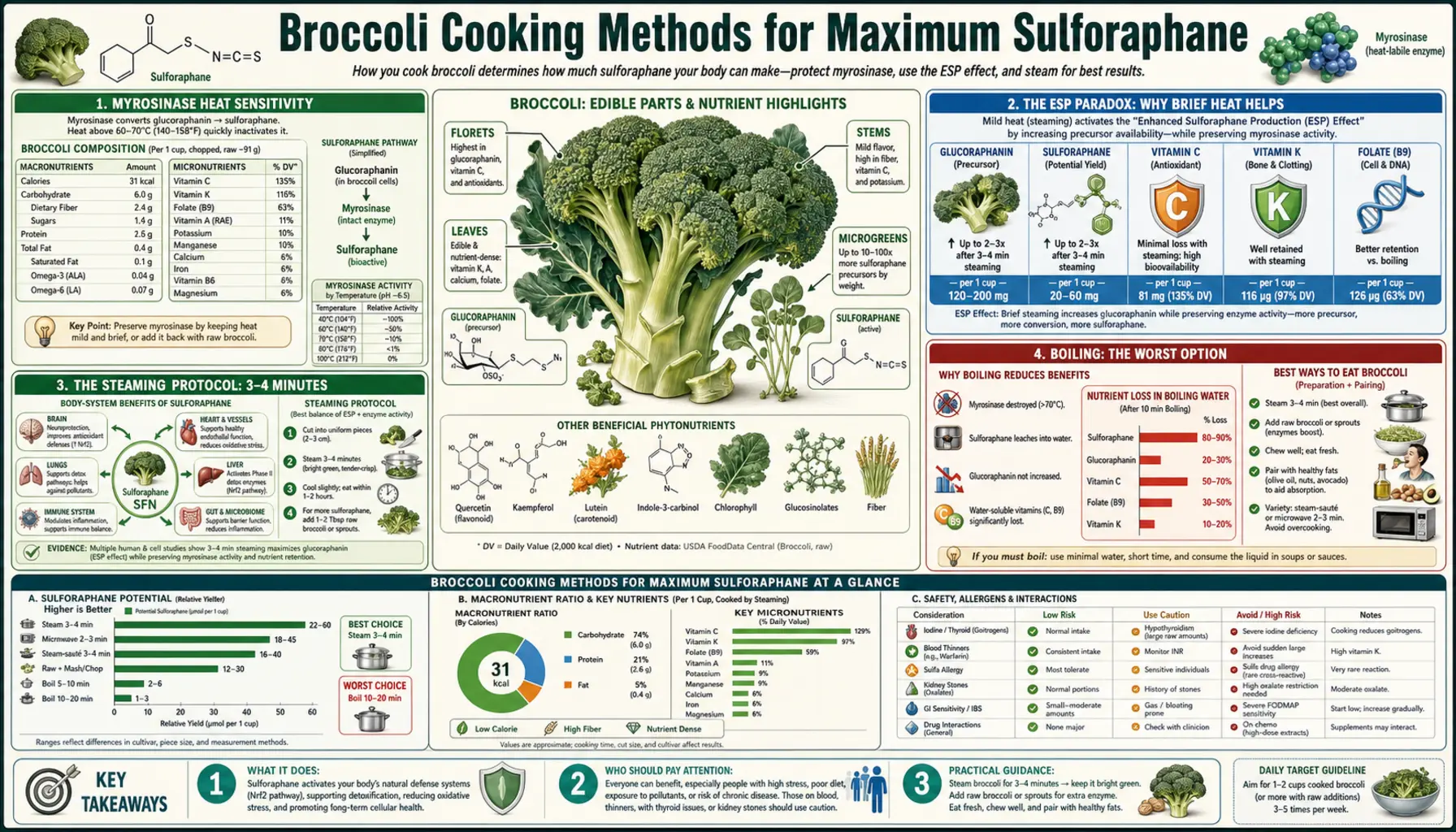
How broccoli is prepared changes how much sulforaphane it can form. Sulforaphane is not present in the intact vegetable: it forms from its precursor, glucoraphanin, when the plant enzyme myrosinase acts on it after the tissue is crushed or chewed (Matusheski 2004). Myrosinase is heat-sensitive, and a second, even more heat-sensitive protein — epithiospecifier protein (ESP) — steers the same reaction toward an inactive nitrile. In laboratory measurements, steaming for 1–3 minutes raised sulforaphane yield in three of four broccoli cultivars, while boiling and microwaving raised and then lost it within the first minute (Wang 2012). In human feeding studies, raw broccoli gave more absorbed sulforaphane than cooked broccoli (37% versus 3.4% bioavailability in Vermeulen 2008; about three times more in Conaway 2000); adding 1 g of powdered brown mustard to cooked broccoli raised urinary sulforaphane metabolites more than four-fold (Okunade 2018); and letting broccoli hydrolyze for 90 minutes before stir-frying raised its sulforaphane content 2.8-fold in a laboratory study (Wu 2018).
Table of Contents
- Myrosinase Heat Sensitivity
- The ESP Paradox: Why Brief Heat Can Raise Yield
- Steaming: What the Studies Measured
- Boiling: The Largest Losses
- Microwaving: Time Matters
- Stir-Fry and Roasting
- Chop and Wait (“Hack and Hold”)
- Adding Myrosinase Back: Mustard Seed and Daikon
- Raw vs Cooked: Laboratory and Human Results
- Frozen Broccoli: Blanching and Myrosinase
- Summary of What the Studies Measured
- Key Research Papers
- Connections
- Featured Videos
Myrosinase Heat Sensitivity
Myrosinase (beta-thioglucosidase, EC 3.2.1.147) is the plant enzyme that converts the stable storage glucosinolate glucoraphanin into the bioactive isothiocyanate sulforaphane once broccoli tissue is crushed or chewed (Matusheski 2004). When the plant enzyme has been destroyed by cooking, conversion depends on bacteria in the gut. In Fahey 2012, single doses of glucosinolates given as broccoli sprout extracts were converted to urinary isothiocyanate metabolites at anywhere from about 1% to more than 40% of the dose, depending on the person, while ready-formed isothiocyanates (largely sulforaphane) gave uniformly high conversions of 70–90%; the authors note that when myrosinase is heat-inactivated the gut microflora carry out the conversion, a process abolished by enteric antibiotics and bowel cleansing. In Shapiro 2001, ready-formed isothiocyanates were about six times more bioavailable than glucosinolates, which must first be hydrolyzed.
The heat sensitivity of broccoli myrosinase has been measured in several ways. Matusheski 2004 heated fresh broccoli florets and sprouts before homogenizing them: heating to 60°C (140°F) increased sulforaphane formation and decreased sulforaphane nitrile formation, while heating florets to 70°C (158°F) and above decreased formation of both products (sprouts did not show that decrease). In broccoli juice, Van Eylen 2007 described the kinetics of myrosinase heat inactivation across 45–60°C. In real cooking, Wang 2012 found that in boiling water and in the microwave, the rise in sulforaphane yield and its subsequent loss both happened within the first minute.
Moderate cooking does not necessarily destroy the glucoraphanin itself. Ghawi 2013 found less than 12% thermal degradation of broccoli glucoraphanin when broccoli was cooked in a vacuum-sealed bag (sous vide) at 100°C for 8 or 12 minutes, yet boiling broccoli in water prevented the formation of any significant sulforaphane because myrosinase was inactivated. Song and Thornalley 2007 found that steaming, microwaving and stir-frying did not cause significant glucosinolate losses, while boiling did, through leaching into the cooking water. Broccoli that has been steamed or cooked sous vide can therefore still carry most of its glucoraphanin while having little or no active plant enzyme left to convert it.
A 2007 review by Rungapamestry and colleagues (Proc Nutr Soc) describes where the conversion happens: after raw brassica vegetables with active myrosinase are eaten, glucosinolate breakdown products are released in the upper gastrointestinal tract; after cooked brassica devoid of plant myrosinase, glucosinolates are hydrolyzed in the colon by the resident microflora. In rats, glucoraphanin placed directly into the cecum produced isothiocyanates in the blood draining the gut by 120 minutes, against 15 minutes for sulforaphane itself (Lai 2010, an animal study). Saha 2012 showed that human gut bacteria can produce sulforaphane, erucin and their nitriles from glucoraphanin.
The ESP Paradox: Why Brief Heat Can Raise Yield
If myrosinase is heat-sensitive, why does raw broccoli not form the most sulforaphane in laboratory tests? The answer is a second protein, epithiospecifier protein (ESP), a non-catalytic cofactor of myrosinase (Matusheski 2004). Matusheski 2006 cloned a 43 kDa protein with ESP activity from broccoli and showed that it directs myrosinase-dependent hydrolysis of glucoraphanin toward sulforaphane nitrile in place of sulforaphane; with alkenyl glucosinolates such as epi-progoitrin, the same protein produces epithionitriles. The authors note that sulforaphane has been shown to have anticarcinogenic properties and sulforaphane nitrile has not.
In Matusheski 2004, sulforaphane nitrile was the primary hydrolysis product when broccoli tissue was crushed at room temperature. Wang 2012 measured nitrile at 52% to 91% of the hydrolysis products of unheated broccoli, depending on the cultivar (four cultivars tested). This is why raw broccoli is not the highest-yield preparation in tissue measurements, despite having fully intact myrosinase.
ESP is more heat-sensitive than myrosinase (Wang 2012). In Matusheski 2004, heating florets or sprouts to 60°C before homogenization simultaneously increased sulforaphane formation and decreased sulforaphane nitrile formation; the loss of ESP activity paralleled the fall in nitrile, and induction of the detoxification enzyme quinone reductase in cultured mouse liver cancer cells rose in parallel with sulforaphane. Heating florets to 70°C and above reduced both products.
Wang 2012 tested this window with real cooking. Steaming increased sulforaphane yield between 1.0 and 3.0 minutes in three of the four cultivars (not in the cultivar Brigadier), while boiling and microwaving produced only a brief rise, followed by loss, within the first minute. These are measurements of the sulforaphane the cooked tissue can form, not of absorption in people; the human studies that compared fresh with cooked broccoli are summarized under Raw vs Cooked.
Steaming: What the Studies Measured
Steaming gave the most consistent results across the cooking studies cited here:
- Sulforaphane yield in the tissue — Wang 2012 found that steaming enhanced sulforaphane yield between 1.0 and 3.0 minutes in all but one of four cultivars, and described this as “proof of concept that steaming for 1.0–3.0 min provides less nitrile and more sulforaphane yield from a broccoli meal.”
- Glucosinolate retention — Song and Thornalley 2007 found no significant loss of glucosinolates from steaming.
- Other nutrients — Yuan 2009 compared five domestic methods (steaming, microwaving, boiling, stir-frying, and stir-frying followed by boiling). All except steaming caused significant losses of chlorophyll and vitamin C, and steaming gave the lowest loss of total glucosinolates.
- Absorption in people — in Conaway 2000 (12 men, crossover design, 200 g of broccoli), 24-hour urinary excretion of isothiocyanates was 10.2% of the amount ingested after steamed broccoli and 32.3% after fresh broccoli. The authors attributed the difference to myrosinase inactivated by cooking; the abstract does not state the steaming time.
The 1–3 minute window in Wang 2012 reflects that study's equipment, portion sizes and cultivars; it is not a universal timing.
Chewing also matters for raw plant material. In Shapiro 2001, chewing fresh broccoli sprouts thoroughly produced higher urinary excretion of isothiocyanate metabolites than swallowing them whole (42.4 versus 28.8 µmol, P = 0.049); the authors explain that thorough chewing exposes the glucosinolates to plant myrosinase.
Boiling: The Largest Losses
Across the studies cited here, boiling produced the largest losses, for two separate reasons:
- Leaching — glucoraphanin is water-soluble. Song and Thornalley 2007 found that boiling, unlike steaming, microwaving or stir-frying, caused significant glucosinolate losses, and about 90% of the lost glucosinolate was detected in the cooking water.
- Myrosinase inactivation — Ghawi 2013 found that boiling broccoli in water prevented the formation of any significant levels of sulforaphane because myrosinase was inactivated, and Wang 2012 saw the boiling-induced rise and loss of sulforaphane yield both happen within one minute.
Two findings bear on broccoli that has been boiled. In Song and Thornalley 2007, most of the lost glucosinolate ended up in the cooking water itself. In Ghawi 2013, adding powdered mustard seed to heat-processed broccoli significantly increased sulforaphane formation (see Adding Myrosinase Back). Whether cutting broccoli and letting it stand before boiling protects the sulforaphane has not been measured in the studies cited here: the pre-hydrolysis study (Wu 2018) used stir-frying, and Van Eylen 2007 found isothiocyanates to be relatively thermolabile.
Microwaving: Time Matters
Results for microwaving depend on how long the broccoli is heated:
- Tissue measurements — in Wang 2012, microwave heating, like boiling, caused an initial loss of nitrile with a rise in sulforaphane, followed by loss of sulforaphane, all within 1 minute.
- Absorption in people — in Rungapamestry 2007 (Br J Nutr; 12 volunteers, 150 g of broccoli), the estimated yield of sulforaphane in the body was about 3-fold higher after lightly cooked broccoli (microwaved 2.0 minutes) than after fully cooked broccoli (microwaved 5.5 minutes).
- Precursor retention — Song and Thornalley 2007 found no significant glucosinolate loss from microwaving, so the precursor largely stays in the broccoli; the question is whether the enzyme survives.
- Other nutrients — in Yuan 2009, microwaving, like every method except steaming, caused significant losses of vitamin C and chlorophyll.
Stir-Fry and Roasting
Wu 2018 measured what happens to broccoli during stir-frying. Myrosinase activity fell by 80% after 3 minutes, while sulforaphane itself had a half-life of 7.7 minutes in the pan (5.9 minutes for total isothiocyanates). The authors concluded that sulforaphane and total isothiocyanates were more stable than myrosinase, and that their content fell during stir-frying largely because the enzyme was destroyed.
Studies disagree on how much glucosinolate stir-frying costs. Song and Thornalley 2007 found no significant glucosinolate loss from stir-frying, while Yuan 2009 found that stir-frying, and stir-frying followed by boiling, caused the highest losses of total glucosinolates of the five methods it compared.
None of the studies cited here measured oven roasting of broccoli. The closest evidence is the heat data above: Matusheski 2004 found that heating florets to 70°C and above reduced sulforaphane formation, and Van Eylen 2007 found isothiocyanates relatively thermolabile at 60–90°C. The two approaches that have been tested for heat-treated broccoli are letting it hydrolyze before cooking (Wu 2018) and adding an outside source of myrosinase afterward (Ghawi 2013; Okunade 2018; Dosz and Jeffery 2013).
Chop and Wait (“Hack and Hold”)
The chop-and-wait idea, popularized as “hack and hold,” rests on the fact that myrosinase begins working as soon as broccoli cells are damaged, so cut broccoli left to stand before cooking has time to form sulforaphane before heat destroys the enzyme.
The clearest test is Wu 2018. Compared with stir-frying straight away, letting broccoli hydrolyze for 90 minutes and then stir-frying it increased its sulforaphane content 2.8-fold and its total isothiocyanate content 2.6-fold. Because sulforaphane was more stable in the pan than myrosinase, forming it before cooking left more of it in the finished dish.
The waiting time tested in Wu 2018 was 90 minutes. The 40-minute figure that circulates with “hack and hold” was not the interval tested in the studies cited here. Song and Thornalley 2007 measured a related time course: in finely shredded vegetables, glucosinolate levels declined with the time elapsed after shredding — by up to 75% over 6 hours — and part of that loss was detected as isothiocyanates.
Two limits apply. Wu 2018 tested stir-frying only; standing time before boiling, microwaving or roasting was not tested in these studies, and isothiocyanates are relatively thermolabile (Van Eylen 2007). Room-temperature hydrolysis is also the condition under which Matusheski 2004 found sulforaphane nitrile to be the primary product, so not all of the glucoraphanin that reacts while cut broccoli stands becomes sulforaphane.
Adding Myrosinase Back: Mustard Seed and Daikon
Mustard seeds come from another member of the cabbage family (Brassicaceae) and carry their own myrosinase. Ghawi 2013 describes the myrosinase of white mustard seed (Sinapis alba) as a more resilient isoform than broccoli's, studied the heat inactivation of both, and tested adding powdered mustard seed to cooked broccoli.
In Ghawi 2013, boiling broccoli in water prevented the formation of any significant sulforaphane because its myrosinase was inactivated, and adding powdered mustard seeds to the heat-processed broccoli significantly increased sulforaphane formation.
Okunade 2018 tested the same idea in people. In a randomized crossover study, 12 healthy adults ate 200 g of cooked broccoli with or without 1 g of powdered brown mustard, and all urine was collected for 24 hours. Mean urinary excretion of the sulforaphane metabolite SF-NAC was 9.8 ± 5.1 µmol per g creatinine after broccoli alone and 44.7 ± 33.9 µmol per g creatinine with mustard added — in the authors' words, bioavailability “over four times greater” than from cooked broccoli eaten alone.
Dosz and Jeffery 2013 tested daikon radish root as a myrosinase source. It still supported some sulforaphane formation after being heated at 125°C for 10 minutes, and 0.25% daikon radish added to frozen broccoli that was then allowed to thaw supported sulforaphane formation without visibly altering the broccoli. Broccoli's own root, by contrast, was not more heat-stable than its florets as a myrosinase source.
Horseradish, wasabi and arugula are also cabbage-family plants that contain myrosinase, but they were not tested in the cooked-broccoli studies cited here.
Raw vs Cooked: Laboratory and Human Results
Whether raw or lightly cooked broccoli comes out ahead depends on what is measured. Laboratory measurements of the sulforaphane formed in the tissue favor brief, mild heat; the two human studies cited here that compared raw with cooked broccoli found more sulforaphane absorbed from raw:
- Raw broccoli, tissue measurements — intact myrosinase but active ESP: nitrile made up 52–91% of the hydrolysis products of unheated broccoli, depending on cultivar (Wang 2012).
- Brief mild heat, tissue measurements — heating to 60°C before homogenization (Matusheski 2004) and steaming for 1–3 minutes (Wang 2012) increased sulforaphane yield compared with unheated broccoli.
- Fresh vs steamed, in people — Conaway 2000 (12 men, 200 g): 32.3% versus 10.2% of the ingested isothiocyanates excreted in urine over 24 hours, which the authors summarize as about three times greater bioavailability from fresh broccoli.
- Raw vs cooked, in people — Vermeulen 2008 (8 men, 200 g of crushed broccoli eaten with a warm meal): bioavailability 37% raw versus 3.4% cooked; peak plasma time 1.6 hours versus 6 hours; excretion half-lives similar (2.6 and 2.4 hours).
- Lightly vs fully microwaved, in people — Rungapamestry 2007 (Br J Nutr): about 3-fold higher estimated sulforaphane yield after 2.0 minutes than after 5.5 minutes.
- Cooked broccoli with mustard, in people — Okunade 2018: more than four times the urinary sulforaphane metabolite of cooked broccoli alone.
- Fresh vs commercial frozen, in people — Saha 2012: sulforaphane bioavailability about tenfold higher from soups made with fresh broccoli.
The abstract of Conaway 2000 does not state how long its broccoli was steamed, and no other human study cited here tested the 1–3 minute steaming window, so whether the laboratory advantage of brief steaming carries over to absorption in people has not been established.
For other nutrients, Yuan 2009 found that of five domestic methods only steaming avoided significant losses of vitamin C and chlorophyll.
Frozen Broccoli: Blanching and Myrosinase
Commercial frozen broccoli is blanched before freezing. Dosz and Jeffery 2013 note that industrial blanching usually aims to inactivate peroxidase, although lipoxygenase plays a greater role in quality loss during frozen storage; myrosinase is not the target. In their tests, blanching at 86°C or higher inactivated peroxidase, lipoxygenase and myrosinase, while blanching at 76°C inactivated 92% of lipoxygenase activity with only an 18% loss in myrosinase-dependent sulforaphane formation. The same group had earlier found that several commercially available frozen broccoli products did not retain the ability to form sulforaphane.
In Saha 2012, 18 healthy volunteers ate soups made from lightly cooked fresh or commercial frozen broccoli florets. Sulforaphane bioavailability was about tenfold higher from the fresh-broccoli soup, and the authors traced the reduction to destruction of myrosinase by the commercial blanching-freezing process.
Dosz and Jeffery 2013 also found that thawing frozen broccoli for 9 hours did not support sulforaphane formation unless an outside source of myrosinase was added; 0.25% daikon radish added to the frozen broccoli before thawing supported sulforaphane formation.
Broccoli sprouts are covered in Sprouts vs Mature. Eaten raw, they have not been blanched: in Cramer and Jeffery 2011 (4 men), 74% of the sulforaphane dose from myrosinase-rich air-dried broccoli sprouts was recovered in 24-hour urine, against 19% from a glucoraphanin-rich broccoli powder lacking myrosinase.
Summary of What the Studies Measured
- Storage — storage at room temperature or in a domestic refrigerator caused a minor 9–26% glucosinolate loss over 7 days, with no significant difference between the two; finely shredded vegetables lost up to 75% over 6 hours after shredding, partly as isothiocyanates (Song and Thornalley 2007).
- Steaming — no significant glucosinolate loss (Song and Thornalley 2007) and the lowest losses of glucosinolates and vitamin C among five domestic methods (Yuan 2009); sulforaphane yield rose with 1–3 minutes of steaming in tissue measurements (Wang 2012).
- Boiling — the largest losses, through leaching into the water and myrosinase inactivation (Song and Thornalley 2007; Ghawi 2013).
- Microwaving — 2.0 minutes gave about three times the estimated in-body sulforaphane yield of 5.5 minutes (Rungapamestry 2007, Br J Nutr).
- Standing before cooking — 90 minutes of hydrolysis before stir-frying raised sulforaphane content 2.8-fold (Wu 2018).
- Adding myrosinase back — 1 g of powdered brown mustard with 200 g of cooked broccoli raised urinary sulforaphane metabolites more than four-fold in 12 adults (Okunade 2018); daikon radish supported sulforaphane formation in thawed frozen broccoli (Dosz and Jeffery 2013).
- Raw vs cooked in people — raw or fresh broccoli gave higher isothiocyanate absorption than steamed or cooked broccoli in both human comparisons (Conaway 2000; Vermeulen 2008).
Sprouts are covered in Sprouts vs Mature. Fahey 1997 found that 3-day-old sprouts of certain broccoli and cauliflower cultivars contain 10–100 times more glucoraphanin than the corresponding mature plants, so a small weight of sprouts can carry as much precursor as a much larger weight of mature broccoli.
Key Research Papers
- Wang GC, Farnham M, Jeffery EH (2012). Impact of thermal processing on sulforaphane yield from broccoli (Brassica oleracea L. ssp. italica). J Agric Food Chem. — PubMed PMID: 22471240
- Ghawi SK, Methven L, Niranjan K (2013). The potential to intensify sulforaphane formation in cooked broccoli (Brassica oleracea var. italica) using mustard seeds (Sinapis alba). Food Chem. — PubMed PMID: 23411305
- Matusheski NV, Juvik JA, Jeffery EH (2004). Heating decreases epithiospecifier protein activity and increases sulforaphane formation in broccoli. Phytochemistry. — PubMed PMID: 15184012
- Conaway CC et al. (2000). Disposition of glucosinolates and sulforaphane in humans after ingestion of steamed and fresh broccoli. Nutr Cancer. — PubMed PMID: 11525594
- Vermeulen M et al. (2008). Bioavailability and kinetics of sulforaphane in humans after consumption of cooked versus raw broccoli. J Agric Food Chem. — PubMed PMID: 18950181
- Song L, Thornalley PJ (2007). Effect of storage, processing and cooking on glucosinolate content of Brassica vegetables. Food Chem Toxicol. — PubMed PMID: 17011103
- Saha S et al. (2012). Isothiocyanate concentrations and interconversion of sulforaphane to erucin in human subjects after consumption of commercial frozen broccoli compared to fresh broccoli. Mol Nutr Food Res. — PubMed PMID: 23109475
- Dosz EB, Jeffery EH (2013). Modifying the processing and handling of frozen broccoli for increased sulforaphane formation. J Food Sci. — PubMed PMID: 23915112
- Howard LA et al. (1997). Retention of phytochemicals in fresh and processed broccoli. J Food Sci. — doi:10.1111/j.1365-2621.1997.tb12221.x
- Rungapamestry V et al. (2007). Effect of cooking brassica vegetables on the subsequent hydrolysis and metabolic fate of glucosinolates. Proc Nutr Soc. — PubMed PMID: 17343774
- Lai RH et al. (2010). Glucoraphanin hydrolysis by microbiota in the rat cecum results in sulforaphane absorption. Food Funct. — PubMed PMID: 21776467
- Cramer JM, Jeffery EH (2011). Sulforaphane absorption and excretion following ingestion of a semi-purified broccoli powder rich in glucoraphanin and broccoli sprouts in healthy men. Nutr Cancer. — PubMed PMID: 21240766
- Okunade O, Niranjan K, Ghawi SK, Kuhnle G, Methven L (2018). Supplementation of the diet by exogenous myrosinase via mustard seeds to increase the bioavailability of sulforaphane in healthy human subjects after the consumption of cooked broccoli. Mol Nutr Food Res. — PubMed PMID: 29806738
- Wu Y, Shen Y, Wu X, et al. (2018). Hydrolysis before stir-frying increases the isothiocyanate content of broccoli. J Agric Food Chem. — PubMed PMID: 29357241
- Rungapamestry V, Duncan AJ, Fuller Z, Ratcliffe B (2007). Effect of meal composition and cooking duration on the fate of sulforaphane following consumption of broccoli by healthy human subjects. Br J Nutr. — PubMed PMID: 17349076
- Matusheski NV, Swarup R, Juvik JA, et al. (2006). Epithiospecifier protein from broccoli (Brassica oleracea L. ssp. italica) inhibits formation of the anticancer agent sulforaphane. J Agric Food Chem. — PubMed PMID: 16536577
- Fahey JW, Wehage SL, Holtzclaw WD, et al. (2012). Protection of humans by plant glucosinolates: efficiency of conversion of glucosinolates to isothiocyanates by the gastrointestinal microflora. Cancer Prev Res (Phila). — PubMed PMID: 22318753
- Shapiro TA, Fahey JW, Wade KL, Stephenson KK, Talalay P (2001). Chemoprotective glucosinolates and isothiocyanates of broccoli sprouts: metabolism and excretion in humans. Cancer Epidemiol Biomarkers Prev. — PubMed PMID: 11352861
- Van Eylen D, Oey I, Hendrickx M, Van Loey A (2007). Kinetics of the stability of broccoli (Brassica oleracea Cv. Italica) myrosinase and isothiocyanates in broccoli juice during pressure/temperature treatments. J Agric Food Chem. — PubMed PMID: 17305356
- Yuan GF, Sun B, Yuan J, Wang QM (2009). Effects of different cooking methods on health-promoting compounds of broccoli. J Zhejiang Univ Sci B. — PubMed PMID: 19650196
- Fahey JW, Zhang Y, Talalay P (1997). Broccoli sprouts: an exceptionally rich source of inducers of enzymes that protect against chemical carcinogens. Proc Natl Acad Sci U S A. — PubMed PMID: 9294217