Bell Pepper Vitamin C: Red Versus Green
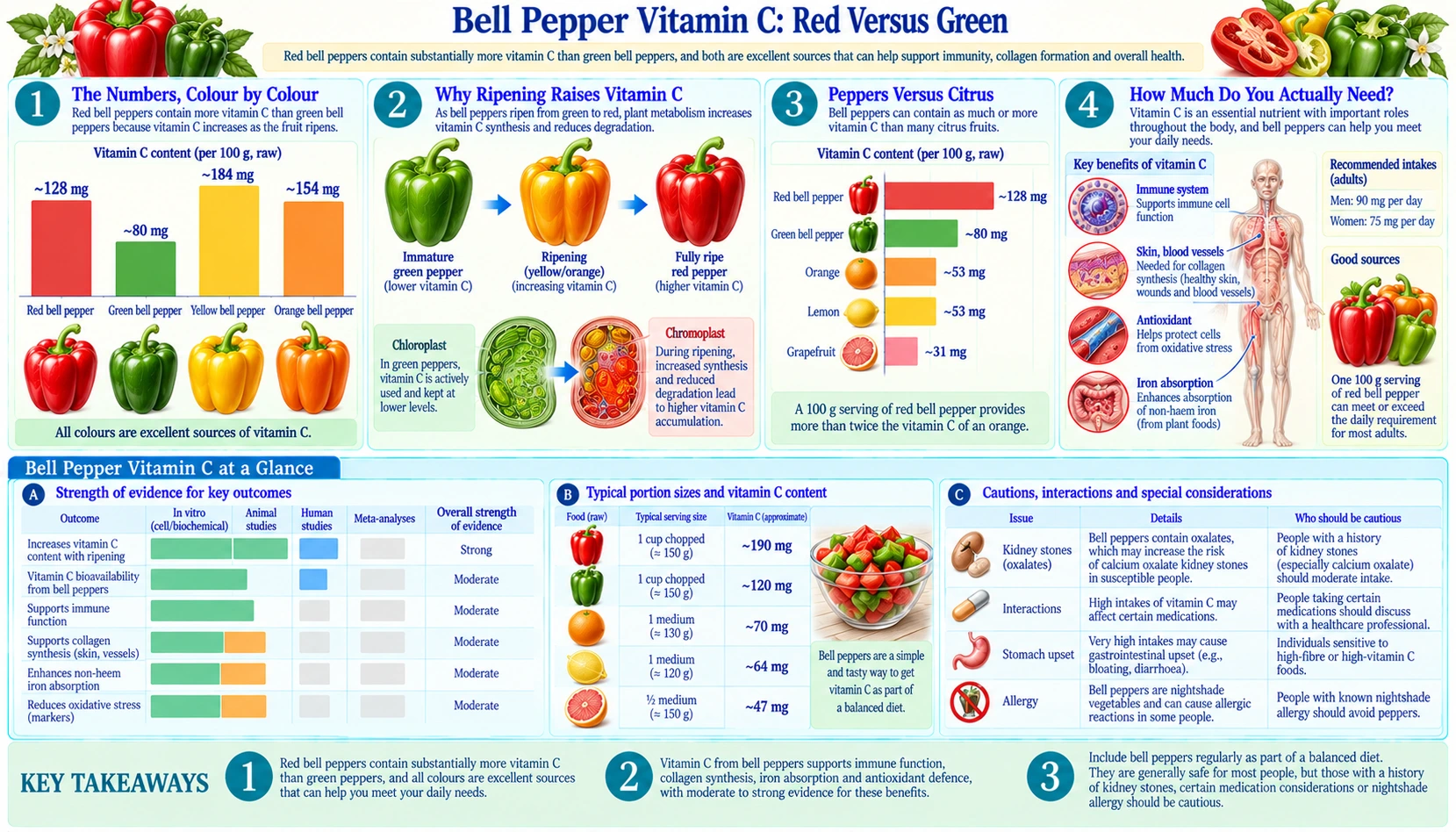
The single most useful fact about bell peppers is one most people have backwards: the pepper, not the orange, is the everyday vitamin C champion. USDA's reference figures for raw sweet peppers are 80 mg of vitamin C per 100 g for green, 128 mg for red, and 184 mg for yellow, against 53 mg per 100 g for a raw orange. A single raw red pepper covers a whole day's requirement with room to spare. This article explains where that vitamin C comes from, why the colour of the pepper changes the number so much, how much survives in the pan, how peppers compare with citrus, and what the human evidence actually says about getting your vitamin C this way — including the trials that found vitamin C does not do some of the things it is famous for.
Table of Contents
- The Numbers, Colour by Colour
- Why Ripening Raises Vitamin C
- Peppers Versus Citrus
- How Much Do You Actually Need
- What Cooking Does to It
- Food Vitamin C Versus a Tablet
- What Vitamin C Does, and Does Not Do
- A Practical Bonus: Iron Absorption
- Who Gets the Most From This
- Key Research Papers
- Connections
- Featured Videos
The Numbers, Colour by Colour
All of the figures below are USDA FoodData Central reference values (SR Legacy) for raw sweet peppers, per 100 g — a little under a medium pepper's worth of flesh:
- Green bell pepper: 80.4 mg vitamin C, 20 calories, 93.9% water, 1.7 g fibre.
- Red bell pepper: 128 mg vitamin C, 26 calories, 92.2% water, 2.1 g fibre.
- Yellow bell pepper: 184 mg vitamin C, 27 calories, 92.0% water, 0.9 g fibre.
- For comparison, raw orange: 53.2 mg vitamin C, 47 calories, 2.4 g fibre.
Two things stand out. First, the ripe colours carry more vitamin C than green: a red pepper has about 60% more than a green one, and the USDA yellow sample carries more than double. Second, all three are far ahead of an orange, gram for gram — the green pepper by half again, the red by roughly two and a half times, the yellow by about three and a half. The current Daily Value for vitamin C on food labels is 90 mg, so 100 g of raw red pepper is about 140% of it and 100 g of yellow is over 200%.
Two honest caveats about those figures. They are averages of sampled peppers: variety, growing conditions, time since harvest and storage temperature all move the real number, and analyses of individual cultivars vary widely. And the yellow figure comes from a single USDA reference entry rather than the many samples behind the green and red entries, so treat "yellow beats red" as plausible rather than settled. What is settled, across every analysis, is that the coloured, ripe peppers carry more vitamin C than green ones, and that all of them are an excellent source.
Why Ripening Raises Vitamin C
A green bell pepper is an unripe fruit. Left on the plant, the same pepper turns yellow or orange and then red as it matures (some varieties are bred to stop at yellow or orange). Ripening is a busy chemical process: the fruit converts starch to sugar, breaks down chlorophyll, builds the red and orange carotenoid pigments, and — the part that matters here — keeps synthesising ascorbic acid from sugar precursors as it goes.
The classic study tracking this is Howard and colleagues' 2000 analysis of several pepper types (sweet and hot) sampled at successive stages of maturity. The concentrations of ascorbic acid, carotenoids and most phenolic compounds generally rose as the fruit matured; at full maturity the peppers supplied 124 to 338% of the then-current vitamin C RDA per 100 g, depending on type. The same pattern shows in Sun and colleagues' 2007 comparison of green, yellow, orange and red bell peppers bought at retail: total phenolics climbed from 2.4 micromoles per gram in green to 4.2 in red, and red peppers carried the most beta-carotene, capsanthin, quercetin and luteolin, while green peppers had no detectable capsanthin at all.
The practical rule follows directly: a red pepper is a green pepper that was given more time, and the extra time bought more vitamin C, more sugar (which is why it tastes sweet rather than grassy) and a completely different set of pigments. Growers charge more for red peppers because they occupy the plant for longer and are more perishable, not because they are a different vegetable.
One nuance from the ripening studies is worth knowing for the carotenoid article: not everything rises with ripeness. Howard's group found lutein declined as peppers matured while zeaxanthin and capsanthin rose, and USDA's figures agree — green peppers carry about 341 micrograms of lutein plus zeaxanthin per 100 g against only 51 in red. Colour is a trade, not a strict upgrade.
Peppers Versus Citrus
Oranges own the reputation for a historical reason — they were the practical scurvy cure of the sailing era — and a marketing one. On the numbers, a raw orange carries 53 mg of vitamin C per 100 g, and a typical whole fruit of about 130 g gives around 70 mg. A red bell pepper delivers that from roughly 55 g of flesh, a few strips. A whole red pepper of around 120 g eaten raw supplies around 150 mg, about twice what a whole orange does.
That does not make oranges a poor choice. They are a good vitamin C source, and both foods bring other things a table of one nutrient does not show: the orange more fibre per 100 g (2.4 g against 2.1 g) and the flavonoid hesperidin, the pepper more vitamin A activity, vitamin B6, vitamin E and potassium per calorie. Nor is the pepper the winner of every plant. Per 100 g, a handful of foods run higher still — guava, blackcurrants and some chilli varieties — but they are not foods most people eat by the cupful. Among the vegetables in an ordinary supermarket, the raw bell pepper is about as concentrated as vitamin C gets.
The comparison that actually matters in a kitchen is per serving, as you eat it. Orange juice loses fibre and, with storage, some vitamin C; a cooked pepper loses a share of its vitamin C to heat and water (next sections). A raw red or yellow pepper in a salad, sliced onto a plate with hummus, or eaten out of hand is the highest-vitamin-C serving on this page and needs no equipment.
How Much Do You Actually Need
The US Recommended Dietary Allowance is 90 mg a day for adult men and 75 mg for adult women, with an extra 35 mg for smokers (NIH Office of Dietary Supplements). Where those figures came from is worth a paragraph, because it changes how you read the pepper numbers.
Levine and colleagues' 1996 depletion–repletion study kept seven healthy volunteers in hospital for four to six months on a diet with under 5 mg of vitamin C a day, then measured blood and cell levels at seven daily doses from 30 to 2,500 mg. The relationship was S-shaped: plasma levels climbed steeply between 30 and 100 mg a day, white blood cells (neutrophils, monocytes, lymphocytes) were saturated at 100 mg a day, and no vitamin C appeared in the urine of six of seven volunteers until the dose reached 100 mg. Above about 200 mg the body was essentially full; at 500 mg and more, bioavailability fell and the excess was simply excreted, and at 1,000 mg a day urinary oxalate and urate rose. Those measurements are the basis of the current RDA.
Read against them, the pepper figures are striking. Half a raw red pepper (about 60 g) delivers roughly 75 mg — a woman's RDA in one go; a whole one covers the point where white blood cells are saturated. A 100 g serving of raw yellow pepper (184 mg) sits close to the intake at which the body stops taking more up. There is no case for eating peppers for megadoses; the body caps its own absorption. There is a strong case for eating them because they take a person from marginal to fully replete with a single vegetable.
Frei, Birlouez-Aragon and Lykkesfeldt argued in 2012 that the optimum intake is higher than the scurvy-prevention RDA — around 200 mg a day from food — on the basis of cohort data and smaller trials on blood pressure and endothelial function. Whether or not one accepts that, 200 mg a day is about a whole raw red pepper plus a normal fruit and vegetable intake, not a supplement.
What Cooking Does to It
Vitamin C is water-soluble and heat-sensitive, and it also oxidises when cut surfaces are exposed to air. So the two things that cost the most are water and time. Hwang and colleagues (2012) cooked red peppers four ways for 5, 10 and 15 minutes and measured what was left. Boiling and steaming removed 24 to 67% of the ascorbic acid and 14 to 55% of the total polyphenols; stir-frying and roasting removed only 3 to 26% of the ascorbic acid and 2 to 5% of the polyphenols. Boiling was the worst method at every time point, stir-frying the best, and the losses grew with cooking time.
Lee and colleagues (2018) measured "true retention" — correcting for the water a vegetable gains or loses in the pot — across blanching, boiling, microwaving and steaming for a range of vegetables. Vitamin C retention ranged from nothing to 91% depending on vegetable and method, with microwaving generally best and boiling generally worst. Chuah and colleagues (2008) reached the same ranking for coloured peppers specifically: water-based methods cost the most.
USDA's own figures make the point at the plate: raw green pepper carries 80 mg of vitamin C per 100 g; the boiled-and-drained entry carries 74 mg per 100 g of cooked weight. The drop looks small only because the cooked pepper has taken up water; corrected for that, the loss is real but not catastrophic. In kitchen terms:
- Raw keeps essentially all of it. Slice just before eating; a pepper cut the night before has lost some to air.
- A quick stir-fry or a hot roast keeps most of it — and for the carotenoids, cooking with a little oil actually improves absorption (see the carotenoid article).
- Boiling and long stewing cost the most, and what leaches out is in the liquid. Soups and sauces you eat whole keep it; peppers boiled and drained do not.
- Storage matters too. Whole peppers keep their vitamin C for a week or two in the fridge; heat, light and cut surfaces accelerate the loss.
The right conclusion is not "only eat peppers raw". A roasted red pepper still carries more vitamin C than most raw vegetables. It is that if the vitamin C is the reason you are eating the pepper, eat at least some of it raw.
Food Vitamin C Versus a Tablet
Is the vitamin C in a pepper better absorbed than the ascorbic acid in a tablet? The honest answer from human studies is: no better and no worse. Carr and Vissers' 2013 review went through the animal and human work comparing synthetic with food-derived vitamin C. Some animal studies found differences, but every human steady-state study found synthetic and food-derived vitamin C equally bioavailable — the molecule is identical, and the flavonoids in fruit and vegetables did not measurably change how much reached the blood.
So the argument for the pepper over the tablet is not absorption. It is everything that comes with it: fibre, potassium, vitamin B6, folate, vitamin E, several hundred micrograms of carotenoids, quercetin and luteolin, and 26 calories, in a package that displaces something less useful from the plate. Padayatty and colleagues' 2003 review of vitamin C as an antioxidant made the point plainly: diets rich in fruit and vegetables are associated with less heart disease, stroke and cancer, but supplement trials of vitamin C alone have not reproduced those benefits, and whether the vitamin C itself is the protective ingredient is not known. The food has the track record; the isolated molecule does not.
Levine's kinetics add one more argument. Because absorption is complete at 200 mg and declines above 500 mg, a 1,000 mg tablet is mostly excreted and raises urinary oxalate. Two peppers a day cannot get you there, which is a feature.
What Vitamin C Does, and Does Not Do
Vitamin C is a required helper (cofactor) for the enzymes that cross-link collagen, which is why deficiency produces bleeding gums, bruising, poor wound healing and the loose teeth of scurvy. Normal skin holds high concentrations of it, and Pullar, Carr and Vissers' 2017 review of vitamin C in skin health concluded that it supports collagen synthesis and antioxidant protection against UV damage, while noting that the evidence for topical products is much weaker than the evidence for simply being nutritionally replete. Carr and Maggini's 2017 review of vitamin C and immune function describes its concentration in neutrophils, its role in the skin barrier and in clearing spent immune cells, and the fact that infection drains vitamin C levels — deficiency impairs immunity, and repletion restores it.
That is the case for being replete. The case for going beyond it is much thinner, and this page reports the negative findings as negative:
- Colds. The 2013 Cochrane review by Hemilä and Chalker (29 trial comparisons, 11,306 participants) found that taking at least 200 mg of vitamin C every day did not reduce how often people in the general community caught colds. It modestly shortened them — by about 8% in adults and 14% in children — and it roughly halved the number of colds only in people under heavy physical stress, such as marathon runners, skiers and soldiers on winter exercises. Starting vitamin C once a cold had begun made no consistent difference.
- Mortality and heart disease. In the EPIC-Norfolk cohort (Khaw and colleagues, 2001; 19,496 adults followed about four years), people in the top fifth of blood vitamin C had about half the death rate of those in the bottom fifth, and each 20 micromol/L rise in plasma vitamin C — the difference made by roughly one extra serving of fruit or vegetables a day — was associated with about a 20% lower risk of death. That is a cohort finding: blood vitamin C is also a marker of eating a lot of plants, and the trials of isolated vitamin C have not delivered the same result.
The pepper, in other words, is an excellent way to be securely replete in a nutrient that matters. It is not a medicine, and it should not be sold to you as one.
A Practical Bonus: Iron Absorption
The iron in plant foods, eggs and dairy (non-haem iron) is poorly absorbed — often only a few percent — and is blocked further by the phytates in whole grains and beans and the tannins in tea and coffee. Vitamin C is the best-established dietary enhancer of that absorption. Hallberg and colleagues summarised the mechanism in 1989: ascorbic acid keeps iron soluble in the gut and reduces ferric iron to the ferrous form the intestinal cells can take up, and it counteracts the inhibitors when eaten in the same meal.
This is where a raw pepper earns a place on the plate rather than in a salad on the side. Strips of red or yellow pepper eaten with a lentil dish, a bean chilli, a spinach salad or brown rice will raise the fraction of that meal's iron that is absorbed. The vitamin C has to be present in the meal, so a pepper at lunch does nothing for the iron at dinner. For people with low iron stores — menstruating women, vegetarians and vegans, endurance athletes — this is one of the more useful things a bell pepper does, and it costs nothing.
Who Gets the Most From This
People who eat few fruits and vegetables. The steep part of Levine's curve is between 30 and 100 mg a day. Someone on a low-produce diet who adds half a raw red pepper moves from the bottom of that curve to the top with one habit.
Smokers. Smoking raises vitamin C turnover; the RDA adds 35 mg a day, and smokers' blood levels run lower at any given intake. A whole raw pepper covers the gap easily.
People with low iron. Peppers eaten with iron-containing plant foods, as above.
People who dislike citrus, or cannot eat it. Anyone avoiding oranges and grapefruit — for reflux, for medication interactions with grapefruit, or by taste — has a better vitamin C source in the pepper anyway.
Two groups should read the safety article first: people with birch-pollen hay fever who find raw peppers make their mouth itch (oral allergy syndrome, which cooking usually resolves), and people with a history of calcium-oxalate kidney stones — not because of the pepper, whose vitamin C is far below the doses that raised urinary oxalate in Levine's study, but because that is the reason to get vitamin C from food rather than from gram-dose tablets.
A sensible target, based on the kinetics rather than folklore: half to one raw red or yellow pepper on most days, plus whatever cooked peppers you enjoy. That meets the RDA, saturates the immune cells that use vitamin C, and leaves nothing for a tablet to add.
Key Research Papers
Author names, titles and journals are plain text; only the PMID or DOI is a link. Every identifier below was checked against PubMed or Crossref before publication.
- Sun T, Xu Z, Wu CT, Janes M, Prinyawiwatkul W, No HK (2007). Antioxidant activities of different colored sweet bell peppers (Capsicum annuum L.). Journal of Food Science. — PubMed PMID: 17995862
- Howard LR, Talcott ST, Brenes CH, Villalon B (2000). Changes in phytochemical and antioxidant activity of selected pepper cultivars (Capsicum species) as influenced by maturity. Journal of Agricultural and Food Chemistry. — PubMed PMID: 10820084
- Hwang IG, Shin YJ, Lee S, Lee J, Yoo SM (2012). Effects of different cooking methods on the antioxidant properties of red pepper (Capsicum annuum L.). Preventive Nutrition and Food Science. — PubMed PMID: 24471098
- Lee S, Choi Y, Jeong HS, Lee J, Sung J (2018). Effect of different cooking methods on the content of vitamins and true retention in selected vegetables. Food Science and Biotechnology. — PubMed PMID: 30263756
- Chuah AM, Lee YC, Yamaguchi T, Takamura H, Yin LJ, Matoba T (2008). Effect of cooking on the antioxidant properties of coloured peppers. Food Chemistry. — doi:10.1016/j.foodchem.2008.03.022
- Levine M, Conry-Cantilena C, Wang Y, et al. (1996). Vitamin C pharmacokinetics in healthy volunteers: evidence for a recommended dietary allowance. Proceedings of the National Academy of Sciences of the United States of America. — PubMed PMID: 8623000
- Frei B, Birlouez-Aragon I, Lykkesfeldt J (2012). Authors' perspective: What is the optimum intake of vitamin C in humans? Critical Reviews in Food Science and Nutrition. — PubMed PMID: 22698272
- Carr AC, Vissers MC (2013). Synthetic or food-derived vitamin C — are they equally bioavailable? Nutrients. — PubMed PMID: 24169506
- Padayatty SJ, Katz A, Wang Y, et al. (2003). Vitamin C as an antioxidant: evaluation of its role in disease prevention. Journal of the American College of Nutrition. — PubMed PMID: 12569111
- Pullar JM, Carr AC, Vissers MCM (2017). The roles of vitamin C in skin health. Nutrients. — PubMed PMID: 28805671
- Carr AC, Maggini S (2017). Vitamin C and immune function. Nutrients. — PubMed PMID: 29099763
- Hemilä H, Chalker E (2013). Vitamin C for preventing and treating the common cold. Cochrane Database of Systematic Reviews. — PubMed PMID: 23440782
- Khaw KT, Bingham S, Welch A, et al. (2001). Relation between plasma ascorbic acid and mortality in men and women in EPIC-Norfolk prospective study: a prospective population study. Lancet. — PubMed PMID: 11247548
- Hallberg L, Brune M, Rossander L (1989). The role of vitamin C in iron absorption. International Journal for Vitamin and Nutrition Research. Supplement. — PubMed PMID: 2507689
- Stewart C Jr, Kang BC, Liu K, et al. (2005). The Pun1 gene for pungency in pepper encodes a putative acyltransferase. The Plant Journal. — PubMed PMID: 15918882 (why sweet peppers have no capsaicin)
PubMed Topic Searches
Connections
- All Food
- Bell Peppers
- Bell Pepper Benefits: What the Evidence Actually Shows
- Bell Peppers: Nutrient Profile
- Bell Pepper Carotenoids, Capsanthin, and Eye Health
- Bell Peppers, Blood Sugar, Weight, and the Heart
- Bell Peppers: Nightshades, Allergy, Pesticides, and Safety
- Vitamin C
- Oranges
- Iron
- Broccoli
- Spinach