Tuna — Benefits Deep Dive
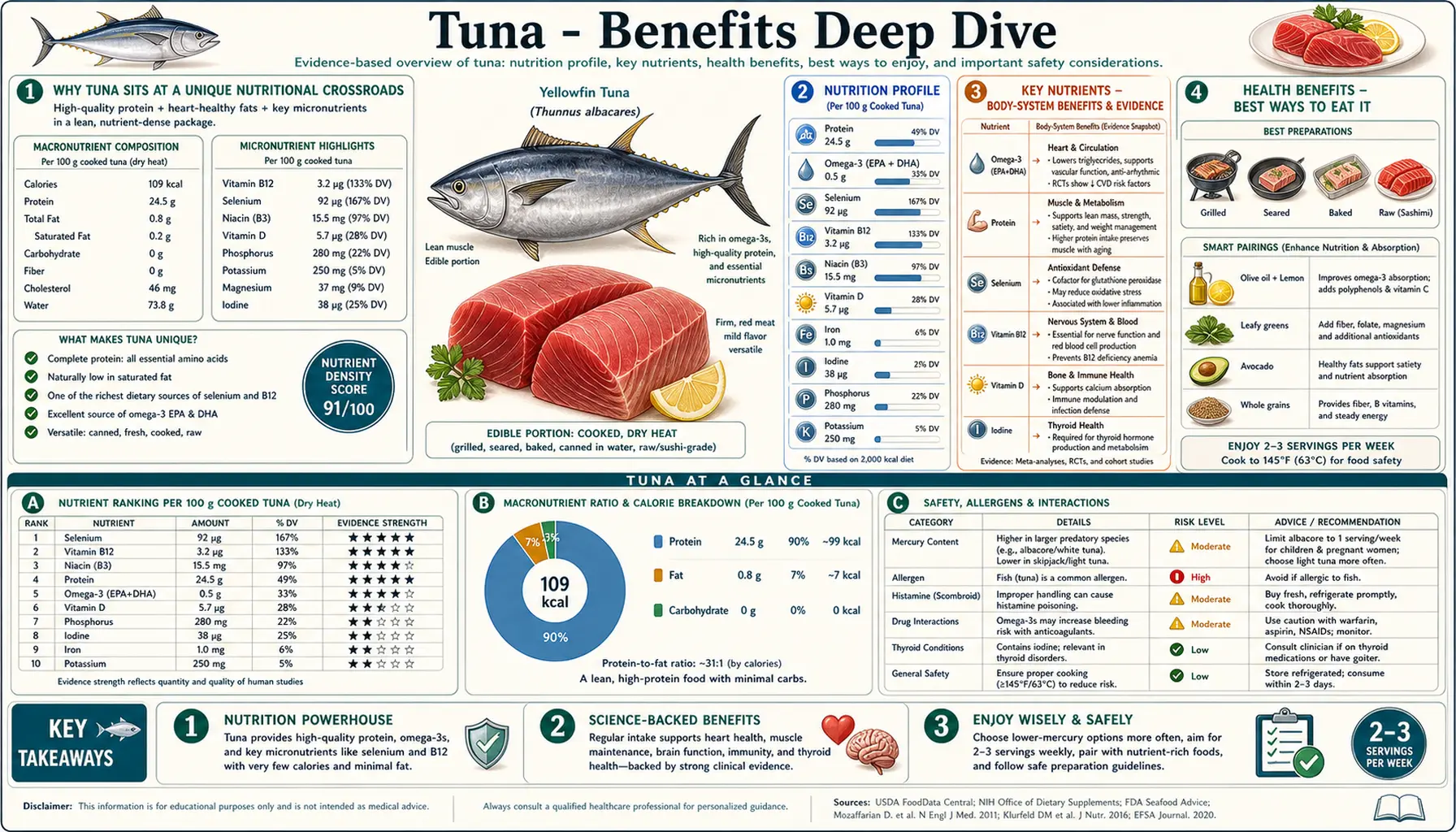
Tuna sits at one of nutrition's most consequential trade-off points: a single 3-oz serving of canned light tuna delivers approximately 22 grams of complete protein, roughly 230 mg of combined eicosapentaenoic acid (EPA) and docosahexaenoic acid (DHA) omega-3 fatty acids, and meaningful selenium, B12, and Vitamin D — yet the same serving also carries methylmercury that accumulated up the marine food chain. Four deep-dive pages below dissect the practical questions every tuna-eater needs answered: how the omega-3 benefit weighs against the mercury risk, what makes tuna an unusually clean lean-protein source, why species and processing method (light skipjack vs albacore vs yellowfin vs bluefin) change the calculation by a factor of three or more, and which sustainability certifications actually correlate with low-bycatch fishing methods.
Deep-Dive Articles
Omega-3 vs Mercury
The central trade-off in every can. Eicosapentaenoic acid and docosahexaenoic acid cardiovascular and brain benefit weighed against methylmercury neurotoxicity, the joint fish advice of the U.S. Food and Drug Administration (FDA) and the U.S. Environmental Protection Agency (revised October 2021), which for pregnancy and breastfeeding lists 2 to 3 servings a week (1 serving = 4 oz) from its "Best Choices" list, which includes canned light tuna, or 1 serving from its "Good Choices" list, which includes albacore, why the Faroese and Seychelles cohort studies arrived at different conclusions about prenatal mercury exposure, and hair mercury testing as a practical biomarker.
Read the deep dive →Lean Protein Profile
22 g complete protein per 3-oz serving, Protein Digestibility-Corrected Amino Acid Score (PDCAAS) of 1.0, leucine content sufficient to trigger muscle protein synthesis, selenium that antagonizes mercury toxicity, vitamin B12 (2.99 µg per 100 g of canned light tuna in water in USDA FoodData Central, against a Daily Value of 2.4 µg), niacin, and Vitamin D from cold-water species. Why tuna is one of the highest-quality protein-per-calorie foods available, and how it compares to chicken breast, eggs, and whey.
Read the deep dive →Light vs Albacore
Skipjack (canned light, ~0.13 ppm mercury, ~230 mg omega-3) vs albacore (canned white, ~0.36 ppm, ~730 mg) vs yellowfin (~0.35 ppm) vs bigeye (~0.69 ppm). U.S. Food and Drug Administration testing data, the 3× mercury differential, why albacore concentrates more omega-3 too, and the species-by-species decision tree for pregnant women, children, and adults.
Read the deep dive →Sustainability
Pole-and-line vs purse seine vs longline. FAD (fish aggregating device) bycatch of dolphins, sea turtles, and sharks. Seafood certification labels, seafood-rating programmes' ratings by species and gear type, the collapse of Atlantic bluefin populations, and where pole-caught skipjack fits.
Read the deep dive →Table of Contents
- Deep-Dive Articles
- Why Tuna Sits at a Unique Nutritional Crossroads
- Research Papers: Omega-3 vs Mercury Balance
- Research Papers: Protein Quality & Micronutrients
- Research Papers: Species, Processing & Mercury Variation
- Research Papers: Sustainability & Fishery Science
- Research Papers: Cross-Cutting (Cardiovascular, Cognitive, Pregnancy)
- External Authoritative Resources
- Connections
- Featured Videos
Why Tuna Sits at a Unique Nutritional Crossroads
Among the protein foods Americans eat regularly, tuna is the most analyzed in the nutritional and toxicological literature for a simple reason: it sits at the intersection of three independently important conversations.
- The omega-3 conversation — eicosapentaenoic acid and docosahexaenoic acid are the only two long-chain omega-3 fatty acids the body uses for membrane phospholipids in the brain, retina, and cardiovascular tissue. Conversion from plant-source alpha-linolenic acid (ALA) is highly inefficient (less than 5% to eicosapentaenoic acid, less than 0.5% to docosahexaenoic acid in most adults). Fatty fish, including tuna, is the dominant dietary source. The American Heart Association and the 2020-2025 Dietary Guidelines for Americans both recommend 8 oz of seafood per week for cardiovascular benefit.
- The methylmercury conversation — tuna, being a long-lived predatory fish, biomagnifies methylmercury from the marine food web. Methylmercury crosses the blood-brain barrier and the placenta, and at high enough exposure causes neurodevelopmental harm in fetuses and young children. The U.S. Food and Drug Administration and the U.S. Environmental Protection Agency jointly publish advice that sorts fish by mercury level into "Best Choices", "Good Choices" and "Choices to Avoid", written for people who might become or are pregnant or breastfeeding and for children aged 1 to 11.
- The sustainability conversation — tuna fisheries are global, contested, and uneven. Skipjack stocks (most canned light tuna) are largely healthy and receive top ratings from seafood-rating programmes. Bluefin populations — particularly Atlantic bluefin — collapsed to less than 10% of unfished biomass before recent management improved the trajectory. Fishing methods range from highly selective pole-and-line (very low bycatch) to FAD-associated purse seine (high juvenile yellowfin and silky shark bycatch) to longline (high sea turtle, seabird, and shark bycatch). Bycatch and stock health differ by species and by the fishing gear used.
These three conversations interact. The mercury advice and the omega-3 recommendation create a tension that the joint advice of the U.S. Food and Drug Administration and the U.S. Environmental Protection Agency (revised October 2021) explicitly addresses: canned light tuna (which includes skipjack) is on its "Best Choices" list, albacore (white) tuna, canned and fresh/frozen, and yellowfin tuna are on its "Good Choices" list, and bigeye tuna is on its "Choices to Avoid" list of fish with the highest mercury levels. For pregnancy and breastfeeding, the advice lists 2 to 3 servings a week from the "Best Choices" list or 1 serving from the "Good Choices" list, with 1 serving being 4 ounces. The sustainability picture overlays on top: a pole-caught Pacific skipjack from a certified fishery and a longline-caught yellowfin can have similar mercury and omega-3 profiles, yet the bycatch of the two fishing methods differs by an order of magnitude.
The FDA's mercury monitoring table (1990–2012) gives these mean mercury levels for tuna: canned light 0.126 ppm, fresh/frozen skipjack 0.144 ppm, canned albacore 0.350 ppm, fresh/frozen yellowfin 0.354 ppm and fresh/frozen bigeye 0.689 ppm (FDA: Mercury Levels in Commercial Fish and Shellfish (1990–2012)).
On the benefit side, a 2006 review in JAMA by Mozaffarian and Rimm found that modest fish consumption (for example 1–2 servings a week), especially of species higher in eicosapentaenoic acid and docosahexaenoic acid, reduced the risk of coronary death by 36% and total mortality by 17%. It found that 250 mg a day of eicosapentaenoic acid plus docosahexaenoic acid appears sufficient for primary prevention, and that the health effects of low-level methylmercury in adults "are not clearly established" (PubMed PMID: 17047219).
In the Avon Longitudinal Study of Parents and Children (ALSPAC), an observational cohort, 11,875 pregnant women reported their seafood intake. Compared with children of mothers who ate more than 340 g of seafood a week, children of mothers who ate no seafood had higher odds of a verbal IQ in the lowest quartile (odds ratio 1.48, 95% CI 1.16–1.90). The authors concluded that "risks from the loss of nutrients were greater than the risks of harm from exposure to trace contaminants in 340 g seafood eaten weekly" (PubMed PMID: 17307104).
The four deep-dive pages explore each axis in turn: the omega-3 vs mercury trade-off, the lean protein and micronutrient profile, the species and processing differences, and the sustainability and fishery picture.
Research Papers: Omega-3 vs Mercury Balance
- FDA / U.S. Environmental Protection Agency joint advisory on fish consumption for pregnant women and children (2021 update) — PubMed: FDA/EPA fish advisory
- Mozaffarian D, Rimm EB (2006). Fish intake, contaminants, and human health: evaluating the risks and the benefits. JAMA — PubMed PMID: 17047219
- Faroe Islands Children's Health Study (Grandjean P et al.) — methylmercury neurodevelopmental outcomes — PubMed: Faroe cohort
- Seychelles Child Development Study (Davidson PW, Myers GJ) — null association in fish-eating population — PubMed: Seychelles study
- U.S. Environmental Protection Agency Reference Dose for methylmercury (0.1 µg/kg/day) and derivation — PubMed: EPA MeHg RfD
- Hair mercury as biomarker of methylmercury exposure — PubMed: Hair mercury biomarker
- ALA to EPA / DHA conversion inefficiency in humans — PubMed: ALA to EPA/DHA conversion
- Selenium-mercury antagonism in seafood — PubMed: Selenium-mercury antagonism
- National Health and Nutrition Examination Survey (NHANES) tuna consumption and blood mercury levels — PubMed: NHANES tuna mercury
- Hibbeln JR, Davis JM, Steer C, Emmett P, Rogers I, Williams C, Golding J (2007). Maternal seafood consumption in pregnancy and neurodevelopmental outcomes in childhood (ALSPAC study): an observational cohort study. Lancet — PubMed PMID: 17307104
Research Papers: Protein Quality & Micronutrients
- PDCAAS protein quality scoring and fish protein — PubMed: PDCAAS and fish
- Leucine threshold for muscle protein synthesis (Phillips SM, 2014) — PubMed: Leucine threshold
- Selenium content of canned tuna and selenoprotein function — PubMed: Selenium in tuna
- Vitamin B12 content of fatty fish and bioavailability — PubMed: B12 in fish
- Vitamin D in fatty fish: tuna, salmon, sardines — PubMed: Vitamin D in fish
- Niacin (B3) content in tuna and metabolic role — PubMed: Niacin in tuna
- Iodine content of marine fish (tuna vs cod vs salmon) — PubMed: Iodine in marine fish
- Taurine content of tuna and cardiovascular role — PubMed: Taurine in tuna
- Histidine content and carnosine biosynthesis — PubMed: Histidine and carnosine
- Tuna in the Mediterranean diet pattern and outcomes — PubMed: Tuna in Mediterranean diet
Research Papers: Species, Processing & Mercury Variation
- FDA mercury levels in commercial fish and shellfish database — PubMed: FDA mercury database
- Skipjack vs albacore vs yellowfin mercury comparison — PubMed: Species mercury comparison
- Bluefin tuna mercury and bioaccumulation — PubMed: Bluefin mercury
- Mercury-omega-3 ratio across tuna species — PubMed: Hg-omega-3 ratio
- Canned vs fresh tuna nutrient and contaminant profile — PubMed: Canned vs fresh
- Age and size of tuna and mercury concentration — PubMed: Size and Hg
- Mercury speciation in tuna (methylmercury vs total) — PubMed: Hg speciation
- Yellowfin and bigeye sashimi-grade mercury survey — PubMed: Sashimi tuna Hg
- Consumer Reports tuna mercury testing (2011, 2017) — PubMed: Consumer Reports tuna
- Karimi R, Fitzgerald TP, Fisher NS (2012). A quantitative synthesis of mercury in commercial seafood and implications for exposure in the United States. Environ Health Perspect — PubMed PMID: 22732656
The 2012 Karimi synthesis pooled government monitoring data and published studies of mercury in seafood sold in the United States. Mean mercury concentrations for each seafood item were highly variable among studies, spanning 0.3–2.4 orders of magnitude, and the authors found "large discrepancies" between their database means and the FDA monitoring program's estimates for most seafood items examined.
Research Papers: Sustainability & Fishery Science
- Global tuna stock assessment (Inter-American Tropical Tuna Commission, International Commission for the Conservation of Atlantic Tunas, Western and Central Pacific Fisheries Commission and Indian Ocean Tuna Commission pooled) — PubMed: Global tuna assessment
- Atlantic bluefin tuna population collapse and recovery — PubMed: Bluefin recovery
- FAD (fish aggregating device) bycatch of juvenile yellowfin — PubMed: FAD bycatch
- Pole-and-line tuna fishery selectivity and bycatch — PubMed: Pole-and-line
- Longline tuna fishery and sea turtle bycatch — PubMed: Longline turtle bycatch
- Silky shark and oceanic whitetip shark bycatch in tuna fisheries — PubMed: Shark bycatch
- Marine Stewardship Council (MSC) certification impact on fishery practices — PubMed: MSC certification
- Dolphin-safe tuna and the eastern tropical Pacific yellowfin fishery — PubMed: Dolphin-safe tuna
- Climate change impacts on tropical tuna distribution — PubMed: Climate and tuna
- IUU (illegal, unreported, unregulated) fishing in global tuna catch — PubMed: IUU tuna fishing
Research Papers: Cross-Cutting (Cardiovascular, Cognitive, Pregnancy)
- Fish intake and coronary heart disease mortality (Mozaffarian D, 2005) — PubMed: Fish and coronary heart disease mortality
- Omega-3 and triglyceride-lowering effect — PubMed: Omega-3 and triglycerides
- DHA and prenatal neurodevelopment — PubMed: DHA and prenatal brain
- Fish consumption and cognitive decline in aging (Morris MC) — PubMed: Fish and cognition
- Fish intake and ischemic stroke risk — PubMed: Fish and stroke
- Mediterranean diet PREDIMED (Prevención con Dieta Mediterránea) trial and fish intake — PubMed: PREDIMED and fish
- AHA scientific statement on fish and omega-3 (Rimm EB, 2018) — PubMed: AHA fish statement 2018
- Histamine in scombroid (tuna, mackerel) and scombroid poisoning — PubMed: Scombroid poisoning
- Mercury chelation with dimercaptosuccinic acid (DMSA, generic name succimer) in chronic exposure — PubMed: DMSA chelation
- Vitamin D status and fatty fish intake in northern latitudes — PubMed: Vitamin D and fish
External Authoritative Resources
- U.S. Food and Drug Administration / U.S. Environmental Protection Agency — Advice About Eating Fish (2021 update) — the joint advisory with the "Best Choices", "Good Choices", "Choices to Avoid" species lists
- Monterey Bay Aquarium Seafood Watch — Tuna ratings by species and gear
- Marine Stewardship Council — Certified sustainable seafood label
- U.S. National Institutes of Health (NIH) Office of Dietary Supplements — Omega-3 Fatty Acids Fact Sheet
- American Heart Association — Fish and Omega-3 Recommendations
- PubMed — All research on tuna, mercury, and omega-3