Tuna: Sustainability and Fishing Methods
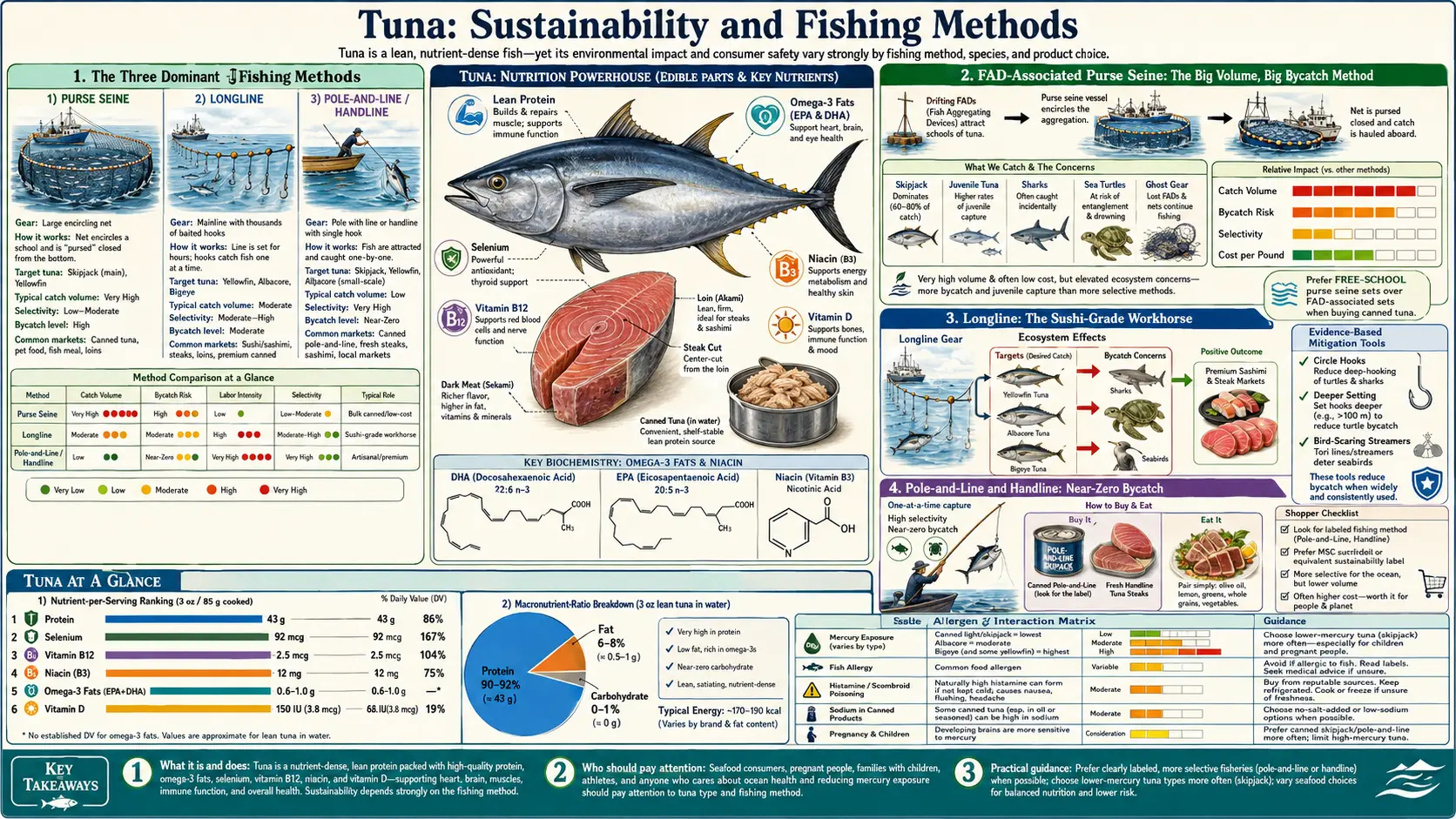
A 165 g can of skipjack tuna can represent radically different fishing footprints depending on how the fish was caught. Pole-and-line skipjack hooked one at a time by Maldivian fishermen has effectively zero bycatch. The same species caught with a purse seine set around a FAD (fish aggregating device) comes from a mixed school that can include juvenile yellowfin, juvenile bigeye, silky sharks (IUCN Vulnerable), and oceanic whitetip sharks (IUCN Critically Endangered). Longline-caught yellowfin or bigeye for sashimi grade can incur bycatch of sea turtles, albatrosses, and pelagic sharks at rates that have driven multiple species toward extinction. Eco-certification labels and seafood-rating programmes each summarise part of this picture. This deep-dive maps the fishing-method-to-bycatch landscape, explains what the fishing-method labels on canned tuna describe, and tracks the divergent trajectories of healthy skipjack stocks vs depleted and recovering bluefin stocks.
Table of Contents
- The Three Dominant Fishing Methods
- FAD-Associated Purse Seine: The Big Volume, Big Bycatch Method
- Longline: The Sushi-Grade Workhorse
- Pole-and-Line and Handline: Near-Zero Bycatch
- Stock Status by Species and Ocean
- The Bluefin Collapse and Recovery
- Eco-Certification, Seafood Ratings, and Dolphin-Safe Labels
- Fishing Methods and Labels on Canned Tuna
- Climate Change and Tuna Distribution Shifts
- Key Research Papers
- Connections
- Featured Videos
The Three Dominant Fishing Methods
Commercial tuna fisheries use one of three principal capture methods, each with very different selectivity and bycatch profiles:
- Purse seine — a vertical wall of net up to 2 km long that is set in a circle around a school of fish, then drawstring-closed at the bottom ("pursed") to enclose the catch. Accounts for ~64% of global tuna catch by weight. Almost all canned tuna in the US is purse-seine-caught. Two sub-types: free-school purse seine (low bycatch) and FAD-associated purse seine (high bycatch).
- Longline — a single main line up to 100 km long with thousands of baited hooks suspended from buoys. Accounts for ~14% of global tuna catch by weight but the dominant method for sashimi-grade yellowfin, bigeye, and bluefin. High bycatch of sea turtles, seabirds, and pelagic sharks.
- Pole-and-line and handline — individual fish caught one at a time on baited hooks attached to bamboo poles (the traditional Maldivian and Indonesian skipjack fishery) or single handlines (Philippines, Indonesia). Accounts for ~10% of global tuna catch. Near-zero bycatch (fish that are not the target are simply released).
The remaining ~12% of global catch comes from troll lines (lures dragged behind a boat — common for Pacific albacore), gillnets (banned in many jurisdictions but still used in some), and miscellaneous artisanal methods.
The bycatch ratio (kg of unwanted species per kg of target tuna) is the most important sustainability metric and varies by an order of magnitude across these methods.
FAD-Associated Purse Seine: The Big Volume, Big Bycatch Method
A FAD (Fish Aggregating Device) is a floating structure — historically a tied bundle of bamboo or netting, now typically a sophisticated buoy with satellite GPS and echo-sounder reporting school size below it — that drifts in the open ocean. Pelagic species, including tuna, instinctively congregate beneath floating objects. A modern industrial tuna fleet deploys 10,000-50,000 satellite-tracked drifting FADs worldwide. When a FAD's echo-sounder reports a sufficiently large school below it, the seiner is dispatched to set the net.
The efficiency is enormous — a single FAD set can yield 100+ tonnes of skipjack. The bycatch is correspondingly significant. The schools that aggregate under FADs are mixed: skipjack of catchable size are joined by juvenile yellowfin, juvenile bigeye, silky sharks (Carcharhinus falciformis, IUCN Vulnerable), oceanic whitetip sharks (Carcharhinus longimanus, IUCN Critically Endangered), mahi-mahi, wahoo, rainbow runners, and various billfish.
FAD fishing by purse seiners has come under increasing criticism for potential harm to tuna stocks, high levels of bycatch and threats to the biodiversity of tropical pelagic ecosystems. Critics argue that the juvenile yellowfin catch cuts off the next generation before the fish can reach reproductive maturity, and that the shark catch adds to the decline of tropical pelagic shark species.
A 2013 scientific review of drifting-FAD fishing by Dagorn and colleagues reached a more mixed view. It found that catching juvenile tuna around FADs “does not necessarily result in overfishing of stocks,” although more selective fishing techniques would likely help obtain higher yield, and that levels of non-tuna bycatch “are comparable to or less than in other commercial tuna fisheries and are primarily comprised of species that are not considered threatened.” The take of vulnerable species such as turtles and sharks could be further reduced by additional mitigation measures, the authors wrote, and “under appropriate management regimes, FAD fishing could be an ecologically and economically sensible fishing method.”
The RFMOs (Regional Fishery Management Organizations — IATTC for the Eastern Pacific, WCPFC for the Western and Central Pacific, ICCAT for the Atlantic, IOTC for the Indian Ocean) have implemented escalating FAD closures over the last decade. The current WCPFC FAD closure is approximately 3-4 months per year in the equatorial Pacific. Effects on stocks have been measurable; effects on bycatch species have been mixed.
Longline: The Sushi-Grade Workhorse
Longline fishing accounts for most sashimi-grade tuna. The economics: longline allows targeting of large individual fish (yellowfin, bigeye, bluefin) at the depth and temperature where they prefer to feed (typically 100-400 m for bigeye, surface for bluefin during certain seasons), without the schooling-behavior dependence that limits purse seine to surface-aggregating species.
The bycatch problem is severe. The species commonly hooked alongside tuna on a pelagic longline include:
- Sea turtles — loggerhead and leatherback turtles ingest baited hooks while attempting to eat the bait. Mitigation: circle hooks (rather than J-hooks) reduce mortality by ~60-80% because they tend to hook in the jaw rather than the throat. Mandatory in many Atlantic fisheries since 2004.
- Seabirds (albatrosses, petrels) — birds dive on baited hooks during line-setting and are dragged underwater. Multiple albatross species are IUCN Endangered or Critically Endangered largely due to longline bycatch. Mitigation: night-setting, weighted hooks, bird-scaring streamer lines ("tori lines").
- Pelagic sharks — blue sharks, mako sharks, thresher sharks, silky sharks, oceanic whitetips. Some are retained for shark fin trade; most are discarded dead or finned. Mitigation: shark-finning bans in most jurisdictions (often poorly enforced), retention requirements (must land sharks whole rather than finning at sea).
- Marlin and other billfish — striped marlin, blue marlin, sailfish. Many billfish stocks are overfished partly due to longline bycatch.
The total longline bycatch ratio varies widely by region and target species. Atlantic swordfish longliners can have bycatch ratios of 30-50% (more bycatch than target catch by weight). Yellowfin longliners in the Pacific are typically 10-20%.
For sashimi-grade yellowfin and bigeye, eco-certification labels and seafood-rating programmes assess longline fisheries on measures such as these: certified longline fisheries have implemented circle hooks, weighted hooks, night-setting, and bycatch monitoring at meaningful rates; uncertified fisheries usually have not.
Pole-and-Line and Handline: Near-Zero Bycatch
Pole-and-line fishing is the oldest commercial tuna method and the gold standard for selectivity. The technique: a bait fish (typically anchovies or sardines, kept live in tanks aboard the vessel) is broadcast over a school of tuna feeding at the surface to trigger a feeding frenzy. Fishermen positioned along the rail of the vessel use 2-4 m bamboo poles with barbless hooks and short lines to flip individual tuna out of the water onto the deck. The barbless hook allows the fish to drop free of the hook on the swing, ready for the next cast.
The Maldives, Indonesia, Japan, and several Pacific island nations operate substantial pole-and-line fleets. The Maldivian skipjack fishery is one of the largest fully eco-certified pole-and-line tuna fisheries globally.
Sustainability advantages:
- Near-zero bycatch — only fish that take the hook are caught; any non-target species can be released by lifting it over the rail and shaking the barbless hook free
- Size selectivity — the bait-broadcast and pole technique tends to attract larger surface-feeding tuna, avoiding the juvenile recruitment problem of FAD purse seine
- Lower carbon footprint per kg of tuna — vessels are smaller, voyages shorter, and there is no satellite-FAD infrastructure to maintain
- Higher local employment — pole-and-line vessels carry crews of 10-20 for a fraction of the catch volume of an industrial purse seiner with a crew of 30-40, so total employment per tonne of catch is much higher
Disadvantages:
- Higher cost — pole-and-line tuna is typically 20-40% more expensive at retail than purse-seine tuna
- Bait fish footprint — the live bait (anchovies, sardines) is itself a fishery with its own sustainability profile
- Limited scale — pole-and-line cannot meet global tuna demand at current consumption levels; if all tuna were required to be pole-caught, supply would fall ~85%
Some canned tuna sold in the US is labelled as pole-and-line caught.
Stock Status by Species and Ocean
The RFMOs publish annual stock assessments for each tuna stock. Current status (as of the 2023-2024 assessment cycle):
- Western and Central Pacific skipjack: Healthy. Biomass above maximum sustainable yield reference point. ~70% of global skipjack catch comes from this stock.
- Eastern Pacific skipjack: Healthy. Stable since 2017 with active FAD closure management.
- Indian Ocean skipjack: Healthy but flagged for caution. Recovery from recent overfishing.
- Atlantic skipjack: Healthy.
- Pacific yellowfin: Healthy at the stock level, but ~30% of the catch is juveniles taken on FAD sets — a recruitment concern that does not yet show in stock biomass numbers.
- Atlantic yellowfin: Slightly overfished. ICCAT implementing tightening quotas.
- Indian Ocean yellowfin: Overfished, no longer overfishing as of 2024 with current quotas.
- Pacific albacore: Healthy. North Pacific and South Pacific stocks both stable.
- Atlantic albacore: Recovering from prior overfishing. Now classified as not overfished and not subject to overfishing.
- Pacific bigeye: Overfished and overfishing continuing in the equatorial Pacific. Heavily impacted by FAD sets that catch juveniles.
- Atlantic bigeye: Overfished, overfishing reduced under recent ICCAT quotas.
- Atlantic bluefin (Western stock, Gulf of Mexico spawning): Severely depleted historically; recovering under strict ICCAT management. Currently classified as "rebuilding".
- Atlantic bluefin (Eastern stock, Mediterranean spawning): Rebuilt from collapse. Currently considered healthy.
- Pacific bluefin: Rebuilding. According to the WCPFC summary of the 2024 assessment, the stock fell to a historic low around 2010; by 2022 its breeding biomass (spawning stock biomass, SSB) reached 23.2% of the unfished level (about 144,000 t), it met the second rebuilding target of 20% of the unfished level in 2021, and it is not overfished and not subject to overfishing. IUCN moved Pacific bluefin from Vulnerable to Near Threatened in 2021, describing it then as still severely depleted at less than 5% of its original biomass.
- Southern bluefin: Overfished, recovering slowly. Moved from Critically Endangered to Endangered in the September 2021 IUCN Red List update.
The IUCN Red List, which rates extinction risk for whole species rather than for regional stocks, was updated for tunas in September 2021. Atlantic bluefin moved from Endangered to Least Concern, southern bluefin from Critically Endangered to Endangered, and Pacific bluefin from Vulnerable to Near Threatened; albacore and yellowfin both moved from Near Threatened to Least Concern. Bigeye remains Vulnerable and skipjack remains Least Concern. IUCN credited countries enforcing more sustainable fishing quotas and combatting illegal fishing, and noted that many regional stocks remain severely depleted: the larger, eastern Atlantic bluefin population, which originates in the Mediterranean, increased by at least 22% over the last four decades, while the smaller western Atlantic population, which spawns in the Gulf of Mexico, declined by more than half over the same period, and yellowfin continues to be overfished in the Indian Ocean.
A 2022 study in Science used the same Red List Index to track yearly changes in extinction risk for tunas, billfishes and sharks over 70 years. After about 58 years of increasing extinction risk, effective fisheries management has shifted the biodiversity loss curve for tunas and billfishes, while the curve continues to worsen for sharks, which the authors describe as “highly undermanaged.”
The headline summary: skipjack populations are doing well; yellowfin and albacore are mostly OK with regional exceptions; bigeye is a problem; bluefin remains a problem despite recovery in some stocks.
The Bluefin Collapse and Recovery
Atlantic bluefin tuna collapsed in the 1990s-2000s due to overfishing for the sushi market. The Western Atlantic stock (which spawns in the Gulf of Mexico) reached approximately 6% of its unfished biomass by 2003. ICCAT quotas had been chronically set above scientific advice, and IUU (illegal, unreported, unregulated) catch may have doubled the official landings. The Eastern Atlantic stock (Mediterranean spawning) faced similar trajectory.
The recovery story is one of the most striking modern fisheries-management success stories. In 2007, ICCAT adopted a strict 15-year recovery plan with tight quotas, electronic vessel monitoring, and improved catch documentation. The Eastern Atlantic stock recovered to its rebuilding target by approximately 2017 and is now classified as healthy. The Western Atlantic stock is recovering more slowly but has been on a rebuilding trajectory since the early 2010s.
Pacific bluefin is a different story. WCPFC and IATTC implemented joint quotas in 2014. According to the WCPFC summary of the 2024 assessment, after decades of high fishing pressure the stock fell to a historic low around 2010 and has since rebuilt strongly: by 2022 its breeding biomass reached 23.2% of the unfished level, more than ten times the 2010 low, and the assessment attributes much of this recovery to sustained reductions in fishing on small, young fish (ages 0–3). Aquaculture (ranching wild-caught juveniles in pens for 6-24 months) accounts for a significant fraction of bluefin reaching the market but does not relieve fishing pressure on the wild stock (since the ranched fish are wild-caught juveniles).
Southern bluefin (CCSBT-managed) is the most depleted of the three bluefin species; in its September 2021 Red List update IUCN moved it from Critically Endangered to Endangered. The CCSBT quota system has stabilized but not yet meaningfully rebuilt the stock.
Why some stocks fell further than others was analysed at the global level by Pons and colleagues (2017). Particularly for tunas, stocks were more depleted if they had high commercial value, were long-lived species, had small pre-fishing biomass and were subject to intense fishing pressure for a long time. Implementing and enforcing total allowable catches (TACs) had the strongest positive influence on rebuilding overfished tuna and billfish stocks; minimum size rules and seasonal closures also reduced fishing pressure, but stocks under TACs showed the fastest increase of biomass.
In short: canned skipjack comes from stocks assessed as healthy, while bluefin sashimi comes from stocks that are depleted or recovering, and some bluefin stocks have rebuilt under enforced quotas.
Eco-Certification, Seafood Ratings, and Dolphin-Safe Labels
Three kinds of certification or rating scheme dominate consumer-facing sustainability information on tuna:
- An eco-certification label. Independent third-party certification of fisheries against the certifier's fisheries standard. Audits stock status, ecosystem impact, and management effectiveness. Certified tuna fisheries include the Maldives pole-and-line skipjack, a fishing association's Pacific troll albacore, and several PNA (Parties to the Nauru Agreement) free-school purse seine skipjack fisheries. The framework requires bycatch monitoring and reduction commitments.
- A seafood-rating programme. Rates seafood by species, gear, and ocean region into three categories: “Best Choice” (green), “Good Alternative” (yellow) and a red category. For tuna specifically: most pole-and-line skipjack ratings are in the top category; FAD-set purse seine skipjack is typically in the middle category; longline yellowfin from various regions ranges from the middle to the red category; longline bigeye is largely red; bluefin is universally red.
- Dolphin-Safe label (run by an environmental group). Originated in response to the 1980s eastern tropical Pacific yellowfin fishery, where purse seiners set nets around schools of dolphins that swam above schools of yellowfin (the "dolphin set" tactic). Dolphin Safe certification prohibits dolphin sets and requires observer verification. The label is essentially universal on US-marketed canned tuna today. Limitation: Dolphin Safe does not address bycatch of other species (sharks, turtles, seabirds, juvenile tuna) and does not address stock status. A FAD-set purse seine skipjack can be Dolphin Safe certified while having significant other bycatch.
What each one covers: the eco-certification label audits a whole fishery (stock status, ecosystem impact and management); the seafood-rating programme rates each species, gear and ocean region separately; and the Dolphin-Safe label covers dolphin sets only, not other bycatch or stock status.
Fishing Methods and Labels on Canned Tuna
An environmental group's canned-tuna ranking has periodically assessed US canned tuna on how the fish was caught, on eco-certification and on how openly the sourcing is reported. The fishing-method terms that appear on cans and in such rankings describe:
- Pole-and-line: fish caught one at a time on baited hooks, with near-zero bycatch (see the pole-and-line section above). Used for skipjack and for Pacific albacore.
- Troll-caught: lures dragged behind a boat; common for Pacific albacore.
- FAD-free (free-school) purse seine: the net is set around a free-swimming school rather than around a fish aggregating device; free-school sets have lower bycatch than FAD sets.
- FAD-associated purse seine: the net is set around a drifting FAD, which gathers mixed schools that can include juvenile tuna and sharks (see the FAD section above).
- Eco-certified: the fishery has been audited by an independent certifier for stock status, ecosystem impact and management.
Environmental-group rankings and seafood-rating consumer guides are updated periodically, so their ratings change over time.
Pole-and-line skipjack costs more: about $3-5 per can against $1-2 for conventional FAD-purse-seine tuna.
Climate Change and Tuna Distribution Shifts
Tropical tuna species (skipjack, yellowfin, bigeye) are responding to ocean warming with measurable distribution shifts. The 2020s have seen accelerated movement of skipjack populations eastward across the equatorial Pacific, with consequences for the small island developing states (Tuvalu, Kiribati, Nauru, Solomon Islands, Federated States of Micronesia, Marshall Islands, Palau, Papua New Guinea) whose Exclusive Economic Zones (EEZs) generate substantial tuna license revenue under the Parties to the Nauru Agreement (PNA) Vessel Day Scheme.
Modeling by Bell et al. (2021) projects that by 2050, under a high greenhouse-gas emissions scenario (RCP 8.5), the total biomass of three tuna species in the waters of ten Pacific small island developing states could decline by an average of 13% (range −5% to −20%), because a greater proportion of the fish would occur in the high seas. For these island economies that could mean an average decline in purse-seine catch of 20% (range −10% to −30%), an average annual loss in regional tuna-fishing access fees of US$90 million, and reductions in government revenue of up to 13% for individual states. Under a lower-emissions scenario (RCP 4.5), the purse-seine catch from their waters is projected to fall by an average of only 3% (range −12% to +9%). The authors describe two pathways: greater reductions in greenhouse gas emissions, in line with the Paris Agreement, and the island states negotiating within the regional fisheries management organization to keep the benefits they receive from tuna today, whatever the effects of climate change on where the fish are. The geopolitical and food-security implications are significant.
For temperate tuna species (albacore, bluefin), warming is driving range expansion poleward. Atlantic bluefin are now caught regularly in Greenland and Iceland waters where they were essentially absent 30 years ago. Pacific bluefin distributional shifts are less well-characterized but follow similar patterns.
Climate adaptation in fisheries management is an active area of policy development. The PNA Vessel Day Scheme has been adapted to allow for shifting effort distribution; ICCAT and other RFMOs are developing climate-aware quota frameworks.
Key Research Papers
- Pons M, Branch TA, Melnychuk MC, et al. (2017). Effects of biological, economic and management factors on tuna and billfish stock status. Fish and Fisheries 18(1):1-21. — doi:10.1111/faf.12163
- Gilman E, Passfield K, Nakamura K (2014). Performance of regional fisheries management organizations: ecosystem-based governance of bycatch and discards. Fish and Fisheries 15(2):327-351. — doi:10.1111/faf.12021
- Dagorn L, Holland KN, Restrepo V, Moreno G (2013). Is it good or bad to fish with FADs? What are the real impacts of the use of drifting FADs on pelagic marine ecosystems? Fish and Fisheries 14(3):391-415. — doi:10.1111/j.1467-2979.2012.00478.x
- Hall MA, Roman M (2013). Bycatches and non-tuna catch in the tropical tuna purse seine fisheries of the world. FAO Fisheries and Aquaculture Technical Paper. — PubMed: Purse seine bycatch
- Watson JW, Epperly SP, Shah AK, Foster DG (2005). Fishing methods to reduce sea turtle mortality associated with pelagic longlines. Canadian Journal of Fisheries and Aquatic Sciences 62(5):965-981. — doi:10.1139/f05-004
- Lewison RL, Crowder LB, Wallace BP, et al. (2014). Global patterns of marine mammal, seabird, and sea turtle bycatch reveal taxa-specific and cumulative megafauna hotspots. PNAS 111(14):5271-6. — PubMed PMID: 24639512
- Block BA et al. (2005). Electronic tagging and population structure of Atlantic bluefin tuna. Nature 434(7037):1121-7. — PubMed PMID: 15858572
- Worm B, Davis B, Kettemer L, et al. (2013). Global catches, exploitation rates, and rebuilding options for sharks. Marine Policy 40:194-204. — doi:10.1016/j.marpol.2012.12.034
- Bell JD, Senina I, Adams T, et al. (2021). Pathways to sustaining tuna-dependent Pacific Island economies during climate change. Nature Sustainability 4(10):900-910 (Author Correction: Nature Sustainability 2023;6:1288). — doi:10.1038/s41893-021-00745-z
- Polacheck T (2006). Tuna longline catch rates in the Indian Ocean: did industrial fishing result in a 90% rapid decline in the abundance of large predatory species? Marine Policy 30(5):470-482. — doi:10.1016/j.marpol.2005.06.016
- Hilborn R et al. (2020). Effective fisheries management instrumental in improving fish stock status. PNAS 117(4):2218-2224. — PubMed PMID: 31932439
- Selden R, Pinsky M (2019). Climate change adaptation and spatial fisheries management. In: Predicting Future Oceans, pp. 207-214. — doi:10.1016/b978-0-12-817945-1.00023-x
- Juan-Jordá MJ, Murua H, Arrizabalaga H, Merino G, Pacoureau N, Dulvy NK (2022). Seventy years of tunas, billfishes, and sharks as sentinels of global ocean health. Science 378(6620):eabj0211. — PubMed PMID: 36356144
- IUCN (2021). Tuna species recovering despite growing pressures on marine life — IUCN Red List. Press release, 4 September 2021. — iucn.org press release
- Western and Central Pacific Fisheries Commission (WCPFC). Pacific bluefin tuna (extended summary), including the 2024 stock assessment. — wcpfc.int/node/149