Sardines — Low Mercury and Sustainability
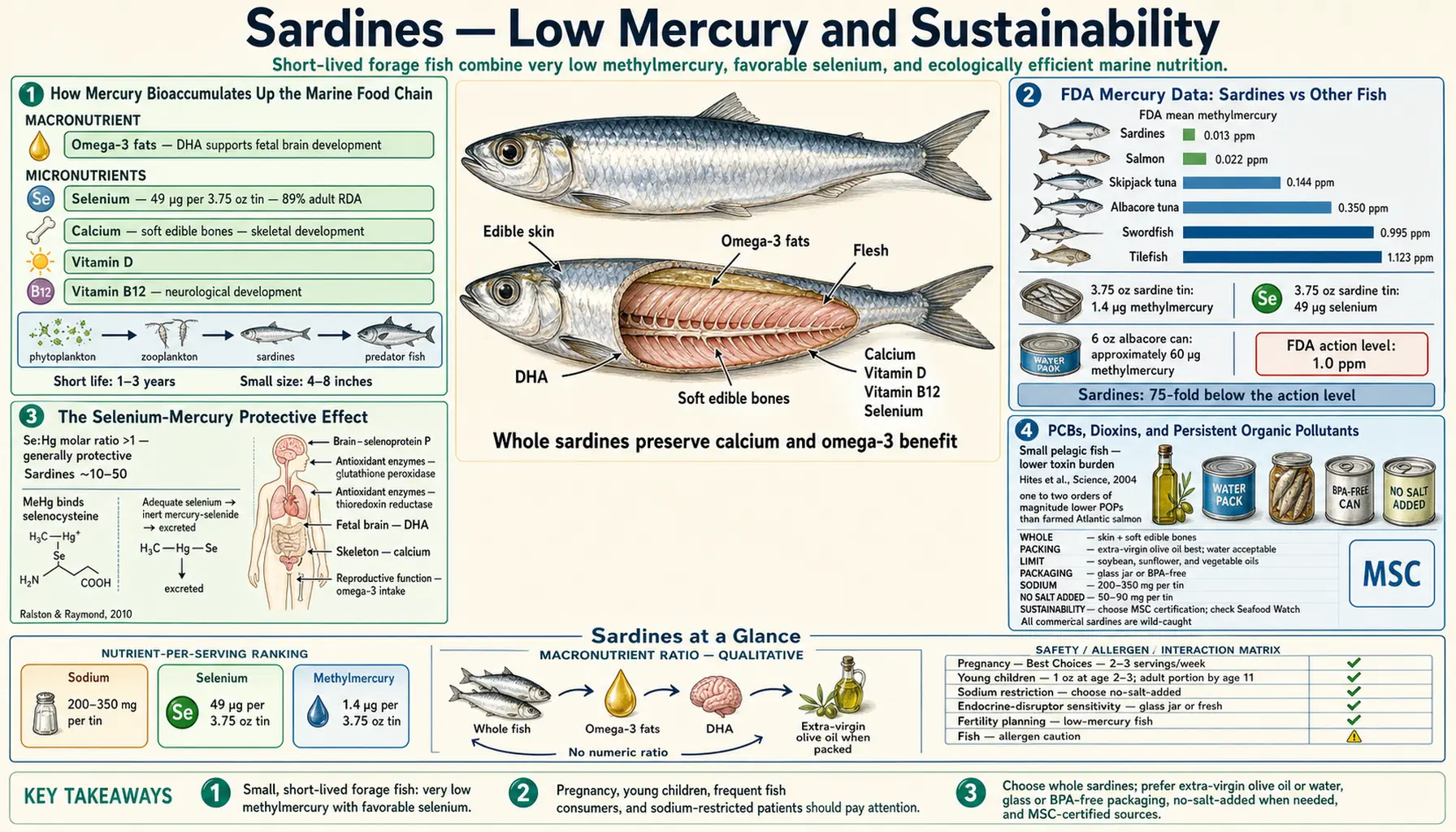
Sardines are small, fast-growing plankton-feeding fish that sit low in the marine food chain. In the FDA’s table of mercury levels in commercial fish and shellfish (1990–2012), sardines have a mean mercury concentration of 0.013 ppm — among the lowest values in the table, against 0.995 ppm for swordfish, 0.979 ppm for shark and 0.730 ppm for king mackerel. The FDA/EPA fish advice lists sardines among its “Best Choices”. Sardines are also rich in selenium, which research links to protection against methylmercury toxicity. The sustainability picture depends on the stock: NOAA Fisheries reports that the US Pacific sardine stock is overfished and that its directed commercial fishery has been closed since 2015. This page covers how mercury builds up in fish, the FDA figures, the selenium question, other contaminants (PCBs, microplastics, BPA in can linings), what the FDA/EPA advice says for pregnancy and childhood, stock status, and sodium content.
Table of Contents
- How Mercury Bioaccumulates Up the Marine Food Chain
- FDA Mercury Data: Sardines vs Other Fish
- The Selenium-Mercury Protective Effect
- PCBs, Dioxins, and Persistent Organic Pollutants
- Microplastics in Seafood
- Pregnancy and Childhood: What the FDA/EPA Advice Says
- Sustainability and Fishery Stock Status
- BPA in Can Linings — The Lingering Concern
- Sodium Content and Product Differences
- Key Research Papers
- Connections
- Featured Videos
How Mercury Bioaccumulates Up the Marine Food Chain
Mercury reaches the ocean from human sources such as coal combustion and gold mining as well as from natural geological emissions. Inorganic mercury deposited from the atmosphere is converted by microorganisms into methylmercury (MeHg) — the toxic form that accumulates in living tissue. Methylmercury binds to sulfur-containing groups in proteins, which is why it is held in fish muscle.
The key mechanism is biomagnification: predators eat many prey items over their lives and retain methylmercury faster than they eliminate it, so concentrations rise at each step up the food chain. Large, long-lived predators therefore carry the most; small plankton feeders carry the least.
Sardines are plankton feeders: NOAA Fisheries describes Pacific sardines as feeding on plankton (tiny floating plants and animals) and as prey for many fish, marine mammals and seabirds. They grow fast and reproduce at age 1 or 2; NOAA reports that Pacific sardines can live up to 13 years but usually not past 5. Their low position in the food chain is the main reason their mercury levels are low.
FDA Mercury Data: Sardines vs Other Fish
The FDA publishes a table of mercury concentrations in commercial fish and shellfish, compiled from FDA testing (and, for a few species, older National Marine Fisheries Service and Gulf of Mexico reports) between 1990 and 2012. Mean mercury concentrations from that table (ppm = parts per million = micrograms per gram):
- Tilefish (Gulf of Mexico) — 1.123 ppm (the highest mean in the table)
- Swordfish — 0.995 ppm
- Shark — 0.979 ppm
- King mackerel — 0.730 ppm
- Bigeye tuna (fresh/frozen) — 0.689 ppm
- Marlin — 0.485 ppm
- Yellowfin tuna (fresh/frozen) — 0.354 ppm
- Albacore tuna (canned) — 0.350 ppm
- Light tuna (canned) — 0.126 ppm
- Cod — 0.111 ppm
- Herring — 0.078 ppm
- Atlantic mackerel (North Atlantic) — 0.050 ppm
- Pollock — 0.031 ppm
- Salmon (fresh/frozen) — 0.022 ppm; canned salmon 0.014 ppm
- Anchovies — 0.016 ppm
- Sardines — 0.013 ppm (median 0.010 ppm, maximum 0.083 ppm, 90 samples, FDA 2002–2010)
- Tilapia — 0.013 ppm
- Shrimp — 0.009 ppm
- Scallops — 0.003 ppm (the lowest mean in the table)
For context, two regulatory reference points: the FDA’s compliance policy guide sets an action level of 1 ppm methylmercury (expressed as mercury, edible portion) for fish and shellfish, and the EPA’s IRIS assessment sets an oral reference dose for methylmercury of 1 × 10⁻⁴ mg/kg body weight per day (0.1 µg/kg/day), based on developmental neuropsychological effects. The sardine mean in the FDA table is far below the action level.
The Selenium-Mercury Protective Effect
Research summarized by Ralston and Raymond (2010) describes methylmercury as a highly specific, irreversible inhibitor of selenium-dependent enzymes (selenoenzymes), which protect the brain and neuroendocrine tissues against oxidative damage. Mercury binds selenium up to a million times more strongly than it binds sulfur, its next-best partner, so methylmercury sequesters selenium and impairs these enzymes. In animal studies, mercury exposures that are neurotoxic or lethal on low-selenium diets are far less serious on normal selenium intakes.
For this reason researchers look at the selenium-to-mercury molar balance of a food, not only its mercury content. Ralston and Raymond note that studies of mothers exposed to foods containing mercury in molar excess of selenium — such as shark or pilot whale meat — found adverse child outcomes, while studies of populations eating selenium-rich ocean fish observed improved child IQ instead of harm. They also note that freshwater fish depend on local soil selenium, so high-mercury fish from selenium-poor regions may be a concern.
Sardines are a rich selenium source: the USDA FoodData Central record for Atlantic sardines canned in oil (drained, with bone) lists 52.7 µg selenium per 100 g, alongside the low mercury figure above. A species-by-species selenium-to-mercury ratio for sardines is not reported in the sources cited on this page.
PCBs, Dioxins, and Persistent Organic Pollutants
Polychlorinated biphenyls (PCBs), polybrominated diphenyl ethers (PBDEs), dioxins and other persistent organic pollutants (POPs) are fat-soluble and accumulate in fatty tissues through the food chain.
The 2004 Hites et al. study in Science analyzed over 2 metric tons of farmed and wild salmon from around the world and found organochlorine contaminant concentrations significantly higher in farmed salmon than in wild salmon, with European-raised salmon carrying greater loads than salmon raised in North and South America. The authors’ risk analysis indicated that consumption of farmed Atlantic salmon may pose health risks that detract from the benefits of fish consumption. That study measured salmon; it did not measure sardines.
A broader 2006 review in JAMA (Mozaffarian and Rimm) concluded that levels of dioxins and PCBs in fish are low and that their potential carcinogenic and other effects are outweighed by the potential benefits of fish intake, with regional advisories relevant mainly for locally caught freshwater fish.
Microplastics in Seafood
Microplastic contamination of seafood is a recent research field, and measurement methods vary. Fish-specific data for sardines are not covered by the studies cited on this page.
One measured comparison comes from shellfish: Catarino et al. (2018) counted microplastics in wild and caged mussels around Scotland and estimated human intake from eating mussels at 123 particles per person per year in the UK, up to 4,620 in countries with higher shellfish consumption. By comparison, they estimated exposure to plastic fibres falling from household dust onto a meal at 13,731–68,415 particles per person per year, and concluded that ingestion via mussels is minimal next to that household source.
The health significance of dietary microplastic ingestion remains uncertain.
Pregnancy and Childhood: What the FDA/EPA Advice Says
The FDA and EPA jointly publish advice about eating fish for those who might become or are pregnant or breastfeeding and for children ages 1–11 (first issued in 2017, revised October 2021). The advice sorts fish into “Best Choices”, “Good Choices” and “Choices to Avoid” based on mercury levels. Examples from its lists:
- Best Choices — sardine, salmon, anchovy, herring, Atlantic mackerel, cod, pollock, tilapia, shrimp, scallop, oyster, clam, freshwater trout, catfish, canned light tuna (includes skipjack)
- Good Choices — albacore/white tuna (canned and fresh/frozen), yellowfin tuna, mahi mahi, halibut, Chilean sea bass, snapper, grouper, monkfish
- Choices to Avoid (highest mercury levels) — king mackerel, marlin, orange roughy, shark, swordfish, tilefish (Gulf of Mexico), bigeye tuna
For pregnancy and breastfeeding, the advice defines a serving as 4 ounces and states 2 to 3 servings a week from the “Best Choices” list (or 1 serving from the “Good Choices” list). It notes that the Dietary Guidelines for Americans recommend that those who are pregnant or breastfeeding consume 8 to 12 ounces of a variety of lower-mercury seafood per week, and that fish provide omega-3 fats (DHA and EPA), iron, iodine and choline that support a child’s brain development.
For children, the advice gives average serving sizes of about 1 ounce at age 1–3, 2 ounces at age 4–7, 3 ounces at age 8–10 and 4 ounces at age 11, and 2 servings a week from the “Best Choices” list. Sardines are also named in its shorter list of “Best Choices” that are even lower in mercury, which the Dietary Guidelines reference for children eating the higher amounts of fish they describe.
In the UK ALSPAC cohort of 11,875 pregnant women (Hibbeln et al., 2007), maternal seafood intake below 340 g per week was associated with a higher risk of children scoring in the lowest quartile for verbal IQ and of suboptimal scores for prosocial behaviour, fine motor, communication and social development; this was an observational study. A 2011 review by Mahaffey et al. notes that it is possible to choose fish species that are both high in n-3 fatty acids and low in methylmercury.
Sustainability and Fishery Stock Status
Sardine stocks are assessed by fishery agencies region by region, and their status differs:
- Pacific sardine (US West Coast) — NOAA Fisheries reports the stock as overfished (2025 stock assessment) but not subject to overfishing. Directed commercial fishing stops when the population falls below 150,000 metric tons; the latest estimate is below that level, the fishery closed in 2015 and has not reopened, and a rebuilding plan targets 2035. NOAA notes that the population naturally goes through large boom-bust swings in abundance.
- Japanese sardine (Sardinops melanostictus, Northwest Pacific) — a 2024 stock-assessment study using fishery data from 2014–2022 (Shi et al.) found abundance gradually increasing and judged the stock to be in a sustainable, recovering state.
- Sardinella (Northwest Africa) — a 2024 study of the Canary Current system from Morocco to Senegal (Sarre et al.) describes the region’s small pelagic stocks as recently overexploited and reports climate-linked northward shifts in their distribution; the flat sardinella stock in Senegal has been described as highly exploited (Ba et al., 2016).
- European pilchard (Sardina pilchardus) — assessed as separate stocks by European fishery bodies; their status is not covered by the sources cited on this page.
Sardines are forage fish — species eaten by larger fish, marine mammals and seabirds. A synthesis of 72 ecosystem models (Pikitch et al., 2014) estimated that forage fish contribute about $16.9 billion a year to global fisheries value (20% of the ex-vessel value of all marine catches), of which the forage fisheries themselves account for $5.6 billion and the predator fisheries they support $11.3 billion. A separate analysis of global landings from 1950 to 2010 (Cashion et al., 2017) found that 27% of reconstructed marine landings went to uses other than direct human consumption, mainly fishmeal and fish oil, and that 90% of those fish were food-grade or prime food-grade — findings the authors present as bearing on how fish are used to feed people.
BPA in Can Linings — The Lingering Concern
Bisphenol A (BPA) is a high-volume industrial chemical used in polycarbonate plastics and in the epoxy resins that have historically lined food cans. A 2007 review (Vandenberg et al.) compiled studies of BPA released from consumer products and of BPA levels in human tissues and fluids, and reported that measured human levels were higher than the concentrations that stimulate molecular endpoints in cell studies and within an order of magnitude of those that cause effects in animal models.
Canned sardines can therefore carry some BPA from the lining unless the can uses a non-BPA lining; lining types vary between products and are not always stated on the label. Cans sold as “BPA-free” use alternative resins or other bisphenols, whose long-term safety has been studied less than BPA’s. Sardines are also sold fresh and in glass jars, which do not have a can lining.
Endocrine disruptors are covered in more detail on the Bisphenol A page and in the Toxins index.
Sodium Content and Product Differences
The USDA FoodData Central record for Atlantic sardines canned in oil (drained solids with bone) lists 307 mg sodium per 100 g; sodium varies between products, including “no salt added” versions. The FDA notes that the Dietary Guidelines for Americans recommend that adults limit sodium to less than 2,300 mg per day, and that Americans eat on average about 3,400 mg per day. Sodium content is most relevant to people on sodium-restricted diets, such as those with heart failure, hypertension or advanced kidney disease.
Other ways canned sardines differ:
- Packing medium — sardines are packed in olive oil, other vegetable oils, water, or sauces such as tomato sauce; the oil adds its own fatty-acid profile to the product.
- Species — some labels name the species (for example Sardina pilchardus, Sardinops sagax or the related sprat, Sprattus sprattus); others say only “sardines”.
- Skinless and boneless vs whole — the USDA calcium value of 382 mg per 100 g and its omega-3 values (EPA 0.473 g and DHA 0.509 g per 100 g) are for sardines canned with bone; skinless, boneless products are a different food and their values differ.
Key Research Papers
- Mahaffey KR et al. (2011). Balancing the benefits of n-3 polyunsaturated fatty acids and the risks of methylmercury exposure from fish consumption. Nutrition Reviews. — PubMed PMID: 21884130
- Hites RA et al. (2004). Global assessment of organic contaminants in farmed salmon. Science. — PubMed PMID: 14716013
- Ralston NVC, Raymond LJ (2010). Dietary selenium's protective effects against methylmercury toxicity. Toxicology. — PubMed PMID: 20561558
- FDA / EPA (2017, updated). Advice About Eating Fish for Those Who Might Become or Are Pregnant or Breastfeeding and Children Ages 1-11 Years. — fda.gov: Advice about Eating Fish
- Mozaffarian D, Rimm EB (2006). Fish intake, contaminants, and human health: evaluating the risks and the benefits. JAMA. — PubMed PMID: 17047219
- Choi AL et al. (2009). Methylmercury exposure and adverse cardiovascular effects in Faroese whaling men. Environmental Health Perspectives. — PubMed PMID: 19337510
- Hibbeln JR et al. (2007). Maternal seafood consumption in pregnancy and neurodevelopmental outcomes in childhood (ALSPAC study). The Lancet. — PubMed PMID: 17307104
- Vandenberg LN et al. (2007). Human exposure to bisphenol A (BPA). Reproductive Toxicology. — PubMed PMID: 17825522
- Cordier S et al. (2002). Neurodevelopmental investigations among methylmercury-exposed children in French Guiana. Environmental Research. — PubMed PMID: 12051779
- Catarino AI et al. (2018). Low levels of microplastics (MP) in wild mussels indicate that MP ingestion by humans is minimal compared to exposure via household fibres fallout during a meal. Environmental Pollution. — PubMed PMID: 29604577
- Pikitch EK et al. (2014). The global contribution of forage fish to marine fisheries and ecosystems. Fish and Fisheries. — doi:10.1111/faf.12004
- Domingo JL (2007). Omega-3 fatty acids and the benefits of fish consumption: is all that glitters gold? Environment International. — PubMed PMID: 17540446
- FDA. Mercury Levels in Commercial Fish and Shellfish (1990–2012). U.S. Food and Drug Administration. — fda.gov: Mercury Levels in Commercial Fish and Shellfish
- FDA. CPG Sec. 540.600 Fish, Shellfish, Crustaceans and Other Aquatic Animals — Fresh, Frozen or Processed — Methyl Mercury. Compliance Policy Guide. — fda.gov: CPG Sec. 540.600
- U.S. EPA (2001). Methylmercury (MeHg); CASRN 22967-92-6. Integrated Risk Information System (IRIS), oral reference dose. — iris.epa.gov: Methylmercury
- USDA Agricultural Research Service. Fish, sardine, Atlantic, canned in oil, drained solids with bone (SR Legacy, FDC ID 175139). FoodData Central. — FoodData Central: FDC ID 175139
- NOAA Fisheries. Pacific Sardine species profile (population status, biology, harvest). — fisheries.noaa.gov: Pacific Sardine
- FDA. Sodium in Your Diet. U.S. Food and Drug Administration. — fda.gov: Sodium in Your Diet
- Cashion T, Le Manach F, Zeller D, Pauly D (2017). Most fish destined for fishmeal production are food-grade fish. Fish and Fisheries 18:837–844. — doi:10.1111/faf.12209
- Shi Y, Han Q, Zhang S, et al. (2024). Seasonal spatio-temporal model improves refined stock assessment and management of Japanese sardine (Sardinops melanostictus) in the Northwest Pacific Ocean. Animals (Basel) 14(23):3434. — PubMed PMID: 39682399
- Sarre A, Demarcq H, Keenlyside N, et al. (2024). Climate change impacts on small pelagic fish distribution in Northwest Africa: trends, shifts, and risk for food security. Scientific Reports 14:12684. — PubMed PMID: 38830920
- Ba K, Thiaw M, Lazar N, et al. (2016). Resilience of key biological parameters of the Senegalese flat sardinella to overfishing and climate change. PLoS One 11(6):e0156143. — PubMed PMID: 27280629
PubMed Topic Searches
Connections
- All Food
- Sardines Overview
- Sardines Benefits Hub
- Sardines — Calcium & Bones
- Sardines — Omega-3 Density
- Sardines — Vitamin D & B12
- Mercury
- Bisphenol A (BPA)
- PCBs
- Microplastics
- All Toxins
- Selenium
- Salmon
- Herring
- Tuna
- Cod
- Neurology
- History
- Nutrients