Organ Meats: History and Origins
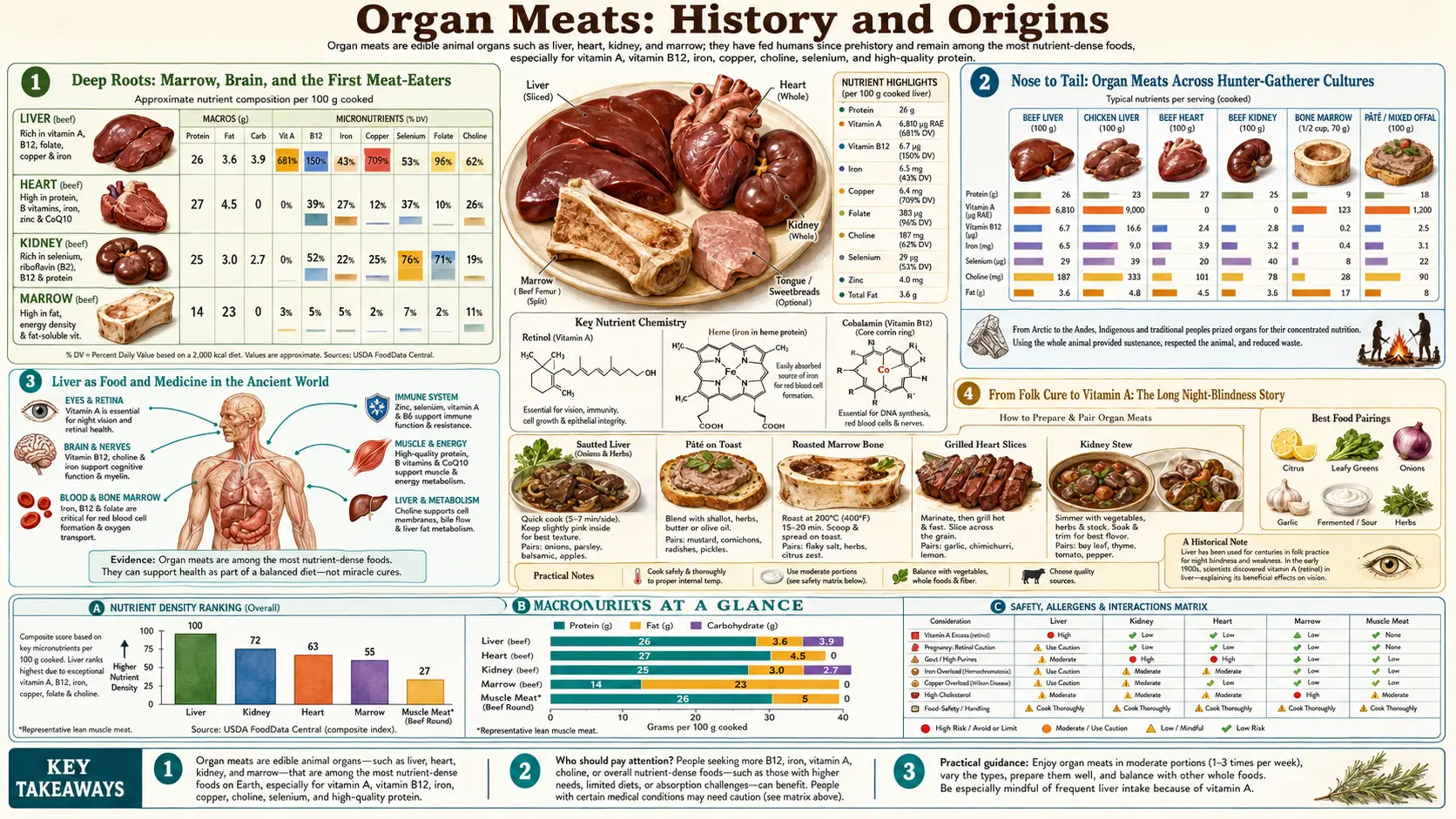
Organ meats — liver, heart, kidney, brain, tongue, marrow, and the rest of what butchers call offal — are among the oldest foods our species has eaten, and for most of human history they were not the leftovers but the prize. Long before anyone understood vitamins, hunter-gatherers cracked bones for their fatty marrow and ate the organs of their kills first; ancient Egyptian, Babylonian, Greek, and Roman healers prescribed liver as both food and medicine for the disease we now call night blindness; and in 1926 two Boston physicians, George Minot and William Murphy, showed that feeding patients large amounts of liver could reverse pernicious anemia, a discovery that helped earn a share of the 1934 Nobel Prize and ultimately led to vitamin B12. Only in the last century did offal slip from the centre of the Western plate toward its margins — and only in recent decades has "nose-to-tail" eating begun to bring it back. This page follows what the archaeological, historical, and scientific record actually supports, and flags clearly where a claim is folk tradition rather than settled science.
Table of Contents
- Deep Roots: Marrow, Brain, and the First Meat-Eaters
- Nose to Tail: Organ Meats Across Hunter-Gatherer Cultures
- Liver as Food and Medicine in the Ancient World
- From Folk Cure to Vitamin A: The Long Night-Blindness Story
- The 1926 Liver Cure for Pernicious Anemia
- From Liver Extract to Vitamin B12
- The Modern Decline of Offal in the West
- The Nose-to-Tail Revival
- Research Papers and References
- Connections
- Featured Videos
Deep Roots: Marrow, Brain, and the First Meat-Eaters
The human relationship with organ meats is older than our own species. Long before modern Homo sapiens appeared, early hominins in Africa were getting nourishment from the insides of animal carcasses. At sites in East Africa's Olduvai Gorge, butchered animal bones dated to nearly two million years ago show that early hominins ate many parts of carcasses, including internal organs and the brain. A common view among researchers is that some of our early ancestors acted in part as scavengers, using stone tools to smash open the long bones and skulls that big cats and other predators could not, in order to reach the fat-rich marrow and brain inside.
This matters because marrow and brain are not lean muscle — they are dense in fat and calories, exactly the kind of high-energy food that would have been precious to a small-brained, hard-pressed hominin. The picture that emerges from the archaeology is that the earliest deliberate eating of animal tissue was not steak-style muscle meat at all, but the soft, fatty, organ-and-marrow fraction of the carcass that other scavengers left behind.
Evidence of how carefully these foods were treated turns up much later, too. Research at Qesem Cave in Israel reported that, roughly 400,000 years ago, Paleolithic people there appear to have saved animal limb bones — with the marrow still sealed inside under the skin — for up to several weeks before cracking them open, in effect treating marrow bones like long-life "cans of soup." Whether the interpretation of delayed consumption holds up to further study or not, the butchery evidence makes the central point: marrow and organs were valued, planned-for foods deep in prehistory, not afterthoughts.
Nose to Tail: Organ Meats Across Hunter-Gatherer Cultures
When anthropologists have studied hunting-and-gathering peoples in the modern era, one pattern recurs again and again: when an animal is killed, very little is wasted, and the organs are often eaten first or reserved for those who need them most. Liver, heart, kidney, brain, tongue, marrow, and fat depots were widely prized rather than discarded. Eating an animal "from nose to tail" — muscle, organs, marrow, and more — was, for most of human history, simply how people ate meat, both because nothing could be wasted and because the organs were recognised as especially sustaining.
There are good practical reasons for this. Organ meats are, gram for gram, among the most nutrient-dense foods available without agriculture: liver in particular is extraordinarily rich in vitamin A, vitamin B12, iron, copper, and folate, while marrow and brain supply concentrated fat. For people relying on lean wild game — whose muscle meat can be very low in fat — the fatty and vitamin-rich organs were not a delicacy so much as a nutritional necessity, helping to round out a diet that lean meat alone could not.
It is worth being careful here. Popular "ancestral" and modern dietary writing sometimes claims that early peoples discarded muscle meat in favour of organs, or assigns very specific rankings to which organ was most valued by which tribe. The well-supported core — that organ meats and marrow were broadly prized and routinely eaten across hunter-gatherer cultures — is solid and is reflected in the ethnographic and archaeological record. Sweeping claims that muscle was generally thrown away are not reliably established and should be treated as overstatement rather than settled fact.
Liver as Food and Medicine in the Ancient World
As civilisations rose, liver kept its special status — not only as a food but as a recognised medicine. The clearest thread runs through the treatment of what we now call night blindness (difficulty seeing in dim light), a condition the ancient world knew well and tried to cure with animal liver. The remedy turns up independently across the great early medical traditions, an unusually long-lived piece of practical knowledge.
In Egypt, the famous Ebers Papyrus (about 1500 BC) recommended roasted ox liver, pressed and applied to the eyes, for the condition, and an earlier Egyptian text, the Kahun Papyrus (about 1825 BC), points to liver use as well. Assyrian and Babylonian medical texts from around the early first millennium BC similarly prescribed liver for night blindness, even while attributing the disease to causes such as moonlight. The Greeks shifted the emphasis from applying liver to the eyes toward eating it — the physician Hippocrates (about 460–370 BC) is credited with recommending the consumption of liver, often described as raw liver taken with honey, as a cure.
The Roman world carried the tradition forward. The hugely influential Greek-Roman physician Galen (about AD 130–210) advocated the continued eating of liver, including goat liver, for failing night vision. None of these healers knew anything about vitamins — that concept lay roughly two thousand years in the future — but their persistent, cross-cultural use of liver shows they had grasped, empirically, that something in this particular organ could prevent or cure a specific disease. They were right for reasons they could not yet explain.
From Folk Cure to Vitamin A: The Long Night-Blindness Story
For most of recorded history the liver cure for night blindness remained exactly that — a remedy that worked, handed down without an explanation. Outbreaks of night blindness continued to be noticed and linked to diet in the 18th and 19th centuries by various European observers, but the underlying mechanism stayed a mystery. The empirical knowledge survived for millennia precisely because it kept producing results, even though no one could say why liver helped.
The explanation finally arrived in the early 20th century with the discovery of the fat-soluble vitamins. Researchers studying animal diets identified a fat-soluble growth factor — eventually named vitamin A — and went on to connect a deficiency of it to eye problems including night blindness and the more severe drying of the eye known as xerophthalmia. Liver, it turned out, is one of the body's main storage sites for vitamin A, which is exactly why eating animal liver had relieved the condition for the Egyptians, Greeks, and Romans. The ancient remedy and the modern science finally met.
This is one of the cleaner examples in the history of nutrition of a folk practice being vindicated and then explained by laboratory work. It is important, though, to keep the two apart: the ancients had a reliable treatment, not an understanding. The leap from "eat liver to cure night blindness" to "night blindness is caused by a deficiency of vitamin A, which liver happens to store" was the achievement of 20th-century biochemistry, building on, but going far beyond, what any ancient healer knew.
The 1926 Liver Cure for Pernicious Anemia
The most dramatic chapter in the medical history of organ meats concerns a different, far deadlier disease: pernicious anemia. For a long time this was an invariably fatal illness — patients slowly wasted as their bodies failed to make healthy red blood cells, and there was no cure. The breakthrough came, once again, from liver, and it unfolded in two stages.
First, the pathologist George Hoyt Whipple (1878–1976), studying anemia produced in dogs by repeated bleeding, found that a diet rich in liver stimulated the regeneration of their blood. Building on that lead, two Boston physicians, George Richards Minot (1885–1950) and William Parry Murphy (1892–1987), tried feeding large amounts of liver to people with pernicious anemia. In 1926 they published a landmark report describing how a diet centred on roughly half a pound of raw or lightly cooked liver per day produced striking, life-saving improvement in a series of patients (their study followed 45 cases). A disease that had been a death sentence could now be controlled with food.
The achievement was recognised at the highest level. The Nobel Prize in Physiology or Medicine for 1934 was awarded jointly to Whipple, Minot, and Murphy — in the words of the Nobel citation, "for their discoveries concerning liver therapy in cases of anæmia." It remains one of the clearest instances of a Nobel-honoured medical advance that began, quite literally, on the dinner plate. Eating liver in such quantity was unpleasant for patients, however, which immediately spurred the search for a more practical form of the treatment.
From Liver Extract to Vitamin B12
Feeding very sick people half a pound of raw liver a day was effective but hard to sustain, so chemists set out to capture whatever in the liver was doing the work. Working with the biochemist Edwin Cohn, Minot helped develop concentrated liver extracts that delivered the active principle in a far smaller, more tolerable dose. These extracts — taken by mouth and later given by injection — became the mainstay of pernicious-anemia treatment for years, sparing patients the ordeal of the raw-liver diet while keeping them alive.
The final step was to identify the active substance itself. In 1948, the red crystalline factor responsible was isolated from liver, essentially simultaneously, by two independent teams: one led by Karl Folkers at Merck in the United States, and one led by Ernest Lester Smith at Glaxo in Britain. The substance was named vitamin B12. Its complex structure was later worked out by the crystallographer Dorothy Hodgkin and colleagues using X-ray methods, an accomplishment that contributed to Hodgkin's own Nobel Prize in Chemistry in 1964.
So the long arc that began with hunter-gatherers eating liver, and ran through Minot and Murphy's 1926 raw-liver cure, ended with a precisely defined vitamin. Pernicious anemia is caused by an inability to absorb vitamin B12, a nutrient that is abundant in liver and other animal foods — which is why eating liver worked all along. Today the condition is treated directly with B12 rather than with organ meat, but the vitamin was found because liver cured the disease first.
The Modern Decline of Offal in the West
Given how central organ meats once were — nutritionally, culturally, and even medically — their retreat from the modern Western plate is striking. For most of history, thrift alone guaranteed that offal was eaten: an animal was too valuable to waste, and liver, kidney, heart, tripe, and the rest appeared regularly in traditional cooking across Europe and beyond. Dishes built on organ meats — from liver and onions to steak-and-kidney pie to blood sausage — were ordinary fare, not curiosities.
Over the 20th century, and especially after mid-century, that changed in much of the English-speaking world and other wealthy regions. Rising affluence and the industrialisation of meat made boneless muscle cuts cheap and abundant, so the old economic pressure to use every part of the animal faded. At the same time, offal increasingly came to be seen as poverty food or as squeamish "guts," with strong tastes and textures that drifted out of fashion. Organ meats slid from everyday staple toward something many Western shoppers rarely buy or cook.
It is fair to note that this decline was uneven and is partly a Western, modern phenomenon. Many of the world's food cultures never abandoned offal at all: liver, tripe, heart, tongue, blood, and other organs remain prized, everyday ingredients across large parts of Asia, Africa, Latin America, the Middle East, and southern and eastern Europe. The "disappearance" of organ meats is best understood as a shift in particular affluent cultures over roughly the last hundred years, not a global abandonment of a food humans have always eaten.
The Nose-to-Tail Revival
In recent decades, organ meats have begun a comeback in the very Western food cultures that had set them aside. The rallying idea is "nose-to-tail" eating — the principle that if an animal is raised and killed for food, it is more honest, more sustainable, and less wasteful to use the whole carcass, organs and all, rather than only the prime cuts. The phrase became closely associated with a wave of chefs and writers who championed cooking with offal and made dishes built on liver, heart, marrow, and other organs fashionable again on restaurant menus.
Several currents feed this revival. Concerns about food waste and the environmental cost of meat make using the whole animal newly appealing. Interest in traditional, regional, and "ancestral" ways of eating has drawn fresh attention to organ meats' remarkable nutrient density — particularly liver's concentration of vitamin A, B12, iron, and other micronutrients. Marrow bones, once humble, have reappeared on menus and in bone-broth recipes, and even desiccated-liver and other organ supplements have found a modern market.
The honest summary is that organ meats are enjoying renewed interest rather than a full return to their former everyday role; for most Western households they remain occasional rather than staple foods. Their genuine nutritional value is real and well-documented, but offal also concentrates certain nutrients so strongly — vitamin A in liver being the classic example — that moderation matters, which is one reason these foods are best understood as a powerful occasional addition to the diet. How organ meats actually fit into healthy eating today — their nutrients, benefits, and sensible limits — is taken up on the companion Organ Meats Benefits articles and on the main Organ Meats page. Nothing here is medical or dietary advice; this has been the long story of where these foods came from, told as plainly as the record allows.
Research Papers and References
The list below combines historical and scientific sources on organ-meat consumption, the liver cure for night blindness, and the liver-therapy work on pernicious anemia, together with curated PubMed topic-search links and reputable reference pages. Author names, titles, and journals are given as plain text; only the stable DOI, PMID, or archive link is hyperlinked, and each opens in a new tab. Where the article above describes folk practice or an actively debated point, that uncertainty is stated in the text rather than hidden in the citations.
- Minot GR, Murphy WP. Treatment of pernicious anemia by a special diet. Journal of the American Medical Association. 1926;87(7):470-476. — doi:10.1001/jama.1926.02680070016005
- The Nobel Prize in Physiology or Medicine 1934 — George H. Whipple, George R. Minot, William P. Murphy, "for their discoveries concerning liver therapy in cases of anaemia." The Nobel Foundation. — NobelPrize.org — 1934 Medicine
- Whipple GH, Robscheit-Robbins FS. Blood regeneration in severe anemia. II. Favorable influence of liver, heart and skeletal muscle in diet. American Journal of Physiology. 1925;72(3):408-418. — doi:10.1152/ajplegacy.1925.72.3.408
- Bin Saeedan A, et al. (review). Night blindness and ancient remedy. Saudi Journal of Ophthalmology / historical review. — PMC4348990
- Wolf G. A historical note on the mode of administration of vitamin A for the cure of night blindness. American Journal of Clinical Nutrition. 1978;31(2):290-292. — PMID: 341683
- Stargardt-era and historical review: historical aspects of the major neurological vitamin deficiency disorders — fat-soluble vitamin A. Handbook of Clinical Neurology. 2010. — PMID: 19892132
- Blasco R, et al. Bone marrow storage and delayed consumption at Middle Pleistocene Qesem Cave, Israel. Science Advances. 2019;5(10):eaav9822. — doi:10.1126/sciadv.aav9822
- Pobiner B. Meat-eating among the earliest humans. American Scientist. 2016;104(2):110. — doi:10.1511/2016.119.110
- History of pernicious anemia and liver therapy — PubMed: liver therapy and pernicious anemia history
- Vitamin B12 isolation and history — PubMed: vitamin B12 isolation and history
- Organ meats, offal, and nutrient density — PubMed: organ meat and offal nutrient density
- Vitamin A, liver, and night blindness — PubMed: vitamin A, liver and night blindness
External Authoritative Resources
- NobelPrize.org — Physiology or Medicine 1934 (Whipple, Minot & Murphy, liver therapy)
- NIH Office of Dietary Supplements — Vitamin B12 fact sheet
- NIH Office of Dietary Supplements — Vitamin A fact sheet