Dark Chocolate — Benefits Deep Dive
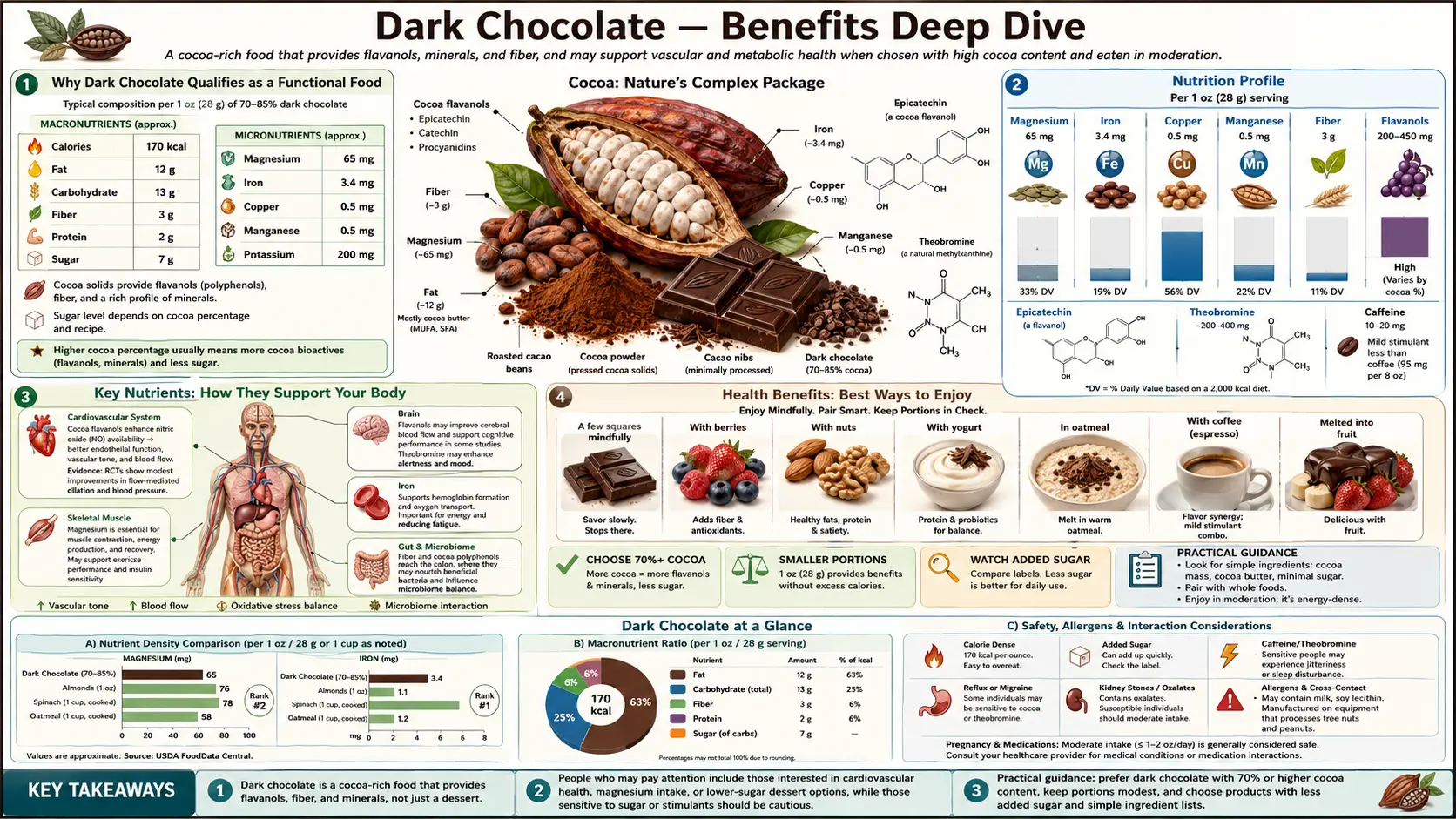
Dark chocolate is the rare confection that registers as a legitimate functional food. The active molecules — cocoa flavanols (principally epicatechin), a substantial dose of magnesium and iron per ounce, theobromine as a longer-acting alternative to caffeine, and phenylethylamine (PEA) as an endogenous mood molecule — were all on the research bench long before the marketing arrived. Four benefit pages below trace where the science is strongest (flavanol-driven endothelial nitric oxide production and blood pressure reduction), where the mineral story is meaningful but easy to misread (iron content sounds impressive but is non-heme and modestly absorbed; magnesium content is the more useful claim), where consumer choices actually move the dose (cacao percentage, added sugar, alkalization losses), and where the cultural mythology overshoots the data (the mood-and-PEA story is real but smaller than chocolate marketing implies).
Deep-Dive Articles
Flavanols & Endothelial Function
The best-validated benefit. Cocoa epicatechin activates endothelial nitric oxide synthase (eNOS), raising plasma nitric oxide, dilating vessels, and producing small blood pressure reductions in meta-analyses of randomized trials (a 2017 Cochrane review: about 1.8 mmHg systolic overall, about 4 mmHg in people with high blood pressure). The COSMOS trial (COcoa Supplement and Multivitamin Outcomes Study, 21,442 older adults, American Journal of Clinical Nutrition 2022) gave a 500 mg/day cocoa flavanol extract for a median 3.6 years: its primary outcome, total cardiovascular events, was not significantly reduced (hazard ratio 0.90, P=0.11), while cardiovascular death, a secondary endpoint, was 27% lower.
Read the deep dive →Iron, Magnesium & Mineral Content
One ounce (28 g) of 70-85% dark chocolate delivers ~3.4 mg iron (19% Recommended Dietary Allowance, RDA), ~64 mg magnesium (15% Recommended Dietary Allowance), ~0.5 mg copper (56% Recommended Dietary Allowance), ~0.5 mg manganese, plus phosphorus, zinc, and potassium. The iron is non-heme and absorption is modest, particularly because chocolate is rich in phytate, tannins, and oxalate that all inhibit non-heme iron uptake. The magnesium and copper claims are more practically useful.
Read the deep dive →Cacao Percentage & Sugar
The single consumer decision that determines whether dark chocolate behaves as a functional food or a confection. Cacao content drives flavanol dose; added sugar offsets the cardiometabolic benefit; Dutch-process alkalization can destroy 60% or more of the original flavanol content: a 2008 survey of cocoa powders measured average total flavanols of 34.6 mg/g in natural cocoa, 13.8 in lightly, 7.8 in medium and 3.9 mg/g in heavily alkalized cocoa. The labels commonly used to judge this are the cacao percentage (70% or more), where sugar sits on the ingredient list, and whether Dutch process or alkali is listed.
Read the deep dive →Mood & PEA
Beta-phenylethylamine (PEA) is an endogenous trace amine released during attraction and elevated mood. Cocoa contains small amounts (0.5-3 mg per 100 g), but oral PEA from chocolate is largely degraded by monoamine oxidase B in the gut wall before reaching the brain. The genuine mood benefit comes through theobromine's mild dopaminergic effect, anandamide and N-acyl-ethanolamine signaling at cannabinoid receptors, and the well-documented placebo/hedonic-reward component of palatable food intake.
Read the deep dive →Table of Contents
- Deep-Dive Articles
- Why Dark Chocolate Qualifies as a Functional Food
- What the Large Cocoa Trials Found for Memory
- Research Papers: Flavanols & Cardiovascular
- Research Papers: Mineral Content & Bioavailability
- Research Papers: Processing, Cacao%, and Sugar
- Research Papers: Mood, PEA, and Neuroactives
- Research Papers: Cross-Cutting (Insulin, Cognition, Skin)
- External Authoritative Resources
- Connections
- Featured Videos
Why Dark Chocolate Qualifies as a Functional Food
A "functional food" is one that produces a reproducible physiological benefit beyond basic nutrition. Most candy fails this test. Dark chocolate, in its higher-cacao forms, passes for four mechanistic reasons that map onto the four deep-dive pages below.
- Flavanol-driven endothelial nitric oxide signaling — (-)-epicatechin and (+)-catechin from cocoa upregulate endothelial nitric oxide synthase (eNOS), raising plasma nitric oxide concentration and producing vasodilation, reduced blood pressure (a 2017 Cochrane review of 35 trials in 1,804 mainly healthy adults found about 1.8 mmHg lower systolic and diastolic pressure overall, and about 4 mmHg lower systolic pressure in people with high blood pressure, with no significant drop in people with normal pressure; the effect shrank when trials with authors employed by the sponsoring industry were excluded, which the reviewers read as “indicating some reporting bias”, and unblinded trials tended to show larger drops than double-blinded ones), and improved flow-mediated dilation. This is the best-validated single mechanism in cocoa science. See Flavanols & Endothelial Function.
- Concentrated mineral micronutrient density — dark chocolate is among the most magnesium-dense foods commonly consumed, with secondary contributions of copper, manganese, iron, and zinc. The mineral density is genuine but easy to misread because much of the iron is non-heme and absorption is limited by the same polyphenols that drive the cardiovascular benefit. See Iron, Magnesium & Mineral Content.
- Methylxanthine pharmacology (theobromine and caffeine) — theobromine is the dominant methylxanthine in cocoa (about 227 mg per ounce of 70–85% dark chocolate, from USDA's 802 mg per 100 g) with caffeine present in smaller amounts. Theobromine is a mild diuretic and weak phosphodiesterase inhibitor with a longer half-life than caffeine, producing the gentle stimulant character of chocolate without the abrupt onset of coffee. This is part of the mood-and-energy effect explored in Mood & PEA.
- Endocannabinoid-system signaling — cocoa contains anandamide (an endogenous cannabinoid) plus two N-acyl-ethanolamines (N-oleoylethanolamine, N-linoleoylethanolamine) that inhibit anandamide degradation. The doses are small relative to endogenous production but plausibly contribute to the mood and pleasure effect at the margin.
The dose matters. Most of the cardiovascular trials use 500-1,000 mg cocoa flavanols per day, which corresponds to roughly 30-50 g of high-quality 70%+ dark chocolate. That is a daily caloric load of 150-275 kcal — not trivial, but tractable. The cardiometabolic benefit holds only when the chocolate is not also delivering a significant added-sugar load and when the cacao has not been Dutch-processed (alkali treatment to mellow the flavor destroys most flavanols; heavily alkalized cocoa powders averaged 3.9 mg/g of flavanols against 34.6 mg/g in natural cocoa in a 2008 survey). The fourth deep-dive on cacao percentage and sugar walks through the buyer's decision tree in detail.
Two notes on what dark chocolate is not. First, it is not a meaningful source of dietary phenylethylamine (PEA) in any pharmacologically relevant sense — the gut-wall MAO-B barrier degrades nearly all of it before systemic absorption. The cultural "chocolate = love hormone" association is a real cultural fact but a thin physiological one. Second, dark chocolate is not a weight-loss food. The 150-275 kcal in the amounts used in trials adds to the day's total energy intake.
What the Large Cocoa Trials Found for Memory
Two large trials run inside COSMOS tested a daily cocoa extract containing 500 mg of flavanols against a placebo in older adults. In COSMOS-Mind (2,262 people, mean age 73, three years, thinking tested by telephone every year), the cocoa extract had no effect on the overall thinking score (mean z-score 0.03, 95% CI −0.02 to 0.08; P=.28). In COSMOS-Web (3,562 older adults), the main memory endpoint after one year was not statistically significant either, but memory improved in the people whose usual diet was lower in quality or lower in flavanols, and rising urine flavanol levels during the trial went with improving memory.
A smaller, shorter trial reported gains on specific tests. In the CoCoA study (90 cognitively healthy older adults in Italy, eight weeks), drinks with 993 mg or 520 mg of cocoa flavanols a day improved timed trail-making and verbal-fluency scores compared with a 48 mg drink, while the overall Mini-Mental State Examination score did not change. Several of these trials were funded in part by, or had authors employed by, a chocolate maker, which the papers disclose.
Research Papers: Flavanols & Cardiovascular
- Sesso HD, Manson JE, Aragaki AK, et al., effect of cocoa flavanol supplementation for the prevention of cardiovascular disease events: the COcoa Supplement and Multivitamin Outcomes Study (COSMOS) randomized clinical trial (Am J Clin Nutr 2022) — PubMed PMID: 35294962
- Ried K, Fakler P, Stocks NP, effect of cocoa on blood pressure (Cochrane Database Syst Rev 2017) — PubMed PMID: 28439881
- Schroeter H et al., (-)-epicatechin mediates beneficial effects of flavanol-rich cocoa on vascular function (PNAS 2006) — PubMed PMID: 16418281
- Heiss C, Dejam A, Kleinbongard P, et al., vascular effects of cocoa rich in flavan-3-ols (JAMA 2003) — PubMed PMID: 12941674
- Hooper L et al., effects of chocolate, cocoa, and flavan-3-ols on cardiovascular health (Am J Clin Nutr 2012) — PubMed PMID: 22301923
- Buijsse B et al., cocoa intake, blood pressure, and cardiovascular mortality: the Zutphen Elderly Study (Arch Intern Med 2006) — PubMed PMID: 16505260
- Taubert D et al., effects of low habitual cocoa intake on blood pressure (JAMA 2007) — PubMed PMID: 17609490
- FLAVIOLA trial: cocoa flavanols on cardiovascular function in healthy individuals (Br J Nutr 2015) — PubMed PMID: 26348767
- Ottaviani JI, Momma TY, Kuhnle GK, et al., structurally related (-)-epicatechin metabolites in humans: assessment using de novo chemically synthesized authentic standards (Free Radic Biol Med 2012) — PubMed PMID: 22240152
- Loffredo L et al., dark chocolate acutely improves walking autonomy in patients with peripheral artery disease (J Am Heart Assoc 2014) — PubMed PMID: 24990275
Research Papers: Mineral Content & Bioavailability
- USDA FoodData Central composition of dark chocolate 70-85% cacao PubMed: USDA cocoa composition
- Hurrell RF, Reddy M, Cook JD, inhibition of non-haem iron absorption in man by polyphenolic-containing beverages (Br J Nutr 1999) — PubMed PMID: 10999016
- Cinquanta L, Di Cesare C, Manoni R, et al., mineral essential elements for nutrition in different chocolate products (Int J Food Sci Nutr 2016) — PubMed PMID: 27346251
- Volpe SL, magnesium in disease prevention and overall health (Adv Nutr 2013) — PubMed PMID: 23674807
- Klevay LM, dietary copper deficiency and cardiovascular disease PubMed: Klevay copper cardiovascular
- Yanagisawa H, zinc deficiency and clinical practice PubMed: Yanagisawa zinc deficiency
- Cadmium and lead in chocolate: product testing reported by a consumer-testing group and an advocacy group (not peer-reviewed), and the peer-reviewed exposure literature PubMed: Chocolate cadmium consumer
Research Papers: Processing, Cacao%, and Sugar
- Miller KB et al., impact of alkalization on the antioxidant and flavanol content of natural cocoa powders (J Agric Food Chem 2008) — PubMed PMID: 18710243
- Andres-Lacueva C et al., flavanol and flavonol contents of cocoa powder products: influence of the manufacturing process PubMed: Andres-Lacueva cocoa processing
- Vinson JA et al., chocolate is a powerful ex vivo and in vivo antioxidant PubMed: Vinson chocolate antioxidant
- Steinberg FM et al., cocoa and chocolate flavonoids: implications for cardiovascular health PubMed: Steinberg flavonoid cardiovascular
- Belscak A et al., comparative study of commercially available cocoa products in terms of their bioactive composition PubMed: Cocoa products bioactive
- Lippi G, dark chocolate: consumption for pleasure or therapy? PubMed: Lippi chocolate pleasure therapy
- Visioli F et al., chocolate, lifestyle, and health (Crit Rev Food Sci Nutr 2009) — Search PubMed
- Jalil AMM, Ismail A, polyphenols in cocoa and cocoa products: is there a link between antioxidant properties and health? PubMed: Jalil cocoa polyphenols
- Kim J et al., effects of cacao bean roasting conditions on cocoa flavanol and antioxidant content PubMed: Roasting flavanol content
- WHO sugar intake guideline (2015) free sugars to under 10% of total energy intake PubMed: WHO free sugars guideline
Research Papers: Mood, PEA, and Neuroactives
- di Tomaso E, Beltramo M, Piomelli D, brain cannabinoids in chocolate (Nature 1996) — PubMed PMID: 8751435
- Pase MP et al., cocoa polyphenols enhance positive mood states but not cognitive performance PubMed: Pase cocoa mood
- Scholey AB et al., consumption of cocoa flavanols results in acute improvements in mood and cognitive performance PubMed: Scholey cocoa cognition
- Sabelli HC et al., clinical studies on the phenylethylamine hypothesis of affective disorder PubMed: Sabelli PEA affective
- Mumford GK et al., absorption rate of methylxanthines following capsules, cola and chocolate PubMed: Mumford methylxanthines
- Smit HJ, Gaffan EA, Rogers PJ, methylxanthines are the psycho-pharmacologically active constituents of chocolate — PubMed PMID: 15549276
- Mitchell ES et al., differential contributions of theobromine and caffeine on mood, psychomotor performance and blood pressure (Physiol Behav 2011) — PubMed PMID: 21839757
- Macht M, Mueller J, immediate effects of chocolate on experimentally induced mood states PubMed: Macht chocolate mood
- Parker G, Parker I, Brotchie H, mood state effects of chocolate — PubMed PMID: 16546266
- Sokolov AN et al., chocolate and the brain: neurobiological impact of cocoa flavanols on cognition and behavior — PubMed PMID: 23810791
Research Papers: Cross-Cutting (Insulin, Cognition, Skin)
- Grassi D et al., cocoa reduces blood pressure and insulin resistance and improves endothelium-dependent vasodilation in hypertensives (Hypertension 2005) — PubMed PMID: 16027246
- Brickman AM et al., enhancing dentate gyrus function with dietary flavanols improves cognition in older adults (Nat Neurosci 2014) — PubMed PMID: 25344629
- Mastroiacovo D, Kwik-Uribe C, Grassi D, et al., cocoa flavanol consumption improves cognitive function, blood pressure control, and metabolic profile in elderly subjects: the Cocoa, Cognition, and Aging (CoCoA) Study (Am J Clin Nutr 2015) — PubMed PMID: 25733639
- Baker LD, Manson JE, Rapp SR, et al., effects of cocoa extract and a multivitamin on cognitive function: a randomized clinical trial (COSMOS-Mind) (Alzheimers Dement 2023) — PubMed PMID: 36102337
- Brickman AM, Yeung LK, Alschuler DM, et al., dietary flavanols restore hippocampal-dependent memory in older adults with lower diet quality and lower habitual flavanol consumption (COSMOS-Web) (Proc Natl Acad Sci U S A 2023) — PubMed PMID: 37252983
- Heinrich U et al., long-term ingestion of high-flavanol cocoa provides photoprotection against UV-induced erythema — PubMed PMID: 16702322
- Neukam K et al., consumption of flavanol-rich cocoa acutely increases microcirculation in human skin (Eur J Nutr 2007) — PubMed PMID: 17164979
- Jenkins DJA et al., supplementation with dark chocolate may improve fasting lipid profile PubMed: Jenkins chocolate lipids
- Mellor DD et al., high-cocoa polyphenol-rich chocolate improves HDL cholesterol in type 2 diabetes — PubMed PMID: 20968113
- Hooper L et al., flavonoids, flavonoid-rich foods, and cardiovascular risk: a meta-analysis of randomized controlled trials. — Search PubMed
- Davinelli S et al., cocoa flavanols and microbial metabolism for cardiometabolic health PubMed: Cocoa microbiome
External Authoritative Resources
- Linus Pauling Institute — Flavonoids (includes cocoa flavanols) — the most authoritative ongoing scientific summary of cocoa biology and clinical evidence
- U.S. Department of Agriculture (USDA) FoodData Central — canonical nutrient composition tables for dark chocolate by cacao percentage
- European Food Safety Authority (EFSA) — the 2012 European Food Safety Authority panel approved a health claim that 200 mg cocoa flavanols per day contributes to normal blood vessel elasticity
- American Heart Association — dietary guidance on cocoa and chocolate
- PubMed — cocoa flavanol cardiovascular literature (10,000+ papers)