Dark Chocolate Iron, Magnesium, and Mineral Content
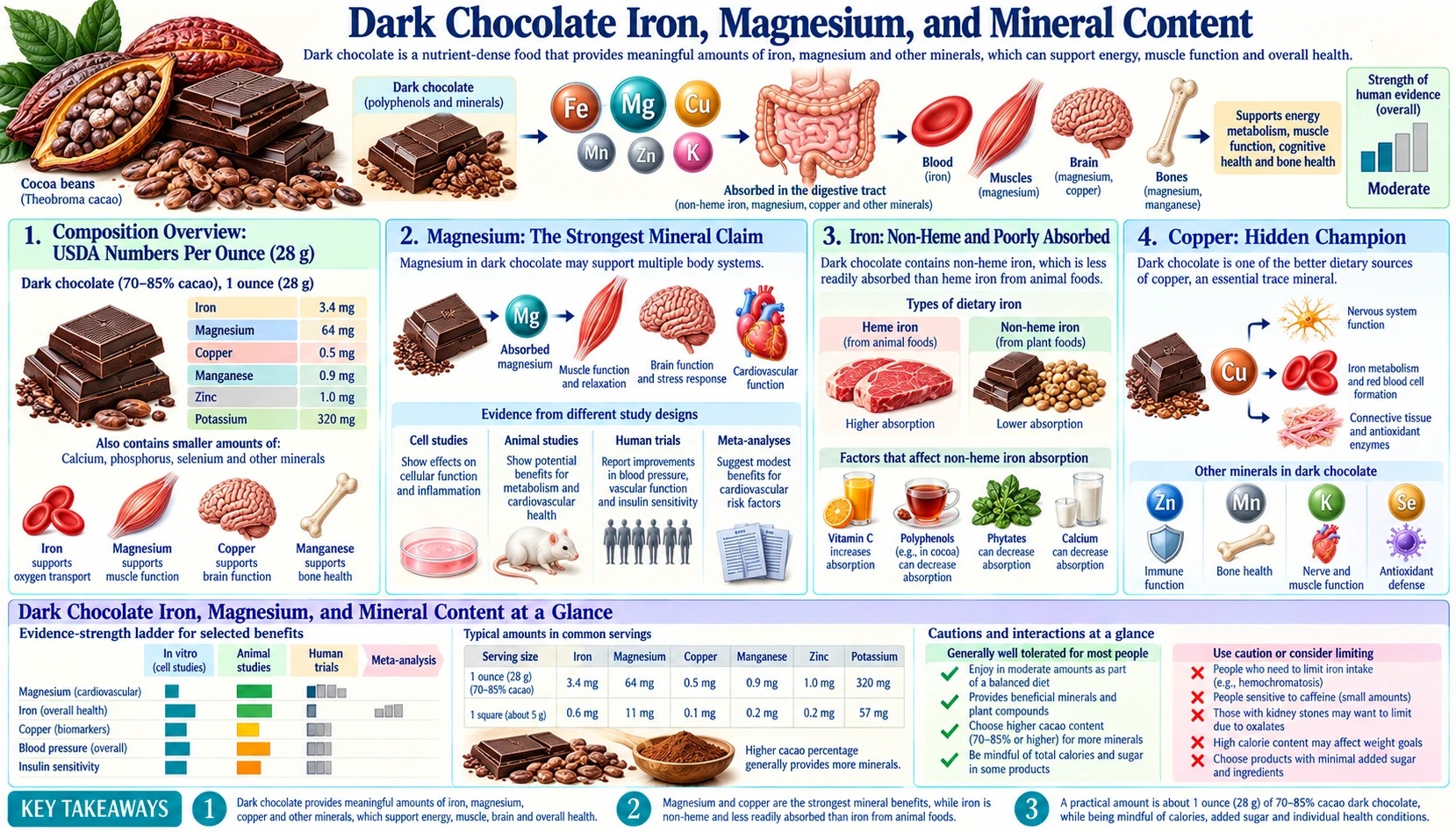
Dark chocolate is one of the most mineral-dense common foods. A single ounce of 70-85% cacao delivers approximately 19% of the iron Recommended Dietary Allowance (RDA), 15% of magnesium, 56% of copper, and meaningful manganese, phosphorus, zinc, and potassium. The mineral story is genuine but rewards a careful read — the iron is non-heme and absorption is suppressed by the same polyphenols, phytate, and oxalate that give dark chocolate its flavor and antioxidant character, so the practical iron contribution is smaller than the headline number. The magnesium and copper claims are the most useful: cocoa is a top-shelf magnesium source in the typical Western diet (which is broadly magnesium-deficient), and a remarkable copper source rivaling shellfish and organ meats. This page walks through each mineral, the bioavailability story, the toxic-metals risk from cocoa-soil cadmium, and the practical implications for using dark chocolate as a mineral supplement.
Table of Contents
- Composition Overview: U.S. Department of Agriculture Numbers Per Ounce
- Magnesium: The Strongest Mineral Claim
- Iron: Non-Heme and Poorly Absorbed
- Copper: Hidden Champion
- Manganese, Phosphorus, Potassium, Zinc
- Phytate, Polyphenols, and Mineral Bioavailability
- Cadmium and Lead Contamination
- Comparison to Other Common Food Sources
- What the Findings Mean in Practice
- Cautions
- Key Research Papers
- Connections
- Featured Videos
Composition Overview: U.S. Department of Agriculture Numbers Per Ounce
Per U.S. Department of Agriculture (USDA) FoodData Central, one ounce (28.35 g) of 70-85% cacao dark chocolate delivers approximately:
- Iron — 3.4 mg (19% of the 18 mg female adult Recommended Dietary Allowance, 42% of the 8 mg male/postmenopausal Recommended Dietary Allowance)
- Magnesium — 64 mg (15% of the 400-420 mg male Recommended Dietary Allowance, 20% of the 310-320 mg female Recommended Dietary Allowance)
- Copper — 0.5 mg (56% of the 0.9 mg adult Recommended Dietary Allowance)
- Manganese — 0.5 mg (22% of the 2.3 mg male Adequate Intake, 28% of the 1.8 mg female Adequate Intake)
- Phosphorus — 87 mg (12% of the 700 mg Recommended Dietary Allowance)
- Zinc — 0.9 mg (8% of the 11 mg male Recommended Dietary Allowance, 11% of the 8 mg female Recommended Dietary Allowance)
- Potassium — 203 mg (a small share of the Adequate Intake of 3,400 mg for men and 2,600 mg for women — modest but not trivial)
- Selenium — 1.9 mcg (a small share of the 55 mcg Recommended Dietary Allowance)
- Calcium — 21 mg (small, not a significant calcium source)
The pattern is unusual. Most foods cluster around one or two prominent minerals: red meat is iron and zinc, dairy is calcium, leafy greens are magnesium and potassium, shellfish is copper and zinc. Dark chocolate hits four minerals (iron, magnesium, copper, manganese) at meaningful percentages of Recommended Dietary Allowance in a single ounce, which is why it appears in essentially every "nutrient-dense food" list. The macronutrient cost is approximately 170 kcal, 12 g fat (8 g saturated, mostly stearic acid), 13 g carbohydrate (7 g sugar, 3 g fiber), and 2 g protein.
The actual bioavailability story is more complex than the gross composition, as discussed in the next sections.
Magnesium: The Strongest Mineral Claim
Magnesium is the mineral where dark chocolate's claim is clearest. Approximately half of US adults consume less than the EAR (estimated average requirement) for magnesium, making the country broadly magnesium-deficient in subclinical terms. A 30 g portion of 70-85% dark chocolate delivers ~68 mg magnesium — comparable to a handful of pumpkin seeds, an ounce of almonds, or a small serving of dark leafy greens.
The magnesium in cocoa is in mixed forms (citrate, malate, oxalate complexes, and free magnesium) and is relatively bioavailable — absorption is approximately 30-40% in healthy adults, comparable to magnesium glycinate supplements. The polyphenol content of cocoa does not appear to substantially impair magnesium absorption (in contrast to its strong inhibition of iron absorption).
Why magnesium matters: magnesium is a cofactor in over 300 enzymatic reactions, regulates muscle contraction, plays a central role in nerve transmission, and is essential for adenosine triphosphate (ATP) generation. Adequate magnesium is associated with lower blood pressure, improved insulin sensitivity, reduced risk of type 2 diabetes, lower fracture risk, and reduced migraine frequency. Repletion of magnesium-deficient adults produces measurable improvements in several of these endpoints.
The practical takeaway: 30-50 g/day of dark chocolate delivers 70-115 mg magnesium — a meaningful contribution to closing the gap between typical US intake (~250 mg/day) and the Recommended Dietary Allowance (310-420 mg/day). It does not substitute for the magnesium contribution from leafy greens, nuts, seeds, and legumes, but it stacks usefully with them. For more on magnesium see our Magnesium page.
Iron: Non-Heme and Poorly Absorbed
The iron headline is the most misread mineral claim for dark chocolate. The gross iron content (3.4 mg/oz) looks impressive, but the practical iron contribution is much smaller than the percentage of the Recommended Dietary Allowance suggests, for three converging reasons:
- The iron is non-heme. Plant-source iron is in the ferric (Fe3+) form, which must be reduced to ferrous (Fe2+) before intestinal absorption. Heme iron from animal sources is absorbed at 15-35%; non-heme iron from plants is absorbed at 2-20% depending on accompanying foods.
- The accompanying polyphenols strongly inhibit non-heme iron absorption. Hurrell and colleagues established in the 1990s that polyphenol-containing beverages such as tea, coffee, and cocoa reduce non-heme iron absorption from a co-ingested meal — by 60-90% for beverages containing 100-400 mg of polyphenols per serving. The exact mechanism involves polyphenol-iron complexation in the intestinal lumen, forming poorly absorbed precipitates.
- Phytate and oxalate are also present. Cocoa contains significant phytate (inositol hexaphosphate) and oxalate, both of which further inhibit non-heme iron absorption by forming insoluble complexes with iron in the gut.
Net effect: the bioavailable iron from a 30 g portion of dark chocolate is likely under 0.5 mg — perhaps one-eighth of the apparent gross content. Dark chocolate is not a meaningful iron source for menstruating women, pregnant women, or anyone with iron-deficiency anemia. The better-absorbed routes to more iron are heme sources (red meat, organ meats, oysters), iron-fortified foods eaten apart from polyphenol-rich foods, and supplementation — not dark chocolate.
The polyphenol-iron interaction also runs the other direction: chronic dark chocolate consumption may modestly impair iron absorption from meals consumed simultaneously. For people with iron deficiency, the commonly described practice is to keep dark chocolate (and tea and coffee) at least 2 hours apart from iron-rich meals or iron supplements.
Copper: Hidden Champion
Copper is the surprising standout in dark chocolate's mineral profile. One ounce delivers 0.5 mg copper, which is 56% of the adult Recommended Dietary Allowance. A 30 g serving covers more than half the daily requirement — though a 3-ounce serving of oysters or beef liver, the two most-cited dietary copper sources, contains far more (see the comparison below).
Copper deficiency is uncommon but not rare. The condition is concentrated among:
- Patients with malabsorption disorders (celiac, Crohn's, gastric bypass)
- Patients with prolonged high-dose zinc supplementation (zinc induces intestinal metallothionein, which preferentially binds copper and reduces its absorption; excess zinc is one of the most common causes of acquired copper deficiency, although serious neurologic complications are reported to be rare)
- Patients with rare genetic copper transport disorders (Menkes disease)
- Vegans without adequate seed and nut intake
Copper is essential for several iron-handling enzymes (ceruloplasmin, hephaestin) and for the cytochrome-c-oxidase complex of the mitochondrial electron transport chain. Severe copper deficiency presents as a normocytic anemia that resembles iron deficiency but does not respond to iron supplementation — the mechanism is failure of ceruloplasmin-mediated iron release from storage.
The bioavailability of copper from cocoa appears reasonable (estimates of 30-50% absorption), and unlike iron the polyphenols do not substantially impair copper absorption. Dark chocolate is a legitimately useful copper source.
The flip side is that high chronic copper intake from supplements may be problematic. Some controversial work by Larry Klevay and others has linked low copper status to cardiovascular disease, but other work has raised concerns about copper as a pro-oxidant under specific conditions. For most adults, dietary sources provide the copper they need. Copper status matters most for people taking high-dose zinc supplements. For more on copper see our Copper page.
Manganese, Phosphorus, Potassium, Zinc
Manganese — one ounce of 70-85% dark chocolate delivers 0.5 mg manganese, roughly a quarter of the daily Adequate Intake (AI). Manganese is a cofactor for several antioxidant enzymes including manganese-superoxide dismutase (MnSOD), and for several glycosyltransferases involved in proteoglycan synthesis. Manganese deficiency is rare in unselected adults; toxicity from chronic excessive intake (mostly occupational inhalation, very rarely dietary) is a more meaningful clinical issue and produces a parkinsonism-like syndrome.
Phosphorus — one ounce delivers approximately 87 mg phosphorus, ~12% of the Recommended Dietary Allowance. Phosphorus is abundant in most Western diets and supplementation is rarely indicated; the dark chocolate contribution is incremental rather than meaningful for most consumers.
Potassium — one ounce delivers approximately 203 mg potassium, a small share of the Adequate Intake. Potassium is broadly under-consumed in the US (typical intake 2,500-3,000 mg/day vs. the National Academies' 2019 Adequate Intake of 3,400 mg/day for men and 2,600 mg/day for women), and any high-potassium food contribution is welcome, but a dark chocolate portion is a modest addition rather than a meaningful source. Bananas, potatoes, dried fruits, and beans contribute substantially more.
Zinc — one ounce delivers approximately 0.9 mg zinc, ~8-11% of the adult Recommended Dietary Allowance. The zinc bioavailability from cocoa is modest because of the phytate-zinc complexation that limits non-heme iron uptake; the practical zinc contribution is somewhat smaller than the gross number. Oysters, beef, and pumpkin seeds are far better zinc sources.
Phytate, Polyphenols, and Mineral Bioavailability
Cocoa contains substantial phytate (inositol hexaphosphate, IP6) at approximately 1.5-2 g/100 g of dry cocoa. Phytate is the storage form of phosphorus in seeds and grains, and chelates di- and trivalent cations (iron, zinc, calcium, magnesium) in the gut lumen, forming poorly absorbed complexes. The phytate:mineral molar ratio determines the strength of the inhibition; a 2010 review gives suggested desirable molar ratios for absorption of below 1 for phytate:iron and below 18 for phytate:zinc.
The polyphenol-iron interaction is the largest. The Hurrell laboratory at ETH Zürich quantified this in a series of studies in the 1990s: in a 1999 study, black tea reduced non-heme iron absorption from a bread meal by 79-94% and cocoa by 71%; a 1995 study found absorption 2- to 3-fold higher with a low-polyphenol white wine than with red wines, although its authors judged the red-wine effect unlikely to affect iron balance significantly. The effect is dose-dependent and largely abolished when meals are separated by 2+ hours.
What this means in practice:
- For magnesium — cocoa is a reasonably bioavailable source, the phytate effect on magnesium is modest at typical intakes.
- For iron — cocoa is a poor practical iron source and does little to address iron deficiency.
- For zinc — cocoa is a modest source, with bioavailability reduced by phytate. Better zinc sources elsewhere.
- For copper — cocoa is a good source, with bioavailability not substantially affected by the polyphenols or phytate.
- For manganese — cocoa is a good source, manganese is generally well absorbed.
In summary: dark chocolate is a useful magnesium, copper, and manganese source, but an overrated iron and zinc source.
Cadmium and Lead Contamination
The single most concerning issue for chronic dark chocolate consumers is heavy-metal contamination — principally cadmium, and to a lesser extent lead. Cadmium is taken up by the cacao tree from soil and concentrates in the bean; the contamination is greater in cacao grown in volcanic soils common in Central and South America. Lead contamination is largely post-harvest, occurring during fermentation, drying, and processing.
The 2022 Consumer Reports analysis of 28 dark chocolate bars tested all bars against California Proposition 65 maximum allowable dose levels (MADL) of 0.5 mcg/day for lead and 4.1 mcg/day for cadmium. The results:
- 23 of 28 bars exceeded the cadmium and/or lead MADL based on a 1-ounce serving
- 5 bars were under both thresholds — two organic and three conventional bars, at 70-86% cacao
- Bars with higher levels included premium and organic bars as well as a store-brand bar — results can change as makers reformulate
The risk frame matters. California's MADL is conservative — it is set 1,000-fold below the lowest dose with observable effects. Consuming a dark chocolate bar that exceeds the MADL by 2-3x is not an emergency for an adult. But chronic daily consumption of high-contamination bars over years can elevate cumulative cadmium and lead exposure, and both metals accumulate (cadmium in kidney with a 10-30 year half-life, lead in bone with similar kinetics). The concern is greatest for pregnant women and children.
What the testing and sourcing data show:
- Profiles differ between products. Different brands have different contamination profiles depending on cacao origin; spreading intake across several products reduces cumulative exposure from any single source.
- Cacao origin matters. Cacao from West Africa (Ghana, Côte d'Ivoire) tends to have lower cadmium than South American cacao because of soil composition.
- Test results can change. The contamination data for specific brands changes as suppliers reformulate or change sourcing.
- Exposure scales with the amount eaten. The thresholds above were applied to a 1-ounce (~30 g) daily serving; the mineral and flavanol benefits plateau while the contamination risk keeps scaling with mass.
- Pregnancy is when this exposure raises the most concern — a daily intake under 20 g and bars from the low-contamination group cut cumulative exposure further.
Comparison to Other Common Food Sources
To calibrate dark chocolate's mineral contribution, here is the rough rank ordering for each major mineral, on a per-serving basis:
- Magnesium — pumpkin seeds (168 mg/oz) > spinach cooked (157 mg/cup) > almonds (76 mg/oz) > dark chocolate (64 mg/oz) > black beans (60 mg/half cup) > cashews (74 mg/oz). Dark chocolate is in the top tier of practical magnesium sources.
- Iron (bioavailable) — oysters (7.8 mg/3 oz) > beef liver (5 mg/3 oz heme) > beef (2 mg/3 oz heme) >> spinach (3 mg/half cup non-heme) > lentils (3 mg/half cup non-heme) >>> dark chocolate (3.4 mg/oz non-heme, heavily inhibited absorption). Dark chocolate is a poor practical iron source.
- Copper — beef liver (12.4 mg/3 oz) > oysters (4.8 mg/3 oz) > dark chocolate (0.5 mg/oz) > cashews (0.6 mg/oz) > sunflower seeds (0.5 mg/oz). Dark chocolate is in the top tier of practical copper sources for non-liver-eating omnivores.
- Manganese — pine nuts (2.5 mg/oz) > pecans (1.3 mg/oz) > whole oats (1.5 mg/half cup) > pumpkin seeds (1.5 mg/oz) > dark chocolate (0.5 mg/oz). Dark chocolate is a useful but not exceptional manganese source.
- Zinc — oysters (32 mg/3 oz) > beef (6 mg/3 oz) > pumpkin seeds (2.2 mg/oz) >> dark chocolate (0.9 mg/oz). Dark chocolate is a minor zinc contributor.
The honest synthesis: dark chocolate is a useful incremental contributor to magnesium, copper, and manganese intake, but does not substitute for the dietary anchors of mineral intake (animal protein, nuts and seeds, legumes, leafy greens).
What the Findings Mean in Practice
- A magnesium and copper accent, not a primary mineral source. 30 g daily of 70%+ chocolate adds ~68 mg magnesium and ~0.5 mg copper to the daily ledger — useful, but not a substitute for nuts, seeds, leafy greens, and shellfish/organ meats.
- A poor source of usable iron. The non-heme iron in cocoa is heavily inhibited by the polyphenols and phytate. For iron-deficiency anemia, the better-absorbed options are heme sources (red meat, organ meats, oysters) and iron supplementation, not dark chocolate.
- Timing affects iron absorption. The polyphenol-iron complexation effect runs both directions; chocolate consumed with an iron supplement or iron-rich meal reduces iron absorption from that meal, which is why a gap of 2+ hours is commonly described.
- Contamination differs by bar. Consumer Reports cadmium and lead testing found large differences between bars, and West African cacao tends to be lower in cadmium.
- Amount matters. Heavy-metal risk scales with mass, while the flavanol and mineral benefits plateau by approximately 50 g; a chronic intake of 30-40 g/day or less keeps cumulative exposure lower.
- Pregnancy. Fetal sensitivity to cadmium and lead makes cumulative exposure a bigger concern during pregnancy; smaller amounts (under 20 g/day) and low-contamination bars reduce it.
- People taking chronic high-dose zinc (typical scenario: 50+ mg/day for prostate or immune supplementation) are a group at risk of low copper; dark chocolate is one low-side-effect food source of copper.
Cautions
- Cadmium and lead contamination. Discussed above. Real risk for chronic high-volume consumers and for pregnant women.
- Iron-deficiency anemia. Dark chocolate is no substitute for evidence-based iron repletion in iron deficiency. The polyphenols actively inhibit iron absorption from co-ingested meals.
- Hemochromatosis — conversely, patients with hereditary hemochromatosis (chronic iron overload) may benefit modestly from the polyphenol-iron inhibition. Dark chocolate is not a primary management tool but is at least not contraindicated.
- Kidney stones. The oxalate content of cocoa (~120-200 mg per 100 g of dark chocolate) is meaningful. For people with calcium-oxalate kidney stones, the oxalate increases urinary oxalate excretion and stone risk, so the amount eaten matters.
- Pets. Theobromine in dark chocolate is toxic to dogs and cats. Doses of 100-200 mg theobromine per kg body weight are potentially lethal for dogs. A 1-oz square of 85% dark chocolate is dangerous for a small dog.
- Children. Dark chocolate is safe but the methylxanthine content is age-relevant; the concern for children lies with large daily portions of high-cacao chocolate.
- Calorie load. 30 g of 70% dark chocolate is ~170 kcal, which adds to the day's energy intake unless it replaces another dessert or sweet.
Key Research Papers
- Hurrell RF, Reddy M, Cook JD (1999). Inhibition of non-haem iron absorption in man by polyphenolic-containing beverages. Br J Nutr — Search PubMed
- Cinquanta L et al. (2016). Mineral essential elements for nutrition in different chocolate products. Int J Food Sci Nutr 67(7):773-8 — PubMed PMID: 27346251
- Volpe SL (2013). Magnesium in disease prevention and overall health. Adv Nutr — PubMed PMID: 23674807
- Saltzman E, Russell RM (1998). The aging gut. Nutritional issues. Gastroenterol Clin North Am. PubMed
- Sangkhae V, Nemeth E (2017). Regulation of the iron homeostatic hormone hepcidin. Adv Nutr — Search PubMed
- Klevay LM (2000). Cardiovascular disease from copper deficiency — a history. J Nutr — Search PubMed
- Plum LM, Rink L, Haase H (2010). The essential toxin: impact of zinc on human health. Int J Environ Res Public Health — PubMed PMID: 20617034
- Yanus RL et al. (2014). Trace elements in cocoa solids and chocolate: an ICPMS study. Talanta. PubMed PMID: 24401377
- Mounicou S et al. (2003). Concentrations and bioavailability of cadmium and lead in cocoa powder and related products. Food Addit Contam 20(4):343-52. PubMed PMID: 12775476
- Bost M et al. (2016). Dietary copper and human health: current evidence and unresolved issues. J Trace Elem Med Biol — PubMed PMID: 27049134