Pumpkin Seeds, Tryptophan, Sleep and Mood
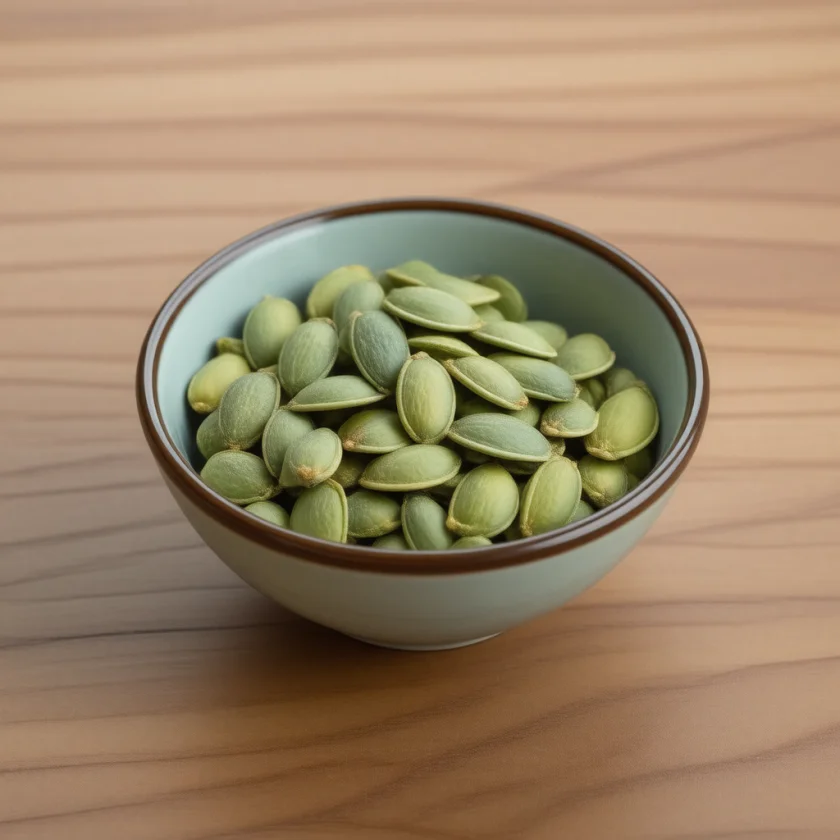
"Pumpkin seeds help you sleep because they are full of tryptophan" is one of those claims that is true in every individual word and misleading as a sentence. The seeds do carry a lot of tryptophan — 576 mg per 100 g by USDA figures, about 161 mg in a handful — and tryptophan is the raw material for serotonin and melatonin. But eating a protein food does not raise brain tryptophan; it usually lowers it, because the other amino acids in the same mouthful crowd tryptophan out at the blood-brain barrier. The one clinical trial that made pumpkin-family seed work for insomnia had to pair a de-oiled seed concentrate with a dose of sugar to get around exactly that problem. Meanwhile the seed's magnesium, a nutrient with its own small but real sleep evidence, goes unmentioned in the tryptophan story. This page separates what has been tested in people from what has only been reasoned about, gives the numbers that show why a plate of seeds is not a tryptophan pill, and ends with the realistic version of the bedtime snack.
Table of Contents
- The Claim and the Numbers
- Why Eating Tryptophan Is Not the Same as Raising Brain Serotonin
- The De-oiled Gourd Seed Trial
- The Social Anxiety Pilot
- What Tryptophan Supplement Trials Show, and the Dose Problem
- The Magnesium Route
- Zinc, Magnesium and Mood
- A Realistic Evening Routine
- Who Benefits, and Who Should Be Careful
- Key Research Papers
- Connections
- Featured Videos
The Claim and the Numbers
Tryptophan is one of the nine essential amino acids — the body cannot make it — and it is the scarcest amino acid in most proteins, typically about 1% of the total. It has two jobs that matter here: the brain turns a little of it into serotonin, the neurotransmitter that steadies mood and helps start sleep, and the pineal gland turns serotonin into melatonin after dark. So a food rich in tryptophan looks like a food for sleep, and pumpkin seeds are richer than most.
The USDA entry for dried pumpkin and squash seed kernels lists 0.576 g of tryptophan per 100 g, inside 30.23 g of total protein. That works out to about 19 mg of tryptophan per gram of protein — roughly double the proportion in most animal proteins, which is why the seed keeps topping "tryptophan foods" lists. In serving terms:
- A handful (28 g, three level tablespoons) gives about 161 mg of tryptophan, with 8.5 g of protein and 157 calories.
- A heaped tablespoon (10 g) gives about 58 mg.
- To reach 1 g of tryptophan — the threshold at which supplement trials start to show a sleep effect, discussed below — you would need about 174 g of kernels, nearly a full cup, carrying 970 calories.
The last line is the whole argument in miniature. Pumpkin seeds are an excellent tryptophan food by density and a hopeless tryptophan supplement by dose. But the dose is only half the problem.
Why Eating Tryptophan Is Not the Same as Raising Brain Serotonin
Tryptophan crosses from blood into brain on a shared transporter that also carries five other large neutral amino acids (LNAAs) — leucine, isoleucine, valine, phenylalanine and tyrosine. The transporter does not care which it carries; it carries whichever is most abundant. So what matters is not how much tryptophan is in the blood but the ratio of tryptophan to its competitors. This was worked out in rats in 1971: a carbohydrate meal, which contains almost no protein, raised brain serotonin, because the insulin it released pushed the competing amino acids into muscle and left tryptophan a clearer run at the transporter (Fernstrom and Wurtman 1971, animal study).
The same thing has been measured in people eating normal breakfasts. Nine fasted adults ate, on separate days, a carbohydrate-rich breakfast (70 g carbohydrate, 5 g protein) and a protein-rich one (15 g carbohydrate, 47 g protein). The two meals moved the plasma tryptophan-to-LNAA ratio in opposite directions, and the median difference between them was 54% (range 36–88%); insulin rose only after the carbohydrate meal (Wurtman 2003, randomised crossover). The high-protein meal — the one containing far more tryptophan — was the one that lowered the ratio, because it delivered even more of tryptophan's competitors.
Pumpkin seeds are a high-protein food. A handful supplies 161 mg of tryptophan but also 0.68 g of leucine, 0.35 g of lysine and comparable amounts of the other LNAAs (USDA). Eaten on their own, they behave like the protein breakfast: more tryptophan in the blood, a worse ratio, no extra serotonin. Whatever pumpkin seeds do for sleep on their own, it is not through this pathway. The only way to make the tryptophan in a protein food count is to eat it with carbohydrate — which is precisely what the one successful trial did.
The De-oiled Gourd Seed Trial
In 2005 a Canadian group tested whether a food protein could do what pharmaceutical tryptophan does, using de-oiled gourd seed — pumpkin-family seed with the oil pressed out, which concentrates the protein to about 22 mg of tryptophan per gram of protein — combined with glucose to suppress the competing amino acids (Hudson 2005). The design was a double-blind, placebo-controlled randomised trial in adults with chronic insomnia, three weeks long, with three arms:
- Protein-source tryptophan (de-oiled gourd seed) plus carbohydrate;
- Pharmaceutical-grade tryptophan plus carbohydrate;
- Carbohydrate alone.
Of 57 people enrolled, 49 completed. Sleep was measured both by questionnaire and objectively. The results:
- Both tryptophan arms improved significantly on subjective and objective measures of insomnia; carbohydrate alone did not.
- The seed-protein arm was the one that significantly reduced time awake during the night.
- The authors concluded that protein-source tryptophan "is comparable to pharmaceutical grade tryptophan for the treatment of insomnia".
This is a real, controlled, human result, and it is the reason the pumpkin-seed sleep claim is not simply folklore. It comes with three honest qualifications. It is a single trial of 49 people that has not been replicated. It used a concentrated, de-oiled seed protein taken with sugar, not a bowl of pepitas — the carbohydrate was part of the treatment, not a garnish. And the amount of seed protein in the dose is not stated in the published abstract, so we cannot tell you how many spoonfuls of ordinary seed it corresponds to; any website that does is guessing.
The Social Anxiety Pilot
The same group ran a follow-up in social anxiety disorder: a double-blind, placebo-controlled crossover in which each person took, a week apart, de-oiled gourd seed with carbohydrate and carbohydrate alone, and was then exposed to an anxiety-provoking stimulus (Hudson 2007). The seed-protein condition, and not the carbohydrate alone, produced a significant improvement on an objective measure of anxiety.
The number to remember is seven: seven participants completed the study. It is a pilot in the strict sense — a demonstration that the experiment can be run and that the direction of effect is worth pursuing — and it should not be quoted as evidence that pumpkin seeds treat anxiety. Nobody has run the larger trial.
What Tryptophan Supplement Trials Show, and the Dose Problem
Because the seed trials are so few, it helps to know what tryptophan itself does when given as a supplement, since that sets a ceiling on what any tryptophan food can do.
- A wide review of tryptophan-loading studies found the effects on mood strongest in vulnerable people, on memory strongest where serotonin is already disturbed, and on sleep real "in adults with some sleep disturbances" — with a consistent mild sedative effect that slows reaction time (Silber and Schmitt 2010, review). Tryptophan is not a stimulant for the well-rested; it helps people who are short of sleep or of serotonin.
- A 2022 systematic review and meta-analysis pooled the controlled trials and found tryptophan supplementation shortened time awake after falling asleep, and that the benefit was concentrated in trials using 1 g a day or more (28.9 minutes awake versus 56.6 minutes on doses under 1 g). It did not improve the other sleep measures (Sutanto 2022).
- A safety review of non-nutritional tryptophan use found it well tolerated at ordinary supplement doses, with the historical eosinophilia-myalgia epidemic traced to a contaminated batch rather than to the amino acid itself (Fernstrom 2012, review).
Put the dose finding next to the seed arithmetic and the conclusion writes itself. The sleep effect appears at 1 g of tryptophan; a handful of pumpkin seeds supplies 0.16 g, alongside the competing amino acids that block its entry to the brain. Six handfuls would supply the gram — and 940 calories and 51 g of protein, an amount that would sink the tryptophan ratio further. The food cannot get there. That is not a criticism of the food; it is the reason the tryptophan story is the wrong story about it.
The Magnesium Route
The nutrient in pumpkin seeds with a plausible sleep effect at food doses is magnesium: 166 mg in a handful, about half a woman's daily requirement, as the mineral page sets out. Magnesium blocks the NMDA receptor and supports the GABA system — the brain's brake — and low magnesium is associated with restless sleep. The human evidence:
- A double-blind randomised trial in 46 older adults with insomnia gave 500 mg of magnesium or placebo daily for eight weeks. Magnesium significantly improved the insomnia severity score, sleep efficiency, sleep time and the time taken to fall asleep, and raised blood melatonin while lowering cortisol; total sleep time by diary did not differ between groups (Abbasi 2012, RCT).
- A systematic review of the trials in older adults found only three randomised trials, 151 people in all. Pooled, magnesium shortened sleep-onset latency by 17 minutes versus placebo; total sleep time rose by 16 minutes but not significantly. The authors rated every trial at moderate-to-high risk of bias and the evidence as low to very low quality — and still concluded that, magnesium being cheap and safe, the evidence "may support" its use for insomnia symptoms (Mah and Pitre 2021).
- The CARDIA cohort followed 3,964 American adults for decades. Those in the top quarter of magnesium intake were 36% less likely to sleep under seven hours than those in the bottom quarter (odds ratio 0.64), and borderline more likely to rate their sleep as good; the association with short sleep held in people without depression but not in those with it (Zhang 2022, cohort — association, not proof).
The trials used 500 mg supplements; the cohort measured food intake, where a handful of seeds is the biggest single step available. Neither is strong evidence, and both are stronger than the tryptophan story. If pumpkin seeds at bedtime help anyone sleep, the magnesium is the likelier reason.
Zinc, Magnesium and Mood
The mood claims for pumpkin seeds run through the same two minerals, and the evidence is at the same tier: suggestive, not settled.
- Zinc and depression. A meta-analysis of 17 studies (1,643 depressed people, 804 controls) found blood zinc about 1.85 µmol/L lower in depression, with the gap wider in more severe and in hospitalised cases (Swardfager 2013). This is an association: depression may lower zinc through poor appetite as easily as low zinc may worsen depression, and the study did not test supplementation. Pumpkin seeds supply 2.2 mg of zinc a handful, a meaningful contribution and no more.
- Magnesium and depression. A randomised crossover trial in 126 primary-care adults with mild-to-moderate depression gave 248 mg of elemental magnesium daily for six weeks against six weeks of no treatment. Depression scores fell by a net 6.0 points on the PHQ-9 and anxiety scores by 4.5 points, with effects visible within two weeks (Tarleton 2017). The catch is in the design: it was open-label — participants knew whether they were taking magnesium — and in a condition as expectation-sensitive as mild depression that is a serious limitation, one the authors acknowledged. A blinded trial is still needed.
Neither result is about pumpkin seeds; both are about nutrients pumpkin seeds happen to be dense in. A handful a day delivers two-thirds of the Tarleton magnesium dose from food. That is a reasonable thing to do, and a modest thing to expect from.
A Realistic Evening Routine
Taking the evidence at face value, the bedtime pumpkin seed makes sense — but built the way the trial built it, not the way the meme does.
- Pair the seeds with a carbohydrate. This is the one lesson from the Hudson trials and the Wurtman ratio study: protein alone lowers the tryptophan ratio; protein with carbohydrate can raise it. A tablespoon or two of pumpkin seeds over a small bowl of oatmeal, stirred into a little yoghurt with fruit, or on a slice of banana on wholegrain toast is the trial's logic in kitchen form. Brown rice pudding with pumpkin seeds is the same idea for anyone who wants a proper dessert.
- Keep the portion at a handful or less. More seeds means more competing amino acids and more calories, not more effect.
- Eat it an hour or two before bed, not on the pillow: the ratio study saw changes over 40 to 240 minutes.
- Count the magnesium as the main event. If the seeds are your main magnesium source, the evening is as good a time as any to eat them, and the mineral is the part of the story with a supplement trial behind it.
- Do not expect a sleeping pill. The supplement trials shortened time to fall asleep by a quarter of an hour and time awake at night by half an hour. That is worth having; it is not sedation.
The tryptophan page covers the amino acid itself, and the insomnia page covers what to do when a snack is not the answer, which for chronic insomnia it usually is not: the treatment with the best evidence is cognitive-behavioural therapy for insomnia, not any food.
Who Benefits, and Who Should Be Careful
Most likely to notice something:
- People whose magnesium intake is low — which is about half the population — especially older adults, in whom the sleep trials were run.
- People with mild sleep-maintenance trouble (waking in the night rather than failing to fall asleep), the measure on which the seed-protein trial and the tryptophan meta-analysis both showed their effect.
- Anyone replacing a sugary bedtime snack with seeds and fruit on oatmeal — the swap improves the evening on several fronts regardless of tryptophan.
Be careful if:
- You take an SSRI, SNRI, MAO inhibitor, triptan or lithium. The concern is tryptophan supplements, which can add to serotonin activity and have been associated with serotonin syndrome in combination with these drugs. Pumpkin seeds as food do not deliver a supplement-sized dose and are not a concern; the de-oiled seed concentrate in the trials is closer to a supplement, and anyone on these medicines should treat it as one.
- Your insomnia is severe, long-standing, or comes with low mood, snoring, restless legs or pain. These have causes with treatments; seeds are not among them. The site's insomnia page is the place to start.
- You have advanced kidney disease — the magnesium, potassium and phosphorus load in seeds needs the renal team's view.
- Reflux keeps you up. A fatty snack close to bedtime worsens it; move the seeds earlier in the evening or to breakfast.
Key Research Papers
Author names, titles and journals are plain text; only the DOI or PMID is a link. Every identifier below was checked against PubMed before publication, and the abstracts were read to confirm the results quoted above.
- Hudson C, Hudson SP, Hecht T, MacKenzie J (2005). Protein source tryptophan versus pharmaceutical grade tryptophan as an efficacious treatment for chronic insomnia. Nutritional Neuroscience. — PubMed PMID: 16053244
- Hudson C, Hudson S, MacKenzie J (2007). Protein-source tryptophan as an efficacious treatment for social anxiety disorder: a pilot study. Canadian Journal of Physiology and Pharmacology. — PubMed PMID: 18066139 (seven participants)
- Wurtman RJ, Wurtman JJ, Regan MM, McDermott JM, Tsay RH, Breu JJ (2003). Effects of normal meals rich in carbohydrates or proteins on plasma tryptophan and tyrosine ratios. The American Journal of Clinical Nutrition. — PubMed PMID: 12499331
- Fernstrom JD, Wurtman RJ (1971). Brain serotonin content: increase following ingestion of carbohydrate diet. Science. — PubMed PMID: 5120086 (animal study)
- Fernstrom JD (2012). Effects and side effects associated with the non-nutritional use of tryptophan by humans. The Journal of Nutrition. — PubMed PMID: 23077193
- Silber BY, Schmitt JA (2010). Effects of tryptophan loading on human cognition, mood, and sleep. Neuroscience and Biobehavioral Reviews. — PubMed PMID: 19715722
- Sutanto CN, Loh WW, Kim JE (2022). The impact of tryptophan supplementation on sleep quality: a systematic review, meta-analysis, and meta-regression. Nutrition Reviews. — PubMed PMID: 33942088
- Abbasi B, Kimiagar M, Sadeghniiat K, Shirazi MM, Hedayati M, Rashidkhani B (2012). The effect of magnesium supplementation on primary insomnia in elderly: A double-blind placebo-controlled clinical trial. Journal of Research in Medical Sciences. — PubMed PMID: 23853635
- Mah J, Pitre T (2021). Oral magnesium supplementation for insomnia in older adults: a Systematic Review & Meta-Analysis. BMC Complementary Medicine and Therapies. — PubMed PMID: 33865376
- Zhang Y, Chen C, Lu L, et al. (2022). Association of magnesium intake with sleep duration and sleep quality: findings from the CARDIA study. Sleep. — PubMed PMID: 34883514
- Swardfager W, Herrmann N, Mazereeuw G, Goldberger K, Harimoto T, Lanctôt KL (2013). Zinc in depression: a meta-analysis. Biological Psychiatry. — PubMed PMID: 23806573
- Tarleton EK, Littenberg B, MacLean CD, Kennedy AG, Daley C (2017). Role of magnesium supplementation in the treatment of depression: A randomized clinical trial. PLoS One. — PubMed PMID: 28654669 (open-label)
- Peuhkuri K, Sihvola N, Korpela R (2012). Diet promotes sleep duration and quality. Nutrition Research. — PubMed PMID: 22652369