Pumpkin Seeds, Magnesium, Zinc and Mineral Density
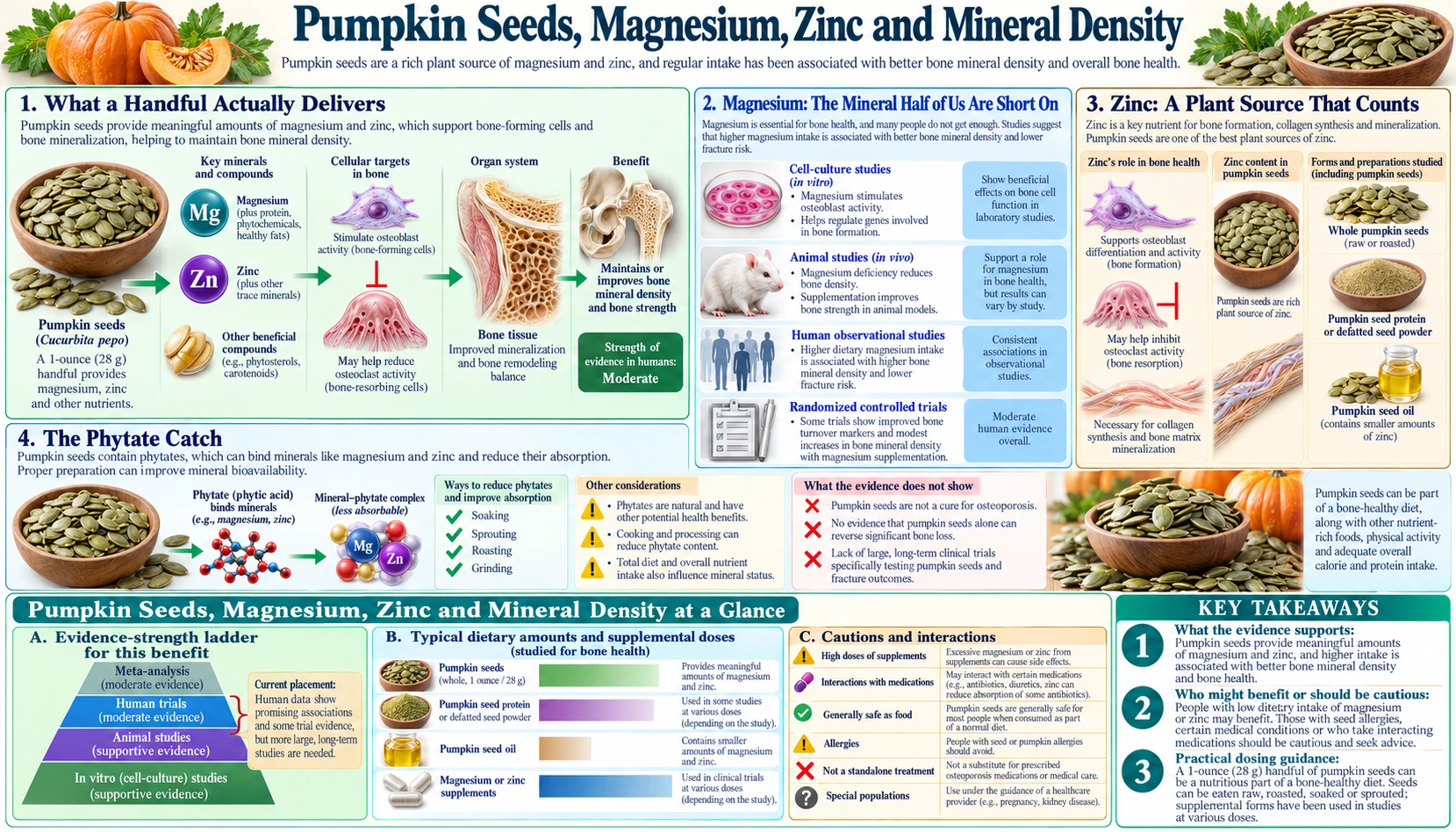
Strip away the marketing and the single best reason to eat pumpkin seeds is arithmetic. Gram for gram, the dried green kernel is one of the most mineral-dense foods in an ordinary kitchen: a cupped handful — about 28 g, three level tablespoons — carries roughly 166 mg of magnesium, 2.2 mg of zinc, 2.5 mg of iron, 345 mg of phosphorus, 1.3 mg of manganese and 0.4 mg of copper, all riding on 8.5 g of protein and 157 calories. Nearly half of Americans eat less magnesium than they need, and a handful of pumpkin seeds closes about half of a woman's daily target in one go. The catch, which this article takes seriously rather than waving away, is phytate: the seed's own phosphorus store, which binds magnesium, zinc and iron in the gut and lets you keep only part of what the label promises. What follows is what the USDA numbers say, what human absorption studies show phytate does, and the kitchen tricks that shift the balance in your favour.
Table of Contents
- What a Handful Actually Delivers
- Magnesium: The Mineral Half of Us Are Short On
- Zinc: A Plant Source That Counts
- The Phytate Catch
- Soaking, Sprouting, Roasting and Pairing
- Iron, Phosphorus, Manganese and Copper
- How Much to Eat, in Kitchen Terms
- Who Benefits Most, and Who Should Be Careful
- Key Research Papers
- Connections
- Featured Videos
What a Handful Actually Delivers
Every figure below comes from USDA FoodData Central's entry for seeds, pumpkin and squash seed kernels, dried (FDC ID 170556), scaled from 100 g to a 28 g serving — the standard "one ounce" that nutrition studies use and that looks, on a plate, like a small cupped handful or three level tablespoons.
- Magnesium: 592 mg per 100 g, about 166 mg per handful. The adult recommended intake is 310–320 mg a day for women and 400–420 mg for men (NIH Office of Dietary Supplements), so one handful covers roughly 40–53% of a day — before absorption is taken into account, which is the subject of the phytate section below.
- Zinc: 7.81 mg per 100 g, about 2.2 mg per handful. Recommended intakes are 8 mg (women) and 11 mg (men), so a handful is 20–27% on paper.
- Iron: 8.82 mg per 100 g, about 2.5 mg per handful. Non-haem plant iron, so poorly absorbed compared with meat, and subject to the same phytate problem.
- Phosphorus: 1,233 mg per 100 g, about 345 mg per handful — an unusually high figure, partly because a good share of it is locked up as phytate.
- Manganese: 4.54 mg per 100 g (1.3 mg per handful); copper: 1.34 mg (0.38 mg per handful); potassium: 809 mg (227 mg per handful); selenium: 9.4 µg (2.6 µg per handful); calcium: only 46 mg (13 mg per handful).
- The carrier: 559 kcal, 30.2 g protein, 49.1 g fat (8.7 g saturated, 16.2 g monounsaturated, 21.0 g polyunsaturated), 10.7 g carbohydrate and 6.0 g fibre per 100 g — so a handful is 157 kcal, 8.5 g protein, 13.7 g fat and 1.7 g fibre.
Two things stand out. First, this is a magnesium food before it is anything else. Very few whole foods carry more than 500 mg per 100 g; among common ones, only a few seeds and bran come close. Second, it is not a calcium food, and its iron, while respectable, is the plant kind. A composition study of dried pumpkin seeds collected in Niger reached the same conclusion from a different continent: rich in potassium, magnesium, zinc and manganese, "but low amounts of calcium and iron" relative to the rest.
Magnesium: The Mineral Half of Us Are Short On
Magnesium is a cofactor in hundreds of enzyme reactions — the ones that make ATP, copy DNA, relax a muscle after it contracts, and steady the electrical rhythm of the heart. It is also, by a wide margin, the mineral most people quietly under-eat. A review of United States intake surveys found that 48% of the population consumed less than the estimated requirement from food in 2005–2006, and that the ratio of calcium to magnesium in the American diet has been climbing for decades — the authors called magnesium an "orphan nutrient" next to calcium (Rosanoff 2012, review). Refined grains, which lose most of their magnesium with the bran, are the main reason.
What does eating more of it buy you? The evidence tier matters here, so take it in order:
- Cohort evidence (association, not proof). A meta-analysis of 13 prospective cohorts with 536,318 participants found each extra 100 mg of magnesium per day was associated with a 14% lower risk of type 2 diabetes (relative risk 0.86; Dong 2011). A later dose-response meta-analysis of 40 cohorts and more than a million people put the same 100 mg increment at a 19% lower diabetes risk, a 22% lower heart-failure risk, a 7% lower stroke risk and a 10% lower all-cause mortality — but found no association with total cardiovascular disease or coronary heart disease (Fang 2016). That null finding is reported here because it is real: magnesium is not a general-purpose heart protector in the cohort data.
- Randomised trial evidence (causal). A meta-analysis of 34 double-blind placebo-controlled trials (2,028 adults) found magnesium supplementation at a median 368 mg a day for a median three months lowered systolic blood pressure by a modest 2.0 mmHg and diastolic by 1.8 mmHg (Zhang 2016). Small, but in the direction that matters, and 300 mg a day was enough to move blood levels.
A handful of pumpkin seeds is not a 368 mg supplement, and it does not need to be. The cohort data are about food magnesium, one 100 mg step at a time — and one handful of pumpkin seeds is a 166 mg step, more than any cohort was comparing. That is the practical point: the seeds move you from the under-eating half of the population into the adequate half in a single serving.
Zinc: A Plant Source That Counts
Zinc is the mineral behind taste, wound healing, immune signalling and the enzyme that gets rid of alcohol; it is also concentrated in the prostate at levels found in no other soft tissue (Costello 2006, review), which is one reason pumpkin seeds keep appearing in prostate folklore — that thread is followed on the prostate and urinary health page. Globally, an estimated 17.3% of the world's population is at risk of inadequate zinc intake, concentrated where diets are dominated by high-phytate cereals and short on animal foods (Wessells 2012).
Pumpkin seeds are among the better plant sources at 7.8 mg per 100 g, but two features of zinc absorption change how to read that number:
- Absorption saturates. Stable-isotope modelling in adults indicates a maximum of about 6 mg of zinc absorbed per day no matter how much is eaten (Hambidge 2010). You cannot load zinc the way you can load calories; you can only keep the daily supply steady.
- Phytate is the main dietary brake, and protein is the main accelerator. Phytate binds zinc strongly; the amount of protein in a meal, by contrast, has a positive effect on zinc absorption (Lönnerdal 2000, review). Pumpkin seeds carry both — a lot of protein (30 g per 100 g) and, like all seeds, phytate — so the seed pulls in both directions at once.
The honest summary: a handful of pumpkin seeds contributes zinc in the same league as a serving of chickpeas or a slice of cheese, not in the league of oysters or red meat. For someone who eats little meat it is one of the few snacks that adds meaningful zinc at all, which is a genuine advantage; it is not a zinc supplement in disguise.
The Phytate Catch
Every seed stores phosphorus for the future plant as phytic acid (inositol hexaphosphate, "phytate"). In your gut, phytate's six phosphate arms grab positively charged minerals — magnesium, zinc, iron, calcium — and hold them in a complex you cannot absorb. A comprehensive review of phytate in foods lists nuts and oilseeds among the richest sources, above most whole grains, and describes the binding chemistry in detail (Schlemmer 2009). Pumpkin seed kernel flour has been assayed and phytic acid was among the "antinutritional compounds" detected, alongside trypsin inhibitors and tannins (El-Adawy 2001). We have not found a phytate value for pumpkin seeds in a source we can verify to the milligram, so no figure is given here; the qualitative point — that it is substantial, as in all oilseeds — is not in doubt.
How much does it cost you? The human studies are precise:
- Magnesium. In a stable-isotope crossover study in healthy adults, adding phytate to phytate-free white bread at the level naturally present in whole-meal bread cut fractional magnesium absorption from 32.5% to 13.0%; at the lower level found in brown bread it fell from 32.2% to 24.0%. The effect was dose-dependent (Bohn 2004, RCT). So the phytate in a whole seed can plausibly remove half or more of the magnesium it carries.
- Zinc. The best-validated model of human zinc absorption uses only two inputs — dietary zinc and dietary phytate — and explains more than 80% of the variation in zinc absorbed (Miller 2007). Fitting that model to newer data shows the average zinc requirement doubles with each 1,000 mg of phytate eaten per day (Hambidge 2010). Interestingly, the same group found the phytate effect in infants and toddlers to be negligible (Miller 2015), so the arithmetic above is an adult problem.
Two things stop this from being a reason to give up on seeds. First, the absorbed fraction from a phytate-rich food is smaller, but the starting number is so large that what gets through is still substantial: half of 166 mg is still 83 mg of magnesium, a quarter of a woman's daily requirement from a single handful. Second, the reference intakes already assume a mixed diet with typical phytate losses built in. Third — and this is where the kitchen comes in — phytate is not fixed.
Soaking, Sprouting, Roasting and Pairing
Phytate is broken down by the enzyme phytase, which the seed itself carries in a dormant state, and by phytases from bacteria and yeasts. Anything that wakes those enzymes up lowers the phytate before the seed reaches your gut. A review of processing methods for grains and seeds ranks the traditional techniques by what they achieve: soaking, germination (sprouting), fermentation and milling each reduce phytate and raise the bioavailability of iron, zinc and magnesium, with germination and fermentation the most effective (Gupta 2015, review). The zinc literature reaches the same conclusion independently: removal or reduction of phytate by phytase treatment, germination or fermentation "markedly improves zinc absorption" (Lönnerdal 2000).
In a home kitchen that translates to:
- Soak raw kernels overnight in warm water, drain, then dry-roast or dehydrate. This is the simplest step and the one with the most consistent effect in the processing literature. Discard the soaking water — that is where dissolved phytate goes.
- Sprout them if you have the patience: rinse twice daily for two to three days until a tail appears, then dry. Germination activates the seed's own phytase.
- Roasting alone does little for phytate — dry heat does not activate phytase, and phytate is heat-stable at roasting temperatures. Roasting has other effects, on the oil, which the heart and oil page covers.
- Eat them with protein and organic acids, not with a phytate pile-up. Protein helps zinc absorption; citrate and other organic acids help too (Lönnerdal 2000). Pumpkin seeds over a salad with a lemon dressing and some cheese or fish is a better mineral meal than pumpkin seeds stirred into a bran cereal, where two phytate-rich foods compete for the same minerals.
- Do not take an iron or zinc pill with your seeds. Iron given together with zinc in a supplement can depress zinc absorption, though not when both arrive as food (Lönnerdal 2000). Keep supplements and seeds a few hours apart.
Iron, Phosphorus, Manganese and Copper
Iron. 2.5 mg per handful sounds generous, and for a plant food it is. But it is all non-haem iron, whose absorption is governed by the same phytate chemistry and is helped chiefly by vitamin C eaten at the same meal. Pumpkin seeds are a useful iron contributor for people who eat little meat; they are not a treatment for iron-deficiency anaemia, and anyone with that diagnosis needs the cause found, not a snack changed.
Phosphorus. 345 mg per handful is a lot, but a good share is phytate phosphorus that you do not absorb — the plant's storage form, not yours. For healthy kidneys this is irrelevant. For someone with advanced chronic kidney disease who has been told to restrict phosphorus and potassium, a food with 1,233 mg of phosphorus and 809 mg of potassium per 100 g is one to discuss with the renal dietitian, even though plant phosphorus is less available than the phosphate additives in processed food.
Manganese (1.3 mg per handful) is a cofactor for the mitochondrial antioxidant enzyme superoxide dismutase and for bone-building enzymes. Adequate intakes are around 1.8–2.3 mg a day, so a handful of pumpkin seeds is most of a day's manganese; deficiency is rare and so is toxicity from food.
Copper (0.38 mg per handful) matters more than its size suggests, because zinc and copper compete for the same intestinal transporter and a high supplemental zinc intake can drive copper deficiency. Pumpkin seeds sidestep that problem: they carry both minerals in a ratio (about 6:1 zinc to copper by weight) that does not starve copper, which is one more argument for the food over the pill.
How Much to Eat, in Kitchen Terms
The serving the numbers above describe — 28 g, three level tablespoons, a small cupped handful — is the right daily unit for most people. It delivers 157 calories, which is roughly the same as a slice of bread with butter, and it is easy to eat three handfuls without noticing while reading, at which point you have eaten 470 calories and half your fat budget for the day. Measure it once with a spoon and you will know what 28 g looks like in your own hand.
- One handful a day meets 40–53% of magnesium and 20–27% of zinc requirements on paper, plausibly half that after phytate; still the biggest single mineral contribution most snacks can make.
- Hulled green kernels (pepitas) versus whole white seeds. The USDA figures are for kernels. Whole seeds with the hull weigh more for the same kernel content, add fibre, and are hard on some digestions; the minerals live in the kernel.
- Raw or lightly dry-roasted, unsalted or lightly salted. Heavily salted seeds turn a 7 mg-sodium food into a high-sodium one.
- Where they go: over brown rice, oatmeal or yoghurt; into a salad; blended into pesto in place of pine nuts; pressed onto fish or chicken before baking; or simply eaten from a small dish, not from the bag.
Who Benefits Most, and Who Should Be Careful
Most likely to benefit:
- Anyone eating a refined-grain diet — the population in which half fall short of magnesium. A handful of seeds is the cheapest correction available.
- People with type 2 diabetes or prediabetes, in whom urinary magnesium losses are higher and the cohort data on magnesium and diabetes risk are strongest (Dong 2011; Fang 2016). The blood sugar page adds a trial in which pumpkin seeds blunted the glucose rise after a meal.
- Older adults, whose magnesium absorption declines and whose diets often shrink; several trials of magnesium for sleep were run in this group, covered on the sleep and mood page.
- Vegetarians and people who eat little meat, for whom zinc and iron sources are scarce and every plant contribution counts — provided the soaking and pairing advice above is followed.
- People with muscle cramps or migraine who have been advised to raise magnesium intake: food first, and this is the densest food.
Be careful if:
- You have advanced kidney disease. Magnesium, potassium and phosphorus are all excreted by the kidney; when it fails, all three can accumulate. A handful is rarely a problem, but this is a food to clear with the renal team.
- You have a seed allergy. Pumpkin seed allergy is rare but documented, including anaphylaxis; see the safety section of the heart and oil page.
- You are counting calories closely. The minerals come wrapped in 13.7 g of fat per handful. That fat is mostly unsaturated and is not the problem; the portion drift is.
- You have a sensitive gut. Whole seeds with hulls are a lot of insoluble fibre at once; choose hulled kernels and soak them.
Key Research Papers
Author names, titles and journals are plain text; only the DOI or PMID is a link. Every identifier below was checked against PubMed before publication.
- Rosanoff A, Weaver CM, Rude RK (2012). Suboptimal magnesium status in the United States: are the health consequences underestimated? Nutrition Reviews. — PubMed PMID: 22364157
- Bohn T, Davidsson L, Walczyk T, Hurrell RF (2004). Phytic acid added to white-wheat bread inhibits fractional apparent magnesium absorption in humans. The American Journal of Clinical Nutrition. — PubMed PMID: 14985216
- Hambidge KM, Miller LV, Westcott JE, Sheng X, Krebs NF (2010). Zinc bioavailability and homeostasis. The American Journal of Clinical Nutrition. — PubMed PMID: 20200254
- Miller LV, Krebs NF, Hambidge KM (2007). A mathematical model of zinc absorption in humans as a function of dietary zinc and phytate. The Journal of Nutrition. — PubMed PMID: 17182814
- Miller LV, Hambidge KM, Krebs NF (2015). Zinc Absorption Is Not Related to Dietary Phytate Intake in Infants and Young Children Based on Modeling Combined Data from Multiple Studies. The Journal of Nutrition. — PubMed PMID: 26108545
- Lönnerdal B (2000). Dietary factors influencing zinc absorption. The Journal of Nutrition. — PubMed PMID: 10801947
- Schlemmer U, Frølich W, Prieto RM, Grases F (2009). Phytate in foods and significance for humans: food sources, intake, processing, bioavailability, protective role and analysis. Molecular Nutrition & Food Research. — PubMed PMID: 19774556
- Gupta RK, Gangoliya SS, Singh NK (2015). Reduction of phytic acid and enhancement of bioavailable micronutrients in food grains. Journal of Food Science and Technology. — PubMed PMID: 25694676
- El-Adawy TA, Taha KM (2001). Characteristics and composition of watermelon, pumpkin, and paprika seed oils and flours. Journal of Agricultural and Food Chemistry. — PubMed PMID: 11312845
- Glew RH, Glew RS, Chuang LT, et al. (2006). Amino acid, mineral and fatty acid content of pumpkin seeds (Cucurbita spp) and Cyperus esculentus nuts in the Republic of Niger. Plant Foods for Human Nutrition. — PubMed PMID: 16770692
- Wessells KR, Brown KH (2012). Estimating the global prevalence of zinc deficiency: results based on zinc availability in national food supplies and the prevalence of stunting. PLoS One. — PubMed PMID: 23209782
- Costello LC, Franklin RB (2006). The clinical relevance of the metabolism of prostate cancer; zinc and tumor suppression: connecting the dots. Molecular Cancer. — PubMed PMID: 16700911
- Dong JY, Xun P, He K, Qin LQ (2011). Magnesium intake and risk of type 2 diabetes: meta-analysis of prospective cohort studies. Diabetes Care. — PubMed PMID: 21868780
- Fang X, Wang K, Han D, et al. (2016). Dietary magnesium intake and the risk of cardiovascular disease, type 2 diabetes, and all-cause mortality: a dose-response meta-analysis of prospective cohort studies. BMC Medicine. — PubMed PMID: 27927203
- Zhang X, Li Y, Del Gobbo LC, et al. (2016). Effects of Magnesium Supplementation on Blood Pressure: A Meta-Analysis of Randomized Double-Blind Placebo-Controlled Trials. Hypertension. — PubMed PMID: 27402922
- Gröber U, Schmidt J, Kisters K (2015). Magnesium in Prevention and Therapy. Nutrients. — PubMed PMID: 26404370