Tomatoes — Benefits Deep Dive
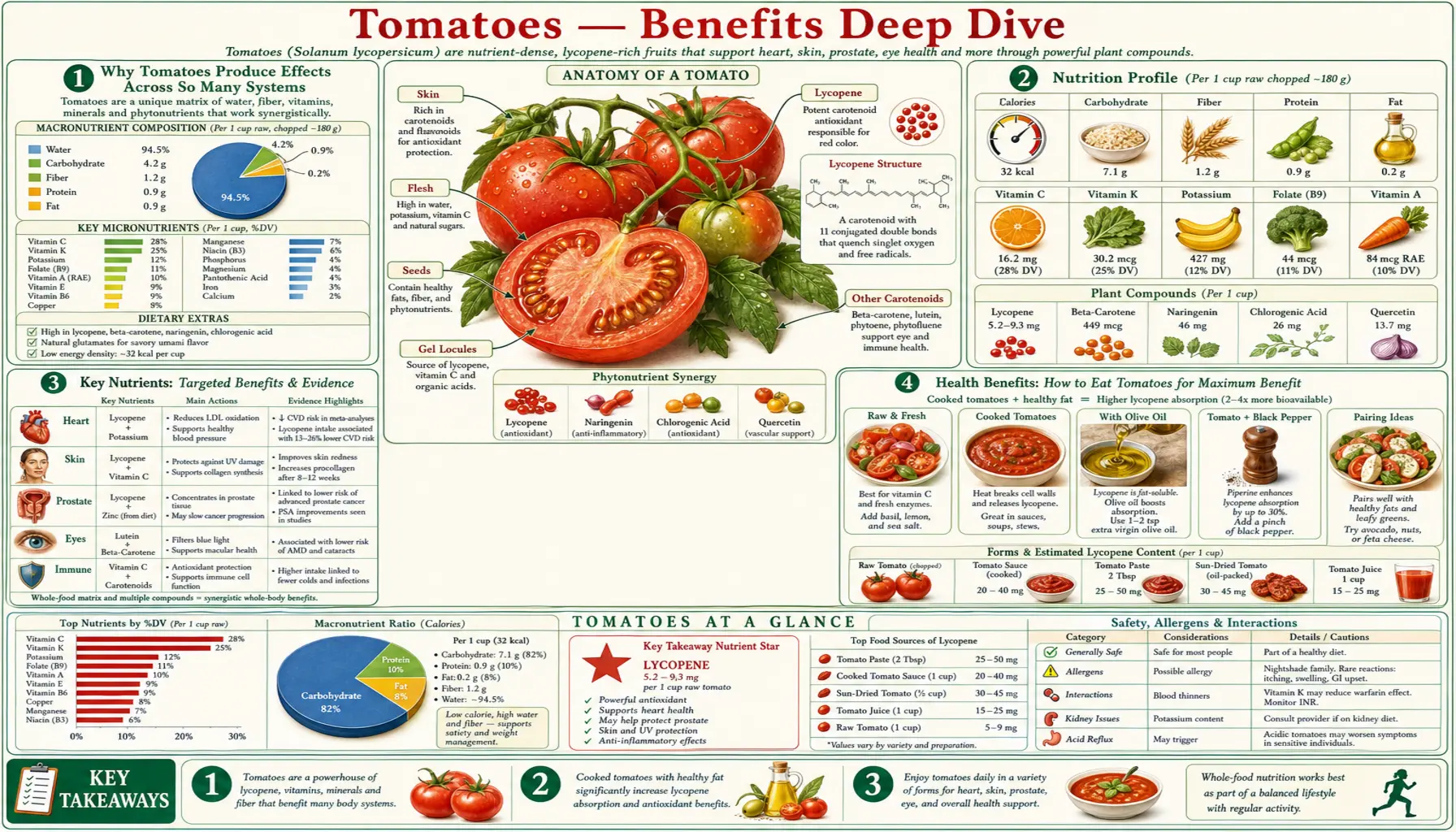
The tomato (Solanum lycopersicum) is one of the few common foods that combines an unusually concentrated single phytochemical — lycopene — with a near-universal place in the global diet. A century of epidemiology and an unbroken thread of mechanistic biology link cooked tomato intake to reduced risk of advanced and lethal prostate cancer, lower cardiovascular event rates, improved endothelial function, and meaningful protection against ultraviolet-induced skin damage. Four sub-articles below explore the most consequential branches of the tomato literature: the prostate-lycopene connection that drove the first major scientific interest in the food, the counterintuitive cooking-and-fat rule that triples bioavailability, the nightshade-family questions raised by patients with autoimmune or inflammatory conditions, and the genuine nutritional differences between commodity hybrid and heirloom open-pollinated varieties.
Deep-Dive Articles
Lycopene & Prostate Cancer
The Giovannucci Harvard Health Professionals Follow-up Study finding that 2+ servings of tomato sauce per week was associated with a 35% lower risk of advanced prostate cancer, the European Prospective Investigation into Cancer and Nutrition (EPIC) study of 137,001 men in 8 countries (plasma lycopene linked with lower risk of advanced but not overall prostate cancer), the small 2001 randomized trial of lycopene before prostate surgery (26 men), mechanism through prostate tissue lycopene concentration, insulin-like growth factor 1 (IGF-1) axis modulation, and why the dietary signal outperforms isolated supplement trials.
Read the deep dive →Cooked vs Raw Bioavailability
The Stahl & Sies 1992 finding that blood lycopene rose only after heat-processed tomato juice (boiled 1 hour with 1% corn oil), with the cis forms (9-cis and 13-cis) seeming somewhat better absorbed than the all-trans form. Why olive oil triples plasma lycopene response, why the Mediterranean trio (cooked tomato + olive oil + garlic) is mechanistically synergistic, and how Italian-American dietary patterns inadvertently optimized lycopene delivery generations before the science existed.
Read the deep dive →Nightshades Considerations
Steroidal glycoalkaloid biology (tomatine, solanine), the AIP / Wahls / Paleo nightshade-elimination protocols, the actual evidence base for nightshade sensitivity in rheumatoid arthritis and inflammatory bowel disease, the difference between green/ripe tomato alkaloid load, lectin questions, and what the elimination-and-reintroduction protocols described for a suspected personal sensitivity involve.
Read the deep dive →Heirloom & Variety Nutrition
The Davis 2004 analysis of U.S. Department of Agriculture (USDA) food tables for 43 garden crops as a group, 1950 to 1999 (median declines in 6 of 13 nutrients, from 6% for protein to 38% for riboflavin, which the authors linked to changes in cultivated varieties — trade-offs between yield and nutrient content), why heirloom varieties (Brandywine, Cherokee Purple, Black Krim) retain higher polyphenol content, the orange-tomato tetra-cis-lycopene anomaly, San Marzano DOP standards, and notes on sourcing.
Read the deep dive →Table of Contents
- Deep-Dive Articles
- Why Tomatoes Produce Effects Across So Many Systems
- Research Papers: Lycopene and Prostate Cancer
- Research Papers: Cardiovascular Disease
- Research Papers: Skin Photoprotection
- Research Papers: Bioavailability and Processing
- Research Papers: Nightshade Sensitivity and Glycoalkaloids
- External Authoritative Resources
- Connections
- Featured Videos
Why Tomatoes Produce Effects Across So Many Systems
The tomato is interesting nutritionally not because it is exceptionally calorie-dense or protein-rich — it is neither — but because it is the dominant dietary source of lycopene, the deep-red acyclic carotenoid that gives tomatoes, watermelon, pink grapefruit, and guava their color. In the Health Professionals Follow-up Study of U.S. men (1995 report), tomatoes, tomato sauce, tomato juice and pizza made up 82% of lycopene intake, and eating them more than 10 times a week, compared with fewer than 1.5 times, was linked with a lower risk of prostate cancer (relative risk 0.65, where 1.0 means no difference) and of advanced prostate cancer (relative risk 0.47). No other common food comes close.
Lycopene is unusual among the carotenoids in three respects, each of which maps to a distinct category of clinical effect:
- Highest singlet-oxygen quenching capacity of any common carotenoid — lycopene has 11 conjugated double bonds, and a 1989 laboratory study measured its singlet-oxygen quenching rate constant at 31 × 109 M−1 s−1, against 14 × 109 for beta-carotene and 0.3 × 10⁹ for alpha-tocopherol. The same study notes that at the levels found in blood plasma, the quenching capacities of lycopene, beta-carotene, bilirubin and alpha-tocopherol are of comparable magnitude. This is the mechanism behind the prostate cancer prevention signal (prostate tissue concentrates lycopene and is especially vulnerable to oxidative DNA damage) and the cardiovascular and skin photoprotection effects.
- Unique tissue distribution favoring prostate, testes, adrenal, and skin — unlike beta-carotene which distributes broadly, lycopene concentrates in specific tissues including the prostate, testes, adrenal glands, liver, and skin; in a 1992 study of seven human tissues, liver, adrenal gland and testes always held more carotenoids than kidney, ovary and fat, and lycopene was the main carotenoid in the testes. The evidence on which prostate cancers the signal applies to is mixed: a 2017 meta-analysis of 42 studies (692,012 participants) linked higher dietary and blood lycopene with lower overall prostate cancer risk but found no link with advanced prostate cancer, while the EPIC study linked higher plasma lycopene with a lower risk of advanced disease only. Skin photoprotection has been measured in supplementation trials (see Skin Photoprotection below).
- Counterintuitive cooking effect — raw tomatoes contain predominantly all-trans lycopene, which is poorly absorbed (typical absorption efficiency 10-30%). In a 1992 study, blood lycopene rose only after tomato juice boiled for 1 hour with 1% corn oil was drunk, not after unprocessed juice, and the cis forms (9-cis and 13-cis) seemed to be somewhat better absorbed than the all-trans form. A 1996 study found cis forms made up 9 to 21% of lycopene in tomatoes, tomato paste and tomato soup but 79 to 88% in prostate tissue. In a 1997 study, tomato paste gave a 2.5-fold higher peak and a 3.8-fold higher area-under-the-curve lycopene response than fresh tomatoes, even though the lycopene isomer pattern was the same in both. Cooked tomato in fat (the canonical Mediterranean form) is therefore a mechanistically optimized lycopene delivery vehicle — a Sunday-sauce simmered in olive oil delivers 3-4× more bioavailable lycopene per gram than the equivalent weight of raw fresh tomato.
The therapeutic complication is that the dietary signal does not transfer cleanly to isolated lycopene supplements. Randomized controlled trials of purified lycopene capsules for prostate cancer prevention have been largely negative. This is the same pattern seen for beta-carotene (ATBC and CARET trials) and for selenium and vitamin E (the Selenium and Vitamin E Cancer Prevention Trial, SELECT, of 35,533 men, in which selenium or vitamin E, alone or together, did not prevent prostate cancer) — isolated supplement doses do not reproduce the food-matrix effect, which depends on the cocktail of co-occurring phytochemicals (phytoene, phytofluene, beta-carotene, gamma-carotene, naringenin chalcone, rutin, chlorogenic acid) and on the fat-soluble carrier matrix of the meal.
The fourth deep-dive page addresses the variety question: not all tomatoes are nutritionally equivalent. Commodity hybrid varieties have been selected for color uniformity, shelf life, and yield per acre, with measurable losses in lycopene density, polyphenol content, and flavor compounds compared to heirloom and traditional regional varieties. The third deep-dive page addresses the nightshade question — whether the small dose of steroidal glycoalkaloids in the Solanaceae family matters clinically for patients with autoimmune or inflammatory bowel conditions, and how elimination-and-reintroduction protocols test that question in one person.
The largest pooled analysis so far, a 2017 meta-analysis of 42 studies with 692,012 participants (43,851 prostate cancer cases), found that both higher dietary lycopene and higher blood lycopene were linked with lower prostate cancer risk (relative risk 0.88 for each). Risk fell by 1% for every additional 2 mg of dietary lycopene. The analysis found no link between lycopene and advanced prostate cancer, with only a borderline trend for less aggressive disease (relative risk 0.74, 95% confidence interval 0.55 to 1.00).
Research Papers: Lycopene and Prostate Cancer
- Giovannucci E, Ascherio A, Rimm EB, Stampfer MJ, Colditz GA, Willett WC (1995). Intake of carotenoids and retinol in relation to risk of prostate cancer. Journal of the National Cancer Institute. 1995;87(23):1767-76. — PubMed PMID: 7473833
- Giovannucci E (2002). A review of epidemiologic studies of tomatoes, lycopene, and prostate cancer. Experimental Biology and Medicine (Maywood). 2002;227(10):852-9. — PubMed PMID: 12424325
- Key TJ, Appleby PN, Allen NE, Travis RC, Roddam AW, et al. (2007). Plasma carotenoids, retinol, and tocopherols and the risk of prostate cancer in the European Prospective Investigation into Cancer and Nutrition study. American Journal of Clinical Nutrition. 2007;86(3):672-81. — PubMed PMID: 17823432
- Giovannucci E, Rimm EB, Liu Y, Stampfer MJ, Willett WC (2002). A prospective study of tomato products, lycopene, and prostate cancer risk. Journal of the National Cancer Institute. 2002;94(5):391-8. — PubMed PMID: 11880478
- Lippman SM, Klein EA, Goodman PJ, Lucia MS, Thompson IM, et al. (2009). Effect of selenium and vitamin E on risk of prostate cancer and other cancers: the Selenium and Vitamin E Cancer Prevention Trial (SELECT). JAMA. 2009;301(1):39-51. — PubMed PMID: 19066370
- Chen L, Stacewicz-Sapuntzakis M, Duncan C, Sharifi R, Ghosh L, et al. (2001). Oxidative DNA damage in prostate cancer patients consuming tomato sauce-based entrees as a whole-food intervention. Journal of the National Cancer Institute. 2001;93(24):1872-9. — PubMed PMID: 11752012
- Lycopene and IGF-1 axis modulation in prostate cancer — PubMed: Lycopene and IGF-1
- Clinton SK, Emenhiser C, Schwartz SJ, Bostwick DG, Williams AW, et al. (1996). cis-trans lycopene isomers, carotenoids, and retinol in the human prostate. Cancer Epidemiology, Biomarkers & Prevention. 1996;5(10):823-33. — PubMed PMID: 8896894
- Kucuk O, Sarkar FH, Sakr W, Djuric Z, Pollak MN, et al. (2001). Phase II randomized clinical trial of lycopene supplementation before radical prostatectomy. Cancer Epidemiology, Biomarkers & Prevention. 2001;10(8):861-8. — PubMed PMID: 11489752
- Lycopene and prostate cancer biochemical recurrence — PubMed: Lycopene and BCR
- Rowles JL 3rd, Ranard KM, Smith JW, An R, Erdman JW Jr (2017). Increased dietary and circulating lycopene are associated with reduced prostate cancer risk: a systematic review and meta-analysis. Prostate Cancer and Prostatic Diseases. 2017;20(4):361-377. — PubMed PMID: 28440323
Research Papers: Cardiovascular Disease
A 2019 meta-analysis of 25 observational studies found that people in the highest lycopene intake group, or with the highest blood lycopene, had a 26% lower risk of stroke and a 14% lower risk of cardiovascular disease, and those with the highest blood lycopene a 37% lower risk of death. Lycopene was not significantly linked with heart attack (myocardial infarction), and in the three studies of tomato intake itself the lower risks of stroke and heart disease were not statistically significant.
- Sesso HD et al., Plasma lycopene and other carotenoids in relation to cardiovascular disease (Women's Health Study) — PubMed: Sesso WHS lycopene
- Kuopio Ischaemic Heart Disease Risk Factor Study lycopene and stroke — PubMed: Kuopio lycopene stroke
- Lycopene and LDL oxidation resistance — PubMed: Lycopene LDL oxidation
- Tomato extract and endothelial function in pre-hypertension — PubMed: Tomato endothelial function
- Lycopene supplementation and blood pressure meta-analysis — PubMed: Lycopene blood pressure meta-analysis
- Tomato consumption and serum lipid profile — PubMed: Tomato and lipid profile
- Mediterranean diet cardiovascular protection PREDIMED trial — PubMed: PREDIMED Mediterranean diet
- Lycopene and inflammatory markers (CRP, IL-6) — PubMed: Lycopene inflammation
- Lycopene and atherosclerotic plaque carotid intima-media thickness — PubMed: Lycopene carotid IMT
- Tomato juice and platelet aggregation (water-soluble tomato concentrate) — PubMed: Water-soluble tomato concentrate and platelets
- Cheng HM, Koutsidis G, Lodge JK, Ashor AW, Siervo M, Lara J (2019). Lycopene and tomato and risk of cardiovascular diseases: A systematic review and meta-analysis of epidemiological evidence. Critical Reviews in Food Science and Nutrition. 2019;59(1):141-158. — PubMed PMID: 28799780
Research Papers: Skin Photoprotection
- Stahl W, Heinrich U, Wiseman S, Eichler O, Sies H, Tronnier H (2001). Dietary tomato paste protects against ultraviolet light-induced erythema in humans. Journal of Nutrition. 2001;131(5):1449-51. — PubMed PMID: 11340098
- Aust O et al., Supplementation with tomato-based nutrient complex protects against UV-induced erythema — PubMed: Aust tomato UV
- Lycopene and matrix metalloproteinase (MMP-1) suppression in UV-irradiated skin — PubMed: Lycopene MMP-1 skin
- Carotenoid skin accumulation and minimum erythema dose (MED) — PubMed: Carotenoid MED
- Tomato-rich diet and skin photoaging biomarkers — PubMed: Tomato photoaging
- Di Mascio P, Kaiser S, Sies H (1989). Lycopene as the most efficient biological carotenoid singlet oxygen quencher. Archives of Biochemistry and Biophysics. 1989;274(2):532-8. — PubMed PMID: 2802626
- Beta-carotene and lycopene in skin photoprotection comparative — PubMed: BC vs lycopene skin
- Tomato extract and skin elasticity, density measurement — PubMed: Tomato skin elasticity
Research Papers: Bioavailability and Processing
- Stahl W, Sies H (1992). Uptake of lycopene and its geometrical isomers is greater from heat-processed than from unprocessed tomato juice in humans. Journal of Nutrition. 1992;122(11):2161-6. — PubMed PMID: 1432255
- Gärtner C, Stahl W, Sies H (1997). Lycopene is more bioavailable from tomato paste than from fresh tomatoes. American Journal of Clinical Nutrition. 1997;66(1):116-22. — PubMed PMID: 9209178
- Cis-trans isomerization of lycopene during processing — PubMed: Cis-trans isomerization
- Stahl W, Schwarz W, Sundquist AR, Sies H (1992). cis-trans isomers of lycopene and beta-carotene in human serum and tissues. Archives of Biochemistry and Biophysics. 1992;294(1):173-7. — PubMed PMID: 1550343
- Olive oil enhancement of lycopene absorption — PubMed: Olive oil lycopene absorption
- Avocado fat and carotenoid absorption from salad — PubMed: Avocado and carotenoids
- Lycopene plasma response after standardized tomato meal — PubMed: Lycopene plasma kinetics
- Tomato pulp particle size and lycopene release — PubMed: Tomato particle size
- Mixed-meal effects on carotenoid absorption (review) — PubMed: Mixed-meal carotenoids
Research Papers: Nightshade Sensitivity and Glycoalkaloids
- Friedman M, Tomato glycoalkaloids: role in the plant and in the diet (J Agric Food Chem) — PubMed: Friedman tomatine review
- Alpha-tomatine bioavailability and human metabolism — PubMed: Tomatine bioavailability
- Solanine glycoalkaloid intestinal permeability — PubMed: Solanine intestinal permeability
- Childers N, Nightshades and arthritis observational reports — PubMed: Childers nightshade arthritis
- Autoimmune protocol (AIP) elimination diet evidence base — PubMed: AIP elimination diet
- Lectin content of nightshade vegetables — PubMed: Lectins in nightshades
- Green tomato glycoalkaloid concentration vs ripe — PubMed: Green vs ripe glycoalkaloid
- Histamine content of tomato and intolerance — PubMed: Tomato histamine
External Authoritative Resources
- Linus Pauling Institute — Carotenoids (including lycopene)
- National Cancer Institute — Antioxidants and Cancer Prevention
- U.S. National Institutes of Health (NIH) Office of Dietary Supplements — Dietary Reference Intakes
- U.S. Department of Agriculture FoodData Central — Tomato nutrient composition
- PubMed — All research on lycopene and tomatoes