⚠ Evidence warning: Clinical trials or other evidence do not support the claims that vitamin B6 at 50-100 mg per day for two weeks before menses is the therapeutic intervention for premenstrual syndrome, and that bananas address two of the main drivers of morning sickness and are a useful adjunct for mild cases. This page keeps it as a report of what people, websites or other media say.
Bananas for Vitamin B6 and Mood
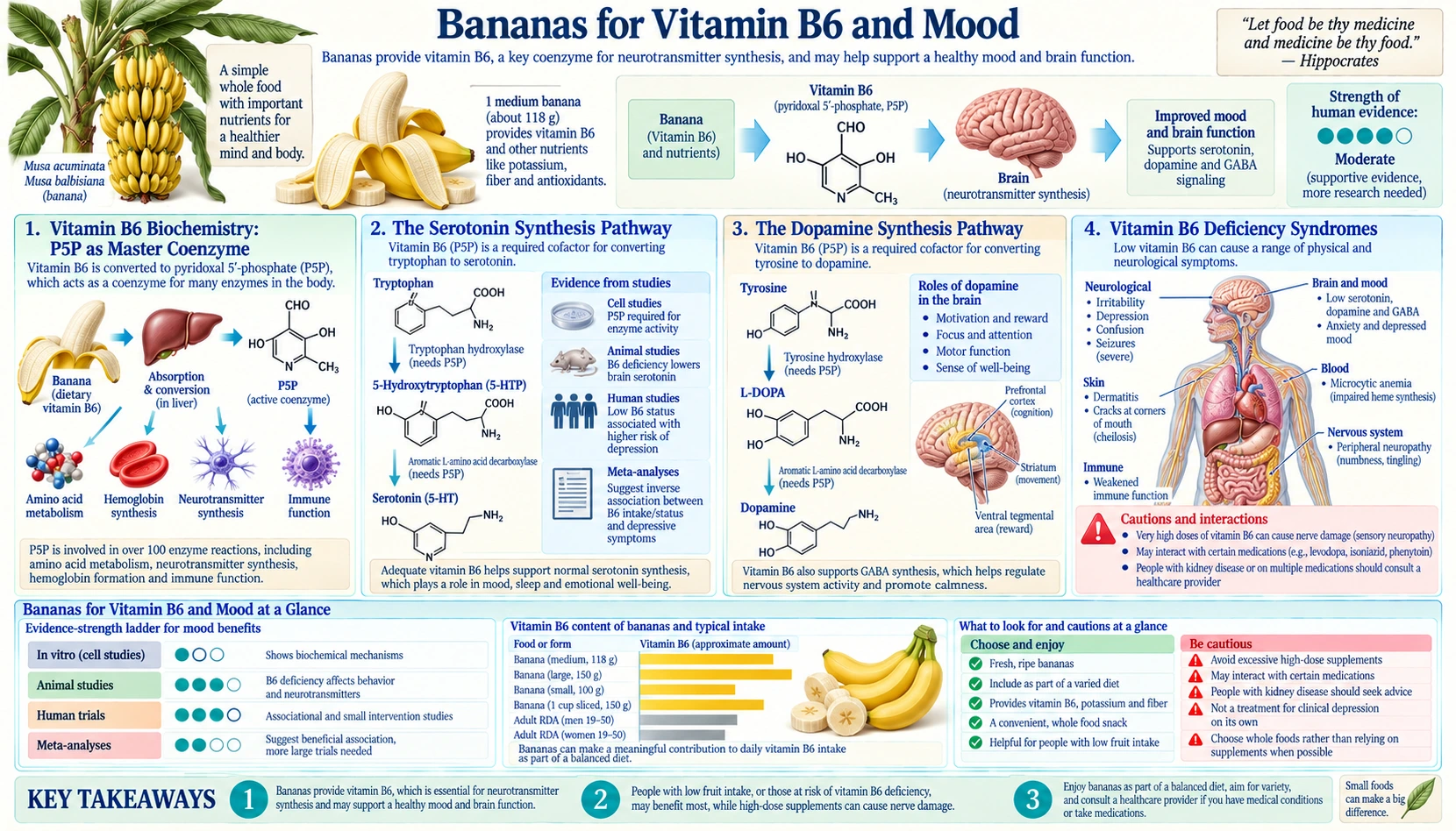
A medium banana delivers 0.43 mg of Vitamin B6 (pyridoxine), approximately 25% of the adult daily requirement. Vitamin B6 in its active coenzyme form — pyridoxal-5-phosphate (P5P) — is the obligate cofactor for aromatic L-amino acid decarboxylase (AADC), the enzyme that converts 5-hydroxytryptophan to serotonin and L-DOPA to dopamine. P5P is also a cofactor for cystathionine beta-synthase (the homocysteine-clearing enzyme), kynureninase (the tryptophan-to-NAD pathway), and glycogen phosphorylase (mobilizing muscle glycogen during exercise). The clinical translation is that frank Vitamin B6 deficiency produces depression, peripheral neuropathy, microcytic anemia, and increased homocysteine; subclinical deficiency in the elderly, in alcoholics, and in oral contraceptive users is more common than usually appreciated. The banana is not a sufficient B6 source on its own, but it is one of the easiest dietary contributors and its frequent consumption nudges most healthy adults toward adequacy.
Table of Contents
- Vitamin B6 Biochemistry: P5P as Master Coenzyme
- The Serotonin Synthesis Pathway
- The Dopamine Synthesis Pathway
- Vitamin B6 Deficiency Syndromes
- Depression and Vitamin B6: The Clinical Evidence
- Premenstrual Syndrome (PMS)
- Nausea and Vomiting of Pregnancy
- Homocysteine and Cardiovascular Disease
- Sleep, Tryptophan, and the Bedtime Banana
- Comparing Bananas to Other B6 Sources
- Cautions: B6 Toxicity at High Chronic Intake
- Key Research Papers
- Connections
- Featured Videos
Vitamin B6 Biochemistry: P5P as Master Coenzyme
Vitamin B6 is a family of six related water-soluble compounds: pyridoxine, pyridoxamine, pyridoxal, and their three phosphorylated forms (pyridoxine-5-phosphate, pyridoxamine-5-phosphate, and pyridoxal-5-phosphate). The biologically active coenzyme form is pyridoxal-5-phosphate (P5P), and all dietary forms are converted to P5P by the liver via the pyridoxal kinase / pyridoxine-5-phosphate oxidase pathway.
P5P is the cofactor for more than 140 distinct enzyme reactions, more than almost any other water-soluble vitamin coenzyme. The vast majority of these are transamination reactions (the building of non-essential amino acids from precursors), decarboxylation reactions (the removal of carboxyl groups, often producing biogenic amines), and racemization reactions. The reactions most relevant to neuropsychiatric outcomes are:
- Aromatic L-amino acid decarboxylase (AADC): converts 5-hydroxytryptophan to serotonin; converts L-DOPA to dopamine; rate-limiting after the tryptophan and tyrosine hydroxylase steps.
- Glutamate decarboxylase (GAD): converts glutamate (excitatory neurotransmitter) to gamma-aminobutyric acid (GABA) (inhibitory neurotransmitter). Insufficient P5P shifts the brain toward an excitatory balance.
- Cystathionine beta-synthase: first step in homocysteine clearance via the transsulfuration pathway. Without P5P, homocysteine accumulates with cardiovascular consequences.
- Kynureninase: in the tryptophan-to-NAD pathway. P5P deficiency shunts tryptophan toward kynurenic acid and quinolinic acid, both of which have neuroactive effects (and quinolinic acid is excitotoxic).
- Glycogen phosphorylase: the enzyme that mobilizes glycogen to glucose-1-phosphate during exercise or fasting. P5P is covalently bound to the enzyme in a stoichiometric ratio, making the body's muscle glycogen stores a major P5P reservoir.
The Serotonin Synthesis Pathway
Serotonin (5-hydroxytryptamine, 5-HT) is synthesized from the essential amino acid tryptophan in three steps:
- Tryptophan hydroxylase (TPH) — the rate-limiting enzyme, requires tetrahydrobiopterin (BH4) cofactor, iron, and molecular oxygen. Converts tryptophan to 5-hydroxytryptophan (5-HTP).
- Aromatic L-amino acid decarboxylase (AADC) — requires P5P cofactor. Converts 5-HTP to serotonin.
- Storage / release: Serotonin is packaged into vesicles by VMAT2 (vesicular monoamine transporter 2) and released at the synaptic cleft.
The pathway has multiple potential bottlenecks. Tryptophan supply from the diet competes with other large neutral amino acids (leucine, isoleucine, valine, phenylalanine, tyrosine) for the L-type amino acid transporter at the blood-brain barrier. A high-carbohydrate, low-protein meal can favor tryptophan delivery to the brain because insulin drives the competing branched-chain amino acids into muscle. This is one of the mechanistic explanations for why a banana before bed (carbohydrate-rich, modest tryptophan) may promote sleep more than a pure tryptophan supplement — the carbohydrate component shifts the amino acid competition at the BBB.
The B6 cofactor step is downstream of the hydroxylation but still essential. Severe B6 deficiency reduces serotonin synthesis throughout the brain and the gut (where 90% of body serotonin actually resides). The clinical correlates include depression, sleep disturbance, increased pain sensitivity, and altered gut motility.
The Dopamine Synthesis Pathway
The dopamine pathway is parallel to the serotonin pathway but uses tyrosine as the precursor:
- Tyrosine hydroxylase (TH) — rate-limiting, requires BH4. Converts tyrosine to L-DOPA.
- Aromatic L-amino acid decarboxylase (AADC) — same enzyme as in serotonin synthesis, requires P5P. Converts L-DOPA to dopamine.
- Storage and release: Dopamine is packaged by VMAT2 and released at the dopaminergic terminal.
The shared AADC step explains why P5P deficiency simultaneously impairs serotonin AND dopamine synthesis — an unusually broad neurochemical effect for a single vitamin. Pharmacologically, AADC is the target of carbidopa, the peripheral AADC inhibitor co-administered with L-DOPA in Parkinson's disease to prevent peripheral decarboxylation of the drug before it reaches the brain. This pharmacologic relationship illustrates how essential P5P-mediated decarboxylation is to monoamine synthesis — if you block it peripherally, almost all L-DOPA reaches the brain unmetabolized.
Bananas also contain measurable dopamine in the pulp (40-50 mg/kg) and notably high concentrations in the peel (700 mg/kg or more). Dopamine in the pulp does not cross the blood-brain barrier intact, so it does not directly act as a central nervous system (CNS) neurotransmitter; however, the peripheral dopamine may contribute to the documented post-meal increase in plasma dopamine that has been measured after banana ingestion.
Vitamin B6 Deficiency Syndromes
Frank Vitamin B6 deficiency is unusual in well-nourished adults but well-documented in specific populations:
- Alcoholism: ethanol metabolism produces acetaldehyde which displaces P5P from its binding sites, leading to functional B6 deficiency despite normal dietary intake.
- Isoniazid and hydralazine therapy: these drugs form Schiff-base adducts with pyridoxal, depleting active B6. Isoniazid-induced peripheral neuropathy in tuberculosis treatment is prevented by 25-50 mg of pyridoxine daily added to the regimen.
- Oral contraceptive use: older formulations were strongly associated with B6 depletion; modern lower-dose pills have a milder effect but still measurable.
- Chronic renal failure / dialysis: P5P is removed by hemodialysis and B6 supplementation is standard in dialysis patients.
- Elderly with poor dietary diversity: approximately 10-15% of community-dwelling elderly have plasma P5P below the laboratory reference range.
- Inflammatory states: P5P is sequestered in inflamed tissue and plasma levels fall, an effect documented in rheumatoid arthritis, inflammatory bowel disease, and severe sepsis. The deficiency may be functional rather than nutritional.
The classic syndrome of severe B6 deficiency includes:
- Seborrheic dermatitis, especially in the nasolabial folds and around the eyes
- Glossitis (inflamed, smooth tongue) and angular stomatitis
- Peripheral neuropathy with burning paresthesias of the feet
- Depressed mood and irritability
- Microcytic anemia (because P5P is required for the first committed step of heme synthesis: ALA synthase)
- In severe / infant cases: seizures (because gamma-aminobutyric acid synthesis is impaired without GAD cofactor)
The most striking pediatric presentation is pyridoxine-responsive seizures in newborns — usually due to a rare inherited defect in P5P handling, treated with high-dose pyridoxine supplementation.
Depression and Vitamin B6: The Clinical Evidence
The relationship between Vitamin B6 status and depression is documented but more modest than the mechanistic story (serotonin and dopamine synthesis) would suggest. The strongest evidence:
- Hvas et al. 2004 (Psychother Psychosom) — a study of 140 people found that 18 of them (13%) were depressed, and that a low blood level of active B6 (plasma P5P) was significantly linked to a higher depression score (p=0.002). Vitamin B12, folate and homocysteine showed no significant link. The authors wrote that randomized trials were needed to test whether B6 treatment improves depression.
- Skarupski et al. 2010 (Am J Clin Nutr) — the Chicago Health and Aging Project followed 3,503 adults aged 65 and over for an average of 7.2 years. Higher total intake of B6 and B12 — food plus supplements — was linked to fewer new cases of depressive symptoms (each extra 10 mg of B6 and 10 mcg of B12 went with 2% lower odds of depressive symptoms per year). B6 from food alone showed no association with depressive symptoms.
- Merete et al. 2008 (J Am Coll Nutr) — a cross-sectional study of 618 older Caribbean Hispanic adults and 251 non-Hispanic white older adults in Massachusetts. A plasma P5P below 20 nmol/L roughly doubled the likelihood of depression on the Center for Epidemiologic Studies Depression Scale (CES-D). B6 from the diet was significantly linked to depression scores, but total intake (diet plus supplements) was not. The authors wrote that long-term studies are needed to tell which comes first.
- Williams et al. 2005 (Fam Pract) — a systematic review of ten papers (five randomized trials, one intervention study, three reviews and one case report) found no meaningful effect of B6 supplements on depression in general, but a consistent signal of benefit in the papers on depression in women before menopause.
A 2022 double-blind study at the University of Reading gave 478 young adults a high-dose vitamin B6 or vitamin B12 supplement, or a placebo, for one month. B6 lowered self-reported anxiety and showed a trend toward lower depression scores; the authors link this to B6's role in making gamma-aminobutyric acid, the brain's calming chemical messenger. These were high supplement doses, not the amounts found in food (Field et al. 2022).
Taken together, these studies link low blood B6 with depressed mood. They do not show that B6 supplements lift mood in people who already have enough B6, and no study has tested whether the B6 in a banana changes mood. The bananas-and-depression relationship is therefore most relevant for the modestly deficient subgroup (elderly, alcoholic, contraceptive-user, dialysis), and for whom the dietary intervention is a small piece of a broader treatment plan rather than a stand-alone therapy.
Premenstrual Syndrome (PMS)
Vitamin B6 supplementation for premenstrual syndrome has been one of the most-studied nutritional interventions in women's health, with mixed but generally favorable results. The Wyatt et al. systematic review and meta-analysis (BMJ 1999) pooled nine placebo-controlled trials with 940 women and concluded that B6 doses up to 100 mg per day were superior to placebo for both general PMS symptoms (odds ratio 2.32, 95% confidence interval (CI) 1.95-2.54) and, in the four of those trials (541 women) that reported it, PMS-related depression (odds ratio (OR) 1.69, 1.39-2.06). The authors added that their conclusions are limited by the low quality of most of the trials.
The proposed mechanism is the serotonin synthesis pathway: PMS is associated with disturbed serotonin tone in the luteal phase, and adequate B6 supports serotonin synthesis. The effect is more pronounced for premenstrual irritability and depression than for the physical symptoms of bloating and breast tenderness.
A daily banana delivers about 25% of the Recommended Dietary Allowance (RDA) but is far short of the 50-100 mg doses used in the PMS trials, where bananas would be a small dietary contributor. For PMS management, bananas are a small dietary contributor; the therapeutic intervention is supplemental B6 at 50-100 mg per day for two weeks before menses (taken consistently — not just on symptomatic days). The trials in the Wyatt review used supplemental B6 at doses up to 100 mg per day. Those trial doses reach the US Institute of Medicine upper limit of 100 mg per day and are far above the European Food Safety Authority's 2023 adult upper limit of 12 mg per day; nerve damage (peripheral neuropathy) has been reported at 100-200 mg per day taken for months (see Cautions below).
Nausea and Vomiting of Pregnancy
Vitamin B6 is recommended by the American College of Obstetricians and Gynecologists (ACOG) as first-line therapy for nausea and vomiting of pregnancy, typically at doses of 10-25 mg three to four times daily. The recommendation is based on randomized trials dating back to the 1990s and a more recent body of evidence supporting B6 alone or in combination with doxylamine (doxylamine-pyridoxine, a 1956–1983 product that was withdrawn, and today's doxylamine-pyridoxine delayed-release tablets). The American College of Obstetricians and Gynecologists' 2018 Practice Bulletin No. 189 also states that mild cases of nausea and vomiting of pregnancy may be resolved with lifestyle and dietary changes.
The 1991 randomized double-blind trial by Sahakian and colleagues gave 31 women 25 mg of B6 every 8 hours for 3 days and 28 women a placebo. B6 clearly reduced nausea only in the women with severe nausea; in mild to moderate nausea, and in the group as a whole, B6 did no better than placebo. After the 3 days, 8 of the 31 women on B6 still had any vomiting, compared with 15 of the 28 on placebo, a statistically significant difference.
The mechanism is not fully understood. Theories include direct antiemetic action via dopamine receptor effects, or improved homocysteine metabolism altering nausea sensitivity. Whatever the mechanism, the clinical effect is real and the safety profile is favorable.
For the pregnant patient with mild morning sickness, several small bananas spread across the day provide both B6 and easily-digested carbohydrate, which together address two of the main nausea drivers. Several small bananas spread across the day provide some B6 together with easily digested carbohydrate. A medium banana's 0.43 mg of B6 is far below the 25 mg doses used in the trial above, and no trial has tested bananas for morning sickness. This is not a substitute for the ACOG-recommended B6 doses for moderate-to-severe symptoms, but it is a useful adjunct for mild cases.
Homocysteine and Cardiovascular Disease
Homocysteine is a sulfur-containing amino acid produced as an intermediate in methionine metabolism. Elevated plasma homocysteine is an independent risk factor for cardiovascular disease, stroke, and dementia. Three vitamins clear homocysteine: folate (B9, via the remethylation pathway), Vitamin B12 (cofactor for methionine synthase), and Vitamin B6 (cofactor for cystathionine beta-synthase in the transsulfuration pathway).
The cardiovascular effect of B6 supplementation alone is modest in trials — the larger benefits come from folate. However, in patients with confirmed elevated homocysteine and an inadequate diet, the combination of B6, B12, and folate effectively normalizes homocysteine. A banana's 0.43 mg of B6 plus 24 mcg of folate contributes both nutrients in a single serving.
The HOPE-2 trial and similar large randomized trials of B-vitamin supplementation for cardiovascular event prevention have been disappointing — lowering homocysteine reduced stroke risk modestly but did not reduce overall cardiovascular events. HOPE-2 gave 5,522 people aged 55 or older with vascular disease or diabetes a daily combination of 2.5 mg folic acid, 50 mg vitamin B6 and 1 mg vitamin B12, or a placebo, for an average of five years. Major cardiovascular events (death from heart disease, heart attack and stroke combined) were not reduced (relative risk 0.95), there were fewer strokes (relative risk 0.75), and more people on the vitamins were admitted to hospital for unstable angina (relative risk 1.24). The Norwegian NORVIT trial of 3,749 people who had just had a heart attack found no benefit from 40 mg of B6 a day, and a trend toward higher risk in the group given B6 together with folic acid and B12 (relative risk 1.22).
The pragmatic conclusion is that ensuring adequate dietary B6, B12, and folate intake matters for the modestly deficient, but megadose supplementation of replete adults does not produce additional benefit.
Sleep, Tryptophan, and the Bedtime Banana
The "bedtime banana for sleep" folk wisdom has more biological support than most folk wisdom. The mechanism is multi-step:
- The banana provides modest tryptophan (~11 mg per medium fruit) and adequate Vitamin B6 (0.43 mg) for the conversion of 5-HTP to serotonin.
- The carbohydrate content (~27 g) provokes an insulin response. Insulin drives the branched-chain amino acids (leucine, isoleucine, valine) and other large neutral amino acids into muscle, reducing their competition with tryptophan at the L-type amino acid transporter at the blood-brain barrier.
- The net effect is increased tryptophan delivery to the brain, where it is converted (via tryptophan hydroxylase and P5P-dependent AADC) to serotonin.
- Serotonin in the pineal gland is further converted by acetylserotonin methyltransferase to melatonin, the principal sleep-regulating hormone.
The magnitude of effect is real but modest. A single banana 30-60 minutes before bed is more likely to facilitate sleep onset than a high-protein meal eaten at the same time, but no controlled trial has shown a banana to be clinically equivalent to a melatonin supplement. A small 2002 double-blind study by Ebben and colleagues gave 12 college students 100 mg or 250 mg of B6, or a placebo, at bedtime for five days each. At 250 mg (not at 100 mg), morning dream-salience scores (vividness, bizarreness, emotion and colour) rose over the first three days. The authors proposed a link to B6's role in turning tryptophan into serotonin, and wrote that the study needs to be repeated, including in a sleep laboratory, before the results can be considered certain.
The Halson and other sleep-nutrition reviews suggest that the most effective dietary sleep interventions combine carbohydrate, modest protein with tryptophan, B6, and magnesium. A banana plus a small spoonful of almond butter approximates this pattern in a convenient bedtime snack.
Comparing Bananas to Other B6 Sources
| Food (typical serving) | Vitamin B6 (mg) | % Recommended Dietary Allowance (adult) |
|---|---|---|
| Chickpeas, 1 cup cooked | 1.1 | 65% |
| Beef liver, 3 oz | 0.86 | 51% |
| Yellowfin tuna, 3 oz | 0.88 | 52% |
| Sockeye salmon, 3 oz | 0.59 | 35% |
| Chicken breast, 3 oz | 0.52 | 31% |
| Potato, 1 medium baked | 0.54 | 32% |
| Banana, 1 medium | 0.43 | 25% |
| Sunflower seeds, 1 oz | 0.32 | 19% |
| Avocado, 1/2 fruit | 0.21 | 12% |
| Spinach, 1 cup cooked | 0.44 | 26% |
The banana is not the densest dietary B6 source — chickpeas, beef liver, and oily fish all win on density. The banana's practical advantage is its convenience and palatability for daily consumption. Most adults who eat a banana per day, plus regular consumption of poultry or fish, comfortably exceed the B6 Recommended Dietary Allowance of 1.3-1.7 mg.
Cautions: B6 Toxicity at High Chronic Intake
Vitamin B6 is unusual among water-soluble vitamins in having a well-documented chronic toxicity syndrome. The Schaumburg et al. 1983 NEJM paper described seven adults who developed severe sensory neuropathy from chronic high-dose pyridoxine supplementation (2-6 g per day for several months). Symptoms included progressive numbness and tingling of the hands and feet, gait ataxia from loss of proprioception, and impaired pain and temperature sensation. The neuropathy generally improved after stopping the supplement but recovery was incomplete in some cases.
Subsequent case reports have documented sensory neuropathy at doses as low as 100-200 mg per day taken for months to years. The Institute of Medicine established a Tolerable Upper Intake Level (UL) for adult Vitamin B6 of 100 mg per day from supplements. In 2023 the European Food Safety Authority (EFSA) set a much lower adult upper limit of 12 mg per day, including for pregnant and breastfeeding women. EFSA said a lowest dose that causes harm could not be established from human data; it started from a reference point of 50 mg per day taken from a case-control study, supported by case reports and vigilance data.
A 2023 case report described a 73-year-old man with three years of worsening nerve damage (peripheral neuropathy) and a blood B6 level of 259.9 nmol/L (reference range 20-125 nmol/L) whose only reported source was a daily multivitamin containing 6 mg of B6 — below the EFSA limit. A medium banana's 0.43 mg is a small fraction of either limit.
Bananas pose no toxicity risk: even consuming five to ten bananas per day would deliver only 2-4 mg of B6, well below the Tolerable Upper Intake Level. The risk is purely from supplemental pyridoxine, particularly multi-ingredient "B-complex" supplements that contain 100 mg or more of B6 per serving, taken chronically. The supplemental P5P form (pyridoxal-5-phosphate) is sometimes promoted as having a different toxicity profile, but the evidence for this is weak. The official adult upper limits are 12 mg per day (EFSA, 2023) and 100 mg per day (Institute of Medicine).
Key Research Papers
- Hvas AM et al., Vitamin B6 level and depression in elderly — Psychother Psychosom 2004. — PubMed PMID: 15479988
- Wyatt KM et al., Vitamin B6 for premenstrual syndrome meta-analysis — BMJ 1999. — PubMed PMID: 10334745
- Skarupski KA, Tangney C, Li H, Ouyang B, Evans DA, Morris MC, Longitudinal association of vitamin B-6, folate, and vitamin B-12 with depressive symptoms among older adults over time — Am J Clin Nutr 2010;92(2):330-5. — PubMed PMID: 20519557
- Schaumburg H et al., Sensory neuropathy from pyridoxine abuse — NEJM 1983. — PubMed PMID: 6308447
- Ebben M, Lequerica A, Spielman A, Effects of pyridoxine on dreaming: a preliminary study — Percept Mot Skills 2002;94(1):135-40. — PubMed PMID: 11883552
- Merete C, Falcon LM, Tucker KL, Vitamin B6 is associated with depressive symptomatology in Massachusetts elders — J Am Coll Nutr 2008;27(3):421-7. — PubMed PMID: 18838531
- Williams AL, Cotter A, Sabina A, Girard C, Goodman J, Katz DL, The role for vitamin B-6 as treatment for depression: a systematic review — Fam Pract 2005;22(5):532-7. — PubMed PMID: 15964874
- EFSA Panel on Nutrition, Novel Foods and Food Allergens (NDA), Turck D, Bohn T, Castenmiller J, et al., Scientific opinion on the tolerable upper intake level for vitamin B6 — EFSA J 2023;21(5):e08006. — PubMed PMID: 37207271
- Paluszny A, Qiu S, Vitamin B6 Toxicity Secondary to Daily Multivitamin Use: A Case Report — Cureus 2023;15(11):e48792. — PubMed PMID: 38098895
- Field DT, Cracknell RO, Eastwood JR, Scarfe P, Williams CM, Zheng Y, Tavassoli T, High-dose Vitamin B6 supplementation reduces anxiety and strengthens visual surround suppression — Hum Psychopharmacol 2022;37(6):e2852. — PubMed PMID: 35851507
- Matthews A et al., Interventions for nausea and vomiting in early pregnancy (Cochrane Review) — PubMed PMID: 26348534
- Sahakian V, Rouse D, Sipes S, Rose N, Niebyl J, Vitamin B6 is effective therapy for nausea and vomiting of pregnancy: a randomized, double-blind placebo-controlled study — Obstet Gynecol 1991;78(1):33-6. — PubMed PMID: 2047064
- Committee on Practice Bulletins-Obstetrics, ACOG Practice Bulletin No. 189: Nausea And Vomiting Of Pregnancy — Obstet Gynecol 2018;131(1):e15-e30. — PubMed PMID: 29266076
- Lonn E, Yusuf S, Arnold MJ, Sheridan P, Pogue J, Micks M, McQueen MJ, Probstfield J, Fodor G, Held C, Genest J Jr; Heart Outcomes Prevention Evaluation (HOPE) 2 Investigators, Homocysteine lowering with folic acid and B vitamins in vascular disease — N Engl J Med 2006;354(15):1567-77. — PubMed PMID: 16531613
- Bønaa KH, Njølstad I, Ueland PM, Schirmer H, Tverdal A, Steigen T, Wang H, Nordrehaug JE, Arnesen E, Rasmussen K; NORVIT Trial Investigators, Homocysteine lowering and cardiovascular events after acute myocardial infarction — N Engl J Med 2006;354(15):1578-88. — PubMed PMID: 16531614
- Selhub J, Homocysteine metabolism review — Annu Rev Nutr 1999 PubMed: Selhub review
- NIH Office of Dietary Supplements Vitamin B6 Fact Sheet evidence summary PubMed: B6 status review