Natto Safety and Interactions
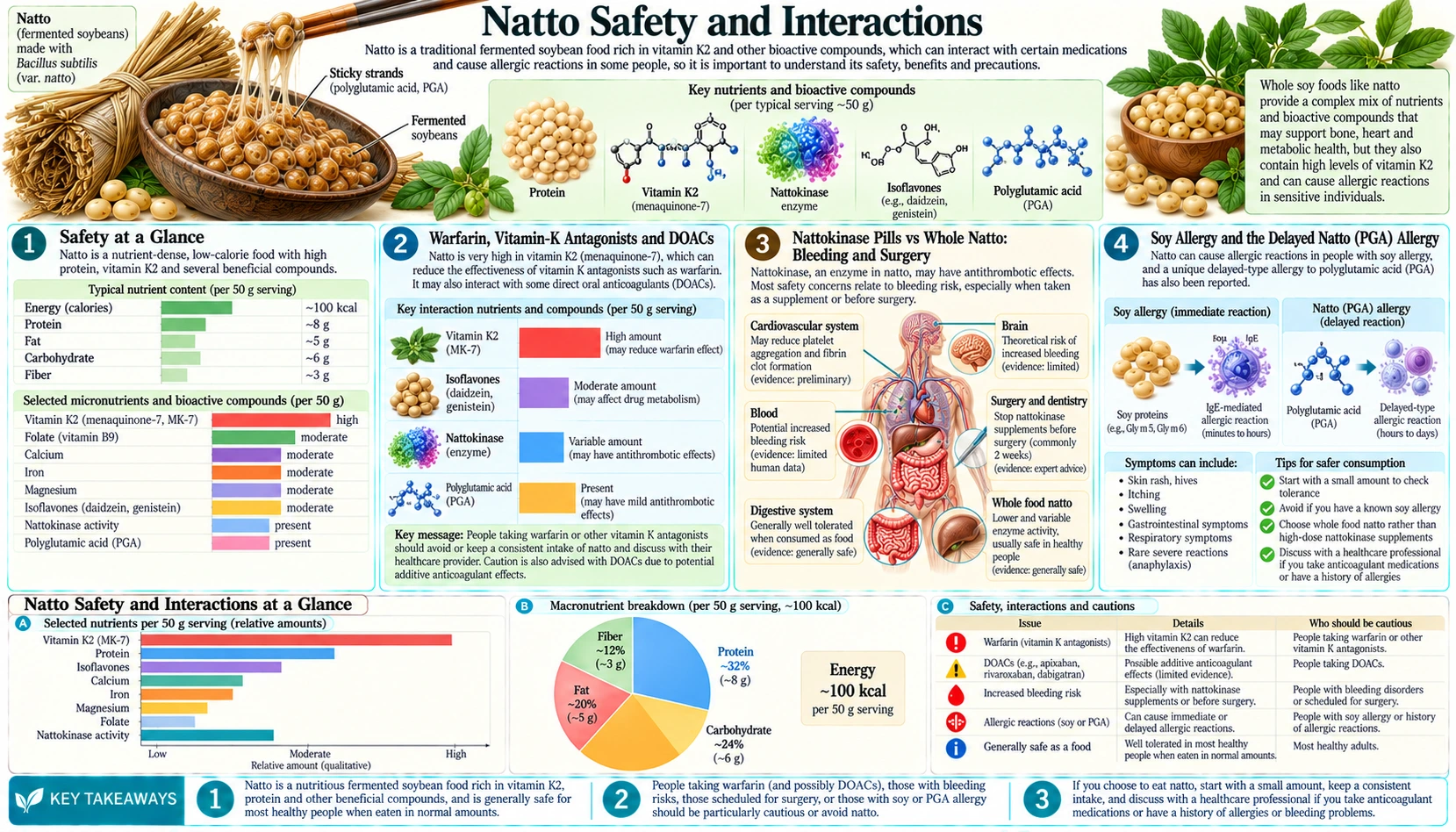
Natto is an everyday food for millions of people in Japan, and for almost everyone it is simply that: a nourishing fermented food. A short list of people do need a plan first. The big one is anyone on warfarin, because natto is the richest food source of vitamin K2 ever measured and can undo the drug. This page walks through every known interaction — blood thinners, nattokinase pills, a rare delayed allergy, thyroid, gout, kidneys, pregnancy and weakened immunity — and grades each by how common it is, how serious it is, and how good the evidence is.
Table of Contents
- Safety at a Glance
- Warfarin, Vitamin-K Antagonists and DOACs
- Nattokinase Pills vs Whole Natto: Bleeding and Surgery
- Soy Allergy and the Delayed Natto (PGA) Allergy
- Thyroid, Isoflavones and Iodine
- Gout, Kidney Disease and Histamine
- Pregnancy, Children and Weakened Immunity
- Risk Matrix: Who Should Talk to a Clinician First
- Key Research Papers
- Connections
- Featured Videos
Safety at a Glance
Think of natto safety as one tall gate and a few low fences. The tall gate is warfarin (and its cousins, the vitamin-K antagonists). Natto is so loaded with vitamin K2 that a single pack can push a carefully balanced warfarin dose off course. If that gate does not apply to you, there are a handful of low fences — an allergy, a supplement pill on top of a blood thinner, gout, advanced kidney disease, or a badly weakened immune system — that a quick check clears. Past those, natto is an ordinary food.
Two numbers explain why warfarin gets its own gate. Japanese food chemists measured 939 micrograms (µg) of MK-7 per 100 g of natto (Kamao 2007, food analysis), which means one 50 g pack carries roughly 470 µg. In a controlled study of people on a warfarin-type drug, as little as 10 µg of MK-7 a day nudged blood clotting tests in a clinically relevant way in at least 40% of volunteers (Theuwissen 2013, controlled dose-response study). One pack is close to fifty times that amount.
The rest of the page takes each box in turn, with the evidence behind it.
Warfarin, Vitamin-K Antagonists and DOACs
How warfarin works, in one picture. Your liver builds several clotting proteins, and each needs a "finishing touch" from vitamin K before it works. Vitamin K gets used up in that step and is recycled, like a reusable tool. Warfarin (and its relatives acenocoumarol and phenprocoumon, together called vitamin-K antagonists, or VKAs) jams the recycling machine, so fewer clotting proteins get finished and blood clots more slowly. Your INR blood test measures exactly how slowly. Flood the system with fresh vitamin K and the liver no longer needs the recycling machine — the drug's effect fades and the INR drops, which raises the risk of the very clot or stroke warfarin was prescribed to prevent.
Why natto is in a class of its own. Leafy greens contain vitamin K1. Natto contains vitamin K2 in its MK-7 form, made by the Bacillus subtilis bacteria during fermentation, and in quantities nothing else on the plate approaches: 939 µg per 100 g in one Japanese analysis (Kamao 2007, food analysis). MK-7 also lingers. In a study of healthy volunteers, MK-7 had a very long half-life and built up to 7- to 8-fold higher blood levels with daily intake than vitamin K1 did, and the authors warned that 50 µg a day or more could interfere with anticoagulant treatment in a clinically relevant way (Schurgers 2007, controlled human study).
How little it takes. A later dose-finding study put 18 healthy volunteers on acenocoumarol, a warfarin-type drug, and then added MK-7 in rising amounts. At 45 µg a day the group's average INR fell by about 40%. Even 10 and 20 µg a day were judged by two blood specialists to cause a clinically relevant INR drop in at least 40% and 60% of people respectively (Theuwissen 2013, controlled dose-response study). Their conclusion was blunt: MK-7 supplements should be avoided by people on VKA therapy. A 50 g pack of natto, at roughly 470 µg, dwarfs every dose they tested.
It lasts for days, not hours. In a Japanese study, volunteers who ate natto saw their blood MK-7 jump from 1.86 to 14.54 ng/mL five hours later, and it was still raised at 48 hours (Homma 2006, small human study). That is why "I'll skip natto the day before my INR test" does not work. The same study found that boiling natto knocked its MK-7 down sharply and produced only a mild rise in blood levels — an interesting finding, but it measured blood vitamin K, not INR, and it is not a do-it-yourself licence.
What to actually do on warfarin. The general rule for warfarin and food is consistency: a steady daily vitamin K intake keeps the INR steadier than swinging between high and low days (Kampouraki 2017, review). Natto is the exception that strains that rule, because one pack carries so much K2 that "consistent" means eating it every single day in the same amount and having the dose re-set around it. In practice, Japanese patients on warfarin are routinely told to avoid natto altogether, and that is the safe default. If you love natto and are on warfarin, the right conversation is with your prescriber: some people are candidates for a different anticoagulant, and anyone who changes their natto habit needs extra INR checks.
DOACs: apixaban, rivaroxaban, edoxaban and dabigatran
The newer direct oral anticoagulants (DOACs) block a clotting protein directly — factor Xa for apixaban, rivaroxaban and edoxaban, thrombin for dabigatran — rather than starving the liver of finished vitamin K. So vitamin K in food is not expected to blunt them the way it blunts warfarin. Honesty requires one caveat: a 2017 review noted that whether dietary vitamin K affects DOAC response in humans "remains to be investigated" (Kampouraki 2017, review). The mechanism is reassuring and there is no human signal of a problem, but it has not been formally tested with natto. The more relevant DOAC question is not the food at all — it is whether you are also taking a nattokinase supplement, which is the next section.
Nattokinase Pills vs Whole Natto: Bleeding and Surgery
Natto contains an enzyme called nattokinase that can break down fibrin, the mesh that holds a blood clot together (see Nattokinase and Fibrinolysis). Nattokinase is sold separately as a concentrated pill, and that is where the bleeding concern lives. Note the irony: the pill and the food pull in opposite directions on clotting. Whole natto brings a large dose of vitamin K2, which supports clotting factor production; most nattokinase capsules are made to remove the vitamin K. So a person can be at risk from natto (on warfarin) or from nattokinase (on aspirin or a DOAC) for completely different reasons.
The bleeding case. Doctors in Taiwan described a patient who was already taking aspirin after a stroke, added nattokinase 400 mg a day, and seven days later had a bleed in the cerebellum. Brain scans also showed many tiny old "microbleeds," a sign of fragile small vessels (Chang 2008, case report). The authors suggested that nattokinase may raise bleeding risk in people with bleeding-prone small vessels who are also on another antithrombotic drug. One case cannot prove cause, but it is a plausible mechanism and the right reason for caution.
The clot case. The opposite mistake is also documented. Surgeons in Texas reported a patient with a mechanical heart valve who replaced warfarin with nattokinase on their own; after nearly a year a clot formed on the valve and the valve had to be replaced again (Elahi 2015, case report). Nattokinase is not a substitute for a prescribed anticoagulant.
The reassuring trial. In the largest long-term trial, 265 healthy adults with a median age of 65.3 years took 2,000 fibrinolytic units of nattokinase or a placebo for a median of 3 years. There was no difference in artery-wall thickening or stiffness, and no significant effect on blood pressure or on any laboratory measure, including clotting and clot-dissolving factors (Hodis 2021, randomized controlled trial). That is disappointing for anyone hoping the pill prevents heart disease, but reassuring on safety for healthy people not on blood thinners.
Practical rules
- Eating natto as food is not the bleeding concern; the case reports involve concentrated pills.
- On aspirin, clopidogrel, a DOAC, heparin or warfarin? Do not add a nattokinase supplement without asking the prescriber.
- Before surgery, dental extraction or an epidural, list nattokinase with your medicines. Surgical teams commonly ask that supplements with blood-thinning effects be stopped about one to two weeks beforehand — follow your own team's instruction.
- Never use nattokinase in place of a prescribed anticoagulant, especially with a mechanical valve, atrial fibrillation or a past clot.
More on the enzyme itself: Nattokinase and Nattokinase: Cardiovascular and Fibrinolysis.
Soy Allergy and the Delayed Natto (PGA) Allergy
Ordinary soy allergy
Natto is made from whole soybeans, so anyone with a diagnosed soy allergy should treat natto as soy unless an allergist says otherwise. Fermentation changes some proteins, but it does not reliably make soy safe for an allergic person. Soy allergy is most common in young children and is often outgrown; whether a particular child or adult can now eat fermented soy is a question for supervised testing, not trial and error at the dinner table. See Food Allergy.
The natto allergy that is not a soy allergy
The strands that make natto stringy are mostly poly-gamma-glutamic acid (PGA), a long chain the bacteria spin around the beans. A small number of people become allergic to PGA itself, and the reaction has an unusual and dangerous signature: it arrives many hours late.
A Yokohama dermatology group reviewed 7 patients, all men aged 26 to 42. Every one had widespread hives and trouble breathing, and 5 lost consciousness. The reactions started 5 to 14 hours after eating natto, with an average of 9.6 hours (Inomata 2007, case series). Picture eating natto at breakfast and collapsing in the late afternoon — few people, and few emergency doctors, would connect the two. Many of these patients tolerate tofu and soy sauce, because the culprit is the PGA, not the soy protein.
The surfer connection. The same group noticed that one patient was a surfer allergic to both natto and jellyfish — and jellyfish stings contain PGA. In a follow-up of 140 food-allergy outpatients, all 13 with natto allergy reacted to PGA on skin and blood-cell tests, 92.3% had a marine-sport hobby and 84.6% surfed. Marine sports were very strongly linked to PGA sensitization (odds ratio 278), while the amount of natto people ate was not (Inomata 2018, case-control questionnaire study). The leading explanation is that repeated stings through the skin "teach" the immune system to see PGA as an enemy, and natto then triggers it. The pattern is reminiscent of alpha-gal syndrome, where tick bites sensitize people to a sugar in red meat and reactions also come hours late.
- Who should think of it: surfers, divers and others stung often by jellyfish who get hives, wheeze or faintness hours after a meal that included natto.
- What to do: stop natto and see an allergist; skin-prick and basophil tests can confirm it. Severe reactions belong in Anaphylaxis territory, with an emergency plan.
Thyroid, Isoflavones and Iodine
Soybeans contain isoflavones, plant compounds that in test tubes and animals can interfere with the enzyme that builds thyroid hormone. That lab finding is the root of the worry, and it applies to all soy, fermented or not. What matters is what happens in people.
A 2019 meta-analysis pooled randomized trials (18 articles) in which people took soy and had thyroid tests. Soy had no effect on the thyroid hormones free T3 and free T4. TSH, the pituitary's "work harder" signal, rose by a very small average of 0.248 mIU/L, and the authors judged the clinical significance, if any, unclear (Otun 2019, meta-analysis of RCTs). Most of those trials used soy protein or isoflavone supplements rather than natto, so they test a larger isoflavone dose than a daily pack of natto delivers, not a smaller one.
The practical points are simple:
- Iodine is the real lever. The thyroid needs iodine to make hormone. The theoretical concern about soy is greatest in people whose iodine intake is marginal — and in Japan, natto is traditionally eaten alongside seaweed, a rich iodine source. See Iodine Deficiency, Hypothyroidism and Fatigue.
- If you take levothyroxine, soy foods eaten at the same time can reduce how much of the pill you absorb. Take the pill on an empty stomach as directed, keep natto at a different meal, and keep your habit steady so your dose can be set around it. See Hypothyroidism and the TSH test.
- For a healthy, iodine-sufficient adult, the evidence does not support avoiding natto for thyroid reasons.
A useful contrast: this site does not recommend unfermented, industrial soy products (soy protein isolate, soy milk, soybean oil, soy formula), for reasons covered elsewhere. Traditional fermented soy such as natto, miso and tempeh is a different food — whole beans, a living ferment, eaten in modest daily portions.
Gout, Kidney Disease and Histamine
Purines and gout
Purines are building blocks of DNA that the body breaks down into uric acid; too much uric acid can crystallize in joints as gout. A Japanese laboratory measured purines in 270 foods and found natto at 113.9 mg per 100 g, placing it in their "moderate" group (100 to 200 mg per 100 g). Tofu and soymilk measured under 50 mg, dried soybeans 172.5 mg, and the truly purine-dense foods were organ meats, fish milt, meats, fish and yeast (Kaneko 2014, food analysis). Japanese guidance for gout recommends keeping total dietary purines under 400 mg a day. A 50 g pack of natto supplies about 57 mg — a modest slice of that budget. People with gout can usually keep natto on the menu in normal portions; the bigger levers are alcohol (especially beer), sugary drinks and large servings of organ meats and certain seafood. See also the Uric Acid test.
Kidney disease: potassium and phosphorus
Healthy kidneys handle natto's minerals easily, and the potassium is a plus for blood pressure. In advanced chronic kidney disease, though, potassium and phosphorus can build up, and many patients are given daily limits. USDA FoodData Central lists natto at 729 mg potassium and 174 mg phosphorus per 100 g, so a 50 g pack adds about 365 mg potassium and 87 mg phosphorus. That does not forbid natto; it means a renal dietitian should fit it into your numbers. Two further notes: the soy sauce or seasoning packet adds sodium that the beans themselves barely contain, and natto's 939 µg of MK-7 per 100 g matters if you are on warfarin for dialysis-related reasons. Also note that the USDA vitamin K figure for natto (23 µg per 100 g) counts only vitamin K1 — it leaves out the MK-7, which is why it looks so much lower than the Japanese measurement. See Kidney Disease.
Histamine and other biogenic amines
Many fermented foods — aged cheese, sauerkraut, soy sauce, miso, fish sauce — can contain histamine and tyramine, made when microbes break down amino acids. Natto is a Bacillus ferment, and like other ferments its amine content varies with the strain, the temperature and how long it sits in the fridge. Good measurements specific to natto are scarce, so treat this as a low-evidence, individual issue (food chemistry, limited data):
- Histamine intolerance or mast cell activation: if fermented foods in general give you flushing, headache or hives, trial natto in a small amount and choose fresh packs over old ones. See the Low-Histamine Diet.
- Older MAO-inhibitor antidepressants (such as phenelzine or tranylcypromine) carry a tyramine warning for fermented soy products; ask the prescriber before eating natto.
Pregnancy, Children and Weakened Immunity
Pregnancy and breastfeeding
Natto is a normal food for pregnant and breastfeeding women in Japan, and nothing in the evidence suggests otherwise. Vitamin K from food has no known toxicity — no tolerable upper intake has been set for it, because high food intakes have not been shown to cause harm in people who are not on vitamin-K antagonists. The usual pregnancy food-safety rules apply: keep natto refrigerated, eat it before its date, and skip any pack that smells sour-rotten rather than its usual ammonia-and-nut aroma. Pregnant women on warfarin are rare (warfarin is usually avoided in pregnancy), but anyone on an anticoagulant follows the warfarin and nattokinase sections above.
Children
Japanese children commonly eat natto over rice from toddlerhood. For young children the practical points are soy allergy (above) and texture: the sticky beans can be chopped and mixed into brown rice so they are easy to chew and swallow.
Weakened immunity and Bacillus subtilis
Natto is a living food carrying billions of Bacillus subtilis var. natto cells per gram (Homma 2006 counted about 9.7 log units per gram). For a healthy gut these are friendly passengers (see Bacillus subtilis). Rarely, in someone with a breached gut lining or a crippled immune system, they can get into the blood.
- At a Tokyo children's hospital, among children receiving chemotherapy, 78% of those with B. subtilis bloodstream infection had eaten natto in the prior week versus 50% of matched controls; natto intake was linked to about 3.3 times higher odds after accounting for low white-cell counts (Aoyagi 2023, case-control study).
- A Japanese hospital found that 69 of 70 B. subtilis blood-culture isolates over seven years were the natto strain. Of these, 25 were judged true infections, mostly in older adults with abdominal infections, pneumonia or urinary infections; 28% needed urgent procedures and 16% died within 30 days (Sada 2025, retrospective cohort).
These are real but uncommon events in very sick people, not a risk for the healthy population that eats natto daily. If you are on chemotherapy, have had a transplant, have very low neutrophil counts, or have a condition that damages the gut wall, ask your care team whether to pause natto and other live-culture foods for a while.
Risk Matrix: Who Should Talk to a Clinician First
The matrix below lines up every issue on this page by three separate questions: how many natto eaters it touches, how bad it is when it happens, and how strong the evidence is. Keeping the three apart matters — the warfarin interaction is both well proven and serious, while the PGA allergy is serious but rare, and the thyroid question is common but mild.
Talk to a clinician before eating natto (or before changing how much you eat) if you:
- take warfarin, acenocoumarol or phenprocoumon — the default is to avoid natto; any change needs INR checks;
- take a DOAC, aspirin, clopidogrel or another antiplatelet and want to add a nattokinase supplement;
- have surgery or a procedure coming up and take nattokinase;
- have a diagnosed soy allergy, or have had hives, wheeze or fainting hours after a meal — especially if you surf or dive and get jellyfish stings;
- have advanced kidney disease with a potassium or phosphorus limit;
- take levothyroxine and are starting natto as a new daily habit (so the dose can be checked);
- take an older MAO-inhibitor antidepressant;
- are on chemotherapy, have had a transplant, or have very low white-cell counts.
The conclusion: safe for most people
For the large majority of people — including people with well-controlled gout, healthy thyroids, pregnant women, children and older adults not on warfarin — natto is a safe, traditional fermented food. A daily pack over brown rice is how much of Japan eats it. The interactions on this page are real, but they are concentrated in a few clearly defined groups, and each one has a simple answer: avoid it, adjust around it, or check first. If none of those groups describes you, enjoy it. For the benefits side of the story, see Natto for Vitamin K2 (MK-7) and Natto Longevity and Heart Studies.
Key Research Papers
- Kamao M, Suhara Y, Tsugawa N, Uwano M, Yamaguchi N, Uenishi K, Ishida H, Sasaki S, Okano T (2007). Vitamin K content of foods and dietary vitamin K intake in Japanese young women. J Nutr Sci Vitaminol (Tokyo). 53(6):464-470. — PubMed PMID: 18202532
- Schurgers LJ, Teunissen KJ, Hamulýak K, Knapen MH, Vik H, Vermeer C (2007). Vitamin K-containing dietary supplements: comparison of synthetic vitamin K1 and natto-derived menaquinone-7. Blood. 109(8):3279-3283. — PubMed PMID: 17158229
- Theuwissen E, Teunissen KJ, Spronk HM, Hamulýak K, Ten Cate H, Shearer MJ, Vermeer C, Schurgers LJ (2013). Effect of low-dose supplements of menaquinone-7 (vitamin K2) on the stability of oral anticoagulant treatment: dose-response relationship in healthy volunteers. J Thromb Haemost. 11(6):1085-1092. — PubMed PMID: 23530987
- Homma K, Wakana N, Suzuki Y, Nukui M, Daimatsu T, Tanaka E, Tanaka K, Koga Y, Nakajima Y, Nakazawa H (2006). Treatment of natto, a fermented soybean preparation, to prevent excessive plasma vitamin K concentrations in patients taking warfarin. J Nutr Sci Vitaminol (Tokyo). 52(5):297-301. — PubMed PMID: 17190098
- Kampouraki E, Kamali F (2017). Dietary implications for patients receiving long-term oral anticoagulation therapy for treatment and prevention of thromboembolic disease. Expert Rev Clin Pharmacol. 10(8):789-797. — PubMed PMID: 28635328
- Chang YY, Liu JS, Lai SL, Wu HS, Lan MY (2008). Cerebellar hemorrhage provoked by combined use of nattokinase and aspirin in a patient with cerebral microbleeds. Intern Med. 47(5):467-469. — PubMed PMID: 18310985
- Elahi MM, Choi CH, Konda S, Shake JG (2015). Consequence of patient substitution of nattokinase for warfarin after aortic valve replacement with a mechanical prosthesis. Proc (Bayl Univ Med Cent). 28(1):81-82. — PubMed PMID: 25552810
- Hodis HN, Mack WJ, Meiselman HJ, Kalra V, Liebman H, Hwang-Levine J, et al. (2021). Nattokinase atherothrombotic prevention study: A randomized controlled trial. Clin Hemorheol Microcirc. 78(4):339-353. — PubMed PMID: 33843667
- Inomata N, Osuna H, Kawano K, Yamaguchi J, Yanagimachi M, Matsukura S, Ikezawa Z (2007). Late-onset anaphylaxis after ingestion of Bacillus subtilis-fermented soybeans (natto): clinical review of 7 patients. Allergol Int. 56(3):257-261. — PubMed PMID: 17519580
- Inomata N, Miyakawa M, Aihara M (2018). Surfing as a risk factor for sensitization to poly(γ-glutamic acid) in fermented soybeans, natto, allergy. Allergol Int. 67(3):341-346. — PubMed PMID: 29175280
- Otun J, Sahebkar A, Östlundh L, Atkin SL, Sathyapalan T (2019). Systematic review and meta-analysis on the effect of soy on thyroid function. Sci Rep. 9(1):3964. — PubMed PMID: 30850697
- Kaneko K, Aoyagi Y, Fukuuchi T, Inazawa K, Yamaoka N (2014). Total purine and purine base content of common foodstuffs for facilitating nutritional therapy for gout and hyperuricemia. Biol Pharm Bull. 37(5):709-721. — PubMed PMID: 24553148
- Aoyagi R, Okita K, Uda K, Ikegawa K, Yuza Y, Horikoshi Y (2023). Natto intake is a risk factor of Bacillus subtilis bacteremia among children undergoing chemotherapy for childhood cancer: A case-control study. J Infect Chemother. 29(3):329-332. — PubMed PMID: 36585273
- Sada RM, Yamamoto G, Hamaguchi S, Kuroda E, Okura A, Cai M, et al. (2025). The majority of Bacillus subtilis strains isolated from blood cultures were derived from traditional Japanese fermented soybeans natto: a single-center retrospective study. Open Forum Infect Dis. 12(9):ofaf574. — PubMed PMID: 41018695
PubMed Topic Searches
- PubMed: Natto, warfarin and vitamin K
- PubMed: Natto allergy and poly-gamma-glutamic acid
- PubMed: Nattokinase, bleeding and antiplatelet drugs
External Authoritative Resources
- USDA FoodData Central — search "Natto" (SR Legacy) for the potassium, phosphorus and vitamin K1 figures used above.
Connections
- All Food
- Natto
- Fermented Foods
- Natto for Vitamin K2 (MK-7)
- Nattokinase and Fibrinolysis
- Natto Nutrients
- Bacillus Subtilis and Gut Health
- Longevity and Heart Studies
- How to Make Natto
- Nattokinase
- Nattokinase and Vitamin K2
- Vitamin K2
- PT/INR Test
- Bacillus subtilis
- Food Allergy
- Gout
- Hypothyroidism
- Kidney Disease