Natto — Benefits Deep Dive
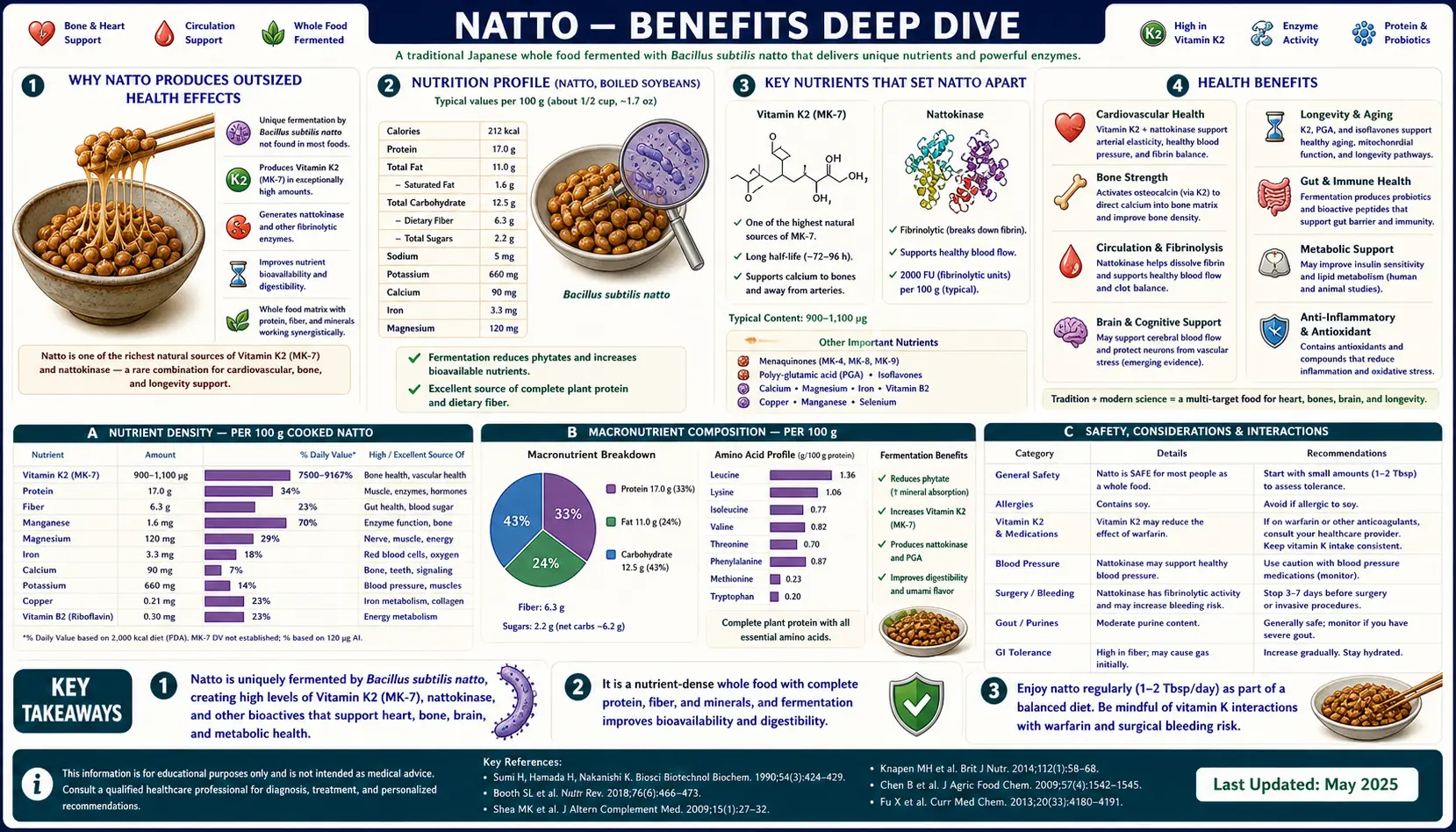
Natto, soybeans fermented with Bacillus subtilis var. natto, has been measured at 939 µg of menaquinone-7 (MK-7, a form of vitamin K2) per 100 g (Kamao 2007), and the same fermentation produces nattokinase, a subtilisin-like enzyme that digests fibrin, the protein mesh of a blood clot (Fujita 1993). The research on natto runs along three lines: Japanese cohort studies that link eating natto to lower cardiovascular mortality and fewer osteoporotic fractures; trials of MK-7 or nattokinase given as capsules, whose results are mixed; and the interactions that matter for people taking anticoagulants. The four deep-dive pages below cover vitamin K2, nattokinase, bone density, and the food's strong aroma and sticky texture.
Deep-Dive Articles
Vitamin K2 (MK-7)
What food analyses have measured for natto's MK-7, the menaquinone side chains, MK-7's circulating half-life of about 3 days against 1–2 hours for MK-4, the gamma-carboxylation of osteocalcin and matrix Gla protein, the Rotterdam Study and other cohorts linking menaquinone intake to lower coronary heart disease risk, the doses used in the MK-7 trials, and what the research reports about vitamin K and warfarin.
Read the deep dive →Nattokinase & Fibrinolysis
Sumi's 1987 report of a fibrinolytic enzyme in natto, the 275-amino-acid subtilisin-like serine protease, the FU activity unit, the small human studies of fibrinogen, clot-breakdown markers and blood pressure (Hsia, Kurosawa, Kim), long-flight thrombosis, and the bleeding concern alongside anticoagulant and antiplatelet drugs.
Read the deep dive →Bone Density
The Kaneki prefecture data linking natto intake to lower hip-fracture rates, the JPOS cohort studies of bone loss and fractures, the osteocalcin and matrix Gla protein mechanism, the 3-year Knapen MK-7 trial and the MK-7 trials that found no bone-density effect, the Japanese menatetrenone (MK-4) fracture trials and their retractions, the meta-analyses including the 2019 update that judged the fracture evidence insufficient, and what the large calcium and vitamin D trials found.
Read the deep dive →Acquired Taste Tips
Why natto smells and feels the way it does — ammonia, branched-chain fatty acids and the sticky poly-gamma-glutamic acid (PGA) threads — the traditional Japanese preparation with mustard, soy sauce and scallion, serving temperature and freezer storage, mixing with rice or egg, the natto sold in Asian markets, how MK-7 supplements compare, and recipes.
Read the deep dive →Table of Contents
- Deep-Dive Articles
- Two Compounds and What the Research Shows
- Research Papers: Vitamin K2 (MK-7)
- Research Papers: Nattokinase & Fibrinolysis
- Research Papers: Bone Density
- Research Papers: Cardiovascular Outcomes
- Research Papers: Cross-Cutting (Fermentation, Probiotic, Safety)
- External Authoritative Resources
- Connections
- Featured Videos
Two Compounds and What the Research Shows
Natto is a whole-soybean food fermented with Bacillus subtilis var. natto. Two compounds made in that fermentation are the subject of the research summarised here: menaquinone-7 (MK-7), a form of vitamin K2, and nattokinase, a fibrin-digesting enzyme. They act on different systems, and the evidence for each, and for natto as a food, is set out below.
- Vitamin K2 as menaquinone-7 (MK-7) — a Japanese food analysis measured 939 µg of MK-7 per 100 g of natto and found MK-7 “characteristically in fermented soybean products such as natto” (Kamao 2007). In a Dutch analysis, cheese had the highest menaquinone concentrations of the foods measured except for natto, and sauerkraut, the other fermented vegetable tested, held 200-fold less than natto (Vermeer 2018). MK-7 has a circulating half-life of about 3 days, against 1–2 hours for MK-4, the form found in meat, resulting in more constant plasma levels (Knapen 2007). Compared with synthetic vitamin K1, natto-derived MK-7 produced much more stable serum levels and more complete carboxylation of osteocalcin, a vitamin K-dependent bone protein (Schurgers 2007). The second vitamin K-dependent protein, matrix Gla protein, is described in a 2008 review as generally accepted to be a potent inhibitor of arterial calcification (Schurgers 2008). See the Vitamin K2 MK-7 deep dive for the menaquinone side-chain biochemistry and the half-life data.
- Nattokinase, a fibrin-digesting serine protease — a fibrinolytic enzyme first reported in natto by Sumi and colleagues (1987). Purified and sequenced, it is a subtilisin-like serine protease of 275 amino acids that digests fibrin (Fujita 1993). Oral nattokinase or natto produced a mild enhancement of plasma fibrinolytic activity in Sumi's 1990 report. In a placebo-controlled crossover study of 12 healthy young men, a single 2,000 FU dose raised D-dimer and fibrin/fibrinogen degradation products and prolonged the activated partial thromboplastin time, all within the normal range (Kurosawa 2015). In an uncontrolled study, 45 people took two 2,000 FU capsules a day for 2 months, and fibrinogen, factor VII and factor VIII fell (Hsia 2009). In an 8-week placebo-controlled trial of 86 adults with untreated systolic pressure of 130–159 mmHg, the net change in systolic pressure was −5.55 mmHg (Kim 2008). In the Nattokinase Atherothrombotic Prevention Study, 265 adults without cardiovascular disease took 2,000 FU of nattokinase or placebo for a median of 3 years; carotid intima-media thickness and arterial stiffness did not change differently from placebo, and there was no effect on blood pressure or any laboratory measure (Hodis 2021). Laboratory and animal work describes further actions, such as inhibited platelet aggregation in rabbit platelets and delayed arterial occlusion in rats (Jang 2013). See the Nattokinase deep dive for the Sumi discovery, the FU activity unit and the human trial data.
- Two compounds, two systems — MK-7 is studied for where calcium is deposited, in bone and in the artery wall; nattokinase is studied for clotting. The cohort findings below concern natto eaten as a food, while the trials used the isolated vitamin or enzyme as capsules. The studies cited on this page include no randomised trial of natto itself on heart disease or fractures.
Cardiovascular cohorts. In the Takayama Study of 13,355 men and 15,724 women in Japan followed for 16 years, the highest quartile of natto intake had a lower risk of death from cardiovascular disease than the lowest (HR 0.75, 95% CI 0.64–0.88) and a lower risk of death from stroke (HR 0.68, 0.52–0.88). Total soy protein, total soy isoflavones, and soy protein or isoflavones from soy foods other than natto were not associated with total cardiovascular mortality (Nagata 2017). In the Japan Public Health Center-based Prospective Study of 92,915 adults followed for 14.8 years, natto intake was inversely associated with cardiovascular mortality in both sexes, and the authors caution that the association of fermented soy products might be attenuated by unadjusted residual confounding (Katagiri 2020). In the Dutch Rotterdam Study, the highest tertile of menaquinone intake from the whole diet had a relative risk of 0.43 (0.24–0.77) for coronary heart disease mortality compared with the lowest, while phylloquinone (K1) was not related to any outcome (Geleijnse 2004); cheese and curd are described as the most important sources of long-chain menaquinones in the Western diet (Vermeer 2018). All of these are observational associations.
Bone. Kaneki and colleagues (2001) found a statistically significant inverse correlation between natto consumption and the incidence of hip fractures in women across Japan's prefectures, an ecological correlation of regional averages. In the Japanese Population-Based Osteoporosis (JPOS) cohort, natto intake was associated with less postmenopausal bone loss at the femoral neck (Ikeda 2006) and, over a median of 15.2 years, with fewer osteoporotic fractures: after full adjustment, the hazard ratio was 0.56 (0.32–0.99) for 7 or more packs a week compared with less than one pack, while 0.79 (0.56–1.10) for 1–6 packs was not statistically significant (Kojima 2020). Trials of MK-7 capsules are mixed: in 244 healthy postmenopausal women, 180 µg a day for 3 years decreased the age-related decline in bone density at the lumbar spine and femoral neck but not at the total hip (Knapen 2013), while 360 µg a day for 1 year in 334 Norwegian women (Emaus 2010) and 375 µg a day for 3 years in 142 Danish women with osteopenia (Rønn 2021) did not affect bone loss. The large fracture reductions in the 2006 meta-analysis came from Japanese menatetrenone (MK-4) trials, and the journal published a caution notice on it in 2018 (Cockayne 2006). Three vitamin K2 bone papers from one Japanese author group have since been retracted (Sato 2005; Sato 2011; Iwamoto 2004), and the separate Yamaguchi Osteoporosis Prevention Study was retracted in 2025 (Ishida 2004). The 2019 update of the meta-analysis found no evidence of an effect on bone density or vertebral fractures; the odds ratio for clinical fracture was 0.72 (0.55–0.95) overall but 0.76 (0.58–1.01) in trials at low risk of bias, and the authors judged the evidence insufficient to confirm a fracture benefit (Mott 2019).
Anticoagulants and bleeding. Added vitamin K opposes warfarin and the other vitamin K antagonists. Schurgers and colleagues (2007) concluded that preparations supplying 50 µg a day or more of MK-7 may interfere with oral anticoagulant treatment in a clinically relevant way. In 15 healthy volunteers anticoagulated with acenocoumarol, 45 µg of MK-7 a day lowered the group mean INR by about 40%, and the authors concluded that “the use of MK-7 supplements needs to be avoided in patients receiving VKA therapy” (Theuwissen 2013). Japanese researchers describe natto as a food that “must be avoided by warfarin-dependent patients”; in their 7-day trial, a natto made with a low-MK-7 strain did not change PT-INR in 10 warfarin-dependent patients at up to 20 g a day (Nakajima 2021). For nattokinase, case reports describe a cerebellar hemorrhage in a patient taking aspirin after 7 days of nattokinase at 400 mg a day (Chang 2008), a fatal hemoperitoneum in an elderly woman taking nattokinase (Ramachandran 2021), and thrombus on a mechanical heart valve in a patient who substituted nattokinase for warfarin for nearly a year (Elahi 2015). Decisions about natto, vitamin K and nattokinase alongside these drugs belong with a clinician.
Gut, aroma and allergy. A 2019 review of fermented foods lists natto among the four (with kefir, sauerkraut and sourdough bread) tested in at least one randomised trial for gastrointestinal effects, and concludes that there is very limited clinical evidence for the effectiveness of most fermented foods in gastrointestinal health and disease (Dimidi 2019). A Japanese case report describes bacterial meningitis in a 67-year-old woman who ate natto daily, with sequencing identifying the strain as B. subtilis var. natto (Tokano 2023). The fermentation also produces natto's odor: ammonia, 2,5-dimethylpyrazine and 2-methylbutanoic acid were identified as natto-like odor compounds (Tanaka 1998), and branched-chain short fatty acids such as isovaleric acid are described as the cause of its unpleasant odor (Hong 2017). The sticky threads contain poly-gamma-glutamic acid (PGA). Natto allergy is described as late-onset: in one case report, anaphylaxis came 10 to 14 hours after a meal containing natto, and the authors hypothesize delayed absorption or release of PGA as the mechanism (Suzuki 2006). Anaphylaxis from nattokinase has been reported in a patient with natto allergy (Awatani-Yoshidome 2022). The Acquired Taste Tips deep dive covers how the food is prepared and served, and the Bone Density deep dive covers the Japanese regional, cohort and trial data in full.
Research Papers: Vitamin K2 (MK-7)
- Schurgers LJ, Vermeer C (2000). Determination of phylloquinone and menaquinones in food. Effect of food matrix on circulating vitamin K concentrations. Haemostasis 30(6):298–307. — PubMed PMID: 11356998
- Schurgers LJ, Teunissen KJ, Hamulýak K, Knapen MH, Vik H, Vermeer C (2007). Vitamin K-containing dietary supplements: comparison of synthetic vitamin K1 and natto-derived menaquinone-7. Blood 109(8):3279–3283. — PubMed PMID: 17158229
- Sato T, Schurgers LJ, Uenishi K (2012). Comparison of menaquinone-4 and menaquinone-7 bioavailability in healthy women. Nutrition Journal 11:93. — PubMed PMID: 23140417
- Geleijnse JM, Vermeer C, Grobbee DE, Schurgers LJ, Knapen MH, van der Meer IM, et al. (2004). Dietary intake of menaquinone is associated with a reduced risk of coronary heart disease: the Rotterdam Study. J Nutr 134(11):3100–3105. — PubMed PMID: 15514282
- Beulens JW, Bots ML, Atsma F, Bartelink ML, Prokop M, Geleijnse JM, et al. (2009). High dietary menaquinone intake is associated with reduced coronary calcification. Atherosclerosis 203(2):489–493. — PubMed PMID: 18722618
- Knapen MH, Drummen NE, Smit E, Vermeer C, Theuwissen E (2013). Three-year low-dose menaquinone-7 supplementation helps decrease bone loss in healthy postmenopausal women. Osteoporosis International 24(9):2499–2507. — PubMed PMID: 23525894
- Knapen MH, Braam LA, Drummen NE, Bekers O, Hoeks AP, Vermeer C (2015). Menaquinone-7 supplementation improves arterial stiffness in healthy postmenopausal women. A double-blind randomised clinical trial. Thrombosis & Haemostasis 113(5):1135–1144. — PubMed PMID: 25694037
- Theuwissen E, Cranenburg EC, Knapen MH, Magdeleyns EJ, Teunissen KJ, Schurgers LJ, et al. (2012). Low-dose menaquinone-7 supplementation improved extra-hepatic vitamin K status, but had no effect on thrombin generation in healthy subjects. British Journal of Nutrition 108(9):1652–1657. — PubMed PMID: 22289649
- Halder M, Petsophonsakul P, Akbulut AC, Pavlic A, Bohan F, Anderson E, et al. (2019). Vitamin K: double bonds beyond coagulation insights into differences between vitamin K1 and K2 in health and disease. International Journal of Molecular Sciences 20(4):896. — PubMed PMID: 30791399
- Vermeer C (2012). Vitamin K: the effect on health beyond coagulation – an overview. Food & Nutrition Research 56. — PubMed PMID: 22489224
- Kamao M, Suhara Y, Tsugawa N, Uwano M, Yamaguchi N, Uenishi K, et al. (2007). Vitamin K content of foods and dietary vitamin K intake in Japanese young women. J Nutr Sci Vitaminol 53(6):464–470. — PubMed PMID: 18202532
- Knapen MH, Schurgers LJ, Vermeer C (2007). Vitamin K2 supplementation improves hip bone geometry and bone strength indices in postmenopausal women. Osteoporosis International 18(7):963–972. — PubMed PMID: 17287908
- Vermeer C, Raes J, van 't Hoofd C, Knapen MHJ, Xanthoulea S (2018). Menaquinone content of cheese. Nutrients 10(4):446. — PubMed PMID: 29617314
- Theuwissen E, Teunissen KJ, Spronk HM, Hamulýak K, Ten Cate H, Shearer MJ, et al. (2013). Effect of low-dose supplements of menaquinone-7 (vitamin K2) on the stability of oral anticoagulant treatment: dose-response relationship in healthy volunteers. J Thromb Haemost 11(6):1085–1092. — PubMed PMID: 23530987
- Nakajima T, Taya Y, Nishikawa T, Kitamura Y, Kato H, Mathis BJ, et al. (2021). First clinical trial of a newly developed, low menaquinone-7, fermented soybean natto in warfarin-dependent patients. J Med Food 24(8):860–865. — PubMed PMID: 34406879
Research Papers: Nattokinase & Fibrinolysis
- Sumi H, Hamada H, Tsushima H, Mihara H, Muraki H (1987). A novel fibrinolytic enzyme (nattokinase) in the vegetable cheese Natto; a typical and popular soybean food in the Japanese diet. Experientia 43(10):1110–1111. — PubMed PMID: 3478223
- Hsia CH, Shen MC, Lin JS, Wen YK, Hwang KL, Cham TM, et al. (2009). Nattokinase decreases plasma levels of fibrinogen, factor VII, and factor VIII in human subjects. Nutrition Research 29(3):190–196. — PubMed PMID: 19358933
- Kurosawa Y, Nirengi S, Homma T, Esaki K, Ohta M, Clark JF, et al. (2015). A single-dose of oral nattokinase potentiates thrombolysis and anti-coagulation profiles. Scientific Reports 5:11601. — PubMed PMID: 26109079
- Chen H, McGowan EM, Ren N, Lal S, Nassif N, Shad-Kaneez F, et al. (2018). Nattokinase: a promising alternative in prevention and treatment of cardiovascular diseases. Biomarker Insights 13:1177271918785130. — PubMed PMID: 30013308
- Jang JY, Kim TS, Cai J, Kim J, Kim Y, Shin K, et al. (2013). Nattokinase improves blood flow by inhibiting platelet aggregation and thrombus formation. Laboratory Animal Research 29(4):221–225. — PubMed PMID: 24396387 (rabbit platelets and rats)
- Suzuki Y, Kondo K, Matsumoto Y, Zhao BQ, Otsuguro K, Maeda T, et al. (2003). Dietary supplementation of fermented soybean, natto, suppresses intimal thickening and modulates the lysis of mural thrombi after endothelial injury in rat femoral artery. Life Sciences 73(10):1289–1298. — PubMed PMID: 12850244 (rat study)
- Fujita M, Nomura K, Hong K, Ito Y, Asada A, Nishimuro S (1993). Purification and characterization of a strong fibrinolytic enzyme (nattokinase) in the vegetable cheese natto, a popular soybean fermented food in Japan. Biochemical & Biophysical Research Communications 197(3):1340–1347. — PubMed PMID: 8280151
- Weng Y, Yao J, Sparks S, Wang KY (2017). Nattokinase: an oral antithrombotic agent for the prevention of cardiovascular disease. International Journal of Molecular Sciences 18(3):523. — PubMed PMID: 28264497
- Pais E, Alexy T, Holsworth RE Jr, Meiselman HJ (2006). Effects of nattokinase, a pro-fibrinolytic enzyme, on red blood cell aggregation and whole blood viscosity. Clinical Hemorheology & Microcirculation 35(1–2):139–142. — PubMed PMID: 16899918 (in vitro study)
- Kim JY, Gum SN, Paik JK, Lim HH, Kim KC, Ogasawara K, et al. (2008). Effects of nattokinase on blood pressure: a randomized, controlled trial. Hypertension Research 31(8):1583–1588. — PubMed PMID: 18971533
- Hodis HN, Mack WJ, Meiselman HJ, Kalra V, Liebman H, Hwang-Levine J, et al. (2021). Nattokinase atherothrombotic prevention study: a randomized controlled trial. Clinical Hemorheology & Microcirculation 78(4):339–353. — PubMed PMID: 33843667
- Chang YY, Liu JS, Lai SL, Wu HS, Lan MY (2008). Cerebellar hemorrhage provoked by combined use of nattokinase and aspirin in a patient with cerebral microbleeds. Internal Medicine 47(5):467–469. — PubMed PMID: 18310985
- Ramachandran L, Aqeel A, Jafri A, Sidhu Y, Mohamed Djirdeh T (2021). Nattokinase-associated hemoperitoneum in an elderly woman. Cureus 13(12):e20074. — PubMed PMID: 35003944
- Elahi MM, Choi CH, Konda S, Shake JG (2015). Consequence of patient substitution of nattokinase for warfarin after aortic valve replacement with a mechanical prosthesis. Proc (Bayl Univ Med Cent) 28(1):81–82. — PubMed PMID: 25552810
Research Papers: Bone Density
- Kaneki M, Hodges SJ, Hosoi T, Fujiwara S, Lyons A, Crean SJ, et al. (2001). Japanese fermented soybean food as the major determinant of the large geographic difference in circulating levels of vitamin K2: possible implications for hip-fracture risk. Nutrition 17(4):315–321. — PubMed PMID: 11369171
- Yamaguchi M (2006). Regulatory mechanism of food factors in bone metabolism and prevention of osteoporosis. Yakugaku Zasshi 126(11):1117–1137. — PubMed PMID: 17077614
- Knapen MH, Drummen NE, Smit E, Vermeer C, Theuwissen E (2013). Three-year low-dose menaquinone-7 supplementation helps decrease bone loss in healthy postmenopausal women. Osteoporosis International 24(9):2499–2507. — PubMed PMID: 23525894
- Iwamoto J, Sato Y, Takeda T, Matsumoto H (2009). High-dose vitamin K supplementation reduces fracture incidence in postmenopausal women: a review of the literature. Nutrition Research 29(4):221–228. — PubMed PMID: 19410972 (previously listed here as a 2005 trial; it is a 2009 review)
- Cockayne S et al. (2006). Vitamin K and the prevention of fractures: systematic review and meta-analysis of randomized controlled trials. Archives of Internal Medicine 166(12):1256–1261. — PubMed PMID: 16801507 — Expression of concern (JAMA Intern Med 2018: PubMed PMID: 29582046)
- Inaba N, Sato T, Yamashita T (2015). Low-dose daily intake of vitamin K2 (menaquinone-7) improves osteocalcin γ-carboxylation: a double-blind, randomized controlled trials. J Nutr Sci Vitaminol 61(6):471–480. — PubMed PMID: 26875489
- Shea MK, O'Donnell CJ, Hoffmann U, Dallal GE, Dawson-Hughes B, Ordovas JM, et al. (2009). Vitamin K supplementation and progression of coronary artery calcium in older men and women. American Journal of Clinical Nutrition 89(6):1799–1807. — PubMed PMID: 19386744 (a vitamin K1 trial)
- Plaza SM, Lamson DW (2005). Vitamin K2 in bone metabolism and osteoporosis. Alternative Medicine Review 10(1):24–35. — PubMed PMID: 15771560
- Booth SL, Dallal G, Shea MK, Gundberg C, Peterson JW, Dawson-Hughes B (2008). Effect of vitamin K supplementation on bone loss in elderly men and women. Journal of Clinical Endocrinology & Metabolism 93(4):1217–1223. — PubMed PMID: 18252784
- Tsugawa N, Shiraki M, Suhara Y, Kamao M, Tanaka K, Okano T (2006). Vitamin K status of healthy Japanese women: age-related vitamin K requirement for gamma-carboxylation of osteocalcin. American Journal of Clinical Nutrition 83(2):380–386. — PubMed PMID: 16469998
- Ikeda Y, Iki M, Morita A, Kajita E, Kagamimori S, Kagawa Y, et al. (2006). Intake of fermented soybeans, natto, is associated with reduced bone loss in postmenopausal women: Japanese Population-Based Osteoporosis (JPOS) Study. J Nutr 136(5):1323–1328. — PubMed PMID: 16614424
- Kojima A, Ikehara S, Kamiya K, Kajita E, Sato Y, Kouda K, et al. (2020). Natto intake is inversely associated with osteoporotic fracture risk in postmenopausal Japanese women. J Nutr 150(3):599–605. — PubMed PMID: 31825069 — corrigendum 2021: PubMed PMID: 33704500
- Emaus N, Gjesdal CG, Almås B, Christensen M, Grimsgaard AS, Berntsen GK, et al. (2010). Vitamin K2 supplementation does not influence bone loss in early menopausal women: a randomised double-blind placebo-controlled trial. Osteoporosis International 21(10):1731–1740. — PubMed PMID: 19937427
- Rønn SH, Harsløf T, Oei L, Pedersen SB, Langdahl BL (2021). The effect of vitamin MK-7 on bone mineral density and microarchitecture in postmenopausal women with osteopenia, a 3-year randomized, placebo-controlled clinical trial. Osteoporosis International 32(1):185–191. — PubMed PMID: 33030563
- Mott A, Bradley T, Wright K, Cockayne ES, Shearer MJ, Adamson J, et al. (2019). Effect of vitamin K on bone mineral density and fractures in adults: an updated systematic review and meta-analysis of randomised controlled trials. Osteoporosis International 30(8):1543–1559. — PubMed PMID: 31076817 — correction 2020: PubMed PMID: 32965511
- Sato Y, Kanoko T, Satoh K, Iwamoto J (2005). Menatetrenone and vitamin D2 with calcium supplements prevent nonvertebral fracture in elderly women with Alzheimer's disease. Bone 36(1):61–68. — PubMed PMID: 15664003 — Retracted (retraction notice: PubMed PMID: 29150013)
- Sato Y, Honda Y, Umeno K, Hayashida N, Iwamoto J, Takeda T, et al. (2011). The prevention of hip fracture with menatetrenone and risedronate plus calcium supplementation in elderly patients with Alzheimer disease: a randomized controlled trial. Kurume Med J 57(4):117–124. — PubMed PMID: 21778673 — Retracted (retraction notice: PubMed PMID: 28408729); retracted because of scientific misconduct
- Iwamoto J, Takeda T, Sato Y (2004). Effects of vitamin K2 on osteoporosis. Curr Pharm Des 10(21):2557–2576. — PubMed PMID: 15320745 — Retracted (retraction notice: PubMed PMID: 34264184)
- Ishida Y, Kawai S (2004). Comparative efficacy of hormone replacement therapy, etidronate, calcitonin, alfacalcidol, and vitamin K in postmenopausal women with osteoporosis: the Yamaguchi Osteoporosis Prevention Study. Am J Med 117(8):549–555. — PubMed PMID: 15465502 — Retracted (retraction notice: PubMed PMID: 40222753)
Research Papers: Cardiovascular Outcomes
- Geleijnse JM, Vermeer C, Grobbee DE, Schurgers LJ, Knapen MH, van der Meer IM, et al. (2004). Dietary intake of menaquinone is associated with a reduced risk of coronary heart disease: the Rotterdam Study. J Nutr 134(11):3100–3105. — PubMed PMID: 15514282
- Gast GC, de Roos NM, Sluijs I, Bots ML, Beulens JW, Geleijnse JM, et al. (2009). A high menaquinone intake reduces the incidence of coronary heart disease. Nutrition, Metabolism & Cardiovascular Diseases 19(7):504–510. — PubMed PMID: 19179058
- Beulens JW, Bots ML, Atsma F, Bartelink ML, Prokop M, Geleijnse JM, et al. (2009). High dietary menaquinone intake is associated with reduced coronary calcification. Atherosclerosis 203(2):489–493. — PubMed PMID: 18722618
- Schurgers LJ, Cranenburg EC, Vermeer C (2008). Matrix Gla-protein: the calcification inhibitor in need of vitamin K. Thrombosis & Haemostasis 100(4):593–603. — PubMed PMID: 18841280
- Knapen MH, Braam LA, Drummen NE, Bekers O, Hoeks AP, Vermeer C (2015). Menaquinone-7 supplementation improves arterial stiffness in healthy postmenopausal women. A double-blind randomised clinical trial. Thrombosis & Haemostasis 113(5):1135–1144. — PubMed PMID: 25694037
- Hsia CH, Shen MC, Lin JS, Wen YK, Hwang KL, Cham TM, et al. (2009). Nattokinase decreases plasma levels of fibrinogen, factor VII, and factor VIII in human subjects. Nutrition Research 29(3):190–196. — PubMed PMID: 19358933
- Suzuki Y, Kondo K, Matsumoto Y, Zhao BQ, Otsuguro K, Maeda T, et al. (2003). Dietary supplementation of fermented soybean, natto, suppresses intimal thickening and modulates the lysis of mural thrombi after endothelial injury in rat femoral artery. Life Sciences 73(10):1289–1298. — PubMed PMID: 12850244 (rat study)
- Nagata C, Wada K, Tamura T, Konishi K, Goto Y, Koda S, et al. (2017). Dietary soy and natto intake and cardiovascular disease mortality in Japanese adults: the Takayama study. American Journal of Clinical Nutrition 105(2):426–431. — PubMed PMID: 27927636
- Bellinge JW, Dalgaard F, Murray K, Connolly E, Blekkenhorst LC, Bondonno CP, et al. (2021). Vitamin K intake and atherosclerotic cardiovascular disease in the Danish Diet Cancer and Health Study. Journal of the American Heart Association 10(16):e020551. — PubMed PMID: 34369182 (previously credited here to “Eriksen AK et al.”; the first author is Bellinge)
- Haugsgjerd TR, Egeland GM, Nygård OK, Vinknes KJ, Sulo G, Lysne V, et al. (2020). Association of dietary vitamin K and risk of coronary heart disease in middle-age adults: the Hordaland Health Study Cohort. BMJ Open 10(5):e035953. — PubMed PMID: 32444431
- Katagiri R, Sawada N, Goto A, Yamaji T, Iwasaki M, Noda M, et al.; Japan Public Health Center-based Prospective Study Group (2020). Association of soy and fermented soy product intake with total and cause specific mortality: prospective cohort study. BMJ 368:m34. — PubMed PMID: 31996350
Research Papers: Cross-Cutting (Fermentation, Probiotic, Safety)
- Kiuchi K, Hosoi T (2003). Natto — a food made by fermenting cooked soybeans with Bacillus subtilis (natto). In: Handbook of Fermented Functional Foods (CRC Press). — doi:10.1201/9780203009727.ch9
- Inatsu Y, Nakamura N, Yuriko Y, Fushimi T, Watanasiritum L, Kawamoto S (2006). Characterization of Bacillus subtilis strains in Thua nao, a traditional fermented soybean food in northern Thailand. Letters in Applied Microbiology 43(3):237–242. — PubMed PMID: 16910925
- Berenjian A et al. (2011). Production of menaquinone-7 by Bacillus subtilis natto. Biotechnology Letters. — PubMed: MK-7 production — Not found in PubMed or Crossref (checked 2026-10-14); listed unverified
- Sumi H, Hamada H, Nakanishi K, Hiratani H (1990). Enhancement of the fibrinolytic activity in plasma by oral administration of nattokinase. Acta Haematologica 84(3):139–143. — PubMed PMID: 2123064
- Cao H et al. (2013). Allergenic potential of soybean: in vivo assessment in natto-fermented soybean. Food & Chemical Toxicology. — PubMed: Allergen assessment — Not found in PubMed or Crossref (checked 2026-10-14); listed unverified
- Tamang JP, Shin DH, Jung SJ, Chae SW (2016). Functional properties of microorganisms in fermented foods. Frontiers in Microbiology 7:578. — PubMed PMID: 27199913
- Inaoka Y, Kakimoto K (1999). Quantification of Bacillus subtilis natto and analysis of viability in natto. Bioscience, Biotechnology & Biochemistry. — PubMed: Viability quantification — Not found in PubMed or Crossref (checked 2026-10-14); listed unverified
- Hong KJ et al. (2004). Aspects of the antiplatelet and antithrombotic effects of natto. Korean Journal of Microbiology & Biotechnology. — PubMed: Antiplatelet/antithrombotic — Not found in PubMed or Crossref (checked 2026-10-14); listed unverified
- Wagatsuma A (2007). The way of natto: its tradition and medical perspective. Bulletin of the National Institute of Public Health (Japan). — PubMed: Cultural/medical perspective — Not found in PubMed or Crossref (checked 2026-10-14); listed unverified
- Lampe JW (2003). Isoflavonoid and lignan phytoestrogens as dietary biomarkers. Journal of Nutrition 133 Suppl 3:956S–964S. — PubMed PMID: 12612182
- Dimidi E, Cox SR, Rossi M, Whelan K (2019). Fermented foods: definitions and characteristics, impact on the gut microbiota and effects on gastrointestinal health and disease. Nutrients 11(8):1806. — PubMed PMID: 31387262
- Tokano M, Tarumoto N, Imai K, Sakai J, Maeda T, Kawamura T, et al. (2023). Bacterial meningitis caused by Bacillus subtilis var. natto. Internal Medicine 62(13):1989–1993. — PubMed PMID: 36418098
- Tanaka T, Muramatsu K, Kim HR, Watanabe T, Takeyasu M, Kanai Y, et al. (1998). Comparison of volatile compounds from Chungkuk-jang and Itohiki-natto. Bioscience, Biotechnology & Biochemistry 62(7):1440–1444. — PubMed PMID: 27397006
- Hong C, Chen Y, Li L, Chen S, Wei X (2017). Identification of a key gene involved in branched-chain short fatty acids formation in natto by transcriptional analysis and enzymatic characterization in Bacillus subtilis. J Agric Food Chem 65(8):1592–1597. — PubMed PMID: 28165735
- Suzuki S, Nakamura Y, Kawano Y, Nishioka K (2006). [A case of “late-onset” anaphylaxis caused by fermented soybeans; Natto] (in Japanese, English abstract). Arerugi 55(7):832–836. — PubMed PMID: 16883111
- Awatani-Yoshidome K, Hashimoto T, Satoh T (2022). Anaphylaxis from nattokinase in a patient with fermented soybean (natto) allergy. Allergology International 71(1):153–154. — PubMed PMID: 34452810