Kefir Probiotic Diversity
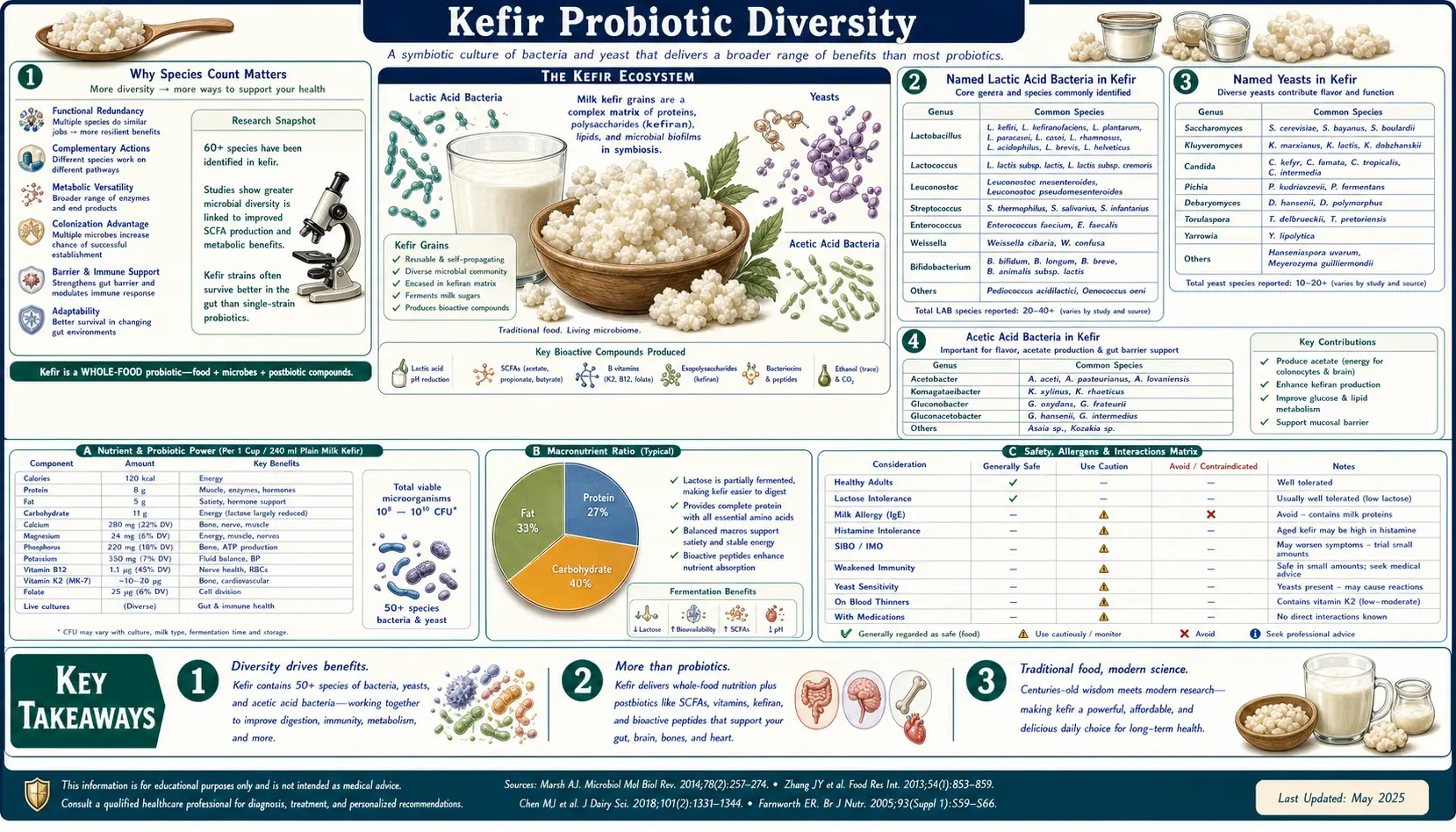
Kefir made from traditional grains carries a mixed community of lactic acid bacteria, acetic acid bacteria and yeasts, bound together in the kefir grain by a polysaccharide called kefiran. Sequencing studies of grains collected from many regions find that the community is large and that it varies from grain to grain: one study of 25 kefir milks and grains from 8 regions found bacterial populations dominated by two phyla and yeast populations dominated by Kazachstania, Kluyveromyces and Naumovozyma, with a variable minor population, and another identified 20 main bacterial species across 5 grains. By comparison, the U.S. federal standard of identity for yogurt (21 CFR 131.200) requires a culture containing two named bacteria, Lactobacillus delbrueckii subsp. bulgaricus and Streptococcus thermophilus. Reviews describe the large yeast population as one feature that sets traditionally produced kefir apart from many commercially produced fermented dairy products. Whether this diversity translates into health effects is a question human trials are only beginning to test.
Table of Contents
- Why Species Count Is Studied
- Named Lactic Acid Bacteria in Kefir
- Named Yeasts in Kefir
- Acetic Acid Bacteria
- The Kefiran Polysaccharide Matrix
- Bacteria-Yeast Symbiosis
- Grain-Fermented vs Commercial Kefir
- Strain Survival and Colonization
- What Human Trials Report
- Key Research Papers
- Connections
- Featured Videos
Why Species Count Is Studied
Probiotic products are usually labeled by colony-forming units (CFU), but microbiome research also looks at diversity — how many different kinds of microbes are present. A healthy adult gut holds hundreds of bacterial species, and lower microbial diversity has been reported in a range of conditions, including inflammatory bowel disease, obesity and the period after antibiotic treatment. This has led researchers to ask whether foods that carry many species at once act differently from single-strain products.
The clearest human test so far is a Stanford randomized study (Wastyk and colleagues, Cell 2021) that compared a high-fiber diet with a diet high in fermented foods in healthy adults over 17 weeks, with 18 people per arm. The fermented-food diet steadily increased gut microbiota diversity and decreased inflammatory markers, while the high-fiber diet left community diversity stable. The diet included several fermented foods, so the result is not specific to kefir. No head-to-head trial comparing kefir with probiotic capsules was found; claims that kefir outperforms capsules because it carries more species are not supported by published trials.
Named Lactic Acid Bacteria in Kefir
Culture-based and sequencing studies of kefir grains from many locations repeatedly identify the lactic acid bacteria below. Composition varies between grains, and several of these species were moved out of the genus Lactobacillus in a 2020 reclassification (for example, L. kefiri is now Lentilactobacillus kefiri); the older names are kept here because most kefir studies use them.
- Lactobacillus kefiranofaciens — the main producer of kefiran, the exopolysaccharide that makes up the grain matrix; it was found in all nine grains in one Argentine study and was the dominant bacterial species early in 24-hour fermentations in a metagenomic study. In an animal study, a Taiwanese strain (M1) reduced chemically induced colitis in mice.
- Lactobacillus kefiri — named for kefir and among the dominant species in sequencing studies.
- Lactobacillus brevis — a heterofermentative species (it produces lactic acid plus CO2), also found in sourdough and sauerkraut.
- Lactobacillus parakefiri — closely related to L. kefiri, often isolated alongside it.
- Lactobacillus acidophilus — a classical probiotic species, also used in yogurts and probiotic capsules.
- Lactobacillus delbrueckii subsp. bulgaricus — one of the two bacteria in the U.S. yogurt standard.
- Lactobacillus helveticus — studied for milk peptides with angiotensin-converting enzyme (ACE) inhibitory activity in laboratory tests.
- Lactococcus lactis subsp. lactis — widely used in cheese starter cultures.
- Lactococcus lactis subsp. cremoris — among the dominant species in a 16S sequencing study of five kefir grains.
- Leuconostoc mesenteroides — heterofermentative, also in sauerkraut; it became more prevalent in the later stages of 24-hour kefir fermentations in a metagenomic study.
- Streptococcus thermophilus — the second yogurt-standard bacterium.
Less consistently present but documented include L. casei, L. plantarum, L. paracasei, L. rhamnosus, L. fermentum, Enterococcus faecium, Lactobacillus crispatus and various Bifidobacterium species. Reported proportions of bacteria and yeasts vary with the grain, the milk and the fermentation conditions.
Named Yeasts in Kefir
The yeast community is a main difference between kefir and yogurt; the U.S. yogurt standard names only bacteria. Yeasts contribute the effervescence (CO2), small amounts of ethanol, and part of the aroma: in a metagenomic study, Saccharomyces levels correlated with flavor esters. A large sequencing study found kefir fungal populations dominated by Kazachstania, Kluyveromyces and Naumovozyma, and identified several genera and species not previously reported in kefir.
- Saccharomyces cerevisiae — the same species as brewing and baking yeast; it does not ferment lactose, and reviews describe non-lactose-fermenting yeasts such as Saccharomyces declining as fermentation progresses.
- Saccharomyces unisporus — commonly isolated from kefir.
- Kluyveromyces marxianus — one of the few yeasts able to use lactose; reviews describe Kluyveromyces as making up most or all of the lactose-using yeast population in kefir.
- Kluyveromyces lactis — another lactose-using yeast.
- Candida kefyr — the older asexual-stage name for Kluyveromyces marxianus, so many studies listing it are describing the same organism; it is a different species from Candida albicans.
- Pichia fermentans — reported in some grains, associated with flavor compounds.
- Torulaspora delbrueckii — known from wine and beer fermentation, reported in some kefir grains.
- Issatchenkia orientalis (syn. Candida krusei) — identified in some kefir grain analyses.
A systematic review of randomized kefir trials (Kairey and colleagues, 2023) concluded that kefir appears safe for generally healthy populations, but noted that safety was assessed in only 5 of the 18 included publications. Safety data for people with severe immunosuppression were not reported; decisions about live-culture foods in that setting belong with a clinician.
Acetic Acid Bacteria
A third microbial group in kefir is the acetic acid bacteria — species in the genera Acetobacter and Gluconobacter. These are aerobes that oxidize ethanol to acetic acid, the same biochemistry behind vinegar and kombucha. In sequencing studies:
- Gluconobacter frateurii, Acetobacter orientalis and Acetobacter lovaniensis were among the dominant bacterial species in a study of five kefir grains.
- Acetobacter levels correlated with acetic acid in finished kefir in a metagenomic study of 24-hour fermentations.
- Acetic acid adds to the sour, slightly vinegary note of well-developed kefir.
Water kefir (tibicos) grains are a different culture grown in sugar water rather than milk; a sequencing study of four water kefirs found them dominated by Zymomonas, with lactic acid bacteria and acetic acid bacteria also present.
The Kefiran Polysaccharide Matrix
Kefir grains are not loose populations of microbes — they are gelatinous, cauliflower-shaped clusters of microbes held in a matrix of protein and a glucose-galactose polysaccharide called kefiran. Kefiran is produced mainly by Lactobacillus kefiranofaciens; researchers studying this species point to the importance of kefiran for grain integrity, and kefiran output differs from strain to strain. The kefiran matrix:
- Gives the grain the physical structure that lets it be strained out and reused batch after batch
- Has been studied as a bioactive compound in its own right, mostly in cell and animal work: kefiran protected cultured intestinal cells from damage by Bacillus cereus in a laboratory study
- Increased bifidobacteria in the feces and colon of mice given kefiran by mouth, in an animal study; this has not been shown in humans
Because the grain grows as it ferments, the surplus can be passed on, which is how kefir grains have traditionally spread from household to household.
Bacteria-Yeast Symbiosis
Reviews describe the bacteria and yeasts in kefir grains as a symbiotic community, and studies of fermentation show how the members depend on each other:
- Lactose use is divided. Lactic acid bacteria and lactose-using yeasts such as Kluyveromyces break down milk sugar; yeasts that cannot use lactose, such as Saccharomyces, rely on the sugars and other products released by the rest of the community.
- Acidification. Lactic acid from the bacteria lowers the pH of the milk, which restricts many other microbes; kefir yeasts tolerate these acidic conditions.
- Succession. In a metagenomic study, L. kefiranofaciens dominated early in a 24-hour fermentation and Leuconostoc mesenteroides became more prevalent later; genes for aromatic amino acid synthesis were absent from L. kefiranofaciens but present in L. mesenteroides, a pattern the authors linked to this shift.
- Acetic acid bacteria use yeast-produced ethanol. They convert part of the ethanol made by yeasts into acetic acid.
- Antimicrobial activity. Kefir isolates have been studied for activity against food-borne pathogens; one L. plantarum strain isolated from kefir protected cultured cells from shiga toxin in a laboratory study.
Kefir grains are commonly described as stable over long periods of reuse, although sequencing studies show their composition differs from one source to another.
Grain-Fermented vs Commercial Kefir
Many kefirs sold in stores are made with defined starter cultures rather than live grains, and the microbes they contain can differ substantially from grain-fermented kefir. Studies on this point report:
- Different organisms. A randomized crossover pilot study (Bourrie and colleagues, 2023; 21 men with elevated LDL cholesterol, 4 weeks per treatment, 2 servings totalling 350 g per day) compared a commercial kefir made without traditional kefir organisms with a kefir pitched with traditional organisms.
- Different results in that study. Compared with baseline, the traditional-organism kefir reduced LDL cholesterol, ICAM-1 and VCAM-1, while the commercial kefir increased TNF-α; the traditional-organism kefir produced greater reductions in IL-8, CRP, VCAM-1 and TNF-α than the commercial kefir. The authors called for larger studies. Three of the authors hold a patent on the method used to make the traditional-organism kefir.
- Starter cultures can be built from traditional organisms. A 2025 laboratory study found that freeze-dried starter cultures made of five traditional kefir bacteria and four traditional kefir yeasts produced kefir with microbial composition, acids, sugars and volatile compounds comparable to fresh cultures of the same species.
- Grain sources differ too. In a sequencing study, a grain bought in a supermarket differed from the others in size, cohesion and texture, which the authors linked to a probable lower level of L. kefiranofaciens.
Home fermentation with live grains is described on the Make at Home page. The commercial kefir in the 2023 pilot study was a single product, so its results may not apply to every commercial kefir.
Strain Survival and Colonization
A separate question from how many strains are in kefir is how many reach the intestine alive and how long they stay. Published evidence here is limited:
- Acid and bile tolerance varies by strain. In one study, 13 of 34 yeast strains isolated from kefir grains were selected for resistance to low pH and bile salts, and two of them survived passage through the gut of mice (an animal result).
- Persistence in the human gut is not well measured. Across the probiotic literature, most ingested strains are not thought to colonize the gut permanently; specific persistence times for kefir strains in humans were not found in the sources reviewed for this page.
- Diversity changes have been measured at the diet level. In the 2021 Stanford study, gut microbiota diversity rose steadily over the fermented-food phase of a diet that included several fermented foods.
What Human Trials Report
- Systematic review. A 2023 systematic review of randomized trials (16 studies in 18 publications) found that kefir may have potential as a complementary therapy for reducing oral Streptococcus mutans and in H. pylori eradication therapy, with very limited evidence for dyslipidemia and hypertension; 12 of the studies had an overall high risk of bias, and the authors wrote that high-quality trials are needed before recommendations can be made.
- H. pylori. In a randomized double-blind study of 82 patients, adding 250 mL of kefir twice daily to 14-day triple therapy was followed by eradication in 78.2% (36 of 46) versus 50.0% (18 of 36) with placebo milk, and fewer and milder side effects.
- Antibiotic-associated diarrhea. In a double-blind randomized trial in 125 children aged 1 to 5 years, a commercially available kefir did not prevent antibiotic-associated diarrhea (18% vs 21.9% with a heat-killed placebo).
- Lactose maldigestion. In a randomized study of 15 adults with lactose maldigestion, plain kefir and plain yogurt each produced much less breath hydrogen than milk containing the same 20 g of lactose, and all the kefirs and yogurts reduced perceived flatulence severity by 54% to 71% relative to milk; flavored kefir gave an intermediate breath-hydrogen response. A dairy-free culture is described on the Tibicos page.
- Amounts used in trials. The trials above used 250 mL twice daily (H. pylori) and 350 g per day (lipid pilot study). Home fermentation methods are covered on the Make at Home page.
Key Research Papers
- Garrote GL, Abraham AG, De Antoni GL (2010). Microbial interactions in kefir: a natural probiotic drink. In: Biotechnology of Lactic Acid Bacteria: Novel Applications. Wiley-Blackwell; 327-340. — doi:10.1002/9780813820866.ch18
- Marsh AJ, O'Sullivan O, Hill C, Ross RP, Cotter PD (2013). Sequencing-based analysis of the bacterial and fungal composition of kefir grains and milks from multiple sources. PLoS One 8(7):e69371. — PubMed PMID: 23894461
- Witthuhn RC, Schoeman T, Britz TJ (2005). Characterisation of the microbial population at different stages of Kefir production and Kefir grain mass cultivation. International Dairy Journal 15(4):383-389. — doi:10.1016/j.idairyj.2004.07.016
- Nielsen B, Gürakan GC, Ünlü G (2014). Kefir: a multifaceted fermented dairy product. Probiotics and Antimicrobial Proteins 6(3-4):123-135. — PubMed PMID: 25261107
- Pogačić T, Šinko S, Zamberlin Š, Samaržija D (2013). Microbiota of kefir grains. Mljekarstvo 63(1):3-14. — DOAJ record
- Walsh AM, Crispie F, Kilcawley K, O'Sullivan O, O'Sullivan MG, Claesson MJ, Cotter PD (2016). Microbial succession and flavor production in the fermented dairy beverage kefir. mSystems 1(5):e00052-16. — PubMed PMID: 27822552
- Plessas S, Nouska C, Mantzourani I, Kourkoutas Y, Alexopoulos A, Bezirtzoglou E (2017). Microbiological exploration of different types of kefir grains. Fermentation 3(1):1. — doi:10.3390/fermentation3010001
- Hamet MF, Piermaria JA, Abraham AG (2015). Selection of EPS-producing Lactobacillus strains isolated from kefir grains and rheological characterization of the fermented milks. LWT - Food Science and Technology 63(1):129-135. — doi:10.1016/j.lwt.2015.03.097
- Chen YP, Hsiao PJ, Hong WS, Dai TY, Chen MJ (2012). Lactobacillus kefiranofaciens M1 isolated from milk kefir grains ameliorates experimental colitis in vitro and in vivo. Journal of Dairy Science 95(1):63-74. — PubMed PMID: 22192184
- Kakisu E, Abraham AG, Farinati CT, Ibarra C, De Antoni GL (2013). Lactobacillus plantarum isolated from kefir protects vero cells from cytotoxicity by type-II shiga toxin from Escherichia coli O157:H7. Journal of Dairy Research 80(1):64-71. — PubMed PMID: 23186804
- Diosma G, Romanin DE, Rey-Burusco MF, Londero A, Garrote GL (2014). Yeasts from kefir grains: isolation, identification, and probiotic characterization. World Journal of Microbiology and Biotechnology 30(1):43-53. — PubMed PMID: 23824665
- Korsak N, Taminiau B, Leclercq M, Nezer C, Crevecoeur S, Ferauche C, Detry E, Delcenserie V, Daube G (2015). Short communication: Evaluation of the microbiota of kefir samples using metagenetic analysis targeting the 16S and 26S ribosomal DNA fragments. Journal of Dairy Science 98(6):3684-3689. — PubMed PMID: 25828663
- Wastyk HC, Fragiadakis GK, Perelman D, Dahan D, Merrill BD, Yu FB, Topf M, Gonzalez CG, Van Treuren W, Han S, Robinson JL, Elias JE, Sonnenburg ED, Gardner CD, Sonnenburg JL (2021). Gut-microbiota-targeted diets modulate human immune status. Cell 184(16):4137-4153.e14. — PubMed PMID: 34256014
- Bourrie BC, Willing BP, Cotter PD (2016). The microbiota and health promoting characteristics of the fermented beverage kefir. Frontiers in Microbiology 7:647. — PubMed PMID: 27199969
- Bourrie BCT, Forgie AJ, Makarowski A, Cotter PD, Richard C, Willing BP (2023). Consumption of kefir made with traditional microorganisms resulted in greater improvements in LDL cholesterol and plasma markers of inflammation in males when compared to a commercial kefir: a randomized pilot study. Applied Physiology, Nutrition, and Metabolism 48(9):668-677. — PubMed PMID: 37224566
- Mudoor Sooresh M, Jayawickrama A, Silva A, Nguyen S, Schmidt S, Sebastian J, Carey S, Harynuk J, Willing BP, Bourrie BCT (2025). Fermentation of kefir with traditional freeze-dried starter cultures successfully recreates fresh culture fermented kefir. Frontiers in Microbiology 16:1655390. — PubMed PMID: 41140397
- Hamet MF, Londero A, Medrano M, Vercammen E, Van Hoorde K, Garrote GL, Huys G, Vandamme P, Abraham AG (2013). Application of culture-dependent and culture-independent methods for the identification of Lactobacillus kefiranofaciens in microbial consortia present in kefir grains. Food Microbiology 36(2):327-334. — PubMed PMID: 24010614
- Medrano M, Hamet MF, Abraham AG, Pérez PF (2009). Kefiran protects Caco-2 cells from cytopathic effects induced by Bacillus cereus infection. Antonie van Leeuwenhoek 96(4):505-513. — PubMed PMID: 19633916
- Hamet MF, Medrano M, Pérez PF, Abraham AG (2016). Oral administration of kefiran exerts a bifidogenic effect on BALB/c mice intestinal microbiota. Beneficial Microbes 7(2):237-246. — PubMed PMID: 26689227
- Kairey L, Leech B, El-Assaad F, Bugarcic A, Dawson D, Lauche R (2023). The effects of kefir consumption on human health: a systematic review of randomized controlled trials. Nutrition Reviews 81(3):267-286. — PubMed PMID: 35913411
- Bekar O, Yilmaz Y, Gulten M (2011). Kefir improves the efficacy and tolerability of triple therapy in eradicating Helicobacter pylori. Journal of Medicinal Food 14(4):344-347. — PubMed PMID: 21186984
- Merenstein DJ, Foster J, D'Amico F (2009). A randomized clinical trial measuring the influence of kefir on antibiotic-associated diarrhea: the measuring the influence of Kefir (MILK) Study. Archives of Pediatrics & Adolescent Medicine 163(8):750-754. — PubMed PMID: 19652108
- Hertzler SR, Clancy SM (2003). Kefir improves lactose digestion and tolerance in adults with lactose maldigestion. Journal of the American Dietetic Association 103(5):582-587. — PubMed PMID: 12728216
- Marsh AJ, O'Sullivan O, Hill C, Ross RP, Cotter PD (2013). Sequence-based analysis of the microbial composition of water kefir from multiple sources. FEMS Microbiology Letters 348(1):79-85. — PubMed PMID: 24004255