Kefir: Nutrient Profile
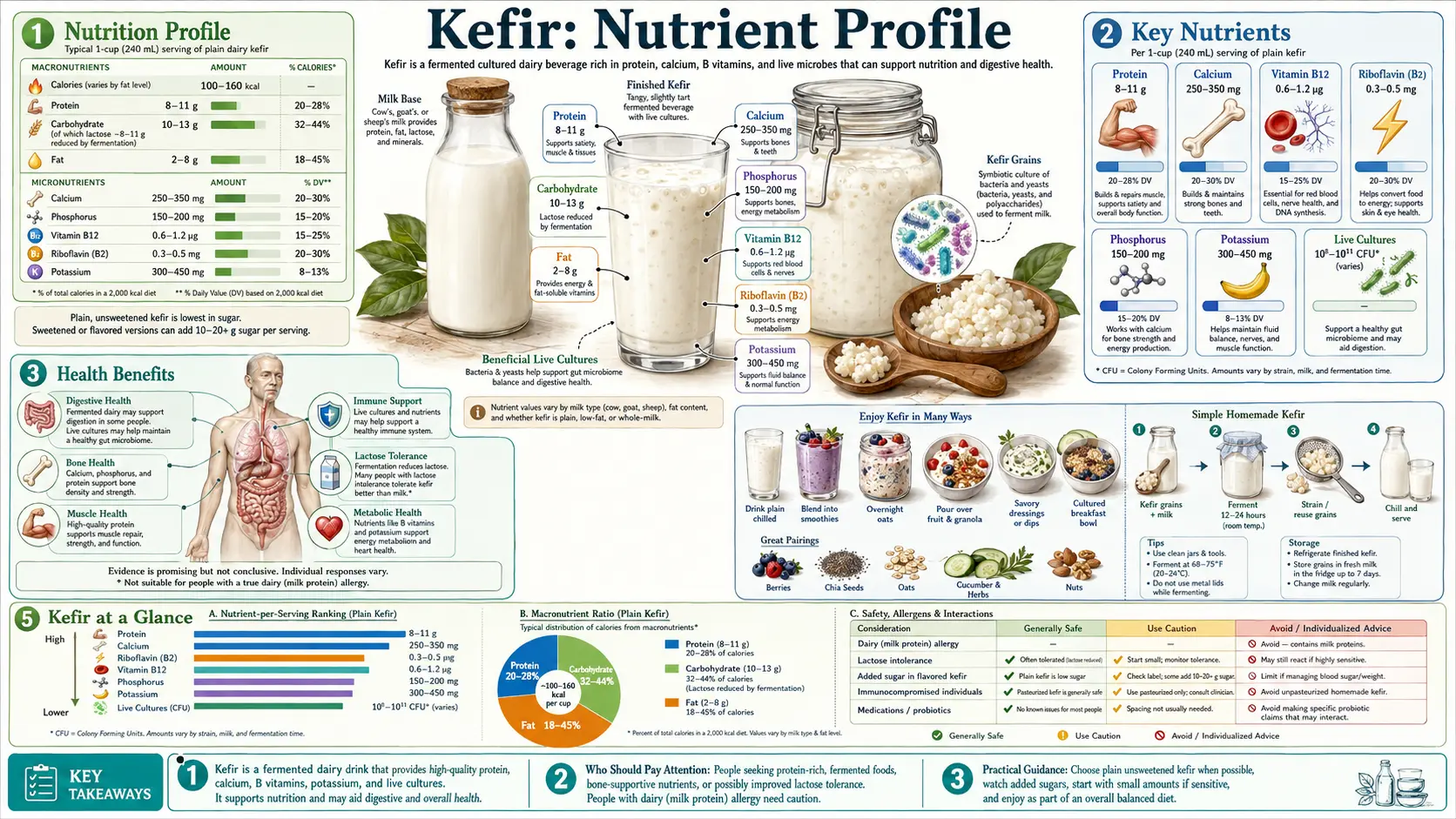
What is Kefir richest in? Below are the vitamins, minerals and amino acids that 100 g of Kefir delivers in the highest amounts. Each one links to that nutrient’s own page listing the best foods to get it from.
| Kefir: Richest Nutrients (per 100 g) | ||||
|---|---|---|---|---|
| Rank | Nutrient | Per 100 g | %DV / 100g | Purpose |
| Vitamins | ||||
| 1 | Vitamin A | 171 mcg | 🟡 19% | Vision, skin & immunity |
| 2 | Vitamin B12 | 0.3 mcg | 🟡 12% | Nerves & red blood cells |
| 3 | Vitamin B2 (Riboflavin) | 0.1 mg | 🟡 10% | Energy & cell health |
| Minerals | ||||
| 1 | Calcium | 130 mg | 🟡 10% | Bones & teeth |
Values are per 100 g of the U.S. Department of Agriculture (USDA) FoodData Central record FDC 170904, “Kefir, lowfat, plain, LIFEWAY” (SR Legacy). %DV is the amount per 100 g divided by the adult Daily Value in 21 CFR 101.9.
Lactose in Kefir
In a study of 15 adults who poorly digest lactose (lactose maldigestion), each test meal held 20 g of lactose. Plain kefir produced far less breath hydrogen, a marker of undigested lactose, than the same lactose as milk (87 vs 224 ppm·h), while flavored kefir gave an in-between result (156 ppm·h). The kefirs and yogurts all reduced how bad people rated their flatulence by 54% to 71% compared with milk (Hertzler & Clancy 2003, J Am Diet Assoc — PubMed PMID: 12728216).