Blackberries
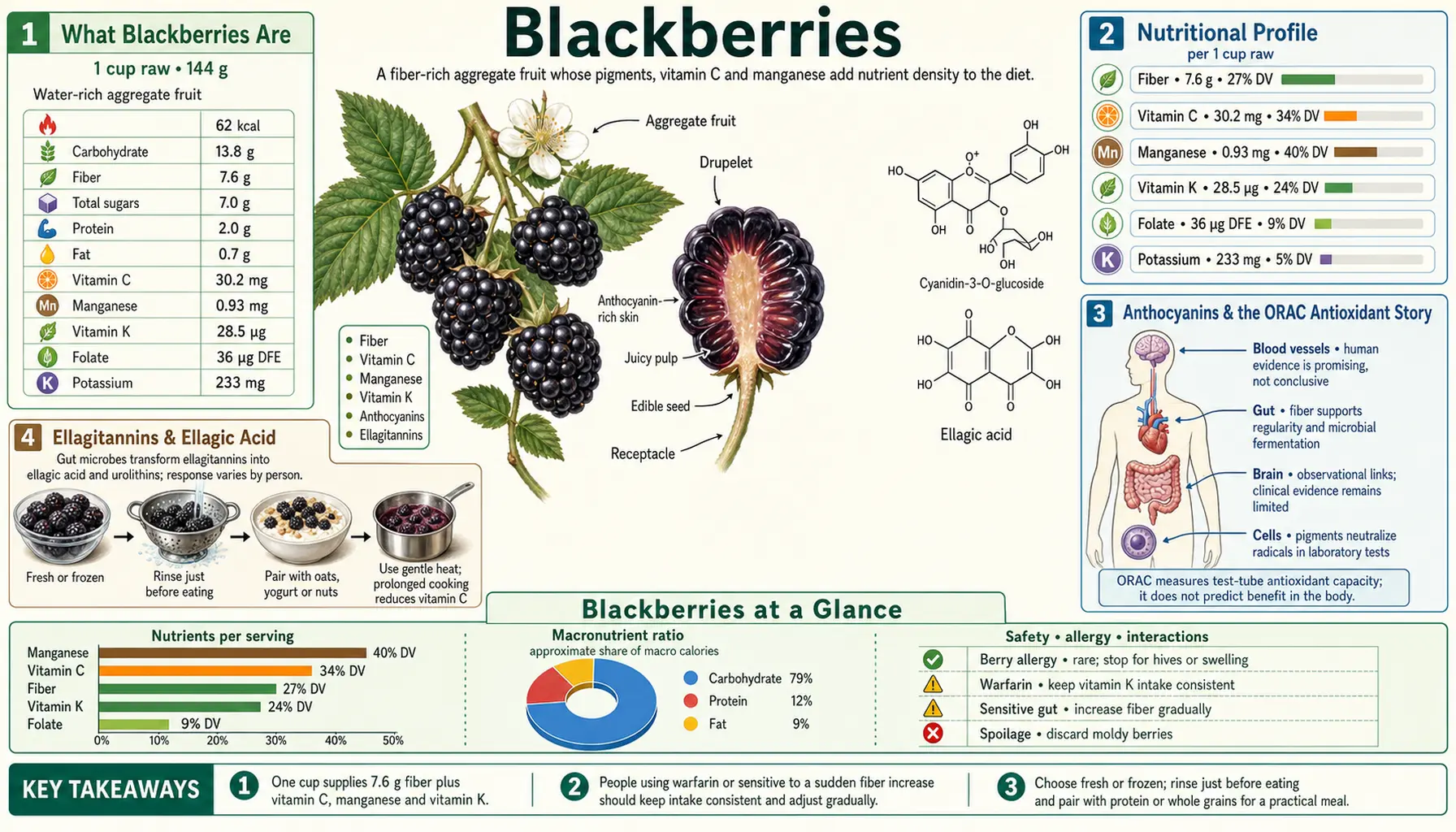
Blackberries (Rubus fruticosus) are the deep-purple-to-black, glossy fruits that grow on thorny brambles along roadsides, field edges, and in gardens across much of the world. They are close cousins of the raspberry, but where a ripe raspberry pulls away from its core to leave a hollow center, a blackberry keeps its core inside — which is one quick way to tell them apart. Nutritionally, blackberries are one of the standout fruits: they carry an exceptional load of antioxidant pigments called anthocyanins, a class of polyphenols called ellagitannins that your gut turns into other compounds, a genuinely large amount of fiber, and useful doses of vitamin C, vitamin K, and the mineral manganese — all with relatively little sugar. This page walks through what blackberries are, what is actually in them, and what the research does and does not show about their effects on the brain, heart, blood sugar, and gut. The honest through-line: blackberries are a genuinely excellent food, and a lot of the more dramatic health claims lean on test-tube or animal studies rather than long-term human trials.
Table of Contents
- What Blackberries Are
- Nutritional Profile
- Anthocyanins & the ORAC Antioxidant Story
- Ellagitannins & Ellagic Acid
- Brain, Cognition & Aging
- Heart Health & Inflammation
- Blood Sugar & the High-Fiber Advantage
- Oral & Gut Health
- How to Select & Store Them
- Safety & Considerations
- Research Papers
- Connections
- Featured Videos
What Blackberries Are
A blackberry is not, botanically speaking, a single berry at all. It is an aggregate fruit — a cluster of many tiny fruitlets called drupelets, each with its own seed, all packed together around a central core. That is why a blackberry has that bumpy, beaded look and a satisfying seedy crunch. The plants are brambles: sprawling, thorny, fast-growing canes in the genus Rubus, the same genus that gives us raspberries.
The relationship to raspberries is worth understanding, because the two are often confused. Both are aggregate Rubus fruits, and they share much of the same nutritional makeup. The clearest difference is what happens when you pick them: a ripe raspberry separates cleanly from its central plug and leaves a hollow, thimble-shaped hole, while a ripe blackberry comes off with its white core still inside, giving it a denser, chewier bite. Blackberries also tend to be larger, darker, and a little more tart-sweet.
There is a real split between wild and cultivated blackberries. Wild brambles — the ones you find growing free along hedgerows and trails — usually produce smaller, seedier, more intensely flavored berries, and foragers have gathered them for thousands of years. Cultivated varieties, bred for size, sweetness, thornless canes, and shelf life, are what you mostly see in stores. Both are nutritious; wild berries are sometimes even richer in pigments and polyphenols because they face more environmental stress, though the practical difference for most people is small. A quick note on names: "blackberry" is used loosely for a whole family of Rubus fruits and hybrids — marionberries, boysenberries, olallieberries, and dewberries are all close relatives that share this profile.
Nutritional Profile
Blackberries are a textbook example of a nutrient-dense, low-sugar fruit: they deliver a lot of fiber and micronutrients for very few calories. A standard 1-cup serving (about 144 grams of fresh berries) provides roughly:
- About 62 calories — so a generous, filling portion costs very little energy.
- Around 8 grams of fiber — roughly a quarter to a third of a typical daily target from a single cup. This is one of the highest fiber contents of any commonly eaten fruit, and it is the single most important thing about blackberries nutritionally.
- About 30 mg of vitamin C — roughly a third of the daily value. Vitamin C supports the immune system, collagen production, and iron absorption, and it acts as an antioxidant in its own right.
- Around 29 micrograms of vitamin K — roughly a quarter of the daily value. Vitamin K is essential for normal blood clotting and for the proteins that direct calcium into bone.
- About 0.9 mg of manganese — close to 40% of the daily value. Manganese is a trace mineral your body uses in bone formation and in enzymes that handle metabolism and antioxidant defense.
- Only about 7 grams of total sugar — modest for a fruit, because so much of a blackberry's carbohydrate is fiber rather than sugar. That combination gives blackberries a low glycemic impact (more on that below).
Blackberries also contribute smaller amounts of folate, copper, magnesium, potassium, and vitamin E, plus a little water — they are around 88% water, which is part of why they are so low in calories. But the headline story is the polyphenols: plant compounds with strong antioxidant activity that go well beyond the vitamins. Two families dominate. Anthocyanins are the blue-black pigments that give blackberries their color, with cyanidin-3-glucoside being the most abundant. And blackberries are especially rich in ellagitannins, large polyphenols that your body cannot absorb directly. Both of these are covered in their own sections below, because they are where most of the scientific interest — and most of the hype — lives.
Anthocyanins & the ORAC Antioxidant Story
The deep, almost-black color of a ripe blackberry is not just for show. It comes from anthocyanins, a group of water-soluble pigments in the flavonoid family that range from red through purple to near-black depending on the plant and its acidity. Blackberries are among the richest common sources of them. In the body, anthocyanins act as antioxidants — molecules that can neutralize reactive, unstable compounds called free radicals — and they also appear to influence cell-signaling pathways involved in inflammation. You can read more on the dedicated Anthocyanins page.
Because blackberries are so pigment-rich, they consistently score near the top when foods are ranked by laboratory antioxidant measures. This is where it is worth understanding the ORAC story honestly, because it is widely misused in marketing. ORAC stands for Oxygen Radical Absorbance Capacity — a test-tube assay that measures how well a food extract can soak up free radicals in a lab dish. Blackberries, blueberries, and other dark berries score extremely high on ORAC and related measures, and large surveys of the U.S. food supply have repeatedly placed blackberries among the most antioxidant-dense foods people actually eat.
Here is the honest catch. A high ORAC number tells you what a food does in a test tube — not what it does inside your body. Antioxidant compounds are absorbed, transformed, and eliminated in ways that a lab dish cannot capture, so the raw ORAC score does not reliably predict a health benefit. This is not a fringe opinion: in 2012 the U.S. Department of Agriculture withdrew its ORAC database entirely, stating that ORAC values had been "routinely misused" by food and supplement companies to imply health effects the data did not support. So the accurate way to read the antioxidant story is this: blackberries genuinely are one of the most polyphenol-rich fruits you can eat, and that is a real point in their favor — but a big "antioxidant" number on a label is a lab measurement, not a promise of what will happen in your body. The value of eating blackberries comes from the whole package of fiber, vitamins, and polyphenols in the context of a good diet, not from any single antioxidant score.
Ellagitannins & Ellagic Acid
Alongside their anthocyanins, blackberries are notably high in ellagitannins — a class of large, complex polyphenols also found in raspberries, strawberries, pomegranates, and walnuts. Ellagitannins are too big for the human gut to absorb directly. Instead, two things happen. In the stomach and intestine they slowly release ellagic acid, a smaller compound that has been studied for decades; and further along, in the large intestine, your gut bacteria break ellagic acid down into a family of metabolites called urolithins (mainly urolithin A). You can read more about the parent compound on the Ellagic Acid page.
This gut-conversion step is one of the more interesting and honest wrinkles in berry science. Not everyone produces urolithins to the same degree — it depends on which bacteria happen to live in your gut. Researchers describe different "urolithin metabotypes," meaning two people eating the exact same bowl of blackberries can end up with very different levels of these metabolites in their blood. Urolithins are being actively studied for possible effects on inflammation, metabolism, and the way cells clear out their own worn-out parts.
It is important to be clear-eyed here: most of the ellagic-acid and urolithin research is still preclinical — done in cells and animals, or in short human studies measuring blood markers rather than long-term health outcomes. Ellagic acid has shown anti-inflammatory and anti-cancer activity in the laboratory, but that is a very different thing from proof that eating blackberries prevents disease in people. The reasonable takeaway is that blackberries deliver a meaningful dose of these compounds, that this is a legitimate and promising area of study, and that the honest verdict is "worth eating and worth researching," not "proven medicine."
Brain, Cognition & Aging
Berries have a genuinely encouraging reputation in brain research, and blackberries share the polyphenol profile that drives it. The most cited human evidence comes from large, long-running observational studies. In the Nurses' Health Study, women who ate more berries and more of the flavonoids berries contain showed slower rates of cognitive decline over many years — by one estimate, a delay of roughly a year and a half in measured aging of the mind. Laboratory and animal work backs up a plausible mechanism: berry polyphenols appear to reduce inflammation and oxidative stress in the brain and to support communication between neurons.
Now the honest caveats, which matter a lot here:
- Most of the human evidence is about berries in general — and mostly blueberries and strawberries specifically. The big cognition studies tracked overall berry and flavonoid intake, not blackberries on their own. Blackberries are chemically similar, so it is reasonable to expect they belong in the same beneficial category, but they have been studied far less directly for brain outcomes.
- Observational studies cannot prove cause. People who eat lots of berries tend to eat better and live healthier overall, and no food-frequency study can fully untangle the berries from the lifestyle around them.
- The strongest mechanistic data are preclinical. A lot of the exciting "berries protect the brain" findings come from aged rats and cell models, not from long-term randomized trials in humans.
So the fair summary is: the berry-and-brain research is promising and consistent enough to be worth taking seriously, blackberries plausibly fit right into it, but the direct human evidence for blackberries specifically improving memory or preventing dementia is not there yet. Enjoy them as part of a brain-friendly diet, not as a treatment.
Heart Health & Inflammation
The evidence linking anthocyanin-rich foods to heart health is some of the better berry evidence, though it too comes mostly from observational studies. In a large cohort of younger and middle-aged women, those with the highest anthocyanin intake had a modestly lower risk of heart attack than those with the lowest. Pooled analyses of many such cohort studies have found small reductions in coronary heart disease and cardiovascular death associated with higher anthocyanin intake, and systematic reviews report improvements in intermediate markers — things like blood pressure, LDL cholesterol, and measures of blood-vessel function — in some controlled trials of anthocyanin-rich foods and extracts.
Blackberries plausibly contribute to this picture through several honest, low-drama mechanisms:
- Fiber helps lower LDL ("bad") cholesterol and supports healthy blood pressure and body weight — and blackberries are a fiber powerhouse.
- Anthocyanins and other polyphenols appear to support the flexibility of blood-vessel linings and to dampen low-grade inflammation, at least in shorter studies of markers.
- Potassium in blackberries helps counterbalance sodium and supports normal blood pressure.
The two caveats worth repeating: most of this is associational, so it shows berry-eaters tend to be healthier rather than proving the berries did it; and the effects are modest. Blackberries are a heart-friendly food, not a substitute for the fundamentals — not smoking, staying active, managing blood pressure, and eating an overall good diet. Within that picture, they are a smart, delicious choice.
Blood Sugar & the High-Fiber Advantage
This is where blackberries have one of their clearest, most intuitive advantages. Because they pair a lot of fiber with relatively little sugar, they are gentle on blood glucose. Fiber slows the release of sugar from the digestive tract, which blunts the spike-and-crash pattern that more sugary foods can cause. For anyone watching their blood sugar — including people with prediabetes or type 2 diabetes — a fruit that is mostly fiber and water is close to ideal.
Small human studies point in a favorable direction. In a controlled trial, a mixed berry puree (which included blackberries) reduced the insulin response to bread in healthy women, meaning the body needed less insulin to handle the same carbohydrate load. And in a small U.S. Department of Agriculture feeding study, men who were overweight or obese and ate blackberries daily showed increased fat burning and improved insulin sensitivity compared with a control period. These are early, small studies rather than definitive proof, but they line up neatly with what you would expect from any high-fiber, low-sugar fruit.
The practical guidance is simple. Blackberries are one of the best fruit choices for blood-sugar-conscious eating: eat them whole (not juiced, which strips the fiber), and use their pleasant tartness to satisfy a sweet craving without a sugar load. A bowl of blackberries with plain yogurt or a handful stirred into oatmeal is a far steadier choice than most sweet snacks.
Oral & Gut Health
Blackberries feed your gut in two complementary ways. First, plain fiber: at roughly 8 grams per cup, blackberries deliver a large dose of the fermentable fiber that the bacteria in your large intestine use as food. In return, those bacteria produce short-chain fatty acids that nourish the cells lining your colon and help keep the gut environment healthy. Fiber also does the everyday, unglamorous work of keeping you regular by adding bulk and softness to stool.
Second, blackberries deliver those ellagitannins discussed earlier, which pass largely undigested into the large intestine, where gut bacteria convert them into urolithins. In effect, blackberries act as a kind of prebiotic — they arrive at the gut carrying compounds that only your microbiome can unlock. This two-way relationship (you feed the bacteria; the bacteria make compounds you can use) is a real and active area of nutrition science.
On oral health, the evidence is thinner and mostly at the laboratory level. Blackberry extracts and their anthocyanins and ellagic acid have shown antibacterial activity against some oral bacteria in test-tube studies, including species involved in cavities and gum inflammation. That is genuinely interesting, but it is a long way from showing that eating blackberries prevents cavities or gum disease in people — and like all fruit, blackberries do contain natural sugars and acids, so they are not a replacement for brushing and flossing. The honest bottom line: blackberries are a strong prebiotic food for the gut, and their potential mouth benefits are a promising lab finding rather than an established fact.
How to Select & Store Them
Blackberries are delicate and perishable, so a little know-how prevents waste:
- Choosing fresh: Look for plump, deep-black, glossy berries that are firm but yield slightly. Avoid containers with red or purple (underripe) drupelets, and steer clear of any with mushy spots, leaking juice staining the bottom of the pack, or the first fuzz of mold — mold spreads fast between touching berries. Unlike some fruit, blackberries do not ripen further after picking, so what you buy is what you get.
- Storing fresh: Keep them dry and refrigerated, and do not wash them until just before eating — surface moisture accelerates mold. Eat fresh blackberries within a day or two for the best flavor and safety.
- Frozen is often the smart buy. Frozen blackberries are picked ripe and frozen quickly, which locks in their nutrients — the vitamin and polyphenol content of frozen berries is essentially comparable to fresh, and sometimes higher than fresh berries that have sat in transit for days. They cost a fraction of fresh out of season and work beautifully in smoothies, oatmeal, yogurt, sauces, and baking. There is no meaningful nutritional downside.
- Eat them whole — seeds and all. Much of the fiber and polyphenol content lives in the skin and around the seeds, so the crunchy seeds are a feature, not a flaw. Juicing or straining blackberries throws away the fiber that makes them special. If you make a sauce or jam, note that added sugar changes the picture — the whole fresh or frozen fruit is the healthiest form.
- Skip the heavy syrup. Canned blackberries packed in sweet syrup add a lot of sugar and undercut the low-sugar advantage; if you buy canned or jarred, look for fruit packed in water or juice.
Practical ways to use them: scatter over plain yogurt or oatmeal, blend into a smoothie, fold into whole-grain pancakes or muffins, toss into a green salad, or simmer briefly (no added sugar needed) into a sauce for whole-grain toast. Their tart-sweet flavor brightens dishes without much help.
Safety & Considerations
Blackberries are a whole food and are safe for nearly everyone, with only a few practical notes:
- They are very safe. For the general population there is no meaningful risk from eating blackberries as food. The main "downside" of a big serving is simply the fiber — if you are not used to a lot of fiber, a large bowl at once can cause temporary gas or bloating, so build up gradually and drink water.
- Oxalates — a note for stone-formers. Blackberries contain a moderate amount of oxalate, a natural compound that, in susceptible people, can contribute to calcium-oxalate kidney stones. For the vast majority of people this is irrelevant. But if you have a history of calcium-oxalate stones and have been advised to follow a lower-oxalate diet, it is reasonable to keep blackberry portions moderate rather than making them your main fruit, and to stay well hydrated.
- Seeds and fiber. The tiny seeds are harmless and are part of why blackberries are so fiber-rich. People with certain gut conditions who have been told to limit seeds or roughage during a flare should follow their own clinician's guidance; for everyone else, the seeds are a benefit.
- Allergy is rare but possible, as with any food. True blackberry allergy is uncommon.
- Foraging caution. Wild blackberries are a wonderful free food, but only pick from areas you know are not sprayed with herbicides or heavily exposed to roadside pollution, and rinse foraged berries well. (Store-bought blackberries generally test relatively low for pesticide residue; a quick rinse right before eating is all that is needed.)
None of these caveats changes the overall picture: for almost everyone, blackberries are one of the healthiest, most nutrient-dense fruits available, and the sensible advice is simply to enjoy them — fresh or frozen, whole, and often.
Research Papers
- Kaume L, Howard LR, Devareddy L. The blackberry fruit: a review on its composition and chemistry, metabolism and bioavailability, and health benefits. Journal of Agricultural and Food Chemistry. 2012;60(23):5716–5727. doi:10.1021/jf203318p — A comprehensive review of blackberry composition (anthocyanins, ellagitannins, fiber, vitamins) and the evidence for its health effects; a good scientific overview of the fruit.
- Halvorsen BL, Carlsen MH, Phillips KM, et al. Content of redox-active compounds (ie, antioxidants) in foods consumed in the United States. The American Journal of Clinical Nutrition. 2006;84(1):95–135. doi:10.1093/ajcn/84.1.95 — A large survey of the antioxidant content of American foods; blackberries ranked among the most antioxidant-dense fruits measured.
- Wu X, Beecher GR, Holden JM, et al. Lipophilic and hydrophilic antioxidant capacities of common foods in the United States. Journal of Agricultural and Food Chemistry. 2004;52(12):4026–4037. doi:10.1021/jf049696w — One of the source datasets behind the ORAC rankings; dark berries including blackberries scored very high in the laboratory antioxidant assay.
- Cassidy A, Mukamal KJ, Liu L, et al. High anthocyanin intake is associated with a reduced risk of myocardial infarction in young and middle-aged women. Circulation. 2013;127(2):188–196. doi:10.1161/CIRCULATIONAHA.112.122408 — In a large cohort of younger women, higher intake of anthocyanins (the pigments abundant in blackberries) was associated with a modestly lower rate of heart attack; observational, not proof of cause.
- Kimble R, Keane KM, Lodge JK, Howatson G. Dietary intake of anthocyanins and risk of cardiovascular disease: a systematic review and meta-analysis of prospective cohort studies. Critical Reviews in Food Science and Nutrition. 2019;59(18):3032–3043. doi:10.1080/10408398.2018.1509835 — Pooled cohort studies found small reductions in coronary heart disease and cardiovascular mortality with higher anthocyanin intake.
- Wallace TC, Slavin M, Frankenfeld CL. Systematic review of anthocyanins and markers of cardiovascular disease. Nutrients. 2016;8(1):32. doi:10.3390/nu8010032 — A review of controlled trials finding that anthocyanin-rich foods and extracts improved some cardiovascular markers such as LDL cholesterol and blood-vessel function.
- Devore EE, Kang JH, Breteler MMB, Grodstein F. Dietary intakes of berries and flavonoids in relation to cognitive decline. Annals of Neurology. 2012;72(1):135–143. doi:10.1002/ana.23594 — In the Nurses' Health Study, higher long-term berry and flavonoid intake was associated with slower cognitive decline; the berries studied were mostly blueberries and strawberries, and the design is observational.
- Miller MG, Shukitt-Hale B. Berry fruit enhances beneficial signaling in the brain. Journal of Agricultural and Food Chemistry. 2012;60(23):5709–5715. doi:10.1021/jf2036033 — A review of the mostly preclinical (animal and cell) evidence for how berry polyphenols may reduce brain inflammation and support neuron signaling.
- Törrönen R, Kolehmainen M, Sarkkinen E, et al. Berries reduce postprandial insulin responses to wheat and rye breads in healthy women. The Journal of Nutrition. 2013;143(4):430–436. doi:10.3945/jn.112.169771 — A controlled trial in which a mixed berry puree (including blackberries) lowered the insulin needed to handle a starchy meal, consistent with berries' high-fiber, low-sugar profile.
- Solverson PM, Rumpler WV, Leger JL, et al. Blackberry feeding increases fat oxidation and improves insulin sensitivity in overweight and obese males. Nutrients. 2018;10(8):1048. doi:10.3390/nu10081048 — A small USDA feeding study in which daily blackberry intake increased fat burning and improved insulin sensitivity; early and small, but a blackberry-specific human result.
- Tomás-Barberán FA, González-Sarrías A, García-Villalba R, et al. Urolithins, the rescue of "old" metabolites to understand a "new" concept: metabotypes as a nexus among phenolic metabolism, microbiota dysbiosis, and host health status. Molecular Nutrition & Food Research. 2017;61(1):1500901. doi:10.1002/mnfr.201500901 — Explains how gut bacteria convert poorly absorbed ellagitannins (abundant in blackberries) into urolithins, and why people differ in how much they produce — an active but still-early research area.
- Espín JC, Larrosa M, García-Conesa MT, Tomás-Barberán F. Biological significance of urolithins, the gut microbial ellagic acid-derived metabolites: the evidence so far. Evidence-Based Complementary and Alternative Medicine. 2013;2013:270418. doi:10.1155/2013/270418 — A review of the mostly preclinical evidence on urolithins — the gut-derived metabolites of ellagic acid — for inflammation and cellular health.
Connections
- All Food
- Raspberries
- Blueberries
- Strawberries
- Anthocyanins
- Ellagic Acid
- Vitamin C
- Vitamin K
- Manganese
- All Antioxidants