Fake Avocado Oil: Seed-Oil Adulteration, Rancidity, and How to Spot It
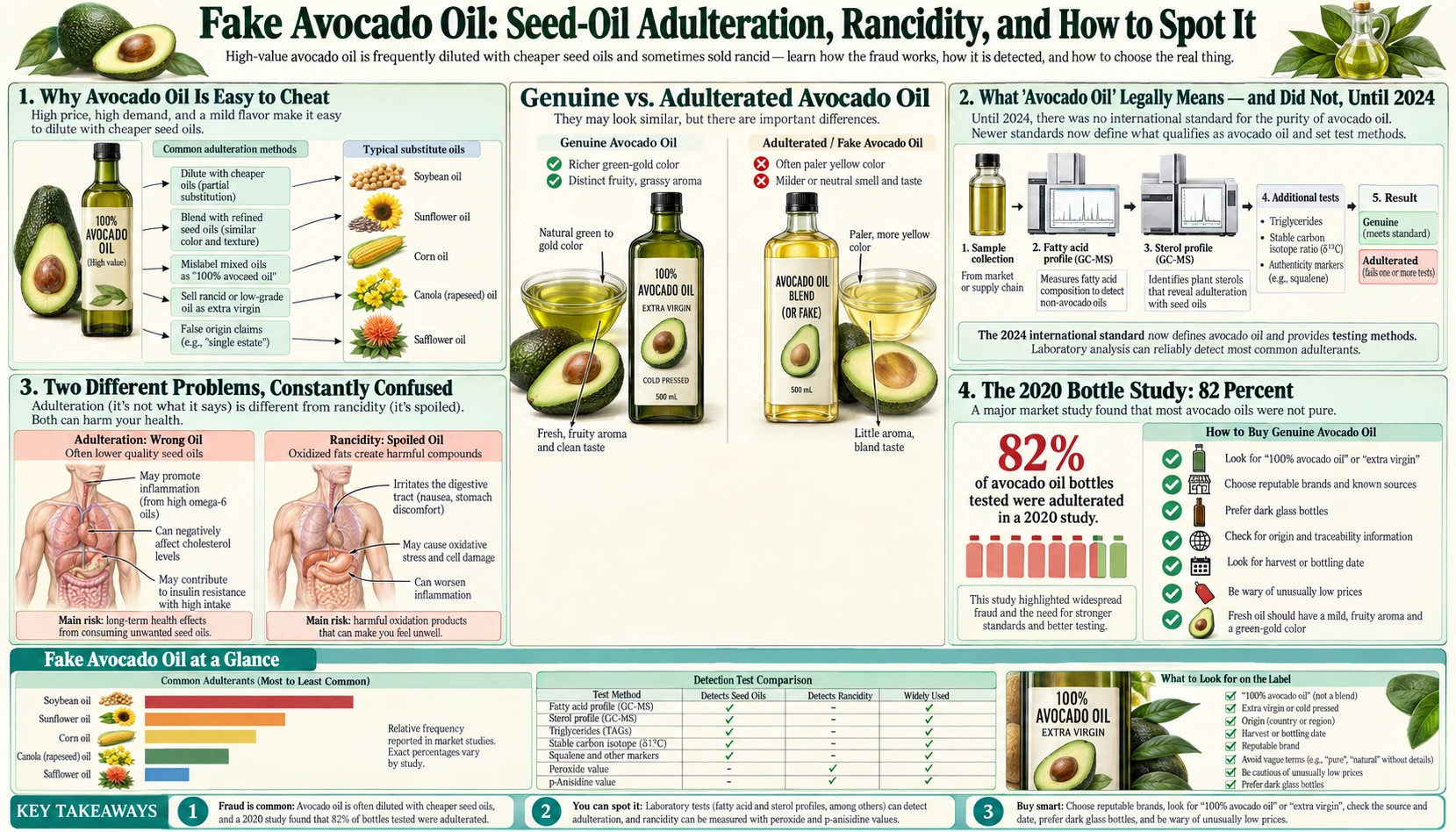
Avocado oil has every property a food needs to be worth faking. It sells at several times the price of the seed oils it most resembles; it is a liquid, so a cheaper oil can be stirred into it in any proportion; the difference between the genuine article and the blend is invisible, tasteless in a fried chip, and undetectable in a jar of mayonnaise; and, until November 2024, there was no international standard saying what “avocado oil” had to contain. Olive oil, by comparison, has been fought over, standardised and tested for a century. Avocado oil became a mass-market product in about a decade, and the testing has only just begun to catch up.
What follows is not a list of brands to avoid. Three laboratory studies from the same University of California, Davis group — on bottled oils in 2020, on store-brand oils in 2023, and on chips, mayonnaise and dressings in 2026 — found that most of what they bought was either rancid or was not avocado oil. Those results are alarming, but a brand-level verdict goes stale with the next batch, and it teaches nothing you can use on a bottle the study never tested. This page explains the mechanism: what avocado oil is chemically, the two different failures that get lumped together as “fake,” how a laboratory tells a real one from a blend, what the regulations actually say now, what the objections to the studies are and how far they go, and what you can and cannot check yourself.
Table of Contents
- Why Avocado Oil Is Easy to Cheat
- What “Avocado Oil” Legally Means — and Did Not, Until 2024
- Two Different Problems, Constantly Confused
- The 2020 Bottle Study: 82 Percent
- The 2023 Store-Brand Study: Nearly 70 Percent
- The 2026 Processed-Food Study: 48 of 54
- How the Fingerprint Works: Fatty Acids and Sterols
- The Objection — “Outdated Reference Ranges” and What the Study Did About It
- Why the Olive-Oil Products Passed
- Where It Happens: Honestly, Unknown
- What a Shopper Can Actually Do
- The Kitchen Test That Does Not Work
- Why It Matters for Health, Honestly
- The Bottom Line
- The Interview That Prompted This Page
- Key Research Papers
- Connections
- Featured Videos
Why Avocado Oil Is Easy to Cheat
Food fraud follows the money, and it follows it most eagerly where three things line up: a large price gap between the real product and a plausible substitute, a substitute that is physically easy to blend in, and a buyer who cannot tell the difference. Avocado oil scores on all three.
The price gap is obvious on any shelf. The blendability is a matter of chemistry: avocado oil is, like olive oil, an oil dominated by oleic acid — the same monounsaturated fat that makes olive oil what it is — and a whole family of cheap seed oils has been bred to be high in oleic acid too. High-oleic sunflower, high-oleic safflower and high-oleic canola were developed for frying stability, and their headline fatty-acid numbers sit close enough to avocado oil that a blend does not jump out of a basic analysis. The invisibility is the third factor. Extra virgin olive oil has a taste panel written into its legal standard because a trained palate can detect defects and, often, dilution. Avocado oil has no such tradition; most of it is sold refined, which means neutral in flavour by design; and once it has been used to fry a chip or emulsify a mayonnaise, nobody could taste the difference if they tried.
Add a fourth factor, the one that makes avocado oil different from olive oil: youth. Olive oil has an international standard, a national grade system in the United States, a global council that sets chemical limits, and decades of published authentication work behind it. Avocado oil went from a niche product to a supermarket staple in roughly ten years, and for most of that time nobody had written down what it was supposed to contain.
What “Avocado Oil” Legally Means — and Did Not, Until 2024
The honest history is short. In the United States the Food and Drug Administration keeps a list of standards of identity — legal definitions of what a food must contain to be sold under a given name. There has never been one for avocado oil. There is no federal grade standard for it either, of the kind the Department of Agriculture publishes for olive oil. When the first UC Davis study appeared in 2020, its authors made the point directly: with no standard of identity, there was no legal basis on which quality or authenticity could be enforced at all.
Internationally, the situation changed on 25 November 2024. The Codex Alimentarius Commission, the joint FAO/WHO body that writes the food standards most countries adopt or reference, agreed to include avocado oil in its Standard for Named Vegetable Oils (CXS 210-1999). In the Commission’s own words, the addition establishes “science-based quality and purity as well as food safety criteria for this increasingly traded product,” and provides “a basis for determining the authenticity of the product.” The purity ranges in that standard rest heavily on the UC Davis group’s compositional work, including a 2023 paper that evaluated the proposed CODEX limits against hundreds of authentic samples.
A Codex standard is a reference, not a police force. It gives regulators, buyers and laboratories an agreed definition of what genuine avocado oil looks like chemically, which is the precondition for any enforcement. It does not, by itself, make anyone test anything. In California, the state that grows most American avocados, a 2023 bill (AB 239) would have required state standards of identity for avocado oil and created an Avocado Oil Commission; it died in committee in February 2024 without a vote. So the accurate summary as of 2026 is: there is now an international chemical definition, there is still no US legal definition, and there is no routine testing regime anywhere in the American market. What testing exists is done by researchers, by a few producers who publish their own results, and by nobody else.
Two Different Problems, Constantly Confused
“Fake avocado oil” covers two failures that have different causes, different tests and different consequences, and they are routinely added together into a single alarming percentage. They deserve to be separated.
Rancidity is a quality failure. The oil in the bottle may be entirely avocado oil, but it has oxidised — through age, heat, light or poor storage — to the point where its free fatty acids and peroxides exceed the levels a fresh oil would have. Rancid oil smells and tastes stale, has lost most of the antioxidants that were part of its appeal, and is the same substance chemically whether the label says avocado or olive. It is detected with the classic quality measures: free fatty acidity, peroxide value, and ultraviolet absorbance, which together read how far oxidation has gone. A rancid oil is a genuine product that has gone bad, often before the best-by date printed on it.
Adulteration is a purity failure. Something that is not avocado oil has been blended in, or the bottle contains no avocado oil at all. This is the fraud, and it is detected by a completely different set of measurements: the fatty-acid profile and the sterol profile, described below, which act as a compositional fingerprint of which plant the oil came from.
The two can co-exist — a blend can also be rancid — but they are not the same claim. When you read that “82 percent of avocado oil is fake,” the underlying finding was that 82 percent was either stale or mixed with other oil, and in the 2020 study the larger share of that figure was staleness. That is still a bad result. It is just a different bad result from the one the headline implies, and the difference matters for what you can do about it.
The 2020 Bottle Study: 82 Percent
The first systematic look at avocado oil sold in the United States was published in Food Control in 2020 by Hilary Green and Selina Wang of UC Davis. They bought 22 domestic and imported avocado oils from stores and online, extracted their own reference oil from fresh fruit for comparison, and ran both the quality and the purity measures.
The headline: at least 82 percent of the samples were either oxidised before their expiration date or mixed with other oils. Broken down, 15 of the 22 were rancid before the printed date; 6 contained large amounts of other oils, identified as sunflower, safflower and soybean; and 3 bottles labelled “pure” or “extra virgin” avocado oil were nearly 100 percent soybean oil. Two products passed as both pure and fresh. Wang’s comment at the time was that she had been surprised some of the samples did not contain any avocado oil at all — and that, with no standard of identity, there was no mechanism to do anything about it.
The 2023 Store-Brand Study: Nearly 70 Percent
The follow-up, also in Food Control, looked specifically at private-label oils — the store brands — bought from 19 retailers across the United States and Canada at a range of prices. Nearly 70 percent were rancid or mixed with other oils. Two findings from that study are worth keeping. First, the cheapest products had the highest probability of being adulterated. Second, and more uncomfortably, a high price did not guarantee purity or freshness. Price was a weak signal in one direction and no signal in the other.
The 2026 Processed-Food Study: 48 of 54
The study that prompted this page moved from the bottle to the pantry. Published in Applied Food Research in July 2026 by Lopez-Alvarez and colleagues in the same UC Davis group, it asked a question nobody had tested: when a bag of chips, a jar of mayonnaise or a bottle of salad dressing names avocado oil as its only oil, is that what is inside? The group bought 74 such products in 2025 and 2026, from online retailers and California stores — 54 declaring avocado oil as the sole oil and 20 declaring olive oil — extracted the fat from each, and ran the fatty-acid and sterol fingerprints. The work received no outside funding.
Of the 54 avocado-oil products, 48 — 89 percent — had compositional profiles inconsistent with authentic avocado oil. By category, 93 percent of the chips, 71 percent of the mayonnaises and 100 percent of the salad dressings failed. The adulterated samples showed a consistent pattern: palmitic acid, palmitoleic acid, cis-vaccenic acid, beta-sitosterol and clerosterol were lower than avocado oil should have, while stearic acid, campesterol, stigmasterol, delta-7-stigmastenol and delta-7-avenasterol were higher. That is the direction a seed-oil blend pushes every one of those markers, and the study is explicit that both independent fingerprints — the fats and the sterols — drifted the same way.
Two design choices make the result harder to argue with. The researchers built in a conservative 10 percent margin of deviation around the authentic ranges, so that natural variation between avocados could not by itself push a genuine oil into the failing zone; a product had to be well outside what any real avocado oil looks like. And, anticipating the objection that frying or emulsifying might change an oil’s chemistry, they fried and emulsified authentic avocado oil in the laboratory and re-measured it. The markers changed only minimally. Processing does not explain the pattern; a different oil does.
One more finding deserves to be stated plainly because it is the one that turns a labelling problem into a consumer-deception problem: the products marketed on their premium oil charged more than comparable products made with ordinary vegetable oil, and price showed no correlation with whether the oil was authentic. The premium was being collected either way.
How the Fingerprint Works: Fatty Acids and Sterols
Every plant oil is a mixture of the same few dozen molecules in proportions characteristic of the plant that made it. Authenticity testing works by measuring those proportions and asking whether they fall inside the range that genuine oil from that plant can produce. Two families of molecules do most of the work.
Fatty acids are the building blocks of the fat itself. Each has a carboxylic-acid head and a hydrocarbon tail, and the tails vary in length and in how many double bonds they contain. Avocado oil, like olive oil, is dominated by oleic acid, an 18-carbon chain with one double bond; but it carries an unusually large share of palmitoleic acid, a 16-carbon chain with one double bond that is scarce in most seed oils, and a relatively high share of cis-vaccenic acid, an isomer of oleic acid that the Davis group identified in 2022 as a specific marker for seed-oil dilution and refined into a threshold in 2026. Seed oils bring their own signatures: soybean oil is rich in linoleic and linolenic acids, and the high-oleic seed oils that mimic avocado’s oleic content still carry more stearic acid and far less palmitoleic and cis-vaccenic. The fatty-acid profile is measured by gas chromatography — the oil is converted to volatile esters, driven through a long capillary column, and each component emerges at its own characteristic time and in proportion to its amount.
Sterols are the plant world’s counterpart to cholesterol: large, four-ring molecules present in tiny amounts, with a composition that is far more plant-specific than the fatty acids and much harder to fake. Avocado oil is dominated by beta-sitosterol and carries a distinctive amount of clerosterol; seed oils carry more campesterol and stigmasterol, and specific seed oils leave specific traces — the delta-7 sterols elevated in the 2026 failures are characteristic of sunflower and safflower. Because an adulterator would have to remove the seed oil’s sterols and add avocado’s to defeat this test, and because both are present at parts-per-thousand levels, the sterol profile is the closer thing to a smoking gun. When the fatty acids and the sterols both point the same way, as they did in 48 of 54 products, the alternative explanations run out.
Newer methods exist alongside these. The Davis group has published a triacylglycerol-based approach with principal-component analysis that needs fewer reference samples, and a high-resolution NMR method that distinguishes avocado oil from olive, canola and other oils. None replaces the fatty-acid and sterol pair yet; they are the methods on which the Codex ranges were built.
The Objection — “Outdated Reference Ranges” and What the Study Did About It
The main criticism raised against the 2026 study is that the reference ranges for what counts as “authentic” avocado oil might be too narrow: that avocados vary by cultivar, region, harvest time and ripeness, and that a database built on one set of fruit could flag a genuine oil from a different orchard as adulterated. It is a fair question to ask of any authenticity method, and it is worth answering properly rather than dismissing.
Three things address it. First, the natural variation is not a surprise to the people who built the ranges. The same group published, in 2022 and 2023, the studies documenting how avocado oil composition shifts with harvest time and growing region, and the paper evaluating the proposed Codex limits against that variation. The ranges were built to contain it. Second, the 10 percent margin was added on top of those ranges specifically so that a real oil at the edge of its natural variation would not fail. Third, and most decisively, natural variation moves the markers in scattered directions; seed-oil dilution moves every one of them in a single, predictable direction, and moves the fatty acids and the sterols together. A genuine oil from an unusual cultivar might drift on one marker. It does not lower palmitoleic acid, lower cis-vaccenic acid, lower clerosterol and raise the delta-7 sterols all at once. That coherent pattern, across two independent chemistries, is what the 48 failures share.
What the objection gets right is narrower: this is one study, from one laboratory, on products bought in one period, and it did not measure how much adulterant was present — only that the product fell outside what authentic oil can be. The 10 percent figure describes the margin of tolerance, not a measured blend percentage. Independent replication by other laboratories would strengthen the result, and until then “89 percent” should be read as one careful measurement rather than a settled fact about the whole market. That is a reason for more testing, not for less concern.
Why the Olive-Oil Products Passed
The 20 olive-oil products in the same study were the built-in control, and they behaved differently: only one failed. The researchers’ own reading is the right one. Olive oil authenticity has been studied, standardised and scrutinised for decades; every serious buyer of olive oil as an ingredient knows the tests exist and can be run; and a supplier who sells adulterated olive oil into a processed-food supply chain has a meaningful chance of being caught. Avocado oil has had none of that history. The contrast is not evidence that olive oil is honest and avocado oil is not. It is evidence of what routine testing does to a market, and of what its absence permits.
Where It Happens: Honestly, Unknown
The study did not, and could not, say where in the supply chain the substitution occurs. A chip manufacturer may be buying a drum labelled avocado oil in good faith from a supplier who has already blended it; the blending may happen at a refinery, at a bulk importer, or at the brand; and a brand’s statement that it “stands behind 100 percent avocado oil” may be sincere and still describe a product that fails the test, because the brand is trusting a certificate it never verified. The 2026 authors’ recommendation is aimed precisely at this gap: verification of premium-oil ingredients throughout the supply chain, routine analytical testing, and monitoring that would let a manufacturer prove what it bought. None of that tells a shopper which bag to trust. It tells the industry what it would take to make the label mean something.
What a Shopper Can Actually Do
Less than you would like, and more than nothing.
- Prefer producers who publish third-party test results by batch. A statement that a company “tests” means little; a published certificate of analysis showing fatty-acid and sterol results for the lot in your hand means a great deal. A handful of avocado oil brands do this. It is the single most useful signal available.
- Buy oil, not oil-as-an-ingredient, when authenticity matters to you. The 2026 failure rate in processed foods (89 percent) was far worse than the rate in bottled oils, and a bottle can at least be smelled and tasted. If you are paying a premium for avocado oil in a chip, the study’s numbers say the odds are against you.
- Treat price as a weak, one-directional signal. Very cheap avocado oil was more likely to be adulterated in the 2023 study; expensive oil was not reliably genuine in any of the three. Do not let a high price reassure you.
- Use your nose for the quality half of the problem. Rancidity you can detect: stale, crayon-like or putty-like smells mean oxidised oil, whatever the date on the bottle. Buy dark glass or tins, buy small, keep it cool and closed, and use it within weeks of opening.
- Read the ingredients line, not the front of the pack. “Made with avocado oil” on the front is compatible with a blend on the back; a product listing avocado oil as the only oil is making a stronger claim — and, per the 2026 study, one that is frequently untrue.
- Watch for the standards to arrive. The Codex definition exists now. If the FDA adopts a standard of identity, or a state does, testing becomes enforceable and the market changes quickly, as the olive-oil comparison shows.
The Kitchen Test That Does Not Work
The internet’s favourite home test — put the bottle in the refrigerator and see whether it solidifies — does not work for olive oil and works no better for avocado oil. Whether an oil clouds or sets in the cold depends on its overall fatty-acid mix and its minor components, and both genuine oils and blends can go either way; UC Davis tested the fridge test on olive oil years ago and found it could not separate real from fake. There is no reliable home test for avocado oil authenticity. The fingerprint that catches a blend lives in molecules present at parts-per-thousand levels and is read by a gas chromatograph. Anyone offering a kitchen shortcut is selling you a feeling. The sibling page on olive oil covers what your senses genuinely can detect — and it is the rancidity, not the substitution.
Why It Matters for Health, Honestly
It is worth being precise about what harm is and is not involved, because the loudest voices on this subject are not.
Seed oils are not poison. A chip fried in high-oleic sunflower oil instead of avocado oil is not a toxic product; high-oleic seed oils are, by fatty-acid composition, closer to avocado oil than the ordinary versions are, and the health debate about seed oils — covered on their own page with the evidence on both sides — is a debate about polyunsaturated-fat intake and processing, not about acute harm. Someone who has been eating adulterated avocado-oil chips has been eating chips fried in vegetable oil, which is what the cheaper bag next to it contains.
The harm is of three other kinds. The first is economic: a premium of several dollars a unit collected for an ingredient that was not there, at market scale, for years. The second is the harm to informed choice, which is the whole basis of food labelling: people who chose the product to reduce their intake of polyunsaturated seed oils, or to avoid a specific oil, were unable to do so and did not know it. The third is the harm rancidity does, which is real but modest: oxidised oil delivers oxidation products and has lost the antioxidants that were part of the reason for buying it. For the people who matter most here — the family paying ten dollars a bag because they are trying to do something right — the accurate statement is that they were cheated, not that they were poisoned. That is enough. It does not need inflating.
The Bottom Line
Avocado oil is a young premium product with a decade-old market, a Codex definition that is less than two years old, no legal definition in the United States, and no routine testing anywhere. Three studies from one careful laboratory found that most bottled avocado oil was stale or diluted, that store brands were no better, and that nine in ten processed foods naming it as their only oil were made with something else — while olive-oil products, with their decades of scrutiny, almost all passed. The chemistry behind those findings is sound, the controls were run, and the main objection to the results does not survive the fact that two independent fingerprints failed in the same direction. What remains genuinely open is how much adulterant, where in the chain it enters, and whether other laboratories will find the same thing. What a shopper can do is limited: favour producers who publish batch tests, keep the quality half of the problem under control with a nose and a cool cupboard, and stop treating price as a guarantee. The fix for the rest is not vigilance. It is the standard, and the testing that follows a standard, that olive oil already has.
The Interview That Prompted This Page
This page was written after the interview below, in which a fitness broadcaster and a former lipid researcher discuss the 2026 UC Davis study. It is embedded here permanently; unlike the Featured Videos at the foot of the page, which rotate, this frame is fixed.

Thomas DeLauer — The Avocado Oil Scandal Just Got 10x Worse, YouTube (18 minutes, 3 September 2026).
What the interview gets right. The study is real, recent and well designed; its numbers are reported accurately (54 products, 48 failing, one nearly all soybean oil); the explanation of gas chromatography as a fingerprint is a good one; the point that the sterol profile is the more decisive of the two chemistries is correct; and the observation that the olive-oil products passed while the avocado-oil products failed, and that the difference tracks decades of olive-oil regulation, is exactly the reading the study’s authors give. The closing demand — that brands making the claim should test every batch and publish the results — is the most useful sentence in it.
What we have not repeated, and one thing we would correct. The interview names brands and speculates about their motives, corporate ownership and sponsorship arrangements; the study names none, we cannot verify any of it, and brand-level accusations go stale while the mechanism does not, so none of that appears above. A digression into heavy metals in chocolate belongs on a different page. And one statement of chemistry is reversed: the guest says that fatty acids found in nature “are almost always in odd numbers” of carbons. The opposite is true. Fatty acids are assembled two carbons at a time, so the ones that dominate every food oil are even-numbered — 16 and 18 carbons in avocado and olive oil, and the 8-, 10- and 12-carbon chains he cites from coconut oil are even as well. Odd-chain fatty acids exist, but as minor components, mostly of dairy fat. The correction changes nothing about the study’s findings; it is noted because a page about authenticity should be accurate about the molecules.
Key Research Papers
The UC Davis authenticity studies
- Lopez-Alvarez M, Li X, Vizgordiski … Wang SC. Authenticity of avocado and olive oils used as ingredients in commercially processed foods. Applied Food Research. 2026. — the 2026 study: 74 products, 48 of 54 avocado-oil-labelled foods inconsistent with authentic avocado oil, 1 of 20 olive-oil foods; frying and emulsifying controls; no outside funding. — doi:10.1016/j.afres.2026.102389
- Green HS, Wang SC. First report on quality and purity evaluations of avocado oil sold in the US. Food Control. 2020;116:107328. — 22 bottled oils; at least 82 percent stale before their date or mixed with other oils; three “pure” or “extra virgin” bottles nearly all soybean oil. — doi:10.1016/j.foodcont.2020.107328
- Green HS, Wang SC. Purity and quality of private labelled avocado oil. Food Control. 2023;152:109837. — store brands from 19 US and Canadian retailers; nearly 70 percent rancid or adulterated; low price raised the odds of adulteration, high price guaranteed nothing. — doi:10.1016/j.foodcont.2023.109837
- Green HS, Wang SC. Evaluation of proposed CODEX purity standards for avocado oil. Food Control. 2023;146:109277. — the compositional groundwork for the ranges Codex adopted in 2024, tested against natural variation. — doi:10.1016/j.foodcont.2022.109277
- Green HS, Wang SC. Extra virgin grade avocado oil can be achieved using whole fruits or only mesocarp. Applied Food Research. 2022;2(2):100190. — what “extra virgin” can mean for avocado oil, and how the fruit is pressed. — doi:10.1016/j.afres.2022.100190
The fingerprint: markers and methods
- Green HS, Wang SC. Cis-vaccenic acid: new marker to detect seed oil adulteration in avocado oil. Food Chemistry Advances. 2022;1:100107. — the fatty-acid isomer that avocado oil carries and high-oleic seed oils lack. — doi:10.1016/j.focha.2022.100107
- Wannasin D, Wang SC. Cis-vaccenic acid as a compositional marker for detecting high-oleic seed oil adulteration. Journal of the American Oil Chemists’ Society. 2026. — turns the marker into a threshold that accounts for natural variability in authentic oils; addresses exactly the objection discussed above. — doi:10.1002/aocs.70129
- Green HS, Wang SC. Tandem triacylglycerol (TAG) and PCA adulteration detection approach for avocado oil. Food Analytical Methods. 2023. — a method needing fewer reference samples than fatty-acid and sterol limits, for products where standards do not yet exist. — doi:10.1007/s12161-023-02468-7
- Tang J, Green HS, Wang SC. Analysis and authentication of avocado oil using high resolution NMR spectroscopy. Molecules. 2021;26(2):310. — distinguishes avocado oil from olive, canola and other oils by NMR. — doi:10.3390/molecules26020310
- Flores M, Saravia C, Vergara CE, Avila F, Valdés H, Ortiz-Viedma J. Avocado oil: characteristics, properties, and applications. Molecules. 2019;24(11):2172. — the composition review: oleic-dominant, distinctive palmitoleic acid, beta-sitosterol-dominant sterols, extraction methods and grades. — doi:10.3390/molecules24112172
Regulatory and primary records
- Codex Alimentarius. Standard for Named Vegetable Oils, CXS 210-1999, as revised 2024 to include avocado oil. fao.org (PDF)
- FAO. FAO-WHO Codex Alimentarius Commission adopts new standards, 47th session, 25 November 2024. fao.org — the source of the quoted wording on avocado oil.
- US Food and Drug Administration. Standards of Identity for Food. fda.gov — the list on which avocado oil does not appear.
- California Legislature. AB 239 (2023–2024), Avocado oil: regulations: standards of identity. digitaldemocracy.org — filed with the Chief Clerk 1 February 2024; did not become law.
- UC Davis. Most avocado oil chips and dressings are adulterated, study finds. July 2026. ucdavis.edu
- UC Davis. Nearly 70% of private label avocado oil rancid or mixed with other oils. May 2023. ucdavis.edu
- UC Davis. Study finds 82 percent of avocado oil rancid or mixed with other oils. 2020. ucdavis.edu
- Food Safety Magazine. UC Davis researchers find widespread authenticity issues with avocado oil in processed foods. 2026. food-safety.com — reports the marker-by-marker pattern in the failing samples.
Connections
- Fake Food — The section hub: adulteration, dilution, mislabelling and grade fraud
- Fake Olive Oil — The same two frauds in the oil that has had a century of regulation, and what that regulation bought
- Avocado — The fruit the genuine oil is pressed from
- Avocado’s Monounsaturated Fats — The oleic acid that avocado and olive oil share
- Olive Oil — Nutrition, cooking and health benefits of the older premium oil
- Cooking Temperature — What heat does to an oil in your own pan
- Seed Oils — The oils most often used to cut a costlier one, and the health debate stated fairly
- Processed Oils — What refining, bleaching and deodorising do to a fat
- Ultra-Processed Foods — The category most of the failing products belong to
- Food Additives — What is deliberately added to food, and why
- Honey — Another of the most adulterated foods in world trade
- Saffron — The spice with the same economics and the same fraud problem
- Food — The complete food library