Renal Cell Carcinoma
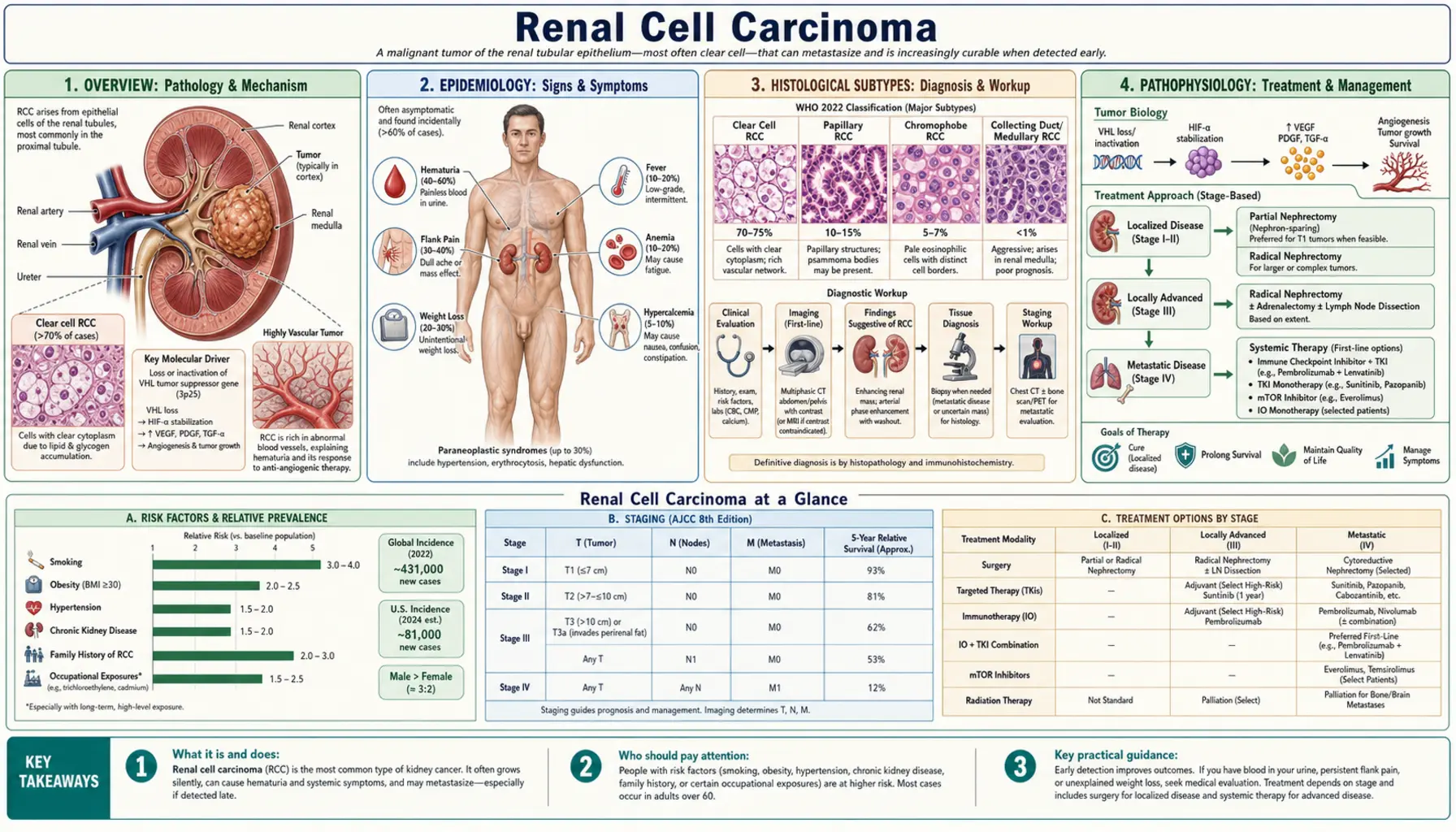
Table of Contents
1. Overview
Renal Cell Carcinoma (RCC) is cancer that arises from the renal epithelium. A 2011 review of RCC epidemiology states that approximately 90% of all kidney cancers are renal cell carcinomas (PubMed PMID: 21741761). The disease encompasses more than ten histological and molecular subtypes; clear cell RCC (ccRCC) is the most common and accounts for most cancer-related deaths (PubMed PMID: 28276433).
In ccRCC, loss of the VHL (von Hippel-Lindau) tumor suppressor gene on chromosome 3p25 is described as the earliest, truncal driving event; it lets hypoxia-inducible factors (HIF-1 and HIF-2) accumulate and switch on genes that regulate angiogenesis, glycolysis and apoptosis (PubMed PMID: 28276433). Most diagnoses now come from incidental findings on ultrasound or CT performed for another reason, and analyses of US cancer-registry data indicate that the rise in RCC incidence is confined to small, localized tumors (same review).
2. Epidemiology
The US National Cancer Institute's SEER program estimates 80,450 new cases of kidney and renal pelvis cancer and 15,160 deaths in the United States in 2026. Its age-adjusted incidence rates for 2019–2023 were 24.4 per 100,000 in men and 12.3 per 100,000 in women, and the median age at diagnosis was 65 (SEER Cancer Stat Facts: Kidney and Renal Pelvis Cancer). SEER rates differ by race and ethnicity: among men, the highest rate is in non-Hispanic American Indian/Alaska Native men (37.4 per 100,000) and the lowest in non-Hispanic Asian/Pacific Islander men (12.7 per 100,000), with non-Hispanic Black men at 26.8 and non-Hispanic White men at 25.1.
SEER reports five-year relative survival for 2016–2022 of 93.6% when the cancer is localized, 77.6% when it has spread regionally and 20.3% when it has spread to distant sites (79.2% overall); 66% of cases are diagnosed at the localized stage, 17% regional and 15% distant (same SEER page). Smoking, overweight and obesity, and germline mutations in specific genes are established risk factors, and hypertension and advanced kidney disease requiring dialysis also increase risk (PubMed PMID: 21741761). Hereditary kidney cancer syndromes account for 3–5% of all RCCs, according to a 2017 review (PubMed PMID: 28276433).
3. Histological Subtypes
A 2017 review describes three major subtypes, each making up at least 5% of cases: clear cell, papillary and chromophobe RCC. The remaining subtypes are each very rare (1% or less), and tumors that fit no subtype are designated unclassified RCC (about 4%) (PubMed PMID: 28276433).
Clear Cell RCC (ccRCC)
Under the microscope, ccRCC usually consists of cells with clear cytoplasm, arranged in nests or tubules surrounded by a rich vascular network; the clear appearance comes from accumulated glycogen and lipids. Clear cell histology predominates in metastatic disease (83–88%) (PubMed PMID: 28276433).
Papillary RCC
The Cancer Genome Atlas analysis of 161 papillary tumors states that papillary RCC accounts for 15 to 20% of renal-cell carcinomas. Type 1 tumors were associated with MET alterations; type 2 tumors were characterized by CDKN2A silencing, SETD2 mutations, TFE3 fusions and increased NRF2 pathway activity, and a subgroup of type 2 tumors with a CpG island methylator phenotype and fumarate hydratase (FH) mutation had poor survival (PubMed PMID: 26536169).
Chromophobe and Rarer Subtypes
Chromophobe RCC is the third of the major subtypes. Clear cells are not unique to ccRCC and can also be seen in papillary, chromophobe and MiT family translocation RCC, so careful evaluation of cell features, growth pattern, immunophenotype and genetic alterations is used in difficult cases. All RCC types can contain foci of high-grade spindle cells (sarcomatoid differentiation), which the review describes as a progression of any RCC type rather than a separate entity (PubMed PMID: 28276433).
4. Pathophysiology
The molecular pathogenesis of ccRCC centers on the VHL–HIF axis and on genes that control chromatin:
VHL–HIF Axis
VHL is the substrate-recognition part of an E3 ligase complex that tags HIF-1α and HIF-2α for destruction by the proteasome. When VHL is lost through mutation, deletion of 3p25 or promoter methylation, HIF proteins accumulate even in well-oxygenated tissue and drive genes for angiogenesis, glycolysis and apoptosis. Loss of the short arm of chromosome 3 is described as nearly universal in ccRCC (PubMed PMID: 28276433).
VEGF and Angiogenesis
ccRCC tumors are rich in lipids and glycogen and are highly vascular, which the 2017 review gives as the reason that agents inhibiting VEGF and its receptor are effective treatments for metastatic ccRCC (PubMed PMID: 28276433).
mTOR Pathway
The Cancer Genome Atlas survey of more than 400 ccRCC tumors found 19 significantly mutated genes and recurrent mutations in the PI(3)K/AKT pathway, suggesting that pathway as a therapeutic target (PubMed PMID: 23792563). MTOR mutations occur in 5–6% of ccRCC and are generally activating; activating MTOR mutations and loss of both copies of TSC1 or TSC2 have been identified as potential markers of long-term response to mTOR inhibitors (PubMed PMID: 28276433).
Chromatin Regulator Genes
Large genomic projects found mutations in PBRM1 (29–41% of tumor samples), SETD2 (8–12%), BAP1 (6–10%) and KDM5C (4–7%). PBRM1, SETD2 and BAP1 sit at 3p21, near VHL. BAP1 mutations were associated with larger tumors, higher nuclear grade and worse cancer-specific survival, SETD2 mutations with reduced relapse-free survival, and BAP1 and PBRM1 mutations tend not to occur together (PubMed PMID: 28276433). The Cancer Genome Atlas linked SETD2 mutation to widespread DNA hypomethylation (PubMed PMID: 23792563).
Metabolic Reprogramming
In The Cancer Genome Atlas data, aggressive ccRCC showed a metabolic shift: lower expression of TCA-cycle genes, decreased AMPK and PTEN protein, and higher expression of pentose phosphate pathway and glutamine transporter genes (PubMed PMID: 23792563). Metabolomic profiling of 138 matched tumor/normal tissue pairs found broad shifts in central carbon metabolism, one-carbon metabolism and antioxidant response, and tumor progression and metastasis were associated with increases in glutathione and cysteine/methionine metabolites (PubMed PMID: 26766592).
5. Paraneoplastic Syndromes
Paraneoplastic syndromes are symptoms caused by hormones or cytokines released by tumor cells, or by an immune response against the tumor. A 2017 review describes them as not uncommon in RCC and states that most usually reverse after the tumor is removed (PubMed PMID: 28276433). A 2018 review notes a large gap between reporting and true incidence, because most of the literature is case reports and older reviews (PubMed PMID: 29429069).
- Hypercalcemia: named the most important paraneoplastic syndrome in RCC by the 2018 review, which adds that a paraneoplastic syndrome can be the first symptom of RCC and can serve as a tumor marker for recurrence (PubMed PMID: 29429069).
- Fever and erythrocytosis: listed with hypercalcemia among the paraneoplastic symptoms of RCC (PubMed PMID: 28276433).
- Stauffer syndrome: first recognized more than 50 years ago in association with RCC; a 2018 review characterizes it as reversible paraneoplastic intrahepatic cholestasis, with a jaundiced variant, and states that its cause is still poorly understood, with immune mechanisms appearing to play a role (PubMed PMID: 29657090).
6. Diagnosis and Staging
Imaging
Typical imaging features of ccRCC include outward (exophytic) growth, heterogeneity from internal necrosis or hemorrhage, and strong uptake of contrast. A 2017 review states that contrast-enhanced CT of the chest, abdomen and pelvis is required for optimal staging, and that MRI can add information on whether the tumor extends into the vena cava (PubMed PMID: 28276433).
Nephrometry Scoring
Nephrometry systems score features such as tumor location, depth into the kidney, involvement of the collecting system and diameter; clinical studies found that they predict the risk of bleeding and complications after partial nephrectomy (PubMed PMID: 28276433).
Biopsy
Malignancy is confirmed either by renal core biopsy or on the nephrectomy specimen. The 2017 review states that biopsy is recommended before ablation (in people for whom surgery is not an option) and before starting systemic therapy for metastatic disease (PubMed PMID: 28276433). The 2021 American Urological Association guideline reviews the evolving role of renal mass biopsy and advocates individualized counseling (PubMed PMID: 34115547).
Pathological Grading
The 2017 review describes the Fuhrman system as the most widely used grading system for ccRCC: four nuclear grades in order of increasing nuclear size, irregularity and nucleolar prominence, with shown prognostic value (PubMed PMID: 28276433).
TNM Staging
Stage reflects tumor size, invasion outside the kidney, lymph-node involvement and whether the tumor has metastasized; imaging assesses whether the tumor is organ-confined or extends into perinephric fat or the kidney hilum, regional lymph nodes, and distant sites such as lung, bone and distant lymph nodes (PubMed PMID: 28276433).
IMDC Risk Score
The International Metastatic RCC Database Consortium (IMDC) model came from 645 patients treated with VEGF-targeted therapy. Six factors independently predicted shorter survival: hemoglobin below normal, corrected calcium above normal, Karnofsky performance status below 80%, less than one year from diagnosis to treatment, neutrophils above normal and platelets above normal. Patients with no factors (favorable risk) had a 2-year overall survival of 75%; with one or two factors (intermediate), a median of 27 months and 2-year survival of 53%; with three to six factors (poor), a median of 8.8 months and 2-year survival of 7% (PubMed PMID: 19826129). Several of the trials below enrolled or analyzed patients by these risk groups.
7. Surgical Treatment
Nephron-Sparing Partial Nephrectomy
The 2021 American Urological Association guideline recommends priority for partial nephrectomy for clinical T1a lesions, with selective use of thermal ablation, and provides criteria intended to reduce overuse of radical nephrectomy (PubMed PMID: 34115547). A 2017 review describes partial nephrectomy as indicated for T1 tumors with a normal opposite kidney, and strongly recommended for people with one kidney, tumors in both kidneys or von Hippel-Lindau syndrome; conditions that can impair kidney function (kidney stones, hypertension, diabetes, pyelonephritis) are relative indications. Compared with radical nephrectomy in T1 tumors, partial nephrectomy offers less loss of kidney function and equivalent cancer-survival outcomes, while its effect on overall survival remains debated (PubMed PMID: 28276433).
Radical Nephrectomy
Classical radical nephrectomy removes the kidney, perirenal fat, adrenal gland and regional lymph nodes. The 2017 review states that the adrenal gland can be spared for tumors of 5 cm or less at the lower pole, and that lymph-node dissection can be reserved for nodes found to be positive on CT or during surgery. Most stage I and II radical nephrectomies are performed laparoscopically, with open surgery remaining the standard for more complex cases (PubMed PMID: 28276433).
IVC Thrombectomy
RCC can grow into the inferior vena cava as a tumor thrombus, which MRI helps to map. The 2017 review notes that, in experienced hands, a robot-assisted approach may be an alternative to open surgery in cases with venous tumor thrombus (PubMed PMID: 28276433).
Cytoreductive Nephrectomy in Metastatic Disease
The CARMENA trial randomized 450 patients with metastatic clear-cell RCC at intermediate or poor risk (Memorial Sloan Kettering model) to nephrectomy followed by sunitinib or sunitinib alone. Sunitinib alone was noninferior for overall survival (hazard ratio 0.89; median 18.4 vs. 13.9 months), with no significant differences in response rate or progression-free survival (PubMed PMID: 29860937).
8. Systemic Treatment
Historical: High-Dose IL-2
In seven phase II trials pooling 255 patients with metastatic RCC, high-dose interleukin-2 (IL-2) produced objective responses in 14%, including complete responses in 5%. Treatment caused severe acute toxicities that generally reversed quickly after therapy, and 4% of patients died of adverse events judged possibly or probably treatment-related (PubMed PMID: 7884429). A 2017 review states that interferon-α and high-dose IL-2 typically benefit only a small subset of patients and carry significant toxicity (PubMed PMID: 28276433).
VEGFR Tyrosine Kinase Inhibitors (TKIs)
In a phase 3 trial of 750 previously untreated patients, Motzer and colleagues (2007, PubMed PMID: 17215529) found longer median progression-free survival with sunitinib than with interferon-α (11 vs. 5 months) and a higher objective response rate (31% vs. 6%); overall survival was a secondary end point and its result is not given in that report's abstract. A 2017 review lists sorafenib, sunitinib, pazopanib, axitinib, lenvatinib and cabozantinib as VEGF-axis TKIs approved in the United States and European Union for metastatic RCC (PubMed PMID: 28276433). Cabozantinib inhibits VEGFR-2, MET and AXL; in the randomized phase II CABOSUN trial of 157 intermediate- or poor-risk patients, it lengthened median progression-free survival compared with sunitinib (8.2 vs. 5.6 months) and raised the response rate (33% vs. 12%) (PubMed PMID: 28199818). Grade 3–4 adverse events in CABOSUN included diarrhea, fatigue, hypertension and hand-foot skin reaction (palmar-plantar erythrodysesthesia).
mTOR Inhibitors
In 626 patients with untreated, poor-prognosis metastatic RCC, intravenous temsirolimus lengthened overall survival compared with interferon-α (median 10.9 vs. 7.3 months; hazard ratio 0.73), while adding temsirolimus to interferon did not (PubMed PMID: 17538086). Oral everolimus lengthened progression-free survival compared with placebo (median 4.0 vs. 1.9 months) in patients whose disease had progressed on sunitinib, sorafenib or both (PubMed PMID: 18653228).
Immune Checkpoint Inhibitors
In CheckMate 025, nivolumab (anti-PD-1) lengthened overall survival compared with everolimus in 821 previously treated patients with advanced ccRCC (median 25.0 vs. 19.6 months; hazard ratio 0.73), with a response rate of 25% vs. 5% and fewer grade 3–4 treatment-related adverse events (19% vs. 37%) (PubMed PMID: 26406148). Adjuvant pembrolizumab after surgery is described under Recent Research below.
First-Line Combination Regimens in Phase 3 Trials
- Nivolumab + ipilimumab (CheckMate 214, PubMed PMID: 29562145): In intermediate- and poor-risk patients, overall survival (hazard ratio 0.63) and objective response (42% vs. 27%) were significantly better than with sunitinib, and complete responses occurred in 9% vs. 1%. Progression-free survival (11.6 vs. 8.4 months) did not meet the trial's prespecified significance threshold.
- Pembrolizumab + axitinib (KEYNOTE-426, PubMed PMID: 30779529): At the first interim analysis, overall survival (hazard ratio 0.53; 12-month survival 89.9% vs. 78.3%) and progression-free survival (15.1 vs. 11.1 months) were longer than with sunitinib, and the response rate was 59.3% vs. 35.7%. The benefit was observed across the favorable, intermediate and poor IMDC risk groups and regardless of PD-L1 expression.
- Nivolumab + cabozantinib (CheckMate 9ER, PubMed PMID: 33657295): Progression-free survival 16.6 vs. 8.3 months, overall survival hazard ratio 0.60, and objective response 55.7% vs. 27.1% compared with sunitinib; the benefit was consistent across subgroups.
- Lenvatinib + pembrolizumab (CLEAR, PubMed PMID: 33616314): Median progression-free survival 23.9 vs. 9.2 months with sunitinib (hazard ratio 0.39), with longer overall survival (hazard ratio 0.66). Grade 3 or higher adverse events occurred in 82.4% with the combination and 71.8% with sunitinib.
- Avelumab + axitinib (JAVELIN Renal 101, PubMed PMID: 30779531): Progression-free survival was longer than with sunitinib both in patients with PD-L1-positive tumors (13.8 vs. 7.2 months) and in the overall population (13.8 vs. 8.4 months); the report's abstract gives only death counts (37 vs. 44) at about 11 months of follow-up.
CheckMate 214, KEYNOTE-426 and CheckMate 9ER enrolled patients with clear-cell disease. A 2017 review notes that, because clear-cell histology dominates metastatic RCC, the other subtypes have been grouped together as non-clear-cell RCC for the feasibility of running clinical trials (PubMed PMID: 28276433).
9. Ablative and Stereotactic Therapies
Thermal Ablation
Cryoablation and radiofrequency ablation can be performed laparoscopically or through the skin under CT or ultrasound guidance. A meta-analysis of case series cited in a 2017 review reported efficacy of 89% for cryoablation and 90% for radiofrequency ablation, with complication rates of 20% and 19%; low-quality studies suggest a higher local recurrence rate with ablation than with partial nephrectomy (PubMed PMID: 28276433). The 2021 American Urological Association guideline describes thermal ablation as having good efficacy for tumors of 3.0 cm or less (PubMed PMID: 34115547).
Active Surveillance
The 2021 American Urological Association guideline states that active surveillance with possible delayed intervention is an option to consider for solid, enhancing renal masses smaller than 2 cm, and for predominantly cystic Bosniak 3–4 lesions, with shared decision-making that weighs the risks of intervention and competing causes of death (PubMed PMID: 34115531). In the prospective DISSRM registry, 318 people with small renal masses (4 cm or less) chose surveillance; the median growth rate was 0.09 cm per year, growth was highly variable in the first 6–12 months, and no patient developed metastases or died of kidney cancer during a median imaging follow-up of 1.83 years (PubMed PMID: 28951284).
Stereotactic Ablative Body Radiotherapy (SABR)
An individual-patient meta-analysis from the International Radiosurgery Consortium of the Kidney (IROCK) followed 190 patients treated with SABR for primary RCC at 12 institutions for a median of 5 years; 75% of those with operability data had been judged inoperable. The 5-year cumulative incidence of local failure was 5.5%, there were no grade 3 toxic effects or treatment-related deaths, kidney function (eGFR) fell by a median of 14.2 mL/min per 1.73 m², and 4% of patients needed dialysis. Single-fraction treatment had fewer local failures than multifraction treatment, and the authors call for randomized trials (PubMed PMID: 36400098).
10. Complications
- Metastatic spread: distant sites assessed at staging include the lung, bone and distant lymph nodes. Despite nephrectomy with curative intent, about 30% of patients with localized ccRCC eventually develop metastases, according to a 2017 review (PubMed PMID: 28276433).
- TKI toxicities: diarrhea was more frequent with sunitinib than with interferon-α (PubMed PMID: 17215529); grade 3–4 events with cabozantinib and sunitinib included diarrhea, fatigue, hypertension and hand-foot skin reaction (PubMed PMID: 28199818); and in the CLEAR trial, grade 3 or higher adverse events that occurred in at least 10% of patients in any group included hypertension, diarrhea and raised lipase (PubMed PMID: 33616314).
- Immune checkpoint inhibitor toxicities: in CheckMate 214, grade 3–4 treatment-related adverse events occurred in 46% of patients given nivolumab plus ipilimumab and 63% given sunitinib, and treatment-related events led to discontinuation in 22% and 12% (PubMed PMID: 29562145). With adjuvant pembrolizumab, grade 3 or 4 treatment-related adverse events occurred in 18.6% vs. 1.2% with placebo (PubMed PMID: 38631003).
- Loss of kidney function: partial nephrectomy causes less loss of kidney function than radical nephrectomy (PubMed PMID: 28276433); after SABR, 4% of patients in the IROCK analysis needed dialysis (PubMed PMID: 36400098).
11. Recent Research
Belzutifan (HIF-2α inhibitor): In a phase 2 single-group trial in people with RCC associated with von Hippel-Lindau disease, belzutifan 120 mg daily produced an objective response of the kidney tumors in 49% of patients, and responses were also seen in pancreatic lesions (77%) and central nervous system hemangioblastomas (30%); the most common adverse events were anemia (90%) and fatigue (66%) (PubMed PMID: 34818478). In the phase 3 LITESPARK-005 trial, 746 patients with advanced ccRCC previously treated with immune checkpoint and antiangiogenic therapy received belzutifan or everolimus. Median progression-free survival was 5.6 months in both groups, but more patients on belzutifan were alive and progression-free at 18 months (24.0% vs. 8.3%) and responses were more frequent (21.9% vs. 3.5%); overall survival (median 21.4 vs. 18.1 months; hazard ratio 0.88) did not meet the significance criterion (PubMed PMID: 39167807). On December 14, 2023, the FDA approved belzutifan for advanced RCC following a PD-1 or PD-L1 inhibitor and a VEGF-TKI, based on LITESPARK-005 (FDA approval notice).
Adjuvant therapy: In the KEYNOTE-564 trial, 994 patients with clear-cell RCC at high risk of recurrence after nephrectomy received pembrolizumab or placebo every 3 weeks for about 1 year. At the first interim analysis, disease-free survival was significantly longer with pembrolizumab (77.3% vs. 68.1% at 24 months; hazard ratio 0.68) (PubMed PMID: 34407342). At a median follow-up of 57.2 months, overall survival was also significantly better (hazard ratio 0.62; 91.2% vs. 86.0% alive at 48 months); the 2024 report states that adjuvant pembrolizumab had been approved on the basis of the disease-free survival result (PubMed PMID: 38631003). An earlier trial of adjuvant sunitinib (S-TRAC, 615 patients) reported longer median disease-free survival than placebo (6.8 vs. 5.6 years; hazard ratio 0.76), at the cost of more toxic effects; overall-survival data were not mature (PubMed PMID: 27718781).
Metabolic targeting: The metabolic shift found in aggressive ccRCC by The Cancer Genome Atlas — lower TCA-cycle gene expression with higher glutamine-transporter and pentose phosphate pathway expression (PubMed PMID: 23792563) — is one line of evidence for metabolic vulnerabilities in RCC. The glutaminase inhibitor telaglenastat, which blocks glutamine use, worked together with cabozantinib in preclinical RCC models, but in the randomized CANTATA trial (444 patients) adding telaglenastat to cabozantinib did not improve progression-free survival (9.2 vs. 9.3 months; hazard ratio 0.94) (PubMed PMID: 36048457).
Key Research Papers
- Siegel RL, Miller KD, Wagle NS, Jemal A., 2023. Cancer statistics, 2023. CA Cancer J Clin. — PubMed PMID: 36633525
- Motzer RJ, Hutson TE, Tomczak P, et al., 2007. Sunitinib versus interferon alfa in metastatic renal-cell carcinoma. N Engl J Med. — PubMed PMID: 17215529
- Motzer RJ, Tannir NM, McDermott DF, et al., 2018. Nivolumab plus ipilimumab versus sunitinib in advanced renal-cell carcinoma. N Engl J Med. — PubMed PMID: 29562145
- Rini BI, Plimack ER, Stus V, et al., 2019. Pembrolizumab plus axitinib versus sunitinib for advanced renal-cell carcinoma. N Engl J Med. — PubMed PMID: 30779529
- Jonasch E, Donskov F, Iliopoulos O, et al., 2021. Belzutifan for renal cell carcinoma in von Hippel-Lindau disease. N Engl J Med. — PubMed PMID: 34818478
- Ljungberg B, Campbell SC, Choi HY, et al., 2011. The epidemiology of renal cell carcinoma. Eur Urol. — PubMed PMID: 21741761
- Choueiri TK, Powles T, Burotto M, et al., 2021. Nivolumab plus cabozantinib versus sunitinib for advanced renal-cell carcinoma. N Engl J Med. — PubMed PMID: 33657295
- Linehan WM, Spellman PT, Ricketts CJ, et al., 2016. Comprehensive molecular characterization of papillary renal-cell carcinoma. N Engl J Med. — PubMed PMID: 26536169
- Ravaud A, Motzer RJ, Pandha HS, et al., 2016. Adjuvant sunitinib in high-risk renal-cell carcinoma after nephrectomy. N Engl J Med. — PubMed PMID: 27718781
- Choueiri TK, Tomczak P, Park SH, et al., 2021. Adjuvant pembrolizumab after nephrectomy in renal-cell carcinoma (KEYNOTE-564). N Engl J Med. — PubMed PMID: 34407342
- Hakimi AA, Reznik E, Lee CH, et al., 2016. An integrated metabolic atlas of clear cell renal cell carcinoma. Cancer Cell. — PubMed PMID: 26766592
- Choueiri TK, Motzer RJ, 2017. Systemic therapy for metastatic renal-cell carcinoma. N Engl J Med. — PubMed PMID: 28121507
- Hsieh JJ, Purdue MP, Signoretti S, et al., 2017. Renal cell carcinoma. Nat Rev Dis Primers. — PubMed PMID: 28276433
- Cancer Genome Atlas Research Network, 2013. Comprehensive molecular characterization of clear cell renal cell carcinoma. Nature. — PubMed PMID: 23792563
- Choueiri TK, Tomczak P, Park SH, et al., 2024. Overall survival with adjuvant pembrolizumab in renal-cell carcinoma. N Engl J Med. — PubMed PMID: 38631003
- Choueiri TK, Powles T, Peltola K, et al., 2024. Belzutifan versus everolimus for advanced renal-cell carcinoma (LITESPARK-005). N Engl J Med. — PubMed PMID: 39167807
- Méjean A, Ravaud A, Thezenas S, et al., 2018. Sunitinib alone or after nephrectomy in metastatic renal-cell carcinoma (CARMENA). N Engl J Med. — PubMed PMID: 29860937
- Motzer R, Alekseev B, Rha SY, et al., 2021. Lenvatinib plus pembrolizumab or everolimus for advanced renal cell carcinoma (CLEAR). N Engl J Med. — PubMed PMID: 33616314
- Motzer RJ, Penkov K, Haanen J, et al., 2019. Avelumab plus axitinib versus sunitinib for advanced renal-cell carcinoma (JAVELIN Renal 101). N Engl J Med. — PubMed PMID: 30779531
- Motzer RJ, Escudier B, McDermott DF, et al., 2015. Nivolumab versus everolimus in advanced renal-cell carcinoma (CheckMate 025). N Engl J Med. — PubMed PMID: 26406148
- Choueiri TK, Halabi S, Sanford BL, et al., 2017. Cabozantinib versus sunitinib as initial targeted therapy for patients with metastatic renal cell carcinoma of poor or intermediate risk: the Alliance A031203 CABOSUN trial. J Clin Oncol. — PubMed PMID: 28199818
- Hudes G, Carducci M, Tomczak P, et al., 2007. Temsirolimus, interferon alfa, or both for advanced renal-cell carcinoma. N Engl J Med. — PubMed PMID: 17538086
- Motzer RJ, Escudier B, Oudard S, et al., 2008. Efficacy of everolimus in advanced renal cell carcinoma: a double-blind, randomised, placebo-controlled phase III trial. Lancet. — PubMed PMID: 18653228
- Fyfe G, Fisher RI, Rosenberg SA, et al., 1995. Results of treatment of 255 patients with metastatic renal cell carcinoma who received high-dose recombinant interleukin-2 therapy. J Clin Oncol. — PubMed PMID: 7884429
- Heng DY, Xie W, Regan MM, et al., 2009. Prognostic factors for overall survival in patients with metastatic renal cell carcinoma treated with vascular endothelial growth factor-targeted agents: results from a large, multicenter study. J Clin Oncol. — PubMed PMID: 19826129
- Campbell SC, Clark PE, Chang SS, et al., 2021. Renal mass and localized renal cancer: evaluation, management, and follow-up: AUA guideline: Part I. J Urol. — PubMed PMID: 34115547
- Campbell SC, Uzzo RG, Karam JA, et al., 2021. Renal mass and localized renal cancer: evaluation, management, and follow-up: AUA guideline: Part II. J Urol. — PubMed PMID: 34115531
- Uzosike AC, Patel HD, Alam R, et al., 2018. Growth kinetics of small renal masses on active surveillance: variability and results from the DISSRM registry. J Urol. — PubMed PMID: 28951284
- Siva S, Ali M, Correa RJM, et al., 2022. 5-year outcomes after stereotactic ablative body radiotherapy for primary renal cell carcinoma: an individual patient data meta-analysis from IROCK. Lancet Oncol. — PubMed PMID: 36400098
- Tannir NM, Agarwal N, Porta C, et al., 2022. Efficacy and safety of telaglenastat plus cabozantinib vs placebo plus cabozantinib in patients with advanced renal cell carcinoma: the CANTATA randomized clinical trial. JAMA Oncol. — PubMed PMID: 36048457
- Hegemann M, Kroeger N, Stenzl A, et al., 2018. Rare and changeable as a chameleon: paraneoplastic syndromes in renal cell carcinoma. World J Urol. — PubMed PMID: 29429069
- Fontes-Sousa M, Magalhães H, da Silva FC, et al., 2018. Stauffer's syndrome: a comprehensive review and proposed updated diagnostic criteria. Urol Oncol. — PubMed PMID: 29657090
PubMed Topic Searches
- Immunotherapy combinations for metastatic RCC — PubMed search
- VHL gene and clear cell RCC — PubMed search
- Belzutifan (HIF-2α inhibitor) for RCC — PubMed search
- Partial vs. radical nephrectomy outcomes — PubMed search
- Nivolumab + ipilimumab in RCC (CheckMate trials) — PubMed search
- SBRT for renal cell carcinoma — PubMed search
- VEGFR TKIs in kidney cancer — PubMed search
- Paraneoplastic syndromes in RCC — PubMed search