Palindromic Rheumatism
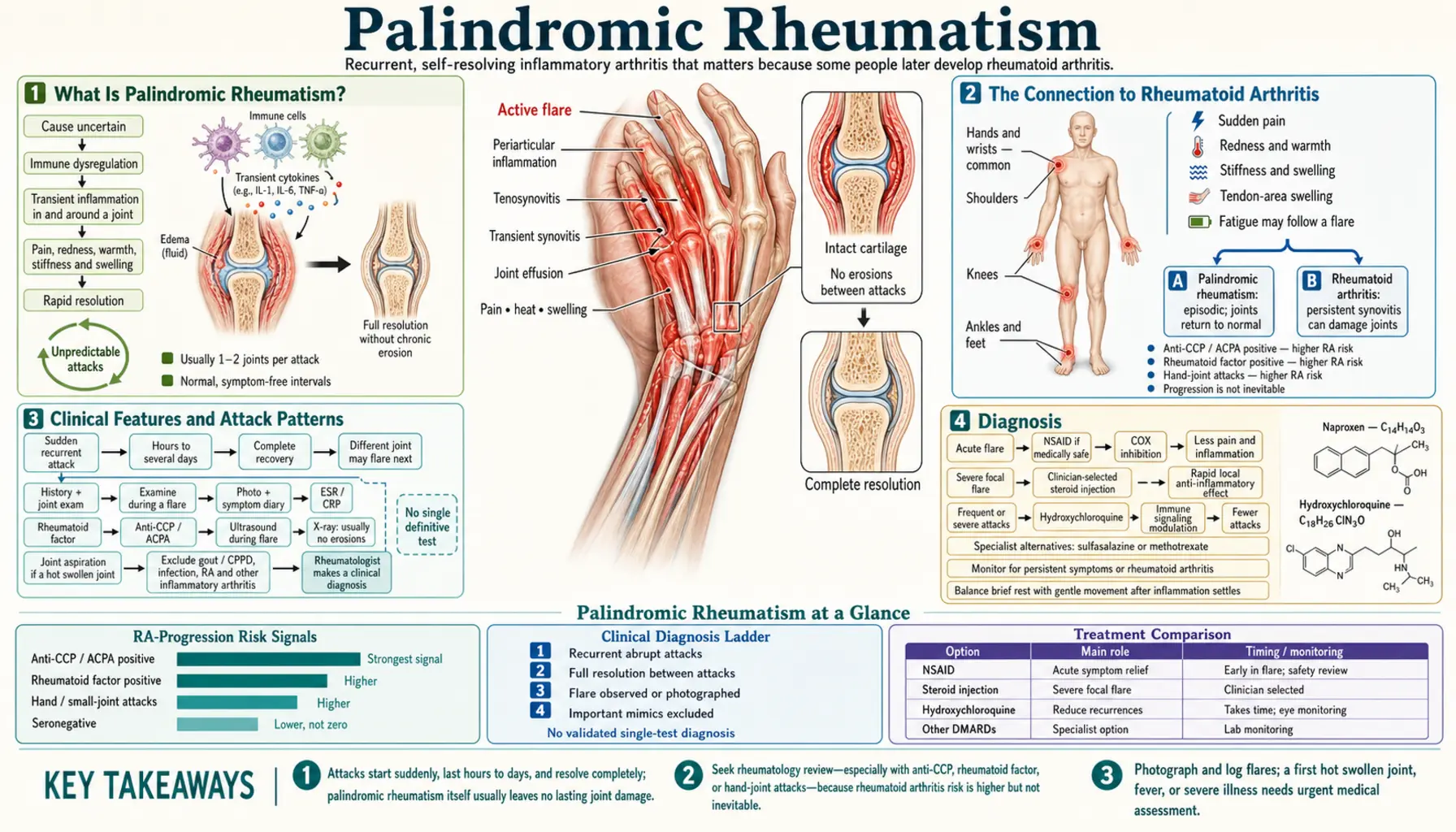
- What Is Palindromic Rheumatism?
- The Connection to Rheumatoid Arthritis
- Clinical Features and Attack Patterns
- Diagnosis
- Who Gets Palindromic Rheumatism?
- Treatment Options
- Living with Palindromic Rheumatism
- Prognosis — Will This Become RA?
- Key Research Papers
- Connections
- Featured Videos
What Is Palindromic Rheumatism?
Palindromic rheumatism (PR) is a form of episodic arthritis defined by recurrent, brief attacks of acute joint inflammation that completely resolve between episodes, leaving no lasting damage. The word palindromic was chosen deliberately by rheumatologists Philip Hench and Edward Rosenberg in 1944, who named the condition after the Greek word palindromos — meaning "recurring" or "running back again" — evoking the image of a palindrome sentence that reads the same forward and backward. The recurrence goes in both directions: attacks appear, vanish, and appear again, over and over, without any single episode leaving a permanent mark on the joint.
What makes palindromic rheumatism so striking — and so confusing for patients — is that during an attack the joint can look devastated: red, swollen, hot, and intensely painful. Yet within hours to three days, the joint returns completely to normal, both clinically (no swelling, no tenderness, no redness) and radiographically (X-rays remain clean, with no erosions). Between attacks, a person with PR feels entirely normal. There is no persistent morning stiffness, no ongoing joint tenderness, and blood inflammatory markers return to baseline. This pattern of "catastrophic attack followed by complete recovery" is the hallmark that defines the condition.
During an attack, inflammation typically strikes a single joint (monoarthritis) or a very small number of joints simultaneously or in rapid succession (oligoarthritis). The attack can also involve periarticular structures — the tendons, bursae, fascia, and soft tissues surrounding a joint — rather than, or in addition to, the joint cavity itself. This periarticular involvement is so characteristic that temporary inflammatory nodules sometimes appear around the fingers, heel, or wrist during attacks and then vanish completely when the attack resolves.
Palindromic rheumatism is considered a diagnosis of exclusion. Because the attacks are brief and self-resolving, many patients are not seen by a physician during an attack, and when they do see a doctor between episodes the examination is entirely normal. The condition is almost certainly underdiagnosed. The original description by Hench and Rosenberg — based on a patient who had suffered dozens of such attacks over many years without anyone naming what was happening — remains clinically accurate more than eighty years later.
The Connection to Rheumatoid Arthritis
The relationship between palindromic rheumatism and rheumatoid arthritis (RA) is one of the most important things to understand about this condition, and it has major implications for how aggressively to treat it. Approximately 30 to 40 percent of people with palindromic rheumatism will eventually develop persistent rheumatoid arthritis, most commonly within the first five to ten years after PR is diagnosed. For many of these patients, palindromic rheumatism is not a separate disease — it is the earliest expression of RA, a kind of pre-RA state in which the immune system is already activated against joint tissue but has not yet crossed the threshold into continuous, erosive synovitis.
The single strongest predictor of RA conversion is the presence of anti-cyclic citrullinated peptide (anti-CCP) antibodies in the blood. These antibodies target proteins in which the amino acid arginine has been modified to citrulline — a change that happens in inflamed tissue and that seems to be a key early trigger in RA autoimmunity. Among PR patients who test positive for anti-CCP antibodies, the rate of eventual RA conversion is dramatically higher: somewhere between 50 and 75 percent, depending on the study. Among anti-CCP-negative PR patients, the conversion rate is substantially lower, though not zero. Rheumatoid factor (RF), the older antibody test for RA, also predicts conversion, but anti-CCP is more specific and more powerful.
Genetic factors also influence conversion risk. The HLA-DRB1 gene locus, specifically the "shared epitope" alleles that are the strongest known genetic risk factor for RA, are overrepresented among PR patients who ultimately develop RA. The shared epitope may prime the immune system toward citrullinated protein recognition, which is why anti-CCP positivity and shared epitope status tend to cluster together in patients who convert.
From a biological standpoint, the leading hypothesis is that PR represents a state of recurring but self-limiting immune activation in genetically susceptible individuals. Each attack reflects a burst of synovial inflammation that the immune system — for reasons not fully understood — manages to switch off completely. Over time, in those who are destined to convert, this self-limiting capacity is lost, and synovitis becomes persistent. The PrePAd (Prevention of Palindromic Arthritis developing into persistent rheumatoid Arthritis with Disease-modifying antirheumatic drugs) clinical trial has directly tested whether early intervention with hydroxychloroquine in anti-CCP-positive PR patients can prevent or delay this conversion — a question with major practical implications for every patient who receives a PR diagnosis and tests anti-CCP positive.
Clinical Features and Attack Patterns
Understanding what a palindromic rheumatism attack actually feels like — from the inside — helps patients recognize what is happening to them and communicate it accurately to their doctors.
How an Attack Begins
Attacks typically begin abruptly, often within minutes to hours, reaching peak intensity quickly. Many patients describe waking up with a joint that is already severely inflamed, or noticing that a finger or knee suddenly became massively swollen and agonizingly painful over the course of an afternoon. There is usually no clear warning. Unlike gout, in which many patients can sense an attack coming, palindromic attacks tend to arrive without a prodrome.
Which Joints Are Involved
The fingers — particularly the proximal interphalangeal (PIP) joints, the knuckles in the middle of each finger — are the most commonly affected site. The wrists, knees, shoulders, and ankles are also frequently involved. Any joint can be targeted, and over the course of a patient's history the attacks often wander unpredictably: one attack strikes the right knee, the next one the left wrist, the one after that the right index finger. This "wandering" quality is characteristic. Only one or two joints are typically involved simultaneously, though the exact pattern varies from person to person.
Periarticular Involvement
One of the most distinctive features of palindromic rheumatism — one that distinguishes it from most other forms of arthritis — is the frequency of periarticular inflammation. The attack does not stay neatly inside the joint capsule. Tendons, bursae, fascia, and the soft tissues immediately surrounding the joint can all become acutely inflamed, producing painful swelling that is larger and "squishier" than the tightly defined intra-articular swelling of a simple joint effusion. Characteristic inflammatory nodules can appear around the fingers, at the heel, or along the wrist during attacks. These nodules are not the firm, non-tender rheumatoid nodules of longstanding RA — they are tender, warm, and transient, disappearing completely when the attack resolves.
Duration and Frequency of Attacks
Most attacks last between a few hours and three days. The average is one to two days. On the shorter end, some attacks begin and resolve within the same afternoon; on the longer end, an attack can linger for four or five days before fully clearing. Attacks typically occur one to three times per month on average, though the frequency varies enormously — some patients have attacks nearly every week, others go months between episodes. There is no predictable rhythm, which is one of the features that makes living with PR so psychologically disruptive.
Common Triggers
Many patients identify personal triggers that seem to reliably precipitate attacks. The most commonly reported are physical exertion or overuse of a joint, emotional stress, and certain dietary factors (some patients notice that alcohol, specific foods, or large meals precipitate attacks, though the evidence for dietary triggers is largely anecdotal). Cold weather and fatigue are also frequently mentioned. However, triggers vary from person to person, and many attacks have no identifiable cause. Keeping an attack diary to identify personal triggers is a practical strategy that many patients find useful.
What Is Normal Between Attacks
Between attacks, patients with palindromic rheumatism have a completely normal joint examination. There is no residual swelling, no tenderness, no redness, and no loss of motion. Morning stiffness — a hallmark complaint of rheumatoid arthritis, in which joints feel stiff and gelled for 30 minutes to several hours after waking — is absent in PR patients between attacks. Inflammatory blood markers (ESR, CRP) normalize completely between episodes. This return to full normality is the defining feature that distinguishes palindromic rheumatism from early RA, in which there is always some degree of persistent synovitis, even if mild.
Laboratory Findings
Rheumatoid factor (RF) is positive in approximately 30 to 40 percent of PR patients. Anti-CCP antibodies are similarly present in 30 to 40 percent. Antinuclear antibodies (ANA) are positive in about 15 percent. During an attack, inflammatory markers (ESR, CRP) are elevated and the white blood cell count may rise modestly. Between attacks, all of these normalize. Uric acid is normal (an important point for ruling out gout).
Diagnosis
There is no single blood test or imaging finding that confirms palindromic rheumatism. The diagnosis is clinical — it rests on recognizing a characteristic pattern of repeated brief attacks with complete inter-attack resolution — and it requires excluding other conditions that can cause similar episodic joint symptoms.
Diagnostic Criteria
The most widely used diagnostic framework was proposed by Guerne and Weisman (1992) and requires:
- Three or more attacks of acute joint pain and/or swelling
- At least two different joints affected across those attacks
- Attacks are brief, typically resolving within days, with complete clinical resolution between episodes
- Radiographs are normal (no erosive or structural changes)
These criteria are not formally validated to the same degree as, say, the ACR/EULAR criteria for RA, but they reflect the clinical consensus and are widely accepted in practice.
What Must Be Excluded
Because palindromic rheumatism is a diagnosis of exclusion, a rheumatologist must systematically rule out other episodic arthritis conditions before settling on the diagnosis:
- Gout: The most important mimicker. Gout attacks are also abrupt, intense, and self-resolving. Joint fluid aspiration during a PR attack will show normal fluid without monosodium urate crystals; the serum uric acid will be normal. In gout it is elevated.
- Calcium pyrophosphate deposition disease (CPPD / Pseudogout): Another crystal arthropathy; aspirated fluid will show calcium pyrophosphate crystals if CPPD is the cause.
- Septic arthritis: A bacterial joint infection can present with acute monoarthritis, but patients are typically febrile and systemically unwell; joint aspiration shows a grossly elevated white cell count and bacteria on culture.
- Reactive arthritis: Typically triggered by a recent infection (gastrointestinal or genitourinary), usually oligoarticular and lasting weeks rather than days, and often associated with extra-articular features (eye inflammation, urethritis, skin lesions).
- Viral arthritis: Parvovirus B19, hepatitis B and C, and other viruses can cause acute episodic arthritis; a serologic workup and clinical context will usually distinguish these.
- Early RA: Can look very similar early in its course, but RA produces persistent synovitis that does not fully resolve between episodes, and morning stiffness is a consistent complaint.
Tests to Order
At initial evaluation, a rheumatologist will typically order: complete blood count, comprehensive metabolic panel, ESR, CRP, RF, anti-CCP antibodies, ANA, uric acid, and urinalysis. During an acute attack, joint aspiration (arthrocentesis) to look for crystals and rule out infection is valuable if a large enough joint is involved. X-rays of the affected joints are expected to be normal; their value is to document that there are no erosions (which would suggest established RA or psoriatic arthritis).
The Role of MRI
MRI during an active attack shows acute synovitis, joint effusion, and periarticular soft tissue edema — findings consistent with active inflammation. The key research finding is that MRI performed between attacks in palindromic rheumatism returns to normal, in contrast to early RA where subclinical synovitis and bone marrow edema tend to persist on MRI even when the patient feels asymptomatic. In diagnostically ambiguous cases — for example, a patient with very frequent attacks and positive anti-CCP where the distinction from early RA matters therapeutically — MRI between attacks can be a useful discriminator.
Synovial Biopsy
If a joint is biopsied during an attack, the histology shows acute nonspecific synovitis: proliferating synoviocytes, inflammatory cell infiltration (neutrophils early, mononuclear cells later), and vascular congestion. There are no pathognomonic findings — the biopsy cannot by itself confirm or exclude PR — but it confirms that genuine joint inflammation is occurring, which is sometimes useful when a patient's history is questioned.
Who Gets Palindromic Rheumatism?
Palindromic rheumatism has an unusual epidemiological profile compared to many rheumatic diseases. Most autoimmune arthritis conditions show a strong female predominance — RA, lupus, and Sjögren's syndrome all affect women far more than men. Palindromic rheumatism, however, appears to have a roughly equal sex distribution, with some studies finding a slight female predominance and others finding near parity. This is one of the features that prompted early researchers to wonder whether PR might be a distinct entity rather than simply a variant of RA.
Peak onset is typically in the fourth through sixth decade of life, with most patients developing their first attacks between the ages of 40 and 60. However, palindromic rheumatism can occur in younger adults and, less commonly, in the elderly. It is rarely reported in children.
The true prevalence of palindromic rheumatism in the general population is difficult to establish because so many cases go undiagnosed. Many patients experience attacks for years before being seen by a rheumatologist, and those who present during a symptom-free interval often receive a non-diagnosis of "musculoskeletal pain" or "arthralgia." Estimates suggest a prevalence of roughly 1 to 2 per 10,000 people, though the actual number is probably higher. Among patients referred to rheumatology practices, PR may account for 1 to 3 percent of all new referrals.
Racial and ethnic differences in antibody patterns among PR patients have been noted. In some studies, the frequency of anti-CCP positivity among PR patients varies across ethnic groups, which may reflect differences in underlying HLA genetics — the same genetic variation that drives differential RA prevalence and severity across populations.
There is no established occupational, geographic, or lifestyle risk factor that clearly predisposes to palindromic rheumatism. Unlike gout (strongly linked to diet, alcohol, and metabolic syndrome) or reactive arthritis (triggered by specific infections), PR does not have identified modifiable environmental risk factors. The genetic underpinning — particularly HLA-DRB1 shared epitope alleles in anti-CCP-positive patients — suggests that susceptibility is largely inherited.
Treatment Options
Treatment decisions in palindromic rheumatism depend on attack frequency, attack severity, antibody status, and the patient's goals. There are two distinct treatment targets: managing individual attacks when they occur and reducing the frequency and severity of future attacks (or preventing progression to RA) with long-term therapy.
Managing Individual Attacks
NSAIDs (non-steroidal anti-inflammatory drugs) — such as ibuprofen, naproxen, or indomethacin — are the first-line treatment for pain and swelling during an acute attack. Since most PR attacks resolve within one to three days even without treatment, NSAIDs primarily provide comfort rather than dramatically shortening the episode. Patients who have reliable access to NSAIDs at home can take them at the first sign of an attack. Oral steroids (a short course of prednisone) can also terminate or shorten a more severe attack.
Colchicine — the same drug used to prevent gout attacks — has modest evidence for reducing attack frequency in palindromic rheumatism. It is typically taken daily as a preventive agent rather than acutely during an attack, and some patients find it meaningfully reduces how often attacks occur. It is generally well tolerated, and because it is inexpensive and has a known safety profile, it is often worth trying before escalating to DMARDs.
Joint injection with corticosteroids is sometimes used for a large, particularly severe attack (for example, a severely swollen knee) — the steroid is injected directly into the joint to provide rapid anti-inflammatory relief.
Hydroxychloroquine — The Cornerstone of Long-Term Therapy
Hydroxychloroquine (HCQ, brand name Plaquenil) at doses of 200 to 400 mg per day is the most widely used and best-evidenced long-term treatment for palindromic rheumatism. Multiple studies and decades of clinical experience support its use. It reduces attack frequency, diminishes attack severity, and may prevent or delay conversion to persistent rheumatoid arthritis.
The case for HCQ is particularly strong in anti-CCP-positive patients. If palindromic rheumatism in an antibody-positive patient is genuinely a pre-RA state — with the immune attack already underway at a subclinical level — then early immunomodulation with HCQ may interrupt the progression before irreversible synovial damage begins. This is the central hypothesis of the PrePAd trial: that starting HCQ in anti-CCP-positive PR patients can delay or prevent RA conversion. Results from trials like this are still maturing, but the biological rationale is sound and clinical experience is encouraging.
Hydroxychloroquine takes two to four months to reach full clinical effect. Patients should not expect immediate attack cessation. The main long-term safety concern is retinal toxicity, which is rare at standard doses (less than 5 mg/kg/day) but requires annual ophthalmologic monitoring after the first five years of use. Overall, HCQ is one of the safest medications in the rheumatology toolkit.
Other Disease-Modifying Agents
Gold salts (intramuscular gold sodium thiomalate) were used extensively before the modern DMARD era and showed clear efficacy in reducing palindromic attacks. They are rarely used today because of the availability of safer alternatives and the inconvenience of monthly injections, but they remain a historical option for patients who do not respond to HCQ.
Methotrexate (MTX) — the anchor DMARD for established RA — has limited but positive evidence in palindromic rheumatism. It is typically considered when HCQ alone provides insufficient attack control, or when the clinical picture is beginning to suggest conversion toward RA (more frequent attacks, episodes that take slightly longer to fully resolve, early morning stiffness emerging).
Biologic DMARDs (TNF inhibitors such as etanercept or adalimumab; abatacept; rituximab) are not typically used for PR itself, as the evidence is very limited and the episodic, non-erosive nature of PR makes the risk-benefit ratio less favorable than in established RA. However, if a patient with anti-CCP-positive PR appears to be converting to RA — with persistent synovitis on MRI or clinical examination between attacks — a biologic can be considered as it would be for early RA.
When to Start Long-Term Treatment
Not every patient with palindromic rheumatism needs long-term medication. If attacks are rare (once every few months), brief, and mild, a watch-and-wait approach with NSAIDs as needed is reasonable. Long-term therapy is most clearly indicated when: attacks are frequent (more than once or twice per month); attacks are severe or disabling; the patient tests positive for anti-CCP antibodies (given the high RA conversion risk); or there are early signs that complete inter-attack resolution is beginning to be lost.
Living with Palindromic Rheumatism
Living with palindromic rheumatism poses a particular kind of psychological challenge that differs from the challenge of living with a chronic, persistent condition. With diseases like RA or lupus, the disability is constant and visible — others can see that something is wrong. With palindromic rheumatism, patients look and function completely normally between attacks. This invisibility creates a specific set of difficulties.
The Credibility Problem
Patients with palindromic rheumatism frequently report that their attacks are not taken seriously — by family members, employers, coworkers, and sometimes even by their own physicians. Because the patient is completely well between attacks, and because the attacks resolve so rapidly that the person is often back to normal before a medical appointment can be arranged, others may conclude that the episodes were exaggerated, psychosomatic, or simply not as bad as claimed. This is deeply frustrating for patients who have experienced the attacks themselves and know the pain was genuine and severe. Validation — having a physician confirm the diagnosis and communicate its reality to family and employers — is an important part of care that is easily underestimated.
Keeping an Attack Diary
An attack diary is one of the most practical tools available to patients with palindromic rheumatism. Recording the date, duration, joints involved, pain severity (on a 0-10 scale), and any potential triggers for each attack serves multiple purposes: it provides documentation when flares occur during work or at inconvenient times; it helps identify personal triggers that the patient can try to avoid; it tracks whether long-term medication is reducing frequency; and it creates a clinical record that is genuinely useful at rheumatology appointments.
When to Go to the Emergency Room
Most palindromic attacks do not require emergency care. A patient who has been diagnosed and knows their typical pattern can usually manage an attack at home with NSAIDs or other prescribed medications. However, certain features should prompt urgent evaluation: a severely swollen joint in which septic arthritis (bacterial joint infection) cannot be excluded, particularly if the patient has fever, chills, or is systemically unwell; a first attack in a new large joint with no prior diagnosis; or any attack that is dramatically more severe or prolonged than the patient's usual pattern. If there is genuine uncertainty about whether an attack represents a crystal arthropathy or infection rather than PR, joint aspiration by a physician is indicated.
Communicating with Employers
Episodic conditions can be particularly problematic in the workplace. A person with palindromic rheumatism who works with their hands — a surgeon, a craftsperson, a typist — may be completely disabled by an acute finger attack for a day or two, then fully functional the next day, then struck again without warning two weeks later. This unpredictability is difficult for employers to accommodate under standard sick-leave frameworks. A letter from a rheumatologist explaining the condition, its episodic nature, and its legitimacy as a medical diagnosis can be invaluable. Under the Americans with Disabilities Act, episodic conditions that substantially limit major life activities when active may qualify for reasonable accommodation.
Monitoring for RA Conversion
Every patient with palindromic rheumatism should know the warning signs that their condition may be evolving toward rheumatoid arthritis:
- Morning stiffness that lasts 30 minutes or more — in PR there is no inter-attack morning stiffness
- Persistent (rather than episodic) swelling in any joint — swelling that does not fully resolve within a few days
- Attacks that take progressively longer to resolve
- New symmetric involvement (both hands or both feet simultaneously)
- Development of RF or anti-CCP positivity in a patient who was previously seronegative
Any of these changes warrants prompt contact with a rheumatologist, as they may signal the transition to persistent RA that needs more aggressive treatment.
Emotional Well-Being and Uncertainty
The unpredictability of palindromic rheumatism — not knowing when the next attack will come, not knowing whether the condition will eventually become RA — is a legitimate source of anxiety. Patients who are anti-CCP positive and know they have a 50 to 75 percent chance of developing RA carry a chronic background worry that is entirely reasonable but can interfere with quality of life. Connecting with others who have palindromic rheumatism through patient support communities (such as those affiliated with the Arthritis Foundation) can reduce isolation. Psychological approaches including mindfulness-based stress reduction have some evidence base in chronic pain conditions and may help manage the anxiety that episodic disease generates.
Prognosis — Will This Become RA?
The most pressing question for almost every patient newly diagnosed with palindromic rheumatism is: will this turn into rheumatoid arthritis? It is a reasonable fear, and the honest answer is: it depends primarily on your antibody status, and even with positive antibodies many people with PR never develop RA.
Three Long-Term Trajectories
Trajectory 1 — Continuing Palindromic Pattern (largest group): The majority of patients with palindromic rheumatism continue to have episodic attacks throughout their lives without ever developing persistent RA. Their attacks may become less frequent over time, or may continue at a similar rate, but the self-resolving pattern is maintained. For these patients, the primary burden is the attacks themselves and the unpredictability of the condition — not progressive joint damage.
Trajectory 2 — Conversion to Persistent RA (30–40%): A significant minority of PR patients develop rheumatoid arthritis, typically within the first five to ten years of the palindromic illness. Conversion usually manifests as attacks that gradually stop resolving completely — the affected joints retain a degree of swelling and stiffness between episodes, until eventually the pattern transitions from episodic to persistent. At that point, the condition behaves like any other case of RA and is managed accordingly. The good news is that RA developing from PR is not more severe than de novo RA; the same treatments work, and the same prognosis applies.
Trajectory 3 — Spontaneous Remission (small minority): A small but real group of patients with palindromic rheumatism experience spontaneous remission, in which attacks become progressively less frequent and eventually stop entirely. This outcome is more likely in seronegative patients (those negative for both RF and anti-CCP).
Risk Stratification by Antibody Status
Anti-CCP-positive PR patients face RA conversion rates of 50 to 75 percent in follow-up studies. Anti-CCP-negative PR patients have conversion rates closer to 10 to 20 percent. This stratification is clinically important because it determines how aggressively to pursue long-term DMARD therapy. An anti-CCP-positive patient should be counseled clearly about their elevated risk and should have a strong conversation with their rheumatologist about starting hydroxychloroquine (and in some cases considering enrollment in clinical trials like PrePAd if available).
Monitoring Schedule
A practical monitoring approach for patients with palindromic rheumatism:
- At diagnosis: RF, anti-CCP, ANA, uric acid, CRP, ESR, CBC, metabolic panel; X-rays of most commonly affected joints (to document baseline normality)
- Every 6–12 months: Clinical assessment for persistence of inter-attack normality; CRP/ESR; joint count looking for any residual synovitis; attack frequency review
- If anti-CCP positive: Consider repeat antibody titers at 6 months (rising titer may predict earlier conversion); discuss HCQ therapy; consider pulmonary function testing or HRCT if respiratory symptoms develop, as RA-associated interstitial lung disease can occasionally precede the joint manifestations of established RA
- If on hydroxychloroquine: Annual ophthalmologic examination after five years of use
Does Treatment Change the Prognosis?
The PrePAd trial and related observational studies suggest that hydroxychloroquine may delay RA conversion in anti-CCP-positive PR patients, though the evidence is not yet definitive. This is an active area of research. The biological rationale is strong: if HCQ dampens the autoimmune activation that is driving both the palindromic attacks and the progressive immune dysfunction leading to RA, early treatment should logically slow or interrupt that trajectory. Even if HCQ does not prevent RA conversion entirely, it clearly reduces attack burden, which improves quality of life regardless of the long-term trajectory.
Key Research Papers
-
Hench PS, Rosenberg EF. "Palindromic rheumatism: a 'new' oft-recurring disease of joints (arthritis, periarthritis, paraarthritis) apparently producing no articular residues. Report of thirty-four cases; its relation to 'angio-neural arthrosis,' 'allergic rheumatism' and rheumatoid arthritis." Arch Intern Med. 1944;73(4):293–321. (Foundational description of palindromic rheumatism — no PMID, predates PubMed. Landmark historical reference.)
Search PubMed for palindromic rheumatism -
Guerne PA, Weisman MH. "Palindromic rheumatism: part of or apart from the spectrum of rheumatoid arthritis." Am J Med. 1992;93(4):451–60.
Search PubMed -
Sanmarti R, et al. "Palindromic rheumatism and other relapsing arthritis." Best Pract Res Clin Rheumatol. 2004;18(5):647–61.
Search PubMed -
Gonzalez-Lopez L, et al. "Palindromic rheumatism with and without anti-CCP antibodies." Ann Rheum Dis. 2014;73(6):1150–6.
Search PubMed -
Russell AS, et al. "Palindromic rheumatism." J Rheumatol. 1995;22(12):2183–5.
Search PubMed -
Chalès G, et al. "Anti-cyclic citrullinated peptide (anti-CCP) antibodies in palindromic rheumatism." Joint Bone Spine. 2009;76(5):527–32.
Search PubMed -
Maksymowych WP, Russell AS. "Antimalarials in rheumatology: efficacy and safety." Semin Arthritis Rheum. 1987;16(3):206–21.
Search PubMed -
Kim HA, et al. "Palindromic rheumatism: clinical features and conversion to definite rheumatoid arthritis." J Rheumatol. 1997;24(2):282–5.
Search PubMed -
Youssef W, et al. "Palindromic rheumatism. A response to chloroquine." J Rheumatol. 1991;18(1):35–7.
Search PubMed -
Turesson C, Matteson EL. "Genetics of rheumatoid arthritis." Mayo Clin Proc. 2006;81(1):94–101.
Search PubMed -
Rodriguez-Valverde V, et al. "Palindromic rheumatism preceded by articular signs of a systemic disease." J Rheumatol. 1997;24(1):86–91.
Search PubMed -
Soto-Cardenas MJ, et al. "Palindromic rheumatism in the spectrum of anti-CCP-positive rheumatoid arthritis: the effect of HLA-DRB1 shared epitope alleles on disease expression and long-term outcome." Ann Rheum Dis. 2006;65(11):1442–7.
Search PubMed
PubMed Topic Searches
- Palindromic rheumatism — PubMed
- Palindromic rheumatism anti-CCP — PubMed
- Palindromic rheumatism RA conversion — PubMed
- Palindromic rheumatism hydroxychloroquine — PubMed
- PrePAd trial palindromic rheumatism — PubMed
Connections
- Rheumatology
- Rheumatoid Arthritis
- Reactive Arthritis
- Gout
- CPPD / Pseudogout
- Psoriatic Arthritis
- Lab Tests
- Arthritis — the broader category of joint inflammation that palindromic attacks belong to.